REVIEW 4 major objections 4 minor 1 cited by
Self-Route: Automatic Mode Switching via Capability Estimation for Efficient Reasoning
T0 review · 4 major / 4 minor · reviewed 2026-08-07 · deepseek-v4-flash
Pith's one-line read A linear router over a model's own hidden states, read after a brief pre-inference plan, can decide when short answers suffice and when long reasoning is needed, cutting token use by 30-55% with near-unchanged accuracy.
desk verdict Plausible routing idea and a useful difficulty-gradient dataset, but the evaluation lacks a stated train/test separation, so the headline savings are not yet credible. read the letter →
The pith
A machine-rendered reading of the paper's core claim, the machinery that carries it, and where it could break.
The reading
What carries the argument
The load-bearing object is the capability-aware embedding $H_{\mathrm{cap}}(q) = \{h_T^{(1)}, \dots, h_T^{(L)}\}$, the hidden states of all layers at the final decoding timestep of a short pre-inference response; layers around 60-80% of the network give the most reliable signal. A linear router $\hat{y}_i = w^\top h_T^{(l)} + b$ maps one such vector to the probability that the general model will produce a correct answer. The second pillar is Gradient-10K, a dataset built from several sources and re-graded by the difficulty score $1 - A_m(q)$ so that questions are densely sampled across five difficulty levels; this gradient is what lets a linear probe find the boundary between questions the model can handle in short mode and questions that need long reasoning.
What would settle it
Hold out GSM8K and AIME-2024 entirely from Gradient-10K construction and rerun the main tables; if the 30-55% token savings or the under-2% accuracy gap widens materially, the headline numbers depend on evaluation items the router already saw. A second check: on a fresh difficulty-balanced set, compare the router's predicted $P(q)$ per question against whether the general model actually answers correctly, to see whether the hidden-state signal orders questions by true solvability.
Extended reading notes
Core claim
Self-Route's central claim is that a linear router over the hidden representation of the last token, taken after a brief pre-inference plan, can predict whether the general model will solve a question, and that this prediction is accurate enough to route per question without losing the reasoning model's accuracy. The routing rule is explicit: when the estimated probability that the general model answers correctly is at least a threshold $ au$, invoke the general model (short CoT); otherwise fall back to the long-CoT reasoning model. The paper further claims that the router must be trained on a dataset with a dense difficulty gradient, constructed by scoring questions with $D_m(q) = 1 - A_m(q)$, because a router trained on ordinary data without that gradient misplaces the capability boundary and can lose up to about 11 points of accuracy. In experiments, Self-Route reports under 1-2% average accuracy loss relative to the reasoning model while consuming 30-55% fewer tokens, and it works both when routing between separate general and reasoning models and when switching modes inside a hybrid model like Qwen3.
Load-bearing premise
The reported savings assume the evaluation benchmarks are not also training sources: GSM8K and AIME-2024 appear in the list of datasets used to build Gradient-10K, and the paper does not state how those items were separated from the items later used for evaluation.
Editorial extensions
If this is right
- Deploying Self-Route on a single hybrid model, such as Qwen3 with both think and no-think modes, yields the same efficiency gain, so the technique does not require maintaining two separate model instances.
- Because the pre-inference plan consumes under about 5% of long-CoT tokens on the tested datasets, the routing overhead is small relative to the savings.
- The choice of which hidden layer to read matters: layers around 60-80% of the network give the best routing accuracy, suggesting the capability signal is encoded in abstract, higher-level representations.
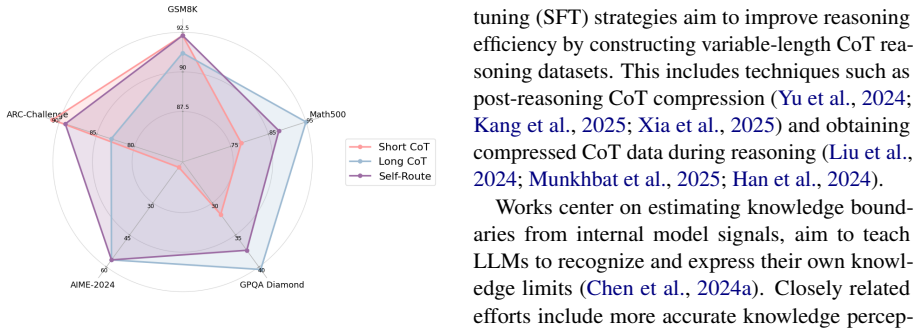
- Routing decisions concentrate short mode on easy sets like GSM8K and ARC-Challenge and long mode on hard sets like GPQA Diamond and AIME-2024, so the aggregate savings come from not overthinking easy questions.
Reading between the lines
- Beyond the paper: the same hidden-state probe could be reused for finer-grained control than binary routing, such as choosing among specialized experts or deciding how many reasoning steps to allocate, since the signal appears to track per-question difficulty continuously rather than only near a threshold.
- Beyond the paper: the linearity of the router and its success at middle layers suggest the model encodes a low-dimensional 'will I get this right' feature; if so, the method should transfer to new benchmarks with similar difficulty distributions, and a testable prediction is that it will degrade most on out-of-distribution questions far from the sampled difficulty levels.
- Beyond the paper: the density of the difficulty gradient is presented as necessary, which implies that building similar routers for new domains such as code generation or tool use requires a graded dataset construction step rather than reusing ordinary training data.
Editorial analysis
A structured set of objections, weighed in public.
Referee Report
Summary. The paper proposes Self-Route, a router that uses a linear probe on the last-token hidden state of a brief pre-inference plan generated by a general model to estimate the probability that the general model answers a question correctly, then routes the question either to the general model (Short CoT) or to a reasoning model (Long CoT). The method is trained on a new difficulty-graded dataset called Gradient-10K, built from several existing sources with difficulty labels derived from a model's own accuracy. Experiments on Qwen2.5-7B, Qwen2.5-32B, and Qwen3-8B with various reasoning backends report 30-55% token reduction with less than 2% accuracy loss compared to always using the reasoning model, across GSM8K, MATH500, GPQA Diamond, AIME-2024, ARC-Challenge, and an aggregate AVG column.
Significance. The core idea is sensible and practically attractive: using the model's own pre-inference hidden states as a capability signal is cheap, and the reported savings would be valuable for deployment. The construction of a densely graded difficulty dataset is a concrete contribution, and the authors are explicit in the Limitations section that the router is linear and the current mode set is binary. However, the reported headline numbers are currently not fully supported. The evaluation section does not state that test items were excluded from the training sources, the token accounting appears inconsistent between Tables 2 and 5, there are no error bars on small test sets, and there is no comparison to existing routing methods. These gaps are fixable within the manuscript's scope, so I recommend major revision rather than rejection.
major comments (4)
- [Section 3.1 (Training Dataset vs. Evaluation Dataset)] The Training Dataset paragraph lists GSM8K and AMC/AIME as components of Gradient-10K, while the Evaluation Dataset paragraph lists GSM8K and AIME-2024 as test sets, with no statement that evaluation items were excluded from the training pool. Because the router is a linear probe trained on per-question correctness labels, exact overlap on GSM8K and AIME-2024 would allow the router to memorize label-correlated hidden-state patterns rather than learn a generalizable capability estimator. The Table 2 results on those benchmarks would then not be valid as evidence of transfer. Please report an explicit deduplication or split between the Gradient-10K training questions and each evaluation set, and ideally provide an overlap analysis.
- [Section 3.4.1 and Table 5 vs. Table 2] Table 5 reports pre-inference token consumption as an average per dataset, for example 67 tokens on GSM8K and 136 tokens on AIME-2024 for Qwen2.5-7B, and states that this is additional to Short and Long CoT generation. Yet the Self-Route rows in Table 2 report 324.3 tokens on GSM8K, which is less than the sum of the 308.4 Short CoT tokens and the 67 pre-inference tokens (375.4). Either pre-inference tokens are not included in Table 2's reported token consumption, or the accounting is internally inconsistent. Since the abstract's 30-55% token savings claim depends on total inference cost, the paper must state explicitly whether pre-inference tokens are included in the reported Self-Route token counts and, if not, recompute the savings with the overhead included.
- [Section 3.2, Table 2] The accuracy comparisons in Table 2 lack error bars or significance tests, which is load-bearing on small test sets. AIME-2024 has only 30 questions, so a difference of one question is 3.3 accuracy points, and GPQA Diamond has only 198 questions. The claim of less than 2% average accuracy loss cannot be distinguished from random variation on these sets. Please provide confidence intervals, bootstrap estimates, or multiple router training seeds for the main accuracy and token-consumption comparisons, especially for AIME-2024 and GPQA Diamond.
- [Section 4 and Section 3.2] The Related Work section cites RouteLLM and other existing routers, but the experiments compare Self-Route only to always-Short and always-Long baselines. Without a comparison to an established router under matched conditions, the paper does not demonstrate that the pre-inference hidden-state approach is competitive with or superior to existing routing methods. Please add a baseline such as RouteLLM or a simple confidence-based router to the main results, or clearly explain why such a comparison is not applicable.
minor comments (4)
- [Section 3.4.2 and Figure 3] The paper reports that routers are trained on all hidden layers and that layers around 60-80% perform best, but it does not specify whether the layer selection was made on a held-out validation split. Please clarify the layer-selection protocol to avoid subtle selection bias in the reported routing accuracy.
- [Table 2 and surrounding text] There are several formatting and typographical issues: 'Genaral Model' should be 'General Model', the table header has 'AVG' with inconsistent spacing (e.g., '72.72001.8'), and 'R1-Distill-Qwen-7BSelf-Route' should be 'R1-Distill-Qwen-7B Self-Route'. Please proofread the table and its caption.
- [Section 3.1, Gradient-7B description] The text says Gradient-7B is 'based on Qwen2.5-7B-Instruct and trained on the Gradient-10K dataset by distilling reasoning trajectories from DeepSeek-R1', but the previous paragraph says all training was conducted on Gradient-10K. Please clarify whether Gradient-7B is a reasoning model trained with distillation from Gradient-10K or a general model trained differently, since it appears in the reasoning-model comparison rows.
- [Section 3.1, AIME description] AIME-2024 is described as 'middle school math competitions', but the AIME is generally aimed at high school students. This is a minor factual correction.
Circularity Check
No significant circularity: Self-Route's router is an empirical probe trained on the model's own correctness labels, and its evaluation benchmarks are external; the claimed savings are not forced by construction.
full rationale
The paper makes no first-principles derivation claim. Its load-bearing assertion is empirical: a linear router over the last-token hidden vector from a brief pre-inference plan can predict whether the general model Ms will answer correctly. The router's training labels y_i are exactly Ms's per-question correctness (Section 2.4, Eq. 5), and the difficulty score D_m(q)=1-A_m(q) (Eq. 1) is likewise defined from Ms's accuracy. This self-referential target is not circular in the prohibited sense because the router input (hidden states) is not defined in terms of the output label; it is a testable empirical hypothesis that hidden states carry information about future correctness. No load-bearing claim is justified by a self-citation or by an author-imported uniqueness theorem. The arXiv version includes no statement that GSM8K and AIME-2024 items were excluded from Gradient-10K despite both appearing in Section 3.1's training sources and evaluation lists; that is a data-hygiene and correctness risk that could invalidate the reported numbers, but it is not a circularity of the derivation chain, since the method is also evaluated on external benchmarks and the router is not defined to equal the evaluation metric by construction.
Assumptions & free parameters
free parameters (4)
- routing threshold tau =
not reported
- hidden layer index l =
not reported; around 60%-80% of network depth
- pre-inference token budget =
not reported
- difficulty level boundaries =
not reported
assumptions (3)
- domain assumption Hidden states at the last token of a brief plan encode the model's probability of solving the question.
- domain assumption Question difficulty can be measured by 1 minus A_m(q), the general model's accuracy on that question, and this proxy is stable enough to label training data.
- domain assumption The Qwen3-8B no_think hidden states are informative about whether think mode is needed, despite the different generation mode.
Cite this review
Pith. "Pith review of Self-Route: Automatic Mode Switching via Capability Estimation for Efficient Reasoning." pith.science (2026). https://pith.science/paper/P2FOP3TC
@misc{pith2026250520664,
  author       = {Pith},
  title        = {Pith review of: Self-Route: Automatic Mode Switching via Capability Estimation for Efficient Reasoning},
  year         = {2026},
  howpublished = {\url{https://pith.science/paper/P2FOP3TC}},
  note         = {Machine review of arXiv:2505.20664}
}
read the original abstract
While reasoning-augmented large language models (RLLMs) significantly enhance complex task performance through extended reasoning chains, they inevitably introduce substantial unnecessary token consumption, particularly for simpler problems where Short Chain-of-Thought (Short CoT) suffices. This overthinking phenomenon leads to inefficient resource usage without proportional accuracy gains. To address this issue, we propose Self-Route, a dynamic reasoning framework that automatically selects between general and reasoning modes based on model capability estimation. Our approach introduces a lightweight pre-inference stage to extract capability-aware embeddings from hidden layer representations, enabling real-time evaluation of the model's ability to solve problems. We further construct Gradient-10K, a model difficulty estimation-based dataset with dense complexity sampling, to train the router for precise capability boundary detection. Extensive experiments demonstrate that Self-Route achieves comparable accuracy to reasoning models while reducing token consumption by 30-55\% across diverse benchmarks. The proposed framework demonstrates consistent effectiveness across models with different parameter scales and reasoning paradigms, highlighting its general applicability and practical value.
Figures


Figures from the paper (3 more)


Forward citations
Cited by 1 Pith paper
-
Towards Concise and Adaptive Thinking in Large Reasoning Models: A Survey
A comprehensive review that categorizes methods for shortening and adaptively triggering chain-of-thought reasoning in large language models.
Reference graph
Works this paper leans on
-
[1]
Josh Achiam, Steven Adler, Sandhini Agarwal, Lama Ahmad, Ilge Akkaya, Florencia Leoni Aleman, Diogo Almeida, Janko Altenschmidt, Sam Altman, Shyamal Anadkat, and 1 others. 2023. Gpt-4 technical report. arXiv preprint arXiv:2303.08774
arXiv 2023
-
[2]
Pranjal Aggarwal and Sean Welleck. 2025. L1: Controlling how long a reasoning model thinks with reinforcement learning. arXiv preprint arXiv:2503.04697
arXiv 2025
-
[3]
Daman Arora and Andrea Zanette. 2025. Training language models to reason efficiently. arXiv preprint arXiv:2502.04463
arXiv 2025
-
[4]
Dhananjay Ashok and Jonathan May. 2025. Language models can predict their own behavior. arXiv preprint arXiv:2502.13329
arXiv 2025
-
[5]
ukasz Borchmann. 2024. In case you missed it: Arc'challenge'is not that challenging. arXiv preprint arXiv:2412.17758
work page Pith review arXiv 2024
-
[6]
S \'e bastien Bubeck, Varun Chadrasekaran, Ronen Eldan, Johannes Gehrke, Eric Horvitz, Ece Kamar, Peter Lee, Yin Tat Lee, Yuanzhi Li, Scott Lundberg, and 1 others. 2023. Sparks of artificial general intelligence: Early experiments with gpt-4
work page 2023
-
[7]
Andong Chen, Yuchen Song, Wenxin Zhu, Kehai Chen, Muyun Yang, Tiejun Zhao, and 1 others. 2025 a . Evaluating o1-like llms: Unlocking reasoning for translation through comprehensive analysis. arXiv preprint arXiv:2502.11544
arXiv 2025
-
[8]
Lida Chen, Zujie Liang, Xintao Wang, Jiaqing Liang, Yanghua Xiao, Feng Wei, Jinglei Chen, Zhenghong Hao, Bing Han, and Wei Wang. 2024 a . Teaching large language models to express knowledge boundary from their own signals. arXiv preprint arXiv:2406.10881
arXiv 2024
Show all 36 references
-
[9]
Qiguang Chen, Libo Qin, Jinhao Liu, Dengyun Peng, Jiannan Guan, Peng Wang, Mengkang Hu, Yuhang Zhou, Te Gao, and Wanxiang Che. 2025 b . Towards reasoning era: A survey of long chain-of-thought for reasoning large language models. arXiv preprint arXiv:2503.09567
2025 arXiv
-
[10]
Xingyu Chen, Jiahao Xu, Tian Liang, Zhiwei He, Jianhui Pang, Dian Yu, Linfeng Song, Qiuzhi Liu, Mengfei Zhou, Zhuosheng Zhang, and 1 others. 2024 b . Do not think that much for 2+ 3=? on the overthinking of o1-like llms. arXiv preprint arXiv:2412.21187
2024 arXiv
-
[11]
Peter Clark, Isaac Cowhey, Oren Etzioni, Tushar Khot, Ashish Sabharwal, Carissa Schoenick, and Oyvind Tafjord. 2018. Think you have solved question answering? try arc, the ai2 reasoning challenge. arXiv preprint arXiv:1803.05457
2018 arXiv
-
[12]
Karl Cobbe, Vineet Kosaraju, Mohammad Bavarian, Mark Chen, Heewoo Jun, Lukasz Kaiser, Matthias Plappert, Jerry Tworek, Jacob Hilton, Reiichiro Nakano, and 1 others. 2021. Training verifiers to solve math word problems. arXiv preprint arXiv:2110.14168
2021 arXiv
-
[13]
Daya Guo, Dejian Yang, Haowei Zhang, Junxiao Song, Ruoyu Zhang, Runxin Xu, Qihao Zhu, Shirong Ma, Peiyi Wang, Xiao Bi, and 1 others. 2025. Deepseek-r1: Incentivizing reasoning capability in llms via reinforcement learning. arXiv preprint arXiv:2501.12948
2025 arXiv
-
[14]
Tingxu Han, Zhenting Wang, Chunrong Fang, Shiyu Zhao, Shiqing Ma, and Zhenyu Chen. 2024. Token-budget-aware llm reasoning. arXiv preprint arXiv:2412.18547
2024 arXiv
-
[15]
Aaron Jaech, Adam Kalai, Adam Lerer, Adam Richardson, Ahmed El-Kishky, Aiden Low, Alec Helyar, Aleksander Madry, Alex Beutel, Alex Carney, and 1 others. 2024. Openai o1 system card. arXiv preprint arXiv:2412.16720
2024 arXiv
-
[16]
Yu Kang, Xianghui Sun, Liangyu Chen, and Wei Zou. 2025. C3ot: Generating shorter chain-of-thought without compromising effectiveness. In Proceedings of the AAAI Conference on Artificial Intelligence, volume 39, pages 24312--24320
2025
-
[17]
Moxin Li, Yong Zhao, Yang Deng, Wenxuan Zhang, Shuaiyi Li, Wenya Xie, See-Kiong Ng, and Tat-Seng Chua. 2024. Knowledge boundary of large language models: A survey. arXiv preprint arXiv:2412.12472
2024 arXiv
-
[18]
From system 1 to system 2: A survey of reasoning large language models, 2025
Zhong-Zhi Li, Duzhen Zhang, Ming-Liang Zhang, Jiaxin Zhang, Zengyan Liu, Yuxuan Yao, Haotian Xu, Junhao Zheng, Pei-Jie Wang, Xiuyi Chen, and 1 others. From system 1 to system 2: A survey of reasoning large language models, 2025. URL https://arxiv. org/abs/2502.17419
2025 arXiv
-
[19]
Yuxin Liang, Zhuoyang Song, Hao Wang, and Jiaxing Zhang. 2024. Learning to trust your feelings: Leveraging self-awareness in llms for hallucination mitigation. arXiv preprint arXiv:2401.15449
2024 arXiv
-
[20]
Hunter Lightman, Vineet Kosaraju, Yuri Burda, Harrison Edwards, Bowen Baker, Teddy Lee, Jan Leike, John Schulman, Ilya Sutskever, and Karl Cobbe. 2023. Let's verify step by step. In The Twelfth International Conference on Learning Representations
2023
-
[21]
Sheng-Chieh Lin, Luyu Gao, Barlas Oguz, Wenhan Xiong, Jimmy Lin, Wen-tau Yih, and Xilun Chen. 2024. Flame: Factuality-aware alignment for large language models. arXiv preprint arXiv:2405.01525
2024 arXiv
-
[22]
Tengxiao Liu, Qipeng Guo, Xiangkun Hu, Cheng Jiayang, Yue Zhang, Xipeng Qiu, and Zheng Zhang. 2024. Can language models learn to skip steps? arXiv preprint arXiv:2411.01855
2024 arXiv
-
[23]
Arindam Mitra, Hamed Khanpour, Corby Rosset, and Ahmed Awadallah. 2024. Orca-math: Unlocking the potential of slms in grade school math. arXiv preprint arXiv:2402.14830
2024 arXiv
-
[24]
Niklas Muennighoff, Zitong Yang, Weijia Shi, Xiang Lisa Li, Li Fei-Fei, Hannaneh Hajishirzi, Luke Zettlemoyer, Percy Liang, Emmanuel Cand \`e s, and Tatsunori Hashimoto. 2025. s1: Simple test-time scaling. arXiv preprint arXiv:2501.19393
2025 arXiv
-
[25]
Tergel Munkhbat, Namgyu Ho, Seo Hyun Kim, Yongjin Yang, Yujin Kim, and Se-Young Yun. 2025. Self-training elicits concise reasoning in large language models. arXiv preprint arXiv:2502.20122
2025 arXiv
-
[26]
I Ong, A Almahairi, V Wu, W Chiang, T Wu, JE Gonzalez, MW Kadous, and I Stoica. 2024. Routellm: Learning to route llms with preference data. arxiv. org
2024
-
[27]
David Rein, Betty Li Hou, Asa Cooper Stickland, Jackson Petty, Richard Yuanzhe Pang, Julien Dirani, Julian Michael, and Samuel R Bowman. 2024. Gpqa: A graduate-level google-proof q&a benchmark. In First Conference on Language Modeling
2024
-
[28]
Shuchang Tao, Liuyi Yao, Hanxing Ding, Yuexiang Xie, Qi Cao, Fei Sun, Jinyang Gao, Huawei Shen, and Bolin Ding. 2024. When to trust llms: Aligning confidence with response quality. arXiv preprint arXiv:2404.17287
2024 arXiv
-
[29]
Kimi Team, Angang Du, Bofei Gao, Bowei Xing, Changjiu Jiang, Cheng Chen, Cheng Li, Chenjun Xiao, Chenzhuang Du, Chonghua Liao, and 1 others. 2025. Kimi k1. 5: Scaling reinforcement learning with llms. arXiv preprint arXiv:2501.12599
2025 arXiv
-
[30]
Katherine Tian, Eric Mitchell, Huaxiu Yao, Christopher D Manning, and Chelsea Finn. 2023. Fine-tuning language models for factuality. In The Twelfth International Conference on Learning Representations
2023
-
[31]
Heming Xia, Yongqi Li, Chak Tou Leong, Wenjie Wang, and Wenjie Li. 2025. Tokenskip: Controllable chain-of-thought compression in llms. arXiv preprint arXiv:2502.12067
2025
-
[32]
An Yang, Baosong Yang, Beichen Zhang, Binyuan Hui, Bo Zheng, Bowen Yu, Chengyuan Li, Dayiheng Liu, Fei Huang, Haoran Wei, and 1 others. 2024. Qwen2. 5 technical report. arXiv preprint arXiv:2412.15115
2024 arXiv
-
[33]
Edward Yeo, Yuxuan Tong, Morry Niu, Graham Neubig, and Xiang Yue. 2025. Demystifying long chain-of-thought reasoning in llms. arXiv preprint arXiv:2502.03373
2025 arXiv
-
[34]
Ping Yu, Jing Xu, Jason Weston, and Ilia Kulikov. 2024. Distilling system 2 into system 1. arXiv preprint arXiv:2407.06023
2024 arXiv
-
[35]
online" 'onlinestring :=
ENTRY address archivePrefix author booktitle chapter edition editor eid eprint eprinttype howpublished institution journal key month note number organization pages publisher school series title type volume year doi pubmed url lastchecked label extra.label sort.label short.list...
-
[36]
write newline
" write newline "" before.all 'output.state := FUNCTION n.dashify 't := "" t empty not t #1 #1 substring "-" = t #1 #2 substring "--" = not "--" * t #2 global.max substring 't := t #1 #1 substring "-" = "-" * t #2 global.max substring 't := while if t #1 #1 substring * t #2 gl...
Reviewed August 7, 2026 · model on record in the stance chip above.
Discussion (0). Sign in to comment.