Combining a Diffraction-Limited Coronagraph with Fiber Nulling: A Demonstration of Serially Coupling Different Nullers
Pith reviewed 2026-07-01 03:29 UTC · model grok-4.3
The pith
Serially coupling a one-dimensional diffraction-limited coronagraph with a parity fiber nuller suppresses off-design stellar leak by a factor of 20.
A machine-rendered reading of the paper's core claim, the machinery that carries it, and where it could break.
Core claim
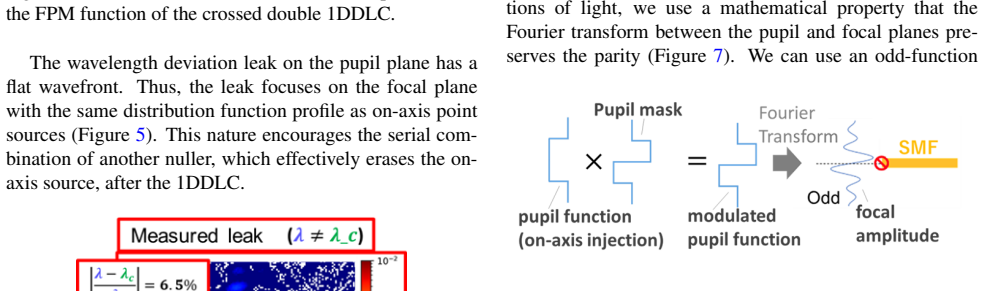
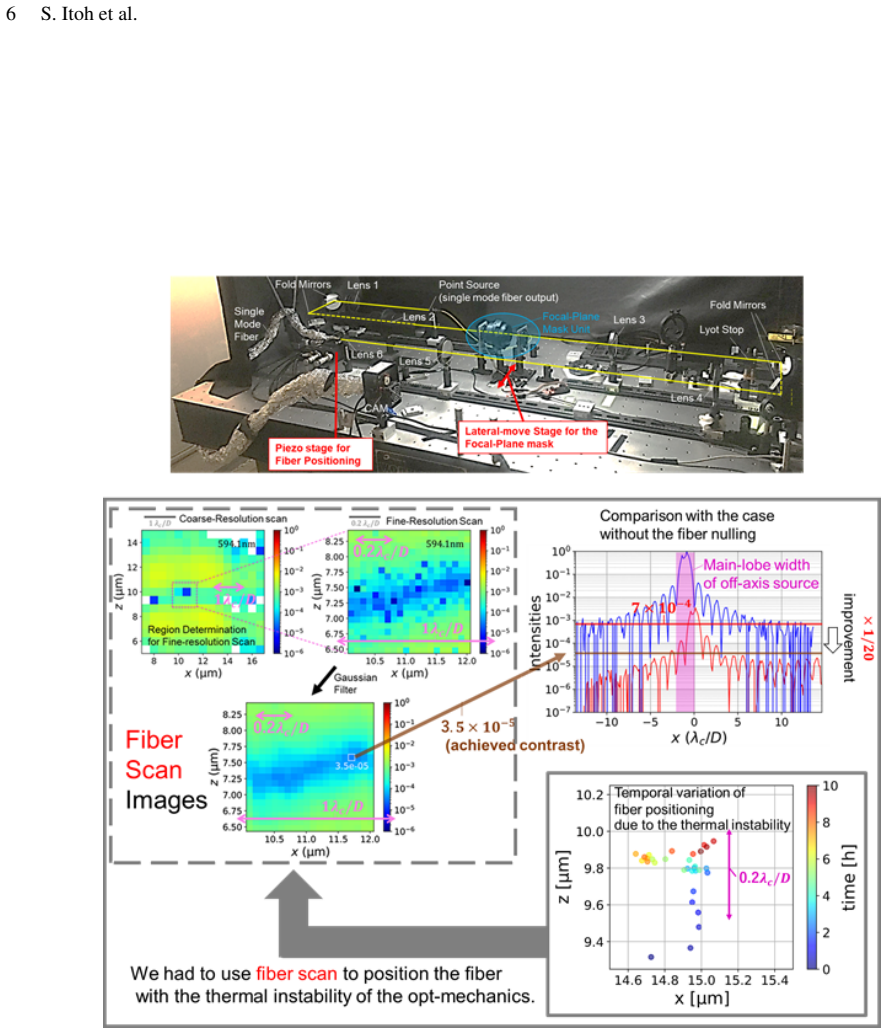
The 1DDLC outputs stellar leak due to wavelengths other than the design wavelength only as a flat wavefront on the Lyot-stop plane, preserving the same complex amplitude profile as an on-axis point source, so that the downstream PFN can erase it. For a wavelength 6 percent less than the coronagraph design center, the combined system reached a contrast of 3.5 times 10 to the minus 5, approximately 1/20 the value obtained with the 1DDLC alone.
What carries the argument
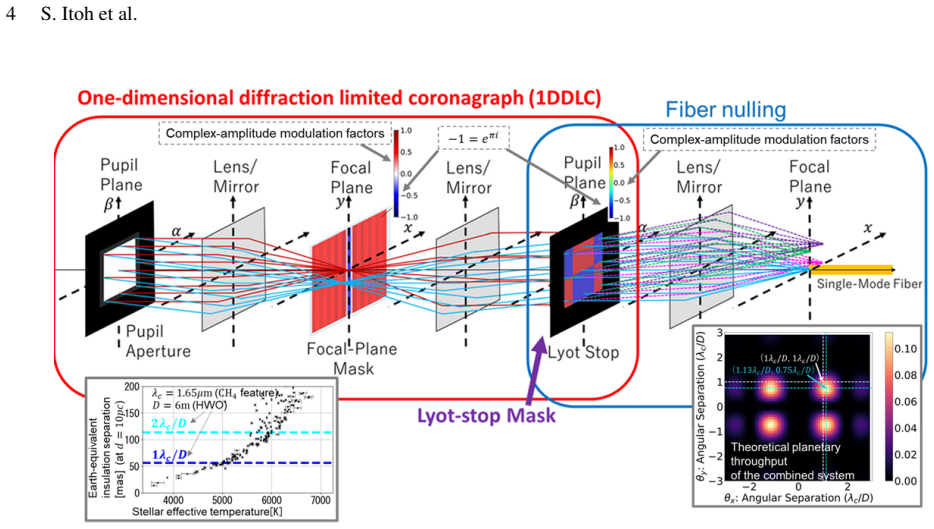
Serial coupling of the 1DDLC front-end and PFN second stage, where the first stage converts chromatic leaks into a flat wavefront that the second stage can null.
If this is right
- The combined system maintains high contrast at small inner working angles of about 1 lambda/D even when the input light is not monochromatic.
- The PFN stage can be added after other coronagraphs that also produce flat wavefront leaks from chromatic errors.
- Contrast levels below 10 to the minus 5 will require further demonstration to confirm the broadband robustness.
- The approach avoids the need for additional chromatic correction optics between the two nullers.
Where Pith is reading between the lines
- The same serial principle may apply to other first-stage nullers whose chromatic residuals are spatially uniform on the output pupil.
- If the flat-wavefront property holds for tip-tilt or other low-order aberrations, the PFN could also suppress those leaks.
- Laboratory validation at multiple wavelengths would test whether the factor-of-20 improvement scales linearly with bandwidth.
Load-bearing premise
Off-design wavelength leaks from the 1DDLC appear on the Lyot plane as a flat wavefront whose complex amplitude matches that of an on-axis point source.
What would settle it
A measurement showing that the wavefront of the 1DDLC leak at 6 percent wavelength offset is not flat on the Lyot plane, or that the combined contrast fails to improve by roughly a factor of 20 relative to the coronagraph alone.
Figures

read the original abstract
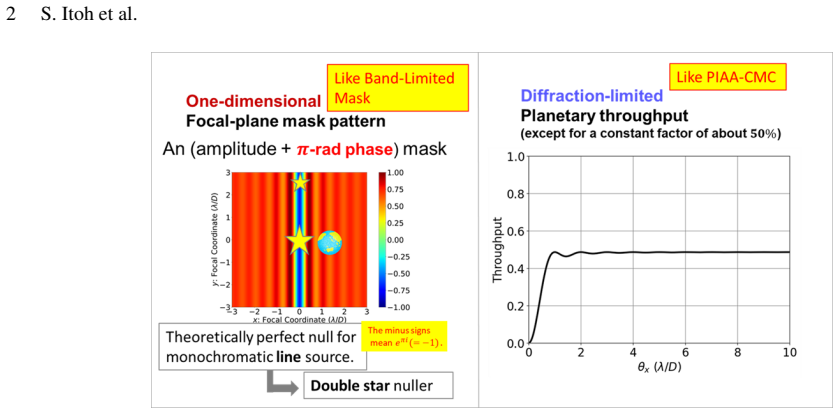
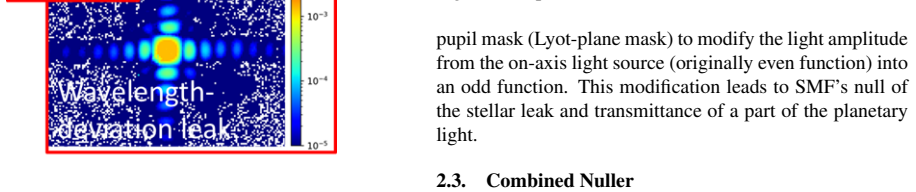
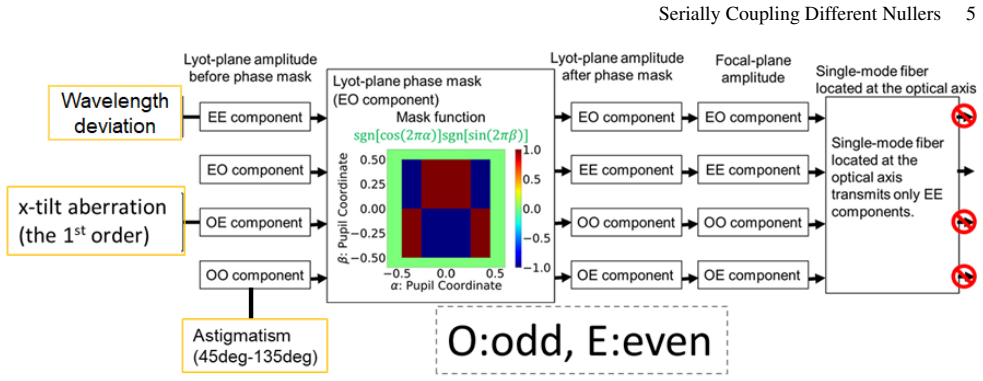
We present experimental results of an efficient small-IWA ($\sim$1 $\lambda/D$) high contrast imaging approach realized by co-optimizing a coronagraph front-end with a fiber nulling 2nd stage. The setup includes the one-dimensional diffraction-limited coronagraph (1DDLC) and Parity Fiber Nuller (PFN). The 1DDLC has promising features (binary nuller, small inner working angles (IWAs)). Although the 1DDLC has the 2nd/4th-order sensitivity to spectral bandwidth and tilt aberrations, it outputs stellar leak due to wavelengths other than the design wavelength only as a flat wavefront on the Lyot-stop plane, preserving the same complex amplitude profile as an on-axis point source. The PFN after the 1DDLC erases the leak from the 1DDLC. For the wavelength 6% less than the coronagraph's design-center wavelength, we confirmed the contrast mitigation ability of $3.5\times10^{-5}$, which is about 1/20 times the value of the case with only 1DDLC, suggesting that the combined system works robustly against the broad spectral bandwidth. Future work needs to address the demonstration of the anticipated broadband robustness for the contrast level lower than about $10^{-5}$.
Editorial analysis
A structured set of objections, weighed in public.
Referee Report
Summary. The paper presents an experimental demonstration of serially coupling a one-dimensional diffraction-limited coronagraph (1DDLC) front-end with a Parity Fiber Nuller (PFN) second stage. It reports that at a wavelength 6% below the 1DDLC design center, the combined system achieves a contrast of 3.5×10^{-5} (approximately 1/20 the value obtained with the 1DDLC alone), attributing the improvement to the 1DDLC producing off-design stellar leaks as flat wavefronts at the Lyot plane that the PFN can null. The abstract notes the need for further work to reach contrasts below ~10^{-5}.
Significance. If the result and its underlying wavefront assumption hold, the work provides a concrete experimental path toward small-IWA (~1 λ/D) high-contrast imaging that is more robust to finite spectral bandwidth than a single nuller. The serial-coupling concept is a practical contribution to the instrumentation literature even if the demonstrated contrast remains above the 10^{-5} regime targeted for future exoplanet imaging.
major comments (2)
- [Abstract] Abstract (and the corresponding theory/measurement sections): the central explanatory claim—that the 1DDLC outputs off-design stellar leaks 'only as a flat wavefront on the Lyot-stop plane, preserving the same complex amplitude profile as an on-axis point source'—is asserted without any wavefront measurement, simulation, or derivation at the Lyot plane for the 6% wavelength offset. This assumption is load-bearing for attributing the observed 20× contrast gain to the PFN nulling the 1DDLC leak rather than to some other mechanism.
- [Abstract] Abstract: the reported contrast value of 3.5×10^{-5} is presented without error bars, a description of the measurement procedure, baseline single-nuller data, or discussion of systematic errors, which prevents quantitative assessment of the claimed factor-of-20 improvement and of the robustness statement.
minor comments (1)
- The abstract states that future work is required below 10^{-5}; the main text should indicate whether any existing data, simulations, or scaling arguments already support the projected broadband performance at those levels.
Simulated Author's Rebuttal
We thank the referee for the constructive review and positive assessment of the work's significance. We address each major comment below and will revise the manuscript to incorporate additional details and clarifications.
read point-by-point responses
-
Referee: [Abstract] Abstract (and the corresponding theory/measurement sections): the central explanatory claim—that the 1DDLC outputs off-design stellar leaks 'only as a flat wavefront on the Lyot-stop plane, preserving the same complex amplitude profile as an on-axis point source'—is asserted without any wavefront measurement, simulation, or derivation at the Lyot plane for the 6% wavelength offset. This assumption is load-bearing for attributing the observed 20× contrast gain to the PFN nulling the 1DDLC leak rather than to some other mechanism.
Authors: The claim follows from the binary-mask design of the 1DDLC, which diffracts off-design light such that the leaked amplitude at the Lyot plane remains spatially uniform and identical to the on-axis case (within the scalar diffraction model used throughout the paper). While the abstract states this concisely, the full manuscript's theory section derives the 1DDLC transmission analytically; however, to directly address the concern we will add an explicit short derivation plus a supporting simulation panel showing the complex amplitude at the Lyot plane for the 6 % offset. This will make the attribution of the contrast improvement to the PFN unambiguous. revision: yes
-
Referee: [Abstract] Abstract: the reported contrast value of 3.5×10^{-5} is presented without error bars, a description of the measurement procedure, baseline single-nuller data, or discussion of systematic errors, which prevents quantitative assessment of the claimed factor-of-20 improvement and of the robustness statement.
Authors: We agree that these elements are necessary for quantitative evaluation. The revised manuscript will include: error bars derived from repeated measurements, a step-by-step description of the contrast calculation and data acquisition, the corresponding 1DDLC-only baseline contrast obtained under identical conditions, and a brief discussion of systematics (alignment drift, source stability, and detector noise). These additions will allow readers to assess the factor-of-20 improvement directly. revision: yes
Circularity Check
No significant circularity; central claim is experimental measurement with no self-referential derivation.
full rationale
The manuscript reports laboratory contrast measurements (3.5e-5 at 6% wavelength offset) for a 1DDLC+PFN combination. The key premise that off-design 1DDLC leaks appear as flat wavefronts identical to on-axis sources at the Lyot plane is asserted as a device property but is not derived from equations within the paper. No mathematical chain, fitted parameter, or self-citation reduces the reported contrast ratio to an input by construction. The result is a direct empirical demonstration rather than a derivation, so no circular steps exist. This aligns with the reader's assessment that the work is measurement-driven.
Axiom & Free-Parameter Ledger
axioms (1)
- domain assumption Off-design-wavelength stellar leak from the 1DDLC exits the Lyot stop as a flat wavefront with the same complex amplitude profile as an on-axis point source.
Reference graph
Works this paper leans on
-
[1]
The Astropy Project: Building an inclusive, open-science project and status of the v2.0 core package
The Astropy Project: Building an Open-science Project and Status of the v2.0 Core Package. , keywords =. doi:10.3847/1538-3881/aabc4f , archivePrefix =. 1801.02634 , primaryClass =
work page internal anchor Pith review Pith/arXiv arXiv doi:10.3847/1538-3881/aabc4f
-
[2]
AstroPIC: near-infrared photonic integrated circuit coronagraph architecture for the Habitable Worlds Observatory. Space Telescopes and Instrumentation 2024: Optical, Infrared, and Millimeter Wave , year = 2024, editor =. doi:10.1117/12.3020518 , adsurl =
-
[3]
Vortex Fiber Nulling for Exoplanet Observations: First Direct Detection of M Dwarf Companions around HIP 21543, HIP 94666, and HIP 50319. , keywords =. doi:10.3847/2041-8213/ad3619 , archivePrefix =. 2403.17295 , primaryClass =
-
[4]
Optics Express , year = 2024, month = may, volume =
Geometric-phase-based phase-knife mask for stellar nulling and coronagraphy. Optics Express , year = 2024, month = may, volume =. doi:10.1364/OE.520548 , adsurl =
-
[5]
Wide-spectral-band Nuller Insensitive to Finite Stellar Angular Diameter with a One-dimensional Diffraction-limited Coronagraph. , keywords =. doi:10.3847/1538-3881/ad3733 , archivePrefix =. 2403.16415 , primaryClass =
-
[6]
Observing inside the coronagraphic regime with optimized single-mode nulling interferometry. Space Telescopes and Instrumentation 2022: Optical, Infrared, and Millimeter Wave , year = 2022, editor =. doi:10.1117/12.2630589 , archivePrefix =. 2210.09412 , primaryClass =
-
[7]
Journal of Korean Astronomical Society , keywords =
Toward a Next Generation Solar Coronagraph: Command and Data Handling System of Balloon-Borne Investigation of Temperature and Speed of Electrons in the Corona. Journal of Korean Astronomical Society , keywords =. doi:10.5303/JKAS.2024.57.2.183 , adsurl =
-
[8]
, year = 1933, month = aug, volume =
The Study of the Solar Corona without an Eclipse. , year = 1933, month = aug, volume =
1933
-
[9]
SCExAO/CHARIS Spectroscopic Characterization of Cloudy L/T Transition Companion Brown Dwarf HIP 93398 B. , keywords =. doi:10.3847/1538-4357/ad90bc , archivePrefix =. 2411.06003 , primaryClass =
-
[10]
The value of combining thermal emission and reflected light for the characterization of Earth twins
Large Interferometer For Exoplanets (LIFE): XIII. The value of combining thermal emission and reflected light for the characterization of Earth twins. , keywords =. doi:10.1051/0004-6361/202450320 , archivePrefix =. 2406.13037 , primaryClass =
-
[11]
Journal of Astronomical Telescopes, Instruments, and Systems , keywords =
Current laboratory performance of starlight suppression systems and potential pathways to desired Habitable Worlds Observatory exoplanet science capabilities. Journal of Astronomical Telescopes, Instruments, and Systems , keywords =. doi:10.1117/1.JATIS.10.3.035004 , archivePrefix =. 2404.18036 , primaryClass =
-
[12]
Journal of Astronomical Telescopes, Instruments, and Systems , keywords =
Paths to robust exoplanet science yield margin for the Habitable Worlds Observatory. Journal of Astronomical Telescopes, Instruments, and Systems , keywords =. doi:10.1117/1.JATIS.10.3.034006 , archivePrefix =. 2405.19418 , primaryClass =
-
[13]
Angular Differential Imaging: a Powerful High-Contrast Imaging Technique
Angular Differential Imaging: A Powerful High-Contrast Imaging Technique. , keywords =. doi:10.1086/500401 , archivePrefix =. astro-ph/0512335 , primaryClass =
work page internal anchor Pith review Pith/arXiv arXiv doi:10.1086/500401
-
[14]
The Coherent Differential Imaging on Speckle Area Nulling (CDI-SAN) Method for High-contrast Imaging under Speckle Variation. , keywords =. doi:10.3847/1538-4357/ac5f44 , archivePrefix =. 2204.10002 , primaryClass =
-
[15]
Kernel Phase and Coronagraphy with Automatic Differentiation. , keywords =. doi:10.3847/1538-4357/abcb00 , archivePrefix =. 2011.09780 , primaryClass =
-
[16]
3C 273 host galaxy with Hubble Space Telescope coronagraphy. , keywords =. doi:10.1051/0004-6361/202348254 , archivePrefix =. 2402.09505 , primaryClass =
-
[17]
Searching for Planets Orbiting Vega with the James Webb Space Telescope. , keywords =. doi:10.3847/1538-3881/ad890d , archivePrefix =. 2410.16551 , primaryClass =
-
[18]
A planet on an inclined orbit as an explanation of the warp in the Beta Pictoris disk
A planet on an inclined orbit as an explanation of the warp in the beta Pictoris disc. , keywords =. doi:10.1093/mnras/292.4.896 , archivePrefix =. astro-ph/9705100 , primaryClass =
work page internal anchor Pith review Pith/arXiv arXiv doi:10.1093/mnras/292.4.896
-
[19]
, year = 2024, month = sep, volume =
A temperate super-Jupiter imaged with JWST in the mid-infrared. , year = 2024, month = sep, volume =. doi:10.1038/s41586-024-07837-8 , adsurl =
-
[20]
A Coronagraphic Search for Brown Dwarfs around Nearby Stars. , keywords =. doi:10.1086/174288 , adsurl =
-
[21]
Astropy: A Community Python Package for Astronomy
Astropy: A community Python package for astronomy. , keywords =. 2013. doi:10.1051/0004-6361/201322068 , archivePrefix =. 1307.6212 , primaryClass =
work page internal anchor Pith review Pith/arXiv arXiv doi:10.1051/0004-6361/201322068 2013
-
[22]
SExtractor: Software for source extraction. , keywords =. 1996. doi:10.1051/aas:1996164 , adsurl =
-
[23]
Quantifying the Observational Effort Required for the Radial Velocity Characterization of TESS Planets. , keywords =. 2018. doi:10.3847/1538-3881/aacea9 , archivePrefix =. 1807.01263 , primaryClass =
work page internal anchor Pith review Pith/arXiv arXiv doi:10.3847/1538-3881/aacea9 2018
-
[24]
X-Ray Scattering Echoes and Ghost Halos from the Intergalactic Medium: Relation to the Nature of AGN Variability. , keywords =. 2015. doi:10.1088/0004-637X/805/1/23 , archivePrefix =. 1503.01475 , primaryClass =
work page internal anchor Pith review Pith/arXiv arXiv doi:10.1088/0004-637x/805/1/23 2015
-
[25]
, keywords =
The 2013 Release of Cloudy. , keywords =. 2013
2013
-
[26]
1989", month =
T _ E X and LAT _ E X Macro Definition Files for Astronomical Publications. , year = "1989", month = "Mar", pages =
1989
-
[27]
LaTeX: A Document Preparation System. 1994
1994
-
[28]
Quasi-periodic Fast Propagating Magnetoacoustic Waves during the Magnetic Reconnection Between Solar Coronal Loops. , keywords =. 2018. doi:10.3847/2041-8213/aaf167 , archivePrefix =. 1811.08553 , primaryClass =
work page internal anchor Pith review Pith/arXiv arXiv doi:10.3847/2041-8213/aaf167 2018
-
[29]
Nominal values for selected solar and planetary quantities: IAU 2015 Resolution B3
Nominal Values for Selected Solar and Planetary Quantities: IAU 2015 Resolution B3. , keywords =. 2016. doi:10.3847/0004-6256/152/2/41 , archivePrefix =. 1605.09788 , primaryClass =
work page internal anchor Pith review Pith/arXiv arXiv doi:10.3847/0004-6256/152/2/41 2015
-
[30]
Swift X-Ray Observations of Classical Novae. II. The Super Soft Source Sample. , keywords =. 2011. doi:10.1088/0067-0049/197/2/31 , archivePrefix =. 1110.6224 , primaryClass =
work page internal anchor Pith review Pith/arXiv arXiv doi:10.1088/0067-0049/197/2/31 2011
-
[31]
Galaxy emission line classification using 3D line ratio diagrams
Galaxy Emission Line Classification Using Three-dimensional Line Ratio Diagrams. , keywords =. 2014. doi:10.1088/0004-637X/793/2/127 , archivePrefix =. 1406.5186 , primaryClass =
work page internal anchor Pith review Pith/arXiv arXiv doi:10.1088/0004-637x/793/2/127 2014
-
[32]
Renhorn and Tomas R
Jörgen Ahlberg and Ingmar G. Renhorn and Tomas R. Chevalier and Joakim Rydell and David Bergström , title =. Algorithms and Technologies for Multispectral, Hyperspectral, and Ultraspectral Imagery XXIII , editor =. 2017 , doi =
2017
-
[33]
Design and performance analysis of a PIAACMC coronagraph on a segmented aperture. Space Telescopes and Instrumentation 2018: Optical, Infrared, and Millimeter Wave , year = 2018, series =. doi:10.1117/12.2314202 , adsurl =
-
[34]
Water Vapor and Clouds on the Habitable-zone Sub-Neptune Exoplanet K2-18b. , keywords =. doi:10.3847/2041-8213/ab59dc , archivePrefix =. 1909.04642 , primaryClass =
-
[35]
Society of Photo-Optical Instrumentation Engineers (SPIE) Conference Series , year = 2017, series =
Shaped pupil coronagraphy for WFIRST: high-contrast broadband testbed demonstration. Society of Photo-Optical Instrumentation Engineers (SPIE) Conference Series , year = 2017, series =. doi:10.1117/12.2272834 , adsurl =
-
[36]
Remote Sensing of Planetary Properties and Biosignatures on Extrasolar Terrestrial Planets. Astrobiology , keywords =. doi:10.1089/15311070260192246 , adsurl =
-
[37]
Exoplanet Biosignatures: Observational Prospects. Astrobiology , keywords =. doi:10.1089/ast.2017.1733 , archivePrefix =. 1705.07098 , primaryClass =
-
[38]
A family of phase masks for broadband coronagraphy example of the wrapped vortex phase mask theory and laboratory demonstration. , keywords =. doi:10.1051/0004-6361/201936971 , archivePrefix =. 2001.06114 , primaryClass =
-
[39]
The Astrophysical Journal , keywords =
Annular Groove Phase Mask Coronagraph. The Astrophysical Journal , keywords =. doi:10.1086/462409 , adsurl =
-
[40]
Optics Express , year = 2017, month = apr, volume =
Study of a coronagraphic mask using evanescent waves. Optics Express , year = 2017, month = apr, volume =. doi:10.1364/OE.25.007273 , adsurl =
-
[41]
A Coronagraph with a Band-Limited Mask for Finding Terrestrial Planets
A Coronagraph with a Band-limited Mask for Finding Terrestrial Planets. The Astrophysical Journal , keywords =. doi:10.1086/339625 , archivePrefix =. astro-ph/0203455 , primaryClass =
work page internal anchor Pith review Pith/arXiv arXiv doi:10.1086/339625
-
[42]
EAS Publications Series , year = 2004, editor =
Cryogenic IR test of the 4QPM coronagraph. EAS Publications Series , year = 2004, editor =. doi:10.1051/eas:2004032 , adsurl =
-
[43]
Optics Express , year = 2009, month = oct, volume =
Coronagraphic mask design using Hermite functions. Optics Express , year = 2009, month = oct, volume =. doi:10.1364/OE.17.020515 , adsurl =
-
[44]
The Publications of the Astronomical Society of the Pacific , keywords =
A Coronagraph with a Variable-Diameter Occulting Disk. The Publications of the Astronomical Society of the Pacific , keywords =. doi:10.1086/319546 , adsurl =
-
[45]
Phase induced amplitude apodization (PIAA) coronagraphy: recent results and future prospects. Space Telescopes and Instrumentation 2012: Optical, Infrared, and Millimeter Wave , year = 2012, editor =. doi:10.1117/12.927187 , adsurl =
-
[46]
Stellar coronagraphy: laboratory testing of the Achromatic Interfero Coronagraph. IAU Colloq. 200: Direct Imaging of Exoplanets: Science & Techniques , year = 2006, editor =. doi:10.1017/S1743921306009823 , adsurl =
-
[47]
IEEE Proceedings , year = 1949, month = jan, volume =
Communication in the Presence of Noise. IEEE Proceedings , year = 1949, month = jan, volume =. doi:10.1109/JPROC.1998.659497 , adsurl =
-
[48]
The Astrophysical Journal , keywords =
The Optical Differentiation Coronagraph. The Astrophysical Journal , keywords =. doi:10.1086/432029 , adsurl =
-
[49]
An Eight-Octant Phase-Mask Coronagraph
An Eight-Octant Phase-Mask Coronagraph. Publications of the Astronomical Society of the Pacific , keywords =. doi:10.1086/592285 , archivePrefix =. 0809.1510 , primaryClass =
work page internal anchor Pith review Pith/arXiv arXiv doi:10.1086/592285
-
[50]
Laboratory demonstration of high contrast with the PIAACMC coronagraph on an obstructed and segmented aperture. Space Telescopes and Instrumentation 2022: Optical, Infrared, and Millimeter Wave , year = 2022, editor =. doi:10.1117/12.2630474 , adsurl =
-
[51]
Optical vortex coronagraph. Optics Letters , keywords =. doi:10.1364/OL.30.003308 , adsurl =
-
[52]
, year = 1934, month = mar, volume =
Diffraction theory of the knife-edge test and its improved form, the phase-contrast method. , year = 1934, month = mar, volume =. doi:10.1093/mnras/94.5.377 , adsurl =
-
[53]
Theoretical Limits on Extrasolar Terrestrial Planet Detection with Coronagraphs
Theoretical Limits on Extrasolar Terrestrial Planet Detection with Coronagraphs. The Astrophysical Journal Supplement Series , keywords =. doi:10.1086/507630 , archivePrefix =. astro-ph/0608506 , primaryClass =
work page internal anchor Pith review Pith/arXiv arXiv doi:10.1086/507630
-
[54]
Exoplanet Imaging with a Phase-induced Amplitude Apodization Coronagraph. I. Principle. , keywords =. doi:10.1086/427771 , archivePrefix =. astro-ph/0412179 , primaryClass =
work page internal anchor Pith review Pith/arXiv arXiv doi:10.1086/427771
-
[55]
High Performance PIAA Coronagraphy with Complex Amplitude Focal Plane Masks. , keywords =. doi:10.1088/0067-0049/190/2/220 , adsurl =
-
[56]
High Performance Lyot and PIAA Coronagraphy for Arbitrarily shaped Telescope Apertures
High Performance Lyot and PIAA Coronagraphy for Arbitrarily Shaped Telescope Apertures. , keywords =. doi:10.1088/0004-637X/780/2/171 , archivePrefix =. 1305.6686 , primaryClass =
work page internal anchor Pith review Pith/arXiv arXiv doi:10.1088/0004-637x/780/2/171
-
[57]
Point Spread Function of Hexagonally Segmented Telescopes by New Symmetrical Formulation
Point spread function of hexagonally segmented telescopes by new symmetrical formulation. , keywords =. doi:10.1093/mnras/sty3052 , archivePrefix =. 1811.02762 , primaryClass =
work page internal anchor Pith review Pith/arXiv arXiv doi:10.1093/mnras/sty3052
-
[58]
Fourth-order Coronagraph for High-contrast Imaging of Exoplanets with Off-axis Segmented Telescopes. Astronomical J. , keywords =. doi:10.3847/1538-3881/ab811c , archivePrefix =. 2002.10762 , primaryClass =
-
[59]
Optical Manufacturing and Testing VII , year = 2007, series =
Structure function analysis of mirror fabrication and support errors. Optical Manufacturing and Testing VII , year = 2007, series =. doi:10.1117/12.736051 , adsurl =
-
[60]
How to Characterize Habitable Worlds and Signs of Life. , keywords =. doi:10.1146/annurev-astro-082214-122238 , archivePrefix =. 1911.05597 , primaryClass =
-
[61]
astro2010: The Astronomy and Astrophysics Decadal Survey , year = 2009, volume =
Exoplanet Characterization and the Search for Life. astro2010: The Astronomy and Astrophysics Decadal Survey , year = 2009, volume =
2009
-
[62]
Aberration analysis of a concentric imaging spectrometer with a convex grating
Seo Hyun Kim and Hong Jin Kong and Soo Chang. Aberration analysis of a concentric imaging spectrometer with a convex grating. Optics Communications. 2014. doi:https://doi.org/10.1016/j.optcom.2014.07.028
-
[63]
D. R. Lobb , journal =. Theory of concentric designs for grating spectrometers , volume =. 1994 , url =. doi:10.1364/AO.33.002648 , abstract =
-
[64]
Lobb , title =
Daniel R. Lobb , title =. Imaging Spectrometry III , editor =. 1997 , doi =
1997
-
[65]
Techniques and Instrumentation for Detection of Exoplanets IV , year = 2009, series =
Vector vortex coronagraph: first results in the visible. Techniques and Instrumentation for Detection of Exoplanets IV , year = 2009, series =. doi:10.1117/12.826569 , adsurl =
-
[66]
Improved High Contrast Imaging with On-Axis Telescopes using a Multi-Stage Vortex Coronagraph
Improved high-contrast imaging with on-axis telescopes using a multistage vortex coronagraph. Optics Letters , keywords =. doi:10.1364/OL.36.001506 , archivePrefix =. 1103.1909 , primaryClass =
work page internal anchor Pith review Pith/arXiv arXiv doi:10.1364/ol.36.001506 1909
-
[67]
Techniques and Instrumentation for Detection of Exoplanets V , year = 2011, series =
Recent results of the second generation of vector vortex coronagraphs on the high-contrast imaging testbed at JPL. Techniques and Instrumentation for Detection of Exoplanets V , year = 2011, series =. doi:10.1117/12.896070 , adsurl =
-
[68]
Apodized Pupil Lyot Coronagraphs for Arbitrary Apertures. V. Hybrid Shaped Pupil Designs for Imaging Earth-like planets with Future Space Observatories. , keywords =. doi:10.3847/0004-637X/818/2/163 , archivePrefix =. 1601.02614 , primaryClass =
work page internal anchor Pith review Pith/arXiv arXiv doi:10.3847/0004-637x/818/2/163
-
[69]
High Contrast Imaging with an Arbitrary Aperture: Active Correction of Aperture Discontinuities
High-contrast Imaging with an Arbitrary Aperture: Active Compensation of Aperture Discontinuities. , keywords =. doi:10.1088/0004-637X/769/2/102 , archivePrefix =. 1211.6112 , primaryClass =
work page internal anchor Pith review Pith/arXiv arXiv doi:10.1088/0004-637x/769/2/102
-
[70]
Offner , title =
A. Offner , title =. Optical Engineering , number =. 1975 , doi =
1975
-
[71]
Revising Properties of Planet-Host Binary Systems. I. Methods and Pilot Study. The Astropysical Journal , keywords =. doi:10.3847/1538-4357/ac7be9 , archivePrefix =. 2206.12304 , primaryClass =
-
[72]
A Survey of Stellar Families: Multiplicity of Solar-Type Stars
A Survey of Stellar Families: Multiplicity of Solar-type Stars. The Astropysical Journal Supplement , keywords =. doi:10.1088/0067-0049/190/1/1 , archivePrefix =. 1007.0414 , primaryClass =
work page internal anchor Pith review Pith/arXiv arXiv doi:10.1088/0067-0049/190/1/1
-
[73]
First light for GRAVITY: Phase referencing optical interferometry for the Very Large Telescope Interferometer. Astronomy & Astrophysics , keywords =. doi:10.1051/0004-6361/201730838 , archivePrefix =. 1705.02345 , primaryClass =
work page internal anchor Pith review Pith/arXiv arXiv doi:10.1051/0004-6361/201730838
-
[74]
Efficient injection from large telescopes into single-mode fibres: Enabling the era of ultra-precision astronomy. , keywords =. doi:10.1051/0004-6361/201630351 , archivePrefix =. 1706.08821 , primaryClass =
work page internal anchor Pith review Pith/arXiv arXiv doi:10.1051/0004-6361/201630351
-
[75]
Combining high-dispersion spectroscopy with high contrast imaging: Probing rocky planets around our nearest neighbors. , keywords =. doi:10.1051/0004-6361/201425018 , archivePrefix =. 1503.01136 , primaryClass =
work page internal anchor Pith review Pith/arXiv arXiv doi:10.1051/0004-6361/201425018
-
[76]
Society of Photo-Optical Instrumentation Engineers (SPIE) Conference Series , year = 2019, series =
Vortex fiber nulling for exoplanet observations: conceptual design, theoretical performance, and initial scientific yield predictions. Society of Photo-Optical Instrumentation Engineers (SPIE) Conference Series , year = 2019, series =. doi:10.1117/12.2528555 , archivePrefix =. 1908.09780 , primaryClass =
-
[77]
The M-dwarfs in Multiples (MinMs) survey - I. Stellar multiplicity among low-mass stars within 15 pc
The M-dwarfs in Multiples (MINMS) survey - I. Stellar multiplicity among low-mass stars within 15 pc. the Monthly Notice of Royal Astronomical Society , keywords =. doi:10.1093/mnras/stv384 , archivePrefix =. 1503.00724 , primaryClass =
work page internal anchor Pith review Pith/arXiv arXiv doi:10.1093/mnras/stv384
-
[78]
Science , year = 2010, month = feb, volume = 327, pages =
Kepler Planet-Detection Mission: Introduction and First Results. Science , keywords =. doi:10.1126/science.1185402 , adsurl =
-
[79]
Lyot-plane phase masks for improved high-contrast imaging with a vortex coronagraph
Lyot-plane phase masks for improved high-contrast imaging with a vortex coronagraph. , keywords =. doi:10.1051/0004-6361/201526561 , archivePrefix =. 1509.05750 , primaryClass =
work page internal anchor Pith review Pith/arXiv arXiv doi:10.1051/0004-6361/201526561
-
[80]
Toward a List of Molecules as Potential Biosignature Gases for the Search for Life on Exoplanets and Applications to Terrestrial Biochemistry. Astrobiology , keywords =. doi:10.1089/ast.2015.1404 , adsurl =
discussion (0)
Sign in with ORCID, Apple, or X to comment. Anyone can read and Pith papers without signing in.