REVIEW 3 major objections 6 minor 1 cited by
Interpreting Transformers for Jet Tagging
T0 review · 3 major / 6 minor · reviewed 2026-08-11 · deepseek-v4-flash
Pith's one-line read Nearly binary attention in Particle Transformer reveals that each jet particle focuses on at most one partner, and the chosen partners match known decay physics — leptons and subjets — enabling sparse top-k attention that preserves…
desk verdict Final-layer ParT attention is sharply concentrated and top-30 pruning recovers most accuracy; the physics interpretation needs a causal check. read the letter →
The pith
A machine-rendered reading of the paper's core claim, the machinery that carries it, and where it could break.
The reading
What carries the argument
The central object is the particle multihead attention (P-MHA) mechanism of ParT, in which the softmax attention logits include a learned pairwise interaction matrix U built from four physics-inspired two-particle features (ln Δ, ln kT, ln z, ln $m^{2}$). The paper's interpretive lens is the final-layer attention matrix: plotting attention scores as edges in the η-φ plane, clustering jets into two, three, or four kT subjets, and comparing trained against randomly initialized attention. The efficiency test uses top-k masked attention, zeroing all but the k largest attention entries before softmax and measuring accuracy and rejection rates.
What would settle it
Take a set of t→bℓν and t→bqq′ jets and intervene on the attended particles: set the attention weights of the top-attended particle (the lepton, or the highest-attention intra-subjet pair) to zero or shuffle their input features, then measure the change in the model's prediction. If classification accuracy is unchanged when the supposedly attended physics is removed, the binary attention pattern is not the information carrier; alternatively, if random masked attention at k=30 also recovers full accuracy in an untrained model, the performance recovery is not evidence of learned sparsity.
Extended reading notes
Core claim
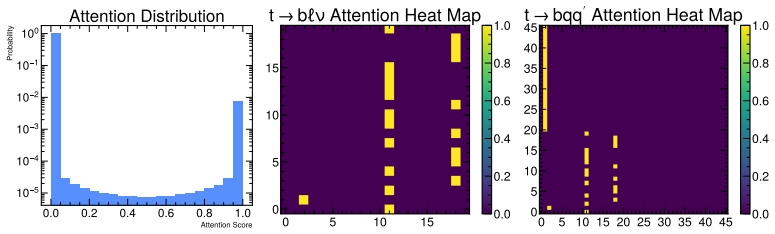
The central claim is that ParT's particle multihead attention (P-MHA) produces a nearly binary attention distribution: over the 128-particle jet representation, most attention scores are close to 0 or 1, so each particle effectively attends to at most one other particle. Visualizing attention weights in the η-φ plane and comparing with randomly initialized weights, the authors observe class-dependent focus: for t→bℓν jets, attention concentrates on the lepton; for t→bqq′ and H→4q, attention forms predominantly inter-subjet or intra-subjet connections after clustering with the kT algorithm. They quantify this by showing that the distribution of attention-to-lepton and attention-between-subjets ratios is sharply peaked in the trained model but not in an untrained one. Finally, they show that truncating each attention head to the top-k particles, with k=30, retains nearly the full tagging performance, while even k=1 keeps substantial accuracy.
Load-bearing premise
The argument assumes that the attention weights in the final layer faithfully explain what the model is actually using to classify; if the model relies on information not visible in those weights, the conclusion that it 'learns leptons and subjets' does not follow.
Editorial extensions
If this is right
- ParT's learned attention is sparse enough that restricting each head to 30 particles reproduces nearly full jet-tagging accuracy.
- The attended particles correspond to known physics, so the model's internals can be sanity-checked against decay kinematics.
- The binary pattern suggests a route to cheaper transformer inference by computing attention only over a small set of key interactions.
- The distribution of attention ratios distinguishes trained from untrained ParT, indicating that the structure is learned from data rather than inherited from the architecture.
- The varying focus by decay class indicates that ParT learns traditional jet-substructure observables.
Reading between the lines
- The paper only examines the final attention layer, so the binary pattern might be a property of the output layer rather than the whole network; if earlier layers are denser, the pruning benefit could be smaller than the headline result suggests.
- Because the pairwise interaction matrix U is added directly into the attention logits, the binary pattern may originate from U rather than from the query-key softmax; testing this by ablating U and re-examining the heat maps would separate the two sources.
- A natural next step, not taken here, is to apply top-k attention during training rather than only at inference; if accuracy holds, the result would be a faster and possibly better-regularized ParT.
Editorial analysis
A structured set of objections, weighed in public.
Referee Report
Summary. The paper analyzes the attention weights of the pre-trained Particle Transformer (ParT) on the JETCLASS jet-tagging dataset. It reports a bimodal distribution of attention scores, which it interprets as a 'binary' pattern in which each particle attends to at most one other particle. It further visualizes attention in the η-φ plane for t→bℓν, t→bqq′, and H→4q jets, concluding that ParT learns physically relevant features such as the lepton and subjet structure. Finally, it proposes a top-k attention pruning scheme and shows that k=30 particles per head approximately recovers full-model performance.
Significance. If the claims are correct, the paper would provide a concrete example of a physics transformer learning interpretable, sparse attention patterns, with implications for efficient inference. The authors use a publicly available pre-trained model and release their analysis code, which supports reproducibility. The main strengths are the comparison against a randomly initialized baseline and the use of real physics processes. However, the significance is limited by the lack of a quantitative sparsity metric and the absence of a faithfulness test for the attention-based interpretation.
major comments (3)
- [Section 3, Fig. 1, and Section 4, Table 1] The claim that 'each particle attends to at most one other particle' is not established by the evidence. The marginal distribution of all attention entries is bimodal, but this is consistent with many rows having several moderately large entries; a row-wise sparsity metric (e.g., number of entries above a threshold per row, row entropy) is missing, and the paper does not report whether the large attention values are on the self-diagonal. Moreover, the top-k pruning results in Table 1 contradict a strict reading of the claim: if every row had at most one nonzero entry, then k=1 per head would essentially reproduce the full model, but the accuracy drops from 0.861 (k=128) to 0.770 (k=1) and rejection rates fall by large factors (e.g., H→b¯b Rej50% from 10638 to 4396). The paper should either revise the sparsity claim or demonstrate that the pruning implementation is consistent with the claimed row-wise structure.
- [Section 3 ('Particle Attention Graphs') and Abstract] The conclusion that ParT 'learns traditional jet substructure observables' assumes that attention weights faithfully represent the information used in the classification decision, but no faithfulness, completeness, or causal test is provided. In P-MHA, the output is a convex combination of value vectors, so a token can receive high attention while its value vector contributes little to the final logit. A concrete test would be to ablate the attended particles (e.g., zero the attention to the lepton in t→bℓν or to specific subjets) and measure the change in classification probability or logit. Without such a test, the observation that attention concentrates on leptons and subjets could be epiphenomenal, and the physics-learning claim is underdetermined. The Limitations paragraph acknowledges final-layer and clustering limitations but does not address this faithfulness issue.
- [Section 3, Fig. 3] The trained-vs-untrained comparison in Fig. 3 is only qualitative. The histograms show visible differences, but no quantitative measure (e.g., Kolmogorov-Smirnov statistic, effect size, or overlap) is reported, and the number of jets and heads aggregated in each histogram is not stated. Since the claim that ParT preferentially attends to leptons or to inter-/intra-subjet connections is a central result, a quantitative summary with uncertainties is needed.
minor comments (6)
- [Section 5] There is a typo in the final paragraph: 'mechanisims' should be 'mechanisms'.
- [Acknowledgments] In the funding statement, 'a nd' should be 'and'.
- [Broader Impact] The sentence 'This study uses an xAI method' is not accurate; the paper uses attention visualization, which is a common but not generally accepted explanatory method. Consider rewording to avoid overclaiming the explanatory status of attention.
- [Section 2, Eq. (1)] The statement that 'the sum of all attention values in a head should be equal to the number of particles' is correct under the usual row-wise softmax, but only for unmasked tokens; it is worth stating this explicitly to avoid confusion.
- [Fig. 2 caption] The caption lists '✚: electron' among the markers, but the t→bℓν example in the figure shows a muon (✖). Clarify whether electrons are present in the selected events or whether the marker list is generic.
- [Table 1] The table would be easier to interpret if the k=128 baseline were clearly separated, values near the baseline were highlighted, and statistical uncertainties (e.g., from multiple seeds or bootstrapping) were reported.
Circularity Check
No significant circularity: the interpretation is a post-hoc analysis of a pretrained model with an independent top-k pruning study, and no load-bearing step reduces to its own input.
full rationale
The paper does not derive a prediction from a fitted parameter or redefine an output as an input. It takes the pretrained ParT model and JetClass dataset from external sources (Refs. [10] and [15]), visualizes final-layer attention, compares against a randomly initialized baseline, and separately evaluates top-k attention pruning on test data. The top-k result is a performance measurement after selecting particles by attention, not a parameter fit that mechanically produces the paper's qualitative claims. The assumption that attention weights faithfully explain the prediction is an interpretability premise, acknowledged as limited to the final layer and clustering procedure, but that is a correctness/faithfulness concern, not the circularity pattern of a derivation equivalent to its input by construction. The only author self-citation, Ref. [14] (Mokhtar, Kansal, Duarte), is cited as related work motivating attention visualization; it is not load-bearing because the visualization method here is direct attention-score inspection and the binary-attention observation is made on the pretrained model's own weights. Therefore no claim reduces by definition to its inputs, and the appropriate circularity score is 0.
Assumptions & free parameters
free parameters (2)
- top-k attention constraint k =
30 (recovered performance); scanned over 1,2,3,4,5,10,20,30,128
- subjet multiplicity per jet class =
2 for t->b l nu, 3 for t->bqq', 4 for H->4q
assumptions (3)
- domain assumption Final-layer attention weights faithfully reflect the information ParT uses for classification.
- domain assumption kT subjet clustering with hand-chosen multiplicities aligns with physical decay products.
- domain assumption A randomly initialized ParT is a valid baseline isolating learned attention behavior.
Cite this review
Pith. "Pith review of Interpreting Transformers for Jet Tagging." pith.science (2026). https://pith.science/paper/P3NVYDKH
@misc{pith2026241203673,
  author       = {Pith},
  title        = {Pith review of: Interpreting Transformers for Jet Tagging},
  year         = {2026},
  howpublished = {\url{https://pith.science/paper/P3NVYDKH}},
  note         = {Machine review of arXiv:2412.03673}
}
abstract
Machine learning (ML) algorithms, particularly attention-based transformer models, have become indispensable for analyzing the vast data generated by particle physics experiments like ATLAS and CMS at the CERN LHC. Particle Transformer (ParT), a state-of-the-art model, leverages particle-level attention to improve jet-tagging tasks, which are critical for identifying particles resulting from proton collisions. This study focuses on interpreting ParT by analyzing attention heat maps and particle-pair correlations on the $\eta$-$\phi$ plane, revealing a binary attention pattern where each particle attends to at most one other particle. At the same time, we observe that ParT shows varying focus on important particles and subjets depending on decay, indicating that the model learns traditional jet substructure observables. These insights enhance our understanding of the model's internal workings and learning process, offering potential avenues for improving the efficiency of transformer architectures in future high-energy physics applications.
Figures


Forward citations
Cited by 1 Pith paper
-
Simulation-based inference for Precision Neutrino Physics through Neural Monte Carlo tuning
Neural density estimators paired with nested sampling recover JUNO's energy response parameters with bias below 0.55% and uncertainties consistent with statistics, in simulation-based closure tests.
Reference graph
Works this paper leans on
-
[1]
Physics Community Needs, Tools, and Resources for Machine Learning
P. Harris et al., “Physics Community Needs, Tools, and Resources for Machine Learning”, in Snowmass 2021. 2022. arXiv:2203.16255. 5
arXiv 2021
-
[2]
A. Vaswani et al., “Attention is all you need”, in Advances in Neural Information Processing Systems, I. Guyon et al., eds., volume 30. Curran Associates, Inc., 2017
work page 2017
-
[3]
Hierarchical text-conditional image generation with clip latents
A. Ramesh et al., “Hierarchical text-conditional image generation with clip latents”, 2022. arXiv:2204.06125
arXiv 2022
-
[4]
Gemini: A family of highly capable multimodal models
Gemini Team, “Gemini: A family of highly capable multimodal models”, 2024. arXiv:2312.11805
arXiv 2024
-
[5]
Language models are few-shot learners
T. B. Brown et al., “Language models are few-shot learners”, 2020. arXiv:2005.14165
arXiv 2020
-
[6]
Search for highly energetic double Higgs boson production in the two bottom quark and two vector boson all-hadronic final state
CMS Collaboration, “Search for highly energetic double Higgs boson production in the two bottom quark and two vector boson all-hadronic final state”, CMS Physics Analysis Summary CMS-PAS-HIG-23-012, 2024
2024
-
[7]
B. Andersson, “The Lund Model”, Nucl. Phys. A 461 (1987) 513C, doi:10.1016/0375-9474(87)90510-0
-
[8]
Jet tagging via particle clouds
H. Qu and L. Gouskos, “Jet tagging via particle clouds”, Phys. Rev. D 101 (2020) doi:10.1103/physrevd.101.056019, arXiv:1902.08570
arXiv 2020
Show all 21 references
-
[9]
Efficient and Robust Jet Tagging at the LHC with Knowledge Distillation
R. Liu et al., “Efficient and Robust Jet Tagging at the LHC with Knowledge Distillation”, in Machine Learning and the Physical Science Workshop at the 37th Conference on Neural Information Processing Systems. 2023. arXiv:2311.14160
2023 arXiv
-
[10]
Particle Transformer for jet tagging
H. Qu, C. Li, and S. Qian, “Particle Transformer for jet tagging”, in Proceedings of the 39th International Conference on Machine Learning, p. 18281. 2022. arXiv:2202.03772
2022 arXiv
-
[11]
Transformer interpretability beyond attention visualization
H. Chefer, S. Gur, and L. Wolf, “Transformer interpretability beyond attention visualization”, in Proceedings of the IEEE/CVF Conference on Computer Vision and Pattern Recognition (CVPR), p. 782. 2021
2021
-
[12]
Graph Neural Networks in Particle Physics
J. Shlomi, P. Battaglia, and J.-R. Vlimant, “Graph Neural Networks in Particle Physics”, Mach. Learn.: Sci Technol. 2 (2021) 021001, doi:10.1088/2632-2153/abbf9a, arXiv:2007.13681
2021 arXiv
-
[13]
Graph neural networks for particle tracking and reconstruction
J. Duarte and J.-R. Vlimant, “Graph neural networks for particle tracking and reconstruction”, in Artificial Intelligence for High Energy Physics, P. Calafiura, D. Rousseau, and K. Terao, eds., p. 387. World Scientific, 2022. arXiv:2012.01249. doi:10.1142/9789811234033_0012
2022 arXiv
-
[14]
Do graph neural networks learn traditional jet substructure?
F. Mokhtar, R. Kansal, and J. Duarte, “Do graph neural networks learn traditional jet substructure?”, in Machine Learning and the Physical Sciences Workshop at the 36th Conference on Neural Information Processing Systems. 2022. arXiv:2211.09912
2022 arXiv
-
[15]
J ETCLASS : A large-scale dataset for deep learning in jet physics
H. Qu, C. Li, and S. Qian, “J ETCLASS : A large-scale dataset for deep learning in jet physics”,
-
[16]
Jet tagging in the Lund plane with graph networks
F. A. Dreyer and H. Qu, “Jet tagging in the Lund plane with graph networks”, JHEP 03 (2021) 052, doi:10.1007/JHEP03(2021)052, arXiv:2012.08526
2021 arXiv
-
[17]
Longitudinally invariantKt clustering algorithms for hadron hadron collisions
S. Catani, Y . L. Dokshitzer, M. H. Seymour, and B. R. Webber, “Longitudinally invariantKt clustering algorithms for hadron hadron collisions”, Nucl. Phys. B 406 (1993) 187, doi:10.1016/0550-3213(93)90166-M
1993 doi
-
[18]
FastJet User Manual
M. Cacciari, G. P. Salam, and G. Soyez, “FastJet User Manual”, Eur. Phys. J. C 72 (2012) 1896, doi:10.1140/epjc/s10052-012-1896-2 , arXiv:1111.6097
2012 arXiv
-
[19]
An array-oriented Python interface for FastJet
A. Roy, J. Pivarski, and C. W. Freer, “An array-oriented Python interface for FastJet”, J. Phys. Conf. Ser. 2438 (2023) 012011, doi:10.1088/1742-6596/2438/1/012011, arXiv:2202.03911
2023 arXiv
-
[20]
Jet Tagging with More-Interaction Particle Transformer
Y . Wu et al., “Jet Tagging with More-Interaction Particle Transformer”, 2024. arXiv:2407.08682. Accepted by Chin. Phys. C. 6
2024 arXiv
-
[2022]
doi:10.5281/zenodo.6619768
Reviewed August 11, 2026 · model on record in the stance chip above.
Discussion (0). Continue with ORCID to comment.