Lattice Matching Dictates the Growth Mode and Quality of Deuterium Crystallization in Confined Spherical Shells
Pith reviewed 2026-06-27 03:34 UTC · model grok-4.3
The pith
Lattice matching to 3.5 angstrom controls whether deuterium forms near-single crystals or rough polycrystalline layers inside spherical shells.
A machine-rendered reading of the paper's core claim, the machinery that carries it, and where it could break.
Core claim
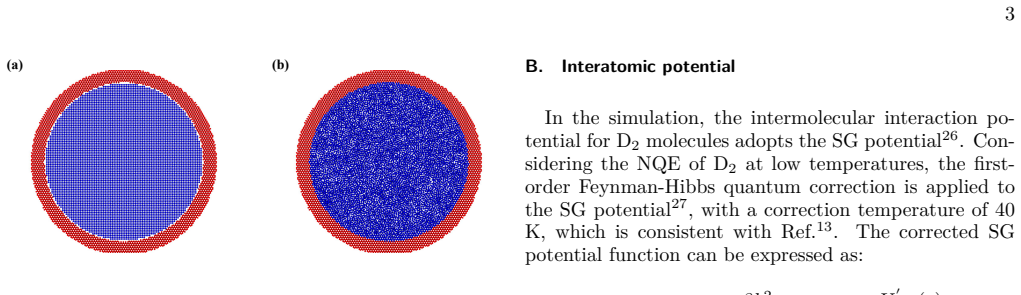
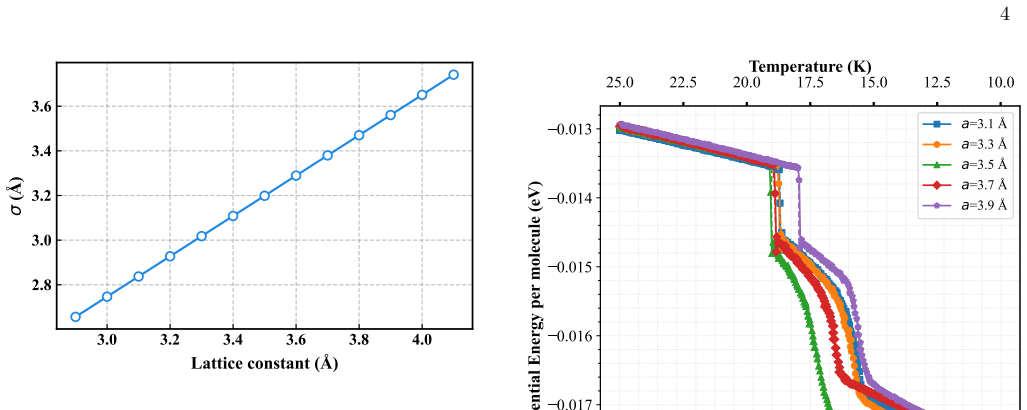
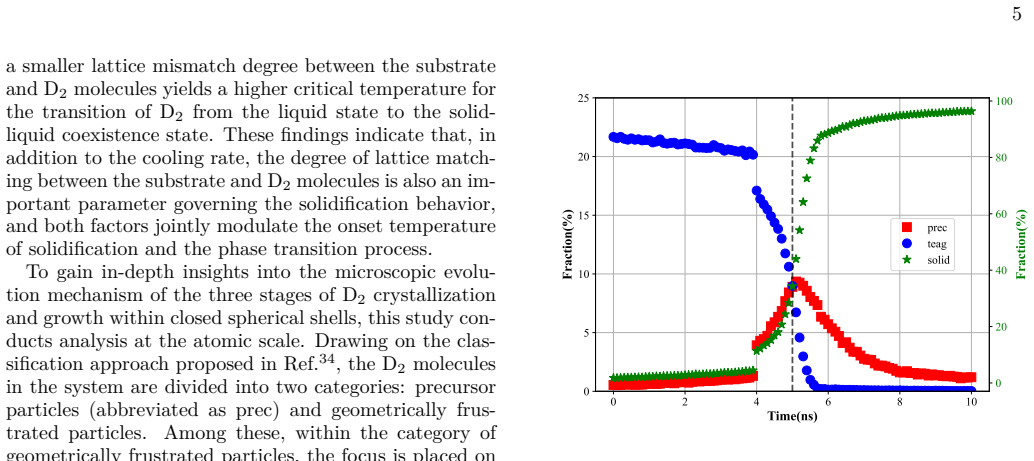
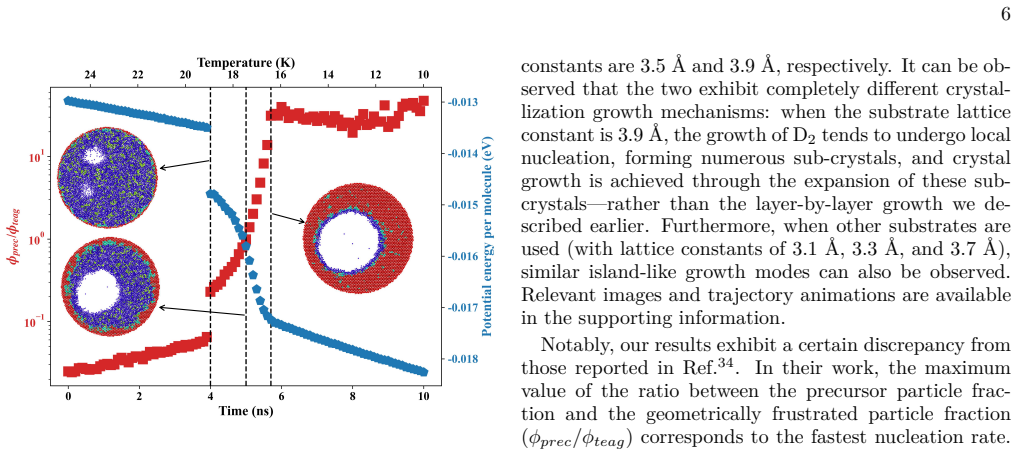
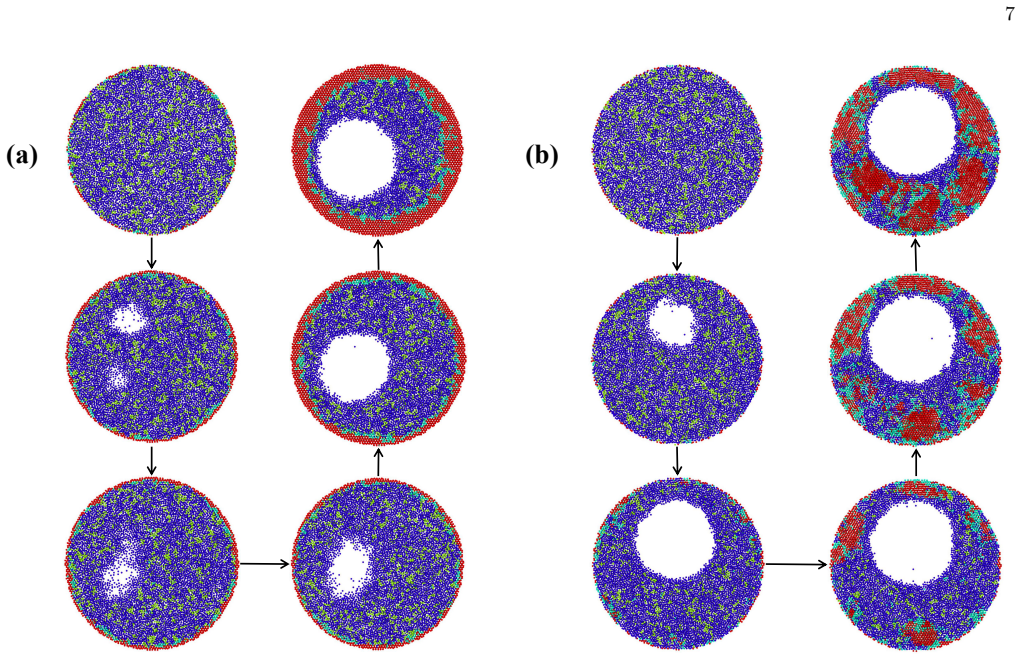
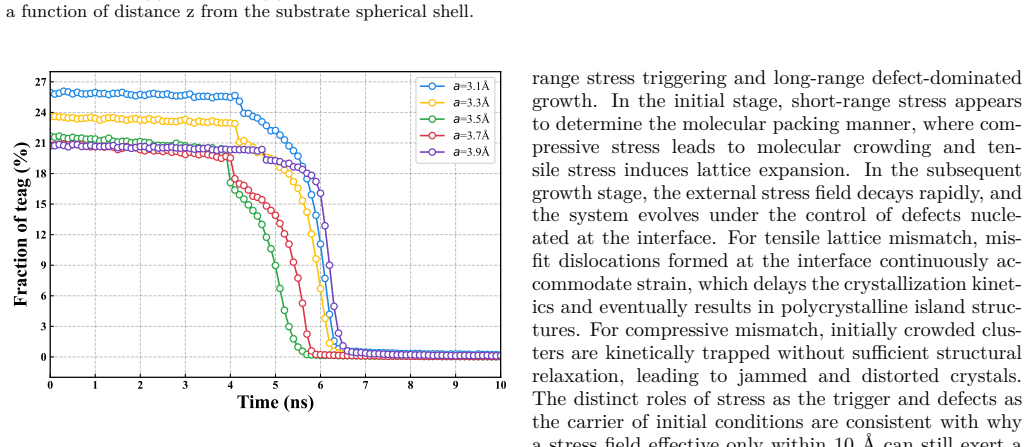
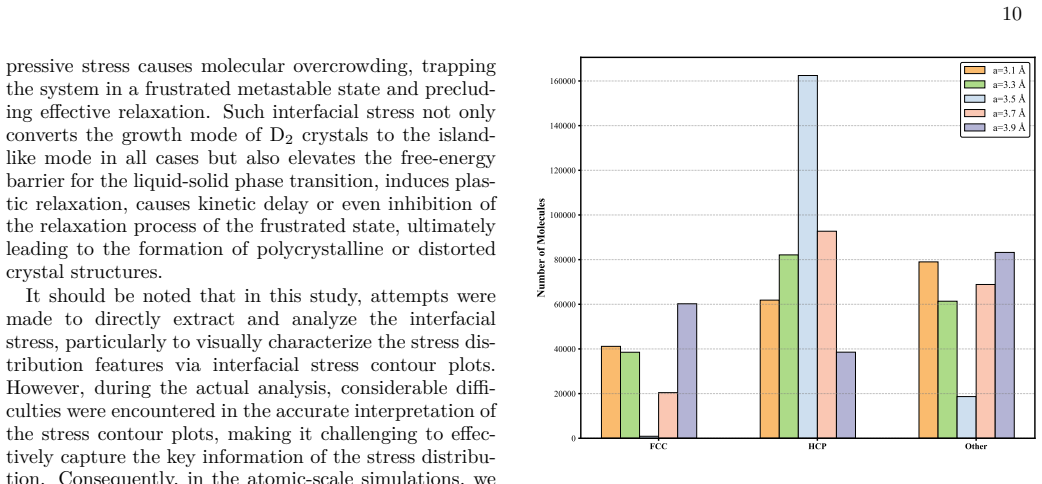
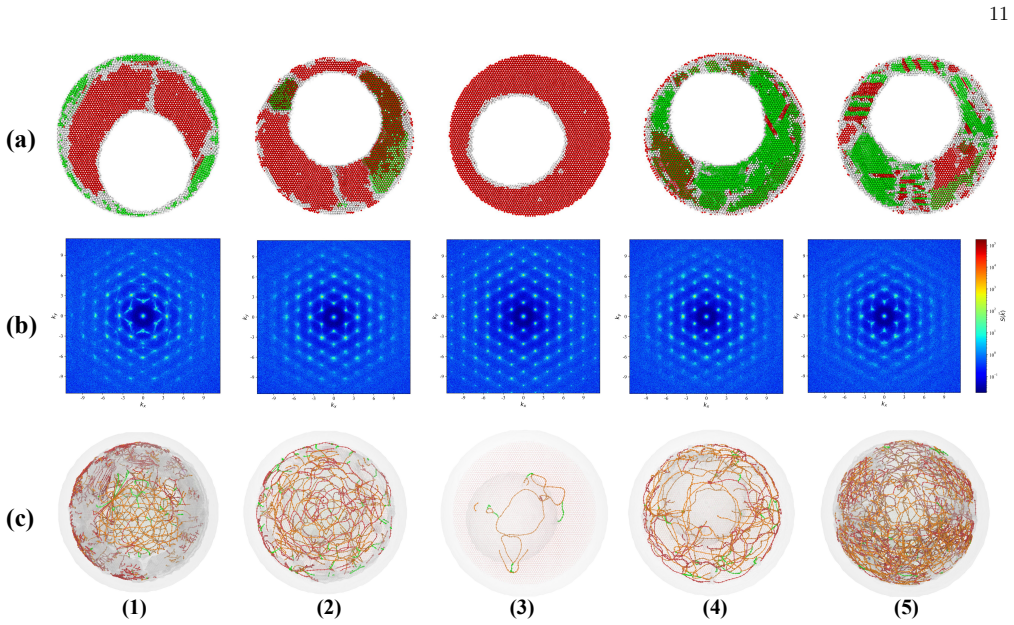
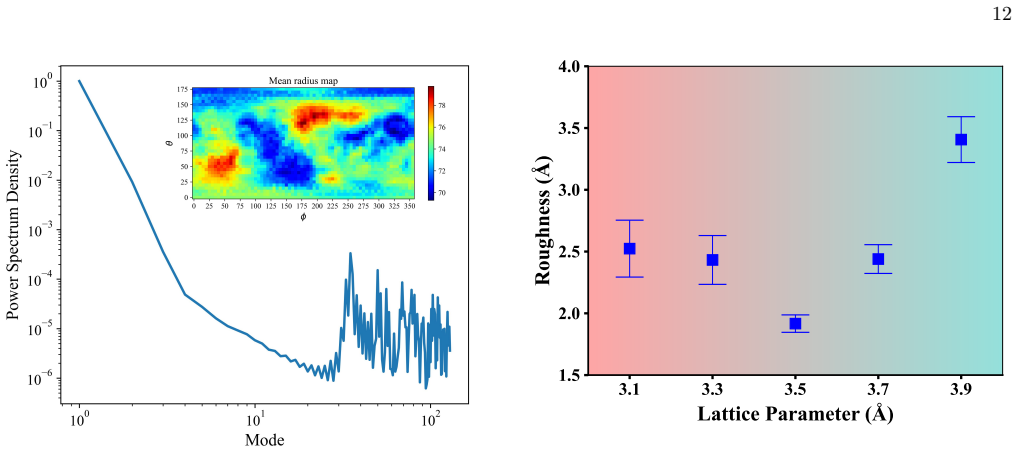
When the substrate lattice closely matches the equilibrium hexagonal-close-packed spacing of cryogenic D2 (approximately 3.5 angstrom), D2 forms coherent layer-by-layer epitaxial growth consistent with Ostwald's stepwise nucleation theory, yielding HCP-dominated near-single crystals with minimal dislocations and ultra-smooth inner surfaces. Large mismatch destabilizes this growth, producing polycrystalline structures with mixed HCP/FCC phases, elevated defects, and increased surface roughness.
What carries the argument
Lattice matching between the rigid spherical substrate constant and the 3.5-angstrom HCP spacing of D2, which selects between coherent epitaxial layer growth and defect-inducing island growth.
If this is right
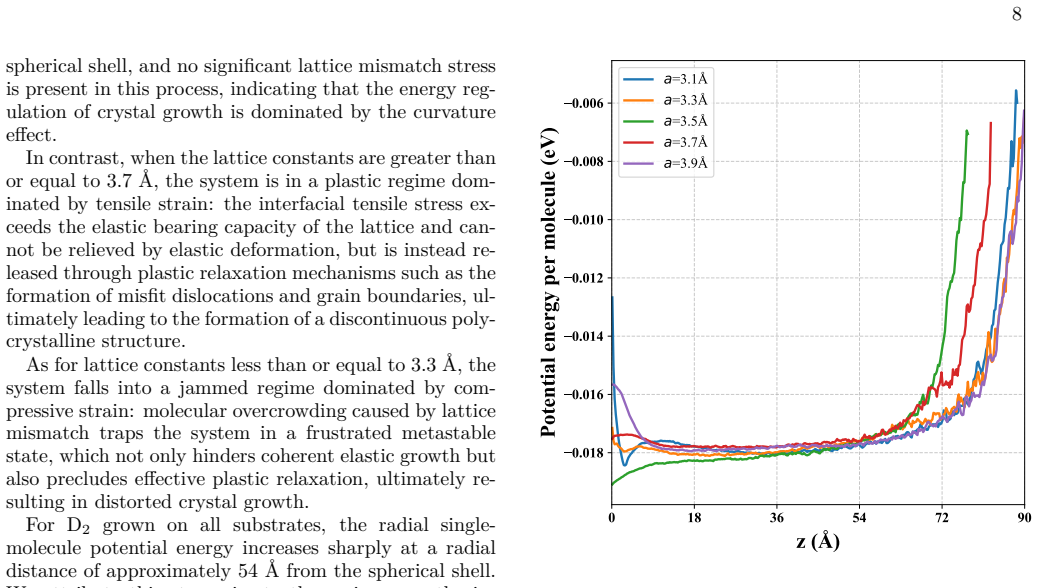
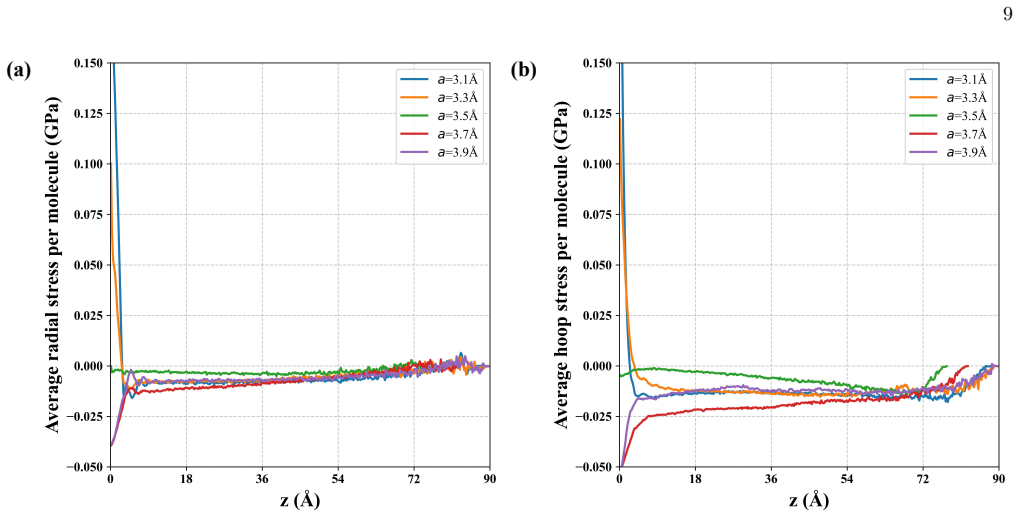
- Interfacial stress from mismatch remains localized to the first 2-3 molecular layers.
- Substrate lattice constant becomes the dominant engineering variable for ablator inner-surface quality in ICF targets.
- The same matching principle supplies atomic-scale guidance for growing smooth single-crystal DT fuel layers.
Where Pith is reading between the lines
- Capsule fabrication methods that allow precise control of inner-surface lattice spacing could be prioritized over other smoothness techniques.
- The finding may generalize to other confined cryogenic solids whose equilibrium spacing can be matched to a container wall.
- Radial stress localization suggests that only a thin buffer layer needs lattice engineering rather than the entire shell thickness.
Load-bearing premise
The Feynman-Hibbs corrected Silvera-Goldman potential correctly describes the intermolecular forces and quantum effects that set how D2 molecules arrange against the substrate.
What would settle it
Direct imaging or diffraction of D2 layers grown inside capsules whose inner lattice constant is tuned across 3.1-3.9 angstrom, checking whether surface roughness and crystal orientation jump sharply at the 3.5-angstrom match point.
Figures

read the original abstract
Cryogenic hydrogen isotope fuel layers with high structural integrity and atomic-scale smoothness are prerequisites for symmetric implosion and ignition in inertial confinement fusion (ICF). Using deuterium (D$_2$) as model fuel, we perform large-scale molecular dynamics simulations with a Feynman-Hibbs corrected Silvera-Goldman potential to describe nuclear quantum effects at low temperatures, systematically investigating D$_2$ crystallization inside spherical ablator capsules. By varying substrate lattice constant from 3.1 angstrom to 3.9 angstrom, we demonstrate that lattice matching dictates the transition from coherent epitaxial growth to polycrystalline formation, establishing it as the primary design principle for high-performance targets. When the substrate lattice closely matches the equilibrium hexagonal-close-packed (HCP) spacing of cryogenic D$_2$ (approximately 3.5 angstrom), D$_2$ forms coherent layer-by-layer epitaxial growth consistent with Ostwald's stepwise nucleation theory, yielding HCP-dominated near-single crystals with minimal dislocations and ultra-smooth inner surfaces. In contrast, large lattice mismatch destabilizes coherent growth and causes island-like growth, producing polycrystalline structures with mixed HCP/FCC phases, elevated defects, and greatly increased surface roughness. Radial stress analysis shows that interfacial stress from mismatch localizes within 2-3 molecular layers near the interface, triggering subsequent defect-mediated growth. These findings highlight substrate lattice matching in regulating confined solid growth and crystallization quality, establish it as a key principle for ablator inner-surface engineering in ICF cryogenic targets, and offer atomic guidance for growing high-quality single-crystal deuterium-tritium (DT) fuel layers with optimal smoothness.
Editorial analysis
A structured set of objections, weighed in public.
Referee Report
Summary. The paper reports large-scale molecular dynamics simulations of deuterium (D2) crystallization inside spherical ablator capsules, employing a Feynman-Hibbs corrected Silvera-Goldman potential to incorporate nuclear quantum effects. By systematically varying the substrate lattice constant from 3.1 Å to 3.9 Å, the authors demonstrate that close matching to the equilibrium HCP spacing of cryogenic D2 (~3.5 Å) produces coherent layer-by-layer epitaxial growth, yielding HCP-dominated near-single crystals with minimal dislocations and ultra-smooth surfaces, consistent with Ostwald stepwise nucleation. Large mismatches instead induce island-like growth, polycrystalline mixed HCP/FCC structures, elevated defect densities, and increased roughness. Radial stress is shown to localize within 2-3 molecular layers at the interface, influencing subsequent defect-mediated growth. The work positions lattice matching as the primary design principle for high-performance ICF cryogenic targets.
Significance. If the underlying potential and simulation protocol are shown to be reliable, the identification of lattice matching as the controlling factor for confined D2 growth mode and quality would provide a concrete, actionable guideline for ablator inner-surface engineering in inertial confinement fusion. The atomic-scale insight into stress localization and phase selection could directly inform target fabrication strategies aimed at achieving the required fuel-layer smoothness and structural integrity.
major comments (2)
- [Methods (potential and simulation details)] The Feynman-Hibbs corrected Silvera-Goldman potential is invoked throughout as the basis for all reported growth modes, defect densities, and stress profiles, yet the manuscript contains no benchmarks against the experimental D2 lattice constant at ~4 K (~3.59 Å), sublimation energy, or documented thin-film crystallization behavior on mismatched substrates. Because every claimed transition (epitaxial vs. island growth, HCP dominance, roughness reduction) is an output of trajectories driven by this potential, the absence of such validation makes the central design-principle conclusion model-dependent rather than robustly predictive.
- [Results (radial stress analysis)] The assertion that interfacial stress localizes within 2-3 molecular layers and thereby triggers defect-mediated growth is load-bearing for the mechanistic explanation, but the manuscript provides no quantitative radial stress profiles, convergence tests with system size, or comparison to alternative potentials that would establish this localization as independent of the specific interaction model.
minor comments (2)
- [Abstract] The abstract states that results are 'consistent with Ostwald's stepwise nucleation theory' without specifying which simulation observables (layer formation times, nucleation barriers, or layer-by-layer coverage fractions) were used for the comparison.
- [Introduction/Methods] Notation for lattice constants and mismatch should be defined once in the main text with explicit units and reference values to avoid ambiguity when readers compare the 3.5 Å matching condition to the experimental 3.59 Å value.
Simulated Author's Rebuttal
We thank the referee for their thorough review and valuable feedback on our manuscript. We address each of the major comments below and outline the revisions we will make to strengthen the presentation of our results.
read point-by-point responses
-
Referee: [Methods (potential and simulation details)] The Feynman-Hibbs corrected Silvera-Goldman potential is invoked throughout as the basis for all reported growth modes, defect densities, and stress profiles, yet the manuscript contains no benchmarks against the experimental D2 lattice constant at ~4 K (~3.59 Å), sublimation energy, or documented thin-film crystallization behavior on mismatched substrates. Because every claimed transition (epitaxial vs. island growth, HCP dominance, roughness reduction) is an output of trajectories driven by this potential, the absence of such validation makes the central design-principle conclusion model-dependent rather than robustly predictive.
Authors: We agree that explicit validation benchmarks would enhance the robustness of our conclusions. The Feynman-Hibbs corrected Silvera-Goldman potential is a well-established model in the literature for describing quantum effects in solid hydrogen isotopes. To directly address this concern, we will add a dedicated subsection in the Methods or a supplementary figure providing benchmarks for the lattice constant, sublimation energy, and comparison to known thin-film behaviors where available from literature. This will make the model dependence explicit and strengthen the predictive aspect. revision: yes
-
Referee: [Results (radial stress analysis)] The assertion that interfacial stress localizes within 2-3 molecular layers and thereby triggers defect-mediated growth is load-bearing for the mechanistic explanation, but the manuscript provides no quantitative radial stress profiles, convergence tests with system size, or comparison to alternative potentials that would establish this localization as independent of the specific interaction model.
Authors: We acknowledge the need for more quantitative support for the stress localization claim. In the revised manuscript, we will include explicit radial stress profiles as a function of distance from the interface for different lattice mismatches. We will also add convergence tests with respect to system size to confirm the localization within 2-3 layers is not an artifact. Regarding comparison to alternative potentials, while performing new simulations with different models would be beyond the scope of a revision, we will discuss the sensitivity by referencing literature on other potentials for D2 and note that the qualitative trends with lattice matching are expected to hold. If the referee deems it essential, we can consider limited additional simulations. revision: partial
Circularity Check
No significant circularity; results are direct outputs of MD simulations with independent inputs
full rationale
The paper reports molecular dynamics trajectories driven by a Feynman-Hibbs corrected Silvera-Goldman potential taken from prior literature. Substrate lattice constants are varied parametrically from 3.1 Å to 3.9 Å as explicit independent inputs. Growth mode, phase composition, defect density, and surface roughness are computed outputs of those trajectories, not algebraic identities or parameters fitted to the target observables and then relabeled as predictions. No load-bearing self-citations, self-definitional steps, or uniqueness theorems imported from the same authors appear in the abstract or described derivation chain. The central claim therefore remains self-contained against external benchmarks and does not reduce to its inputs by construction.
Axiom & Free-Parameter Ledger
axioms (2)
- domain assumption Feynman-Hibbs corrected Silvera-Goldman potential accurately represents D2 interactions at cryogenic temperatures
- domain assumption Substrate atoms remain fixed at chosen lattice spacing during growth
Reference graph
Works this paper leans on
-
[1]
Physical Review B—Condensed Matter and Materials Physics , volume=
Metastable polymorphs of hydrogen isotopes solidified near the triple point , author=. Physical Review B—Condensed Matter and Materials Physics , volume=. 2010 , publisher=
2010
-
[2]
Nature Reviews Chemistry , volume=
Nuclear quantum effects enter the mainstream , author=. Nature Reviews Chemistry , volume=. 2018 , publisher=
2018
-
[3]
Fusion Science and Technology , volume=
Supercooling of hydrogen on template materials to deterministically seed ignition-quality solid fuel layers , author=. Fusion Science and Technology , volume=. 2016 , publisher=
2016
-
[4]
Nuclear Fusion , volume=
Solidification of an atomic fluid inside a spherical shell , author=. Nuclear Fusion , volume=. 2015 , publisher=
2015
-
[5]
The Journal of Chemical Physics , volume=
Effect of wetting on nucleation and growth of D2 in confinement , author=. The Journal of Chemical Physics , volume=. 2018 , publisher=
2018
-
[6]
Fusion Science and Technology , volume=
Materials and Morphology Study for Templated Hydrogen Solidification , author=. Fusion Science and Technology , volume=. 2018 , publisher=
2018
-
[7]
Fusion Technology , volume=
Crystal growth and roughening of solid D2 , author=. Fusion Technology , volume=. 1997 , publisher=
1997
-
[8]
The Journal of Chemical Physics , volume=
The isotropic intermolecular potential for H2 and D2 in the solid and gas phases , author=. The Journal of Chemical Physics , volume=. 1978 , publisher=
1978
-
[9]
Equation of state and force fields for Feynman--Hibbs-corrected Mie fluids. I. Application to pure helium, neon, hydrogen, and deuterium , author=. The Journal of Chemical Physics , volume=. 2019 , publisher=
2019
-
[10]
2005 , publisher=
Quantum mechanics and path integrals: Emended edition , author=. 2005 , publisher=
2005
-
[11]
The Journal of Chemical Physics , volume=
The limits of Feynman--Hibbs corrections in capturing quantum-nuclear contributions to thermophysical properties , author=. The Journal of Chemical Physics , volume=. 2025 , publisher=
2025
-
[12]
Annalen der Physik , volume=
On the History of the Lennard-Jones Potential , author=. Annalen der Physik , volume=. 2024 , publisher=
2024
-
[13]
Computer physics communications , volume=
LAMMPS-a flexible simulation tool for particle-based materials modeling at the atomic, meso, and continuum scales , author=. Computer physics communications , volume=. 2022 , publisher=
2022
-
[14]
Physical Review Letters , volume=
Multiple scenarios of low-temperature nucleation in simple liquids , author=. Physical Review Letters , volume=. 2023 , publisher=
2023
-
[15]
Physical Review B , volume=
Bond-orientational order in liquids and glasses , author=. Physical Review B , volume=. 1983 , publisher=
1983
-
[16]
Nature Physics , volume=
Visualizing kinetic pathways of homogeneous nucleation in colloidal crystallization , author=. Nature Physics , volume=. 2014 , publisher=
2014
-
[17]
The Journal of chemical physics , volume=
Numerical calculation of the rate of crystal nucleation in a Lennard-Jones system at moderate undercooling , author=. The Journal of chemical physics , volume=. 1996 , publisher=
1996
-
[18]
The Journal of chemical physics , volume=
Accurate determination of crystal structures based on averaged local bond order parameters , author=. The Journal of chemical physics , volume=. 2008 , publisher=
2008
-
[19]
Physical Chemistry Chemical Physics , volume=
Homogeneous nucleation and the Ostwald step rule , author=. Physical Chemistry Chemical Physics , volume=. 1999 , publisher=
1999
-
[20]
Thermal physics and thermal analysis: From macro to micro, highlighting thermodynamics, kinetics and nanomaterials , pages=
How do crystals nucleate and grow: Ostwald’s rule of stages and beyond , author=. Thermal physics and thermal analysis: From macro to micro, highlighting thermodynamics, kinetics and nanomaterials , pages=. 2017 , publisher=
2017
-
[21]
Surface and Coatings Technology , volume=
Kinetics of epitaxial formation of nanostructures by Frank--van der Merwe, Volmer--Weber and Stranski--Krastanow growth modes , author=. Surface and Coatings Technology , volume=. 2020 , publisher=
2020
-
[22]
Science , volume=
Layer-by-layer growth of binary colloidal crystals , author=. Science , volume=. 2002 , publisher=
2002
-
[23]
Journal of Applied Physics , volume=
Island growth as a growth mode in atomic layer deposition: A phenomenological model , author=. Journal of Applied Physics , volume=. 2004 , publisher=
2004
-
[24]
Computational Materials Science , volume=
Efficiency in identification of internal structure in simulated monoatomic clusters: Comparison between common neighbor analysis and coordination polyhedron method , author=. Computational Materials Science , volume=. 2022 , publisher=
2022
-
[25]
Journal of Physical Chemistry , volume=
Molecular dynamics study of melting and freezing of small Lennard-Jones clusters , author=. Journal of Physical Chemistry , volume=. 1987 , publisher=
1987
-
[26]
Computational Materials Science , volume=
Systematic analysis of local atomic structure combined with 3D computer graphics , author=. Computational Materials Science , volume=. 1994 , publisher=
1994
-
[27]
Computer Physics Communications , volume=
freud: A software suite for high throughput analysis of particle simulation data , author=. Computer Physics Communications , volume=. 2020 , publisher=
2020
-
[28]
Modelling and simulation in materials science and engineering , volume=
Visualization and analysis of atomistic simulation data with OVITO--the Open Visualization Tool , author=. Modelling and simulation in materials science and engineering , volume=. 2009 , publisher=
2009
-
[29]
Fusion Science and Technology , volume=
Deuterium-tritium fuel layer formation for the National Ignition Facility , author=. Fusion Science and Technology , volume=. 2011 , publisher=
2011
-
[30]
Fusion Science and Technology , volume=
Technique for Forming Solid D2 and DT Layers for Shock Timing Experiments at the National Ignition Facility , author=. Fusion Science and Technology , volume=. 2016 , publisher=
2016
-
[31]
Fusion Science and Technology , volume=
D2 and dT liquid-layer target shots at the national ignition facility , author=. Fusion Science and Technology , volume=. 2018 , publisher=
2018
-
[32]
The Journal of chemical physics , volume=
Shortcomings of the bond orientational order parameters for the analysis of disordered particulate matter , author=. The Journal of chemical physics , volume=. 2013 , publisher=
2013
-
[33]
Nature Physics , volume=
Surface-assisted single-crystal formation of charged colloids , author=. Nature Physics , volume=. 2017 , publisher=
2017
-
[34]
Modelling and Simulation in Materials Science and Engineering , volume=
Robust structural identification via polyhedral template matching , author=. Modelling and Simulation in Materials Science and Engineering , volume=. 2016 , publisher=
2016
-
[35]
Proceedings of the Royal Society of London
A new look at the atomic level virial stress: on continuum-molecular system equivalence , author=. Proceedings of the Royal Society of London. Series A: Mathematical, Physical and Engineering Sciences , volume=. 2003 , publisher=
2003
-
[36]
Europhysics Letters , volume=
The origin of the distinction between microscopic formulas for stress and Cauchy stress , author=. Europhysics Letters , volume=. 2016 , publisher=
2016
-
[37]
International Journal of Solids and Structures , volume=
Continuum interpretation of virial stress in molecular simulations , author=. International Journal of Solids and Structures , volume=. 2008 , publisher=
2008
-
[38]
Acta Mechanica Solida Sinica , volume=
Investigation on applicability of various stress definitions in atomistic simulation , author=. Acta Mechanica Solida Sinica , volume=. 2009 , publisher=
2009
-
[39]
Journal of Computational and Theoretical Nanoscience , volume=
How to compute the atomic stress objectively? , author=. Journal of Computational and Theoretical Nanoscience , volume=. 2009 , publisher=
2009
-
[40]
Discrete and Continuous Dynamical Systems-B , volume=
A comparative study of atomistic-based stress evaluation , author=. Discrete and Continuous Dynamical Systems-B , volume=. 2021 , publisher=
2021
-
[41]
Physical Review B , volume=
Melting line of aluminum from simulations of coexisting phases , author=. Physical Review B , volume=. 1994 , publisher=
1994
-
[42]
Physical review letters , volume=
Melting of lithium hydride under pressure , author=. Physical review letters , volume=. 2003 , publisher=
2003
-
[43]
JOURNAL OF RESEARCH of the National Bureau of Standards , volume=
Pressure-volume-temperature relationships for normal deuterium between 18.7 and 21.0 K , author=. JOURNAL OF RESEARCH of the National Bureau of Standards , volume=
-
[44]
Physical Review E , volume=
Hydrodynamic instability seeding by oxygen nonuniformities in glow discharge polymer inertial fusion ablators , author=. Physical Review E , volume=. 2018 , publisher=
2018
-
[45]
Matter and Radiation at Extremes , volume=
Recent progress in ICF target fabrication at RCLF , author=. Matter and Radiation at Extremes , volume=. 2018 , publisher=
2018
-
[46]
Journal of Physics: Conference Series , volume=
Implosion configurations for robust ignition using high-density carbon (diamond) ablator for indirect-drive ICF at the National Ignition Facility , author=. Journal of Physics: Conference Series , volume=. 2016 , organization=
2016
-
[47]
Matter and Radiation at Extremes , volume=
Density-dependent shock Hugoniot of polycrystalline diamond at pressures relevant to ICF , author=. Matter and Radiation at Extremes , volume=. 2021 , publisher=
2021
-
[48]
Physics of Plasmas , volume=
Comparison of plastic, high density carbon, and beryllium as indirect drive NIF ablators , author=. Physics of Plasmas , volume=. 2018 , publisher=
2018
-
[49]
High Power Laser Science and Engineering , volume=
An investigation progress toward Be-based ablator materials for the inertial confinement fusion , author=. High Power Laser Science and Engineering , volume=. 2017 , publisher=
2017
-
[50]
Chinese Physics B , volume=
Beryllium carbide as diffusion barrier against Cu: First-principles study , author=. Chinese Physics B , volume=. 2020 , publisher=
2020
-
[51]
Matter and Radiation at Extremes , volume=
Hydrodynamic instability growth of the fuel--ablator interface induced by rippled rarefaction waves in inertial confinement fusion implosion experiments , author=. Matter and Radiation at Extremes , volume=. 2025 , publisher=
2025
-
[52]
Matter and Radiation at Extremes , volume=
Scaling of thin wire cylindrical compression with material, diameter, and laser energy after 100 fs Joule surface heating , author=. Matter and Radiation at Extremes , volume=. 2026 , publisher=
2026
-
[53]
Matter and Radiation at Extremes , volume=
Analyzing and relieving the thermal issues caused by fabrication details of a deuterium cryogenic target , author=. Matter and Radiation at Extremes , volume=. 2021 , publisher=
2021
-
[54]
Matter and Radiation at Extremes , volume=
Progress in shock wave diagnostic technology based on velocity interferometers for laser inertial confinement fusion , author=. Matter and Radiation at Extremes , volume=. 2026 , publisher=
2026
-
[55]
Matter and Radiation at Extremes , volume=
Experimental and simulation study on high-power laser irradiation of 3D-printed microstructures , author=. Matter and Radiation at Extremes , volume=. 2026 , publisher=
2026
-
[56]
Physics of plasmas , volume=
The physics basis for ignition using indirect-drive targets on the National Ignition Facility , author=. Physics of plasmas , volume=. 2004 , publisher=
2004
-
[57]
Nuclear fusion , volume=
Design and simulations of indirect drive ignition targets for NIF , author=. Nuclear fusion , volume=
-
[58]
Applied Physics Letters , volume=
Single crystal growth and formation of defects in deuterium-tritium layers for inertial confinement nuclear fusion , author=. Applied Physics Letters , volume=. 2009 , publisher=
2009
-
[59]
Nucleation theory , pages=
Classical nucleation theory , author=. Nucleation theory , pages=. 2012 , publisher=
2012
-
[60]
Physical Review Letters , volume=
Change in Inertial Confinement Fusion Implosions upon Using<? format?> an Ab Initio Multiphase DT Equation of State , author=. Physical Review Letters , volume=. 2011 , publisher=
2011
-
[61]
Matter and Radiation at Extremes , volume=
Unified first-principles equations of state of deuterium-tritium mixtures in the global inertial confinement fusion region , author=. Matter and Radiation at Extremes , volume=. 2020 , publisher=
2020
-
[62]
Modelling and Simulation in Materials Science and Engineering , volume=
Extracting dislocations and non-dislocation crystal defects from atomistic simulation data , author=. Modelling and Simulation in Materials Science and Engineering , volume=
-
[63]
Modelling and Simulation in Materials Science and Engineering , volume=
Automated identification and indexing of dislocations in crystal interfaces , author=. Modelling and Simulation in Materials Science and Engineering , volume=. 2012 , publisher=
2012
discussion (0)
Sign in with ORCID, Apple, or X to comment. Anyone can read and Pith papers without signing in.