When Jets Don't Quench: Near-Infrared H₂ in Star Forming Low-Excitation Radio Galaxies
Pith reviewed 2026-06-29 03:02 UTC · model grok-4.3
The pith
Merger processes primarily excite warm H2 in star-forming low-excitation radio galaxies.
A machine-rendered reading of the paper's core claim, the machinery that carries it, and where it could break.
Core claim
In BLERGs the strongest warm H2 emission occurs in morphologically disturbed and advanced-merger systems with no clear positive dependence on radio power. Merger-driven processes including tidal shocks, gas inflows, and disturbed interstellar medium conditions are therefore the dominant drivers of the excitation, although localized jet-driven heating may contribute in individual systems. The compact radio morphologies and gas-rich hosts are consistent with a short-lived evolutionary phase in which radio AGN activity coexists with an interaction-driven molecular-rich interstellar medium.
What carries the argument
Comparison of mass-normalized warm H2 luminosities from ro-vibrational transitions against radio power and morphological disturbance in a sample of BLERGs.
If this is right
- The properties of BLERGs fit a short-lived phase before the onset of large-scale maintenance-mode feedback.
- Compact radio sources may host localized jet-ISM interactions.
- Spatially resolved spectroscopy and higher-resolution radio imaging are required to disentangle merger and jet roles.
Where Pith is reading between the lines
- Similar excitation mechanisms could operate in merging galaxies without radio AGN.
- Feedback models may need to incorporate temporary coexistence of jets and star formation during mergers.
- Selection effects in identifying BLERGs could be tested with larger samples.
Load-bearing premise
Morphological disturbances and merger signatures drive the observed H2 excitation levels rather than selection effects or undetected jet-ISM interactions.
What would settle it
Detection of strong H2 emission uncorrelated with morphology or a clear scaling with radio power in additional BLERGs would falsify the merger dominance claim.
Figures
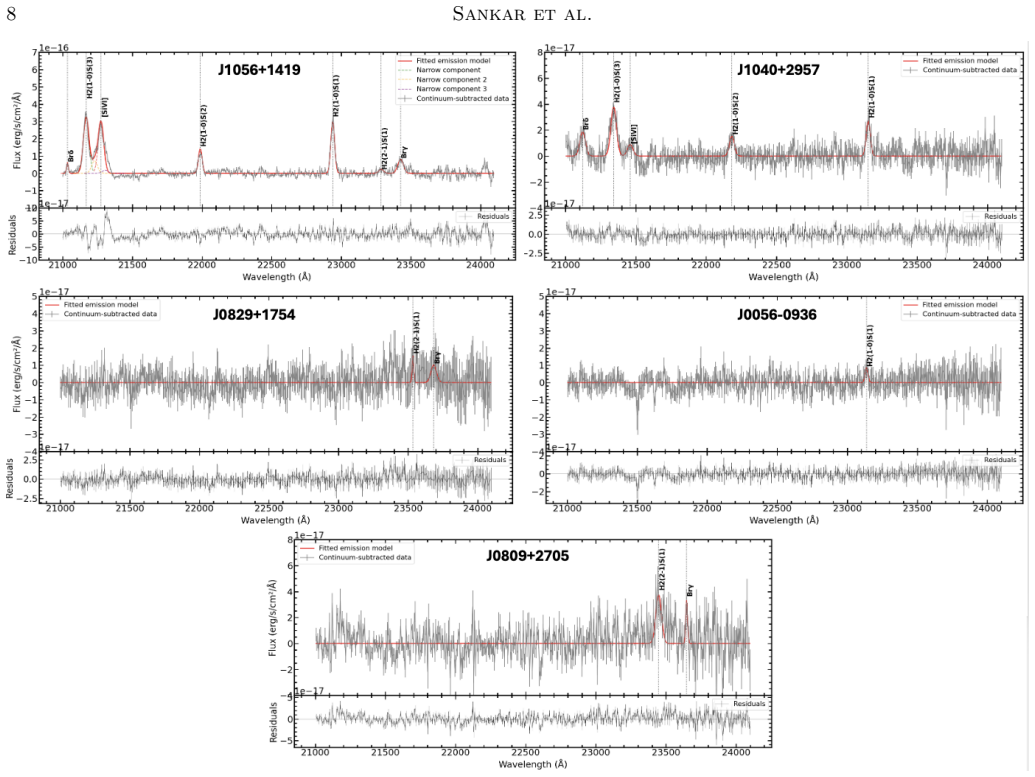
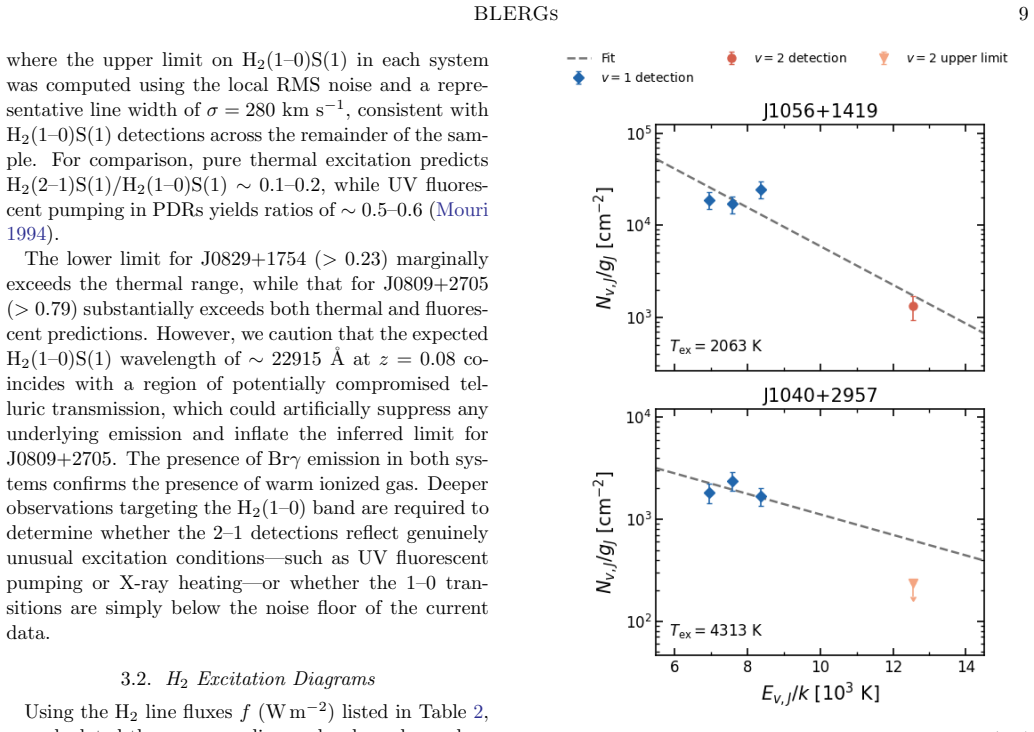
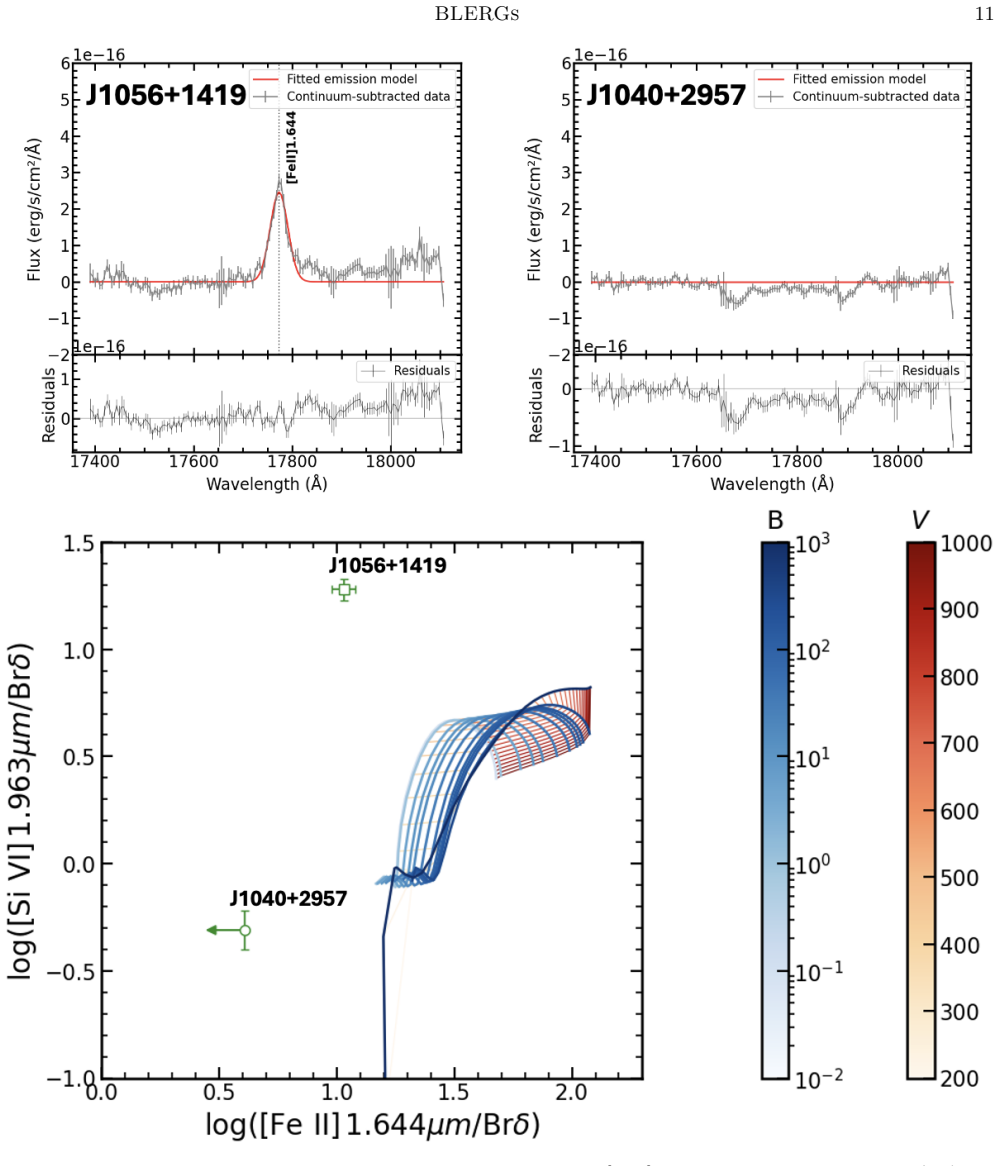
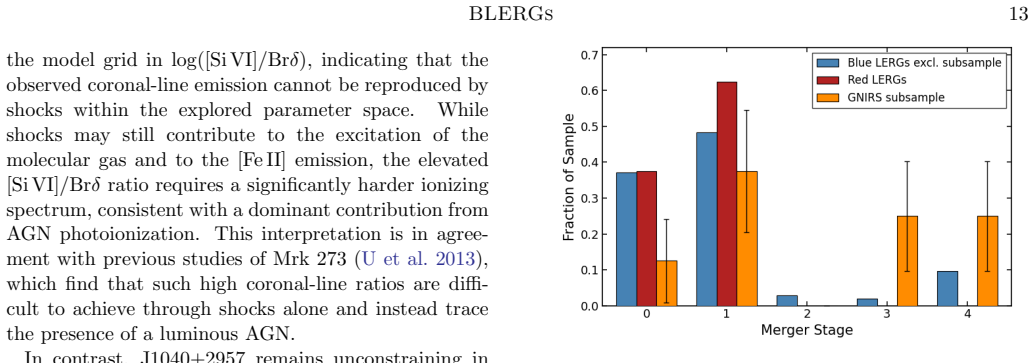
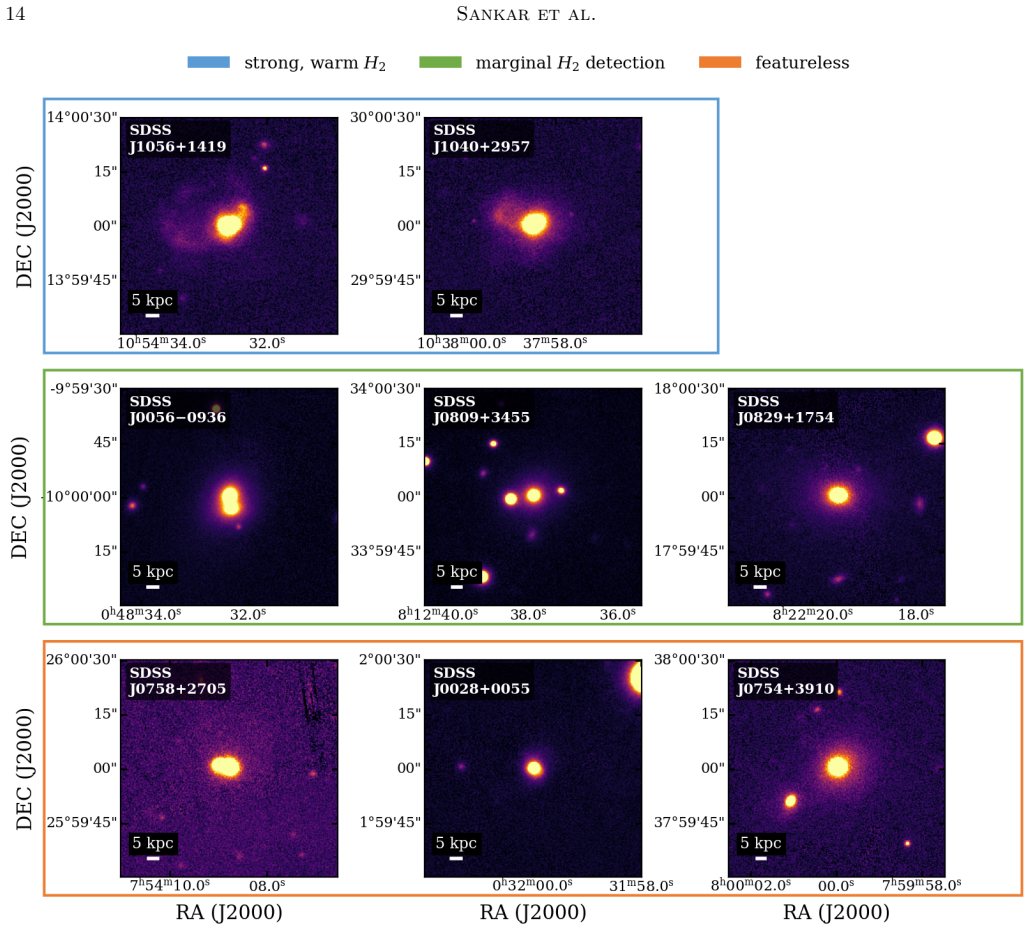
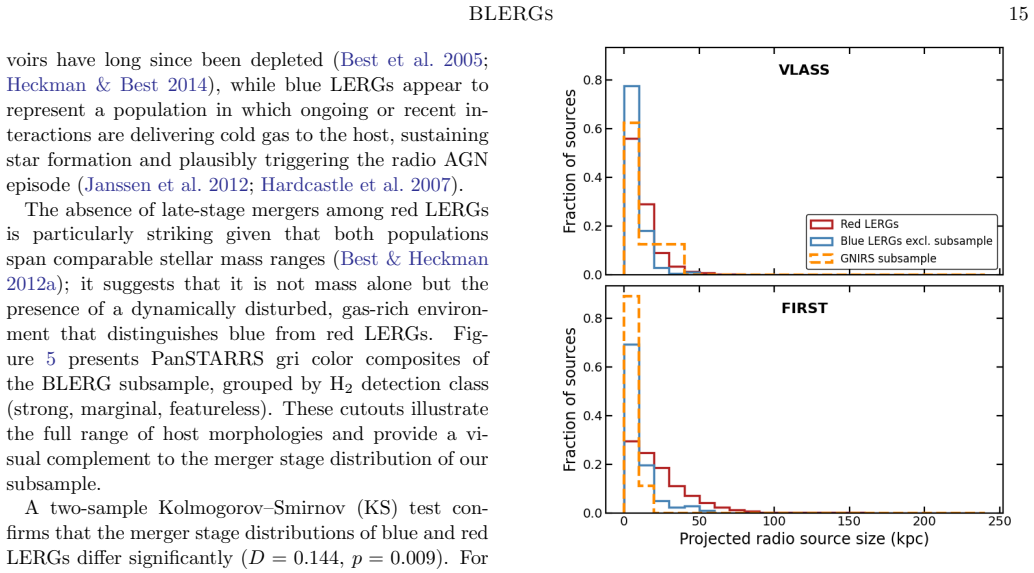
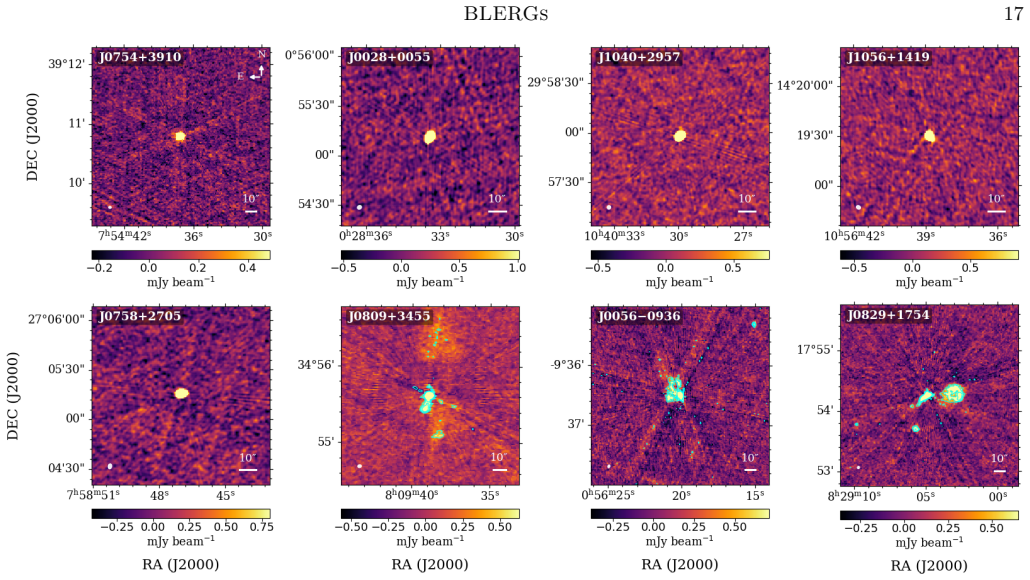
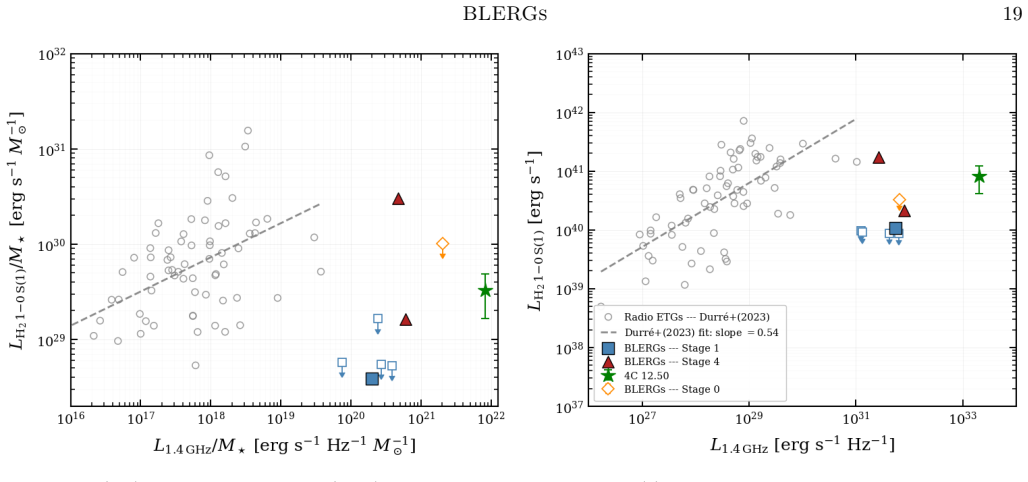
read the original abstract
We present new Gemini/GNIRS near-infrared spectroscopic observations of eight low-redshift ($z < 0.1$) blue low-excitation radio galaxies (BLERGs), a rare subset ($\sim 2.5\%$ of low-excitation radio galaxies; LERGs) that complicate the classical jet-mode AGN picture by combining radio activity with star-forming, gas-rich hosts. These star-forming BLERGs exhibit significant warm H$_2$ emission traced via ro-vibrational transitions at $T \sim 2000$--$4000$ K. We find that BLERGs span a broad range of mass-normalized warm H$_2$ luminosities ($L_{\rm H_2}/M_\star$), comparable to radio-emitting early-type galaxies, yet without a clear positive dependence on radio power. Instead, the strongest H$_2$ emission preferentially occurs in morphologically disturbed and advanced-merger systems, while compact radio sources ($\lesssim 20$ kpc) remain plausible sites of localized jet-ISM interaction. Together, these results suggest that merger-driven processes, including tidal shocks, gas inflows, and disturbed interstellar medium conditions, are the dominant drivers of warm molecular gas excitation in BLERGs, although localized jet-driven heating may contribute in individual systems. The compact radio morphologies, gas-rich hosts, and rarity of BLERGs are consistent with a short-lived evolutionary phase in which radio AGN activity coexists with an interaction-driven, molecular-rich interstellar medium prior to the onset of large-scale maintenance-mode feedback. Spatially resolved spectroscopy and higher-resolution radio imaging will be essential to disentangle the relative roles of mergers and jets in regulating the molecular gas of jet-mode AGN.
Editorial analysis
A structured set of objections, weighed in public.
Referee Report
Summary. The paper presents new Gemini/GNIRS near-infrared spectroscopic observations of eight low-redshift (z < 0.1) blue low-excitation radio galaxies (BLERGs). These objects show significant warm H2 emission (T ~ 2000-4000 K) traced by ro-vibrational lines. The mass-normalized H2 luminosities span a range comparable to other radio-emitting early-type galaxies but exhibit no clear positive correlation with radio power. Instead, the strongest emission occurs preferentially in morphologically disturbed and advanced-merger systems. The authors conclude that merger-driven processes (tidal shocks, gas inflows, disturbed ISM) dominate the excitation, while allowing that localized jet-ISM interactions may contribute in individual cases. They interpret the compact radio morphologies and gas-rich hosts as evidence for a short-lived evolutionary phase prior to large-scale maintenance-mode feedback.
Significance. If the reported trends are robust, the work provides direct observational evidence that radio AGN activity can coexist with star formation and merger-driven molecular gas excitation in a rare (~2.5%) subset of LERGs, complicating the classical jet-mode feedback picture. The NIR spectroscopy of warm H2 offers a useful probe of the ISM conditions in these systems. The manuscript correctly notes the need for resolved spectroscopy and higher-resolution radio imaging to separate contributions. Credit is due for targeting this underrepresented population and for the qualitative morphological correlation analysis.
major comments (2)
- [§3] §3 (Results on H2 luminosities and radio power): the claim of 'no clear positive dependence on radio power' and preference for disturbed morphologies rests on visual inspection of eight objects without reported quantitative tests (e.g., rank correlation coefficients, p-values, or bootstrap uncertainties on the trends). This is load-bearing for the central assertion that mergers dominate over jets.
- [§2] §2 (Sample definition): the manuscript provides no explicit criteria, parent sample size, or completeness assessment for selecting these eight BLERGs from the broader LERG population. Without this, it is impossible to evaluate whether the observed H2-morphology correlation could arise from selection biases rather than physical drivers.
minor comments (2)
- [Figure 1] Figure 1 and associated text: the radio size cutoff of ≲20 kpc used to flag potential jet-ISM sites should be justified with a reference to the beam or resolution limits of the radio data.
- [Methods] Notation: L_H2/M_star is used without an explicit definition of the stellar mass estimation method or IMF assumption in the methods section.
Simulated Author's Rebuttal
We thank the referee for their constructive and detailed report. We address each major comment below and agree that revisions are needed to strengthen the statistical presentation and clarify sample selection.
read point-by-point responses
-
Referee: [§3] §3 (Results on H2 luminosities and radio power): the claim of 'no clear positive dependence on radio power' and preference for disturbed morphologies rests on visual inspection of eight objects without reported quantitative tests (e.g., rank correlation coefficients, p-values, or bootstrap uncertainties on the trends). This is load-bearing for the central assertion that mergers dominate over jets.
Authors: We agree that quantitative tests are warranted to support the trends. In the revised manuscript we will add a Spearman rank correlation analysis between mass-normalized H2 luminosity and radio power, reporting the coefficient and p-value with the explicit caveat of small sample size (N=8). We will also apply bootstrap resampling to estimate uncertainties on the reported trends and will note that the morphological preference remains qualitative but is consistent with the quantitative luminosity ranking. These additions will be placed in §3 without changing the overall interpretation. revision: yes
-
Referee: [§2] §2 (Sample definition): the manuscript provides no explicit criteria, parent sample size, or completeness assessment for selecting these eight BLERGs from the broader LERG population. Without this, it is impossible to evaluate whether the observed H2-morphology correlation could arise from selection biases rather than physical drivers.
Authors: We accept this criticism and will expand §2 with the missing details. The revised text will state the parent LERG catalog (including its total size at z<0.1), the precise optical and radio selection cuts used to identify the blue star-forming subset, and the resulting ~2.5% fraction. We will also discuss survey completeness limits and argue that the uniform selection across the parent sample makes a strong morphology-driven selection bias unlikely, while acknowledging that a larger statistical sample would be ideal. revision: yes
Circularity Check
No significant circularity
full rationale
This is a purely observational paper reporting Gemini/GNIRS near-IR spectra of eight BLERGs, measured H2 luminosities normalized by stellar mass, morphological classifications from imaging, and qualitative trends (strongest H2 in disturbed/merger systems, no clear radio-power correlation). No equations, derivations, fitted parameters, model predictions, or ansatzes appear anywhere in the text. The central suggestion is presented as an interpretation of the observed trends rather than a result derived from any internal chain. No self-citations are load-bearing for any claim, and the argument does not reduce to renaming or self-definition. The paper is self-contained as an empirical report.
Axiom & Free-Parameter Ledger
Reference graph
Works this paper leans on
-
[1]
Unified models for active galactic nuclei and quasars. , keywords =. doi:10.1146/annurev.aa.31.090193.002353 , adsurl =
-
[2]
The EMIR multi-band mm-wave receiver for the IRAM 30-m telescope. , keywords =. doi:10.1051/0004-6361/201118452 , adsurl =
-
[3]
ALMA CO and VLT/SINFONI H2 observations of the Antennae overlap region: mass and energy dissipation
ALMA CO and VLT/SINFONI H _ 2 observations of the Antennae overlap region: mass and energy dissipation. , keywords =. doi:10.1051/0004-6361/201118317 , archivePrefix =. 1201.2942 , primaryClass =
work page internal anchor Pith review Pith/arXiv arXiv doi:10.1051/0004-6361/201118317
-
[4]
Molecular and Atomic Hydrogen Line Emission from Star-forming Galaxies. , keywords =. doi:10.1086/169386 , adsurl =
-
[5]
JWST/NIRSpec and MIRI observations of an expanding, jet-driven bubble of warm H _ 2 in the radio galaxy 3C 326 N. , keywords =. doi:10.1051/0004-6361/202449848 , archivePrefix =. 2404.04341 , primaryClass =
-
[6]
Exceptional AGN-driven turbulence inhibits star formation in the 3C 326N radio-galaxy
Exceptional AGN-driven turbulence inhibits star formation in the 3C 326N radio galaxy. , keywords =. doi:10.1051/0004-6361/201423612 , archivePrefix =. 1410.6155 , primaryClass =
work page internal anchor Pith review Pith/arXiv arXiv doi:10.1051/0004-6361/201423612
-
[7]
, keywords =
The ortho:para-H\_2 ratio in C- and J-type shocks. , keywords =
-
[8]
X-Ray--irradiated Molecular Gas. I. Physical Processes and General Results. , keywords =. doi:10.1086/177532 , adsurl =
-
[9]
On the H 2 Line Emission from NGC 6240 and Other Starburst Galaxies. , keywords =. doi:10.1086/169358 , adsurl =
-
[10]
Detection of Powerful Mid-IR H2 Emission in the Bridge between the Taffy Galaxies
Detection of Powerful Mid-IR H _ 2 Emission in the Bridge between the Taffy Galaxies. , keywords =. doi:10.1088/0004-637X/751/1/11 , archivePrefix =. 1203.4203 , primaryClass =
work page internal anchor Pith review Pith/arXiv arXiv doi:10.1088/0004-637x/751/1/11
-
[11]
Gas and Dust in the Taffy Galaxies: Ugc12914/15
Gas and Dust in the Taffy Galaxies: UGC 12914/15. , keywords =. doi:10.1086/517996 , archivePrefix =. astro-ph/0703200 , primaryClass =
work page internal anchor Pith review Pith/arXiv arXiv doi:10.1086/517996
-
[12]
Powerful H _ 2 Line Cooling in Stephan's Quintet. I. Mapping the Significant Cooling Pathways in Group-wide Shocks. , keywords =. doi:10.1088/0004-637X/710/1/248 , archivePrefix =. 0912.0282 , primaryClass =
work page internal anchor Pith review Pith/arXiv arXiv doi:10.1088/0004-637x/710/1/248
-
[13]
Galaxy pairs in the Sloan Digital Sky Survey - XII. The fuelling mechanism of low-excitation radio-loud AGN. , keywords =. doi:10.1093/mnrasl/slv061 , archivePrefix =. 1504.06255 , primaryClass =
work page internal anchor Pith review Pith/arXiv arXiv doi:10.1093/mnrasl/slv061
-
[14]
Infrared Spectroscopy in Astronomy , year = 1989, editor =
Infrared diagnostics of interstellar shocks. Infrared Spectroscopy in Astronomy , year = 1989, editor =
1989
-
[15]
2002, MNRAS, 329, 355, doi: 10.1046/j.1365-8711.2002.04988.x
Near-infrared spectroscopy of nearby Seyfert galaxies - I. First results. , keywords =. doi:10.1046/j.1365-8711.2002.05181.x , archivePrefix =. astro-ph/0111463 , primaryClass =
-
[16]
Limited impact of jet-induced feedback in the multi-phase nuclear interstellar medium of 4C12.50. , keywords =. doi:10.1051/0004-6361/202245418 , archivePrefix =. 2303.00291 , primaryClass =
-
[17]
The jet-ISM interactions in IC 5063
The jet-ISM interactions in IC 5063. , keywords =. doi:10.1093/mnras/sty067 , archivePrefix =. 1801.06875 , primaryClass =
work page internal anchor Pith review Pith/arXiv arXiv doi:10.1093/mnras/sty067
-
[18]
Relativistic jet feedback - II. Relationship to gigahertz peak spectrum and compact steep spectrum radio galaxies. , keywords =. doi:10.1093/mnras/sty070 , archivePrefix =. 1801.06518 , primaryClass =
work page internal anchor Pith review Pith/arXiv arXiv doi:10.1093/mnras/sty070
-
[19]
Compact steep-spectrum and peaked-spectrum radio sources. , keywords =. doi:10.1007/s00159-021-00131-w , archivePrefix =. 2009.02750 , primaryClass =
-
[20]
The Compact Steep-Spectrum and Gigahertz Peaked-Spectrum Radio Sources. , keywords =. doi:10.1086/316162 , adsurl =
-
[21]
Self-healing high-dimensional quantum key distribution using hybrid spin-orbit Bessel states
Heating Hot Atmospheres with Active Galactic Nuclei. , keywords =. doi:10.1146/annurev.astro.45.051806.110625 , archivePrefix =. 0709.2152 , primaryClass =
work page internal anchor Pith review Pith/arXiv arXiv doi:10.1146/annurev.astro.45.051806.110625
-
[22]
Sensitive observations at 1.4 and 250 GHz of z > 5 QSOs
Sensitive Observations at 1.4 and 250 GHz of z>5 QSOs. , keywords =. doi:10.1086/375645 , archivePrefix =. astro-ph/0304097 , primaryClass =
work page internal anchor Pith review Pith/arXiv arXiv doi:10.1086/375645
-
[23]
The Karl G. Jansky Very Large Array Sky Survey (VLASS). Science Case and Survey Design. , keywords =. doi:10.1088/1538-3873/ab63eb , archivePrefix =. 1907.01981 , primaryClass =
-
[24]
Infrared spectroscopy of nearby radio active early-type galaxies - II: spectral atlas. , keywords =. doi:10.1093/mnras/stad2083 , archivePrefix =. 2307.05931 , primaryClass =
-
[25]
Quadrupole Transition Probabilities for the Excited Rovibrational States of H _ 2. , keywords =. doi:10.1086/313091 , adsurl =
-
[26]
Near-Infrared Molecular Hydrogen Emission from the Central Regions of Galaxies: Regulated Physical Conditions in the Interstellar Medium. , keywords =. doi:10.1086/421233 , archivePrefix =. astro-ph/0403491 , primaryClass =
work page internal anchor Pith review Pith/arXiv arXiv doi:10.1086/421233
-
[27]
Star Formation in Semi-Analytic Galaxy Formation Models with Multiphase Gas
Star formation in semi-analytic galaxy formation models with multiphase gas. , keywords =. doi:10.1093/mnras/stv1877 , archivePrefix =. 1503.00755 , primaryClass =
work page internal anchor Pith review Pith/arXiv arXiv doi:10.1093/mnras/stv1877
-
[28]
J. Xavier Prochaska and Joseph F. Hennawi and Kyle B. Westfall and Ryan J. Cooke and Feige Wang and Tiffany Hsyu and Frederick B. Davies and Emanuele Paolo Farina and Debora Pelliccia , title =. 2020 , publisher =. doi:10.21105/joss.02308 , url =
-
[29]
The star formation and merger evolution of interacting galaxies
-
[30]
2019 , eprint=
The Pan-STARRS1 Surveys , author=. 2019 , eprint=
2019
-
[31]
Case B calculations for H I and He II
Recombination-line intensities for hydrogenic ions - I. Case B calculations for H I and He II. , keywords =. doi:10.1093/mnras/224.3.801 , adsurl =
-
[32]
Ground-based and Airborne Instrumentation for Astronomy , year = 2006, editor =
Design of the Gemini near-infrared spectrograph. Ground-based and Airborne Instrumentation for Astronomy , year = 2006, editor =. doi:10.1117/12.671817 , adsurl =
-
[33]
doi:10.5281/zenodo.3743493 , version =
pypeit/PypeIt: Release 1.0.0. doi:10.5281/zenodo.3743493 , version =
-
[34]
Stellar masses, star formation rates, metallicities and AGN properties for 200,000 galaxies in the SDSS Data Release Two (DR2). arXiv e-prints , keywords =. doi:10.48550/arXiv.astro-ph/0406220 , archivePrefix =. astro-ph/0406220 , primaryClass =
work page internal anchor Pith review Pith/arXiv arXiv doi:10.48550/arxiv.astro-ph/0406220
-
[35]
The Seventh Data Release of the Sloan Digital Sky Survey
The Seventh Data Release of the Sloan Digital Sky Survey. , keywords =. doi:10.1088/0067-0049/182/2/543 , archivePrefix =. 0812.0649 , primaryClass =
work page internal anchor Pith review Pith/arXiv arXiv doi:10.1088/0067-0049/182/2/543
-
[36]
Perspectives for the James Webb Space Telescope
Cosmic rays in molecular clouds probed by H _ 2 rovibrational lines. Perspectives for the James Webb Space Telescope. , keywords =. doi:10.1051/0004-6361/202142560 , archivePrefix =. 2201.08457 , primaryClass =
-
[37]
Molecular Hydrogen Excitation in Ultraluminous Infrared Galaxies
Molecular Hydrogen Excitation in Ultraluminous Infrared Galaxies. , keywords =. doi:10.1086/378634 , archivePrefix =. astro-ph/0307405 , primaryClass =
work page internal anchor Pith review Pith/arXiv arXiv doi:10.1086/378634
-
[38]
Molecular Hydrogen Emission in Galaxies: Determination of Excitation Mechanism. , keywords =. doi:10.1086/174184 , adsurl =
-
[39]
The excitation of near-infrared H2 emission in NGC 253
The excitation of near-infrared H _ 2 emission in NGC 253. , keywords =. doi:10.1051/0004-6361/201220246 , archivePrefix =. 1212.1567 , primaryClass =
work page internal anchor Pith review Pith/arXiv arXiv doi:10.1051/0004-6361/201220246
-
[40]
Cosmic evolution of low-excitation radio galaxies in the LOFAR two-metre sky survey deep fields. , keywords =. doi:10.1093/mnras/stac1128 , archivePrefix =. 2204.07588 , primaryClass =
-
[41]
The Stripe 82 1-2 GHz Very Large Array Snapshot Survey: host galaxy properties and accretion rates of radio galaxies. , keywords =. doi:10.1093/mnras/sty1787 , archivePrefix =. 1806.10143 , primaryClass =
work page internal anchor Pith review Pith/arXiv arXiv doi:10.1093/mnras/sty1787
-
[42]
Interpreting radiative efficiency in radio-loud AGN
Interpreting radiative efficiency in radio-loud AGNs. Nature Astronomy , keywords =. doi:10.1038/s41550-018-0424-1 , archivePrefix =. 1804.04043 , primaryClass =
work page internal anchor Pith review Pith/arXiv arXiv doi:10.1038/s41550-018-0424-1
-
[43]
Kinematics of the molecular gas
The AGN fuelling/feedback cycle in nearby radio galaxies - II. Kinematics of the molecular gas. , keywords =. doi:10.1093/mnras/stz2368 , archivePrefix =. 1908.09229 , primaryClass =
-
[44]
Cold, clumpy accretion onto an active supermassive black hole
Cold, clumpy accretion onto an active supermassive black hole. , keywords =. doi:10.1038/nature17969 , archivePrefix =. 1606.02304 , primaryClass =
work page internal anchor Pith review Pith/arXiv arXiv doi:10.1038/nature17969
-
[45]
Unifying the micro and macro properties of AGN feeding and feedback
Unifying the Micro and Macro Properties of AGN Feeding and Feedback. , keywords =. doi:10.3847/1538-4357/aa61a3 , archivePrefix =. 1701.07030 , primaryClass =
work page internal anchor Pith review Pith/arXiv arXiv doi:10.3847/1538-4357/aa61a3
-
[46]
Solving the Cooling Flow Problem through Mechanical AGN Feedback
Solving the cooling flow problem through mechanical AGN feedback. Astronomische Nachrichten , keywords =. doi:10.1002/asna.201211865 , archivePrefix =. 1209.3305 , primaryClass =
work page internal anchor Pith review Pith/arXiv arXiv doi:10.1002/asna.201211865
-
[47]
Thermal instability and the feedback regulation of hot haloes in clusters, groups and galaxies. , keywords =. doi:10.1111/j.1365-2966.2011.20246.x , archivePrefix =. 1106.4816 , primaryClass =
-
[48]
Smolčić, V. and Zamorani, G. and Schinnerer, E. and Bardelli, S. and Bondi, M. and Bîrzan, L. and Carilli, C. L. and Ciliegi, P. and Elvis, M. and Impey, C. D. and Koekemoer, A. M. and Merloni, A. and Paglione, T. and Salvato, M. and Scodeggio, M. and Scoville, N. and Trump, J. R. , title =. The Astrophysical Journal , abstract =. 2009 , month =. doi:10.1...
-
[49]
New Results on Particle Acceleration in the Centaurus A Jet and Counterjet from a Deep Chandra Observation. , keywords =. doi:10.1086/524197 , archivePrefix =. 0710.1277 , primaryClass =
work page internal anchor Pith review Pith/arXiv arXiv doi:10.1086/524197
-
[50]
BAT AGN Spectroscopic Survey - IV: Near-Infrared Coronal Lines, Hidden Broad Lines, and Correlation with Hard X-ray Emission. , keywords =. doi:10.1093/mnras/stx055 , archivePrefix =. 1701.02755 , primaryClass =
work page internal anchor Pith review Pith/arXiv arXiv doi:10.1093/mnras/stx055
-
[51]
The Inner Kiloparsec of Mrk 273 with Keck Adaptive Optics
The Inner Kiloparsec of Mrk 273 with Keck Adaptive Optics. , keywords =. doi:10.1088/0004-637X/775/2/115 , archivePrefix =. 1307.8440 , primaryClass =
work page internal anchor Pith review Pith/arXiv arXiv doi:10.1088/0004-637x/775/2/115
-
[52]
On the fundamental dichotomy in the local radio-AGN population: accretion, evolution and host galaxy properties. , keywords =. doi:10.1111/j.1365-2966.2012.20414.x , archivePrefix =. 1201.2397 , primaryClass =
-
[53]
PyNeb: a new tool for analyzing emission lines. I. Code description and validation of results. , keywords =. doi:10.1051/0004-6361/201323152 , archivePrefix =. 1410.6662 , primaryClass =
work page internal anchor Pith review Pith/arXiv arXiv doi:10.1051/0004-6361/201323152
-
[54]
COLD GASS, an IRAM legacy survey of molecular gas in massive galaxies - II. The non-universality of the molecular gas depletion time-scale. , keywords =. doi:10.1111/j.1365-2966.2011.18823.x , archivePrefix =. 1104.0019 , primaryClass =
-
[55]
Energetics of the molecular gas in the H _ 2 luminous radio galaxy 3C 326: Evidence for negative AGN feedback. , keywords =. doi:10.1051/0004-6361/200913333 , archivePrefix =. 1003.3449 , primaryClass =
work page internal anchor Pith review Pith/arXiv arXiv doi:10.1051/0004-6361/200913333
-
[56]
Jet-ISM Interaction in the Radio Galaxy 3C 293: Jet-driven Shocks Heat ISM to Power X-Ray and Molecular H _ 2 Emission. , keywords =. doi:10.1088/0004-637X/801/1/17 , archivePrefix =. 1501.01010 , primaryClass =
work page internal anchor Pith review Pith/arXiv arXiv doi:10.1088/0004-637x/801/1/17
-
[57]
TANGO I: ISM in nearby radio galaxies. Molecular gas
TANGO I: Interstellar medium in nearby radio galaxies. Molecular gas. , keywords =. doi:10.1051/0004-6361/200913392 , archivePrefix =. 1001.5009 , primaryClass =
work page internal anchor Pith review Pith/arXiv arXiv doi:10.1051/0004-6361/200913392
-
[58]
The stellar populations of low-luminosity active galactic nuclei - III. Spatially resolved spectral properties. , keywords =. doi:10.1111/j.1365-2966.2004.08452.x , archivePrefix =. astro-ph/0410155 , primaryClass =
-
[59]
The triggering probability of radio-loud AGN. A comparison of high and low excitation radio galaxies in hosts of different colors. , keywords =. doi:10.1051/0004-6361/201219052 , archivePrefix =. 1206.0578 , primaryClass =
work page internal anchor Pith review Pith/arXiv arXiv doi:10.1051/0004-6361/201219052
-
[60]
Classification parameters for the emission-line spectra of extragalactic objects. , keywords =. doi:10.1086/130766 , adsurl =
-
[63]
ERQs are the BOSS of quasar samples: the highest velocity [O III] quasar outflows. , keywords =. 2019. doi:10.1093/mnras/stz1993 , archivePrefix =. 1906.00980 , primaryClass =
-
[64]
The host galaxies and classification of active galactic nuclei. , keywords =. 2006. doi:10.1111/j.1365-2966.2006.10859.x , archivePrefix =. astro-ph/0605681 , primaryClass =
-
[65]
Calibrations and radial velocity catalogue of nearly 800 emission-line point-like sources
A SITELLE view of M31's central region - I. Calibrations and radial velocity catalogue of nearly 800 emission-line point-like sources. , archivePrefix = "arXiv", eprint =. doi:10.1093/mnras/stx2513 , adsurl =
-
[66]
Astronomical Data Analysis Software an Systems XXIV (ADASS XXIV) , year = 2015, series =
ORBS, ORCS, OACS, a Software Suite for Data Reduction and Analysis of the Hyperspectral Imagers SITELLE and SpIOMM. Astronomical Data Analysis Software an Systems XXIV (ADASS XXIV) , year = 2015, series =
2015
-
[67]
, archivePrefix = "arXiv", eprint =
On the Unification of Active Galactic Nuclei. , archivePrefix = "arXiv", eprint =. doi:10.1088/2041-8205/747/2/L33 , adsurl =
-
[68]
Candidate Type II Quasars from the Sloan Digital Sky Survey. III. Spectropolarimetry Reveals Hidden Type I Nuclei. , eprint =. doi:10.1086/427543 , adsurl =
-
[69]
Warm ultraluminous galaxies in the IRAS survey - The transition from galaxy to quasar?. , keywords =. doi:10.1086/185155 , adsurl =
-
[70]
A Cosmological Framework for the Co-Evolution of Quasars, Supermassive Black Holes, and Elliptical Galaxies. II. Formation of Red Ellipticals. , archivePrefix = "arXiv", eprint =. doi:10.1086/524363 , adsurl =
-
[71]
, archivePrefix = "arXiv", eprint =
Stellar and quasar feedback in concert: effects on AGN accretion, obscuration, and outflows. , archivePrefix = "arXiv", eprint =. doi:10.1093/mnras/stw289 , adsurl =
-
[72]
Forming stars in a dual AGN host: molecular and ionized gas in the nearby, luminous infrared merger, Mrk 266. , keywords =. doi:10.1093/mnras/stac3048 , archivePrefix =. 2210.10853 , primaryClass =
-
[73]
The Messenger , year = 2013, month = dec, volume = 154, pages =
The Kilo-Degree Survey. The Messenger , year = 2013, month = dec, volume = 154, pages =
2013
-
[74]
, archivePrefix = "arXiv", eprint =
The role of major mergers in the size growth of intermediate-mass spheroids. , archivePrefix = "arXiv", eprint =. doi:10.1093/mnras/stu1220 , adsurl =
-
[75]
, archivePrefix = "arXiv", eprint =
A substantial population of low-mass stars in luminous elliptical galaxies. , archivePrefix = "arXiv", eprint =. doi:10.1038/nature09578 , adsurl =
-
[76]
The star-formation history of the Universe from the stellar populations of nearby galaxies. , eprint =. doi:10.1038/nature02474 , adsurl =
-
[77]
Population Synthesis in the Blue. IV. Accurate Model Predictions for Lick Indices and UBV Colors in Single Stellar Populations. , eprint =. doi:10.1086/511753 , adsurl =
-
[78]
Advances in Astronomy , archivePrefix = "arXiv", eprint =
AGN Triggering in the Infall Regions of Distant X-Ray Luminous Galaxy Clusters at 0.9 z \ 1.6. Advances in Astronomy , archivePrefix = "arXiv", eprint =. doi:10.1155/2012/138380 , adsurl =
-
[79]
, archivePrefix = "arXiv", eprint =
Enhancement of AGN in a protocluster at z = 1.6. , archivePrefix = "arXiv", eprint =. doi:10.1093/mnras/stx1315 , adsurl =
-
[80]
, archivePrefix = "arXiv", eprint =
The drivers of AGN activity in galaxy clusters: AGN fraction as a function of mass and environment. , archivePrefix = "arXiv", eprint =. doi:10.1093/mnras/sts470 , adsurl =
-
[81]
, archivePrefix = "arXiv", eprint =
LoCuSS: A Dynamical Analysis of X-Ray Active Galactic Nuclei in Local Clusters. , archivePrefix = "arXiv", eprint =. doi:10.1088/0004-637X/754/2/97 , adsurl =
-
[82]
, archivePrefix = "arXiv", eprint =
The Discovery of the First Changing Look Quasar: New Insights Into the Physics and Phenomenology of Active Galactic Nucleus. , archivePrefix = "arXiv", eprint =. doi:10.1088/0004-637X/800/2/144 , adsurl =
discussion (0)
Sign in with ORCID, Apple, or X to comment. Anyone can read and Pith papers without signing in.