Cosmic evolution of the helium and oxygen abundances in type 2 Active Galactic Nuclei: Helium-loud AGNs
Pith reviewed 2026-06-25 20:03 UTC · model grok-4.3
The pith
Most type 2 AGNs at z greater than 2.8 show oversolar helium and subsolar oxygen abundances in their narrow line regions.
A machine-rendered reading of the paper's core claim, the machinery that carries it, and where it could break.
Core claim
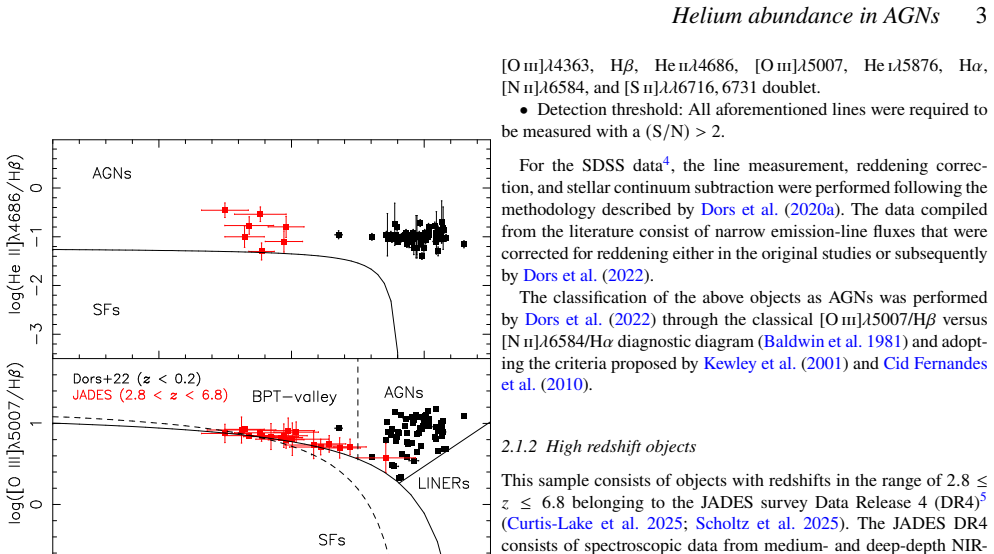
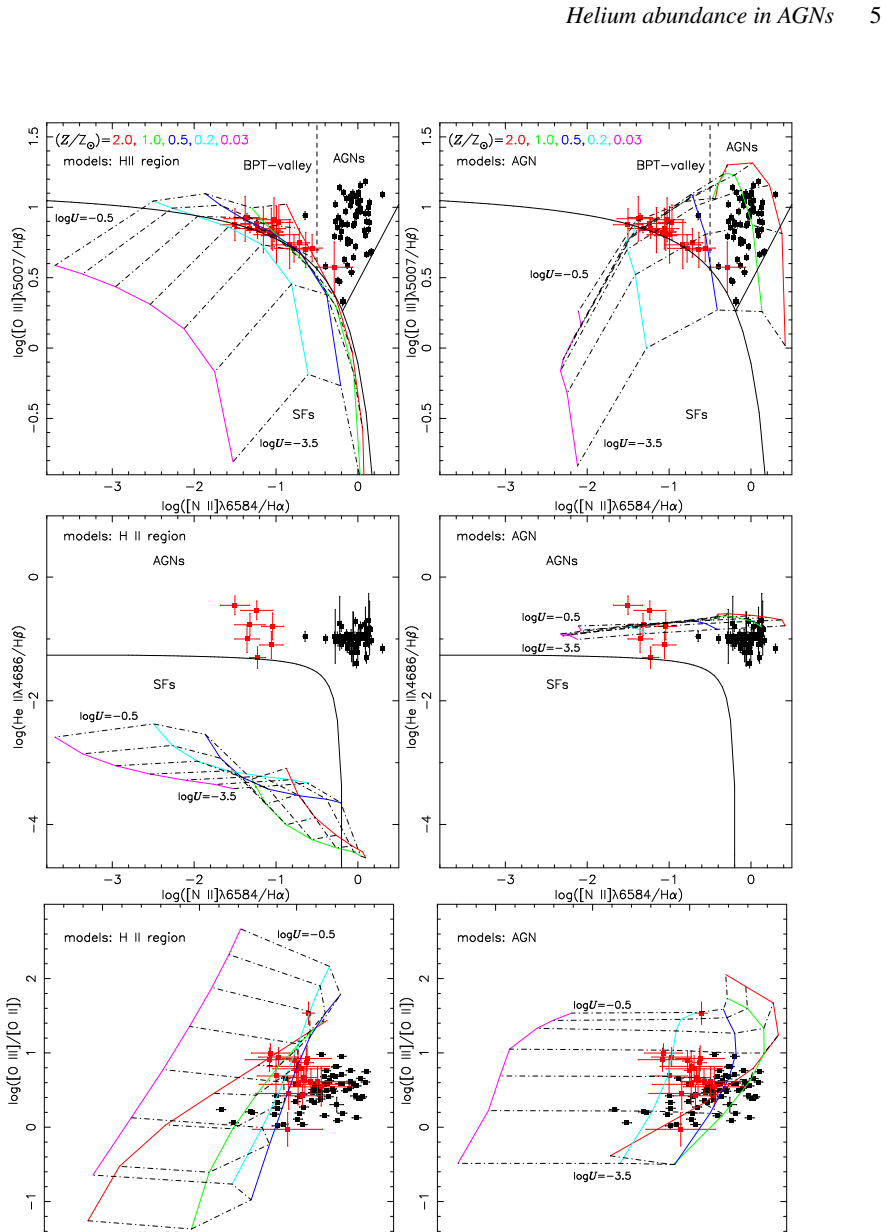
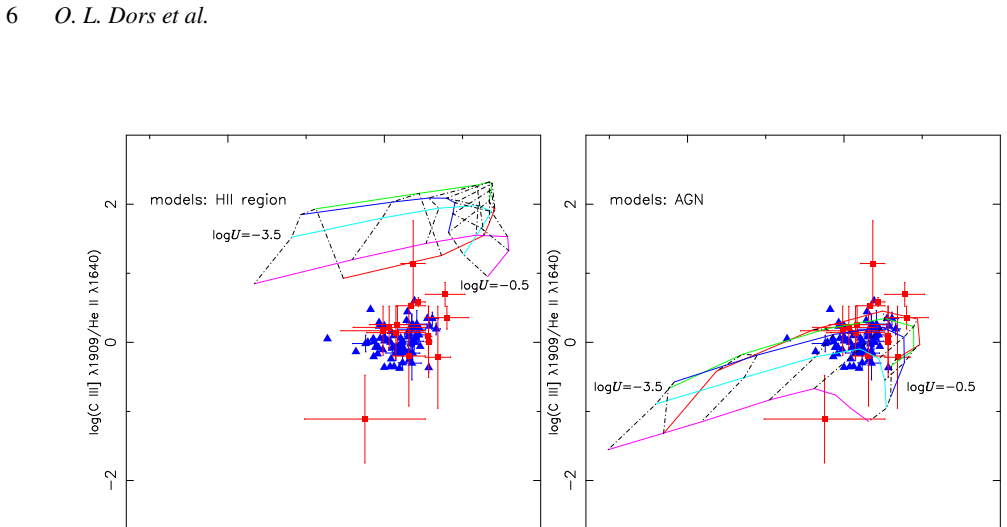
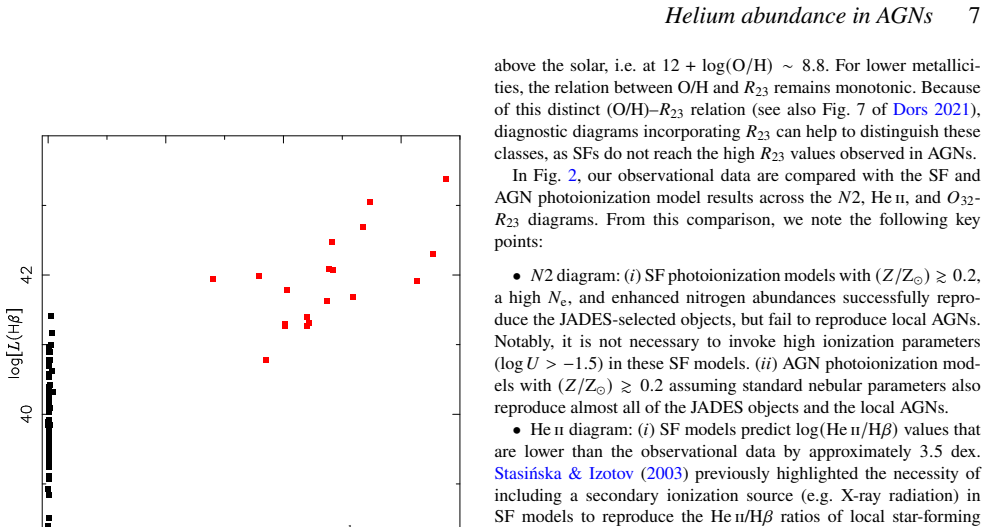
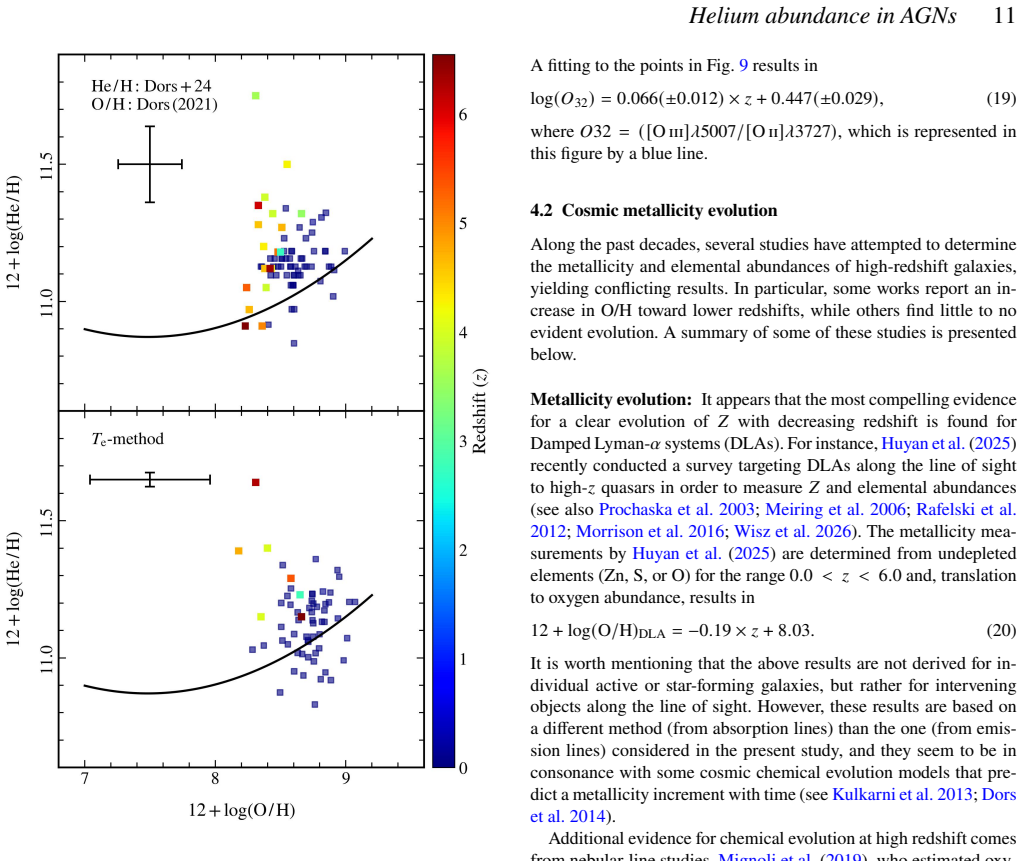
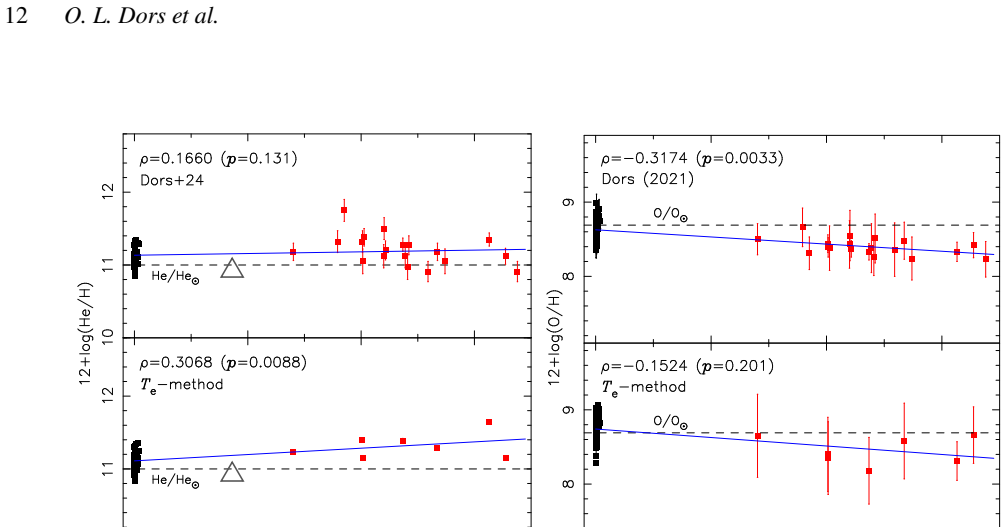
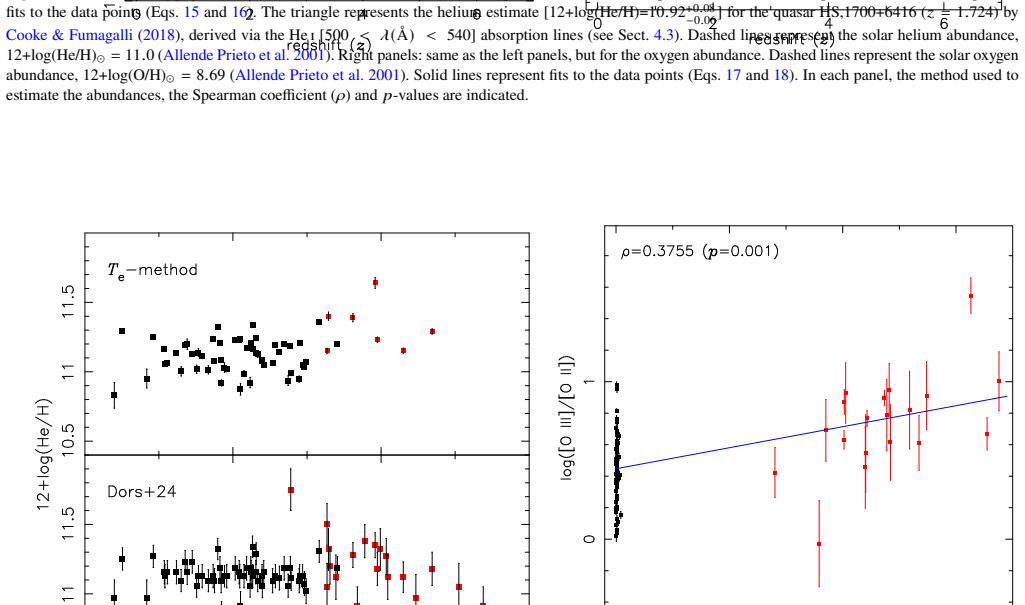
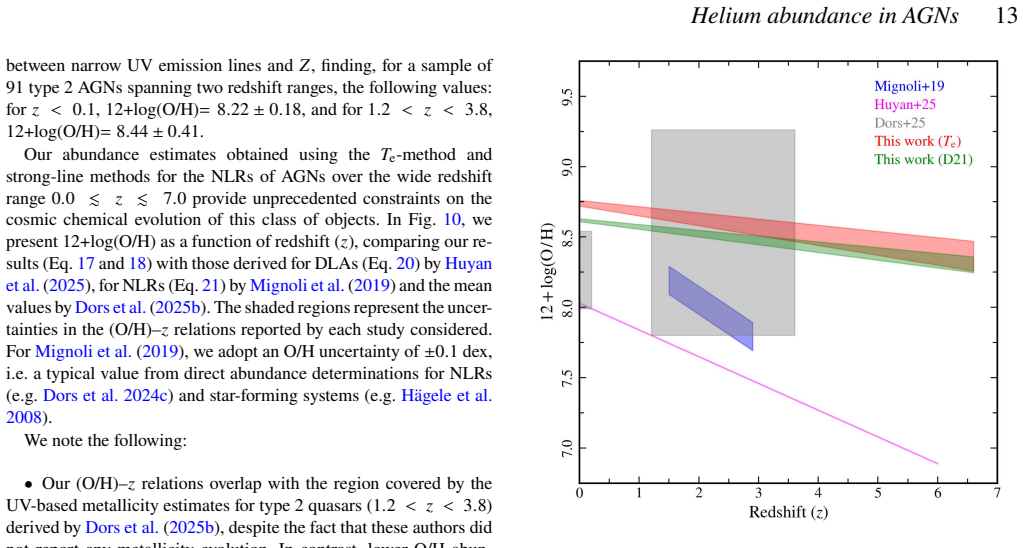
The majority of AGNs at z > 2.8 show oversolar helium abundances and subsolar oxygen abundances. One object at z=6.2615 reaches 12+log(He/H)=11.64 or (He/He⊙)∼4.4, the highest helium abundance estimated to date. The ionization degree rises with redshift, He/H declines marginally by ~0.04 dex per unit redshift toward lower z, and O/H rises by ~0.06 dex per unit redshift toward the present day.
What carries the argument
The Te-method and strong-emission line calibrations applied to rest-frame optical spectra to derive absolute He/H and O/H values.
If this is right
- Ionization degree in AGNs increases toward higher redshifts in a manner similar to star-forming galaxies.
- Helium abundance shows a marginal decline of ~0.04 dex per redshift unit toward the local universe.
- Oxygen abundance increases toward the present day at ~0.06 dex per redshift unit.
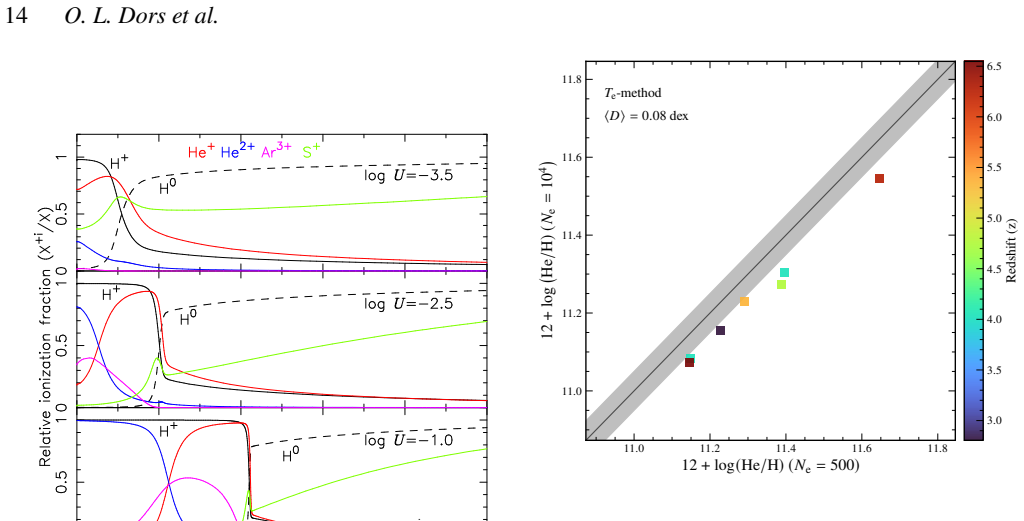
- The high helium values remain stable even when electron density is raised from 500 to 10 000 cm^{-3}.
Where Pith is reading between the lines
- Early AGN hosts may experience distinct helium enrichment pathways compared with local counterparts.
- Models of galactic chemical evolution at high redshift may need to incorporate helium-rich gas in AGN narrow-line regions.
- Future high-resolution spectra of the same objects could test whether the extreme helium values persist under different analysis assumptions.
Load-bearing premise
The strong-emission-line calibrations and Te-method return accurate absolute abundances without large systematic offsets caused by differing ionization parameters, density distributions, or dust depletion relative to the local calibrating samples.
What would settle it
A direct temperature measurement or independent abundance method on goods-s-mediumhst-58850 that returns 12+log(He/H) below 11.0 would falsify the record helium claim.
Figures
read the original abstract
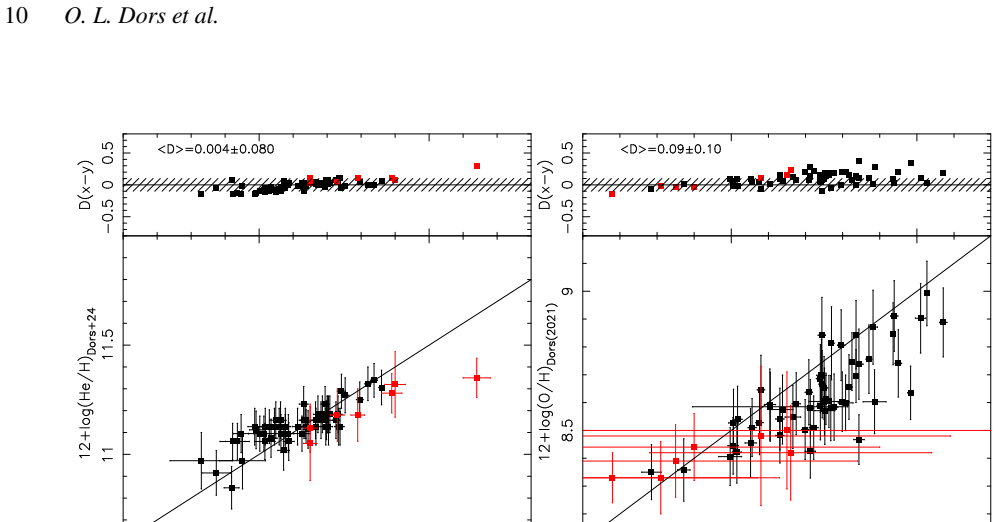
We derive the helium and oxygen abundances in the Narrow Line Regions (NLRs) of 84 Active Galactic Nuclei (AGNs) spanning two redshift ranges: 65 objects at $z \: < \: 0.2$ and 19 objects at $2.8 \lesssim z \lesssim 6.8$. Spectroscopic data in the optical rest-frame range [3000 ${\lambda}(\text{\AA})$ 7000] from the JADES survey and from the literature were used to estimate $\text{He/H}$ and $\text{O/H}$ via the $T_{\rm e}$-method (7 objects) and strong-emission line calibrations (19 objects). Our results indicate that the ionization degree in AGNs increases toward higher redshifts, exhibiting a trend similar to that observed in star-forming galaxies. We find that the majority of our sample of AGNs at $z \: > \: 2.8$ show oversolar helium abundances and subsolar oxygen abundances. We identified, via the $T_{\rm e}$-method, an object (goods-s-mediumhst-58850; $z=6.2615$) with the highest helium abundance estimated to date, i.e. $12+\log({\rm He/H})=11.64$, corresponding to $\rm (He/He_{\odot}) \sim 4.4$. This result remains robust even when we adopt larger electron densities (varying $N_{\rm e}$ from $500$ to $10\:000$ $\rm cm^{-3}$) in abundance estimates using the $T_{\rm e}$-method and empirical strong-line methods. We found marginal evidence for a decline in the He/H abundance ($\sim 0.04$ dex per redshift unit) toward lower redshifts. In contrast, we found evidence for an increase in $\text{O/H}$ toward the local universe at a rate of approximately 0.06 dex per redshift unit.
Editorial analysis
A structured set of objections, weighed in public.
Referee Report
Summary. The manuscript derives helium and oxygen abundances in the narrow-line regions of 84 AGNs (65 at z < 0.2 and 19 at 2.8 ≲ z ≲ 6.8) from JADES and literature spectra in the rest-frame optical. Abundances are obtained via the Te-method (7 objects) and strong-emission-line calibrations (19 objects). The paper reports that ionization degree increases with redshift, that the majority of z > 2.8 AGNs show oversolar He and subsolar O, and identifies one object at z = 6.2615 with 12 + log(He/H) = 11.64 ((He/He⊙) ∼ 4.4). Marginal evidence is presented for a decline in He/H (∼0.04 dex per unit redshift) and an increase in O/H (∼0.06 dex per unit redshift) toward lower redshift. The result is stated to remain robust when Ne is varied from 500 to 10 000 cm^{-3}.
Significance. If the absolute abundances are reliable, the work would constrain chemical evolution and enrichment in AGN host galaxies at cosmic dawn, highlighting possible helium over-enrichment at early times. The combination of Te-method and strong-line methods on a high-redshift sample from JADES is a positive feature, as is the explicit check on electron density.
major comments (2)
- [Abstract] Abstract: The statement that results 'remain robust' when Ne is varied from 500 to 10 000 cm^{-3} addresses only one parameter; it does not test the impact of the reported increase in ionization degree with redshift on the ionization corrections of the Te-method or on the strong-line calibrations. Because the headline claims (oversolar He, subsolar O at z > 2.8, and the 0.04–0.06 dex per unit redshift slopes) rest directly on these absolute abundances, the lack of validation against higher U or altered temperature structure is load-bearing.
- [Abstract] Abstract (methods paragraph): No comparison or cross-check is described between the local Te-method and strong-line calibrations and the high-redshift spectra, despite the explicit finding that ionization increases with redshift. Systematic offsets of several tenths of a dex in He/H and O/H are possible if the NLR conditions at z ∼ 6 differ from the local calibrating samples in ionization parameter or density distribution; this directly affects the central evolutionary claims.
minor comments (1)
- [Abstract] Clarify why abundance estimates are reported for only 26 of the 84 objects; state the selection criteria applied to the full sample.
Simulated Author's Rebuttal
We thank the referee for their careful review and constructive comments on our manuscript. We address the two major comments point by point below.
read point-by-point responses
-
Referee: [Abstract] Abstract: The statement that results 'remain robust' when Ne is varied from 500 to 10 000 cm^{-3} addresses only one parameter; it does not test the impact of the reported increase in ionization degree with redshift on the ionization corrections of the Te-method or on the strong-line calibrations. Because the headline claims (oversolar He, subsolar O at z > 2.8, and the 0.04–0.06 dex per unit redshift slopes) rest directly on these absolute abundances, the lack of validation against higher U or altered temperature structure is load-bearing.
Authors: We agree that varying only electron density does not fully address potential systematic effects from the observed increase in ionization parameter with redshift. The direct Te-method applied to the seven objects uses measured temperatures and is less dependent on ionization corrections, but the strong-line calibrations used for the remaining objects could be affected. In the revised version we will add an explicit discussion of ionization parameter effects, including estimates of U from the available line ratios where possible, and test the sensitivity of the reported He/H and O/H trends to plausible variations in U. revision: yes
-
Referee: [Abstract] Abstract (methods paragraph): No comparison or cross-check is described between the local Te-method and strong-line calibrations and the high-redshift spectra, despite the explicit finding that ionization increases with redshift. Systematic offsets of several tenths of a dex in He/H and O/H are possible if the NLR conditions at z ∼ 6 differ from the local calibrating samples in ionization parameter or density distribution; this directly affects the central evolutionary claims.
Authors: The same calibrations were applied uniformly, yet we acknowledge that no dedicated cross-check for systematic offsets arising from differing NLR conditions is presented. We will add a new subsection that compares Te-method and strong-line results on the local subsample, quantifies any method-dependent offsets, and discusses how the higher ionization at z > 2.8 might propagate into the high-redshift abundances and the reported evolutionary slopes. revision: yes
Circularity Check
No circularity: abundances derived via external standard methods applied to new spectra
full rationale
The paper applies the Te-method (7 objects) and strong-line calibrations (19 objects) to JADES and literature spectra to obtain He/H and O/H values. These are standard techniques calibrated on independent local samples; the paper reports the resulting abundances and redshift trends as direct outputs. No equations, fitted relations, or self-citations within the paper reduce the central claims to inputs by construction. The noted increase in ionization with redshift is an observational finding, not a definitional loop. The Ne robustness test is a sensitivity check on external assumptions, not an internal fit. This is a self-contained application of established methods to new data.
Axiom & Free-Parameter Ledger
Reference graph
Works this paper leans on
-
[1]
Planck 2018 results. VI. Cosmological parameters (Corrigendum). , keywords =. doi:10.1051/0004-6361/201833910e , adsurl =
-
[2]
Physical Processes in Gaseous Nebulae. XVIII. The Chemical Composition of the Planetary Nebulae. , year = 1945, month = sep, volume =. doi:10.1086/144757 , adsurl =
-
[3]
The discovery of shocked emission outside the AGN ionization axis
Chemical abundances in Seyfert galaxies - V. The discovery of shocked emission outside the AGN ionization axis. , keywords =. doi:10.1093/mnrasl/slaa194 , archivePrefix =. 2012.02013 , primaryClass =
-
[4]
Spectral Signatures of Fast Shocks. I. Low-Density Model Grid. , keywords =. doi:10.1086/192255 , adsurl =
-
[5]
Composite models calculated by photoionization + shocks
Chemical abundances of Seyfert 2 AGNs - IV. Composite models calculated by photoionization + shocks. , keywords =. doi:10.1093/mnras/staa3707 , archivePrefix =. 2011.12103 , primaryClass =
-
[6]
The MAPPINGS III Library of Fast Radiative Shock Models
The MAPPINGS III Library of Fast Radiative Shock Models. , keywords =. doi:10.1086/589652 , archivePrefix =. 0805.0204 , primaryClass =
work page internal anchor Pith review Pith/arXiv arXiv doi:10.1086/589652
-
[7]
A Grid of Composite Models for the Simulation of the Emission-Line Spectra from the Narrow-Line Regions of Active Galaxies. , keywords =. doi:10.1086/318956 , archivePrefix =. astro-ph/0009084 , primaryClass =
work page internal anchor Pith review Pith/arXiv arXiv doi:10.1086/318956
-
[8]
The MOSFIRE Deep Evolution Field (MOSDEF) Survey: Rest-frame Optical Spectroscopy for -0.5ex 1500 H-selected Galaxies at 1.37 < z < 3.8. , keywords =. doi:10.1088/0067-0049/218/2/15 , archivePrefix =. 1412.1835 , primaryClass =
work page internal anchor Pith review Pith/arXiv arXiv doi:10.1088/0067-0049/218/2/15
-
[9]
Binary Population and Spectral Synthesis Version 2.1: Construction, Observational Verification, and New Results. , keywords =. doi:10.1017/pasa.2017.51 , archivePrefix =. 1710.02154 , primaryClass =
work page internal anchor Pith review Pith/arXiv arXiv doi:10.1017/pasa.2017.51 2017
-
[10]
Comparison of Theoretical Starburst Photoionisation Models for Optical Diagnostics
Comparison of Theoretical Starburst Photoionization Models for Optical Diagnostics. , keywords =. doi:10.3847/1538-4357/ab1d5e , archivePrefix =. 1905.09528 , primaryClass =
work page internal anchor Pith review Pith/arXiv arXiv doi:10.3847/1538-4357/ab1d5e 1905
-
[11]
, year = 1957, month = mar, volume =
The Ratio of Helium to Hydrogen in the Orion Nebula. , year = 1957, month = mar, volume =. doi:10.1086/146311 , adsurl =
-
[12]
, year = 1959, month = oct, volume =
The Spectrum and Mass of the 30 Doradus Nebula. , year = 1959, month = oct, volume =. doi:10.1086/127418 , adsurl =
-
[13]
, year = 1970, month = mar, volume =
The Abundance Ratio of Helium to Hydrogen in Extragalactic Nebulae. , year = 1970, month = mar, volume =. doi:10.1086/150357 , adsurl =
-
[14]
Chemical Abundance Calibrations for the Narrow-Line-Region of Active Galaxies
Chemical Abundance Calibrations for the Narrow-Line Region of Active Galaxies. , keywords =. doi:10.1086/300242 , archivePrefix =. astro-ph/9711302 , primaryClass =
work page internal anchor Pith review Pith/arXiv arXiv doi:10.1086/300242
-
[15]
N2 metallicity calibration based on SDSS
Chemical abundances of Seyfert 2 AGNs - II. N2 metallicity calibration based on SDSS. , keywords =. doi:10.1093/mnras/staa193 , archivePrefix =. 2001.07126 , primaryClass =
-
[16]
New metallicity calibration for Seyfert 2 galaxies based on the N2O2 index
New metallicity calibration for Seyfert 2 galaxies based on the N2O2 index. , keywords =. doi:10.1093/mnras/stx150 , archivePrefix =. 1701.04997 , primaryClass =
work page internal anchor Pith review Pith/arXiv arXiv doi:10.1093/mnras/stx150
-
[17]
, year = 1973, month = jan, volume =
Big-Bang Nucleosynthesis Revisited. , year = 1973, month = jan, volume =. doi:10.1086/151873 , adsurl =
-
[18]
Primordial Helium Abundance and the Primordial Fireball. II. , year = 1966, month = nov, volume =. doi:10.1086/148918 , adsurl =
-
[19]
, year = 1967, month = apr, volume =
On the Synthesis of Elements at Very High Temperatures. , year = 1967, month = apr, volume =. doi:10.1086/149126 , adsurl =
-
[20]
Chemical composition of H II regions in the Large Magellanic Cloud and its cosmological implications. , keywords =. doi:10.1086/153166 , adsurl =
-
[21]
Big Bang Nucleosynthesis: 2015
Big bang nucleosynthesis: Present status. Reviews of Modern Physics , keywords =. doi:10.1103/RevModPhys.88.015004 , archivePrefix =. 1505.01076 , primaryClass =
work page internal anchor Pith review Pith/arXiv arXiv doi:10.1103/revmodphys.88.015004
-
[22]
Modelling the Galactic Chemical Evolution of Helium. , keywords =. doi:10.1093/mnras/staf373 , archivePrefix =. 2404.08765 , primaryClass =
-
[23]
The primordial helium abundance from observations of extragalactic HII regions. , keywords =. doi:10.1093/mnras/255.2.325 , adsurl =
-
[24]
Determination of the Primordial Helium Abundance Based on NGC 346, an H II Region of the Small Magellanic Cloud. , keywords =. doi:10.3847/1538-4357/ab14e4 , archivePrefix =. 1904.01594 , primaryClass =
work page internal anchor Pith review Pith/arXiv arXiv doi:10.3847/1538-4357/ab14e4 1904
-
[25]
Characterizing Extreme Emission-line Galaxies. I. A Four-zone Ionization Model for Very High-ionization Emission. , keywords =. doi:10.3847/1538-4357/ac141b , archivePrefix =. 2105.12765 , primaryClass =
-
[26]
Strong He I Emission Lines in High N/O Galaxies at z 6 Identified in JWST Spectra: High He/H Abundance Ratios or High Electron Densities?. , keywords =. doi:10.3847/1538-4357/ad72ec , archivePrefix =. 2405.01823 , primaryClass =
-
[27]
EMPRESS. XV. A New Determination of the Primordial Helium Abundance Suggesting a Moderately Low Y_P Value. arXiv e-prints , keywords =. doi:10.48550/arXiv.2506.24050 , archivePrefix =. 2506.24050 , primaryClass =
work page internal anchor Pith review Pith/arXiv arXiv doi:10.48550/arxiv.2506.24050
-
[28]
The PHLEK Survey: A New Determination of the Primordial Helium Abundance. , keywords =. doi:10.3847/1538-4357/ab91af , archivePrefix =. 2005.12290 , primaryClass =
-
[29]
Light Elements in the Universe , year = 2010, editor =
What is ^ 4 He from H II regions? What needs to be done to better understand the systematic errors?. Light Elements in the Universe , year = 2010, editor =. doi:10.1017/S1743921310004011 , adsurl =
-
[30]
Helium abundances and its radial gradient from the spectra of H II regions and ring nebulae of the Milky Way. , keywords =. doi:10.1093/mnras/staa1705 , archivePrefix =. 2006.06577 , primaryClass =
-
[31]
Empirical abundance calibration
Chemical abundances in Seyfert galaxies - VI. Empirical abundance calibration. , keywords =. doi:10.1093/mnras/stab2166 , adsurl =
-
[32]
Emirical calibration for helium abundance determinations in active galactic nuclei. , keywords =. doi:10.1093/mnrasl/slae052 , archivePrefix =. 2406.03259 , primaryClass =
-
[33]
Spectrophotometry of Seyfert 2 galaxies and narrow-line radio galaxies. , keywords =. doi:10.1086/156235 , adsurl =
-
[34]
Probing the Physics of Narrow Line Regions in Active Galaxies. II. The Siding Spring Southern Seyfert Spectroscopic Snapshot Survey (S7). , keywords =. doi:10.1088/0067-0049/217/1/12 , archivePrefix =. 1501.02022 , primaryClass =
work page internal anchor Pith review Pith/arXiv arXiv doi:10.1088/0067-0049/217/1/12
-
[35]
The Sloan Digital Sky Survey: Technical Summary
The Sloan Digital Sky Survey: Technical Summary. , keywords =. doi:10.1086/301513 , archivePrefix =. astro-ph/0006396 , primaryClass =
work page internal anchor Pith review Pith/arXiv arXiv doi:10.1086/301513
-
[36]
Theoretical Diagnostics for Narrow-line Regions of Active Galactic Nuclei. , keywords =. doi:10.3847/1538-4357/ad8f37 , archivePrefix =. 2411.04103 , primaryClass =
-
[37]
Abundance and colour gradients in discs
Oxygen and helium abundances in Galactic Hii regions - II. Abundance gradients. , keywords =. doi:10.1046/j.1365-8711.2000.03030.x , adsurl =
-
[38]
, year = 1992, month = oct, volume =
The chemical composition of the galactic H II region M17. , year = 1992, month = oct, volume =
1992
-
[39]
The ionization structure of helium in H II region complexes. , keywords =. doi:10.1086/131873 , adsurl =
-
[40]
Rapid Chemical Enrichment by Intermittent Star Formation in GN-z11. , keywords =. doi:10.3847/2041-8213/ad1de1 , archivePrefix =. 2308.15583 , primaryClass =
-
[41]
Dating N-loud AGNs at high redshift: GS\_3073 as a snapshot of a Centauri-like evolution of a nuclear star cluster. , keywords =. doi:10.1051/0004-6361/202554957 , archivePrefix =. 2507.06311 , primaryClass =
-
[42]
2023, MNRAS, 521, 1264, doi: 10.1093/mnras/stad506
Unveiling hidden active nuclei in MaNGA star-forming galaxies with He II 4686 line emission. , keywords =. doi:10.1093/mnras/stad506 , archivePrefix =. 2302.04282 , primaryClass =
-
[43]
Chemical Abundances in Star-Forming Galaxies at High Redshift
Chemical Abundances in Star-Forming Galaxies at High Redshift. Chemical Abundances in the Universe: Connecting First Stars to Planets , year = 2010, editor =. doi:10.1017/S1743921310000438 , archivePrefix =. 0912.0313 , primaryClass =
work page internal anchor Pith review Pith/arXiv arXiv doi:10.1017/s1743921310000438 2010
-
[44]
AGNIFS survey of local AGN: GMOS-IFU data and outflows in 30 sources. , keywords =. doi:10.1093/mnras/stab2058 , archivePrefix =. 2107.07635 , primaryClass =
-
[45]
Oxygen abundances in the narrow line regions of Seyfert galaxies and the metallicity-luminosity relation. , keywords =. doi:10.1093/mnras/stad217 , archivePrefix =. 2301.07596 , primaryClass =
-
[46]
Gas metallicity diagnostics in star-forming galaxies
Gas metallicity diagnostics in star-forming galaxies. , keywords =. doi:10.1051/0004-6361:20065216 , archivePrefix =. astro-ph/0603580 , primaryClass =
work page internal anchor Pith review Pith/arXiv arXiv doi:10.1051/0004-6361:20065216
-
[47]
Chemical Evolution of High-Redshift Radio Galaxies
Chemical evolution of high-redshift radio galaxies. , keywords =. doi:10.1051/0004-6361/200811478 , archivePrefix =. 0905.1581 , primaryClass =
work page internal anchor Pith review Pith/arXiv arXiv doi:10.1051/0004-6361/200811478
-
[48]
Spatially resolved gas-phase metallicity in Seyfert galaxies. , keywords =. doi:10.1093/mnras/stae2263 , archivePrefix =. 2409.20465 , primaryClass =
-
[49]
Strongly star forming galaxies in the local Universe with nebular He II 4686 emission. , keywords =. doi:10.1111/j.1365-2966.2012.20439.x , archivePrefix =. 1201.1290 , primaryClass =
-
[50]
GA-NIFS: an extremely nitrogen-loud and chemically stratified galaxy at z 5.55. , keywords =. doi:10.1093/mnras/stae2375 , archivePrefix =. 2404.04148 , primaryClass =
-
[51]
The Seventh Data Release of the Sloan Digital Sky Survey. , keywords =. doi:10.1088/0067-0049/182/2/543 , archivePrefix =. 0812.0649 , primaryClass =
work page internal anchor Pith review Pith/arXiv arXiv doi:10.1088/0067-0049/182/2/543
-
[52]
JADES: nitrogen enhancement in high-redshift broad-line active galactic nuclei. , keywords =. doi:10.1093/mnrasl/slaf056 , archivePrefix =. 2502.12091 , primaryClass =
-
[53]
High N/O ratio at high redshift as a result of a strong burst of star formation and differential galactic winds. , keywords =. doi:10.1051/0004-6361/202453275 , archivePrefix =. 2412.05363 , primaryClass =
-
[54]
JADES: The star formation and chemical enrichment history of a luminous galaxy at z 9.43 probed by ultra-deep JWST/NIRSpec spectroscopy. , keywords =. doi:10.1051/0004-6361/202451410 , archivePrefix =. 2407.02575 , primaryClass =
-
[55]
Only Nitrogen-enhanced Galaxies Have Detectable Ultraviolet Nitrogen Emission Lines at High Redshift. , keywords =. doi:10.3847/2041-8213/ae1c43 , archivePrefix =. 2511.03681 , primaryClass =
-
[56]
Discovery of a new N-emitter in the epoch of reionization. , keywords =. doi:10.1051/0004-6361/202450721 , archivePrefix =. 2406.08408 , primaryClass =
-
[57]
Potential Nitrogen Enrichment via Direct-Collapse Wolf-Rayet Stars in a z=4.7 Star-Forming Galaxy. arXiv e-prints , keywords =. doi:10.48550/arXiv.2502.04817 , archivePrefix =. 2502.04817 , primaryClass =
-
[58]
The JWST EXCELS survey: direct estimates of C, N, and O abundances in two relatively metal-rich galaxies at z ≃ 5. , keywords =. doi:10.1093/mnras/staf855 , archivePrefix =. 2412.10557 , primaryClass =
-
[59]
A Nitrogen-rich AGN Powering a Large Ionizing Bubble at z=8.63. arXiv e-prints , keywords =. doi:10.48550/arXiv.2508.01372 , archivePrefix =. 2508.01372 , primaryClass =
-
[60]
The Dual Nature of GHZ9: Coexisting Active Galactic Nuclei and Star Formation Activity in a Remote X-Ray Source at z = 10.145. , keywords =. doi:10.3847/1538-4357/ade706 , archivePrefix =. 2410.18763 , primaryClass =
-
[61]
Fe Abundances of Early Galaxies at z = 9─12 Derived with Deep JWST Spectra. , keywords =. doi:10.3847/1538-4357/ae04e6 , archivePrefix =. 2503.11457 , primaryClass =
-
[62]
The Nature of Nitrogen Enhanced High Redshift Galaxies. arXiv e-prints , keywords =. doi:10.48550/arXiv.2512.04043 , archivePrefix =. 2512.04043 , primaryClass =
-
[63]
A Close Look at the Closest Nitrogen-loud Active Galaxy Akn 564. , keywords =. doi:10.3847/2041-8213/ae25f1 , adsurl =
-
[64]
JADES: Evolution of nitrogen abundances in star-forming galaxies from z -0.5ex 1.5-7. arXiv e-prints , keywords =. doi:10.48550/arXiv.2601.15964 , archivePrefix =. 2601.15964 , primaryClass =
-
[65]
The THESAN-ZOOM project: Mystery N/O more - uncovering the origin of peculiar chemical abundances and a not-so-fundamental metallicity relation at 3 < z < 12. , keywords =. doi:10.1093/mnras/stag016 , archivePrefix =. 2507.08787 , primaryClass =
-
[66]
Direct estimates of nitrogen abundance for Seyfert 2 nuclei. , keywords =. doi:10.1093/mnras/stae2253 , archivePrefix =. 2405.13906 , primaryClass =
-
[67]
, year = 1971, month = jul, volume =
The Helium Abundance in Quasi-Stellar Objects. , year = 1971, month = jul, volume =. doi:10.1086/180753 , adsurl =
-
[68]
, year = 1971, month = jan, volume =
Some Inferences from Spectrophotometry of Quasi-Stellar Sources. , year = 1971, month = jan, volume =. doi:10.1086/150762 , adsurl =
-
[69]
Theoretical ISM Pressure and Electron Density Diagnostics for Local and High-redshift Galaxies. , keywords =. doi:10.3847/1538-4357/ab16ed , archivePrefix =. 1908.05504 , primaryClass =
-
[70]
High resolution spectroscopy of the extended narrow-line region of IC 5063 and NGC 7212
High-resolution spectroscopy of the extended narrow-line region of IC 5063 and NGC 7212. , keywords =. doi:10.1093/mnras/stx1628 , archivePrefix =. 1706.08970 , primaryClass =
work page internal anchor Pith review Pith/arXiv arXiv doi:10.1093/mnras/stx1628
-
[71]
EPOCHS VI: the size and shape evolution of galaxies since z 8 with JWST Observations. , keywords =. doi:10.1093/mnras/stad3597 , archivePrefix =. 2309.04377 , primaryClass =
-
[72]
2023, ApJ, 956, 139, doi: 10.3847/1538-4357/acf376
Redshift Evolution of Electron Density in the Interstellar Medium at z 0-9 Uncovered with JWST/NIRSpec Spectra and Line-spread Function Determinations. , keywords =. doi:10.3847/1538-4357/acf376 , archivePrefix =. 2301.06811 , primaryClass =
-
[74]
Spectral properties of the narrow-line region in Seyfert galaxies selected from the SDSS-DR7. , keywords =. doi:10.1111/j.1365-2966.2012.22060.x , archivePrefix =. 1210.5201 , primaryClass =
-
[75]
Physical properties of the emission-line regions
Coronal-line forest active galactic nuclei - I. Physical properties of the emission-line regions. , keywords =. doi:10.1093/mnras/staa3320 , archivePrefix =. 2010.12595 , primaryClass =
-
[76]
A Spectrophotometric Study of Seyfert Galaxies: Physical Conditions of the Emitting Gas. , keywords =. doi:10.1086/132900 , adsurl =
-
[77]
Modeling the Pan-Spectral Energy Distribution of Starburst Galaxies. III. Emission Line Diagnostics of Ensembles of Evolving H II Regions. , keywords =. doi:10.1086/508261 , archivePrefix =. astro-ph/0608062 , primaryClass =
work page internal anchor Pith review Pith/arXiv arXiv doi:10.1086/508261
-
[78]
Analysing derived metallicities and ionization parameters from model-based determinations in ionized gaseous nebulae. , keywords =. doi:10.1111/j.1365-2966.2011.18978.x , archivePrefix =. 1104.5460 , primaryClass =
-
[79]
A Survey of the Profiles of Narrow Emission Lines in Seyfert Galaxies. , keywords =. doi:10.1086/191515 , adsurl =
-
[80]
Anomalously Narrow Line Widths of Compact Massive Star-forming Galaxies at z 2.3: A Possible Inclination Bias in the Size-Mass Plane. , keywords =. doi:10.3847/2041-8213/ab54d1 , archivePrefix =. 1910.10722 , primaryClass =
-
[81]
High-resolution spectroscopy of the blue compact dwarf galaxy Haro 15 - II. Chemodynamics. , keywords =. doi:10.1111/j.1365-2966.2012.20858.x , archivePrefix =. 1203.0531 , primaryClass =
discussion (0)
Sign in with ORCID, Apple, or X to comment. Anyone can read and Pith papers without signing in.