REVIEW 4 major objections 5 minor 4 references
Medical AI models are 'geometrically blind,' and this paper claims that reinforcement learning on three self-generated spatial puzzles — scale, jigsaw, anomaly — cures it, beating leading models by over 40% on a new perception benchmark.
Reviewed by Pith at T0; open to challenge. T0 means a machine referee read the full paper against a public rubric. the ladder, T0–T4 →
T0 review · deepseek-v4-flash
2026-08-03 06:08 UTC pith:PD3XRNFI
load-bearing objection A thoughtful method and a genuinely useful pilot study, but the headline 40% result is measured with a benchmark that is effectively the training reward on an in-distribution subset, so the central claim of 'curing geometric blindness' is not supported by the primary evidence. the 4 major comments →
Med-Scout: Curing MLLMs' Geometric Blindness in Medical Perception via Geometry-Aware RL Post-Training
The pith
A machine-rendered reading of the paper's core claim, the machinery that carries it, and where it could break.
Core claim
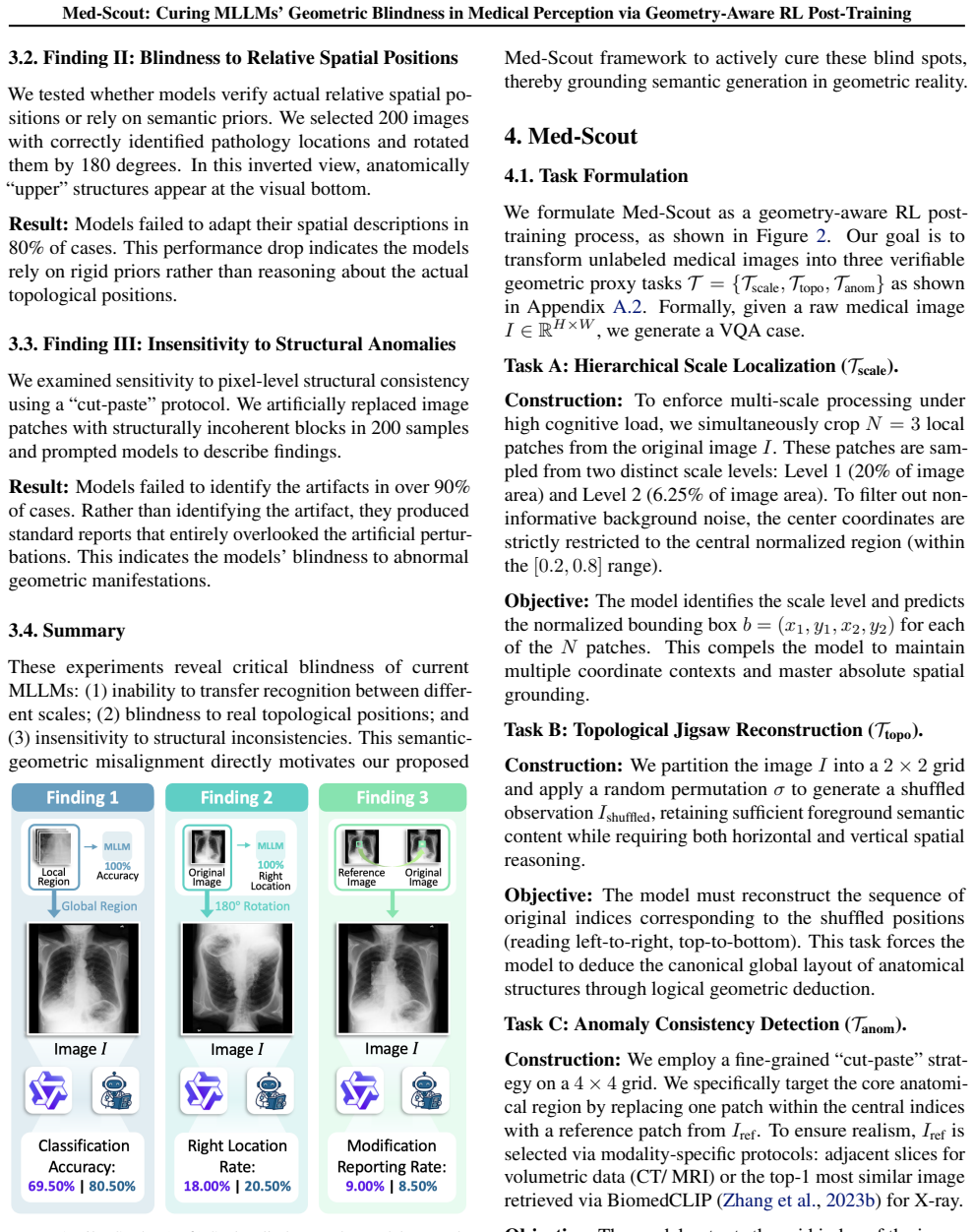
On its own terms, the paper discovers that geometric blindness in medical MLLMs is measurable and curable: in a pilot study models lose over 20% accuracy when lesions found in crops must be found again in global views, ignore a 180° rotation in 80% of cases, and miss pasted-in structural artifacts in over 90%. Med-Scout converts these deficits into three machine-verifiable tasks — scale-level and bounding-box prediction for local patches, reordering 2×2 shuffled quadrants, and locating a foreign patch in a 4×4 grid — and optimizes them with GRPO under a dense geometric reward. After training on ~97k samples, all four backbones improve from roughly 30–40% to 70–90% on Med-Scout-Bench, and six
What carries the argument
The load-bearing mechanism is the Dense Geometric Reward (DGR) inside the GRPO reinforcement loop: total reward R = R_acc + R_fmt + I_CoT·R_reason, where R_acc is continuous per task — average IoU over predicted patch boxes for scale localization, element-wise index match for jigsaw, and an exponential Euclidean-distance decay for anomaly location — so the policy earns partial credit for near-correct answers instead of a binary 0/1. This dense gradient, applied through three complementary proxy tasks, is what the paper claims steers models from semantic mimicry to spatial grounding.
Load-bearing premise
The headline improvement is computed on a benchmark carved from the same 108k-sample perturbation pool used for training and measured with the very reward function that drives the RL updates, so the 40% number chiefly shows that the model fits its training objective; the claim that this is a general cure for geometric blindness rests on the smaller external-benchmark gains.
What would settle it
Take Med-Scout-trained models and a matched baseline, apply geometric perturbations from a different generator (different grid granularities, unseen modalities, novel distortion types such as organ transposition), and have expert radiologists score the outputs instead of the DGR reward: if the advantage evaporates, or if the factual-vs-counterfactual energy gap fails to widen on new report pairs, the cure does not generalize and the 40% is a training-loop artifact.
If this is right
- If geometric blindness is cured as claimed, open-source MLLMs post-trained with Med-Scout can surpass proprietary models like GPT-5 and Gemini-3-Flash on geometric perception without any expert annotation.
- The three proxy tasks together — removing any one degrades results — provide a recipe for instilling spatial awareness that transfers to radiological VQA and report generation.
- Dense geometric rewards outperform sparse binary rewards on external benchmarks, and RL generalizes where SFT overfits, so reward design is central to the claimed cure.
- The widened energy gap between factual and spatially-inverted report pairs indicates the model's probability mass shifts away from geometric hallucinations, a property relevant to clinical reliability.
Where Pith is reading between the lines
- We infer that the headline 40% gain measures within-distribution optimization, since Med-Scout-Bench is a 10% sample of the same perturbation pipeline used for training and is scored by the identical reward function; the genuinely out-of-distribution evidence is the smaller but consistent gains on external VQA benchmarks.
- If the mechanism is what the paper says, the same proxy-task template — scale localization, layout reconstruction, anomaly detection — can be applied to other structured-imaging domains such as pathology whole-slide images (where magnification changes are natural scale tasks) or ultrasound, using only unlabeled data.
- A direct testable extension: apply Med-Scout to a much larger backbone (70B+) and to held-out modalities; the paper predicts the geometric-alignment principles are model-size agnostic and modality-general.
- One could also probe whether the energy-gap analysis holds for adversarial perturbations beyond left-right spatial inversions, e.g., organ swaps or scale distortions, which would tell whether the model learned general geometric constraints or narrow positional priors.
Editorial analysis
A structured set of objections, weighed in public.
Referee Report
Summary. The paper introduces Med-Scout, a reinforcement-learning post-training framework aimed at reducing 'geometric blindness' in medical MLLMs. It defines three automatically generated proxy tasks—hierarchical scale localization, topological jigsaw reconstruction, and anomaly consistency detection—and optimizes models with a dense geometric reward (DGR) via GRPO. The authors also release Med-Scout-Bench, a 10,800-sample benchmark constructed from the same 108,000-case pool used for training. They report that Med-Scout improves internal benchmark scores by over 40% relative to baselines and yields consistent, albeit smaller, gains on radiological VQA, medical VQA, and report generation benchmarks. The paper includes ablations on task difficulty, reward type, proxy task composition, and an SFT-vs-RL comparison.
Significance. If the external gains are robust, the proposed framework is a promising low-cost approach to improving geometric grounding in medical MLLMs without expert annotations. The three proxy tasks and the dense reward design are reasonable and the authors provide a useful open-source benchmark and a detailed appendix. The paper also contains a valuable negative result: SFT can match internal benchmark scores without transferring to external tasks, which the authors correctly interpret as evidence that internal scores alone do not measure generalization. However, the central quantitative claim—that Med-Scout 'cures' geometric blindness—is currently supported primarily by an in-distribution metric that is exactly the training reward, and the external evidence is modest and without statistical confidence intervals. The validity of the benchmark as an independent measure needs to be established before the headline claim can be accepted.
major comments (4)
- [§4.3, §5.2, Appendix A.1] The headline improvement of over 40% is measured on Med-Scout-Bench, which is a 10% random subset of the same 108,000-case pool used for RL training, and the DGR score is computed by the same reward functions (Eqs. 2–5) optimized during training. This makes the primary result a measure of reward optimization on the training distribution, not an independent test of geometric competence. The paper's own SFT-vs-RL comparison in Appendix C.7 (Tables 10–11) demonstrates the danger: SFT reaches internal scores comparable to RL (e.g., 82.2 vs. 84.4 for Qwen3-VL-4B) yet shows no external gains. The authors should either construct a benchmark with source images disjoint from training and a metric not used as a reward, or substantially temper the 'curing geometric blindness' claim to focus on the external generalization results.
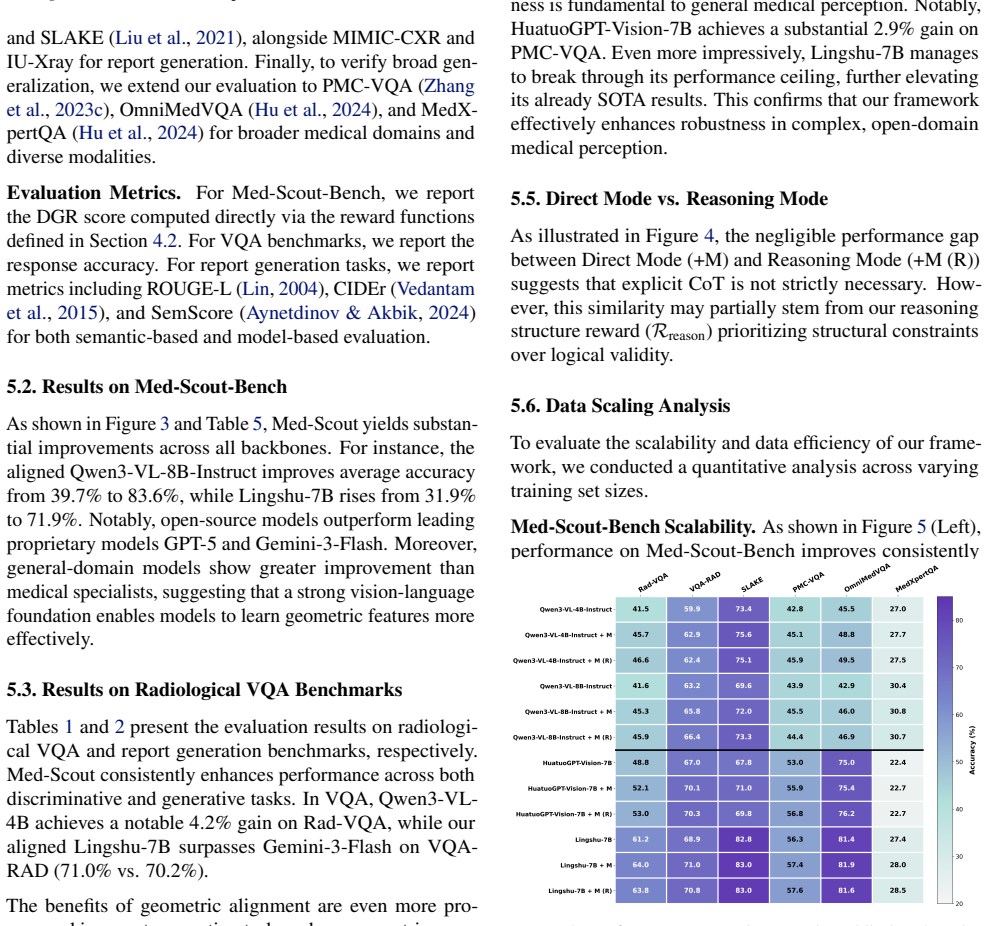
- [§5.3, Tables 1–2] The external benchmark gains, which are the only independent evidence for generalization, are modest (most improvements are between 0.2 and 4.2 points) and are reported without error bars, multiple seeds, or significance tests. Given the small magnitudes, some gains (e.g., Lingshu-7B on SLAKE, +0.2; on MIMIC-CXR CIDEr, +0.3) may be within run-to-run variability. The authors should provide confidence intervals or a statistical comparison (e.g., bootstrap or paired tests) across multiple seeds to support the claim of consistent and meaningful generalization.
- [§5.6, Figure 5 (Right)] The authors use the positive correlation between Med-Scout-Bench scores and external benchmark accuracy to argue that the internal benchmark is a 'reliable indicator' of broader clinical visual reasoning. However, since the Med-Scout-Bench score is the training reward, this correlation is largely a reflection of training progress. It does not establish benchmark validity. The SFT results in Appendix C.7 directly contradict the interpretation: SFT achieves high internal scores without external improvement, so the correlation is not a reliable indicator when the model is not optimized against the reward. The authors should validate the benchmark using models that did not train on it, or at least discuss this confound.
- [Appendix D] The section titled 'Proof of True Grounding via Energy Landscapes' claims that an increased energy gap between factual and counterfactual reports (Gap ≈ 0.69 vs. 0.06) is a 'theoretical certificate' that Med-Scout internalized geometric constraints. This is not a proof; it is an empirical observation on a probe set of 800 examples, with no statistical analysis or discussion of how the probe set relates to training data. The theoretical formalism (Eqs. 8–9) describes an ideal behavior but does not by itself certify the trained model. The authors should reframe this as a qualitative analysis and provide proper error bars or a larger probe set, or remove the 'certificate' language.
minor comments (5)
- [Algorithm 3 vs §A.2.3] In §A.2.3 the reference slice offset is described as 'z±5', but Algorithm 3, line 8, reads 'I.z±1'. Please make the values consistent.
- [§3 Pilot Study] The pilot study is based on 200 filtered samples per task, but the selection criteria and the exact prompts used are not described. Adding these details and confidence intervals would help the reader assess the robustness of the three findings.
- [§5.2 / Table 5] The benchmark scores are reported as 'scaled by a factor of 100' and the average is a simple mean across tasks. Consider reporting per-task standard errors, especially since Task C for several baselines is very low (e.g., 8.6–9.2), which makes the average sensitive to task composition.
- [§5.4 / Table 1] The 'Generalization' column of Table 1 includes benchmarks that are not purely radiological; consider renaming to 'Broader Medical VQA' for clarity.
- [Appendix B.3.2] The reward curves are visually described but not quantified. Reporting the converged reward values in a small table would be more precise than the qualitative statements.
Circularity Check
Med-Scout-Bench's DGR metric is the RL training reward on a same-pipeline subset; the headline >40% gain is therefore not independent evidence of curing geometric blindness.
specific steps
-
self definitional
[Section 4.2 (Eqs. 1-7), Section 4.3, Section 5.1 (Evaluation Metrics)]
"For Med-Scout-Bench, we report the DGR score computed directly via the reward functions defined in Section 4.2. ... The total reward R is composed of three components: R=R acc +R fmt +I CoT · Rreason (1)"
The benchmark metric (DGR) is, by the paper's own definition, the same dense reward optimized by GRPO during training (Eqs. 2-7). Therefore the reported gains on Med-Scout-Bench (e.g., Qwen3-VL-8B from 39.7 to 83.6) measure how well the model learned to maximize its training objective on a held-in-distribution subset; they do not independently establish a general geometric faculty. The claim 'Med-Scout significantly mitigates geometric blindness' rests on a score that is the training reward by construction.
-
other
[Section 4.3; Appendix A.1; Appendix C.7 (Tables 10-11)]
"From this pool, we sampled a high-quality subset of 10,800 cases (10%) as the benchmark. ... The rest of the data used for training and validation (N=97,200) follows the same pattern, ensuring that the way the model is trained matches the way it is tested. ... SFT achieves performance levels comparable to or even surpassing the RL-tuned models. ... SFT merely overfits to the proxy task patterns without internalizing the underlying geometric reasoning."
The benchmark is defined as a 10% random subset of the same 108,000-case pool (TotalSegmentor/MIMIC-CXR) and is generated by the same perturbation algorithms used to create the RL training data. Hence Med-Scout-Bench is an in-distribution evaluation of the training distribution and task templates, not an independent definition of geometric perception. The paper's own SFT-vs-RL comparison confirms this: SFT reaches 82.2 average on Med-Scout-Bench while yielding negligible or negative gains on external benchmarks, showing the internal DGR score is not a valid proxy for curing geometric blindness.
full rationale
The central derivation chain contains a genuine circular element in the primary evaluation: Med-Scout-Bench reports the DGR score, and DGR is exactly the dense reward function that the GRPO training maximizes (Section 4.2, Eqs. 1-7; Section 5.1). The benchmark is also carved from the same 108k VQA-case pool and same generation pipeline as the training data (Section 4.3, Appendix A.1), so the headline 'over 40%' improvement largely reflects optimization of the training objective on a same-distribution subset. The paper itself supplies strong evidence that this internal score is not sufficient: SFT achieves near-RL DGR scores on Med-Scout-Bench but no external transfer (Appendix C.7, Tables 10-11). However, the paper does not rely solely on the internal benchmark: external radiological VQA, general medical VQA, and report-generation gains (Tables 1-2, Sections 5.3-5.4), plus the energy-landscape and attention analyses (Section 5.7), provide partially independent evidence that the training transfers. The external gains are modest (mostly 0.2-4.2 points), unreplicated, and reported without significance tests, so they temper but do not eliminate the circularity. No load-bearing self-citation chain, imported uniqueness theorem, or ansatz-via-citation pattern was found. Accordingly, the score is 6 rather than 8: one or more central 'predictions' (the Med-Scout-Bench scores) reduce by construction to the training reward, but independent external results keep the paper from being wholly tautological.
Axiom & Free-Parameter Ledger
free parameters (4)
- Anomaly temperature τ (Eq. 5) =
0.1
- Reward caps R_fmt and R_reason =
0.5 each
- Scale ratios {0.20, 0.0625} and crop count N=3 =
0.20, 0.0625, N=3
- ROI bounds [0.2, 0.8] =
0.2, 0.8
axioms (5)
- domain assumption The three proxy tasks (scale, topology, anomaly) adequately capture the geometric constraints that matter for medical perception.
- domain assumption TotalSegmentator and MIMIC-CXR provide accurate anatomical ground truth.
- domain assumption LLM-as-a-Judge with Gemini-3-Flash reliably evaluates open-ended medical VQA responses.
- domain assumption The energy function E(x,y) = -log P(y|x) is a valid measure of geometric grounding.
- domain assumption The 10% benchmark subset is representative of the full dataset distribution.
read the original abstract
Despite recent Multimodal Large Language Models (MLLMs)' linguistic prowess in medical diagnosis, we find even state-of-the-art MLLMs suffer from a critical perceptual deficit: geometric blindness. This failure to ground outputs in objective geometric constraints leads to plausible yet factually incorrect hallucinations, rooted in training paradigms that prioritize linguistic fluency over geometric fidelity. This paper introduces Med-Scout, a novel framework that "cures" this blindness via Reinforcement Learning (RL) that leverages the intrinsic geometric logic latent within unlabeled medical images. Instead of relying on costly expert annotations, Med-Scout derives verifiable supervision signals through three strategic proxy tasks inspired by the systematic reading and reasoning patterns of clinicians: Hierarchical Scale Localization, Topological Jigsaw Reconstruction, and Anomaly Consistency Detection. To rigorously quantify this deficit, we present Med-Scout-Bench, a new benchmark specifically designed to evaluate geometric perception. Extensive evaluations show that Med-Scout significantly mitigates geometric blindness, outperforming leading proprietary and open-source MLLMs by over 40% on our benchmark. Furthermore, this enhanced geometric perception generalizes to broader medical understanding, achieving superior results on radiological and comprehensive medical VQA tasks.
Figures




Reference graph
Works this paper leans on
-
[1]
larger is better,
Visual Input:We use special tokens (e.g., <image>) to represent the medical scans. Note that for theHierarchical Scale Localizationtask (Figure 9a), the input specifically supports multi-image sequences (Global View + Local Crops). 2.User Prompt:A structured instruction that clearly defines the geometric objective and constrains the output format. 3.Targe...
2025
-
[2]
heart” patch must be spatially adjacent to and above the “stomach
Coordinate Regression:Explicitly predict the normalized bounding box (x1, y1, x2, y2) of the patch in the original image frame. Algorithm 1Data Generation for Hierarchical Scale Localization Require:Original ImageI∈R H×W Require: Hyperparameters: 1:Num PatchesN←3 2:Scale RatiosS ← {0.20,0.0625} {Area ratios for Level 1 and Level 2} 3:ROI Bounds[α min, αma...
-
[2024]
URL https: //doi.org/10.48550/arXiv.2412.08737
doi: 10.48550/ARXIV .2412.08737. URL https: //doi.org/10.48550/arXiv.2412.08737. Zhang, J., Khayatkhoei, M., Chhikara, P., and Ilievski, F. MLLMs know where to look: Training-free perception of small visual details with multimodal LLMs. InThe Thirteenth International Conference on Learning Rep- resentations, ICLR 2025, Singapore, April 24-28, 2025. OpenRe...
-
[2025]
Subsequently, we describe the rigorous algorithmic protocols employed to synthesize the three geometric proxy tasks
and MIMIC-CXR (Johnson et al., 2019). Subsequently, we describe the rigorous algorithmic protocols employed to synthesize the three geometric proxy tasks. Finally, we present the unified VQA instruction templates used to standardize these tasks for effective RL post-training. A.1. Data Composition and Distribution Statistics We primarily analyze the Med-S...
2019
discussion (0)
Sign in with ORCID, Apple, or X to comment. Anyone can read and Pith papers without signing in.