REVIEW 4 major objections 8 minor 40 references
Reviewed by Pith at T0; open to challenge.
T0 means a machine referee read the full paper against a public rubric. The mark states how deep the mechanical check went, never who wrote it. the ladder, T0–T4 →
T0 review · glm-5.2
Entropy regularizer keeps traffic simulators diverse
2026-07-09 01:09 UTC pith:PDCY2MKL
load-bearing objection Solid backbone contribution; the entropy-regularized distillation evidence is split across configurations in a way that undermines the central claim. the 4 major comments →
Flow-ERD: Agent-type Aware Flow Matching with Entropy-Regularized Distillation for Diverse Traffic Simulation
The pith
A machine-rendered reading of the paper's core claim, the machinery that carries it, and where it could break.
Core claim
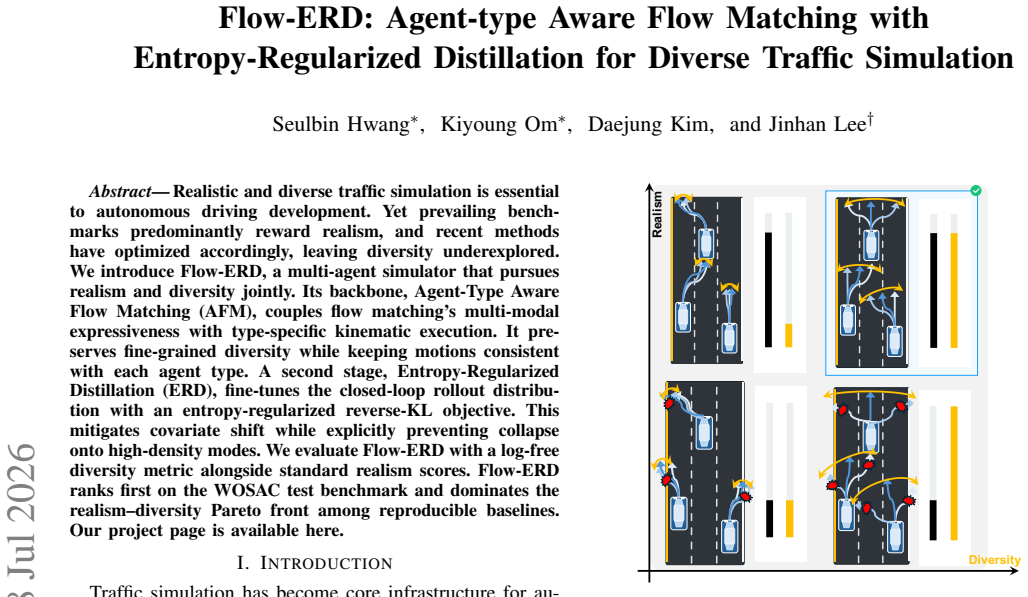
The core discovery is that entropy-regularized distillation (ERD) can mitigate closed-loop covariate shift without collapsing diversity. By adding an entropy regularizer to the reverse-KL objective, the method effectively matches the closed-loop rollout distribution against a tempered data distribution that reduces density contrast between modes. This preserves minority behaviors (e.g., rare U-turns) that vanilla reverse-KL would suppress. The paper also shows that AFM, by separating continuous action generation from type-specific kinematic execution, breaks the realism-diversity trade-off that token-based and unconstrained continuous methods face.
What carries the argument
entropy-regularized reverse-KL objective
Load-bearing premise
The method substitutes a frozen pretrained open-loop model's score function for the true data score, assuming it approximates the data distribution well on the data support. If the open-loop model already underrepresents minority modes, the tempered target inherits that bias, and the diversity preservation may be an artifact of the proxy rather than a property of the true data distribution.
What would settle it
If the frozen open-loop model systematically underrepresents minority modes relative to the true data distribution, then ERD's tempered target inherits that bias, and the observed diversity preservation would be an artifact of the proxy score rather than a genuine recovery of data multimodality.
If this is right
- Traffic simulation benchmarks could adopt joint realism-diversity evaluation, moving beyond single-trajectory likelihood scores that inadvertently reward mode collapse.
- The entropy tempering approach could be applied to other closed-loop generative models (e.g., video prediction, robot control) where covariate shift fine-tuning risks narrowing behavioral diversity.
- Agent-type aware kinematic execution could become a standard design pattern for continuous generative models in multi-agent settings, ensuring physical plausibility without sacrificing expressiveness.
- The Cross-Pair Diversity metric provides a log-independent way to measure rollout spread, which could be adopted more broadly for evaluating generative simulators.
Where Pith is reading between the lines
- The entropy temperature beta effectively parameterizes a realism-diversity Pareto frontier, suggesting that practitioners could select beta based on downstream task requirements (e.g., safety-critical testing might prefer higher diversity).
- If the frozen open-loop score model underrepresents minority modes at pretraining, ERD's diversity preservation may be limited by that inherited bias rather than reflecting the true data distribution's full multimodality.
- The separation of generation from kinematic execution could be extended to other physically constrained domains beyond traffic (e.g., humanoid motion, robotic manipulation) where continuous generation must respect different agent or embodiment types.
Editorial analysis
A structured set of objections, weighed in public.
Referee Report
Summary. Flow-ERD introduces a two-stage multi-agent traffic simulator. The backbone, Agent-Type Aware Flow Matching (AFM), uses continuous flow matching in a kinematic action space with type-specific transitions (holonomic for pedestrians, non-holonomic for vehicles/cyclists). The second stage, Entropy-Regularized Distillation (ERD), fine-tunes the closed-loop rollout distribution via an entropy-regularized reverse-KL objective, which the authors show reduces to distribution matching against a tempered data distribution. The method is evaluated on the WOSAC 2025 benchmark: AFM achieves competitive realism and the highest diversity (CPD) among backbones on the validation split, and Flow-ERD ranks first in RMM on the test split. The core claim is that entropy regularization (beta < 1) preserves minority modes during fine-tuning while improving closed-loop realism.
Significance. The paper addresses a genuine gap in traffic simulation: the joint pursuit of realism and diversity, where most prior work optimizes realism alone. The ERD derivation (Eqs. 15-19) is mathematically clean, correctly showing the equivalence between entropy-regularized reverse-KL and tempered distribution matching. The agent-type-aware transition design (Table II ablation) is well-motivated and empirically supported. The CPD metric (Eqs. 20-21) is a reasonable log-free diversity measure. The test-split RMM result (0.7878, Table I) is a concrete, falsifiable benchmark achievement. The project page is referenced for reproducibility. However, the central empirical claim about diversity preservation rests on a configuration split across data splits that is not jointly validated, which limits the significance of the ERD contribution specifically.
major comments (4)
- Section V-B.2, Table I vs. Table II: The headline test-split result (RMM=0.7878) uses beta=1.0 (vanilla reverse-KL, no entropy regularization), while the diversity-preservation claim relies on beta=0.99 evaluated only on the 4% validation split. No single configuration demonstrates both the realism ranking and the diversity-preservation claim on the same data split. The paper should either run beta=0.99 on the test split to confirm competitive realism, or explicitly qualify that the two claims are supported on different splits with different configurations. As stated, the abstract's claim of jointly achieving realism and diversity is not directly supported by a single experiment.
- Table II, beta=0.99 vs. beta=1.0: The entire empirical basis for the claim that entropy regularization preserves diversity is the CPD difference of 0.0144 (0.1828 vs. 0.1684) on the 4% validation split, with no confidence intervals or significance testing reported. On a split this small, this difference could be within sampling noise. The paper should report error bars or bootstrap confidence intervals for CPD to establish that this gap is not statistical noise.
- Section IV-B, Eq. (19): The ERD gradient substitutes beta * g_OL_theta0 for the true tempered data score g_p^beta_data. The justification is a single citation to Self-Forcing [39] with the claim that p_OL_theta0 approximates p_data 'on the data support.' If the open-loop model underrepresents minority modes at the pretraining stage, the tempered target inherits that bias, and the diversity-preservation claim could be an artifact of the proxy rather than a property of the true data distribution. The paper does not validate this approximation quality empirically. At minimum, the authors should discuss this limitation and its potential impact on the diversity-preservation claim.
- Table II: Even at beta=0.99, CPD (0.1828) remains below the pretrained AFM backbone (0.1858). The paper frames ERD as preserving diversity, but the method does not fully preserve backbone diversity—it reduces the collapse relative to beta=1.0. The claim in the abstract that ERD 'explicitly preventing collapse onto high-density modes' overstates the empirical evidence, which shows partial mitigation rather than prevention. The framing should be adjusted to match the evidence.
minor comments (8)
- Section III-B, Eq. (2): The no-slip offset r is introduced but its relationship to rho_c (used in Section IV-A.4) could be made clearer earlier. The reader must wait until Section IV-A.4 to understand how r is determined.
- Algorithm 1: The notation 'sg' for stop-gradient is used but not defined in the algorithm caption; it is defined in the surrounding text but would benefit from an inline note.
- Fig. 2: The caption mentions 'B sized chunk' and 'N x' without clear definition in the figure context. These should be labeled or referenced to the architecture description.
- Section V-A: The CPD metric uses per-type scale sigma_c 'fixed on the training set' but the method for fixing this scale is not described. Clarify whether it is a standard deviation of per-type displacements or another statistic.
- Table I: The dagger symbol for 'fine-tuned from SMART' is placed after the method name but its meaning is only explained in the caption. Consider adding a footnote or inline note for clarity.
- Section V-B.3, Fig. 5: The intent classification follows 'the WOMD trajectory-type rule [5]' but the specific rule set is not described. A brief summary or reference to the specific appendix/section would help reproducibility.
- Minor typo in Section I: 'must berealistic' should be 'must be realistic'.
- Section IV-B: The temperature beta is defined as 1/(1+gamma) but gamma is introduced in Eq. (16) without prior mention. Consider introducing gamma before or at Eq. (16) for smoother reading.
Simulated Author's Rebuttal
We thank the referee for a careful and substantive review. The comments identify genuine gaps between our framing and the empirical evidence. We address each below and commit to revisions where the manuscript overstates what the experiments show.
read point-by-point responses
-
Referee: Section V-B.2, Table I vs. Table II: The headline test-split result (RMM=0.7878) uses beta=1.0 (vanilla reverse-KL, no entropy regularization), while the diversity-preservation claim relies on beta=0.99 evaluated only on the 4% validation split. No single configuration demonstrates both the realism ranking and the diversity-preservation claim on the same data split.
Authors: The referee is correct that no single configuration simultaneously demonstrates the test-split RMM ranking and the diversity-preservation claim. The test-split result (Table I) uses β=1.0 because the WOSAC leaderboard evaluates only realism, and we submitted the configuration that maximizes RMM. The diversity benefit of β=0.99 is shown only on the validation split (Table II). We acknowledge this is a gap in the evidence chain. We will revise the abstract and contributions to explicitly state that the realism ranking (test split, β=1.0) and the diversity-preservation result (validation split, β=0.99) are supported on different splits and configurations. We will also add a sentence in Section V-B.2 noting that we did not evaluate β=0.99 on the test split because the leaderboard does not report diversity, and we cannot compute CPD on the test split as ground-truth rollouts for diversity comparison are not available through the WOSAC test server. We agree this qualification is necessary for the claims to be accurately supported. revision: yes
-
Referee: Table II, beta=0.99 vs. beta=1.0: The entire empirical basis for the claim that entropy regularization preserves diversity is the CPD difference of 0.0144 (0.1828 vs. 0.1684) on the 4% validation split, with no confidence intervals or significance testing reported.
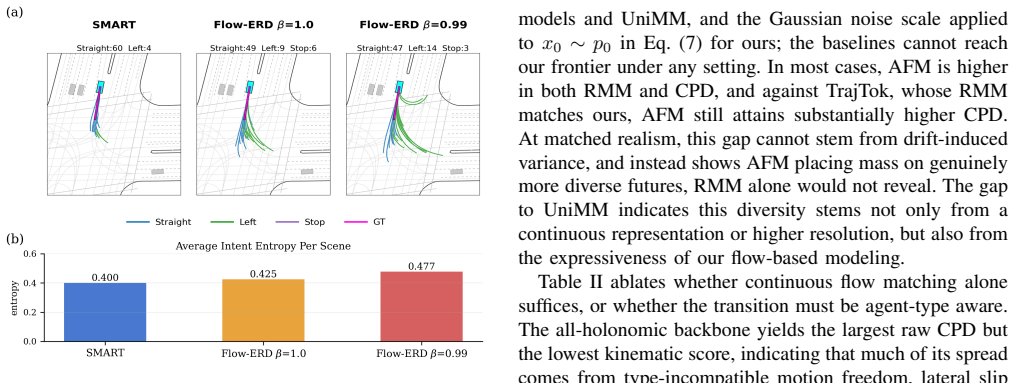
Authors: This is a fair criticism. We did not report confidence intervals for CPD, and on a 4% validation split the gap of 0.0144 could plausibly fall within sampling noise. We will add bootstrap confidence intervals (95% CI) for all CPD values in Table II, computed by resampling scenarios with replacement. If the confidence intervals for β=0.99 and β=1.0 overlap substantially, we will explicitly state that the diversity-preservation effect is suggestive but not statistically significant at the current split size, and soften the corresponding claims accordingly. We will also note that the qualitative intent-entropy analysis (Fig. 5b) provides complementary evidence, though we agree it does not substitute for quantitative significance testing on CPD. revision: yes
-
Referee: Section IV-B, Eq. (19): The ERD gradient substitutes beta * g_OL_theta0 for the true tempered data score g_p^beta_data. The justification is a single citation to Self-Forcing [39] with the claim that p_OL_theta0 approximates p_data 'on the data support.' If the open-loop model underrepresents minority modes at the pretraining stage, the tempered target inherits that bias.
Authors: The referee raises a valid and important limitation. The proxy g_OL_θ0 is used because the true data score is intractable for autoregressive flow rollouts, and this substitution means that any minority modes underrepresented by the pretrained open-loop model will also be underrepresented in the tempered target. Our diversity-preservation claim is therefore conditional on the backbone having captured those modes in open loop. We cannot fully rule out that the backbone's open-loop distribution already underrepresents some minority modes, which would limit ERD's ability to preserve them. We will add a paragraph in Section IV-B discussing this limitation explicitly: (1) the tempered target inherits the backbone's mode coverage, (2) ERD can only preserve diversity that the backbone already represents, and (3) validating the approximation quality of p_OL_θ0 ≈ p_data on minority modes is an important direction for future work. We cannot provide empirical validation of this approximation within the current revision cycle, so we will frame it as a stated limitation rather than a resolved question. revision: partial
-
Referee: Table II: Even at beta=0.99, CPD (0.1828) remains below the pretrained AFM backbone (0.1858). The paper frames ERD as preserving diversity, but the method does not fully preserve backbone diversity—it reduces the collapse relative to beta=1.0. The claim in the abstract that ERD 'explicitly preventing collapse onto high-density modes' overstates the empirical evidence.
Authors: The referee is correct. At β=0.99, CPD drops from 0.1858 (backbone) to 0.1828, a reduction of 0.003. ERD mitigates the collapse relative to β=1.0 (which drops CPD to 0.1684), but it does not fully prevent it. The abstract's phrase 'explicitly preventing collapse onto high-density modes' overstates what the evidence shows. We will revise the abstract to say 'mitigating collapse onto high-density modes' rather than 'preventing,' and will make the same change in the contributions list (Section I) and in Section IV-B where the method is introduced. In Section V-B.2, we already note the ΔCPD values honestly; we will add an explicit sentence stating that ERD at β=0.99 reduces but does not eliminate the diversity loss relative to the backbone, and that 'partial preservation' is a more accurate characterization than 'preservation.' revision: yes
Circularity Check
No significant circularity found; derivation chain is self-contained with external citations and external benchmarks.
full rationale
I walked the paper's load-bearing derivation chain and found no step that reduces to its own inputs by construction. (1) The ERD mathematical derivation (Eqs. 16→17→18) is a standard variational identity: entropy-regularized reverse-KL equals KL against a tempered target p^β_data ∝ p_data^β. This is known mathematics, not a self-referential definition. (2) The score substitution in Eq. 19 replaces the true data score g_pdata with the frozen pretrained model's score g_OL_θ0, justified by citing Self-Forcing [39] (Huang et al., external authors, no overlap with the present paper). This is an unvalidated approximation—a correctness risk—but it is not circular: the cited work is external, and the approximation does not define the target in terms of the method's own outputs. (3) The CPD metric (Eqs. 20–21) is a generic pairwise L2 distance averaged over rollout pairs, with per-type scales σ_c 'fixed on the training set'—not fitted to the method's validation outputs. The metric rewards spread, which is its stated purpose, but it is not defined in terms of Flow-ERD's specific architecture or loss function. (4) The headline realism result (RMM=0.7878) is evaluated on the external WOSAC test benchmark, providing independent validation. The concern that β=1.0 is used for the test split while β=0.99 is used for diversity on the validation split is an experimental design issue (correctness risk), not a circularity: no equation or definition forces the claimed outcome. The one minor point preventing a score of 0 is that the authors both define the CPD metric and demonstrate superiority on it, which is a mild structural advantage, but the metric itself is a standard spread measure with no method-specific parameters, so it does not rise to the level of circularity.
Axiom & Free-Parameter Ledger
free parameters (9)
- rho_c (no-slip offset ratio) =
estimated per type from logged turning intervals (Eq. 12)
- beta (entropy temperature) =
1.0 and 0.99 reported; swept on validation
- gamma (entropy regularization weight) =
related to beta by gamma = 1/beta - 1
- B (commitment horizon) =
B < H, exact value not stated
- H (prediction horizon) =
not explicitly stated
- L_phase (phase length in Algorithm 1) =
not stated
- n_critic (critic step interval) =
not stated
- eta (fake-score step size) =
not stated
- sigma_c (per-type scale for CPD) =
fixed on training set
axioms (5)
- domain assumption The frozen pretrained open-loop model's score function approximates the data score on the data support: p_OL_theta0 ≈ p_data (Section IV-B, Eq. 19 derivation)
- standard math The affine optimal-transport path x_lambda = (1-lambda)x_0 + lambda*x_1 is appropriate for action-space flow matching (Section III-D)
- domain assumption Bicycle-style non-holonomic motion with a no-slip offset r is an adequate model for vehicle and cyclist kinematics (Section III-B, Eq. 2)
- ad hoc to paper Cross-Pair Diversity (CPD) measures meaningful behavioral diversity rather than prediction error variance (Section V-A)
- domain assumption The WOSAC realism meta-metric (RMM) is a valid measure of traffic realism (Section V-A)
read the original abstract
Realistic and diverse traffic simulation is essential to autonomous driving development. Yet prevailing benchmarks predominantly reward realism, and recent methods have optimized accordingly, leaving diversity underexplored. We introduce \textbf{Flow-ERD}, a multi-agent simulator that pursues realism and diversity jointly. Its backbone, \textbf{Agent-Type Aware Flow Matching} (AFM), couples flow matching's multi-modal expressiveness with type-specific kinematic execution. It preserves fine-grained diversity while keeping motions consistent with each agent type. A second stage, \textbf{Entropy-Regularized Distillation} (ERD), fine-tunes the closed-loop rollout distribution with an entropy-regularized reverse-KL objective. This mitigates covariate shift while explicitly preventing collapse onto high-density modes. We evaluate Flow-ERD with a log-free diversity metric alongside standard realism scores. Flow-ERD ranks first on the WOSAC test benchmark and dominates the realism--diversity Pareto front among reproducible baselines. Our project page is available \href{https://seulbinhwang.github.io/flow-erd-project-page/}{here}.
Figures


Reference graph
Works this paper leans on
-
[1]
Carla: An open urban driving simulator,
A. Dosovitskiy, G. Ros, F. Codevilla, A. Lopez, and V . Koltun, “Carla: An open urban driving simulator,” inConf. Robot Learn. (CoRL), 2017
work page 2017
-
[2]
Waymax: An accelerated, data-driven simulator for large-scale autonomous driving research,
C. Gulinoet al., “Waymax: An accelerated, data-driven simulator for large-scale autonomous driving research,”Adv. Neural Inf. Process. Syst., 2023
work page 2023
-
[3]
The waymo open sim agents challenge,
N. Montaliet al., “The waymo open sim agents challenge,”Adv. Neural Inf. Process. Syst., 2023
work page 2023
-
[4]
Trafficsim: Learning to simulate realistic multi-agent behaviors,
S. Suo, S. Regalado, S. Casas, and R. Urtasun, “Trafficsim: Learning to simulate realistic multi-agent behaviors,” inProc. IEEE/CVF Conf. Comput. Vis. Pattern Recognit., 2021
work page 2021
-
[5]
Large scale interactive motion forecasting for autonomous driving: The waymo open motion dataset,
S. Ettingeret al., “Large scale interactive motion forecasting for autonomous driving: The waymo open motion dataset,” inProc. IEEE/CVF Int. Conf. Comput. Vis. (ICCV), 2021
work page 2021
-
[6]
Improv- ing language understanding by generative pre-training,
A. Radford, K. Narasimhan, T. Salimans, I. Sutskever,et al., “Improv- ing language understanding by generative pre-training,” 2018
work page 2018
-
[7]
Denoising diffusion probabilistic models,
J. Ho, A. Jain, and P. Abbeel, “Denoising diffusion probabilistic models,”Adv. Neural Inf. Process. Syst., 2020
work page 2020
-
[8]
Trajeglish: Traffic modeling as next-token prediction,
J. Philion, X. B. Peng, and S. Fidler, “Trajeglish: Traffic modeling as next-token prediction,” in12th Int. Conf. Learn. Represent. (ICLR), 2024
work page 2024
-
[9]
Smart: Scalable multi-agent real-time motion generation via next-token prediction,
W. Wu, X. Feng, Z. Gao, and Y . Kan, “Smart: Scalable multi-agent real-time motion generation via next-token prediction,”Adv. Neural Inf. Process. Syst., 2024
work page 2024
-
[10]
Trajtok: What makes for a good trajectory tokenizer in behavior generation?
Z. Zhanget al., “Trajtok: What makes for a good trajectory tokenizer in behavior generation?” in14th Int. Conf. Learn. Represent. (ICLR), 2026
work page 2026
-
[11]
Versatile behavior diffusion for generalized traffic agent simulation,
Z. Huang, Z. Zhang, A. Vaidya, Y . Chen, J. F. Fisac, and C. Lv, “Versatile behavior diffusion for generalized traffic agent simulation,” IEEE Trans. Intell. Transp. Syst., 2026
work page 2026
-
[12]
Scenediffuser: Efficient and controllable driving simulation initialization and rollout,
C. M. Jianget al., “Scenediffuser: Efficient and controllable driving simulation initialization and rollout,”Adv. Neural Inf. Process. Syst., 2024
work page 2024
-
[13]
MDG: Masked denoising generation for multi-agent behavior modeling in traffic environments,
Z. Huang, Z. Zhou, T. Cai, Y . Zhang, and J. Ma, “MDG: Masked denoising generation for multi-agent behavior modeling in traffic environments,”arXiv:2511.17496, 2025
-
[14]
Revisit mixture models for multi-agent simulation: Experimental study within a unified framework,
L. Linet al., “Revisit mixture models for multi-agent simulation: Experimental study within a unified framework,” 2025
work page 2025
-
[15]
Closed-loop supervised fine-tuning of tokenized traf- fic models,
Z. Zhanget al., “Closed-loop supervised fine-tuning of tokenized traf- fic models,” inProc. IEEE/CVF Conf. Comput. Vis. Pattern Recognit., 2025
work page 2025
-
[16]
Advancing multi-agent traffic simulation via r1-style reinforcement fine-tuning,
M. Pei, S. Shi, and S. Shen, “Advancing multi-agent traffic simulation via r1-style reinforcement fine-tuning,” in14th Int. Conf. Learn. Represent. (ICLR), 2026
work page 2026
-
[17]
Kigras: Kinematic-driven generative model for realistic agent simulation,
J. Zhaoet al., “Kigras: Kinematic-driven generative model for realistic agent simulation,”IEEE Robot. Autom. Lett., 2024
work page 2024
-
[18]
Guided conditional diffusion for controllable traffic simulation,
Z. Zhonget al., “Guided conditional diffusion for controllable traffic simulation,” inProc. IEEE Int. Conf. Robot. Autom. (ICRA), 2023
work page 2023
-
[19]
Diffusiondrive: Truncated diffusion model for end-to- end autonomous driving,
B. Liaoet al., “Diffusiondrive: Truncated diffusion model for end-to- end autonomous driving,” 2025
work page 2025
-
[20]
A reduction of imitation learning and structured prediction to no-regret online learning,
S. Ross, G. Gordon, and D. Bagnell, “A reduction of imitation learning and structured prediction to no-regret online learning,” inProc. 14th Int. Conf. Artif. Intell. Stat. (AISTATS), 2011
work page 2011
-
[21]
G. Garcia-Coboet al., “Road: Rollouts as demonstrations for closed-loop supervised fine-tuning of autonomous driving policies,” arXiv:2512.01993, 2025
-
[22]
Langtraj: Diffusion model and dataset for language-conditioned trajectory simulation,
W.-J. Chang, W. Zhan, M. Tomizuka, M. Chandraker, and F. Pittaluga, “Langtraj: Diffusion model and dataset for language-conditioned trajectory simulation,” inProc. IEEE/CVF Int. Conf. Comput. Vis. (ICCV), 2025
work page 2025
-
[23]
E. Ahmadiet al., “Rlftsim: Realistic and controllable multi- agent traffic simulation via reinforcement learning fine-tuning,” arXiv:2605.19033, 2026
work page internal anchor Pith review Pith/arXiv arXiv 2026
-
[24]
K. Guo, H. Liu, X. WU, and C. Lv, “DecompGAIL: Learning realistic traffic behaviors with decomposed multi-agent generative adversarial imitation learning,” in14th Int. Conf. Learn. Represent. (ICLR), 2026
work page 2026
-
[25]
Flow matching for generative modeling,
Y . Lipman, R. T. Chen, H. Ben-Hamu, M. Nickel, and M. Le, “Flow matching for generative modeling,” in11th Int. Conf. Learn. Represent. (ICLR), 2023
work page 2023
-
[26]
BehaviorGPT: Smart agent simulation for autonomous driving with next-patch prediction,
Z. Zhouet al., “BehaviorGPT: Smart agent simulation for autonomous driving with next-patch prediction,” inAdv. Neural Inf. Process. Syst., 2024
work page 2024
-
[27]
SAFE-SIM: Safety-critical closed-loop traffic simulation with diffusion-controllable adversaries,
W.-J. Chang, F. Pittaluga, M. Tomizuka, W. Zhan, and M. Chan- draker, “SAFE-SIM: Safety-critical closed-loop traffic simulation with diffusion-controllable adversaries,” inEur. Conf. Comput. Vis. (ECCV), 2024
work page 2024
-
[28]
ProSim: Promptable closed-loop traffic simulation,
S. Tanet al., “ProSim: Promptable closed-loop traffic simulation,” in Proc. 8th Conf. Robot Learn. (CoRL), 2024
work page 2024
-
[29]
Decoupled diffusion sparks adaptive scene generation,
Y . Zhouet al., “Decoupled diffusion sparks adaptive scene generation,” inICCV, 2025
work page 2025
-
[30]
Generative adversarial imitation learning,
J. Ho and S. Ermon, “Generative adversarial imitation learning,”Adv. Neural Inf. Process. Syst., 2016
work page 2016
-
[31]
Improving multi-step prediction of learned time series models,
A. Venkatraman, M. Hebert, and J. Bagnell, “Improving multi-step prediction of learned time series models,” inProc. AAAI Conf. Artif. Intell., 2015
work page 2015
-
[32]
A survey of motion planning and control techniques for self-driving urban vehicles,
B. Paden, M. Cap, S. Z. Yong, D. Yershov, and E. Frazzoli, “A survey of motion planning and control techniques for self-driving urban vehicles,”IEEE Trans. Intell. Veh., 2016
work page 2016
-
[33]
P. Polack, F. Altch ´e, B. d’Andr´ea Novel, and A. de La Fortelle, “Guar- anteeing consistency in a motion planning and control architecture using a kinematic bicycle model,”IEEE Trans. Intell. Veh., 2018
work page 2018
-
[34]
A learning algorithm for continually running fully recurrent neural networks,
R. J. Williams and D. Zipser, “A learning algorithm for continually running fully recurrent neural networks,”Neural Comput., 1989
work page 1989
-
[35]
Imitation learning as f-divergence minimization,
L. Ke, S. Choudhury, M. Barnes, W. Sun, G. Lee, and S. Srinivasa, “Imitation learning as f-divergence minimization,” inInt. Workshop Algorithmic Found. Robot. (WAFR), 2020
work page 2020
-
[36]
C. M. Bishop,Pattern Recognition and Machine Learning. Springer, 2006
work page 2006
-
[37]
Scalable diffusion models with transformers,
W. Peebles and S. Xie, “Scalable diffusion models with transformers,” inProc. IEEE/CVF Int. Conf. Comput. Vis. (ICCV), 2023
work page 2023
-
[38]
One-step diffusion with distribution matching distilla- tion,
T. Yinet al., “One-step diffusion with distribution matching distilla- tion,” inProc. IEEE/CVF Conf. Comput. Vis. Pattern Recognit., 2024
work page 2024
-
[39]
Self Forcing: Bridging the train-test gap in autoregressive video diffusion,
X. Huang, Z. Li, G. He, M. Zhou, and E. Shechtman, “Self Forcing: Bridging the train-test gap in autoregressive video diffusion,” inAdv. Neural Inf. Process. Syst., 2025
work page 2025
-
[40]
Classifier-free diffusion guidance,
J. Ho and T. Salimans, “Classifier-free diffusion guidance,” 2022
work page 2022
discussion (0)
Sign in with ORCID, Apple, or X to comment. Anyone can read and Pith papers without signing in.