Emerging Flexible Designs for Geospatial Multimodal Foundation Models
Pith reviewed 2026-06-27 10:03 UTC · model grok-4.3
The pith
Controlled comparisons of geospatial foundation models reveal flexibility-performance trade-offs.
A machine-rendered reading of the paper's core claim, the machinery that carries it, and where it could break.
Core claim
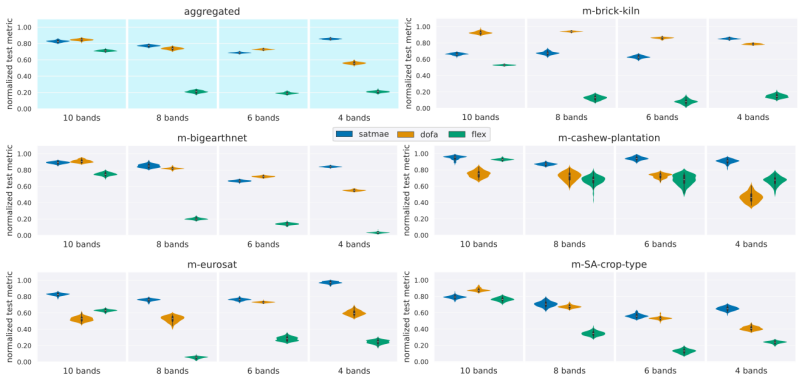
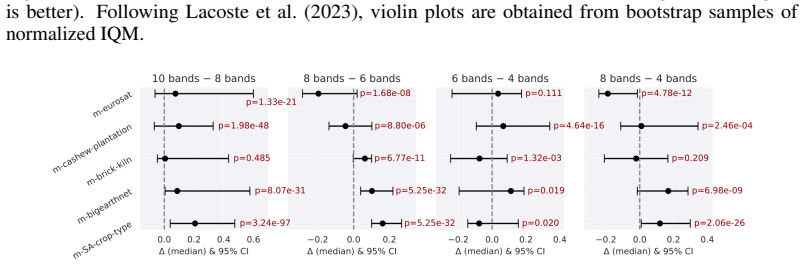
Our results offer new insights into the design trade-offs between model flexibility, modality alignment, and downstream task performance by standardizing pretraining using identical self supervised learning objectives and training datasets, and evaluating all models under consistent parameterization on the GEOBench benchmark across classification and segmentation tasks.
What carries the argument
Standardized pretraining and evaluation of encoder-only, encoder-decoder, and masked autoencoding paradigms for geospatial multimodal data.
If this is right
- Flexibility across spectral band configurations comes with potential costs in modality alignment.
- Downstream task performance depends on the balance between flexibility and alignment.
- Architectural strengths and limitations can be identified under controlled conditions.
- Guidance is provided for building next generation geospatial foundation models.
Where Pith is reading between the lines
- These trade-offs may inform design choices in other multimodal domains such as medical imaging or autonomous driving.
- Testing the models on additional benchmarks could validate if the observed trade-offs are consistent.
- The emphasis on flexibility suggests potential benefits for models that adapt to new sensor types without retraining.
Load-bearing premise
Applying identical self-supervised learning objectives and training datasets across architectures produces a fair comparison of their inherent capabilities.
What would settle it
If models trained with their native objectives and datasets show reversed performance rankings compared to the standardized setup, the value of the apples-to-apples comparison would be questioned.
Figures


read the original abstract
Foundation models are rapidly transforming Earth observation by enabling scalable pretraining across diverse unlabeled geospatial modalities. However, their architectural diversity ranging from encoder-only to encoder-decoder and masked autoencoding paradigms makes it challenging to assess performance trade offs in a consistent manner. In this work, we present an apples-to-apples comparison of leading FM architectures designed for geospatial multimodal reasoning, with a particular focus on flexibility across varied spectral band configurations. We standardize pretraining using identical self supervised learning objectives and training datasets, and evaluate all models under consistent parameterization on the GEOBench benchmark across classification and segmentation tasks. Our results offer new insights into the design trade-offs between model flexibility, modality alignment, and downstream task performance. By highlighting architectural strengths and limitations under controlled conditions, this study provides practical guidance for building next generation geospatial foundation models capable of robust multimodal reasoning.
Editorial analysis
A structured set of objections, weighed in public.
Referee Report
Summary. The paper conducts an apples-to-apples empirical comparison of geospatial multimodal foundation model architectures (encoder-only, encoder-decoder, and masked autoencoding) by standardizing identical self-supervised pretraining objectives and datasets across models, then evaluating them under consistent parameterization on the GEOBench benchmark for classification and segmentation tasks. It claims to derive new insights into design trade-offs among model flexibility, modality alignment, and downstream task performance, offering guidance for next-generation geospatial FMs.
Significance. If the controlled experimental results hold and demonstrate reproducible trade-offs, the work would provide practical value to the geospatial FM community by clarifying architectural strengths and limitations under standardized conditions, which is currently lacking in the literature.
minor comments (2)
- The abstract states that results offer new insights but provides no quantitative findings, error bars, dataset sizes, or specific performance numbers; the full manuscript should include these in §4 or §5 to allow verification of the claimed trade-offs.
- The claim of a 'fair apples-to-apples comparison' via identical SSL objectives rests on an assumption that may introduce hidden biases (e.g., differing optimal hyperparameters per architecture); §3 should explicitly discuss any sensitivity analysis performed.
Simulated Author's Rebuttal
We thank the referee for their summary of our work and for noting its potential practical value to the geospatial FM community through standardized comparisons. We observe that the report lists no specific major comments for us to address point-by-point. We remain available to provide further details or clarifications on the experimental design, results, or any other aspect of the manuscript.
Circularity Check
No significant circularity
full rationale
The paper is an empirical benchmarking study that standardizes self-supervised pretraining objectives and datasets across encoder-only, encoder-decoder, and masked autoencoding architectures, then evaluates them on GEOBench for classification and segmentation tasks. No derivations, equations, fitted parameters presented as predictions, or self-citation chains appear in the provided text. The central claims about design trade-offs rest on the experimental standardization and downstream results rather than any reduction to inputs by construction. This is the most common honest finding for controlled empirical comparisons.
Axiom & Free-Parameter Ledger
Reference graph
Works this paper leans on
-
[1]
InIGARSS 2024-2024 IEEE International Geoscience and Remote Sensing Symposium
Towards Diverse and Represen- tative Global Pretraining Datasets for Remote Sensing Foundation Models. InIGARSS 2024-2024 IEEE International Geoscience and Remote Sensing Symposium. IEEE, 2723–2728. Guillaume Astruc, Nicolas Gonthier, Clement Mallet, and Loic Landrieu
2024
-
[2]
arXiv:2404.08351 [cs.CV] https://arxiv
OmniSat: Self- Supervised Modality Fusion for Earth Observation. arXiv:2404.08351 [cs.CV] https://arxiv. org/abs/2404.08351 Guillaume Astruc, Nicolas Gonthier, Clement Mallet, and Loic Landrieu
-
[3]
AnySat: One Earth Observation Model for Many Resolutions, Scales, and Modalities. arXiv:2412.14123 [cs.CV] https://arxiv.org/abs/2412.14123 Kumar Ayush, Burak Uzkent, Chenlin Meng, Kumar Tanmay, Marshall Burke, David Lobell, and Stefano Ermon
-
[4]
Nikolaos-Ioannis Bountos, Arthur Ouaknine, Ioannis Papoutsis, and David Rolnick
Geography-Aware Self-Supervised Learning.ICCV(2021). Nikolaos-Ioannis Bountos, Arthur Ouaknine, Ioannis Papoutsis, and David Rolnick
2021
-
[5]
FoMo: Multi-Modal, Multi-Scale and Multi-Task Remote Sensing Foundation Models for Forest Monitor- ing. InAAAI. 27858–27868.https://doi.org/10.1609/aaai.v39i27.35002 Yezhen Cong, Samar Khanna, Chenlin Meng, Patrick Liu, Erik Rozi, Yutong He, Marshall Burke, David B. Lobell, and Stefano Ermon
-
[6]
SatMAE: Pre-training Transformers for Temporal and Multi-Spectral Satellite Imagery. arXiv:2207.08051 [cs.CV] https://arxiv.org/abs/2207. 08051 Philipe Dias, Aristeidis Tsaris, Jordan Bowman, Abhishek Potnis, Jacob Arndt, H. Lexie Yang, and Dalton Lunga
-
[7]
OReole-FM: successes and challenges toward billion-parameter foundation models for high-resolution satellite imagery. InProceedings of the 32nd ACM International Conference on Advances in Geographic Information Systems(Atlanta, GA, USA)(SIGSPATIAL ’24). Association for Computing Machinery, New York, NY , USA, 597–600. doi: 10.1145/ 3678717.3691292 Alexey ...
-
[8]
https://source.coop/esa/fusion-competition
Fusion Competition - ESA x Source. https://source.coop/esa/fusion-competition. Accessed: 2025-06-04. Yingchao Feng, Peijin Wang, Wenhui Diao, Qibin He, Huiyang Hu, Hanbo Bi, Xian Sun, and Kun Fu
2025
-
[9]
Synergistic use of Sentinel-1 and Sentinel-2 images for in-season crop type classification,
A Self-Supervised Cross-Modal Remote Sensing Foundation Model with Multi-Domain Representation and Cross-Domain Fusion. InIGARSS 2023 - 2023 IEEE International Geoscience and Remote Sensing Symposium. 2239–2242. doi:10.1109/IGARSS52108.2023.10282433 Carlos Gomes, Benedikt Blumenstiel, Joao Lucas de Sousa Almeida, Pedro Henrique de Oliveira, Paolo Fraccaro...
-
[10]
14 Patrick Helber, Benjamin Bischke, Andreas Dengel, and Damian Borth
TerraTorch: The Geospatial Foundation Models Toolkit.arXiv preprint arXiv:2503.20563(2025). 14 Patrick Helber, Benjamin Bischke, Andreas Dengel, and Damian Borth
-
[11]
Jeremy Irvin, Lucas Tao, Joanne Zhou, Yuntao Ma, Langston Nashold, Benjamin Liu, and An- drew Y
Eurosat: A novel dataset and deep learning benchmark for land use and land cover classification.IEEE Journal of Selected Topics in Applied Earth Observations and Remote Sensing12, 7 (2019), 2217–2226. Jeremy Irvin, Lucas Tao, Joanne Zhou, Yuntao Ma, Langston Nashold, Benjamin Liu, and An- drew Y . Ng
2019
-
[12]
USat: A Unified Self-Supervised Encoder for Multi-Sensor Satellite Imagery. arXiv:2312.02199 [cs.CV]https://arxiv.org/abs/2312.02199 Alexandre Lacoste, Nils Lehmann, Pau Rodriguez, Evan Sherwin, Hannah Kerner, Björn Lütjens, Jeremy Irvin, David Dao, Hamed Alemohammad, Alexandre Drouin, et al
-
[13]
Jihyeon Lee, Nina R Brooks, Fahim Tajwar, Marshall Burke, Stefano Ermon, David B Lobell, Debashish Biswas, and Stephen P Luby
Geo-bench: Toward foundation models for earth monitoring.Advances in Neural Information Processing Systems36 (2023), 51080–51093. Jihyeon Lee, Nina R Brooks, Fahim Tajwar, Marshall Burke, Stefano Ermon, David B Lobell, Debashish Biswas, and Stephen P Luby
2023
-
[14]
Tung Nguyen, Johannes Brandstetter, Ashish Kapoor, Jayesh K
Scalable deep learning to identify brick kilns and aid regulatory capacity.Proceedings of the National Academy of Sciences118, 17 (2021), e2018863118. Tung Nguyen, Johannes Brandstetter, Ashish Kapoor, Jayesh K. Gupta, and Aditya Grover
2021
-
[15]
ClimaX: A foundation model for weather and climate. arXiv:2301.10343 [cs.LG] https:// arxiv.org/abs/2301.10343 Jonathan Prexl and Michael Schmitt
-
[16]
Multi-Modal Multi-Objective Contrastive Learning for Sentinel-1/2 Imagery. In2023 IEEE/CVF Conference on Computer Vision and Pattern Recognition Workshops (CVPRW). 2136–2144. doi:10.1109/CVPRW59228.2023.0020 Jonathan Prexl and Michael Schmitt
-
[17]
SenPa-MAE: Sensor Parameter Aware Masked Au- toencoder for Multi-Satellite Self-Supervised Pretraining. arXiv:2408.11000 [cs.CV] https: //arxiv.org/abs/2408.11000 Adam B Smith
-
[18]
InAmerican Meteorological Society Meeting Abstracts, V ol
2021 US Billion Dollar Weather and Climate Disasters in Historical Context including New County-Level Exposure, Vulnerability and Projected Damage Mapping. InAmerican Meteorological Society Meeting Abstracts, V ol
2021
-
[19]
Tete Xiao, Yingcheng Liu, Bolei Zhou, Yuning Jiang, and Jian Sun
BigEarthNet-MM: A large-scale, multimodal, multilabel benchmark archive for remote sensing image classification and retrieval [software and data sets].IEEE Geoscience and Remote Sensing Magazine9, 3 (2021), 174–180. Tete Xiao, Yingcheng Liu, Bolei Zhou, Yuning Jiang, and Jian Sun
2021
-
[20]
Unified perceptual parsing for scene understanding. InProceedings of the European conference on computer vision (ECCV). 418–434. Zhitong Xiong, Yi Wang, Fahong Zhang, Adam J. Stewart, Joëlle Hanna, Damian Borth, Ioannis Papoutsis, Bertrand Le Saux, Gustau Camps-Valls, and Xiao Xiang Zhu. 2024b. Neural Plasticity- Inspired Multimodal Foundation Model for E...
-
[21]
Xiao Xiang Zhu, Jingliang Hu, Chunping Qiu, Yilei Shi, Jian Kang, Lichao Mou, Hossein Bagheri, Matthias Haberle, Yuansheng Hua, Rong Huang, et al
Mapping smallholder cashew plantations to inform sustainable tree crop expansion in Benin.Remote Sensing of Environment295 (2023), 113695. Xiao Xiang Zhu, Jingliang Hu, Chunping Qiu, Yilei Shi, Jian Kang, Lichao Mou, Hossein Bagheri, Matthias Haberle, Yuansheng Hua, Rong Huang, et al
2023
-
[22]
So2Sat LCZ42: A benchmark data set for the classification of global local climate zones [software and data sets].IEEE Geoscience and Remote Sensing Magazine8, 3 (2020), 76–89. 15
2020
discussion (0)
Sign in with ORCID, Apple, or X to comment. Anyone can read and Pith papers without signing in.