REVIEW 2 minor 1 cited by
This guide compiles the data formats, processing steps, and analysis strategies needed to extract reliable polarization measurements from IXPE observations.
Reviewed by Pith at T0; open to challenge. T0 means a machine referee read the full paper against a public rubric. the ladder, T0–T4 →
T0 review · grok-4.3
2026-05-13 18:18 UTC pith:PDJFRTBY
load-bearing objection This is a practical handbook compiling existing IXPE analysis advice rather than new science.
The hitchhiker's guide to the IXPE data analysis
The pith
A machine-rendered reading of the paper's core claim, the machinery that carries it, and where it could break.
Core claim
The author presents an almost comprehensive guide that collects suggestions and answers to typical questions raised by users of IXPE data, with the aim of enabling researchers to maximize the scientific return from the observations through proper extraction of polarimetric information and avoidance of systematic errors.
What carries the argument
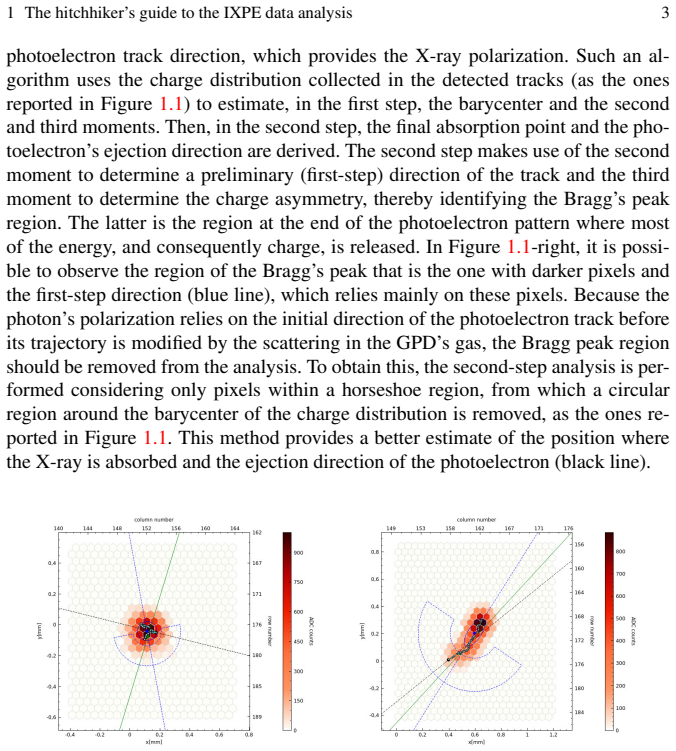
The central mechanism is the set of data processing steps and analysis strategies, including model-independent and model-dependent methods, that allow for accurate polarimetry while using the instrument response functions in their available forms.
Load-bearing premise
The assumption that the outlined strategies, data formats, and processing steps are complete enough to eliminate all potential systematic errors in actual IXPE observations.
What would settle it
Comparing polarization results obtained using the guide's recommended procedures against independent measurements or simulations for a standard candle source with well-known polarization properties.
If this is right
- Applying the described strategies enables extraction of polarimetric information from IXPE observations.
- Optimizing the response leads to the best possible results from the data.
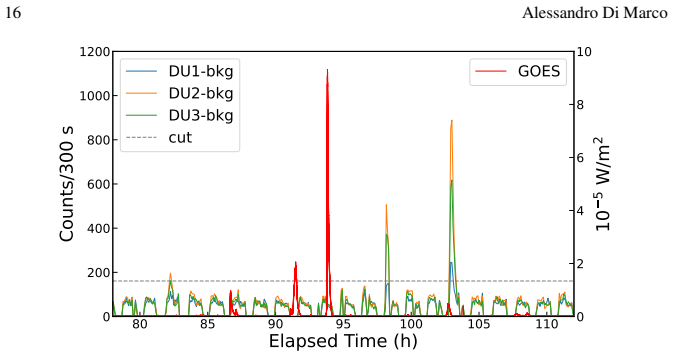
- Using the correct data formats and processing avoids potential systematic errors.
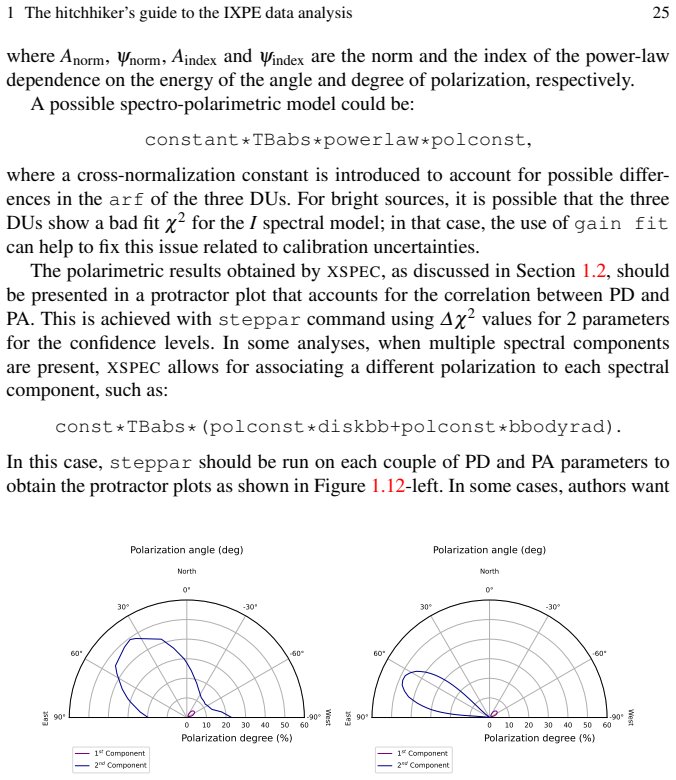
- Both model-independent and model-dependent analyses can be performed effectively with the available response functions.
Where Pith is reading between the lines
- Similar guides could improve data analysis for other space-based X-ray instruments.
- Adopting these methods uniformly might lead to more consistent polarization measurements across different research groups.
- Extensions to handle new data types from future missions could build directly on this framework.
Editorial analysis
A structured set of objections, weighed in public.
Referee Report
Summary. The manuscript presents a guide to IXPE data analysis. It introduces the spacecraft and onboard instrument, describes strategies for extracting polarimetric information and optimizing the response, details data formats and processing steps to avoid systematic errors, and summarizes model-independent and model-dependent analysis paths together with the available flavors of the instrument response functions. The central aim is to compile answers to common user questions so that researchers can maximize the scientific return from IXPE observations.
Significance. If the compiled advice is followed, the chapter provides a practical, centralized resource that draws directly from established mission documentation. It should reduce the incidence of common analysis errors and thereby improve the reliability of polarimetric results in high-energy astrophysics, particularly for users new to the mission.
minor comments (2)
- The abstract states that the guide is 'almost comprehensive'; the introduction would benefit from an explicit statement of the topics deliberately omitted (e.g., advanced time-resolved polarimetry or specific calibration updates post-launch).
- Section describing data formats would be clearer if it included a short table or schematic showing the relationship between the primary event list, the response matrix, and the ancillary response files.
Simulated Author's Rebuttal
We thank the referee for their positive summary of the manuscript, recognition of its utility as a centralized resource for IXPE users, and recommendation to accept. The referee's description accurately reflects the chapter's goals of compiling practical guidance on data formats, analysis strategies, and best practices to maximize scientific return from IXPE observations.
Circularity Check
No significant circularity; handbook-style guide with no derivations
full rationale
This manuscript is an explanatory handbook compiling strategies, data formats, processing steps, instrument response functions, and both model-independent and model-dependent analysis paths for IXPE observations. It draws from prior mission documentation and standard practices without presenting any new mathematical derivations, predictions, fitted parameters, or first-principles results. No equations, self-referential definitions, or load-bearing self-citations reduce any claimed result to its own inputs by construction. The central claim is practical guidance to maximize scientific return, which remains self-contained against external benchmarks and does not invoke uniqueness theorems or ansatzes from the authors' prior work.
Axiom & Free-Parameter Ledger
axioms (1)
- domain assumption Standard assumptions about IXPE instrument response functions and data formats as provided by the mission team.
read the original abstract
This chapter provides an almost comprehensive guide to the Imaging X-ray Polarimetry Explorer (IXPE) data analysis. The chapter briefly introduces the IXPE spacecraft and the instrument onboard; subsequently, the strategies adopted to extract polarimetric information and to optimize the response are given. Moreover, the data formats and processing steps to avoid potential systematic errors and to achieve the best results from the IXPE data are reported. Both the model-independent and the model-dependent analyses are summarized, as the instrument response functions and their different available flavors. The idea behind this chapter is to collect suggestions and answers to questions that are typically raised by users, aiming to enable researchers to maximize the scientific return from IXPE observations.
Figures






Forward citations
Cited by 1 Pith paper
-
Unchanged X-Ray Polarization During Accretion Dips in the Low Hard State of Cygnus X-1
During Cygnus X-1 accretion dips the 2–8 keV polarization is unchanged within errors, indicating the absorbed disk does not contribute and supporting an extended oblate corona.
discussion (0)
Sign in with ORCID, Apple, or X to comment. Anyone can read and Pith papers without signing in.