The First Insights into an Ultraluminous X-ray Pulsar with XRISM: Phase-Resolved High-Resolution Spectroscopy of the Fe K-shell Band of M82 X-2
Pith reviewed 2026-05-20 09:39 UTC · model grok-4.3
The pith
If the candidate pulsation is real, broader Fe Kα line in M82 X-2 pulse peak indicates accretion flow origin
A machine-rendered reading of the paper's core claim, the machinery that carries it, and where it could break.
Core claim
Using the candidate pulsation period, the phase-resolved Resolve spectra indicate that the Fe Kα emission line width is larger in the pulse peak phase (36+60-13 eV) than in the remaining phase at over 3 sigma significance. This implies at least a fraction of the Fe Kα emission is associated with the ULXP system and originates in the accretion flow, since the corresponding velocity dispersion of (1.7+2.8-0.6) x 10^3 km s^{-1} exceeds what the companion star atmosphere can produce and the pulsation rise time constrains the region to be smaller than 6.3 x 10^4 km.
What carries the argument
Phase-resolved high-resolution spectroscopy that bins the Resolve spectra according to the candidate pulsation period and compares the Fe Kα line width between pulse peak and off-peak phases.
Load-bearing premise
The candidate signal detected at 3.15 sigma significance is the true pulsation period allowing reliable phase binning.
What would settle it
A future observation that either fails to recover the same period at higher significance or shows no line-width difference when spectra are binned on an independent period measurement.
Figures




read the original abstract
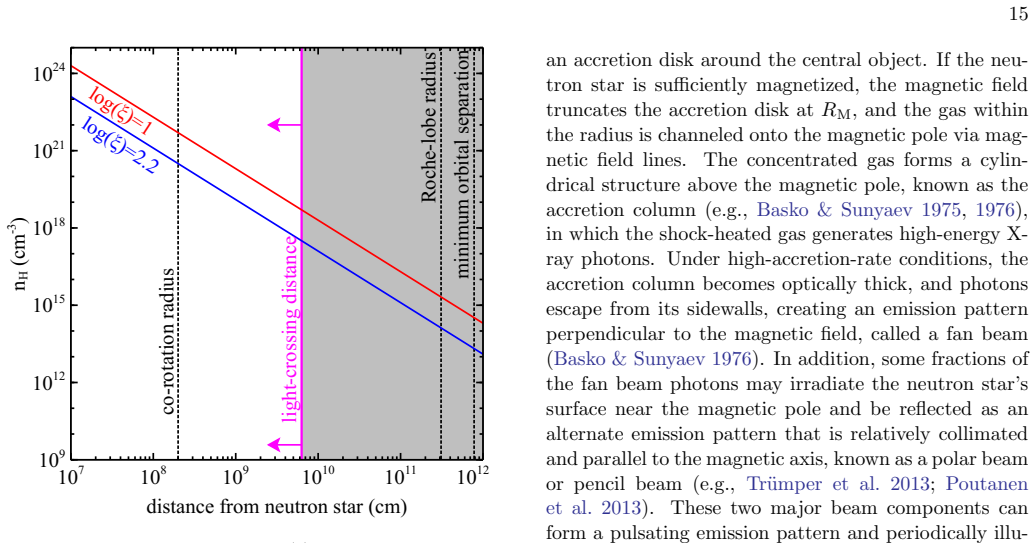
During the performance verification phase, XRISM observed the M82 galaxy for a net exposure of 207.7 ks, with the ultraluminous X-ray pulsar (ULXP) X-2 included in the field of view. A pulsation search identified a candidate signal with a period close to the previously known value, 1.38727 s, at a significance of $3.15\sigma$ based on Monte Carlo simulations. Using this candidate period, phase-resolved spectral analysis with the high spectral resolution of Resolve was performed. The spectra suggest that, if the candidate pulsation is real, the Fe K$\alpha$ emission line in the pulse peak phase has a larger width ($36^{+60}_{-13}$ eV) than that in the remaining phase at a significance exceeding $3\sigma$. This suggests that at least a fraction of the Fe K$\alpha$ emission is associated with the ULXP system. The observed width corresponds to a velocity dispersion of $(1.7^{+2.8}_{-0.6})\times10^3$ km s$^{-1}$, which is too large to be explained by motions in the companion star atmosphere. The rise time of the pulsation constrains the line-emitting region to be smaller than $6.3\times10^4$ km, suggesting an origin in the accretion flow. This work demonstrates the capability of XRISM Resolve for pulsation-resolved high-resolution spectroscopy of ULX pulsars.
Editorial analysis
A structured set of objections, weighed in public.
Referee Report
Summary. The manuscript reports XRISM Resolve observations of M82 X-2 over a 207.7 ks exposure. A Monte Carlo search yields a candidate pulsation period of 1.38727 s at 3.15σ significance. Phase-resolved spectroscopy folded on this candidate period indicates that the Fe Kα line is broader in the pulse-peak phase (36^{+60}_{-13} eV) than in the remaining phases at >3σ significance, interpreted as evidence that at least part of the Fe Kα emission originates in the ULXP accretion flow, with supporting velocity-dispersion and light-travel-time constraints.
Significance. If the candidate period is confirmed, the work would represent the first phase-resolved high-resolution spectroscopy of an ultraluminous X-ray pulsar with XRISM, providing direct constraints on the location and kinematics of Fe Kα emission in these systems and showcasing Resolve's timing-spectroscopy capabilities. The conditional phrasing in the abstract is appropriate, but the result's impact hinges on the robustness of the 3.15σ detection.
major comments (2)
- [Abstract and timing analysis] Abstract and timing section: The headline result (Fe Kα width difference at >3σ) and all subsequent physical arguments (velocity dispersion of (1.7^{+2.8}_{-0.6})×10^3 km s^{-1} and light-travel-time upper limit of 6.3×10^4 km) are obtained only after folding the spectra on the 3.15σ Monte Carlo candidate period. No independent confirmation such as a coherent timing solution across the full 207.7 ks exposure or cross-check with archival data is reported, making the period the load-bearing assumption for the phase binning and the claimed physical association.
- [Phase-resolved spectral analysis] Spectral analysis section: The reported line-width difference carries large asymmetric uncertainties (36^{+60}_{-13} eV); the >3σ significance statement for the difference should include the full error propagation and a baseline comparison (e.g., against a null hypothesis of no phase dependence) to substantiate the claim that the difference is not an artifact of the marginal phasing.
minor comments (2)
- [Abstract] The abstract states the width difference significance without noting that it inherits the period uncertainty; a brief qualifier would improve clarity.
- [Discussion] Notation for the asymmetric uncertainties on the velocity dispersion should be consistent with the line-width presentation.
Simulated Author's Rebuttal
We thank the referee for the careful and constructive review of our manuscript. We address each major comment below with clarifications on the analysis choices and statistical approach, and we indicate the revisions incorporated to improve the robustness and presentation of the results.
read point-by-point responses
-
Referee: [Abstract and timing analysis] Abstract and timing section: The headline result (Fe Kα width difference at >3σ) and all subsequent physical arguments (velocity dispersion of (1.7^{+2.8}_{-0.6})×10^3 km s^{-1} and light-travel-time upper limit of 6.3×10^4 km) are obtained only after folding the spectra on the 3.15σ Monte Carlo candidate period. No independent confirmation such as a coherent timing solution across the full 207.7 ks exposure or cross-check with archival data is reported, making the period the load-bearing assumption for the phase binning and the claimed physical association.
Authors: We acknowledge that the 3.15σ candidate period, derived from Monte Carlo simulations, is the foundation for the phase-resolved analysis and that no fully coherent timing solution over the entire 207.7 ks exposure or direct archival cross-check is presented. The exposure length and source count rate limit the feasibility of such a solution, and the candidate period is consistent with the previously known value for M82 X-2. We have revised the timing section to provide additional details on the Monte Carlo search procedure, explicitly discuss these limitations, and strengthen the conditional phrasing throughout the abstract and main text to make clear that all physical conclusions are predicated on the candidate signal being real. revision: partial
-
Referee: [Phase-resolved spectral analysis] Spectral analysis section: The reported line-width difference carries large asymmetric uncertainties (36^{+60}_{-13} eV); the >3σ significance statement for the difference should include the full error propagation and a baseline comparison (e.g., against a null hypothesis of no phase dependence) to substantiate the claim that the difference is not an artifact of the marginal phasing.
Authors: We agree that the asymmetric uncertainties on the line width require explicit statistical validation. In the revised manuscript we have added a full error propagation for the significance of the width difference and performed a direct comparison against a null-hypothesis model in which the line width is independent of phase. This baseline test confirms that the observed difference exceeds 3σ. The spectral analysis section and relevant figure captions have been updated to include these checks and to clarify the statistical procedure. revision: yes
- Independent confirmation of the candidate 3.15σ pulsation period via a coherent timing solution or archival cross-check is not feasible with the available dataset.
Circularity Check
No significant circularity; period search and spectral fitting remain independent
full rationale
The paper conducts a standalone Monte Carlo timing search to detect a candidate 1.38727 s period at 3.15σ, then applies that period solely for phase binning prior to direct spectral fitting of the Fe Kα line width in Resolve data. The reported width difference (36+60−13 eV at >3σ) and derived velocity dispersion arise from standard Gaussian line modeling of the phase-resolved spectra and do not reduce by construction to any fitted input, self-citation, or ansatz. The analysis is explicitly conditional on the candidate period being real, but this is an external assumption rather than a definitional loop or renamed fit. No load-bearing step equates the final claim to its own inputs.
Axiom & Free-Parameter Ledger
axioms (1)
- domain assumption The candidate signal at 3.15σ is the pulsar's spin period
Lean theorems connected to this paper
-
IndisputableMonolith/Foundation/RealityFromDistinction.leanreality_from_one_distinction unclear?
unclearRelation between the paper passage and the cited Recognition theorem.
A pulsation search identified a candidate signal with a period close to the previously known value, 1.38727 s, at a significance of 3.15σ based on Monte Carlo simulations. Using this candidate period, phase-resolved spectral analysis... Fe Kα emission line in the pulse peak phase has a larger width (36+60−13 eV)
-
IndisputableMonolith/Cost/FunctionalEquation.leanwashburn_uniqueness_aczel unclear?
unclearRelation between the paper passage and the cited Recognition theorem.
The observed width corresponds to a velocity dispersion of (1.7+2.8−0.6)×10^3 km s^{-1}... rise time of the pulsation constrains the line-emitting region to be smaller than 6.3×10^4 km
What do these tags mean?
- matches
- The paper's claim is directly supported by a theorem in the formal canon.
- supports
- The theorem supports part of the paper's argument, but the paper may add assumptions or extra steps.
- extends
- The paper goes beyond the formal theorem; the theorem is a base layer rather than the whole result.
- uses
- The paper appears to rely on the theorem as machinery.
- contradicts
- The paper's claim conflicts with a theorem or certificate in the canon.
- unclear
- Pith found a possible connection, but the passage is too broad, indirect, or ambiguous to say the theorem truly supports the claim.
Reference graph
Works this paper leans on
-
[1]
2026, Nature, 651, 909, doi: 10.1038/s41586-026-10231-1
Audard, M., Awaki, H., Ballhausen, R., et al. 2026, Nature, 651, 909, doi: 10.1038/s41586-026-10231-1
-
[2]
2021, The Astrophysical Journal, 909, 33, doi: 10.3847/1538-4357/abda4a
Bachetti, M., Pilia, M., Huppenkothen, D., et al. 2021, The Astrophysical Journal, 909, 33, doi: 10.3847/1538-4357/abda4a
-
[3]
Bachetti, M., Harrison, F. A., Walton, D. J., et al. 2014, Nature, 514, 202, doi: 10.1038/nature13791
-
[4]
Bachetti, M., Maccarone, T. J., Brightman, M., et al. 2020, The Astrophysical Journal, 891, 44, doi: 10.3847/1538-4357/ab6d00
-
[5]
2022, The Astrophysical Journal, 937, 125, doi: 10.3847/1538-4357/ac8d67
Bachetti, M., Heida, M., Maccarone, T., et al. 2022, The Astrophysical Journal, 937, 125, doi: 10.3847/1538-4357/ac8d67
-
[6]
Basko, M. M., & Sunyaev, R. A. 1975, Astronomy and Astrophysics, 42, 311 —. 1976, Monthly Notices of the Royal Astronomical Society, 175, 395, doi: 10.1093/mnras/175.2.395
-
[7]
2022, The Astrophysical Journal, 929, 138, doi: 10.3847/1538-4357/ac5e37
Brightman, M., Kosec, P., F¨ urst, F., et al. 2022, The Astrophysical Journal, 929, 138, doi: 10.3847/1538-4357/ac5e37
-
[8]
Brightman, M., Walton, D. J., Xu, Y., et al. 2020, The Astrophysical Journal, 889, 71, doi: 10.3847/1538-4357/ab629a
- [9]
-
[10]
Filippova, E. V. 2022, Monthly Notices of the Royal Astronomical Society, 516, 1601, doi: 10.1093/mnras/stac2239 18 1.38726 1.38727 1.38728 (s) rotP0.2 0.25 0.3 0.35 0.4 0.45 0.5 0.55 0.6 0.65 0.7 9 −10×) -1 (s s P 0 5 10 15 20 25 30 35 40 1.38726 1.38727 1.38728 (s) rotP2.48 2.5 2.52 2.54 2.56 2.58 (day) orb P 0 5 10 15 20 25 30 35 40 0.2 0.25 0.3 0.35 0...
-
[11]
Carpano, S., Haberl, F., Maitra, C., & Vasilopoulos, G. 2018, Monthly Notices of the Royal Astronomical Society: Letters, 476, L45, doi: 10.1093/mnrasl/sly030
-
[12]
Collaboration, T. A., Price-Whelan, A. M., Sip˝ ocz, B. M., et al. 2018, The Astronomical Journal, 156, 123, doi: 10.3847/1538-3881/aabc4f
-
[13]
Connors, R. M. T., Garc´ ıa, J. A., Steiner, J. F., et al. 2019, The Astrophysical Journal, 882, 179, doi: 10.3847/1538-4357/ab35df
-
[14]
Dalcanton, J. J., Williams, B. F., Seth, A. C., et al. 2009, The Astrophysical Journal Supplement Series, 183, 67, doi: 10.1088/0067-0049/183/1/67
-
[15]
Debnath, D., Sundqvist, J. O., Moens, N., et al. 2024, Astronomy & Astrophysics, 684, A177, doi: 10.1051/0004-6361/202348206
-
[16]
1989, Annual Review of Astronomy and Astrophysics, 27, 87, doi: 10.1146/annurev.aa.27.090189.000511
Fabbiano, G. 1989, Annual Review of Astronomy and Astrophysics, 27, 87, doi: 10.1146/annurev.aa.27.090189.000511
-
[17]
2014, The Astrophysical Journal Letters, 784, L12, doi: 10.1088/2041-8205/784/1/L12
Goobar, A., Johansson, J., Amanullah, R., et al. 2014, The Astrophysical Journal Letters, 784, L12, doi: 10.1088/2041-8205/784/1/L12
-
[18]
Harris, C. R., Millman, K. J., van der Walt, S. J., et al. 2020, Nature, 585, 357, doi: 10.1038/s41586-020-2649-2
-
[19]
Hayashi, T., Boissay-Malaquin, R., Tamura, K., et al. 2024
work page 2024
-
[20]
Hunter, J. D. 2007, Computing in Science & Engineering, 9, 90, doi: 10.1109/MCSE.2007.55
-
[21]
Ishisaki, Y., Kelley, R. L., Awaki, H., et al. 2025, Journal of Astronomical Telescopes, Instruments, and Systems, 11, 042023, doi: 10.1117/1.JATIS.11.4.042023
-
[22]
Iwasawa, K., Norman, C., Gilli, R., Gandhi, P., & Per´ ez-Torres, M. A. 2023, Astronomy & Astrophysics, 674, A77, doi: 10.1051/0004-6361/202245548
-
[23]
Kallman, T. R., Palmeri, P., Bautista, M. A., Mendoza, C., & Krolik, J. H. 2004, The Astrophysical Journal Supplement Series, 155, 675, doi: 10.1086/424039
-
[24]
2012, The Astrophysical Journal, 752, 18, doi: 10.1088/0004-637X/752/1/18
Kawashima, T., Ohsuga, K., Mineshige, S., et al. 2012, The Astrophysical Journal, 752, 18, doi: 10.1088/0004-637X/752/1/18
-
[25]
L., Ishisaki, Y., Costantini, E., et al
Kelley, R. L., Ishisaki, Y., Costantini, E., et al. 2025, Journal of Astronomical Telescopes, Instruments, and Systems, 11, 042026, doi: 10.1117/1.JATIS.11.4.042026
-
[26]
B., Nakazawa, K., & Makishima, K
Kobayashi, S. B., Nakazawa, K., & Makishima, K. 2019, Monthly Notices of the Royal Astronomical Society, 489, 366, doi: 10.1093/mnras/stz2139
-
[27]
Kosec, P., Pinto, C., Fabian, A. C., & Walton, D. J. 2018a, Monthly Notices of the Royal Astronomical Society, 473, 5680, doi: 10.1093/mnras/stx2695 19
-
[28]
Kosec, P., Pinto, C., Walton, D. J., et al. 2018b, Monthly Notices of the Royal Astronomical Society, 479, 3978, doi: 10.1093/mnras/sty1626
-
[29]
Kosec, P., Pinto, C., Reynolds, C. S., et al. 2021, Monthly Notices of the Royal Astronomical Society, 508, 3569, doi: 10.1093/mnras/stab2856
-
[30]
2024, The Astrophysical Journal, 961, 196, doi: 10.3847/1538-4357/ad17c7
Liu, J. 2024, The Astrophysical Journal, 961, 196, doi: 10.3847/1538-4357/ad17c7
-
[31]
2000, The Astrophysical Journal, 535, 632, doi: 10.1086/308868
Makishima, K., Kubota, A., Mizuno, T., et al. 2000, The Astrophysical Journal, 535, 632, doi: 10.1086/308868
-
[32]
Miller-Jones, J. C. A., Tetarenko, A. J., Sivakoff, G. R., et al. 2019, Nature, 569, 374, doi: 10.1038/s41586-019-1152-0
-
[33]
2006, The Astrophysical Journal, 640, 923, doi: 10.1086/500184
Ohsuga, K. 2006, The Astrophysical Journal, 640, 923, doi: 10.1086/500184
-
[34]
Pinto, C., Middleton, M. J., & Fabian, A. C. 2016, Nature, 533, 64, doi: 10.1038/nature17417
-
[35]
Pinto, C., Soria, R., Walton, D. J., et al. 2021, Monthly Notices of the Royal Astronomical Society, 505, 5058, doi: 10.1093/mnras/stab1648
-
[36]
Porter, F. S., Kilbourne, C. A., Chiao, M., et al. 2024, Space Telescopes and Instrumentation 2024: Ultraviolet to Gamma Ray, 13093, 450, doi: 10.1117/12.3018882
-
[37]
Poutanen, J., Lipunova, G., Fabrika, S., Butkevich, A. G., & Abolmasov, P. 2007, Monthly Notices of the Royal Astronomical Society, 377, 1187, doi: 10.1111/j.1365-2966.2007.11668.x
-
[38]
Poutanen, J., Mushtukov, A. A., Suleimanov, V. F., et al. 2013, The Astrophysical Journal, 777, 115, doi: 10.1088/0004-637X/777/2/115
-
[39]
Prinja, R. K., Barlow, M. J., & Howarth, I. D. 1990, The Astrophysical Journal, 361, 607, doi: 10.1086/169224
-
[40]
Runacres, M. C., & Owocki, S. P. 2002, Astronomy and Astrophysics, 381, 1015, doi: 10.1051/0004-6361:20011526
-
[41]
Shakura, N. I., & Sunyaev, R. A. 1973, Astronomy and Astrophysics, 24, 337
work page 1973
-
[42]
Standish, Jr., E. M. 1990, Astronomy and Astrophysics, 233, 252
work page 1990
-
[43]
Tarter, C. B., Tucker, W. H., & Salpeter, E. E. 1969, The Astrophysical Journal, 156, 943, doi: 10.1086/150026
-
[44]
2025, Publications of the Astronomical Society of Japan, psaf023, doi: 10.1093/pasj/psaf023
Tashiro, M., Kelley, R., Watanabe, S., et al. 2025, Publications of the Astronomical Society of Japan, psaf023, doi: 10.1093/pasj/psaf023
-
[45]
Terada, Y., Shidatsu, M., Sawada, M., et al. 2025, Journal of Astronomical Telescopes, Instruments, and Systems, 11, 042007, doi: 10.1117/1.JATIS.11.4.042007 Tr¨ umper, J. E., Dennerl, K., Kylafis, N. D., Ertan,¨U., &
-
[46]
2013, The Astrophysical Journal, 764, 49, doi: 10.1088/0004-637X/764/1/49
Zezas, A. 2013, The Astrophysical Journal, 764, 49, doi: 10.1088/0004-637X/764/1/49
-
[47]
Walton, D. J., Miller, J. M., Harrison, F. A., et al. 2013, The Astrophysical Journal Letters, 773, L9, doi: 10.1088/2041-8205/773/1/L9
-
[48]
Walton, D. J., Middleton, M. J., Pinto, C., et al. 2016, The Astrophysical Journal Letters, 826, L26, doi: 10.3847/2041-8205/826/2/L26
-
[49]
Xiao, Y. X., Xu, Y. J., Ge, M. Y., et al. 2024, The Astrophysical Journal, 965, 18, doi: 10.3847/1538-4357/ad24f8
discussion (0)
Sign in with ORCID, Apple, or X to comment. Anyone can read and Pith papers without signing in.