REVIEW 3 major objections 3 minor 1 cited by
Entanglement harvesting in quantum superposed spacetime
T0 review · 3 major / 3 minor · reviewed 2026-08-11 · deepseek-v4-flash
Pith's one-line read Entanglement harvesting from a quantum superposition of two non-diffeomorphic quotient Minkowski spacetimes is enhanced by cross-geometry interference, and is maximal when the final spacetime state matches the initial superposition.
desk verdict New two-detector harvesting calculation in superposed quotient Minkowski spacetime, but the Appendix A X-term algebra is internally inconsistent as written, so the headline entanglement enhancement in Fig. 7 is not yet supported. read the letter →
The pith
A machine-rendered reading of the paper's core claim, the machinery that carries it, and where it could break.
The reading
What carries the argument
The load-bearing object is the superposed quotient Minkowski spacetime: a two-dimensional spacetime Hilbert space $H_S=\mathrm{span}\{|L_1\rangle,|L_2\rangle\}$ together with a field operator $\hat\Phi(x)=\sum_i \hat\Phi_{L_i}(x)\otimes|L_i\rangle\langle L_i|$ acting on $H_\phi\otimes H_S$. Each $\hat\Phi_{L_i}$ is an image-sum field built from copies of the ordinary Minkowski field shifted by multiples of $L_i$, with $\gamma=+1$ (untwisted, periodic) or $\gamma=-1$ (twisted, anti-periodic) weighting the images. The mechanism that carries the argument is the cross-Wightman function $W^{L_1L_2}$, the vacuum correlation between the two branches, which would be absent in any classical mixture. Together with the conditioning amplitudes $a=\cos\theta\cos\phi$ and $b=\sin\theta\sin\phi$, it produces $2ab$ interference contributions to the transition probability $P^E$ and to the off-diagonal amplitude $X$ in the detectors' X-state density matrix. The concurrence $C=\max[0,2(|X|-P^E)]$ then converts the competition between the interference-enhanced $|X|$ and the excitation probability $P^E$ into the reported entanglement regions.
What would settle it
A concrete check would be to compute the same two-detector concurrence in a model where each branch of the superposition carries its own field Hilbert space and vacuum rather than sharing one Minkowski Fock space: the $W^{L_1L_2}$ cross terms would then vanish and the predicted enhancement would disappear. A tabletop analogue—a cavity or transmission line whose boundary length is placed in a superposition of two values, with two detectors coupled to the field—should reproduce the enlarged twisted-field entanglement region of Figure 7(d) and the $\theta=\phi$ postselection peak; if it does not, the interference mechanism is wrong.
Extended reading notes
Core claim
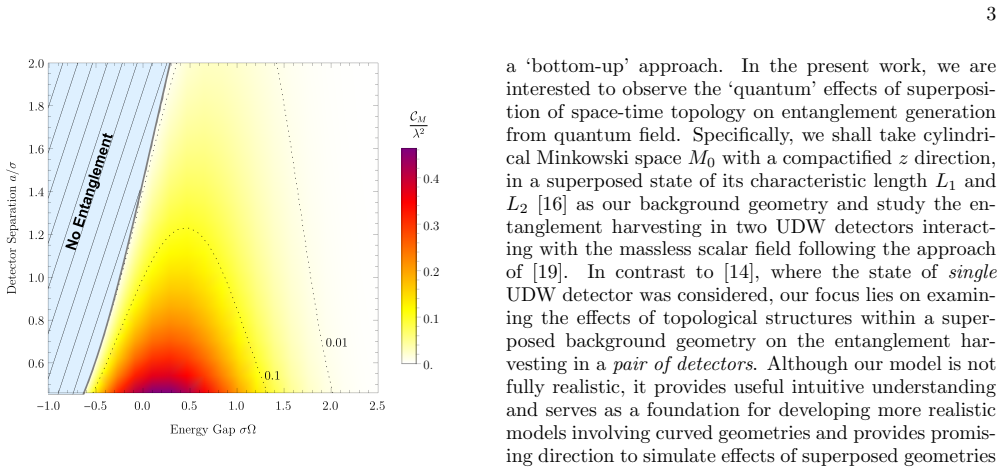
The paper's central claim is that a quantum superposition of two quotient Minkowski spacetimes—flat spaces with a spatial direction identified at two different lengths $L_1$ and $L_2$—is not equivalent to a classical mixture of the two geometries for the purpose of entanglement harvesting. The interference enters through a cross-branch Wightman function $W^{L_1L_2}(x,x')=\langle 0|\hat\Phi_{L_1}(x)\hat\Phi_{L_2}(x')|0\rangle$, built from image sums in a single Minkowski Fock space. This cross term appears in the detectors' reduced density matrix through combinations $a^2 P^{L_1}+b^2 P^{L_2}+2ab P^{L_1L_2}$ (and the analogous combination in the off-diagonal amplitude $X$), where $a=\cos\theta\cos\phi$ and $b=\sin\theta\sin\phi$ encode the initial and final spacetime superposition states. Because the concurrence is $C=\max[0,2(|X|-P^E)]$, the $2ab$ terms are genuine interference rather than mixing, and they enlarge the entanglement region. Maximum concurrence occurs at $\theta=\phi$, that is, when the final spacetime measurement matches the initial preparation, and for twisted fields the no-entanglement region in the $(a/\sigma,\,\sigma\Omega)$ plane is substantially smaller than in Minkowski space or a single quotient spacetime.
Load-bearing premise
The entire result rests on the assumption that a spacetime in a superposition of two periodic geometries is faithfully represented by a two-state model in which both branches share the same flat-space vacuum; if that effective description of quantum spacetime is wrong, the predicted entanglement boost does not follow.
Editorial extensions
If this is right
- Superposition of non-diffeomorphic spacetimes is observable in local quantum-information tasks, not only in single-detector response spectra.
- Conditioning on a final spacetime state identical to the initial superposition is the optimal postselection for entanglement harvesting; mismatched conditioning reduces the concurrence.
- Twisted (anti-periodic) boundary conditions provide a more sensitive probe of spacetime superposition than untwisted ones, since the entanglement region is enlarged in the superposed background.
- The harvested entanglement depends on detector orientation relative to the compactified direction, increasing with alignment for untwisted fields and decreasing for twisted fields.
- Entanglement harvesting can serve as a witness for superposed spacetime topology, complementing the resonance structure previously found in single-detector transition probabilities.
Reading between the lines
- If real quantum gravity allows superpositions of non-diffeomorphic geometries, the same $W^{L_1L_2}$-type cross-branch correlations should appear in other vacuum-mediated information tasks—quantum teleportation, Bell tests, and detector communication—not just in entanglement harvesting.
- Because the enhancement is postselection-dependent, any process that decoheres the spacetime superposition would suppress the cross terms; measuring the enlarged entanglement region could therefore serve as a quantitative bound on spacetime decoherence.
- The two-branch model suggests a direct analogue experiment: a field confined by a boundary length in a quantum superposition should show a peak in harvested entanglement when the final boundary measurement matches the initial one, offering a tabletop test before a full quantum-gravity experiment.
- Generalizing from two discrete lengths to a continuous superposition of compactification lengths would turn the discrete sums into integrals over $W^{L_1L_2}$-type kernels; whether the enhancement survives or averages away is a testable extension.
Signed reviews
Editorial analysis
A structured set of objections, weighed in public.
Referee Report
Summary. The paper studies entanglement harvesting by two Unruh-DeWitt detectors coupled to a massless scalar field on a quantum superposition of two quotient Minkowski spacetimes with different compactification lengths. The spacetime superposition is modeled by a two-dimensional control Hilbert space with field operators embedded in a single Minkowski Fock space via image sums. The authors compute the detector density matrix perturbatively to fourth order, obtain the X-state form, and evaluate the concurrence as a function of energy gap and detector separation. They report that the superposed spacetime significantly enhances harvested entanglement compared to Minkowski or single-quotient spacetimes, with the largest effect for twisted fields, and that the entanglement region is maximal when the final spacetime control state matches the initial one. The central claim is that a quantum superposition of non-diffeomorphic spacetimes leaves an observable imprint in the detector entanglement.
Significance. If the reported effect is correct, the paper would provide a concrete, in-principle observable signature of quantum superposition of spacetime topology in a relativistic quantum information setting. The work uses the standard UDW detector and X-state concurrence machinery, which is appropriate, and it provides explicit analytic expressions for all density-matrix elements. The result is falsifiable within the model and connects to a growing program on quantum superpositions of spacetimes. However, the headline numerical prediction currently rests on an algebraic error in the off-diagonal element X, which is one of only two inputs to the concurrence; until that is corrected and the plots recomputed, the claimed enhancement is not supported by the equations as written.
major comments (3)
- [Appendix A, Eqs. (A15)-(A16)] The derivation of the off-diagonal element X is internally inconsistent. The text before Eq. (A15) states that the m≠0 image terms are obtained by replacing a with Li(m) in the Minkowski result (A14), which contains erf(ia/2σ)+1. However, Eq. (A15), and consequently Eq. (A16), writes these terms with erf(i Li(m)^2/(2σ)) − 1: the argument of the error function is squared and the sign of the constant is inverted. Because erf(iz) is imaginary and grows with z, this is not a harmless typo: it changes both the magnitude and phase of every image contribution. Since the concurrence in Eq. (29) is C = max(0, 2(|X| − P^E)), this error directly affects the central numerical claim. The enlarged twisted-field entanglement region in Fig. 7(d), and the explanation in Section V that |X| is larger in the symmetric superposed space, are not supported by the equations as written. The authors should correct Eqs. (A15)-(A16) to the form consistent with Eq. (A14) and recompute all concurrence figures, checking whether the reported enhancement survives.
- [Section III, after Eq. (11)] The model assumes that the fields on the two quotient spacetimes share the same Minkowski vacuum, with the statement that the mode functions in each spacetime differ only by an overall phase factor. This is not evident for different compactification lengths L1 and L2: the mode sets on quotient spaces with different periodicities are not related by a simple phase. If this shared-vacuum assumption is not justified, the cross-Wightman function W^{L1L2} in Eq. (23), and hence the interference terms in the density matrix (24) and all concurrence predictions, would not describe the proposed physical scenario. Please provide a derivation or a precise reference establishing this property, or clarify that the calculation is an effective toy model whose physical status depends on this assumption.
- [Appendix B and Eq. (24)] The paper claims that the density matrix in Eq. (24) is normalized, but the definition of P^G in Eq. (16) is the unnormalized quantity from Eq. (15). The normalization procedure in Appendix B replaces P^G with \tilde{P}^G = P^G N^{-1}, and the text says the tilde is then omitted. As written, however, Eq. (24) uses P^G from Eq. (16), whose trace with the other diagonal entries differs from 1 at O(λ^2) unless the normalization is applied. This inconsistency should be clarified, since the concurrence formula in Eq. (29) assumes a normalized state. If the normalized P^G is intended, please state this explicitly and give the normalized expression.
minor comments (3)
- [Section V] The sentence 'the quantity X computed in (A16) is simply the addition of XM, XL1, and XL2 for θ=ϕ=π/4' is imprecise: with θ=ϕ=π/4, Eq. (A16) gives X = XM + (1/2)X_L1 + (1/2)X_L2, not a simple unweighted sum. Please adjust the wording.
- [General] There are several typographical issues, including 'for detail calculation refert to [16]' in Appendix A and 'deWitt' for 'DeWitt' in Section II. In addition, the notation for the transition probability switches between P^E_D and P^E, which should be harmonized.
- [Figure 7 caption] The caption states that values θ=π/4 and θ=π/2 indicate superposed and single quotient space respectively, but it does not explicitly describe the difference between panels (b) and (e) beyond the field type. A sentence clarifying the plotted quantity for these panels would help.
Circularity Check
No significant circularity: concurrence is computed from explicit unfitted integrals; citations to author-overlapping [16] are re-derived in Appendix A and do not load-bear the prediction.
full rationale
The paper contains no fitted parameters, no empirical data, and no quantity that is defined in terms of the effect it claims to predict. The concurrence C = Max[0, 2(|X| - P^E)] in Eq. (29) is evaluated from explicit Wightman-function sums: P^Li and P^{L1L2} are expanded in Appendix A, Eqs. (A6)-(A10), and the off-diagonal element X is computed from the image-sum Wightman function in Eqs. (A11)-(A16). These are parameter-free calculations from the stated image-sum field construction (5), the shared-vacuum assumption, and the UDW interaction Hamiltonian; no step re-uses the target entanglement enhancement as an input. The maximum at theta = phi follows algebraically from the definitions a = cos theta cos phi, b = sin theta sin phi in Eqs. (16)-(21). The author-overlapping citations to [16] for the superposed-Minkowski framework and to [19] for the harvesting protocol are pointers to prior derivations that are re-derived here in Appendix A, so they are not load-bearing circular steps. The algebraic inconsistency in Eq. (A16) noted by the skeptic, if confirmed, is a correctness risk in the central numerical claim, not a circularity, because correcting the formula would still produce a prediction from the same stated assumptions.
Assumptions & free parameters
free parameters (5)
- Compactification lengths L1, L2 =
L1/σ=3.8, L2/σ=4
- Lattice cutoff K for image sums =
n,m in [-20,20]
- Detector separation a and energy gap Ω =
plotted ranges, e.g., a/σ up to 8, σΩ up to about 4
- Spacetime state angles θ, φ =
θ=φ=π/4 for symmetric superposition
- Gaussian width σ =
set as unit
assumptions (5)
- domain assumption Spacetime can be assigned a quantum Hilbert space spanned by |L1> and |L2>, with field operators conditioned via Φ̂ = Σ_i Φ̂_{L_i} ⊗ |Li><Li|.
- domain assumption Both quotient fields Φ̂_{L1} and Φ̂_{L2} share the same Minkowski vacuum |0>_F.
- domain assumption The quotient Minkowski image-sum construction (5) with divergent normalization N is the correct field quantization on M0, and the divergent sums are regularized by the divergent normalization or by a finite lattice.
- standard math Perturbative expansion to O(λ^4) plus the X-state completion (24) with E = P_A^E P_B^E + |C|^2 + |X|^2 yields a physical density matrix.
- standard math The Peres-Horodecki conditions reduce to |X| > P^E and |C| > sqrt(E) for identical detectors.
invented entities (1)
-
Spacetime Hilbert space H_S with superposed quotient Minkowski states |L1> and |L2>
Cite this review
Pith. "Pith review of Entanglement harvesting in quantum superposed spacetime." pith.science (2026). https://pith.science/paper/PENID2W3
@misc{pith2026241215870,
  author       = {Pith},
  title        = {Pith review of: Entanglement harvesting in quantum superposed spacetime},
  year         = {2026},
  howpublished = {\url{https://pith.science/paper/PENID2W3}},
  note         = {Machine review of arXiv:2412.15870}
}
read the original abstract
We investigate the phenomenon of entanglement harvesting for a spacetime in quantum superposition, using two Unruh-DeWitt detectors interacting with a quantum scalar field where the spacetime background is modeled as a superposition of two quotient Minkowski spaces which are not related by diffeomorphisms. Our results demonstrate that the superposed nature of spacetime induces interference effects that can significantly enhance entanglement for both twisted and untwisted field. We compute the concurrence, which quantifies the harvested entanglement, as function of the energy gap of detectors and their separation. We find that it reaches its maximum when we condition the final spacetime superposition state to match the initial spacetime state. Notably, for the twisted field, the parameter region without entanglement exhibits a significant deviation from that observed in classical Minkowski space or a single quotient Minkowski space.
Figures


Figures from the paper (5 more)


Forward citations
Cited by 1 Pith paper
-
Privacy-Preserving Driver Drowsiness Detection with Spatial Self-Attention and Federated Learning
Entanglement harvesting from a mass-superposed BTZ black hole is enhanced by interference, while mutual information shows a distance-dependent crossover relative to a single spacetime.
Reference graph
Works this paper leans on
-
[16]
J. Foo, C. S. Arabaci, M. Zych, and R. B. Mann, Phys. Rev. D 107, 045014 (2023), arXiv:2208.12083 [gr-qc]
arXiv 2023
-
[19]
E. Martin-Martinez, A. R. H. Smith, and D. R. Terno, Phys. Rev. D 93, 044001 (2016), arXiv:1507.02688 [quant-ph]
arXiv 2016
-
[1]
J. S. Bell, Physics Physique Fizika 1, 195 (1964). [2] G. V. Steeg and N. C. Menicucci, Phys. Rev. D 79, 044027 (2009). 10
work page 1964
-
[2]
Evaluation of matrix component X Let us start by deriving the individual terms of X = (a2 + ab)XL1 + (b2 + ab)XL2 in (21) given by XLi = Z dt dt′ e− (t+t′)2 2σ2 e−iΩ(t+t′) W Li (x′ B, xA), i = 1, 2, (A11) where the Wightman function W Li (x′ B, xA) (22) is given by W Li (x′ B, xA) = ∞X m=−∞ γm 1 4πi sgn(t′ − t) δ (t′ − t)2 − Li(m)2 − 1 4π2 [(t′ − t)2 − Li...
-
[3]
A. Pozas-Kerstjens and E. Martin-Martinez, Phys. Rev. D 92, 064042 (2015)
work page 2015
-
[4]
A. Belenchia, R. M. Wald, F. Giacomini, E. Castro-Ruiz, C. Brukner, and M. Aspelmeyer, Physical Review D 98, 126009 (2018)
work page 2018
-
[5]
S. Bose, A. Mazumdar, G. W. Morley, H. Ulbricht, M. Toroˇ s, M. Paternostro, A. A. Geraci, P. F. Barker, M. S. Kim, and G. Milburn, Phys. Rev. Lett.119, 240401 (2017)
2017
-
[6]
Marletto and V
C. Marletto and V. Vedral, Phys. Rev. Lett. 119, 240402 (2017)
2017
Show all 42 references
-
[7]
J. Foo, R. B. Mann, and M. Zych, Class. Quant. Grav. 38, 115010 (2021), arXiv:2012.10025 [gr-qc]
2021 arXiv
-
[8]
J. Foo, R. B. Mann, and M. Zych, Int. J. Mod. Phys. D 31, 2242016 (2022), arXiv:2204.00384 [gr-qc]
2022 arXiv
-
[9]
J. Foo, C. S. Arabaci, M. Zych, and R. B. Mann, Phys. Rev. Lett. 129, 181301 (2022), arXiv:2111.13315 [gr-qc]
2022 arXiv
-
[10]
Christodoulou and C
M. Christodoulou and C. Rovelli, Physics Letters B 792, 64–68 (2019)
2019
-
[11]
Giacomini, Quantum 5, 508 (2021), arXiv:2101.11628 [quant-ph]
F. Giacomini, Quantum 5, 508 (2021), arXiv:2101.11628 [quant-ph]
2021 arXiv
-
[12]
Giacomini and C
F. Giacomini and C. Brukner, A VS Quantum Science 4, 10.1116/5.0070018 (2022)
2022 doi
-
[13]
L. J. Henderson, A. Belenchia, E. Castro-Ruiz, C. Bu- droni, M. Zych, C. Brukner, and R. B. Mann, Physi- cal Review Letters 125, 10.1103/physrevlett.125.131602 (2020)
2020 doi
-
[14]
J. Foo, S. Onoe, and M. Zych, Phys. Rev. D 102, 085013 (2020), arXiv:2003.12774 [quant-ph]
2020 arXiv
-
[15]
L. C. Barbado, E. Castro-Ruiz, L. Apadula, and i. c. v. Brukner, Phys. Rev. D 102, 045002 (2020)
2020
-
[17]
Suryaatmadja, C
C. Suryaatmadja, C. S. Arabaci, M. P. G. Robbins, J. Foo, M. Zych, and R. B. Mann, Phys. Rev. D 110, 066018 (2024), arXiv:2310.10864 [gr-qc]
2024 arXiv
-
[18]
L. Goel, E. A. Patterson, M. R. Preciado-Rivas, M. Tora- bian, R. B. Mann, and N. Afshordi, arXiV: 2409.06818 (2024)
2024 arXiv
-
[20]
Pozas-Kerstjens and E
A. Pozas-Kerstjens and E. Martin-Martinez, Phys. Rev. D 94, 064074 (2016), arXiv:1605.07180 [quant-ph]
2016 arXiv
-
[21]
Louko and A
J. Louko and A. Satz, Classical and Quantum Gravity 25, 055012 (2008)
2008
-
[22]
Martin-Martinez, M
E. Martin-Martinez, M. Montero, and M. del Rey, Phys. Rev. D 87, 064038 (2013)
2013
-
[23]
A. M. Alhambra, A. Kempf, and E. Martin-Martinez, Phys. Rev. A 89, 033835 (2014)
2014
-
[24]
Peres, Phys
A. Peres, Phys. Rev. Lett. 77, 1413 (1996)
1996
-
[25]
M. R. V´ azquez, M. del Rey, H. Westman, and J. Le´ on, Annals of Physics 351, 112–137 (2014)
2014
-
[26]
E. G. Brown, E. Martin-Martinez, N. C. Menicucci, and R. B. Mann, Phys. Rev. D 87, 084062 (2013)
2013
-
[27]
Martin-Martinez, E
E. Martin-Martinez, E. G. Brown, W. Donnelly, and A. Kempf, Phys. Rev. A 88, 052310 (2013)
2013
-
[28]
Barcel´ o, L
C. Barcel´ o, L. J. Garay, and G. Garc ´ ıa-Moreno, Eur. Phys. J. C 82, 727 (2022), arXiv:2104.15078 [gr-qc]
2022 arXiv
-
[29]
Steinhauer, Nature Physics 12, 959–965 (2016)
J. Steinhauer, Nature Physics 12, 959–965 (2016)
2016
-
[30]
Langlois, Annals Phys
P. Langlois, Annals Phys. 321, 2027 (2006), arXiv:gr- qc/0510049
2006
-
[31]
D. J. Toms, Phys. Lett. B 126, 445 (1983)
1983
-
[32]
C. Cao, M. van Caspel, and A. R. Zhitnitsky, Phys. Rev. D 87, 105012 (2013)
2013
-
[33]
Banach and J
R. Banach and J. S. Dowker, J. Phys. A 12, 2545 (1979)
1979
-
[34]
Banach, J
R. Banach, J. Phys. A 13, 2179 (1980)
1980
-
[35]
Alonso-Serrano, E
A. Alonso-Serrano, E. Tjoa, L. J. Garay, and E. Martin- Martinez, JHEP 12, 170, arXiv:2108.07274 [quant-ph]
-
[36]
J. S. Pratt, Physical Review Letters 93, 10.1103/phys- revlett.93.237205 (2004)
2004 doi
-
[37]
J. Wang, H. Batelaan, J. Podany, and A. F. Starace, Journal of Physics B: Atomic, Molecular and Optical Physics 39, 4343–4353 (2006)
2006
-
[38]
M. Ali, A. R. P. Rau, and G. Alber, Phys. Rev. A 81, 042105 (2010)
2010
-
[39]
Mart ´ ın-Mart ´ ınez and N
E. Mart ´ ın-Mart ´ ınez and N. C. Menicucci, Classical and Quantum Gravity 31, 214001 (2014)
2014
-
[40]
dτA dt HA(τA(t)) ⊗ I + I ⊗ dτB dt HB(τB(t)) # U2 = − ˆT Z dt Z dt′
R. Howl, A. Akil, H. Kristjansson, X. Zhao, and G. Chiri- bella, Quantum gravity as a communication resource (2024), arXiv:2203.05861 [quant-ph]. 11 Appendix A: Calculation of the components ofρAB The unitary operators Uns up to order of λ2 in (13) are given by U0 = I U1 = −i ...
2024 arXiv
-
[41]
Evaluation of transition probabilities For the following calculations we consider two identical detectors with ηA(t) = ηB(t) = e− t2 2σ2 and Ω A = ΩB = Ω. With these considerations the transition probability of a detector in a single cylindrical spacetime is calculated as P Li...
-
[42]
Expression of matrix component C Although we have not explicitly used this component in computation of entanglement i.e., concurrence, for the sake of completeness we briefly show the computation. We start by evaluating the individual terms of C = a2CL1 + b2CL2 + 2abCL1L2 in (...
Reviewed August 11, 2026 · model on record in the stance chip above.
Discussion (0). Continue with ORCID to comment.