REVIEW 4 major objections 5 minor 37 references
This paper argues that visual creativity can be measured along three separate axes—geometry, material, and texture—and that a lightweight reward model trained only on vision-language-model labels can rank images much as human designers do.
Reviewed by Pith at T0; open to challenge. T0 means a machine referee read the full paper against a public rubric. the ladder, T0–T4 →
CREward, trained only on Gemma-3-generated preference labels, predicts geometry/material/texture creativity rankings that correlate moderately with human designer judgments on a five-object benchmark.
T0 review reviewed 2026-08-03 challenge →
load-bearing objection Type-specific creativity reward is a genuinely useful idea; the headline human-alignment numbers need a holdout guarantee before they convince. the 4 major comments →
CREward: A Type-Specific Creativity Reward Model
The pith
A machine-rendered reading of the paper's core claim, the machinery that carries it, and where it could break.
The reading
Core claim
The central claim is that a frozen vision backbone with a small reward head, trained only on pairwise preferences generated by an open-weight vision-language model, can reproduce human designers' relative judgments of creativity across geometry, material, and texture. The paper presents this as the first type-specific creativity reward model. Comparing CREward's rankings on a human benchmark with those of human annotators and large vision-language models, the authors report that CREward ranks second overall, ahead of its own teacher on material and overall creativity and ahead of the stronger closed-source model on texture. The same differentiable scores then serve as a reward signal to trai
What carries the argument
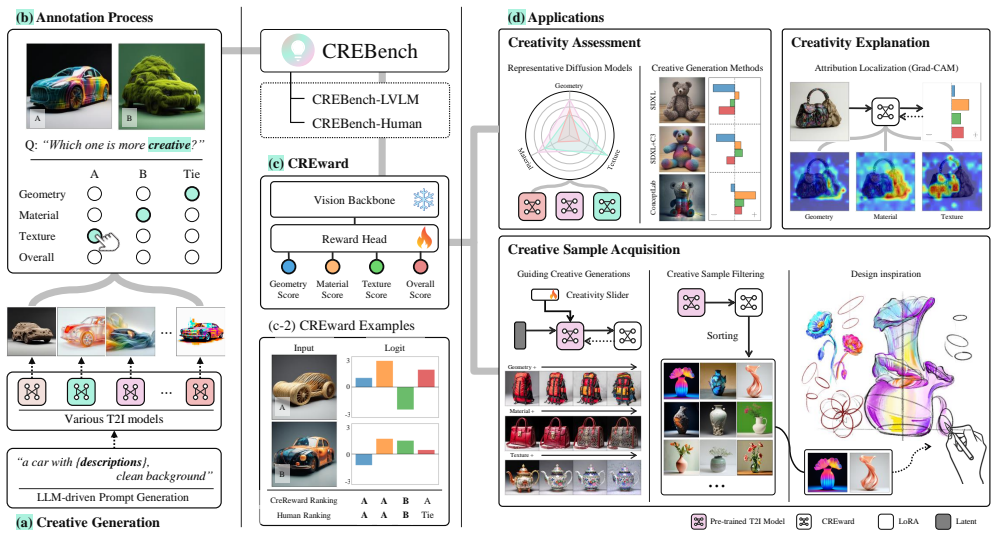
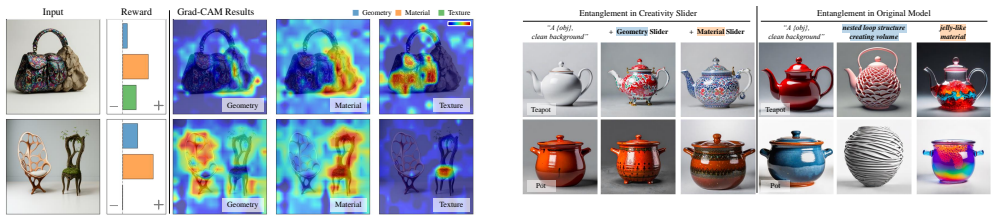
The load-bearing object is CREward itself: a frozen vision backbone (SigLIP) feeding a five-layer MLP head that outputs four scalar scores—geometry, material, texture, and overall—trained with a pairwise logistic loss on 5,000 image-pair triplets labeled by an open-weight LVLM. The type decomposition, grounded in image-formation concepts of shape, surface-light interaction, and surface detail, is what carries the argument: it makes the reward signal interpretable and enables type-specific controls. For generation, one-step denoising estimates are scored by CREward and used to train lightweight LoRA adapters, while Grad-CAM is applied to the differentiable scores for attribution.
Load-bearing premise
The human benchmark images are assumed to have been held out from the 5,000 pairs used to train CREward, but the paper does not state that exclusion, so the reported human correlations could partly reflect memorization of familiar images rather than learned creativity judgments.
What would settle it
Build a fresh human benchmark from newly generated images and prompts that never appeared in CREward's training data, then recompute the same rank correlations. If the numbers fall to roughly the baseline metric's level, the claim of human-aligned generalization collapses; if they stay near 0.6–0.76, it survives.
If this is right
- Creativity evaluation can be scaled without human annotation: LVLM-generated labels can seed a fast, lightweight scorer that tracks human judgments.
- Type-specific scores reveal which axis most strongly drives overall creativity—geometry correlates highest—so generative effort can be directed at shape rather than surface detail.
- CREward can filter large batches of generated images, surfacing top creative examples for design inspiration in human–AI co-creation workflows.
- Because the score is differentiable, it can be plugged into diffusion fine-tuning, yielding type-specific or mixed LoRA sliders that generalize to objects never seen during training.
- The model provides a structured benchmark for comparing text-to-image systems on creative output, complementing fidelity-focused metrics.
Where Pith is reading between the lines
- A natural extension is to build a human benchmark on objects and prompts fully held out from CREward's training set; the sliders already hint at cross-object transfer, but the human-alignment numbers have not been verified there.
- The high texture correlation (0.76) relative to low inter-human agreement (0.46) suggests CREward may be capturing a consensus that individual designers do not reliably express—testable by asking annotators to re-rank texture pairs after group discussion.
- The LVLM-labeling recipe likely transfers beyond still images: the same geometry/material/texture decomposition could be applied to 3D assets or video frames.
- Since the stronger closed-source LVLM still beat CREward overall, distilling labels from that model or ensembling multiple LVLM annotators would probably push an open-weight reward model past the reported ceiling.
Editorial analysis
A structured set of objections, weighed in public.
Referee Report
Summary. The paper proposes CREward, a type-specific creativity reward model that scores generated images along geometry, material, texture, and overall creativity axes. The authors collect a small human pairwise-preference benchmark on five object classes, find that Gemini-2.5 and Gemma-3 correlate with the aggregated human ranks, and then use Gemma-3 labels on 5,000 synthetic image pairs to train a frozen SigLIP backbone with an MLP reward head. They report rank correlations against the human benchmark (Table 1) and use the resulting model for model comparison, sample filtering, Grad-CAM explanations, and LoRA-based creativity sliders. The paper argues that LVLM-derived labels are sufficient to build an open-weight, human-aligned creativity metric.
Significance. If the reported correlations are not an artifact of benchmark overlap or evaluation confounds, CREward would be a practical and interpretable alternative to costly human creativity annotation, and the open-weight model would let others benchmark creative generation along disentangled axes. The paper's strengths are its explicit human benchmark, the systematic comparison of five vision backbones, the pairwise preference formulation with tie handling, and the candid discussion of limitations (novelty-vs-value bias, type entanglement). The main evaluation is, however, built on a very small human sample and on an unstated train/benchmark split, so the significance is conditional on fixing these issues.
major comments (4)
- [Sec. 3.1, 3.3, 3.4] The central evaluation in Table 1 requires that CREBench-Human measures generalization rather than memorization. The paper never states that the 25 benchmark images per object were excluded from the 5,000 training pairs. CREBench-Human is built by selecting 20 creative + 5 normal images from 5,000 generated images for the same five objects used in training, and the training pairs are sampled from generations obtained with the same prompt-generation recipe and, apparently, the same T2I models (Sec. 3.3). If any benchmark image is in the training-pair pool, a frozen backbone with a trainable MLP head can memorize preference labels over 20 epochs, inflating the Table 1 rank correlations. Please add an explicit holdout statement, or re-run the evaluation with a benchmark whose images are provably disjoint from training, and report which models/prompts generated the human benchmark images.
- [Table 1 / Sec. 3.2] The claim that Gemini-2.5 'exceeds inter-human correlation' compares the correlation of Gemini to the averaged human ranking against the mean annotator-to-annotator correlation. These quantities are not commensurable: averaging across annotators removes individual noise and mechanically increases correlation. The same issue affects the relative standing of CREward in Table 1, where CREward is also compared against the averaged human ranking. Please report LVLM/CREward correlations against each annotator separately (and their mean), or compute an inter-human baseline in the same aggregated metric (e.g., split-half correlation of averaged human ranks).
- [Sec. 4.2 / App. C.2.2, Eq. (6)] The LoRA sliders are trained by maximizing the CREward score (Eq. 6), and the quantitative evaluation in Figure C uses that same CREward score as the primary success metric. This is partly self-confirming: the sliders are optimized for exactly the objective used to measure them. The LVLM improvement ratio in Figure D is a useful independent signal, but Gemma-3 is the same model family that generated the training labels, so it is not fully independent. Please report human ratings or a held-out LVLM (e.g., Gemini-2.5) for the slider comparison, and use CREward only as a monitoring signal rather than as the outcome measure.
- [Table 1 / Sec. 3.5] The human benchmark is very small (5 objects, 5 annotators, 25 images per object, 100 pairs per object). With 25 items, the rank correlations have wide confidence intervals; for example, Texture CREward = 0.76 (0.12), Gemini = 0.74 (0.06), and Surprise = 0.49 (0.19) may not be statistically distinguishable. The statement that CREward 'surpasses even the closed-source Gemini-2.5 on texture creativity' is not supported without confidence intervals or a paired test across the five objects. Please provide such intervals or explicitly soften the claim.
minor comments (5)
- [Sec. 4.3] The main text refers to 'Figure H' when presenting Grad-CAM results, but Figure H is a supplementary figure; the in-main reference should be Figure 9.
- [Sec. 3.4] The citation 'SDXL-DMD2 [36, 36]' duplicates reference 36; one entry should be [37]. Also, the TAESD decoder is referenced only by a footnote URL; a formal citation would be preferable.
- [Eq. (3) and App. Eq. (5)-(6)] The clean-sample estimate is denoted \hat{x}_{0,t} in the main text but \bar{x}_{0,t} in the appendix. Please unify the notation.
- [Figure 2(d)] The figure contains the typo 'CreReward Ranking'; it should be 'CREward Ranking'.
- [Sec. 3.5] Minor wording: 'Surprisescore' should be 'Surprise score', and the sentence beginning 'We use theSurprisescore' has a spacing issue.
Circularity Check
LoRA-slider evaluation optimizes and then measures with the same reward/teacher; the central human-alignment benchmark is external and not shown circular.
specific steps
-
fitted input called prediction
[Sec. 4.2 (Guiding Creative Generations), Eq. (6); App. C.2.1–C.2.2]
"For criterion c with reward model f(c)_θ(·), we use Lcre = −f(c)_θ(ˆx0,t) ... For every generated image, we report: (1) the CREward score (higher is better), and (2) the LVLM improvement ratio ... we ask the LVLM (Gemma-3) to choose the more creative image ... between the original output and its creativity-enhanced counterparts."
The LoRA slider is trained by maximizing the CREward score f via Lcre, and the same f is then reported as the primary evidence that the slider enhances creativity. A positive f-score change is therefore a direct consequence of the training objective (modulo regularization and generalization), not an independent prediction. The secondary Gemma-3 improvement ratio is also not independent: Gemma-3 is exactly the LVLM whose preference labels were used to train CREward (Sec. 3.3), so the evaluator shares the training-signal source. The slider validation thus reduces to optimizing and then measuring with the same reward/teacher.
full rationale
The paper's central claim—that CREward, trained solely on Gemma-3 labels, aligns with human creativity rankings—is not circular on its face: CREward is trained on LVLM-generated pairwise labels, and Table 1 compares it against independent human annotator rankings on CREBench-Human. That comparison is an external test, provided the human-benchmark images are disjoint from CREward's training pairs. The paper never explicitly states that holdout, and the 'fixed train–val–test split' in Sec. 3.4 refers only to the LVLM-labeled pair set. If the 25 human-benchmark images per object were included among the images used to sample CREward's 5,000 training pairs, the Table 1 correlations could reflect memorization rather than generalization. However, the text does not demonstrate that overlap, so I do not count it as a demonstrated circular step; it is a missing-support / data-integrity risk. The concrete circularity I find is in the LoRA-slider application: the slider is trained to maximize CREward and then evaluated primarily by CREward itself, with the secondary evaluator (Gemma-3) being the same model that generated CREward's training labels. This makes the application-level evidence partially self-confirming, but it does not undermine the external human-alignment evaluation of CREward itself. There is no load-bearing self-citation or uniqueness-theorem import in the paper. Overall score 4: one meaningful circular evaluation loop in a downstream application, while the central contribution retains independent content.
Axiom & Free-Parameter Ledger
free parameters (2)
- Human/prompt curation choices =
8 of 10 agnostic and 12 of 20 object-specific prompts per type manually selected; 20 of 5,000 images per object manually
- SigLIP backbone and training hyperparameters =
SigLIP (Gemma-3 vision encoder), 5-layer MLP, dropout 0.2, 20 epochs, pairwise logistic loss
axioms (6)
- standard math Pairwise logistic preference model (Eq. 1-2) assumes Bradley-Terry-like transitive preferences and that excluding ties is harmless.
- domain assumption Geometry, material, and texture are the relevant creativity dimensions and are independently judgable by humans and LVLMs.
- domain assumption Expert annotators' pairwise judgments on 25 images per object approximate human creativity perception.
- domain assumption LVLM (Gemma-3) pairwise labels are a reliable proxy for human creativity preferences at scale.
- domain assumption CREBench-Human images are disjoint from CREward training pairs; without this, human-alignment estimates are inflated.
- domain assumption Optimizing CREward score through LoRA increases human-perceived creativity of the target type.
invented entities (2)
-
Geometry/Material/Texture creativity axes
no independent evidence
-
CREward scalar rewards
no independent evidence
Cite this review
Pith. "Pith review of CREward: A Type-Specific Creativity Reward Model." pith.science (2026). https://pith.science/paper/PEXQO3HU
@misc{pith2026251119995,
  author       = {Pith},
  title        = {Pith review of: CREward: A Type-Specific Creativity Reward Model},
  year         = {2026},
  howpublished = {\url{https://pith.science/paper/PEXQO3HU}},
  note         = {Machine review of arXiv:2511.19995}
}
read the original abstract
Creativity is a complex phenomenon. When it comes to representing and assessing creativity, treating it as a single undifferentiated quantity would appear naive and underwhelming. In this work, we learn the \emph{first type-specific creativity reward model}, coined CREward, which spans three creativity ``axes," geometry, material, and texture, to allow us to view creativity through the lens of the image formation pipeline. To build our reward model, we first conduct a human benchmark evaluation to capture human perception of creativity for each type across various creative images. We then analyze the correlation between human judgments and predictions by large vision-language models (LVLMs), confirming that LVLMs exhibit strong alignment with human perception. Building on this observation, we collect LVLM-generated labels to train our CREward model that is applicable to both evaluation and generation of creative images. We explore three applications of CREward: creativity assessment, explainable creativity, and creative sample acquisition for both human design inspiration and guiding creative generation through low-rank adaptation.
Figures



Reference graph
Works this paper leans on
-
[1]
Creativity and artificial intelligence.Ar- tificial intelligence, 103(1-2):347–356, 1998
Margaret A Boden. Creativity and artificial intelligence.Ar- tificial intelligence, 103(1-2):347–356, 1998. 2, 8
1998
-
[2]
Mllm-as-a-judge: Assessing multimodal llm-as-a-judge with vision-language benchmark
Dongping Chen, Ruoxi Chen, Shilin Zhang, Yaochen Wang, Yinuo Liu, Huichi Zhou, Qihui Zhang, Yao Wan, Pan Zhou, and Lichao Sun. Mllm-as-a-judge: Assessing multimodal llm-as-a-judge with vision-language benchmark. InForty- first International Conference on Machine Learning, 2024. 3
2024
-
[3]
Pixart-α: Fast training of dif- fusion transformer for photorealistic text-to-image synthesis,
Junsong Chen, Jincheng Yu, Chongjian Ge, Lewei Yao, Enze Xie, Yue Wu, Zhongdao Wang, James Kwok, Ping Luo, Huchuan Lu, and Zhenguo Li. Pixart-α: Fast training of dif- fusion transformer for photorealistic text-to-image synthesis,
-
[4]
Gheorghe Comanici, Eric Bieber, Mike Schaekermann, Ice Pasupat, Noveen Sachdeva, Inderjit Dhillon, Marcel Blis- tein, Ori Ram, Dan Zhang, Evan Rosen, et al. Gemini 2.5: Pushing the frontier with advanced reasoning, multimodality, long context, and next generation agentic capabilities.arXiv preprint arXiv:2507.06261, 2025. 3
Pith/arXiv arXiv 2025
-
[5]
Scaling recti- fied flow transformers for high-resolution image synthesis
Patrick Esser, Sumith Kulal, Andreas Blattmann, Rahim Entezari, Jonas M ¨uller, Harry Saini, Yam Levi, Dominik Lorenz, Axel Sauer, Frederic Boesel, et al. Scaling recti- fied flow transformers for high-resolution image synthesis. InForty-first international conference on machine learning,
-
[6]
Redefining⟨creative⟩in dictionary: Towards an enhanced se- mantic understanding of creative generation
Fu Feng, Yucheng Xie, Xu Yang, Jing Wang, and Xin Geng. Redefining⟨creative⟩in dictionary: Towards an enhanced se- mantic understanding of creative generation. InProceedings of the Computer Vision and Pattern Recognition Conference, pages 18444–18454, 2025. 2
2025
-
[7]
Stephanie Fu, Netanel Tamir, Shobhita Sundaram, Lucy Chai, Richard Zhang, Tali Dekel, and Phillip Isola. Dream- sim: Learning new dimensions of human visual similar- ity using synthetic data.arXiv preprint arXiv:2306.09344,
-
[8]
Sliderspace: Decomposing the visual capabilities of diffusion models
Rohit Gandikota, Zongze Wu, Richard Zhang, David Bau, Eli Shechtman, and Nick Kolkin. Sliderspace: Decomposing the visual capabilities of diffusion models. InProceedings of the IEEE/CVF International Conference on Computer Vi- sion, pages 15994–16003, 2025. 7, 6
2025
-
[9]
Jiyeon Han, Hwanil Choi, Yunjey Choi, Junho Kim, Jung- Woo Ha, and Jaesik Choi. Rarity score: A new metric to evaluate the uncommonness of synthesized images.arXiv preprint arXiv:2206.08549, 2022. 2
Pith/arXiv arXiv 2022
-
[10]
Enhancing creative generation on stable diffusion-based models
Jiyeon Han, Dahee Kwon, Gayoung Lee, Junho Kim, and Jaesik Choi. Enhancing creative generation on stable diffusion-based models. InProceedings of the Computer Vision and Pattern Recognition Conference, pages 28609– 28618, 2025. 2, 3, 6
2025
-
[11]
Clipscore: A reference-free evaluation met- ric for image captioning
Jack Hessel, Ari Holtzman, Maxwell Forbes, Ronan Le Bras, and Yejin Choi. Clipscore: A reference-free evaluation met- ric for image captioning. InProceedings of the 2021 confer- ence on empirical methods in natural language processing, pages 7514–7528, 2021. 2
2021
-
[12]
Gans trained by a two time-scale update rule converge to a local nash equilib- rium.Advances in neural information processing systems, 30, 2017
Martin Heusel, Hubert Ramsauer, Thomas Unterthiner, Bernhard Nessler, and Sepp Hochreiter. Gans trained by a two time-scale update rule converge to a local nash equilib- rium.Advances in neural information processing systems, 30, 2017. 2
2017
-
[13]
Hughes, Andries van Dam, Morgan McGuire, David F
John F. Hughes, Andries van Dam, Morgan McGuire, David F. Sklar, James D. Foley, Steven K. Feiner, and Kurt Akeley.Computer graphics: principles and practice (3rd ed.). Addison-Wesley Professional, Boston, MA, USA,
-
[14]
Improved precision and recall met- ric for assessing generative models.Advances in neural in- formation processing systems, 32, 2019
Tuomas Kynk ¨a¨anniemi, Tero Karras, Samuli Laine, Jaakko Lehtinen, and Timo Aila. Improved precision and recall met- ric for assessing generative models.Advances in neural in- formation processing systems, 32, 2019. 2
2019
-
[15]
Flux.https://github.com/ black-forest-labs/flux, 2024
Black Forest Labs. Flux.https://github.com/ black-forest-labs/flux, 2024. 4
2024
-
[16]
Blip-2: Bootstrapping language-image pre-training with frozen image encoders and large language models
Junnan Li, Dongxu Li, Silvio Savarese, and Steven Hoi. Blip-2: Bootstrapping language-image pre-training with frozen image encoders and large language models. InIn- ternational conference on machine learning, pages 19730– 19742. PMLR, 2023. 3
2023
-
[17]
Vlm-eval: A general evaluation on video large language models.arXiv preprint arXiv:2311.11865, 2023
Shuailin Li, Yuang Zhang, Yucheng Zhao, Qiuyue Wang, Fan Jia, Yingfei Liu, and Tiancai Wang. Vlm-eval: A general evaluation on video large language models.arXiv preprint arXiv:2311.11865, 2023. 3
Pith/arXiv arXiv 2023
-
[18]
Hunyuan-dit: A powerful multi-resolution diffusion trans- former with fine-grained chinese understanding, 2024
Zhimin Li, Jianwei Zhang, Qin Lin, Jiangfeng Xiong, Yanxin Long, Xinchi Deng, Yingfang Zhang, Xingchao Liu, Minbin Huang, Zedong Xiao, Dayou Chen, Jiajun He, Jiahao Li, Wenyue Li, Chen Zhang, Rongwei Quan, Jianxiang Lu, Jiabin Huang, Xiaoyan Yuan, Xiaoxiao Zheng, Yixuan Li, Ji- hong Zhang, Chao Zhang, Meng Chen, Jie Liu, Zheng Fang, Weiyan Wang, Jinbao Xu...
2024
-
[19]
MIT press, 2010
David Marr.Vision: A computational investigation into the human representation and processing of visual information. MIT press, 2010. 5
2010
-
[20]
Forest before trees: The precedence of global features in visual perception.Cognitive psychology, 9(3): 353–383, 1977
David Navon. Forest before trees: The precedence of global features in visual perception.Cognitive psychology, 9(3): 353–383, 1977. 5
1977
-
[21]
Training language models to follow instructions with human feedback.Ad- vances in neural information processing systems, 35:27730– 27744, 2022
Long Ouyang, Jeffrey Wu, Xu Jiang, Diogo Almeida, Car- roll Wainwright, Pamela Mishkin, Chong Zhang, Sandhini Agarwal, Katarina Slama, Alex Ray, et al. Training language models to follow instructions with human feedback.Ad- vances in neural information processing systems, 35:27730– 27744, 2022. 4
2022
-
[22]
MIT Press, 2023
Matt Pharr, Wenzel Jakob, and Greg Humphreys.Physi- cally based rendering: From theory to implementation. MIT Press, 2023. 1
2023
-
[23]
Learning transferable visual models from natural language supervi- sion
Alec Radford, Jong Wook Kim, Chris Hallacy, Aditya Ramesh, Gabriel Goh, Sandhini Agarwal, Girish Sastry, Amanda Askell, Pamela Mishkin, Jack Clark, et al. Learning transferable visual models from natural language supervi- sion. InInternational conference on machine learning, pages 8748–8763. PmLR, 2021. 5
2021
-
[24]
Conceptlab: Creative concept generation using 9 vlm-guided diffusion prior constraints.ACM Transactions on Graphics, 43(3):1–14, 2024
Elad Richardson, Kfir Goldberg, Yuval Alaluf, and Daniel Cohen-Or. Conceptlab: Creative concept generation using 9 vlm-guided diffusion prior constraints.ACM Transactions on Graphics, 43(3):1–14, 2024. 2, 3, 6
2024
-
[25]
Grad-cam: Visual explanations from deep networks via gradient-based localization
Ramprasaath R Selvaraju, Michael Cogswell, Abhishek Das, Ramakrishna Vedantam, Devi Parikh, and Dhruv Batra. Grad-cam: Visual explanations from deep networks via gradient-based localization. InProceedings of the IEEE in- ternational conference on computer vision, pages 618–626,
-
[26]
Oriane Sim ´eoni, Huy V . V o, Maximilian Seitzer, Federico Baldassarre, Maxime Oquab, Cijo Jose, Vasil Khalidov, Marc Szafraniec, Seungeun Yi, Micha ¨el Ramamonjisoa, Francisco Massa, Daniel Haziza, Luca Wehrstedt, Jianyuan Wang, Timoth´ee Darcet, Th´eo Moutakanni, Leonel Sentana, Claire Roberts, Andrea Vedaldi, Jamie Tolan, John Brandt, Camille Couprie,...
2025
-
[27]
Karen Simonyan and Andrew Zisserman. Very deep convo- lutional networks for large-scale image recognition.arXiv preprint arXiv:1409.1556, 2014. 5
Pith/arXiv arXiv 2014
-
[28]
Learning to summarize with human feed- back.Advances in neural information processing systems, 33:3008–3021, 2020
Nisan Stiennon, Long Ouyang, Jeffrey Wu, Daniel Ziegler, Ryan Lowe, Chelsea V oss, Alec Radford, Dario Amodei, and Paul F Christiano. Learning to summarize with human feed- back.Advances in neural information processing systems, 33:3008–3021, 2020. 4
2020
-
[29]
Gemma 3 technical report.arXiv preprint arXiv:2503.19786, 2025
Gemma Team, Aishwarya Kamath, Johan Ferret, Shreya Pathak, Nino Vieillard, Ramona Merhej, Sarah Perrin, Ta- tiana Matejovicova, Alexandre Ram ´e, Morgane Rivi `ere, et al. Gemma 3 technical report.arXiv preprint arXiv:2503.19786, 2025. 3, 5
Pith/arXiv arXiv 2025
-
[30]
Qwen3 technical report, 2025
Qwen Team. Qwen3 technical report, 2025. 3
2025
-
[31]
Kandinsky 3: Text-to-image synthesis for multifunctional generative framework
Arkhipkin Vladimir, Viacheslav Vasilev, Andrei Filatov, Igor Pavlov, Julia Agafonova, Nikolai Gerasimenko, Anna Averchenkova, Evelina Mironova, Bukashkin Anton, Kon- stantin Kulikov, Andrey Kuznetsov, and Denis Dimitrov. Kandinsky 3: Text-to-image synthesis for multifunctional generative framework. InProceedings of the 2024 Con- ference on Empirical Metho...
2024
-
[32]
Evaluation of text-to-image generation from a cre- ativity perspective
Xinhao Wang, Xinyu Ma, ShengYong Ding, and Derek F Wong. Evaluation of text-to-image generation from a cre- ativity perspective. InFindings of the Association for Com- putational Linguistics: EMNLP 2025, pages 481–493, 2025. 2, 4, 5
2025
-
[33]
Yibin Wang, Yuhang Zang, Hao Li, Cheng Jin, and Jiaqi Wang. Unified reward model for multimodal understanding and generation.arXiv preprint arXiv:2503.05236, 2025. 3
Pith/arXiv arXiv 2025
-
[34]
Imagere- ward: Learning and evaluating human preferences for text- to-image generation.Advances in Neural Information Pro- cessing Systems, 36:15903–15935, 2023
Jiazheng Xu, Xiao Liu, Yuchen Wu, Yuxuan Tong, Qinkai Li, Ming Ding, Jie Tang, and Yuxiao Dong. Imagere- ward: Learning and evaluating human preferences for text- to-image generation.Advances in Neural Information Pro- cessing Systems, 36:15903–15935, 2023. 3, 4, 7, 6
2023
-
[35]
Jiazheng Xu, Yu Huang, Jiale Cheng, Yuanming Yang, Jiajun Xu, Yuan Wang, Wenbo Duan, Shen Yang, Qunlin Jin, Shu- run Li, et al. Visionreward: Fine-grained multi-dimensional human preference learning for image and video generation. arXiv preprint arXiv:2412.21059, 2024. 3
Pith/arXiv arXiv 2024
-
[36]
Im- proved distribution matching distillation for fast image syn- thesis
Tianwei Yin, Micha ¨el Gharbi, Taesung Park, Richard Zhang, Eli Shechtman, Fredo Durand, and William T Freeman. Im- proved distribution matching distillation for fast image syn- thesis. InNeurIPS, 2024. 5, 6
2024
-
[37]
, clean background
Tianwei Yin, Micha ¨el Gharbi, Richard Zhang, Eli Shecht- man, Fr´edo Durand, William T Freeman, and Taesung Park. One-step diffusion with distribution matching distillation. In CVPR, 2024. 6 10 CREward: A Type-Specific Creativity Reward Model Supplementary Material A. Supplementary on CREBench A.1. Selection of Types To identify the factors or elements t...
2024
This paper was first reviewed by deepseek-v4-flash on August 3, 2026.
discussion (0)
Sign in with ORCID, Apple, or X to comment. Anyone can read and Pith papers without signing in.