Quantum Feature Pyramid Gating for Seismic Image Segmentation
Pith reviewed 2026-05-19 15:42 UTC · model grok-4.3
The pith
A 4-qubit quantum circuit at Feature Pyramid merge points raises mean IoU from 0.8404 to 0.9389 on seismic salt segmentation.
A machine-rendered reading of the paper's core claim, the machinery that carries it, and where it could break.
Core claim
Embedding a 4-qubit, 2-layer parameterized quantum circuit with data re-uploading at each Feature Pyramid Network merge point computes a learned convex combination of lateral and top-down features from a global-average-pooled input; this yields higher segmentation accuracy than classical fusion, shown by the 9.85 percentage-point mean IoU gap when the same circuit is replaced by element-wise addition in an EfficientNetV2-L pipeline at 256 by 256 resolution.
What carries the argument
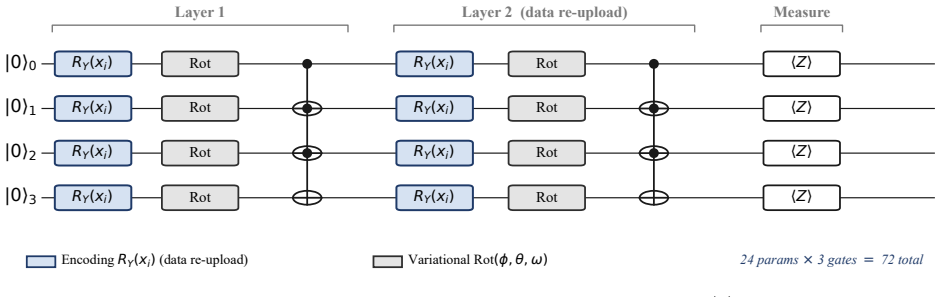
The Quantum FPN Gate: a 4-qubit parameterized quantum circuit that maps pooled encoder features to a learned convex combination of multi-scale skip and lateral features at each pyramid merge point while keeping the quantum parameter count fixed at 72 regardless of image resolution or backbone size.
If this is right
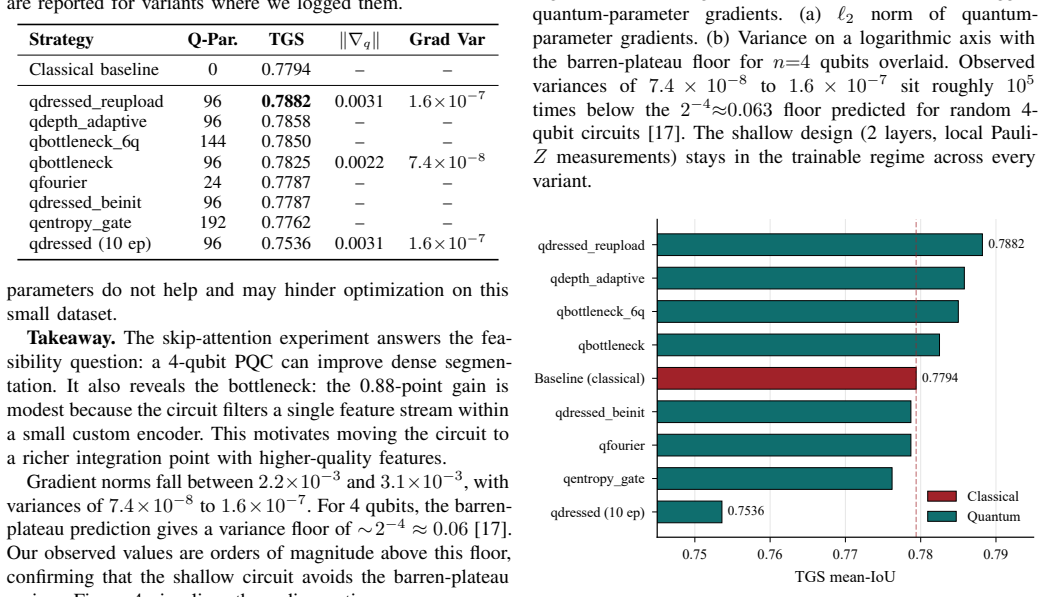
- Placing the same circuit as skip-connection attention inside a custom U-Net raises IoU by 0.88 points over the SolidUNet baseline.
- The size of the performance gain depends on the precise location and role of the quantum gate within the architecture.
- Global average pooling decouples the quantum parameter budget from encoder depth and image resolution, allowing the same 72-parameter circuit to work across backbones ranging from 8 M to 118 M parameters.
Where Pith is reading between the lines
- A direct comparison against a classical neural-network gate that has the same parameter count would isolate whether the quantum circuit contributes beyond extra capacity.
- The same lightweight quantum gating pattern could be tested on other dense-prediction problems that rely on multi-scale feature fusion.
Load-bearing premise
The observed accuracy gain is produced by the quantum circuit itself rather than by the addition of 72 trainable parameters or by the particular gating topology chosen.
What would settle it
Training an otherwise identical model that substitutes a classical parametric layer with exactly 72 parameters for each quantum gate and measuring whether mean IoU stays at 0.9389 or falls back toward 0.8404 would decide whether the quantum properties are required.
Figures



read the original abstract
Accurate salt-body delineation is essential for seismic interpretation because salt structures distort wave propagation, complicate velocity-model building, obscure reservoir geometry, and increase uncertainty in exploration and drilling decisions. Although hybrid quantum-classical models have shown competitive performance on small-scale image-classification tasks, their value for dense, pixel-level geophysical prediction remains largely untested. This work introduces quantum feature gating, a hybrid segmentation architecture that embeds a parameterized quantum circuit (PQC) at feature-fusion points within an encoder-decoder pipeline. A 4-qubit, 2-layer PQC with data re-uploading computes a learned convex combination of lateral and top-down features at each Feature Pyramid Network merge point. A global-average-pooling layer maps encoder features to a fixed 4-dimensional quantum input, decoupling the 72-parameter quantum budget from backbone size and image resolution. The method is evaluated on the 2018 TGS Salt Identification Challenge using 4,000 seismic images at 101 x 101 resolution, across two integration topologies, eight circuit variants, and six encoders with 8M to 118M parameters under five-fold cross-validation. In a controlled EfficientNetV2-L ablation at 256 x 256 resolution, replacing the three Quantum FPN Gates with element-wise addition while holding the encoder, loss schedule, splits, and threshold search fixed reduces mean IoU from 0.9389 to 0.8404, a 9.85 percentage-point gap. Inserting the same circuit as skip-connection attention in a custom U-Net improves IoU by 0.88 points over the SolidUNet baseline, showing that the PQC contribution depends on where and what it gates. These results provide controlled evidence that quantum feature fusion can improve dense seismic segmentation.
Editorial analysis
A structured set of objections, weighed in public.
Referee Report
Summary. The paper introduces a hybrid quantum-classical segmentation architecture that embeds 4-qubit, 2-layer parameterized quantum circuits (PQCs) with data re-uploading as feature gates at Feature Pyramid Network merge points inside encoder-decoder backbones. Global average pooling reduces encoder features to a 4D quantum input, keeping the quantum parameter budget fixed at 72 regardless of backbone size or resolution. On the TGS Salt Identification Challenge dataset the method is tested across encoders, integration topologies, and circuit variants; the central empirical result is a controlled EfficientNetV2-L ablation at 256×256 resolution in which the three Quantum FPN Gates yield mean IoU 0.9389 versus 0.8404 when replaced by element-wise addition (9.85-point gap) while holding encoder, loss schedule, splits, and threshold search fixed.
Significance. If the reported gap is shown to be quantum-specific rather than a consequence of added capacity, the work would supply the first controlled evidence that PQCs can improve dense pixel-level geophysical prediction. The design choice to decouple quantum parameter count from backbone size and the use of five-fold cross-validation on a public benchmark are positive features. The current evidence, however, does not yet isolate the quantum contribution from the simple addition of 72 trainable parameters.
major comments (1)
- [Abstract and ablation study] Abstract and ablation study (EfficientNetV2-L at 256×256): the 9.85-point IoU improvement is obtained by replacing the Quantum FPN Gates with non-parametric element-wise addition. Because the PQC introduces 72 trainable parameters while addition introduces none, the gap does not yet demonstrate a quantum-specific benefit; a classical parametric module (e.g., small MLP or affine transform) with exactly 72 parameters inserted at the identical FPN merge points is required as a capacity-matched control.
minor comments (2)
- [Results] The manuscript states that eight circuit variants were evaluated but reports detailed metrics only for the 4-qubit, 2-layer re-uploading circuit; a brief table or paragraph summarizing IoU for the other variants would clarify whether the observed gain is robust to circuit choice.
- [Experimental results] No standard deviations, error bars, or number of independent training runs are provided for the reported mean IoU values, limiting assessment of statistical reliability of the 9.85-point gap.
Simulated Author's Rebuttal
We thank the referee for the careful review and for identifying the need to isolate the contribution of the quantum circuit from added model capacity. We agree that the current ablation does not fully address this and will revise the manuscript accordingly.
read point-by-point responses
-
Referee: [Abstract and ablation study] Abstract and ablation study (EfficientNetV2-L at 256×256): the 9.85-point IoU improvement is obtained by replacing the Quantum FPN Gates with non-parametric element-wise addition. Because the PQC introduces 72 trainable parameters while addition introduces none, the gap does not yet demonstrate a quantum-specific benefit; a classical parametric module (e.g., small MLP or affine transform) with exactly 72 parameters inserted at the identical FPN merge points is required as a capacity-matched control.
Authors: We agree that the existing control using non-parametric element-wise addition does not match the 72 trainable parameters of the PQC and therefore cannot yet isolate a quantum-specific effect. In the revised manuscript we will add a new ablation that replaces the Quantum FPN Gates with a classical parametric module containing exactly 72 parameters (implemented as a small MLP with one hidden layer or a learned affine transform) at the identical FPN merge points. All other experimental factors—encoder (EfficientNetV2-L), input resolution (256×256), loss schedule, data splits, five-fold cross-validation, and threshold search—will be held fixed. The updated results will be reported in both the abstract and the ablation study section. revision: yes
Circularity Check
No circularity in empirical ablation results
full rationale
The paper presents an empirical ablation study on the TGS Salt Identification dataset, reporting a mean IoU difference between a quantum-gated model and an element-wise addition baseline under fixed encoder, loss, splits, and threshold conditions. No mathematical derivation chain, equations, or first-principles predictions are claimed that reduce the observed IoU gap to quantities defined by the fitted quantum parameters themselves. The central evidence consists of controlled experimental comparisons rather than self-referential constructions, fitted inputs renamed as predictions, or load-bearing self-citations. The analysis is self-contained against external benchmarks and does not rely on any of the enumerated circularity patterns.
Axiom & Free-Parameter Ledger
free parameters (1)
- PQC parameters =
72
axioms (1)
- standard math Parameterized quantum circuits with 4 qubits can be classically simulated without exponential cost
Lean theorems connected to this paper
-
IndisputableMonolith/Cost/FunctionalEquation.leanwashburn_uniqueness_aczel unclear?
unclearRelation between the paper passage and the cited Recognition theorem.
a 4-qubit, 2-layer PQC with data re-uploading computes a learned convex combination of lateral and top-down features at each Feature Pyramid Network merge point... Global-average-pooling compression layer maps encoder features to a fixed 4-dimensional quantum input
-
IndisputableMonolith/Foundation/RealityFromDistinction.leanreality_from_one_distinction unclear?
unclearRelation between the paper passage and the cited Recognition theorem.
replacing the three Quantum FPN Gates with element-wise addition... reduces mean IoU from 0.9389 to 0.8404
What do these tags mean?
- matches
- The paper's claim is directly supported by a theorem in the formal canon.
- supports
- The theorem supports part of the paper's argument, but the paper may add assumptions or extra steps.
- extends
- The paper goes beyond the formal theorem; the theorem is a base layer rather than the whole result.
- uses
- The paper appears to rely on the theorem as machinery.
- contradicts
- The paper's claim conflicts with a theorem or certificate in the canon.
- unclear
- Pith found a possible connection, but the passage is too broad, indirect, or ambiguous to say the theorem truly supports the claim.
Reference graph
Works this paper leans on
-
[1]
Parameterized quantum circuits as machine learning models,
M. Benedetti, E. Lloyd, S. Sack, and M. Fiorentini, “Parameterized quantum circuits as machine learning models,”Quantum Science and Technology, vol. 4, no. 4, p. 043001, 2019
work page 2019
-
[2]
Quantum machine learning for image classification,
A. Senokosov, A. Sedykh, A. Sagingalieva, B. Kyriacou, and A. Mel- nikov, “Quantum machine learning for image classification,”Machine Learning: Science and Technology, vol. 5, p. 015040, 2024
work page 2024
-
[3]
Transfer learning in hybrid classical-quantum neural networks,
A. Mari, T. R. Bromley, J. Izaac, M. Schuld, and N. Killoran, “Transfer learning in hybrid classical-quantum neural networks,”Quantum, vol. 4, p. 340, 2020
work page 2020
-
[4]
Quanvolutional neural networks: Powering image recognition with quantum circuits,
M. Henderson, S. Shakya, S. Pradhan, and T. Cook, “Quanvolutional neural networks: Powering image recognition with quantum circuits,” Quantum Machine Intelligence, vol. 2, p. 2, 2020
work page 2020
-
[5]
Effect of data encoding on the expressive power of variational quantum machine-learning models,
M. Schuld, R. Sweke, and J. J. Meyer, “Effect of data encoding on the expressive power of variational quantum machine-learning models,” Physical Review A, vol. 103, no. 3, p. 032430, 2021
work page 2021
-
[6]
Feature pyramid networks for object detection,
T.-Y . Lin, P. Dollár, R. Girshick, K. He, B. Hariharan, and S. Belongie, “Feature pyramid networks for object detection,” inCVPR, 2017
work page 2017
-
[7]
U-net: Convolutional networks for biomedical image segmentation,
O. Ronneberger, P. Fischer, and T. Brox, “U-net: Convolutional networks for biomedical image segmentation,” inMICCAI, 2015, pp. 234–241
work page 2015
-
[8]
TGS salt identification challenge,
TGS, “TGS salt identification challenge,” 2018, kaggle competition, 3,234 teams. [Online]. Available: https://www.kaggle. com/c/tgs-salt-identification-challenge
work page 2018
-
[9]
Y . Babakhin, A. Sanakoyeu, and H. Kitamura, “Semi-supervised seg- mentation of salt bodies in seismic images using an ensemble of convolutional neural networks,” inPattern Recognition (GCPR), ser. LNCS, vol. 11824. Springer, 2019, pp. 218–231
work page 2019
-
[10]
A comprehensive review of deep learning techniques for salt dome segmentation in seismic images,
M. S. U. Islam and A. Wali, “A comprehensive review of deep learning techniques for salt dome segmentation in seismic images,”Journal of Applied Geophysics, vol. 228, p. 105504, 2024
work page 2024
-
[11]
HQF-Net: A Hybrid Quantum-Classical Multi-Scale Fusion Network for Remote Sensing Image Segmentation
M. A. Hossain, A. V . Patel, S. Gole, S. K. Singh, and B. Banerjee, “HQF-Net: A hybrid quantum-classical multi-scale fusion network for remote sensing image segmentation,”arXiv preprint arXiv:2604.06715, 2026
work page internal anchor Pith review Pith/arXiv arXiv 2026
-
[12]
Squeeze-and-excitation networks,
J. Hu, L. Shen, and G. Sun, “Squeeze-and-excitation networks,” in CVPR, 2018, pp. 7132–7141
work page 2018
-
[13]
Attention U-Net: Learning where to look for the pancreas,
O. Oktay, J. Schlemper, L. L. Folgoc, M. Lee, M. Heinrich, K. Misawa, K. Mori, S. McDonagh, N. Y . Hammerla, B. Kainz, B. Glocker, and D. Rueckert, “Attention U-Net: Learning where to look for the pancreas,” inMedical Imaging with Deep Learning (MIDL), 2018
work page 2018
-
[14]
PennyLane: Automatic differentiation of hybrid quantum-classical computations
V . Bergholm, J. Izaac, M. Schuld, C. Gogolin, S. Ahmed, V . Ajoy, M. S. Alamet al., “Pennylane: Automatic differentiation of hybrid quantum- classical computations,”arXiv preprint arXiv:1811.04968, 2018
work page internal anchor Pith review Pith/arXiv arXiv 2018
-
[15]
Data re-uploading for a universal quantum classifier,
A. Pérez-Salinas, A. Cervera-Lierta, E. Gil-Fuster, and J. I. Latorre, “Data re-uploading for a universal quantum classifier,”Quantum, vol. 4, p. 226, 2020
work page 2020
-
[16]
S. Sim, P. D. Johnson, and A. Aspuru-Guzik, “Expressibility and entan- gling capability of parameterized quantum circuits for hybrid quantum- classical algorithms,”Advanced Quantum Technologies, vol. 2, no. 12, p. 1900070, 2019
work page 2019
-
[17]
Barren plateaus in quantum neural network training landscapes,
J. R. McClean, S. Boixo, V . N. Smelyanskiy, R. Babbush, and H. Neven, “Barren plateaus in quantum neural network training landscapes,”Nature Communications, vol. 9, no. 1, p. 4812, 2018
work page 2018
-
[18]
Cost function dependent barren plateaus in shallow parametrized quantum circuits,
M. Cerezo, A. Sone, T. V olkoff, L. Cincio, and P. J. Coles, “Cost function dependent barren plateaus in shallow parametrized quantum circuits,” Nature Communications, vol. 12, no. 1, p. 1791, 2021
work page 2021
-
[19]
Quantum computing in the NISQ era and beyond,
J. Preskill, “Quantum computing in the NISQ era and beyond,”Quantum, vol. 2, p. 79, 2018
work page 2018
-
[20]
K. Mitarai, M. Negoro, M. Kitagawa, and K. Fujii, “Quantum circuit learning,”Physical Review A, vol. 98, no. 3, p. 032309, 2018
work page 2018
-
[21]
EfficientNetV2: Smaller models and faster training,
M. Tan and Q. V . Le, “EfficientNetV2: Smaller models and faster training,” inICML, 2021, pp. 10 096–10 106
work page 2021
-
[22]
A. Milosavljevi ´c, “Identification of salt deposits on seismic images using deep learning method for semantic segmentation,”ISPRS International Journal of Geo-Information, vol. 9, no. 1, p. 24, 2020
work page 2020
-
[23]
M. S. u. Islam and A. Wali, “Weighted ensemble transfer learning with EfficientNet: Advancing salt body segmentation in seismic imaging,” Computational Geosciences, 2025
work page 2025
-
[24]
CBAM: Convolutional block attention module,
S. Woo, J. Park, J.-Y . Lee, and I. S. Kweon, “CBAM: Convolutional block attention module,” inECCV, 2018, pp. 3–19
work page 2018
-
[25]
EfficientDet: Scalable and efficient object detection,
M. Tan, R. Pang, and Q. V . Le, “EfficientDet: Scalable and efficient object detection,” inCVPR, 2020, pp. 10 781–10 790
work page 2020
-
[26]
Training deep quantum neural networks,
K. Beer, D. Bondarenko, T. Farrelly, T. J. Osborne, R. Salzmann, D. Scheiermann, and R. Wolf, “Training deep quantum neural networks,” Nature Communications, vol. 11, p. 808, 2020
work page 2020
-
[27]
Quantum convolutional neural networks,
I. Cong, S. Choi, and M. D. Lukin, “Quantum convolutional neural networks,”Nature Physics, vol. 15, pp. 1273–1278, 2019
work page 2019
-
[28]
Support vector machines on the D-Wave quantum annealer,
D. Willsch, M. Willsch, H. De Raedt, and K. Michielsen, “Support vector machines on the D-Wave quantum annealer,”Computer Physics Communications, vol. 248, p. 107006, 2020
work page 2020
-
[29]
G. Cavallaro, D. Willsch, M. Willsch, K. Michielsen, and M. Riedel, “Approaching remote sensing image classification with ensembles of support vector machines on the D-Wave quantum annealer,” inIEEE International Geoscience and Remote Sensing Symposium (IGARSS), 2020, pp. 1973–1976
work page 2020
-
[30]
Q-Seg: Quantum annealing-based unsupervised image segmentation,
S. M. Venkatesh, A. Macaluso, M. Nuske, M. Klusch, and A. Dengel, “Q-Seg: Quantum annealing-based unsupervised image segmentation,” IEEE Computer Graphics and Applications, vol. 44, no. 6, pp. 56–67, 2024
work page 2024
-
[31]
Quantum optimization algorithms for CT image segmentation from X-ray data,
K. Jun and H. Lee, “Quantum optimization algorithms for CT image segmentation from X-ray data,”Scientific Reports, vol. 15, 2025
work page 2025
-
[32]
Pyramid Attention Network for Semantic Segmentation
H. Li, P. Xiong, J. An, and L. Wang, “Pyramid attention network for semantic segmentation,”arXiv preprint arXiv:1805.10180, 2018
work page internal anchor Pith review Pith/arXiv arXiv 2018
-
[33]
Self- attention fully convolutional DenseNets for automatic salt segmentation,
O. M. Saad, W. Chen, F. Zhang, L. Yang, X. Zhou, and Y . Chen, “Self- attention fully convolutional DenseNets for automatic salt segmentation,” IEEE Transactions on Neural Networks and Learning Systems, vol. 34, no. 7, pp. 3415–3428, 2022
work page 2022
discussion (0)
Sign in with ORCID, Apple, or X to comment. Anyone can read and Pith papers without signing in.