Evolutionary Optimization Reveals Structural Constraints on Reservoir Architecture for Spatiotemporal Chaos
Pith reviewed 2026-06-26 06:16 UTC · model grok-4.3
The pith
Evolutionary selection on reservoir hyperparameters exposes conserved structural constraints that improve prediction of spatiotemporal chaos.
A machine-rendered reading of the paper's core claim, the machinery that carries it, and where it could break.
Core claim
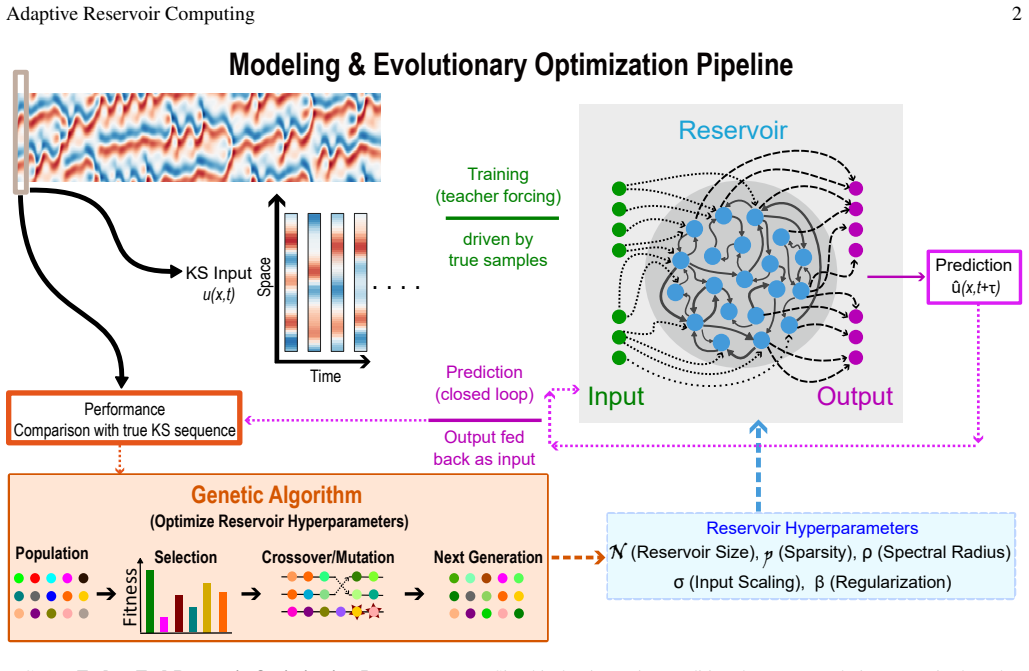
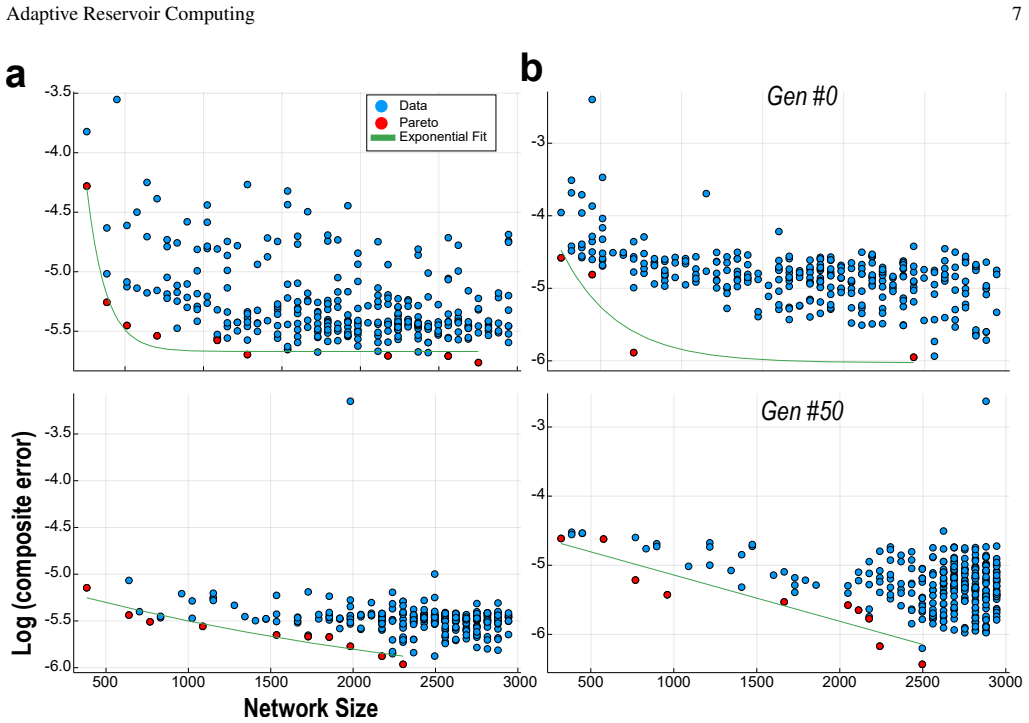
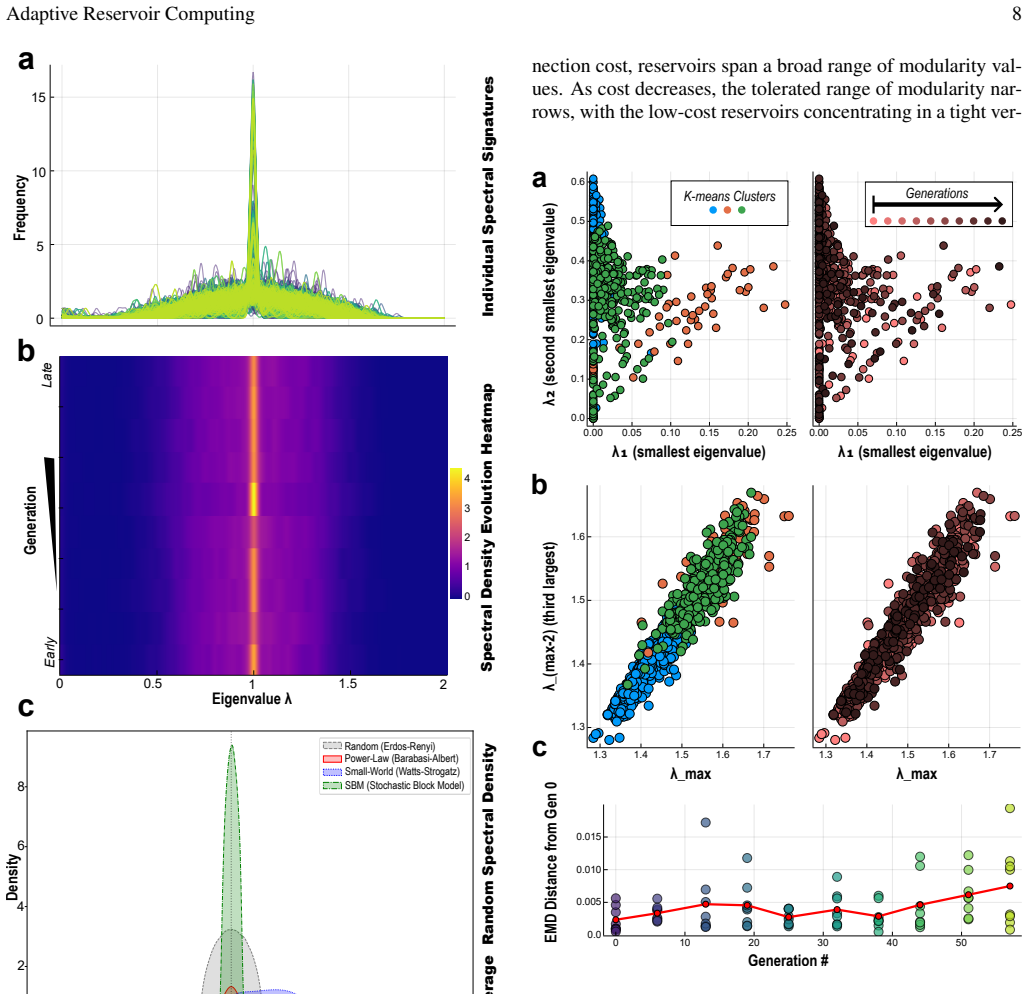
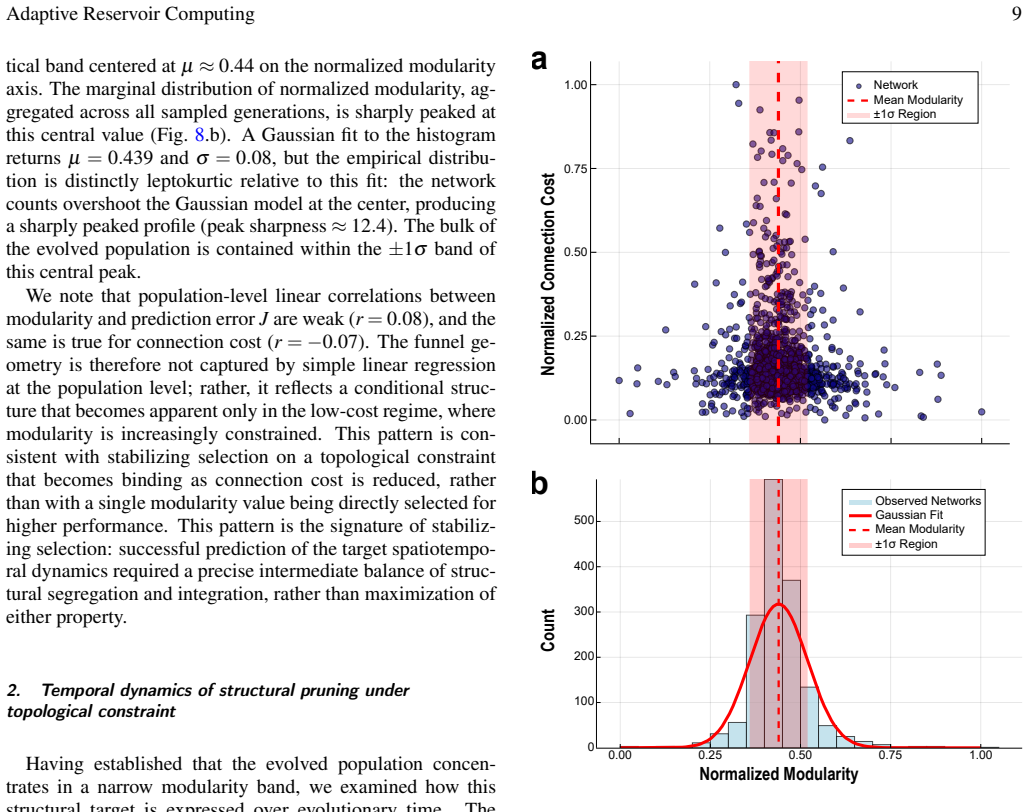
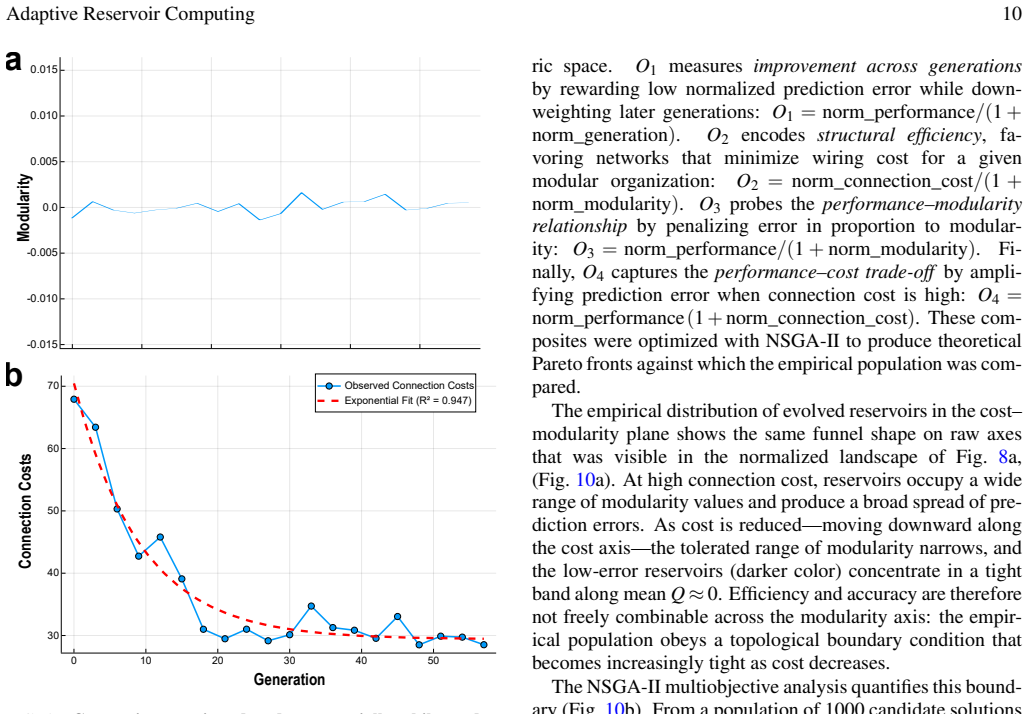
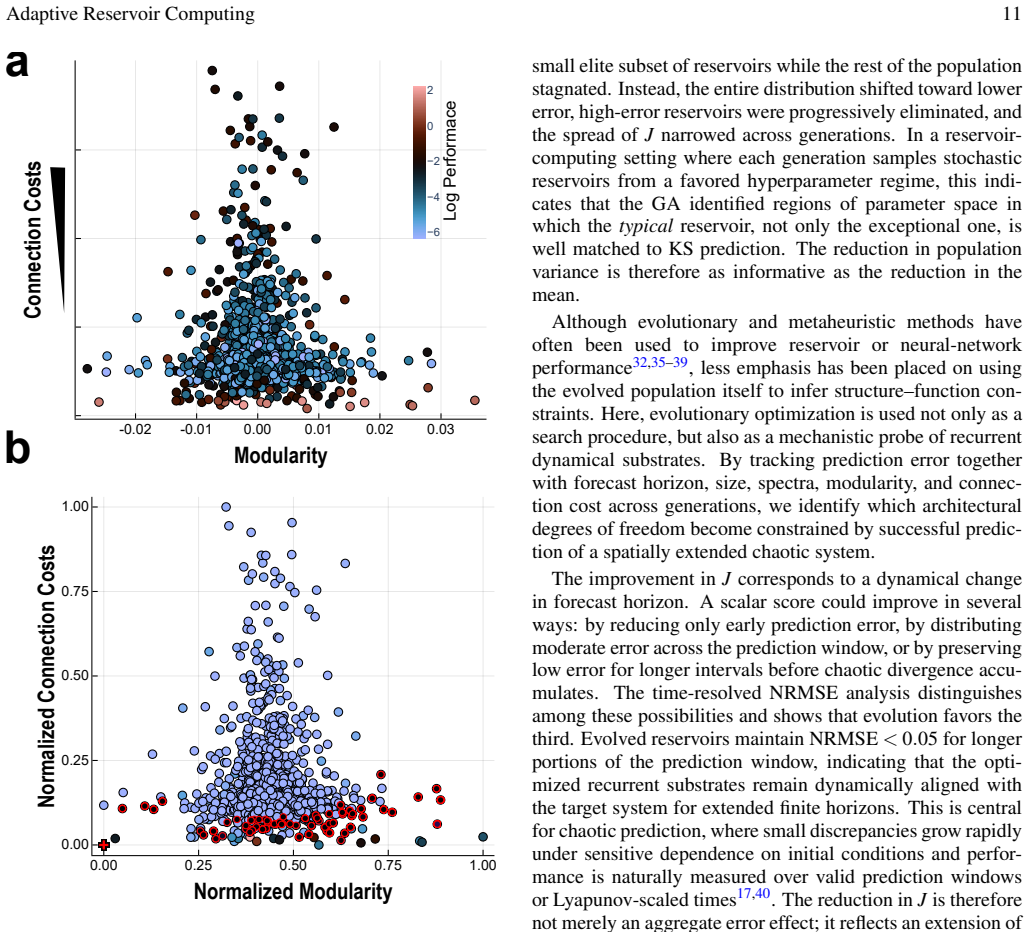
When five reservoir hyperparameters (size, connectivity degree, spectral radius, input scaling, readout regularization) are evolved for Kuramoto-Sivashinsky prediction, the resulting architectures remain inside a conserved stochastic-block-model-like spectral envelope, refine low-eigenvalue modes, lock modularity to an intermediate band, and occupy a horizontal floor in the cost-modularity plane where prediction accuracy and efficiency improve together.
What carries the argument
Evolutionary optimization over the five reservoir construction hyperparameters, which selects networks for prediction performance and thereby stabilizes a task-suitable dynamical class.
If this is right
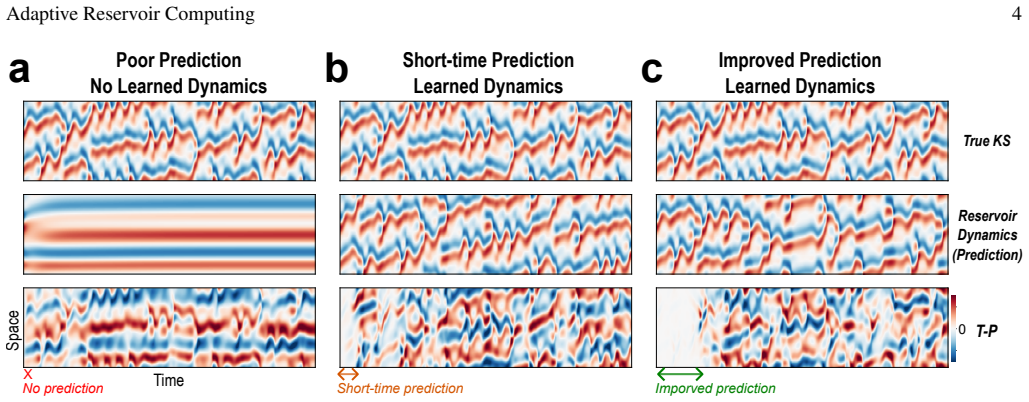
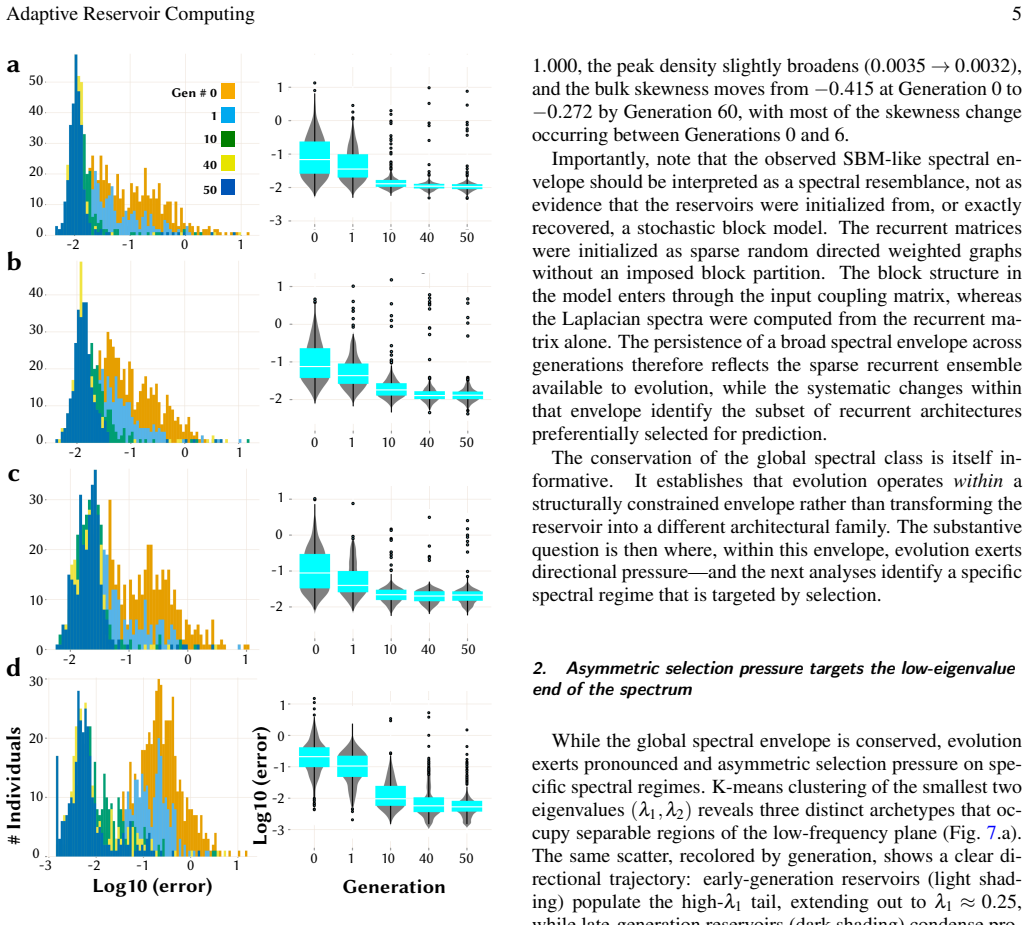
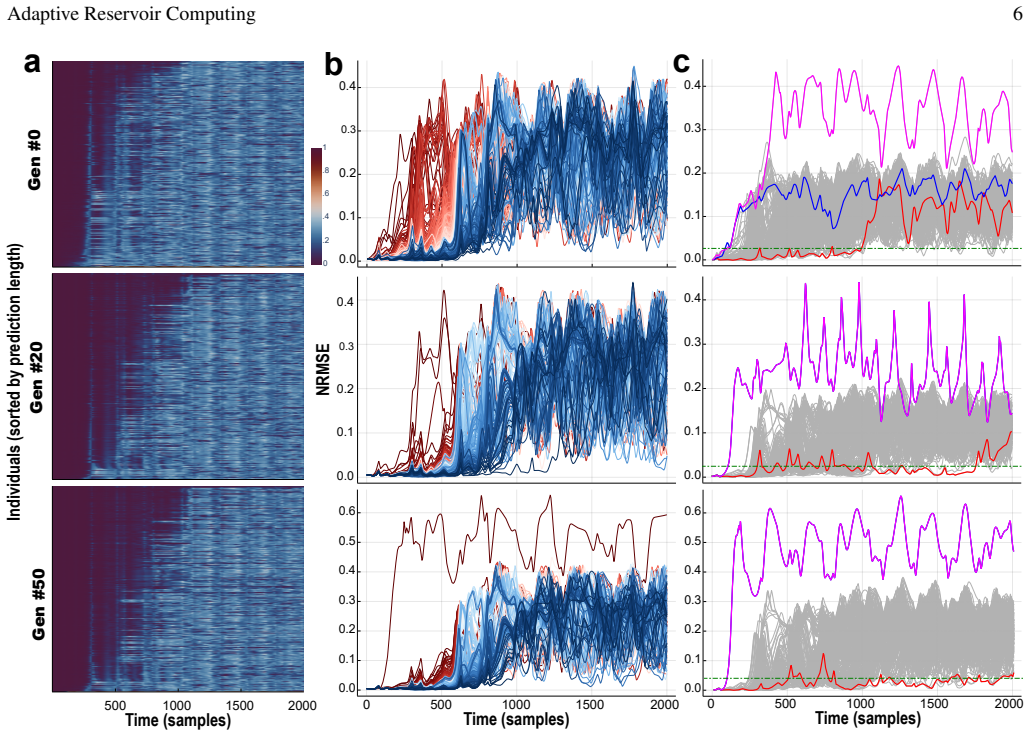
- Evolved reservoirs achieve lower prediction error and longer low-error forecast horizons than randomly initialized ones.
- The design space organizes along a diminishing-return size-efficiency frontier.
- Elite networks jointly optimize accuracy and connection cost rather than trading one for the other.
- Structural refinement occurs mainly by pruning within a conserved spectral and modular band.
Where Pith is reading between the lines
- The same evolutionary procedure could be run on other chaotic partial differential equations to test whether the spectral-envelope and modularity constraints are system-specific or task-general.
- If the intermediate modularity band proves robust, it could serve as a prior when designing recurrent networks for other forecasting tasks.
- Varying the fitness function (for example, adding an explicit energy cost) would likely shift the location of the cost-modularity floor and reveal different structural constraints.
Load-bearing premise
The assumption that five evolved hyperparameters on a single Kuramoto-Sivashinsky testbed suffice to reveal general structural constraints that apply to other chaotic systems or fitness functions.
What would settle it
Reservoirs evolved on a different spatiotemporal chaotic system, such as the two-dimensional Navier-Stokes equations, that fail to converge on the same spectral envelope or intermediate modularity band would falsify the claimed generality of the constraints.
Figures
read the original abstract
Biological systems maintain function in fluctuating environments by transforming past stimulation into internal dynamical states that support future-oriented responses. Reservoir computing provides a computational analogue, but standard formulations often treat the recurrent substrate as a fixed random network and train only the readout. Here we ask how the substrate itself changes when reservoir architecture is placed under evolutionary selection for prediction. Using the Kuramoto--Sivashinsky equation as a testbed for spatiotemporal chaos, we evolved reservoirs over five construction hyperparameters: size, connectivity degree, spectral radius, input scaling, and readout regularization. Evolution reduced prediction error at the population level, extended the low-error forecast horizon, and organized the design space along a diminishing-return size--efficiency frontier. Structural analyses showed that evolved reservoirs remained within a conserved stochastic-block-model-like spectral envelope while refining low-eigenvalue modes, locking modularity to an intermediate band, and pruning connection cost within that band. Pareto analysis showed that elite reservoirs occupied a horizontal floor in the cost--modularity plane, indicating that accuracy and efficiency were achieved jointly rather than through a simple trade-off. These findings show that evolutionary optimization does not merely improve prediction, but exposes interpretable structural constraints on the recurrent substrate: it stabilizes a task-suitable dynamical class and refines the architectural degrees of freedom most relevant for prediction. Evolutionary reservoir computing therefore provides a bio-inspired framework for studying how predictive demands shape adaptive dynamical networks.
Editorial analysis
A structured set of objections, weighed in public.
Referee Report
Summary. The paper claims that placing reservoir architecture under evolutionary selection for prediction on the Kuramoto-Sivashinsky equation (using five hyperparameters: size, connectivity degree, spectral radius, input scaling, readout regularization) yields population-level error reduction, extended forecast horizons, a conserved stochastic-block-model-like spectral envelope with refined low-eigenvalue modes, an intermediate modularity band, connection-cost pruning, and a horizontal Pareto floor in the cost-modularity plane. It concludes that evolution stabilizes a task-suitable dynamical class and exposes interpretable structural constraints on the recurrent substrate beyond mere performance gains.
Significance. If the structural findings hold and generalize, the work would provide a bio-inspired method for identifying how predictive demands constrain reservoir dynamics and architecture, moving beyond random substrates to reveal refined degrees of freedom. The direct evolutionary simulation on an external dynamical system (rather than parameter fitting) is a strength, as is the joint accuracy-efficiency outcome on the Pareto front. However, the single-testbed design limits the reach of the 'general structural constraints' interpretation.
major comments (2)
- [Abstract (final paragraph)] Abstract (final paragraph) and implied Results: The central claim that evolution 'exposes interpretable structural constraints on the recurrent substrate' (conserved spectral envelope, intermediate modularity band, Pareto floor) is load-bearing for the paper's contribution, yet all analyses use a single spatiotemporal chaotic system (Kuramoto-Sivashinsky) and the same five hyperparameters with no cross-system validation or alternative fitness functions reported. This makes it impossible to determine whether the observed features are general properties of predictive reservoirs or KS-specific artifacts.
- [Abstract] Abstract: The reported population-level error reduction, extended low-error forecast horizon, and structural analyses provide no quantitative details on number of independent evolutionary runs, statistical tests, baseline comparisons (e.g., random vs. evolved), or exclusion criteria, undermining assessment of whether the claimed refinements are robust or merely descriptive of the single run set.
Simulated Author's Rebuttal
We thank the referee for the detailed comments. We agree that the abstract overstates the generality of the structural findings and lacks explicit quantitative reporting. Both issues will be addressed through targeted revisions to the abstract and addition of a limitations paragraph.
read point-by-point responses
-
Referee: Abstract (final paragraph) and implied Results: The central claim that evolution 'exposes interpretable structural constraints on the recurrent substrate' (conserved spectral envelope, intermediate modularity band, Pareto floor) is load-bearing for the paper's contribution, yet all analyses use a single spatiotemporal chaotic system (Kuramoto-Sivashinsky) and the same five hyperparameters with no cross-system validation or alternative fitness functions reported. This makes it impossible to determine whether the observed features are general properties of predictive reservoirs or KS-specific artifacts.
Authors: We accept that the single-testbed design (Kuramoto-Sivashinsky only) precludes claims of general structural constraints across predictive reservoirs. The final paragraph of the abstract will be revised to state that the conserved spectral envelope, intermediate modularity, and Pareto floor are observed under evolutionary selection for this specific spatiotemporal chaotic system. A new limitations subsection will be added to the discussion explicitly noting the absence of cross-system validation and alternative fitness functions, framing the results as a detailed case study rather than a general principle. revision: yes
-
Referee: Abstract: The reported population-level error reduction, extended low-error forecast horizon, and structural analyses provide no quantitative details on number of independent evolutionary runs, statistical tests, baseline comparisons (e.g., random vs. evolved), or exclusion criteria, undermining assessment of whether the claimed refinements are robust or merely descriptive of the single run set.
Authors: The full manuscript reports these quantities in the Methods (evolutionary algorithm parameters and run count) and Results (statistical comparisons to random baselines and exclusion of divergent simulations), but the abstract does not summarize them. We will add a concise quantitative statement to the abstract specifying the number of independent evolutionary runs, the statistical tests employed, the random baseline comparisons, and the exclusion criteria. revision: yes
Circularity Check
No significant circularity; results from direct evolutionary simulation on external system
full rationale
The paper's central results derive from running evolutionary optimization on five reservoir hyperparameters against the Kuramoto-Sivashinsky equation as an external testbed, followed by post-hoc structural analysis of the evolved networks. No derivation step reduces by construction to fitted inputs, self-definitions, or self-citation chains; the observed spectral envelopes, modularity bands, and Pareto floors are outputs of the simulation rather than reparameterizations of the optimization objective. The single-testbed limitation affects generalizability but does not create circularity in the reported chain.
Axiom & Free-Parameter Ledger
free parameters (5)
- reservoir size
- connectivity degree
- spectral radius
- input scaling
- readout regularization
axioms (2)
- domain assumption The Kuramoto-Sivashinsky equation is a suitable testbed for spatiotemporal chaos
- domain assumption Standard reservoir computing assumptions (fixed recurrent weights, trainable readout, echo-state-like behavior) hold for the evolved networks
Reference graph
Works this paper leans on
-
[1]
Predictive Behavior Within Microbial Genetic Networks
Tagkopoulos, Ilias and Liu, Yir-Chung and Tavazoie, Saeed. Predictive Behavior Within Microbial Genetic Networks. Science. 2008. doi:10.1126/science.1154456
-
[2]
Frontiers in Physiology , VOLUME=
Deans, Carrie , TITLE=. Frontiers in Physiology , VOLUME=. 2021 , URL=. doi:10.3389/fphys.2021.672457 , ISSN=
-
[3]
Freddolino, Peter L. and Tavazoie, Saeed. Beyond Homeostasis: A Predictive-Dynamic Framework for Understanding Cellular Behavior. Annual Review of Cell and Developmental Biology. 2012. doi:10.1146/annurev-cellbio-092910-154129
-
[4]
Gabalda-Sagarra, Marçal and Carey, Lucas B. and Garcia-Ojalvo, Jordi. Recurrence-based information processing in gene regulatory networks. Chaos: An Interdisciplinary Journal of Nonlinear Science. 2018. doi:10.1063/1.5039861
-
[5]
Echo State Property of Deep Reservoir Computing Networks
Gallicchio, Claudio and Micheli, Alessio. Echo State Property of Deep Reservoir Computing Networks. Cognitive Computation. 2017. doi:10.1007/s12559-017-9461-9
-
[6]
Model-Free Prediction of Large Spatiotemporally Chaotic Systems from Data: A Reservoir Computing Approach , author =. Phys. Rev. Lett. , volume =. 2018 , month =. doi:10.1103/PhysRevLett.120.024102 , url =
-
[7]
and Girvan, Michelle and Ott, Edward , title =
Pathak, Jaideep and Lu, Zhixin and Hunt, Brian R. and Girvan, Michelle and Ott, Edward , title =. Chaos: An Interdisciplinary Journal of Nonlinear Science , volume =. 2017 , month =. doi:10.1063/1.5010300 , url =
-
[8]
and Girvan, Michelle and Ott, Edward , title =
Pathak, Jaideep and Wikner, Alexander and Fussell, Rebeckah and Chandra, Sarthak and Hunt, Brian R. and Girvan, Michelle and Ott, Edward , title =. Chaos: An Interdisciplinary Journal of Nonlinear Science , volume =. 2018 , month =. doi:10.1063/1.5028373 , url =
-
[9]
Tomlin, R. J. and Kalogirou, A. and Papageorgiou, D. T. , title =. Proceedings of the Royal Society A: Mathematical, Physical and Engineering Sciences , volume =. 2018 , month =. doi:10.1098/rspa.2017.0687 , url =
-
[10]
A particle model for the Kuramoto-Sivashinsky equation
Rost, Martin and Krug, Joachim. A particle model for the Kuramoto-Sivashinsky equation. Physica D: Nonlinear Phenomena. 1995. doi:10.1016/0167-2789(95)00184-6
-
[11]
Seoane, Luís F. , title =. Philosophical Transactions of the Royal Society B: Biological Sciences , volume =. 2019 , month =. doi:10.1098/rstb.2018.0377 , url =
-
[12]
Haluszczynski, Alexander and Räth, Christoph. Good and bad predictions: Assessing and improving the replication of chaotic attractors by means of reservoir computing. Chaos: An Interdisciplinary Journal of Nonlinear Science. 2019. doi:10.1063/1.5118725
-
[13]
Kitayama, Ken-ichi. Guiding principle of reservoir computing based on “small-world” network. Scientific Reports. 2022. doi:10.1038/s41598-022-21235-y
-
[14]
d'Andrea, Valeria and Puppin, Michele and Domenico, Manlio De. Complex topological features of reservoirs shape learning performances in bio-inspired recurrent neural networks. Preprint. 2211. doi:10.48550/arxiv.2211.00161
-
[15]
McGraw, Patrick N. and Menzinger, Michael. Laplacian spectra as a diagnostic tool for network structure and dynamics. Physical Review E. 2008. doi:10.1103/physreve.77.031102
-
[16]
Jaeger, Herbert , year=. The “echo state” approach to analysing and training recurrent neural networks , url=. doi:10.24406/publica-fhg-291111 , publisher=
-
[17]
Maass, Wolfgang and Natschläger, Thomas and Markram, Henry , title =. Neural Computation , volume =. 2002 , month =. doi:10.1162/089976602760407955 , url =
-
[18]
Reservoir Computing Approaches to Recurrent Neural Network Training , journal =
Luko. Reservoir Computing Approaches to Recurrent Neural Network Training , journal =. 2009 , volume =
2009
-
[19]
Current Opinion in Neurobiology , year =
Sussillo, David , title =. Current Opinion in Neurobiology , year =
-
[20]
A Survey on Reservoir Computing and its Interdisciplinary Applications Beyond Traditional Machine Learning , year=
Zhang, Heng and Vargas, Danilo Vasconcellos , journal=. A Survey on Reservoir Computing and its Interdisciplinary Applications Beyond Traditional Machine Learning , year=
-
[21]
Logic Journal of the IGPL , volume =
Roeschies, Benjamin and Igel, Christian , title =. Logic Journal of the IGPL , volume =. 2010 , month =. doi:10.1093/jigpal/jzp043 , url =
-
[22]
and Xu, Dongming and Príncipe, José C
Ozturk, Mustafa C. and Xu, Dongming and Príncipe, José C. Analysis and Design of Echo State Networks. Neural Computation. 2007. doi:10.1162/neco.2007.19.1.111
-
[23]
Fleddermann, Luk and Parlitz, Ulrich and Wellecke, Gerrit. Improving the prediction of spatio-temporal chaos by combining parallel reservoir computing with dimensionality reduction. Machine Learning: Science and Technology. 2025. doi:10.1088/2632-2153/ae1806
-
[24]
Effects of singular value spectrum on the performance of echo state network
Li, Fanjun and Wang, Xiaohong and Li, Ying. Effects of singular value spectrum on the performance of echo state network. Neurocomputing. 2019. doi:10.1016/j.neucom.2019.05.068
-
[25]
Neuronal timescales are functionally dynamic and shaped by cortical microarchitecture
Gao, Richard and van den Brink, Ruud L and Pfeffer, Thomas and Voytek, Bradley. Neuronal timescales are functionally dynamic and shaped by cortical microarchitecture. eLife. 2020. doi:10.7554/elife.61277
-
[26]
Chen, Guang and Kang, Byungwoo and Lindsey, Jack and Druckmann, Shaul and Li, Nuo , title=. Cell , year=. doi:10.1016/j.cell.2021.05.026 , url=
-
[27]
Modularity in the Organization of Mouse Primary Visual Cortex , journal=
Ji, Weiqing and G. Modularity in the Organization of Mouse Primary Visual Cortex , journal=. 2015 , month=. doi:10.1016/j.neuron.2015.07.004 , url=
-
[28]
Powell and Bettina Hein and Deyue Kong and Jonas Elpelt and Haleigh N
Nathaniel J. Powell and Bettina Hein and Deyue Kong and Jonas Elpelt and Haleigh N. Mulholland and Matthias Kaschube and Gordon B. Smith , title =. Proceedings of the National Academy of Sciences , volume =. 2024 , doi =
2024
-
[29]
Sporns, Olaf and Betzel, Richard F. Modular Brain Networks. Annual review of psychology. 2016. doi:10.1146/annurev-psych-122414-033634
-
[30]
Meunier, David and Lambiotte, Renaud and Bullmore, Edward T. , TITLE=. Frontiers in Neuroscience , VOLUME=. 2010 , URL=. doi:10.3389/fnins.2010.00200 , ISSN=
-
[31]
The Wiring Economy Principle: Connectivity Determines Anatomy in the Human Brain
Raj, Ashish and Chen, Yu-hsien. The Wiring Economy Principle: Connectivity Determines Anatomy in the Human Brain. PLoS ONE. 2011. doi:10.1371/journal.pone.0014832
-
[32]
Wang, Irving E. and Clandinin, Thomas R. The Influence of Wiring Economy on Nervous System Evolution. Current Biology. 2016. doi:10.1016/j.cub.2016.08.053
-
[33]
Budd, Julian M. L. and Kisvárday, Zoltán F. Communication and wiring in the cortical connectome. Frontiers in Neuroanatomy. 2012. doi:10.3389/fnana.2012.00042
-
[34]
and Daunizeau, Jean and Friston, Karl J
Kiebel, Stefan J. and Daunizeau, Jean and Friston, Karl J. A Hierarchy of Time-Scales and the Brain. PLoS Computational Biology. 2008. doi:10.1371/journal.pcbi.1000209
-
[35]
A Large-Scale Circuit Mechanism for Hierarchical Dynamical Processing in the Primate Cortex
Chaudhuri, Rishidev and Knoblauch, Kenneth and Gariel, Marie-Alice and Kennedy, Henry and Wang, Xiao-Jing. A Large-Scale Circuit Mechanism for Hierarchical Dynamical Processing in the Primate Cortex. Neuron. 2015. doi:10.1016/j.neuron.2015.09.008
-
[36]
Raut, Ryan V. and Snyder, Abraham Z. and Raichle, Marcus E. Hierarchical dynamics as a macroscopic organizing principle of the human brain. Proceedings of the National Academy of Sciences. 2020. doi:10.1073/pnas.2003383117
-
[37]
Shoval, O. and Sheftel, H. and Shinar, G. and Hart, Y. and Ramote, O. and Mayo, A. and Dekel, E. and Kavanagh, K. and Alon, U. Evolutionary Trade-Offs, Pareto Optimality, and the Geometry of Phenotype Space. Science. 2012. doi:10.1126/science.1217405
-
[38]
Neural optimization: Understanding trade-offs with Pareto theory , journal =. 2021 , note =. doi:10.1016/j.conb.2021.08.008 , url =
-
[39]
Pareto Optimality across different scales
Szekely, Pablo. Pareto Optimality across different scales. Text. 2020. doi:10.34933/wis.000185
-
[40]
Variability in Neural Circuit Formation
Mitchell, Kevin J. Variability in Neural Circuit Formation. Cold Spring Harbor perspectives in biology. 2024. doi:10.1101/cshperspect.a041504
-
[41]
Architectures of neuronal circuits
Luo, Liqun. Architectures of neuronal circuits. Science. 2021. doi:10.1126/science.abg7285
-
[42]
Barabási, Dániel L. and Barabási, Albert-László. A Genetic Model of the Connectome. Neuron. 2020. doi:10.1016/j.neuron.2019.10.031
-
[43]
Proceedings of the National Academy of Sciences , volume =
Oren Richter and Elad Schneidman , title =. Proceedings of the National Academy of Sciences , volume =. 2025 , doi =
2025
-
[44]
PLOS Computational Biology , publisher =
Constructive connectomics: How neuronal axons get from here to there using gene-expression maps derived from their family trees , year =. PLOS Computational Biology , publisher =. doi:10.1371/journal.pcbi.1010382 , author =
-
[45]
Brain-inspired modular echo state network for EEG-based emotion recognition
Yang, Liuyi and Wang, Zhaoze and Wang, Guoyu and Liang, Lixin and Liu, Meng and Wang, Junsong. Brain-inspired modular echo state network for EEG-based emotion recognition. Frontiers in Neuroscience. 2024. doi:10.3389/fnins.2024.1305284
-
[46]
Damicelli, Fabrizio and Hilgetag, Claus C. and Goulas, Alexandros. Brain connectivity meets reservoir computing. PLOS Computational Biology. 2022. doi:10.1371/journal.pcbi.1010639
-
[47]
Accessing the topological properties of human brain functional sub-circuits in Echo State Networks
Nguyen, Bach and Chen, Tianlong and Yang, Shu and Hou, Bojian and Shen, Li and Duong-Tran, Duy. Accessing the topological properties of human brain functional sub-circuits in Echo State Networks. 2024. doi:10.48550/arxiv.2412.14999
-
[48]
Zeraati, Roxana and Levina, Anna and Macke, Jakob H. and Gao, Richard. Neural timescales from a computational perspective. 2409. doi:10.48550/arxiv.2409.02684
-
[49]
Frontiers in Computational Neuroscience , year =
Dehghani, Nima , title =. Frontiers in Computational Neuroscience , year =
-
[50]
Journal of Physics: Complexity , year =
Dehghani, Nima and Caterina, Gianluca , title =. Journal of Physics: Complexity , year =
-
[51]
PLOS Complex Systems , year =
Dehghani, Nima , title =. PLOS Complex Systems , year =
-
[52]
Proceedings of the Royal Society B: Biological Sciences , year =
Clune, Jeff and Mouret, Jean-Baptiste and Lipson, Hod , title =. Proceedings of the Royal Society B: Biological Sciences , year =
-
[53]
PLOS Computational Biology , year =
Ellefsen, Kai Olav and Mouret, Jean-Baptiste and Clune, Jeff , title =. PLOS Computational Biology , year =
-
[54]
, title =
Carroll, Thomas L. , title =. Chaos: An Interdisciplinary Journal of Nonlinear Science , year =
-
[55]
and Pecora, Louis M
Carroll, Thomas L. and Pecora, Louis M. , title =. Chaos: An Interdisciplinary Journal of Nonlinear Science , year =
-
[56]
and Parlitz, Ulrich , title =
Zimmermann, Roland S. and Parlitz, Ulrich , title =. Chaos: An Interdisciplinary Journal of Nonlinear Science , year =
-
[57]
, title =
Niraula, Dipesh and El Naqa, Issam and Tuszynski, Jack Adam and Gatenby, Robert A. , title =. iScience , year =
-
[58]
and de Jong, Thijs J
Baltussen, Mathieu G. and de Jong, Thijs J. and Duez, Quentin C. N. and Robinson, William E. and Huck, Wilhelm T. S. , title =. Nature , year =
-
[59]
2026 , eprint=
What Makes a Bacterial Model a Good Reservoir Computer? Predicting Performance from Separability and Similarity , author=. 2026 , eprint=
2026
-
[60]
and Pratap, A
Deb, K. and Pratap, A. and Agarwal, S. and Meyarivan, T. , journal=. A fast and elitist multiobjective genetic algorithm:. 2002 , volume=
2002
-
[61]
Jesús-Adolfo Mejía-de-Dios and Efrén Mezura-Montes , title =. 2022 , publisher =. doi:10.21105/joss.04723 , url =
-
[62]
Progress of Theoretical Physics Supplement , volume =
Kuramoto, Yoshiki , title =. Progress of Theoretical Physics Supplement , volume =. 1978 , month =. doi:10.1143/PTPS.64.346 , url =
-
[63]
Derivation of basic equations , journal =
Nonlinear analysis of hydrodynamic instability in laminar flames—I. Derivation of basic equations , journal =. 1977 , issn =. doi:10.1016/0094-5765(77)90096-0 , url =
-
[64]
Tanneau, Mathieu and Anjos, Miguel F. and Lodi, Andrea , title=. Mathematical Programming Computation , year=. doi:10.1007/s12532-020-00200-8 , url=
-
[65]
JuliaOptimalTransport/OptimalTransport.jl , year =
Zhang, Stephen and Widmann, David and Barreira, Davi Sales and Besan. JuliaOptimalTransport/OptimalTransport.jl , year =
-
[66]
, title =
Rubner, Yossi and Tomasi, Carlo and Guibas, Leonidas J. , title =. International Journal of Computer Vision , year =
-
[67]
Computational Optimal Transport , journal =
Peyr. Computational Optimal Transport , journal =. 2019 , volume =
2019
-
[68]
Newman, M. E. J. and Girvan, M. , title =. Physical Review E , year =
-
[69]
Statistical Mechanics of Community Detection , journal =
Reichardt, J. Statistical Mechanics of Community Detection , journal =. 2006 , volume =
2006
-
[70]
Leicht, E. A. and Newman, M. E. J. , title =. Physical Review Letters , year =
-
[71]
Near Linear Time Algorithm to Detect Community Structures in Large-Scale Networks , journal =
Raghavan, Usha Nandini and Albert, R. Near Linear Time Algorithm to Detect Community Structures in Large-Scale Networks , journal =. 2007 , volume =
2007
-
[72]
JuliaGraphs/Graphs.jl: an optimized graphs package for the Julia programming language , year =
Fairbanks, James and Besan. JuliaGraphs/Graphs.jl: an optimized graphs package for the Julia programming language , year =
-
[73]
1997 , publisher=
Spectral Graph Theory , author=. 1997 , publisher=
1997
-
[74]
Annals of Combinatorics , year=
Chung, Fan , title=. Annals of Combinatorics , year=. doi:10.1007/s00026-005-0237-z , url=
-
[75]
de Lange, Siemon C. and de Reus, Marcel A. and van den Heuvel, Martijn P. The Laplacian spectrum of neural networks. Frontiers Comput. Neurosci. 2014. doi:10.3389/fncom.2013.00189
-
[76]
and Sorensen, Danny C
Lehoucq, Richard B. and Sorensen, Danny C. and Yang, Chao , title =. 1998 , doi =
1998
-
[77]
Exponential Time Differencing for Stiff Systems , journal =. 2002 , issn =. doi:10.1006/jcph.2002.6995 , url =
-
[78]
, title =
Kassam, Aly-Khan and Trefethen, Lloyd N. , title =. SIAM Journal on Scientific Computing , volume =. 2005 , doi =
2005
-
[79]
Neuron , volume = 34, number = 3, pages =
Wiring Optimization in Cortical Circuits , author =. Neuron , volume = 34, number = 3, pages =. doi:10.1016/S0896-6273(02)00679-7 , issn =
-
[80]
Chen and David H
Beth L. Chen and David H. Hall and Dmitri B. Chklovskii , title =. Proceedings of the National Academy of Sciences , volume =. 2006 , doi =
2006
discussion (0)
Sign in with ORCID, Apple, or X to comment. Anyone can read and Pith papers without signing in.