REVIEW 3 major objections 3 minor 47 references
The paper claims that multifingered grasp execution can be reduced to following the negative gradient of a smooth distance field over a set of candidate grasps, with safety and grasp-quality enforced pointwise by a quadratic-program safety
Reviewed by Pith at T0; open to challenge. T0 means a machine referee read the full paper against a public rubric. the ladder, T0–T4 →
Grasp execution via a softmin field over grasp configurations with CBF-QP safety filtering, eliminating trajectory replanning, with a force-closure margin guarantee that fails in one reported trial.
T0 review reviewed 2026-08-05 challenge →
load-bearing objection A genuinely new reactive grasping idea, but the paper's own data break its central quality guarantee, so the claims need to be scaled back before this is publishable. the 3 major comments →
Grasp Execution Without a Planner: Configuration-Space Grasp Distance Fields with Certified Safety & Guaranteed Quality
The pith
A machine-rendered reading of the paper's core claim, the machinery that carries it, and where it could break.
The reading
Core claim
The central claim is that a smooth configuration-space distance field can serve as both the target representation and the control law for multifingered grasping, eliminating the plan-then-track architecture. Concretely, Proposition V.1 states that once the system enters HOLD at configuration q0, the risk-adjusted force-closure margin epsilon^beta(q(t)) stays above epsilon^beta(q0) - kwq for every later time, where kwq is a user-chosen tolerance; the proof makes h_wq = epsilon^beta(q) - (epsilon^beta(q0) - kwq) a control barrier function and applies the standard comparison-lemma invariance argument. The paper also proves the softmin field tracks the true set distance within log N / rho, with
What carries the argument
The central object is the softmin grasp distance field d_G(q) = -(1/rho) log sum_i exp(-rho d_i(q)), where d_i is the Lambda-weighted joint-space distance from the current configuration to the i-th pregrasp configuration. This field is smooth exactly where the hard min is not (the Voronoi boundaries between candidates), its gradient is a convex combination of unit vectors pointing to candidates, and the coefficients of that combination—the softmax weights—act as a continuous, pointwise grasp-selection mechanism. The second load-bearing mechanism is the CLF-CBF quadratic program of Equation (11), which projects the nominal gradient command onto the safe velocity set: hard barrier constraints
Load-bearing premise
The load-bearing premise is that the safety-filter QP remains feasible and its solution locally Lipschitz at every step despite the joint-speed bounds and the underactuation equality block—and that the 20 ms sampling is fine enough to inherit the continuous-time guarantee; the paper's own full-speed run shows a 4.5 cm between-sample obstacle penetration, so that step-size premise is not assured.
What would settle it
Log the continuous trajectory between control samples at full joint-speed limits in the obstacle-dense scene (or any scene where a sampled configuration clears an obstacle but the path between samples does not); the paper reports a 4.5 cm penetration of this kind, which already shows the sampled closed loop does not inherit forward invariance. More directly for the quality claim: sample epsilon^beta(q) at inter-sample times while the wrench-quality barrier is active; Proposition V.1 is a continuous-time statement, so any feasible step at which the margin falls more than kwq below its hold-onse
If this is right
- Execution becomes a fixed state-to-velocity map: object-pose perturbations or moving obstacles require no replanning, only the same pointwise filter evaluation.
- Discrete grasp selection is replaced by softmax weights; in a recorded five-candidate run the weights concentrate on the nearest candidate at every step.
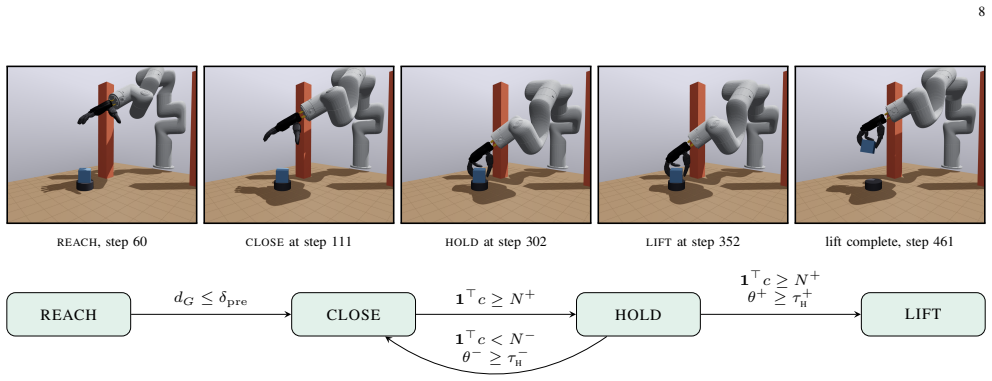
- Reach-grasp-lift is a hybrid system with hysteresis between REACH, CLOSE, HOLD, and LIFT, so contact admission does not break the safety guarantee on the remaining constraints.
- The realized grasp's risk-adjusted margin is bounded below by its hold-onset value minus kwq, giving a probabilistic force-closure certificate through the lift.
- The same controller runs on a 7-DOF arm with an 11-joint hand and on a Unitree G1 humanoid without modification; the full control step costs 2 ms within a 20 ms period.
Where Pith is reading between the lines
- The log N / rho bound implies a design tradeoff the paper does not optimize: for a fixed rho, adding more candidates widens the gap between the softmin and the true set distance, so scaling to large candidate sets likely requires rho to grow with log N.
- Because the sampled implementation penetrates an obstacle by 4.5 cm between two 20 ms samples at full speed, a practical deployment would need either a smaller control period or a safety-margin expansion proportional to speed times timestep; the paper reports the violation but does not turn it into a rule.
- The same wrench-certificate bridge could be reused for other grasp-quality objectives—slip margins, roll-off constraints, or risk-aware friction models—by substituting their differentiable certificates for h_wq, a step the paper mentions but does not implement.
- The static admission test plus trapped equilibria suggests an online candidate-refinement loop: regenerate or prune candidates when the field stops decreasing, which would extend the method to moving objects and dense clutter without reintroducing a planner.
Editorial analysis
A structured set of objections, weighed in public.
Referee Report
Summary. The paper proposes Grasp Distance Fields (GDFs), a softmin-smoothed distance-to-candidate-set field in the arm-hand configuration space, and a CBF-CLF quadratic program that filters a gradient-following nominal command. A hybrid mode structure (REACH/CLOSE/HOLD/LIFT) handles contact admission, and a wrench-quality CBF based on the risk-adjusted margin ε^(β) is claimed to keep the executed grasp's quality within kwq of its hold-onset value. The paper proves field approximation bounds, a forward-invariance safety theorem, and a quality forward-invariance proposition, and reports simulations on 50 objects, dynamic obstacles, and a humanoid model.
Significance. The paper's core idea—reactive grasp execution via a smooth configuration-space field over grasp candidates, with safety and quality certificates—is timely and potentially useful. The softmin bound (Prop. IV.1), the hysteresis mode switch (Sec. V-B), and the attempt to bridge joint-space fields to wrench-space certificates are interesting and clearly presented. If the guarantees held, the contribution would be significant for reactive manipulation. However, the paper's own experiments contradict the two headline certificates: the quality guarantee is violated in a completed lift, and the sampled implementation penetrates obstacles at full model speed. These are not presentation issues; they invalidate the advertised claims as stated.
major comments (3)
- [§VI-B.2 and §V, Proposition V.1] Proposition V.1 states ε^(β)(q(t)) ≥ ε^(β)(q0) − kwq for all t ≥ t0. Section VI-B.2 reports, for kwq = 0.020, that in one completed lift the margin 'falls to 0.060 below its hold-onset value on a contact-set change.' This is a direct measured violation of the stated guarantee. The proof relies on Assumption II.1 (unique nearest facet) and smoothness of the wrench matrix; a contact-set change discontinuously changes the wrench matrix and the margin, so the assumptions fail at exactly the event the hybrid system is designed to undergo. The paper acknowledges the exception but does not revise the theorem or explain why Proposition V.1 does not apply; as written, the theorem and the experimental data are inconsistent.
- [§VI-B.3 and §V-A, Theorem V.1] Section VI-B.3 states that 'Theorem V.1 therefore holds for the continuous-time closed loop, and the sampled implementation inherits it only under a step-size condition that our other reported trials satisfy.' The step-size condition is never formalized or verified. At full model speed, the trajectory penetrates an obstacle by 4.5 cm between two 20 ms samples. Thus the forward-invariance guarantee of Theorem V.1 is not a guarantee for the executed sample-and-hold system; the paper's safety certificate applies to a different (continuous-time) controller than the one evaluated. This undermines the claim that the controller 'renders the safe set forward invariant.'
- [§V-A, Assumption V.1] Assumption V.1 posits that the QP (11) remains feasible and that its solution v⋆ is locally Lipschitz, despite the input bounds |v| ≤ v̄ and the equality block A_m v = 0. The paper notes that [8] provides no guarantee for this case. Feasibility is reported empirically at every step, but no proof or verification of local Lipschitzness is given. Since Theorem V.1 and consequently Proposition V.1 are conditional on this assumption, the theoretical certificates are not fully established for the actual program. This is a load-bearing gap, particularly because the experimental violations indicate that the regularity assumption is not satisfied on the executed trajectories.
minor comments (3)
- [§VI-B.2] The sentence 'the margin decay approaches the k_wq = 0.02 tolerance' is inaccurate: the measured 0.060 exceedance is three times the tolerance. Please correct this wording.
- [Fig. 6] Figure 6(a) reports a worst deviation of 2.6e-4 for one trial, while the text in §VI-B.2 describes another trial with a 0.060 deviation. The relationship between the plotted trial and the exception should be made explicit.
- [General] There are several typos, e.g., 'V oronoi' in Fig. 3 and surrounding text. Also, the counts in Table I (e.g., 'Lift' column) could more clearly state denominators.
Circularity Check
No circular derivation: the field, safety-filter, and quality-invariance theorems are self-contained; the main caveats are unverified assumptions and a measured guarantee violation, which are correctness risks, not circularity.
full rationale
The paper's derivation chain is not circular. The grasp distance field properties (Prop. IV.1, Lemma IV.1) are proven directly from the log-sum-exp construction and standard norm inequalities; no fitted constants or data-dependent parameters are used in the proof. Theorem V.1 is the standard CBF comparison-lemma argument: if the QP enforces ∇h_j(q)^T v ≥ −α0 h_j(q), then h_j(q(t)) ≥ h_j(q(t0)) e^{−α0(t−t0)}. The paper explicitly assumes rather than derives the needed regularity (Assumption V.1, Sec. V-A: "Assumption V.1 therefore posits the regularity in place of deriving it"), which is a proof gap for the full-order or sampled system, but it is not circular reasoning. Proposition V.1 is a direct corollary: h_wq is defined as ε^(β)(q) − (ε^(β)(q0) − k_wq), so the stated bound ε^(β)(q(t)) ≥ ε^(β)(q0) − k_wq is exactly the nonnegativity of the enforced CBF. This is the intended certificate, not a data-derived prediction; indeed the paper reports a measured violation (Sec. VI-B.2: "The single exception falls to 0.060 below its hold-onset value on a contact-set change"), which shows the claim is falsifiable and not true by construction. The risk-adjusted margin is imported from the authors' own FIRMGrasp [6], but the current paper's proofs do not reduce to that citation: the invariance argument would apply to any differentiable margin satisfying the stated regularity assumptions, and the probabilistic force-closure interpretation is external semantic content rather than an input to the forward-invariance proof. The unformalized step-size inheritance condition (Sec. VI-B.3) and the QP-regularity assumption are correctness/validation limitations, not circular steps. No equation is shown to be equivalent to its own input by construction, and no fitted parameter is renamed as a prediction.
Axiom & Free-Parameter Ledger
free parameters (10)
- rho softmin smoothing =
25
- k nominal gain =
2.0
- Lambda arm/hand metric weights =
1.0 / 0.35
- alpha0 barrier rate =
5.0
- eta CLF slack weight =
10^3
- KH hold gain =
0.6
- kwq wrench decay tolerance =
0.02
- delta_pre guard threshold =
0.12
- N+/N- contact hysteresis limits =
3 / 2
- obstacle margin =
1.5 cm
axioms (5)
- domain assumption Kinematic single-integrator model q_dot = v
- domain assumption Assumption II.1: unique nearest GWS facet with six affinely independent vertices at every q
- ad hoc to paper Assumption V.1: QP regularity (differentiability, feasibility, local Lipschitz v*)
- domain assumption Friction prior mu ~ N(0.70, 0.10^2) and CVaR construction from FIRMGrasp [6]
- ad hoc to paper Step-size condition for sampled implementation
Cite this review
Pith. "Pith review of Grasp Execution Without a Planner: Configuration-Space Grasp Distance Fields with Certified Safety & Guaranteed Quality." pith.science (2026). https://pith.science/paper/PGT5HCAM
@misc{pith2026260800600,
  author       = {Pith},
  title        = {Pith review of: Grasp Execution Without a Planner: Configuration-Space Grasp Distance Fields with Certified Safety & Guaranteed Quality},
  year         = {2026},
  howpublished = {\url{https://pith.science/paper/PGT5HCAM}},
  note         = {Machine review of arXiv:2608.00600}
}
abstract
Standard multifingered grasp execution architectures plan a collision-free trajectory to a selected grasp pose and track it with a feedback law. Execution-time object pose uncertainty or perturbations may invalidate the planned trajectory, forcing a costly replanning step. We present Grasp Distance Fields (GDFs), smooth softmin distance fields over grasp configurations in the arm-hand configuration space. Our controller executes a grasp by following the negative GDF gradient with a stationary feedback law, eliminating the need for a planner, stored trajectory, or grasp selection. For safety, we filter the resulting command through a CBF-CLF quadratic program (QP), constraining self-collision, workspace, object, and obstacle clearance, reporting impeded progress as explicit slack. We prove that the softmin tracks the true set distance within $\log N/\rho$ for $N$ candidates and smoothing parameter $\rho$, and that the filtered closed loop renders the safe set forward invariant. Since no smooth field captures hand-object contact switching, we switch between hand closure and grasp retention modes using hysteresis at a pregrasp configuration, trading object collision avoidance for contact admission. A wrench-quality CBF then bounds the realized grasp's force-closure margin within a prescribed tolerance of its value at hold onset. We evaluate in kinematic simulation on a fixed-base arm and a Unitree G1 humanoid, both fitted with the same underactuated hand. Our controller navigates cluttered and dynamic scenes to safely reach for, grasp, and lift 46 of 50 test objects spanning primitive, household, and adversarial classes. Across the 46 lifts, the executed grasps retain a median 94% of their synthesized quality margin, at 0.09 ms QP solve time per 20 ms control step. Project page: www.clintonenwerem.com/gdf.
Figures




Reference graph
Works this paper leans on
-
[1]
Contact- GraspNet: Efficient 6-DoF Grasp Generation in Cluttered Scenes,
M. Sundermeyer, A. Mousavian, R. Triebel, and D. Fox, “Contact- GraspNet: Efficient 6-DoF Grasp Generation in Cluttered Scenes,” in IEEE International Conference on Robotics and Automation (ICRA), 2021, pp. 13 438–13 444
2021
-
[2]
DexGraspNet: A Large-Scale Robotic Dexterous Grasp Dataset for General Objects Based on Simulation,
R. Wang, J. Zhang, J. Chen, Y . Xu, P. Li, T. Liu, and H. Wang, “DexGraspNet: A Large-Scale Robotic Dexterous Grasp Dataset for General Objects Based on Simulation,” in2023 IEEE International Conference on Robotics and Automation (ICRA). IEEE, 2023, pp. 11 359–11 366, arXiv:2210.02697
Pith/arXiv arXiv 2023
-
[3]
Graspit! A Versatile Simulator for Robotic Grasping,
A. Miller and P. Allen, “Graspit! A Versatile Simulator for Robotic Grasping,”IEEE Robotics & Automation Magazine, vol. 11, no. 4, pp. 110–122, 2004
2004
-
[4]
Closing the Loop for Robotic Grasping: A Real-time, Generative Grasp Synthesis Approach,
D. Morrison, J. Leitner, and P. Corke, “Closing the Loop for Robotic Grasping: A Real-time, Generative Grasp Synthesis Approach,” in Robotics: Science and Systems (RSS), 2018
2018
-
[5]
Safety-Critical Manipulation for Collision-Free Food Preparation,
A. Singletary, W. Guffey, T. G. Molnar, R. Sinnet, and A. D. Ames, “Safety-Critical Manipulation for Collision-Free Food Preparation,”IEEE Robotics and Automation Letters, vol. 7, no. 4, pp. 10 954–10 961, 2022
work page 2022
-
[6]
FIRMGrasp: A Friction-Informed Risk Margin for Robust Grasp Synthesis,
C. Enwerem, J. S. Baras, and C. Belta, “FIRMGrasp: A Friction-Informed Risk Margin for Robust Grasp Synthesis,” 2026, arXiv:2607.25049
Pith/arXiv arXiv 2026
-
[7]
Control Barrier Functions: Theory and Applications,
A. D. Ames, S. Coogan, M. Egerstedt, G. Notomista, K. Sreenath, and P. Tabuada, “Control Barrier Functions: Theory and Applications,” in 2019 18th European Control Conference (ECC). IEEE, 2019, pp. 3420–3431, arXiv:1903.11199. 14
Pith/arXiv arXiv 2019
-
[8]
Control Barrier Function Based Quadratic Programs for Safety Critical Systems,
A. D. Ames, X. Xu, J. W. Grizzle, and P. Tabuada, “Control Barrier Function Based Quadratic Programs for Safety Critical Systems,”IEEE Transactions on Automatic Control, vol. 62, no. 8, pp. 3861–3876, 2017
work page 2017
-
[9]
Real-Time Obstacle Avoidance for Manipulators and Mobile Robots,
O. Khatib, “Real-Time Obstacle Avoidance for Manipulators and Mobile Robots,”The International Journal of Robotics Research, vol. 5, no. 1, pp. 90–98, 1986
1986
-
[10]
Comparative Analysis of Control Barrier Functions and Artificial Potential Fields for Obstacle Avoidance,
A. Singletary, K. Klingebiel, J. Bourne, A. Browning, P. Tokumaru, and A. Ames, “Comparative Analysis of Control Barrier Functions and Artificial Potential Fields for Obstacle Avoidance,” in2021 IEEE/RSJ International Conference on Intelligent Robots and Systems (IROS), 2021, pp. 8129–8136
2021
-
[11]
Control Barrier Functions for Mechanical Systems: Theory and Application to Robotic Grasping,
W. Shaw Cortez, D. Oetomo, C. Manzie, and P. Choong, “Control Barrier Functions for Mechanical Systems: Theory and Application to Robotic Grasping,”IEEE Transactions on Control Systems Technology, vol. 29, no. 2, pp. 530–545, 2021
2021
-
[12]
Robust Adaptive Safe Robotic Grasping with Tactile Sensing,
Y . Kim, J. Kim, A. H. Li, A. D. Ames, and C. Sloth, “Robust Adaptive Safe Robotic Grasping with Tactile Sensing,” in2025 European Control Conference (ECC). IEEE, 2025, pp. 2531–2538, arXiv:2411.07833
arXiv 2025
-
[13]
Dynamic Safety in Complex Environments: Synthesizing Safety Filters with Poisson’s Equation,
G. Bahati, R. M. Bena, and A. D. Ames, “Dynamic Safety in Complex Environments: Synthesizing Safety Filters with Poisson’s Equation,” in Proceedings of Robotics: Science and Systems (RSS), Los Angeles, CA, USA, Jun. 2025, also available as arXiv:2505.06794
Pith/arXiv arXiv 2025
-
[14]
M. Wilkinson, G. Bahati, R. M. Bena, E. Fourney, J. W. Burdick, and A. D. Ames, “Full-Body Dynamic Safety for Robot Manipulators: 3D Poisson Safety Functions for CBF-based Safety Filters,” 2026, preprint, arXiv:2604.21189
Pith/arXiv arXiv 2026
-
[15]
R. M. Bena, G. Bahati, B. Werner, R. K. Cosner, L. Yang, and A. D. Ames, “Geometry-Aware Predictive Safety Filters on Humanoids: From Poisson Safety Functions to CBF Constrained MPC,” in2025 IEEE-RAS 24th International Conference on Humanoid Robots (Humanoids). IEEE, 2025, pp. 1–8
work page 2025
-
[16]
Neural Grasp Distance Fields for Robot Manipulation,
T. Weng, D. Held, F. Meier, and M. Mukadam, “Neural Grasp Distance Fields for Robot Manipulation,” inIEEE International Conference on Robotics and Automation (ICRA), 2023, pp. 1814–1821
work page 2023
-
[17]
Configuration Space Distance Fields for Manipulation Planning,
Y . Li, X. Chi, A. Razmjoo, and S. Calinon, “Configuration Space Distance Fields for Manipulation Planning,” inProceedings of Robotics: Science and Systems (RSS), Delft, Netherlands, July 2024
2024
-
[18]
FRoGGeR: Fast Robust Grasp Generation via the Min-Weight Metric,
A. H. Li, P. Culbertson, J. W. Burdick, and A. D. Ames, “FRoGGeR: Fast Robust Grasp Generation via the Min-Weight Metric,” in2023 IEEE/RSJ International Conference on Intelligent Robots and Systems (IROS), 2023, pp. 6809–6816
2023
-
[19]
EquiDexFlow: Contact-Grounded SE(3)-Equivariant Dexterous Grasp Generative Flows,
C. Enwerem, J. S. Baras, and C. Belta, “EquiDexFlow: Contact-Grounded SE(3)-Equivariant Dexterous Grasp Generative Flows,” 2026, preprint, arXiv:2606.12728
Pith/arXiv arXiv 2026
-
[20]
R. M. Murray, Z. Li, and S. S. Sastry,A Mathematical Introduction to Robotic Manipulation, 1st ed. CRC Press, 1994
1994
-
[21]
Planning Optimal Grasps,
C. Ferrari and J. F. Canny, “Planning Optimal Grasps,” inIEEE International Conference on Robotics and Automation (ICRA), 1992, pp. 2290–2295
1992
-
[22]
PONG: Probabilistic Object Normals for Grasping via Analytic Bounds on Force Closure Probability,
A. H. Li, P. Culbertson, and A. D. Ames, “PONG: Probabilistic Object Normals for Grasping via Analytic Bounds on Force Closure Probability,” 2023, preprint, arXiv:2309.16930
Pith/arXiv arXiv 2023
-
[23]
Diffusion Policy: Visuomotor Policy Learning via Action Diffusion,
C. Chi, S. Feng, Y . Du, Z. Xu, E. Cousineau, B. Burchfiel, and S. Song, “Diffusion Policy: Visuomotor Policy Learning via Action Diffusion,” in Robotics: Science and Systems (RSS), 2023
2023
-
[24]
π0: A Vision-Language-Action Flow Model for General Robot Control,
K. Black, N. Brown, D. Driess, A. Esmail, M. R. Equi, C. Finn, N. Fusai, L. Groom, K. Hausman, B. Ichter, S. Jakubczak, T. Jones, L. Ke, S. Levine, A. Li-Bell, M. Mothukuri, S. Nair, K. Pertsch, L. X. Shi, L. Smith, J. Tanner, Q. Vuong, A. Walling, H. Wang, and U. Zhilinsky, “π0: A Vision-Language-Action Flow Model for General Robot Control,” inRobotics: ...
Pith/arXiv arXiv 2025
-
[25]
K. E. Iverson,A Programming Language. New York, NY , USA: John Wiley & Sons, 1962
work page 1962
-
[26]
D. E. Knuth, “Two Notes on Notation,”American Mathematical Monthly, vol. 99, no. 5, pp. 403–422, 1992
work page 1992
-
[27]
Rimon and J
E. Rimon and J. Burdick,The Mechanics of Robot Grasping. Cambridge University Press, 2019
2019
-
[28]
DROP: Dexterous Re- orientation via Online Planning,
A. H. Li, P. Culbertson, V . Kurtz, and A. D. Ames, “DROP: Dexterous Re- orientation via Online Planning,” in2025 IEEE International Conference on Robotics and Automation (ICRA), 2025, pp. 14 299–14 306
work page 2025
-
[29]
Dexterous Contact-Rich Manipulation via the Contact Trust Region,
H. J. T. Suh, T. Pang, T. Zhao, and R. Tedrake, “Dexterous Contact-Rich Manipulation via the Contact Trust Region,”The International Journal of Robotics Research, 2026, advance online publication
work page 2026
-
[30]
Pose Error Robust Grasping from Contact Wrench Space Metrics,
J. Weisz and P. K. Allen, “Pose Error Robust Grasping from Contact Wrench Space Metrics,” in2012 IEEE International Conference on Robotics and Automation, 2012, pp. 557–562
2012
-
[31]
C. Enwerem, S. Kalyanaraman, J. S. Baras, and C. Belta, “Variational Neural Belief Parameterizations for Robust Dexterous Grasping under Multimodal Uncertainty,” 2026, preprint, arXiv:2604.25897
Pith/arXiv arXiv 2026
-
[32]
Toward an Analytic Theory of Intrinsic Robustness for Dexterous Grasping,
A. H. Li, P. Culbertson, and A. D. Ames, “Toward an Analytic Theory of Intrinsic Robustness for Dexterous Grasping,” in2024 IEEE/RSJ International Conference on Intelligent Robots and Systems (IROS). IEEE, 2024, pp. 2992–2999, arXiv:2403.07249
Pith/arXiv arXiv 2024
-
[33]
A New Approach for Grasp Quality Calculation using Continuous Boundary Formulation of Grasp Wrench Space,
S. Qiu and M. R. Kermani, “A New Approach for Grasp Quality Calculation using Continuous Boundary Formulation of Grasp Wrench Space,”Mechanism and Machine Theory, vol. 168, p. 104524, 2022
2022
-
[34]
Constructive safety using control barrier functions,
P. Wieland and F. Allgöwer, “Constructive safety using control barrier functions,” inIFAC Proceedings Volumes (Proc. 7th IFAC Symposium on Nonlinear Control Systems), vol. 40, no. 12, 2007, pp. 462–467
2007
-
[35]
Safety-Critical Kinematic Control of Robotic Systems,
A. Singletary, S. Kolathaya, and A. D. Ames, “Safety-Critical Kinematic Control of Robotic Systems,”IEEE Control Systems Letters, vol. 6, pp. 139–144, 2022
2022
-
[36]
Stabilization with relaxed controls,
Z. Artstein, “Stabilization with relaxed controls,”Nonlinear Analysis: Theory, Methods & Applications, vol. 7, no. 11, pp. 1163–1173, 1983
1983
-
[37]
A ‘universal’ construction of Artstein’s theorem on nonlinear stabilization,
E. D. Sontag, “A ‘universal’ construction of Artstein’s theorem on nonlinear stabilization,”Systems & Control Letters, vol. 13, no. 2, pp. 117–123, 1989
1989
-
[38]
Reach-avoid problems with time-varying dynamics, targets and constraints,
J. F. Fisac, M. Chen, C. J. Tomlin, and S. S. Sastry, “Reach-avoid problems with time-varying dynamics, targets and constraints,” in Proceedings of the 18th International Conference on Hybrid Systems: Computation and Control (HSCC). ACM, 2015, pp. 11–20
2015
-
[39]
Lyapunov-barrier characterization of robust reach- avoid-stay specifications for hybrid systems,
Y . Meng and J. Liu, “Lyapunov-barrier characterization of robust reach- avoid-stay specifications for hybrid systems,”Nonlinear Analysis: Hybrid Systems, vol. 49, p. 101340, 2023
work page 2023
-
[40]
Input-to-State Safety with Control Barrier Functions,
S. Kolathaya and A. D. Ames, “Input-to-State Safety with Control Barrier Functions,”IEEE Control Systems Letters, vol. 3, no. 1, pp. 108–113, 2019
2019
-
[41]
Chasing Stability: Hu- manoid Running via Control Lyapunov Function Guided Reinforcement Learning,
Z. Olkin, K. Li, W. D. Compton, and A. D. Ames, “Chasing Stability: Hu- manoid Running via Control Lyapunov Function Guided Reinforcement Learning,” 2025, preprint, arXiv:2509.19573
arXiv 2025
-
[42]
The YCB Object and Model Set: Towards Common Benchmarks for Manipulation Research,
B. Calli, A. Singh, A. Walsman, S. Srinivasa, P. Abbeel, and A. M. Dollar, “The YCB Object and Model Set: Towards Common Benchmarks for Manipulation Research,” in2015 International Conference on Advanced Robotics (ICAR). IEEE, 2015, pp. 510–517
2015
-
[43]
D. Morrison, P. Corke, and J. Leitner, “EGAD! An Evolved Grasping Analysis Dataset for Diversity and Reproducibility in Robotic Manipula- tion,”IEEE Robotics and Automation Letters, vol. 5, no. 3, pp. 4368–4375, 2020
work page 2020
-
[44]
Risk-Constrained Belief-Space Optimization for Safe Control under Latent Uncertainty,
C. Enwerem, J. S. Baras, and C. Belta, “Risk-Constrained Belief-Space Optimization for Safe Control under Latent Uncertainty,” 2026, preprint, arXiv:2604.03868
Pith/arXiv arXiv 2026
-
[45]
Measurement-Robust Control Barrier Functions: Certainty in Safety with Uncertainty in State,
R. K. Cosner, A. W. Singletary, A. J. Taylor, T. G. Molnar, K. L. Bouman, and A. D. Ames, “Measurement-Robust Control Barrier Functions: Certainty in Safety with Uncertainty in State,” in2021 IEEE/RSJ International Conference on Intelligent Robots and Systems (IROS). IEEE, 2021, pp. 6286–6291
2021
-
[46]
Model-Free Safety-Critical Control for Robotic Systems,
T. G. Molnar, R. K. Cosner, A. W. Singletary, W. Ubellacker, and A. D. Ames, “Model-Free Safety-Critical Control for Robotic Systems,”IEEE Robotics and Automation Letters, vol. 7, no. 2, pp. 944–951, 2022
work page 2022
-
[47]
CBF-RL: Safety Filtering Reinforcement Learning in Training with Control Barrier Functions,
L. Yang, B. Werner, M. de Sa, and A. D. Ames, “CBF-RL: Safety Filtering Reinforcement Learning in Training with Control Barrier Functions,” in 2026 IEEE International Conference on Robotics and Automation (ICRA). IEEE, 2026, arXiv:2510.14959
Pith/arXiv arXiv 2026
This paper was first reviewed by deepseek-v4-flash on August 5, 2026.
discussion (0)
Sign in with ORCID, Apple, or X to comment. Anyone can read and Pith papers without signing in.