Scalarization and superradiant instability of black hole induced by dark matter halo in the scalar-tensor theory of gravity
Pith reviewed 2026-05-25 08:24 UTC · model grok-4.3
The pith
Dark matter halos around black holes can trigger scalarization or superradiant instability in scalar-tensor gravity.
A machine-rendered reading of the paper's core claim, the machinery that carries it, and where it could break.
Core claim
In the scalar-tensor theory the coupling of matter and the scalar field creates an effective mass; this effective mass causes the hairless black hole to develop scalar hair via spontaneous scalarization. For rotating black holes a positive effective mass produces superradiant instability instead. When the same mechanism is applied to black holes surrounded by dark matter halos, both scalarization and superradiant instability occur in some parameter regions. For small halos the halo size and mass affect the strength of scalarization and the number of unstable modes, but for large astronomical halos the dependence on the coupling constant α becomes dominant.
What carries the argument
The effective mass acquired by the scalar field through its coupling to the dark matter halo density, which replaces the usual tachyonic instability condition of spontaneous scalarization.
If this is right
- Scalarization strength depends on halo size and mass only when the halo is small.
- For large halos the outcome is controlled mainly by the value of the coupling constant α.
- Superradiant instability strength and the number of unstable modes likewise vary with halo parameters for small halos.
- The same effective-mass mechanism applies equally to both static and rotating black-hole cases.
Where Pith is reading between the lines
- Galactic black holes embedded in realistic dark matter distributions may exhibit observable deviations from the no-hair theorem even when the halo is too large to resolve directly.
- The transition between halo-size dependence and coupling-constant dominance offers a possible observational discriminant between small and large halo regimes.
- Dynamical halo back-reaction or time-dependent scalar-field evolution could be studied as a direct extension of the fixed-background setup.
Load-bearing premise
The dark matter halo is treated as a fixed, non-dynamical background that only sources an effective mass for the scalar field, with no significant back-reaction on the metric or additional halo dynamics.
What would settle it
A rotating black hole with a measured dark matter halo whose parameters lie inside the region the model predicts to be unstable, yet showing neither scalar hair nor superradiant growth in gravitational-wave or electromagnetic observations.
Figures






read the original abstract
We investigate whether a black hole(BH) surrounded by a dark matter (DM) halo has scalar hair/superradiant instability in the scalar tensor theory of gravity. In the scalar tensor theory, the coupling of matter and the scalar field creates effective mass, this effective mass causes the hairless BH to have scalar hair (spontaneous Scalarization). In the case of rotating BHs, it is also known that if the sign of the effective mass is positive, superradiant instability can occur instead of scalarization. Our study applies this effect to BHs with dark matter haloes. As a result, we confirmed that scalarization and superradiant instability occur in some of the parameter regions. In the case of small haloes, the size and mass of the halo affect the strength of scalarization, but not for astronomically large haloes, where the dependence on the coupling constant $\alpha$ is stronger. In the case of superradiance, we also confirm that for small haloes, the size and mass of the halo affect the strength of the instability and the number of unstable modes.
Editorial analysis
A structured set of objections, weighed in public.
Referee Report
Summary. The paper studies spontaneous scalarization of static black holes and superradiant instability of rotating black holes surrounded by dark matter halos in scalar-tensor gravity. The halo density induces a position-dependent effective mass for the scalar via the non-minimal coupling, triggering tachyonic instability (scalarization) or superradiance depending on the sign. Numerical exploration of parameter space shows these instabilities occur for certain ranges of the coupling α and halo parameters; for small haloes the instability strength depends on halo size and mass, while for astronomically large haloes the dependence on α dominates and halo parameters become irrelevant. Similar halo dependence is reported for the number of unstable superradiant modes.
Significance. If the results hold under the stated approximations, the work provides a concrete astrophysical realization of environment-triggered scalar hair, showing how realistic DM halos can source scalarization or superradiance where vacuum solutions would not. The distinction between small and large haloes supplies a practical criterion for when halo structure matters versus when the coupling alone controls the outcome, which could inform searches for scalarized black holes in galactic centers.
major comments (2)
- [effective mass and background setup (likely §2–3)] The central modeling choice treats the DM halo as a fixed external density profile ρ_DM(r) that sources m_eff²(α,ρ_DM) without back-reaction of the scalar on either the halo or the metric (see the effective-mass derivation and the background metric ansatz). This approximation is load-bearing for the reported claim that halo size and mass affect scalarization strength only for small haloes: a self-consistent solution could readjust ρ_DM and thereby shift the thresholds and mode counts that are presented as depending on those parameters.
- [results and discussion of halo-size dependence] No consistency check or estimate is given for the regime in which the fixed-halo approximation remains valid (e.g., comparison of scalar stress-energy to halo density or to the BH mass). Without such a bound, the distinction between “small” and “astronomically large” haloes cannot be assessed for robustness.
minor comments (2)
- Notation for the coupling constant is introduced as α in the abstract but should be cross-checked for consistency with the action definition in the main text.
- [abstract] The abstract contains the typographical concatenation “black hole(BH)” and “superradiance, we also confirm”; these should be corrected for readability.
Simulated Author's Rebuttal
We thank the referee for the positive assessment and constructive feedback on our manuscript. We agree that the fixed-halo approximation requires further justification regarding its validity regime, and we will revise the manuscript accordingly to include consistency estimates. We address each major comment below.
read point-by-point responses
-
Referee: The central modeling choice treats the DM halo as a fixed external density profile ρ_DM(r) that sources m_eff²(α,ρ_DM) without back-reaction of the scalar on either the halo or the metric (see the effective-mass derivation and the background metric ansatz). This approximation is load-bearing for the reported claim that halo size and mass affect scalarization strength only for small haloes: a self-consistent solution could readjust ρ_DM and thereby shift the thresholds and mode counts that are presented as depending on those parameters.
Authors: We acknowledge the importance of this point. Our approach follows the standard treatment in the literature for environmental effects on black hole instabilities, where the dark matter halo is modeled as a fixed background density profile inducing an effective scalar mass. This allows us to isolate the effect of the halo on the scalar field dynamics. We agree, however, that a discussion of back-reaction is warranted. In the revised version, we will add an estimate comparing the scalar field's energy density to that of the DM halo to delineate the regime where the approximation holds. revision: yes
-
Referee: No consistency check or estimate is given for the regime in which the fixed-halo approximation remains valid (e.g., comparison of scalar stress-energy to halo density or to the BH mass). Without such a bound, the distinction between “small” and “astronomically large” haloes cannot be assessed for robustness.
Authors: We appreciate this suggestion. While our numerical results are based on the fixed-halo model, we will include in the revised manuscript an order-of-magnitude analysis of the scalar stress-energy relative to the halo density and black hole mass. This will help assess the robustness of the distinction between small and large haloes, particularly noting that for large haloes the coupling α dominates, potentially making back-reaction effects less significant. revision: yes
Circularity Check
No significant circularity detected
full rationale
The provided abstract and context describe a standard application of the known scalar-tensor effective-mass mechanism to a new DM-halo background model. No equations, fitting procedures, self-citations, or ansatze are shown that reduce any claimed prediction or result to the inputs by construction. The reported occurrence of scalarization/superradiance in parameter regions follows from solving the field equations on the given fixed background; the modeling assumption of a non-backreacting halo is an external approximation rather than a definitional loop. This is the most common honest non-finding for application papers.
Axiom & Free-Parameter Ledger
free parameters (2)
- coupling constant α
- halo size and mass
axioms (1)
- domain assumption Matter coupling in scalar-tensor theory produces an effective mass for the scalar field that can trigger scalarization or superradiance.
Lean theorems connected to this paper
-
IndisputableMonolith/Cost/FunctionalEquation.leanwashburn_uniqueness_aczel unclear?
unclearRelation between the paper passage and the cited Recognition theorem.
the coupling of matter and the scalar field creates effective mass, this effective mass causes the hairless BH to have scalar hair (spontaneous Scalarization)... μ_s² ≡ V2ϕ/8π - 2 A2/A0 T_E ... α ≡ A2/A0
-
IndisputableMonolith/Foundation/RealityFromDistinction.leanreality_from_one_distinction unclear?
unclearRelation between the paper passage and the cited Recognition theorem.
We use this instability condition (35) to test whether the dark matter halo causes spontaneous scalarization... S = ∫ (ℓ(ℓ+1)/r² + f'(r)/r - 2α T_E) dr < 0
What do these tags mean?
- matches
- The paper's claim is directly supported by a theorem in the formal canon.
- supports
- The theorem supports part of the paper's argument, but the paper may add assumptions or extra steps.
- extends
- The paper goes beyond the formal theorem; the theorem is a base layer rather than the whole result.
- uses
- The paper appears to rely on the theorem as machinery.
- contradicts
- The paper's claim conflicts with a theorem or certificate in the canon.
- unclear
- Pith found a possible connection, but the passage is too broad, indirect, or ambiguous to say the theorem truly supports the claim.
Forward citations
Cited by 1 Pith paper
-
Constraining interacting dark energy models with black hole superradiance
Black hole superradiance constrains the coupling strength in interacting dark energy-dark matter models through modifications to the effective mass of ultralight bosons in two scenarios.
Reference graph
Works this paper leans on
-
[1]
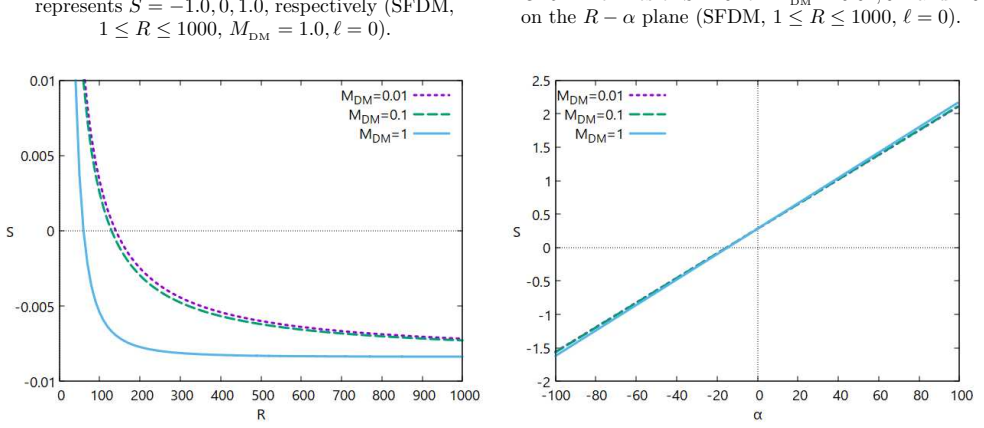
0, and fig.2 shows S = 0 for MDM = 0. 01, 0. 1, 1. 0 in the Rs − α plane. The scalarization occurs in the region below the S = 0 line in these figures. The value of S becomes negative in the α < 0 region for the scalariza- tion. This is a same trend as ordinary materials. This is because T E ∼ − ρ (where ρ is the mass energy density) in ordinary matter such...
-
[2]
0 × 1012M⊙ ,changingα (CDM, ℓ = 0,Rs = 10kpc, M = 1. 0 × 106M⊙ ). ization (the scalar hair) has the expanse and depends on the configuration of the material (metric). Therefore, the heavier the BH, the more the hair is collapsed, and thus scalarization is considered to be conversely weaker. C. SFDM Next we calculate the general case of SFDM. DM halos of SF...
-
[3]
0 × 1012M⊙ , changing α (SFDM, ℓ = 0,R = 10kpc, M = 1. 0 × 106M⊙ ). FIG. 14: The value of S with M = 1. 0 × 106M⊙ − 109M⊙ , changing α (SFDM, ℓ = 0,R = 10kpc, MDM = 1. 0 × 1010M⊙ ). The radial equation becomes ∆ d dr ( ∆ d dr ) R(r) + [K 2(r) − (λ +µ 2(r)r2)∆ ]R(r) = 0. (53) Here,K 2(r) = ω 2(r2 +a2)2 − 2amω (r2 +a2) +a2m2 and λ = Λ ℓm+a2m2− 2amω , where ...
-
[4]
We will take the same approach for the angular equation and compute Λ ℓm
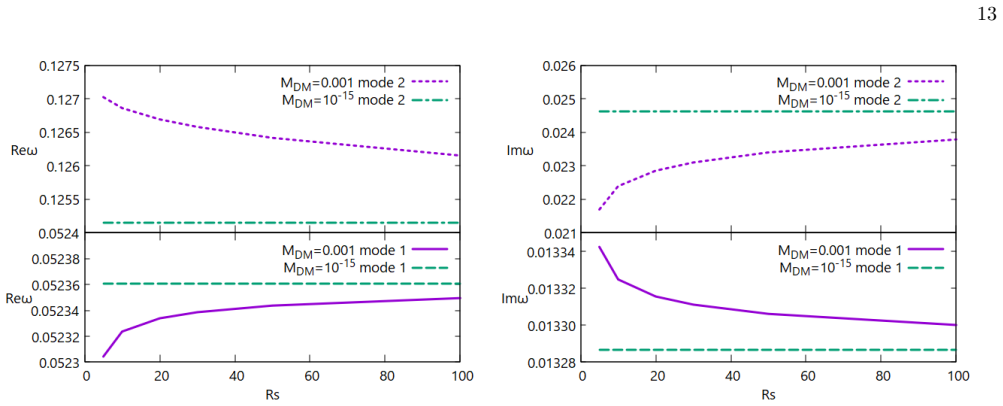
computed Λ ℓm andω using the continued fraction method. We will take the same approach for the angular equation and compute Λ ℓm. From (54), the solution S(x) of the angular equation (52) is considered to be in the form of a continuous solution like : S(x) = exp(akx)(1 − x)|m|/ 2(1 +x)|m|/ 2 ∞ Σ n=0 bn(1 +x)n. (58) Substituting this into (52), we obtain a...
-
[5]
Y. Fujii and K. Maeda, The scalar-tensor theory of gravi- tation, Cambridge Monographs on Mathematical Physics (Cambridge University Press, 2007)
work page 2007
-
[6]
V. Faraoni, Cosmology in Scalar-Tensor Gravity , Funda- mental Theories of Physics (Springer Netherlands, 2004)
work page 2004
-
[7]
C. Brans and R. H. Dicke, Mach’s principle and a rela- tivistic theory of gravitation, Phys. Rev. 124, 925 (1961)
work page 1961
-
[8]
Chameleon Fields: Awaiting Surprises for Tests of Gravity in Space
J. Khoury and A. Weltman, Chameleon Fields: Await- ing Surprises for Tests of Gravity in Space, Physical Re- view Letters 93, 171104 (2004), arXiv:astro-ph/0309300 [astro-ph]
work page internal anchor Pith review Pith/arXiv arXiv 2004
-
[9]
Symmetron Fields: Screening Long-Range Forces Through Local Symmetry Restoration
K. Hinterbichler and J. Khoury, Screening Long-Range Forces through Local Symmetry Restoration, Physical Review Letters 104, 231301 (2010), arXiv:1001.4525 [hep-th]
work page internal anchor Pith review Pith/arXiv arXiv 2010
-
[10]
General Relativity solutions in modified gravity
H. Motohashi and M. Minamitsuji, General Relativity solutions in modified gravity, Physics Letters B 781, 728 (2018), arXiv:1804.01731 [gr-qc]
work page internal anchor Pith review Pith/arXiv arXiv 2018
-
[11]
Perturbed Kerr Black Holes can probe deviations from General Relativity
E. Barausse and T. P. Sotiriou, Perturbed Kerr Black Holes Can Probe Deviations from General Rel- ativity, Physical Review Letters 101, 099001 (2008), arXiv:0803.3433 [gr-qc]
work page internal anchor Pith review Pith/arXiv arXiv 2008
-
[12]
Floating and sinking: the imprint of massive scalars around rotating black holes
V. Cardoso, S. Chakrabarti, P. Pani, E. Berti, and L. Gualtieri, Floating and Sinking: The Imprint of Mas- sive Scalars around Rotating Black Holes, Physical Re- view Letters 107, 241101 (2011), arXiv:1109.6021 [gr-qc]
work page internal anchor Pith review Pith/arXiv arXiv 2011
-
[13]
N. Yunes, P. Pani, and V. Cardoso, Gravitational waves from quasicircular extreme mass-ratio inspirals as probes of scalar-tensor theories, Physical Review D 85, 102003 (2012), arXiv:1112.3351 [gr-qc]
work page internal anchor Pith review Pith/arXiv arXiv 2012
-
[14]
T. P. Sotiriou and V. Faraoni, Black Holes in Scalar- Tensor Gravity, Physical Review Letters 108, 081103 (2012), arXiv:1109.6324 [gr-qc]
work page internal anchor Pith review Pith/arXiv arXiv 2012
- [15]
-
[16]
Matter around Kerr black holes in scalar-tensor theories: scalarization and superradiant instability
V. Cardoso, I. P. Carucci, P. Pani, and T. P. Sotiriou, Matter around Kerr black holes in scalar-tensor theories: Scalarization and superradiant instability, Physical Re- view D 88, 044056 (2013), arXiv:1305.6936 [gr-qc]
work page internal anchor Pith review Pith/arXiv arXiv 2013
- [17]
-
[18]
T. Damour and G. Esposito-Far` ese, Nonperturbative strong-field effects in tensor-scalar theories of gravitati on, Phys. Rev. Lett. 70, 2220 (1993)
work page 1993
-
[19]
Stability Analysis of Spherically Symmetric Star in Scalar-Tensor Theories of Gravity
T. Harada, Stability Analysis of Spherically Symmetri c Star in Scalar-Tensor Theories of Gravity, Progress of Theoretical Physics 98, 359 (1997), arXiv:gr-qc/9706014 [gr-qc]
work page internal anchor Pith review Pith/arXiv arXiv 1997
-
[20]
Neutron star transition to strong-scalar-field state in tensor scalar gravity
J. Novak, Neutron star transition to a strong-scalar-fi eld state in tensor-scalar gravity, Physical Review D 58, 064019 (1998), arXiv:gr-qc/9806022 [gr-qc]
work page internal anchor Pith review Pith/arXiv arXiv 1998
-
[21]
Y. B. Zel’dovich, Generation of waves by a rotating body , Journal of Experimental and Theoretical Physics Letters 14, 270 (1971)
work page 1971
-
[22]
Y. B. Zel’dovich, Amplification of cylindrical electro mag- netic waves reflected from a rotating body (1972)
work page 1972
-
[23]
Small Kerr-anti-de Sitter black holes are unstable
V. Cardoso and ´O. J. Dias, Small Kerr anti-de Sitter black holes are unstable, Physical Review D 70, 084011 (2004), arXiv:hep-th/0405006 [astro-ph]
work page internal anchor Pith review Pith/arXiv arXiv 2004
-
[24]
V. Cardoso, ´O. J. C. Dias, and S. Yoshida, Classical in- stability of Kerr-AdS black holes and the issue of final state, Physical Review D 74, 044008 (2006), arXiv:hep- th/0607162 [hep-th]
-
[25]
N. Uchikata, S. Yoshida, and T. Futamase, Scalar pertur - bations of kerr-ads black holes, Phys. Rev. D 80, 084020 (2009)
work page 2009
-
[26]
W. E. East and F. Pretorius, Superradiant Instability and Backreaction of Massive Vector Fields around Kerr Black Holes, Physical Review Letters 119, 041101 (2017), arXiv:1704.04791 [gr-qc]
work page internal anchor Pith review Pith/arXiv arXiv 2017
-
[27]
W. E. East, Massive Boson Superradiant Instability of Black Holes: Nonlinear Growth, Saturation, and Gravi- tational Radiation, Physical Review Letters 121, 131104 (2018), arXiv:1807.00043 [gr-qc]
work page internal anchor Pith review Pith/arXiv arXiv 2018
-
[28]
Superradiant instability of Kerr-de Sitter black holes in scalar-tensor theory
C.-Y. Zhang, S.-J. Zhang, and B. Wang, Superradiant instability of Kerr-de Sitter black holes in scalar-tensor theory, Journal of High Energy Physics 2014, 11 (2014), arXiv:1405.3811 [hep-th]
work page internal anchor Pith review Pith/arXiv arXiv 2014
-
[29]
G. Lingetti, E. Cannizzaro, and P. Pani, Superradiant instabilities by accretion disks in scalar-tensor theorie s, Physical Review D 106, 024007 (2022), arXiv:2204.09335 [gr-qc]
-
[30]
J. F. Navarro, C. S. Frenk, and S. D. M. White, The Structure of Cold Dark Matter Halos, The Astrophysical Journal 462, 563 (1996), arXiv:astro-ph/9508025 [astro- ph]
work page internal anchor Pith review Pith/arXiv arXiv 1996
- [31]
-
[32]
The Structure of Dark Matter Haloes in Dwarf Galaxies
A. Burkert, The Structure of Dark Matter Halos in Dwarf Galaxies, The Astrophysical Journal Letters 447, L25 (1995), arXiv:astro-ph/9504041 [astro-ph]
work page internal anchor Pith review Pith/arXiv arXiv 1995
-
[33]
T. Matos, L. A. Ure˜ na-L´ opez, M. Alcubierre, R. Becerril, F. S. Guzm´ an, and D. N´ u˜ nez, The scalar field dark matter model: A braneworld connection, in The Early Universe and Observational Cosmology , edited by N. Bret´ on, J. L. Cervantes-Cota, and M. Salgado (Springer Berlin Heidel- berg, Berlin, Heidelberg, 2004) pp. 401–420
work page 2004
-
[34]
Bose-Einstein condensation of dark matter solves the core/cusp problem
T. Harko, Bose-Einstein condensation of dark matter solves the core/cusp problem, Journal of Cosmology and Astroparticle Physics 2011 (5), 022, arXiv:1105.2996 [astro-ph.CO]
work page internal anchor Pith review Pith/arXiv arXiv 2011
-
[35]
L. M. Fern´ andez-Hern´ andez, M. A. Rodr ´ ıguez-Meza, and 21 T. Matos, Comparison between two scalar field models using rotation curves of spiral galaxies, in Journal of Physics Conference Series , Journal of Physics Conference Series, Vol. 1010 (IOP, 2018) p. 012005, arXiv:1708.06681 [astro-ph.GA]
work page internal anchor Pith review Pith/arXiv arXiv 2018
- [36]
- [37]
-
[38]
Z. Xu, X. Hou, X. Gong, and J. Wang, Black hole space- time in dark matter halo, Journal of cosmology and as- troparticle physics 2018, 038 (2018), arXiv:1803.00767 [gr-qc]
work page internal anchor Pith review Pith/arXiv arXiv 2018
-
[39]
W. F. Buell and B. A. Shadwick, Potentials and bound states, American Journal of Physics 63, 256 (1995)
work page 1995
-
[40]
V. H. Robles and T. Matos, Flat central density profile and constant dark matter surface density in galaxies from scalar field dark matter, Monthly Notices of the Royal Astronomical Society 422, 282 (2012), arXiv:1201.3032 [astro-ph.CO]
work page internal anchor Pith review Pith/arXiv arXiv 2012
-
[41]
W. J. C. de Blok and S. S. McGough, Dark Matter in Low Surface Brightness Galaxies, in Dark and Visible Matter in Galaxies and Cosmological Implications , Astronomical Society of the Pacific Conference Series, Vol. 117, edited by M. Persic and P. Salucci (1997) p. 39, arXiv:astro- ph/9610216 [astro-ph]
-
[42]
S. Subramanian, S. Ramya, M. Das, K. George, T. Sivarani, and T. P. Prabhu, Investigating AGN black hole masses and the M BH -σe relation for low surface brightness galaxies, Monthly Notices of the Royal As- tronomical Society 455, 3148 (2016), arXiv:1510.07743 [astro-ph.GA]
work page internal anchor Pith review Pith/arXiv arXiv 2016
- [43]
-
[44]
R. A. Konoplya and A. V. Zhidenko, Stability and quasinormal modes of the massive scalar field around Kerr black holes, Physical Review D 73, 124040 (2006), arXiv:gr-qc/0605013 [gr-qc]
work page internal anchor Pith review Pith/arXiv arXiv 2006
-
[45]
S. R. Dolan, Instability of the massive Klein-Gordon fie ld on the Kerr spacetime, Physical Review D 76, 084001 (2007), arXiv:0705.2880 [gr-qc]
work page internal anchor Pith review Pith/arXiv arXiv 2007
-
[46]
E. W. Leaver, An Analytic representation for the quasi normal modes of Kerr black holes, Proc. Roy. Soc. Lond. A 402, 285 (1985)
work page 1985
-
[47]
Gravitational signature of Schwarzschild black holes in dynamical Chern-Simons gravity
C. Molina, P. Pani, V. Cardoso, and L. Gualtieri, Gravi- tational signature of Schwarzschild black holes in dynam- ical Chern-Simons gravity, Physical Review D 81, 124021 (2010), arXiv:1004.4007 [gr-qc]
work page internal anchor Pith review Pith/arXiv arXiv 2010
-
[48]
W. H. Press, S. A. Teukolsky, B. P. Flannery, and W. T. Vetterling, Numerical Recipes in FORTRAN: The Art of Scientific Computing , 2nd ed. (Cambridge University Press, USA, 1992)
work page 1992
-
[49]
Tensor-scalar gravity and binary-pulsar experiments
T. Damour and G. Esposito-Far` ese, Tensor-scalar grav ity and binary-pulsar experiments, Physical Review D 54, 1474 (1996), arXiv:gr-qc/9602056 [gr-qc]
work page internal anchor Pith review Pith/arXiv arXiv 1996
discussion (0)
Sign in with ORCID, Apple, or X to comment. Anyone can read and Pith papers without signing in.