REVIEW 3 major objections 4 minor 1 cited by
Linear codes are strictly suboptimal for a family of binary distributed hypothesis tests, where the best linear scheme is simple truncation.
Reviewed by Pith at T0; open to challenge. T0 means a machine referee read the full paper against a public rubric. the ladder, T0–T4 →
T0 review · deepseek-v4-flash
2026-08-03 10:17 UTC pith:PHTVP635
load-bearing objection A clean, genuinely new result on linear codes for binary DHT, with a fixable gap in the analytic suboptimality proof — worth reviewing. the 3 major comments →
On the suboptimality of linear codes for binary distributed hypothesis testing
The pith
A machine-rendered reading of the paper's core claim, the machinery that carries it, and where it could break.
Core claim
The central claim is Theorem 2: for testing DSBS(p) against DSBS(1/2), DSBS(1/2) against DSBS(p), or DSBS(p) against DSBS(1-p), the statistic formed by the first k positions of each sequence, (X^k, Y^k), dominates, in the Blackwell order, any pair of linearly compressed messages (GX^n, HY^n) whose ranks are at most k. In words, truncation is the best linear code in these three cases. The proof constructs, for any full-rank generator matrix, a random channel that exactly simulates the compressed messages from the truncated observations under both hypotheses. The paper also proves that the two agents never need different linear codes: G(X^n xor Y^n) dominates (GX^n, HY^n), so the decision can
What carries the argument
The central mechanism is the Blackwell order on statistics together with a channel-simulation construction. To show one statistic dominates another, the paper builds a fixed conditional distribution that maps the dominating statistic to the dominated one simultaneously under both hypotheses, which proves the decision region of the former contains that of the latter. For Theorem 2, the needed simulation adds independent noise to the truncated mod-2 sum to reproduce the discarded coordinates. The asymptotic suboptimality argument uses the classical random-coding (random-binning) exponent for distributed hypothesis testing, in which each agent passes its observation through a binary symmetric c
Load-bearing premise
The load-bearing premise is that the optimal projection in the random-coding exponent calculation is the three-stage binary-symmetric-channel Markov chain X-U-V-Y with transitions BSC(alpha), BSC(alpha * alpha * p), BSC(alpha); the paper asserts this rather than derives it, and the derivative comparison near rate 1 is printed with the wrong limit (alpha -> 1/2, where the rate is 0, instead of alpha -> 0, where the rate is 1).
What would settle it
For testing DSBS(p) against DSBS(1/2) with small p and rate R = 1 - epsilon, solve the I-projection minimization numerically without assuming the asserted Markov-chain ansatz, and compare the resulting exponent to the truncation line (1 - epsilon) * d2(p || 1/2); if the optimized exponent fails to exceed the line for some p and epsilon, the claimed strict suboptimality of linear codes collapses.
If this is right
- For testing DSBS(p) against DSBS(1/2), or the reverse, every linear scheme of rate R has type-II error exponent at most R * d2(p || 1/2), since truncation is the best linear code.
- A classical random-quantization scheme beats that exponent at rates close to 1, so in that regime no linear code achieves the best Stein exponent.
- The same conclusion holds, numerically, for testing DSBS(p) against DSBS(1-p) at sufficiently high rates.
- Agents never lose optimality by using the same linear code and letting the decision maker work only with G(X^n xor Y^n), simplifying code design and the decision rule.
- If Conjecture 1 is correct, the optimality of truncation, and therefore the suboptimality of all linear codes, extends to every pair of hypotheses with correlations of opposite signs.
Where Pith is reading between the lines
- Because the two proved cases of Theorem 2 use different simulation constructions (for the convolution parameter 1/2 and for 1), a proof of Conjecture 1 will likely need a unified channel that interpolates between them; finding such a channel is the natural next objective.
- The random-coding exponent curve is non-concave, so the improved exponent E_com obtained by concatenating an optimal random code with truncation is a general device: any distributed test whose exponent curve is non-concave can likely be improved this way.
- For practical code design, the message is that short-blocklength linear encoders are unlikely to approach the fundamental exponent for tests involving opposite-sign correlations or independence; non-linear quantization or hashing deserves attention there.
- The suboptimality appears only at high rates: the truncation line equals the random-coding exponent at rate 1 and the gap opens just below 1, so linear codes may still be near-optimal when communication is scarce.
Editorial analysis
A structured set of objections, weighed in public.
Referee Report
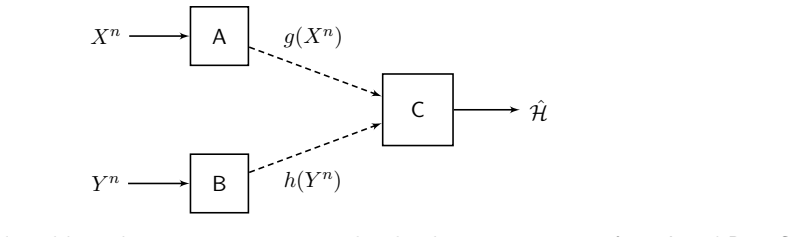
Summary. The paper studies a binary distributed hypothesis testing problem in which two agents observe n i.i.d. pairs from DSBS(p_i) and communicate compressed versions of their observations to a central decision maker. The authors focus on linear compression schemes and analyze them through the Blackwell order of experiments. Theorem 1 shows that for any linear maps G,H, the statistic G(X^n⊕Y^n) is Blackwell-superior to the pair (GX^n,HY^n), so using the same linear code at both agents is at least as good as using different codes. Theorem 2 identifies three hypothesis families—DSBS(p) vs DSBS(1/2), DSBS(1/2) vs DSBS(p), and DSBS(p) vs DSBS(1−p)—for which simple truncation is the best linear code of a given rank. The paper then compares the truncation Stein exponent with Han's random-coding exponent. For testing against independence it claims an analytic proof that Han's scheme with symmetric BSC test channels strictly beats truncation at high rates; for the opposite-sign equal-magnitude case the same conclusion is supported by numerical experiments. A conjecture on general opposite-sign correlations is supported by small-case linear feasibility checks.
Significance. If the results hold, the paper makes a crisp and useful contribution: it identifies a natural, computationally attractive class of codes (linear codes) that is strictly suboptimal for a basic distributed hypothesis testing problem, in contrast to the earlier positive results for same-sign correlations. The Blackwell-order framework and the reduction to modulo-2 sums are elegant and likely to be reused. The proof of Theorems 1 and 2 is transparent, and the numerical feasibility study for Conjecture 1 is honest and reproducible. The main caveats are concentrated in Section 4, where the analytic proof of strict suboptimality has a fixable but real gap and the displayed exponent formula is internally inconsistent as stated. With those points corrected, the paper would be a worthwhile addition to the distributed hypothesis testing literature.
major comments (3)
- [Section 4, derivative calculation] The proof of E'_Han(1)=0 evaluates lim_{α→1/2} of the derivative ratio [d/dα(1−h2(α∗α∗p))]/[d/dα(1−h2(α))]. But R=1−h2(α) tends to 0 as α→1/2, not to 1; the derivative at R=1 requires the limit α→0. The displayed calculation therefore does not establish the claimed behavior near rate 1, and the subsequent conclusion that the Han exponent lies above the truncation line at rates just below 1 is not justified as written. The correct endpoint is α→0, where the ratio indeed tends to 0 because h2'(α)→∞ while the numerator remains finite; please correct the proof and the displayed limit.
- [Section 4, Eq. (2) and following paragraph] The definition of E_Han in Eq. (2) states that π must have the same UX, UY, and UV marginals as P^0, but the immediately following paragraph says that π* has the same UX, UV, and VY marginals and uses this to identify the Markov chain X−U−V−Y and to conclude E_Han=I(U;V). These are different constraint sets. The Markov-chain identification and the formula E_Han=I(U;V) are natural for the latter set (UX, UV, VY), not for the former set written in Eq. (2). Since the analytic comparison with truncation relies entirely on this formula, Eq. (2) must be corrected to the intended constraint set and the I-projection step should be stated explicitly.
- [Abstract and Introduction, item 3] The Introduction and abstract claim that for both 'opposite signs of the same magnitude' and 'for/against independence', classical typicality-based quantization achieves a better Stein exponent than truncation, and hence any linear code is strictly suboptimal. The body provides an analytic derivation only for testing against independence (p1=1/2). For the opposite-sign equal-magnitude case the comparison is supported only by the numerical example in Fig. 3 and by the assertion that the plots are qualitatively identical for other parameters. No theorem is stated or proved for that case. Please either provide a proof or explicitly qualify the claim as numerical evidence, and adjust the abstract and Introduction accordingly.
minor comments (4)
- [Section 3, proof of Theorem 2, case p1=1−p0] The line 'let U=Z^{k_e}⊕iZ^{k_e}' appears to contain a typo: it should be U=Z^{k_e}⊕i·1^{k_e} to match X^{k_e}⊕Y^{k_e}. With the printed formula, the constructed V does not have the claimed distribution.
- [Section 4, Markov relations] The displayed relation U−◦−(X,Y)−◦−V is not implied by the factorization π*=P^1 f1(u,x)f2(v,y)f3(u,v); the relevant structure is the chain X−U−V−Y. Please remove or correct the displayed Markov relation.
- [Figure 3] Please state explicitly whether the curve labeled E_Han for the symmetric BSC case is the analytic formula 1−h2(α∗α∗p) or a numerical solution of (2). The text seems to use both, which is confusing.
- [Abstract] The abstract says Theorem 2 covers 'testing opposite signs of the same magnitude of correlation'; this is correct for the case p1=1−p0, but the general opposite-sign statement is only a conjecture. Please make this distinction explicit.
Circularity Check
No circularity found; derivations are self-contained, with a non-circular analytic gap at the Section 4 endpoint.
full rationale
The derivation chain is self-contained. Theorem 1 and Theorem 2 rest on explicit Blackwell-order channel constructions (Fact 1), and no fitted parameter is renamed as a prediction. In Section 4, E_Han(R) is computed for an explicit test-channel choice P_{U|X}=P_{V|Y}=BSC(α); the expression E_Han=I(U;V)=1−h2(α*α*p) at R=I(U;X)=1−h2(α) follows from the standard I-projection structure cited to Csiszár–Shields [CS04] and from the induced marginals, not from the target conclusion. The paper explicitly notes the BSC choice is 'not known to be the optimal choice of test channel', and the suboptimality claim only requires achievability, so no optimality input is smuggled in. The numerical feasibility checks in Section 5 support Conjecture 1 and are not used to prove Theorem 2. No load-bearing self-citations appear. The analytic suboptimality proof has a non-circular gap: the displayed limit for E'_Han(1) is taken as α→1/2 (rate 0) instead of α→0 (rate 1), so the endpoint derivative is not established as written; this is a correctness issue, not a reduction of the result to its inputs.
Axiom & Free-Parameter Ledger
axioms (4)
- standard math Fact 1 (Blackwell order): U ⪰_B V iff there exists a channel P_{V|U} with P^i_V = P_{V|U} P^i_U for i=0,1.
- domain assumption Han's Stein exponent formula (2): E_Han = min_π D(π||P1_UXYV) over π with the same UX, UY, UV marginals as P0.
- domain assumption The optimal I-projection π* has product structure f1(u,x) f2(v,y) f3(u,v), and for testing against independence simplifies to Markov chain X−U−V−Y with BSC transitions.
- standard math For DSBS(p), X^n⊕Y^n is a sufficient statistic for (X^n,Y^n), and the co-located Stein exponent is d2(p0||p1).
read the original abstract
We study a binary distributed hypothesis testing problem where two agents observe correlated binary vectors and communicate compressed information at the same rate to a central decision maker. In particular, we study linear compression schemes and show that simple truncation is the best linear scheme in two cases: (1) testing opposite signs of the same magnitude of correlation, and (2) testing for or against independence. We conjecture, supported by numerical evidence, that truncation is the best linear code for testing any correlations of opposite signs. Further, for testing against independence, we also compute classical random coding exponents and show that truncation, and consequently any linear code, is strictly suboptimal.
Figures


Forward citations
Cited by 1 Pith paper
-
On The Most Discriminative Boolean Functions for Correlated Sources
Level-k Boolean functions maximize KL divergence and Fisher information for unbiased pairs and identical pairs under nonnegative correlation, and minimize Bayes error in one-bit distributed hypothesis testing.
Reference graph
Works this paper leans on
-
[1]
Hypothesis testing with communication constraints
[AC86] R. Ahlswede and I. Csiszar. “Hypothesis testing with communication constraints”. In: IEEE Transactions on Information Theory32.4 (1986), pp. 533–542 (cit. on pp. 1, 2, 9). [Ber79] Toby Berger. “Decentralized estimation and decision theory”. In:IEEE Seven Springs Workshop on Information Theory. Vol
1986
-
[120]
1979 (cit. on p. 1). [Bla51] David Blackwell. “Comparison of experiments”. In:Proc. Second Berkeley Symposium on Mathematical Statistics and Probability. 1951, pp. 93–102 (cit. on p. 3). [CK14] Thomas A. Courtade and Gowtham R. Kumar. “Which boolean functions maximize mutual information on noisy inputs?” In:IEEE Transactions on Information Theory 60.8 (20...
Pith/arXiv arXiv 1979
discussion (0)
Sign in with ORCID, Apple, or X to comment. Anyone can read and Pith papers without signing in.