Toward Covert Quantum Computing
Pith reviewed 2026-06-30 21:00 UTC · model grok-4.3
The pith
Discrete isoperimetric inequalities limit adversary detection to O(sqrt(n)) border qubits in planar n-qubit circuits.
A machine-rendered reading of the paper's core claim, the machinery that carries it, and where it could break.
Core claim
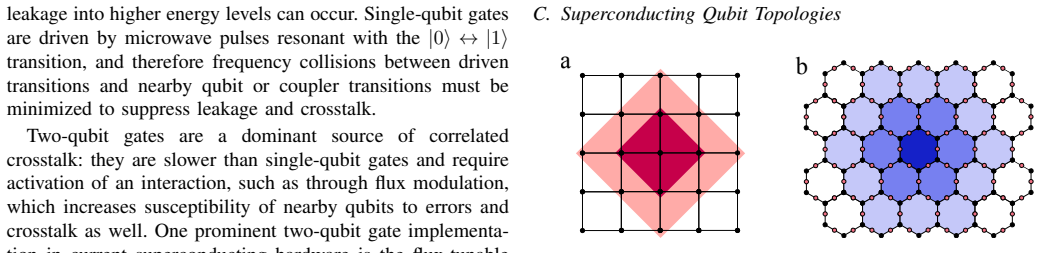
We derive discrete isoperimetric inequalities to show that, for an n-qubit circuit under this model, only O(sqrt(n)) border qubits provide detection information to the adversary.
What carries the argument
discrete isoperimetric inequalities applied to planar graphs with nearest-neighbor crosstalk, which bound the surface-to-volume ratio that controls information leakage to the adversary
If this is right
- Adversary information scales with the square root of circuit size rather than linearly.
- Larger circuits become relatively more private under the assumed crosstalk model.
- Real devices exhibit additional side channels from long-range effects beyond the border qubits.
- Mitigating drive-line leakage could restore the theoretical scaling.
Where Pith is reading between the lines
- If long-range crosstalk can be suppressed through better spatial isolation, multi-tenant quantum clouds could support private computation at scale.
- The border-qubit analysis could guide placement of decoy circuits or shielding structures.
- The same isoperimetric approach may extend to other shared-resource quantum privacy settings such as blind quantum computation.
Load-bearing premise
Crosstalk is strictly nearest-neighbor and every circuit layout is a planar graph.
What would settle it
Measure whether long-range crosstalk on current hardware can be reduced to nearest-neighbor levels; if it cannot, the O(sqrt(n)) bound does not describe real detection risk.
Figures
read the original abstract
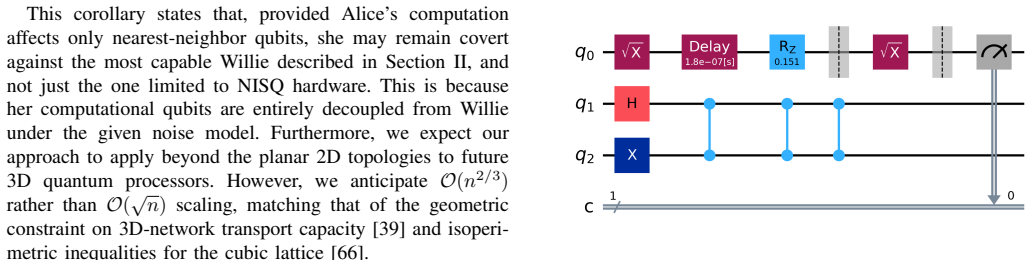
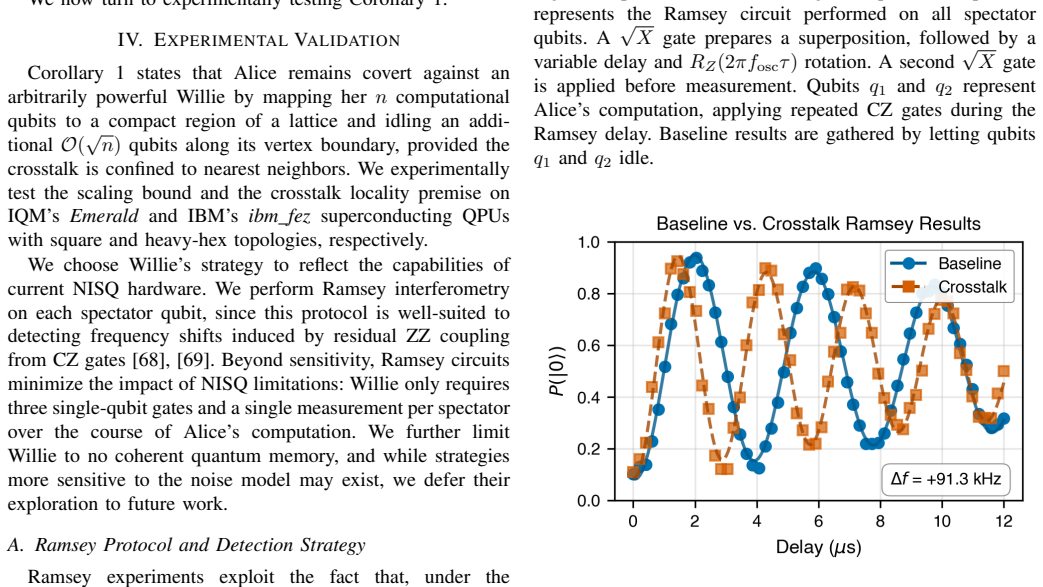
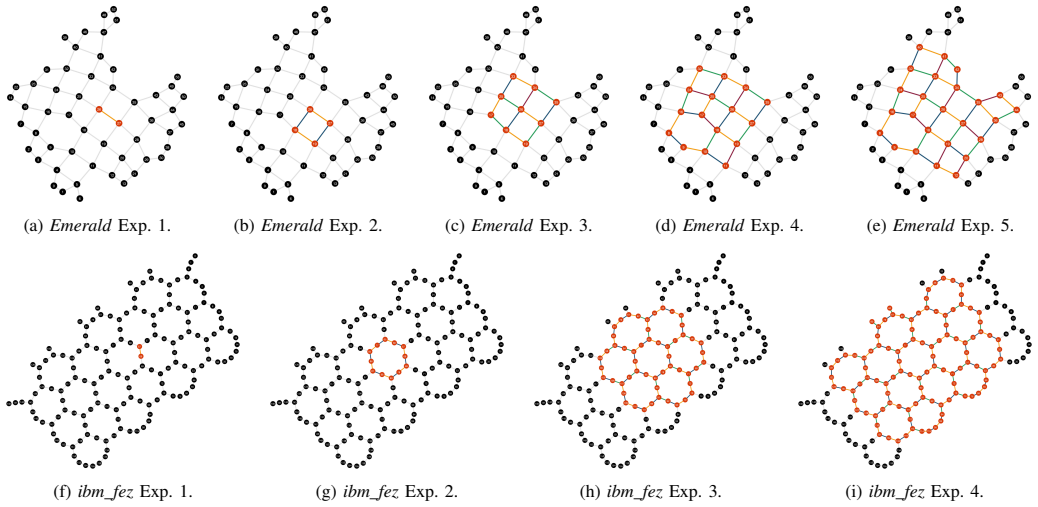
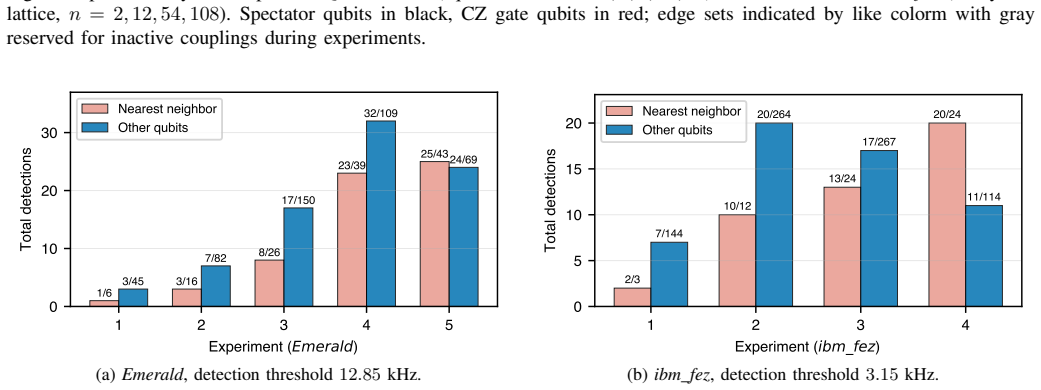
As quantum computers become available through multi-tenant cloud platforms, ensuring privacy against adversaries sharing the same quantum processing unit becomes critical. We introduce and explore \emph{covert quantum computing}, a new concept that ensures an adversary with access to all other quantum computational units (QCUs) of a quantum computer cannot detect computation on the subset that they cannot access. Analogous to covert communication, we employ information theory. However, since here the adversary controls the systems used for detection, we require a richer framework for covertness analysis that accounts for the use of quantum memories and adaptive operations. Thus, we adopt the \emph{quantum-strategy} framework used in quantum game theory and memory channel discrimination. Current quantum computers use planar graph circuit layouts and typically assume nearest-neighbor crosstalk. We derive discrete isoperimetric inequalities to show that, for an $n$-qubit circuit under this model, only $\mathcal{O}(\sqrt{n})$ border qubits provide detection information to the adversary. We then explore this scaling law on IQM's 54-qubit \emph{Emerald} processor and IBM's 156-qubit \emph{ibm\_fez} machine employing the Heron 2 architecture. We implement Ramsey experiments on qubits not used in computation, and detect nearest-neighbor crosstalk, as expected. However, we also observe long-range coupling effects beyond the border qubits, revealing a side channel that the adversary can exploit. We hypothesize that this long-range crosstalk is induced by leakage from the drive and control lines. Beyond weakening covertness, it exposes co-tenants to both adversarial and unintended crosstalk and degrades circuits that span spatially distributed qubits, motivating further work on spatial isolation and crosstalk characterization.
Editorial analysis
A structured set of objections, weighed in public.
Referee Report
Summary. The manuscript introduces covert quantum computing to protect n-qubit computations from detection by an adversary controlling other qubits on a shared device. Under a nearest-neighbor crosstalk model on planar graphs, it derives discrete isoperimetric inequalities showing that only O(sqrt(n)) border qubits suffice to provide the adversary with detection information. Experiments on IQM Emerald (54 qubits) and IBM ibm_fez (156 qubits) confirm nearest-neighbor effects but also observe long-range coupling, hypothesized to stem from drive-line leakage, which the authors note weakens covertness.
Significance. The parameter-free isoperimetric derivation supplies a concrete scaling law for an idealized model and is a clear strength. The experimental data on real hardware, even while deviating from the model, supplies useful observations on crosstalk that could inform hardware isolation efforts. The adoption of the quantum-strategy framework for handling adaptive adversaries with memories is appropriately chosen for the setting.
major comments (1)
- [Experimental exploration] Experimental section (paragraph beginning 'We then explore this scaling law...'): The reported long-range coupling effects directly contradict the strictly nearest-neighbor crosstalk and planar-graph assumptions used to derive the O(sqrt(n)) bound. Because this modeling premise is load-bearing for the central security claim, the experimental results leave the practical applicability of the bound unsupported without additional analysis of how the isoperimetric inequality changes under long-range interactions.
minor comments (2)
- The abstract introduces the acronym 'QCUs' before expanding it; a parenthetical definition on first use would improve readability.
- The transition between the theoretical bound and the experimental observations could be clarified by an explicit statement that the O(sqrt(n)) result is model-specific and does not extend to the observed long-range regime.
Simulated Author's Rebuttal
We thank the referee for highlighting the relationship between our experimental observations and the modeling assumptions in the theoretical analysis. We address the comment below and clarify the scope of our results.
read point-by-point responses
-
Referee: The reported long-range coupling effects directly contradict the strictly nearest-neighbor crosstalk and planar-graph assumptions used to derive the O(sqrt(n)) bound. Because this modeling premise is load-bearing for the central security claim, the experimental results leave the practical applicability of the bound unsupported without additional analysis of how the isoperimetric inequality changes under long-range interactions.
Authors: The O(sqrt(n)) bound is derived under the explicit assumption of nearest-neighbor crosstalk on a planar interaction graph, which is the standard model for analyzing crosstalk in current superconducting processors. The experimental section is presented as an exploration of this scaling law on real hardware rather than a validation that the bound holds in practice. As already stated in the manuscript, the observed long-range coupling (hypothesized to originate from drive-line leakage) constitutes an additional side channel that weakens covertness beyond the border-qubit analysis. We agree that this deviation means the bound does not directly establish practical security on existing devices. In revision we will add explicit language stating that the central theoretical claim applies only to the idealized nearest-neighbor model and that the experimental results demonstrate the need for improved spatial isolation before the bound can be considered practically relevant. A quantitative re-derivation of the isoperimetric inequality under arbitrary long-range interactions lies outside the present scope. revision: partial
- Quantitative analysis of how the isoperimetric inequality and resulting O(sqrt(n)) scaling change under long-range coupling models
Circularity Check
No significant circularity; derivation is self-contained
full rationale
The paper's central claim is a direct derivation of discrete isoperimetric inequalities under an explicit nearest-neighbor planar-graph model for circuit layouts, yielding the O(sqrt(n)) border-qubit scaling. This mathematical step is presented as following from the model assumptions stated upfront and does not reduce to any fitted parameters, self-citations, or renaming of known results. The experimental section on real hardware (observing long-range crosstalk) is separate and does not tune or validate the theoretical bound; the claim is not asserted to hold outside the model. No load-bearing step matches any enumerated circularity pattern.
Axiom & Free-Parameter Ledger
axioms (2)
- domain assumption Crosstalk occurs only between nearest-neighbor qubits on a planar graph layout.
- domain assumption The adversary has access to all qubits outside the user's computational subset and can perform adaptive quantum operations and memory-assisted measurements.
Reference graph
Works this paper leans on
-
[1]
NISQ Quantum Computing: A Security-Centric Tutorial and Survey [Feature],
F. Chen, L. Jiang, H. Müller, P. Richerme, C. Chu, Z. Fu, and M. Yang, “NISQ Quantum Computing: A Security-Centric Tutorial and Survey [Feature],”IEEE Circuits and Systems Magazine, vol. 24, no. 1, pp. 14–32, 2024
2024
-
[2]
Securing Quantum Computer Reset with One-Time Pads,
C. Xu, J. Sikora, and J. Szefer, “Securing Quantum Computer Reset with One-Time Pads,” inProceedings of the 2025 Quantum Security and Privacy Workshop, ser. QSec ’25. New York, NY , USA: Association for Computing Machinery, Oct. 2025, pp. 1–6
2025
-
[3]
Towards Secure Classical-Quantum Systems,
D. V olya, T. Zhang, N. Alam, M. Tehranipoor, and P. Mishra, “Towards Secure Classical-Quantum Systems,” in2023 IEEE Int. Symp. on Hard- ware Oriented Security and Trust (HOST), May 2023, pp. 283–292
2023
-
[4]
A Pragmatic Introduction to Secure Multi-Party Computation,
D. Evans, V . Kolesnikov, and M. Rosulek, “A Pragmatic Introduction to Secure Multi-Party Computation,”Foundations and Trends in Privacy and Security, vol. 2, no. 2-3, pp. 70–246, Dec. 2018
2018
-
[5]
Fully homomorphic encryption using ideal lattices,
C. Gentry, “Fully homomorphic encryption using ideal lattices,” in Proceedings of the Forty-First Annual ACM Symposium on Theory of Computing, ser. STOC ’09. New York, NY , USA: Association for Computing Machinery, May 2009, pp. 169–178
2009
-
[6]
Universal Blind Quantum Computation,
A. Broadbent, J. Fitzsimons, and E. Kashefi, “Universal Blind Quantum Computation,” in2009 50th Annual IEEE Symposium on Foundations of Computer Science, Oct. 2009, pp. 517–526
2009
-
[7]
Private quantum computation: An introduction to blind quantum computing and related protocols,
J. F. Fitzsimons, “Private quantum computation: An introduction to blind quantum computing and related protocols,”npj Quantum Information, vol. 3, no. 1, p. 23, Jun. 2017
2017
-
[8]
Classical Verification of Quantum Computations,
U. Mahadev, “Classical Verification of Quantum Computations,”SIAM J. Comput., vol. 51, no. 4, pp. 1172–1229, Aug. 2022
2022
-
[9]
I Know What You Are Reading: Evaluating Readout Crosstalk in Cloud-based Quantum Computers,
Y . Tan and J. Szefer, “I Know What You Are Reading: Evaluating Readout Crosstalk in Cloud-based Quantum Computers,” inProceedings of the 2025 Quantum Security and Privacy Workshop, ser. QSec ’25. New York, NY , USA: Association for Computing Machinery, Oct. 2025, pp. 10–15
2025
-
[10]
QubitVise: Double-Sided Crosstalk Attack in Superconducting Quantum Computers,
A. A. Arellano, H. Xie, and J. Szefer, “QubitVise: Double-Sided Crosstalk Attack in Superconducting Quantum Computers,” in2025 IEEE International Conference on Quantum Computing and Engineer- ing (QCE), vol. 02, Aug. 2025, pp. 50–53
2025
-
[11]
Schrödinger’s Toolbox: Exploring the Quantum Rowham- mer Attack,
D. Campbell, “Schrödinger’s Toolbox: Exploring the Quantum Rowham- mer Attack,” in2025 IEEE International Conference on Quantum Computing and Engineering (QCE), vol. 02, Aug. 2025, pp. 85–90
2025
-
[12]
Crosstalk Attacks and Defence in a Shared Quantum Computing Environment,
B. Harper, B. Tonekaboni, B. Goldozian, M. Sevior, and M. Usman, “Crosstalk Attacks and Defence in a Shared Quantum Computing Environment,”Advanced Quantum Technologies, vol. 8, no. 10, p. e2500009, Oct. 2025
2025
-
[13]
Square root law for commu- nication with low probability of detection on AWGN channels,
B. A. Bash, D. Goeckel, and D. Towsley, “Square root law for commu- nication with low probability of detection on AWGN channels,” in2012 IEEE Int. Symp. on Information Theory Proceedings. Cambridge, MA, USA: IEEE, Jul. 2012, pp. 448–452
2012
-
[14]
Limits of Reliable Communication with Low Probability of Detection on AWGN Channels,
——, “Limits of Reliable Communication with Low Probability of Detection on AWGN Channels,”IEEE J. Sel. Areas Commun., vol. 31, no. 9, pp. 1921–1930, Sep. 2013
1921
-
[15]
Covert Optical Communication,
B. A. Bash, A. H. Gheorghe, M. Patel, J. Habif, D. Goeckel, D. Towsley, and S. Guha, “Covert Optical Communication,”Nat. Commun., vol. 6, no. 1, p. 8626, Oct. 2015
2015
-
[16]
Covert communication over noisy channels: A resolvabil- ity perspective,
M. R. Bloch, “Covert communication over noisy channels: A resolvabil- ity perspective,”IEEE Trans. Inf. Theory, vol. 62, no. 5, pp. 2334–2354, May 2016
2016
-
[17]
Fundamental limits of communication with low probability of detection,
L. Wang, G. W. Wornell, and L. Zheng, “Fundamental limits of communication with low probability of detection,”IEEE Trans. Inf. Theory, vol. 62, no. 6, pp. 3493–3503, Jun. 2016
2016
-
[18]
Hiding information in noise: Fundamental limits of covert wireless communication,
B. A. Bash, D. Goeckel, D. Towsley, and S. Guha, “Hiding information in noise: Fundamental limits of covert wireless communication,”IEEE Communications Magazine, vol. 53, no. 12, pp. 26–31, Dec. 2015
2015
-
[19]
Covert Capacity of Bosonic Channels,
C. N. Gagatsos, M. S. Bullock, and B. A. Bash, “Covert Capacity of Bosonic Channels,”IEEE Journal on Selected Areas in Information Theory, vol. 1, no. 2, pp. 555–567, Aug. 2020
2020
-
[20]
Signaling for covert quantum sensing,
M. Tahmasbi, B. A. Bash, S. Guha, and M. Bloch, “Signaling for covert quantum sensing,” inProc. IEEE Int. Symp. Inform. Theory (ISIT), 2021, pp. 1041–1045
2021
-
[21]
Fundamental Limits of Covert Commu- nication Over Classical-Quantum Channels,
M. S. Bullock, A. Sheikholeslami, M. Tahmasbi, R. C. Macdonald, S. Guha, and B. A. Bash, “Fundamental Limits of Covert Commu- nication Over Classical-Quantum Channels,”IEEE Trans. Inf. Theory, vol. 71, no. 4, pp. 2741–2762, Apr. 2025
2025
-
[22]
Entanglement-assisted covert communication via qubit depolarizing channels,
E. Zlotnick, B. A. Bash, and U. Pereg, “Entanglement-assisted covert communication via qubit depolarizing channels,”IEEE Trans. Inf. The- ory, vol. 71, no. 5, pp. 3693–3706, 2025
2025
-
[23]
Covert Entanglement Gener- ation and Secrecy,
O. Kimelfeld, B. A. Bash, and U. Pereg, “Covert Entanglement Gener- ation and Secrecy,”IEEE Trans. Inf. Theory, 2026
2026
-
[24]
Fundamental Limits of Bosonic Broadcast Channels,
E. J. D. Anderson, S. Guha, and B. A. Bash, “Fundamental Limits of Bosonic Broadcast Channels,” in2021 IEEE Int. Symp. on Inf. Theory (ISIT). Melbourne, Australia: IEEE, Jul. 2021, pp. 766–771
2021
-
[25]
Covert communications: A comprehensive survey,
X. Chen, J. An, Z. Xiong, C. Xing, N. Zhao, F. R. Yu, and A. Nal- lanathan, “Covert communications: A comprehensive survey,”IEEE Commun. Surv. Tutor., vol. 25, no. 2, pp. 1173–1198, 2023
2023
-
[27]
Covert Entanglement gen- eration over Bosonic channels,
E. J. D. Anderson, M. S. Bullock, O. Kimelfeld, C. K. Eyre, F. Rozp˛ edek, U. Pereg, and B. A. Bash, “Covert Entanglement gen- eration over Bosonic channels,”IEEE Journal on Selected Areas in Communications, 2025, accepted for publication
2025
-
[28]
Achievability of Covert Quantum Communication,
E. J. D. Anderson, M. S. Bullock, F. Rozp˛ edek, and B. A. Bash, “Achievability of Covert Quantum Communication,” arXiv:2501.13103 [quant-ph], Jan. 2025
-
[29]
Square Root Law for Covert Quantum Communication over Optical Channels,
E. J. D. Anderson, C. K. Eyre, I. M. Dailey, F. Rozp˛ edek, and B. A. Bash, “Square Root Law for Covert Quantum Communication over Optical Channels,” in2024 IEEE International Conference on Quantum Computing and Engineering (QCE), vol. 01, Sep. 2024, pp. 1817–1823
2024
-
[30]
Fridrich,Steganography in Digital Media: Principles, Algorithms, and Applications, 1st ed
J. Fridrich,Steganography in Digital Media: Principles, Algorithms, and Applications, 1st ed. New York: Cambridge University Press, 2009
2009
-
[31]
Toward a general theory of quantum games,
G. Gutoski and J. Watrous, “Toward a general theory of quantum games,” Proceedings of the thirty-ninth annual ACM symposium on Theory of computing, 2007
2007
-
[32]
On a measure of distance for quantum strategies,
G. Gutoski, “On a measure of distance for quantum strategies,”Journal of Mathematical Physics, vol. 53, no. 3, p. 032202, Mar. 2012
2012
-
[33]
Memory Effects in Quantum Channel Discrimination,
G. Chiribella, G. M. D’Ariano, and P. Perinotti, “Memory Effects in Quantum Channel Discrimination,”Physical Review Letters, 2008
2008
-
[34]
Theoretical framework for quantum networks,
——, “Theoretical framework for quantum networks,”Physical Review A, vol. 80, no. 2, p. 022339, Aug. 2009
2009
-
[35]
Covert quantum communication over bosonic channels and covert quantum computing,
E. J. D. Anderson, “Covert quantum communication over bosonic channels and covert quantum computing,” Ph.D. dissertation, The University of Arizona, Tucson, AZ, USA, 2025, proQuest document ID 3331448049. [Online]. Available: https://www.proquest.com/docview/ 3331448049
2025
-
[36]
Covert Cycle Stealing in a Single FIFO Server,
B. Jiang, P. Nain, and D. Towsley, “Covert Cycle Stealing in a Single FIFO Server,”ACM Trans. Model. Perform. Eval. Comput. Syst., vol. 6, no. 2, pp. 5:1–5:33, Sep. 2021
2021
-
[37]
A Covert Queueing Problem With Busy Period Statistic,
A. Yardi and T. Bodas, “A Covert Queueing Problem With Busy Period Statistic,”IEEE Communications Letters, vol. 25, no. 3, pp. 726–729, Mar. 2021
2021
-
[38]
The capacity of wireless networks,
P. Gupta and P. Kumar, “The capacity of wireless networks,”IEEE Trans. Inf. Theory, vol. 46, no. 2, pp. 388–404, Mar. 2000
2000
-
[39]
The Capacity of Wireless Networks: Information-Theoretic and Physical Limits,
M. Franceschetti, M. D. Migliore, and P. Minero, “The Capacity of Wireless Networks: Information-Theoretic and Physical Limits,”IEEE Trans. Inf. Theory, vol. 55, no. 8, pp. 3413–3424, Aug. 2009
2009
-
[40]
Wilde,Quantum Information Theory, 2nd ed
M. Wilde,Quantum Information Theory, 2nd ed. Cambridge University Press, 2016
2016
-
[41]
An operational approach to quantum probability,
E. B. Davies and J. T. Lewis, “An operational approach to quantum probability,”Communications in Mathematical Physics, vol. 17, no. 3, pp. 239–260, Sep. 1970
1970
-
[42]
Quantum measuring processes of continuous observables,
M. Ozawa, “Quantum measuring processes of continuous observables,” Journal of Mathematical Physics, vol. 25, no. 1, pp. 79–87, Jan. 1984
1984
-
[43]
M. A. Nielsen and I. L. Chuang,Quantum Computation and Quantum Information: 10th Anniversary Edition. Cambridge University Press, 2011
2011
-
[44]
Quantum computations: Algorithms and error correction,
A. Y . Kitaev, “Quantum computations: Algorithms and error correction,” Russian Mathematical Surveys, vol. 52, no. 6, pp. 1191–1249, Dec. 1997
1997
-
[45]
Quantum circuits with mixed states,
D. Aharonov, A. Kitaev, and N. Nisan, “Quantum circuits with mixed states,” inProceedings of the Thirtieth Annual ACM Symposium on Theory of Computing, ser. STOC ’98. New York, NY , USA: Association for Computing Machinery, May 1998, pp. 20–30
1998
-
[46]
Benchmarking quantum logic operations relative to thresholds for fault tolerance,
A. Hashim, S. Seritan, T. Proctor, K. Rudinger, N. Goss, R. K. Naik, J. M. Kreikebaum, D. I. Santiago, and I. Siddiqi, “Benchmarking quantum logic operations relative to thresholds for fault tolerance,”npj Quantum Information, vol. 9, no. 1, p. 109, Oct. 2023
2023
-
[47]
Covert Communication in the Presence of an Uninformed Jammer,
T. V . Sobers, B. A. Bash, S. Guha, D. Towsley, and D. Goeckel, “Covert Communication in the Presence of an Uninformed Jammer,”IEEE Trans. Wireless Commun., vol. 16, no. 9, pp. 6193–6206, Sep. 2017
2017
-
[48]
Strong converse and Stein’s lemma in quantum hypothesis testing,
T. Ogawa and H. Nagaoka, “Strong converse and Stein’s lemma in quantum hypothesis testing,”IEEE Transactions on Information Theory, vol. 46, no. 7, pp. 2428–2433, Nov. 2000
2000
-
[49]
Perturbation theory for quantum informa- tion,
M. R. Grace and S. Guha, “Perturbation theory for quantum informa- tion,” inIEEE Inform. Theory Workshop (ITW), 2022, pp. 500–505
2022
-
[50]
The future of quantum computing with superconducting qubits,
S. Bravyi, O. Dial, J. M. Gambetta, D. Gil, and Z. Nazario, “The future of quantum computing with superconducting qubits,”Journal of Applied Physics, vol. 132, no. 16, p. 160902, Oct. 2022
2022
-
[51]
Tour de gross: A modular quantum computer based on bivariate bicycle codes,
T. J. Yoder, E. Schoute, P. Rall, E. Pritchett, J. M. Gambetta, A. W. Cross, M. Carroll, and M. E. Beverland, “Tour de gross: A modular quantum computer based on bivariate bicycle codes,” Jun. 2025
2025
-
[52]
Real-time calibration with spectator qubits,
S. Majumder, L. Andreta de Castro, and K. R. Brown, “Real-time calibration with spectator qubits,”npj Quantum Information, vol. 6, no. 1, p. 19, Feb. 2020
2020
-
[53]
Integration of spectator qubits into quantum computer architectures for hardware tune-up and calibration,
R. S. Gupta, L. C. G. Govia, and M. J. Biercuk, “Integration of spectator qubits into quantum computer architectures for hardware tune-up and calibration,”Phys. Rev. A, vol. 102, no. 4, p. 042611, Oct. 2020
2020
-
[54]
Crosstalk Suppression in Individually Addressed Two-Qubit Gates in a Trapped- Ion Quantum Computer,
C. Fang, Y . Wang, S. Huang, K. R. Brown, and J. Kim, “Crosstalk Suppression in Individually Addressed Two-Qubit Gates in a Trapped- Ion Quantum Computer,”Phys. Rev. Lett., vol. 129, no. 24, p. 240504, Dec. 2022
2022
-
[55]
Superconducting Qubits: Current State of Play,
M. Kjaergaard, M. E. Schwartz, J. Braumüller, P. Krantz, J. I.-J. Wang, S. Gustavsson, and W. D. Oliver, “Superconducting Qubits: Current State of Play,”Annual Review of Condensed Matter Physics, vol. 11, no. 1, pp. 369–395, Mar. 2020
2020
-
[56]
Quantum error correction below the surface code threshold,
R. Acharyaet al., “Quantum error correction below the surface code threshold,”Nature, vol. 638, no. 8052, pp. 920–926, Feb. 2025
2025
-
[57]
A Framework for Quantum Advantage,
O. Lanes, M. Beji, A. D. Corcoles, C. Dalyac, J. M. Gambetta, L. Henriet, A. Javadi-Abhari, A. Kandala, A. Mezzacapo, C. Porter, S. Sheldon, J. Watrous, C. Zoufal, A. Dauphin, and B. Peropadre, “A Framework for Quantum Advantage,” arXiv:2506.20658 [quant-ph], Jul. 2025
-
[58]
Demonstrating real-time and low-latency quantum error correction with superconducting qubits,
L. Cauneet al., “Demonstrating real-time and low-latency quantum error correction with superconducting qubits,” arXiv:2410.05202 [quant-ph], Oct. 2024
-
[59]
IBM releases first-ever 1,000-qubit quantum chip,
D. Castelvecchi, “IBM releases first-ever 1,000-qubit quantum chip,” Nature, vol. 624, no. 7991, pp. 238–238, Dec. 2023
2023
-
[60]
Tunable Coupling Scheme for Implementing High-Fidelity Two-Qubit Gates,
F. Yan, P. Krantz, Y . Sung, M. Kjaergaard, D. L. Campbell, T. P. Orlando, S. Gustavsson, and W. D. Oliver, “Tunable Coupling Scheme for Implementing High-Fidelity Two-Qubit Gates,”Physical Review Applied, vol. 10, no. 5, p. 054062, Nov. 2018
2018
-
[61]
Realization of High-Fidelity CZ and $ZZ$- Free iSW AP Gates with a Tunable Coupler,
Y . Sung, L. Ding, J. Braumüller, A. Vepsäläinen, B. Kannan, M. Kjaer- gaard, A. Greene, G. O. Samach, C. McNally, D. Kim, A. Melville, B. M. Niedzielski, M. E. Schwartz, J. L. Yoder, T. P. Orlando, S. Gus- tavsson, and W. D. Oliver, “Realization of High-Fidelity CZ and $ZZ$- Free iSW AP Gates with a Tunable Coupler,”Physical Review X, vol. 11, no. 2, p. ...
2021
-
[62]
Long-Distance Transmon Coupler with cz-Gate Fidelity above $99.8\mathrm{%}$,
F. Marxer, A. Vepsäläinen, S. W. Jolin, J. Tuorila, A. Landra, C. Ockeloen-Korppi, W. Liu, O. Ahonen, A. Auer, L. Belzane, V . Bergholm, C. F. Chan, K. W. Chan, T. Hiltunen, J. Hotari, E. Hyyppä, J. Ikonen, D. Janzso, M. Koistinen, J. Kotilahti, T. Li, J. Luus, M. Papic, M. Partanen, J. Räbinä, J. Rosti, M. Savytskyi, M. Seppälä, V . Sevriuk, E. Takala, B...
2023
-
[63]
Technology and Performance Benchmarks of IQM’s 20-Qubit Quantum Computer,
L. Abdurakhimovet al., “Technology and Performance Benchmarks of IQM’s 20-Qubit Quantum Computer,” arXiv:2408.12433 [quant-ph], Aug. 2024
-
[64]
The IBM Quantum heavy hex lattice | IBM Quantum Computing Blog,
“The IBM Quantum heavy hex lattice | IBM Quantum Computing Blog,” https://www.ibm.com/quantum/blog/heavy-hex-lattice
-
[65]
Optimal Assignments of Numbers to Vertices,
L. H. Harper, “Optimal Assignments of Numbers to Vertices,”Journal of the Society for Industrial and Applied Mathematics, vol. 12, no. 1, pp. 131–135, Mar. 1964
1964
-
[66]
Edge-isoperimetric inequalities in the grid,
B. Bollobás and I. Leader, “Edge-isoperimetric inequalities in the grid,” Combinatorica, vol. 11, no. 4, pp. 299–314, Dec. 1991
1991
-
[67]
Isoperimetric Inequalities on Hexagonal Grids
B. Grußien, “Isoperimetric Inequalities on Hexagonal Grids,” arXiv:1201.0697 [math], Jan. 2012
work page internal anchor Pith review Pith/arXiv arXiv 2012
-
[68]
A quantum engineer’s guide to superconducting qubits,
P. Krantz, M. Kjaergaard, F. Yan, T. P. Orlando, S. Gustavsson, and W. D. Oliver, “A quantum engineer’s guide to superconducting qubits,” Applied Physics Reviews, vol. 6, no. 2, p. 021318, Jun. 2019
2019
-
[69]
Optimized Noise Suppression for Quantum Circuits,
F. Wagner, D. J. Egger, and F. Liers, “Optimized Noise Suppression for Quantum Circuits,”INFORMS Journal on Computing, vol. 37, no. 1, pp. 22–41, Jan. 2025
2025
discussion (0)
Sign in with ORCID, Apple, or X to comment. Anyone can read and Pith papers without signing in.