The fate of Earth during the Sun's giant phases: New constraints from ab initio tidal modelling and AGB mass loss
Pith reviewed 2026-06-26 18:48 UTC · model grok-4.3
The pith
Updated tidal dissipation models predict that Earth survives both the red giant branch and asymptotic giant branch phases of the Sun.
A machine-rendered reading of the paper's core claim, the machinery that carries it, and where it could break.
Core claim
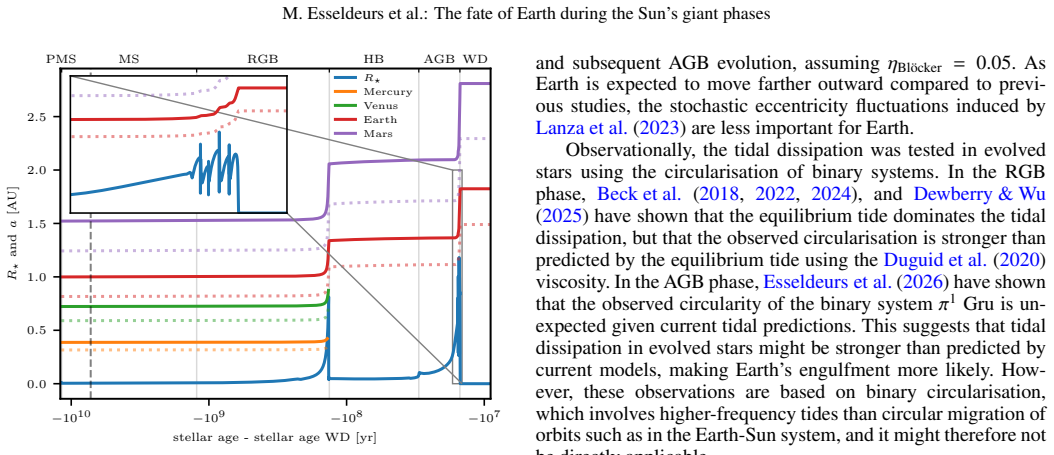
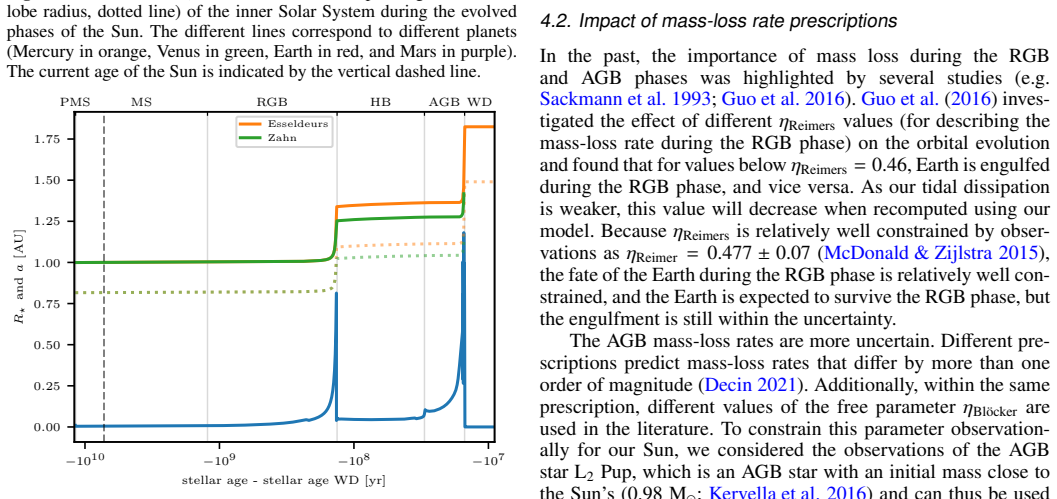
Based on updated tidal dissipation prescriptions, Earth survives the RGB and AGB phases of the Sun. Using the observed mass-loss rates of the AGB star L2 Pup as a proxy for the Sun's future AGB mass-loss rate results in the survival of the Earth during the AGB phase, while earlier tidal prescriptions lead to engulfment.
What carries the argument
Ab initio tidal dissipation prescriptions for the evolving Sun combined with varying AGB mass-loss rates
If this is right
- The predicted fate of the Earth is highly sensitive to the tidal model and the assumed mass-loss rate.
- Earth survives the RGB and AGB phases under the updated tidal prescriptions.
- Earlier tidal dissipation prescriptions lead to engulfment during the AGB phase.
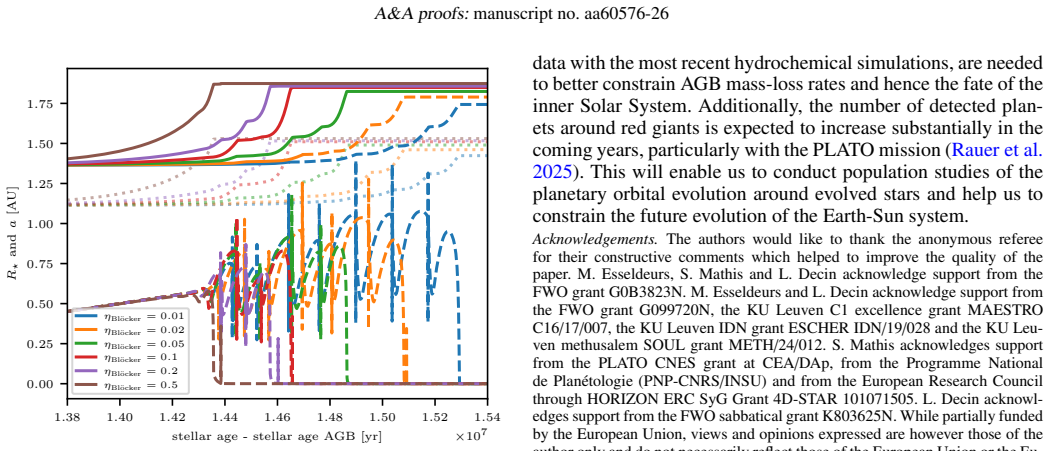
- Low AGB mass-loss rates result in engulfment while higher rates allow survival.
- Using L2 Pup mass-loss rates as proxy results in survival during the AGB phase.
Where Pith is reading between the lines
- The same modeling framework could be used to evaluate survival prospects for the other inner solar system planets.
- Tighter observational constraints on AGB mass-loss rates for solar-mass stars would narrow the range of possible outcomes.
- The approach may inform predictions for the long-term evolution of planets in other systems around solar-type stars.
Load-bearing premise
The mass-loss rate of L2 Pup serves as a valid proxy for the Sun's AGB phase and the ab initio tidal dissipation prescriptions capture the relevant physics in the evolving Sun without major unaccounted effects.
What would settle it
A direct measurement of the Sun's AGB mass-loss rate that differs substantially from L2 Pup, or an observation of tidal dissipation in a giant star that contradicts the ab initio prescriptions.
Figures
read the original abstract
The long-term evolution of planetary systems around solar-type stars is governed by the interplay between stellar expansion, tidal interactions, and mass loss during the red giant branch (RGB) and asymptotic giant branch (AGB) phases. However, tidal dissipation efficiencies and AGB mass-loss rates both remain poorly constrained, leading to significant uncertainty in predicting the fate of planetary systems, in particular, that of the Earth orbiting the ageing Sun. We reassess the survival of the Earth and the inner Solar System planets during the entire evolution of the Sun, focusing on the impact of updated tidal dissipation prescriptions and varying AGB mass-loss rates. We modelled the orbital evolution of the Earth using stellar evolution tracks for a solar-mass star. We compared these results with outcomes obtained using previously published and commonly adopted tidal prescriptions, and we explored a range of AGB mass-loss rates. We find that the predicted fate of the Earth is highly sensitive to the tidal model and the assumed mass-loss rate. Based on updated tidal dissipation prescriptions, Earth survives the RGB and AGB phases of the Sun. In contrast, the use of earlier tidal dissipation prescriptions leads to engulfment during the AGB phase. Furthermore, low AGB mass-loss rates result in engulfment, and vice versa. Using the observed mass-loss rates of the AGB star L2 Pup as a proxy for the Sun's future AGB mass-loss rate results in the survival of the Earth during the AGB phase when combined with our tidal dissipation evaluation. Given the current observational uncertainties in AGB mass-loss rates, the ultimate fate of the Earth remains uncertain, highlighting the need for improved constraints on the late-stages of stellar evolution. However, considering observational proxies for the Sun during the AGB phase, it is likely that the Earth will survive the Sun's giant phases.
Editorial analysis
A structured set of objections, weighed in public.
Referee Report
Summary. The manuscript models the orbital evolution of Earth (and inner planets) during the Sun's RGB and AGB phases using solar-mass stellar evolution tracks. It compares results from updated ab initio tidal dissipation prescriptions against earlier commonly used models, explores sensitivity to AGB mass-loss rates, and adopts the observed mass-loss rate of L2 Pup as a proxy for the Sun's future AGB rate. The central claim is that Earth survives both giant phases under the updated tidal model combined with the L2 Pup proxy, although the ultimate fate remains uncertain given observational uncertainties in AGB mass loss.
Significance. If the ab initio tidal prescriptions hold and L2 Pup is shown to be a quantitatively justified proxy, the work supplies new constraints on the long-term fate of the inner Solar System and on planetary survival around solar-type stars during post-main-sequence evolution. The explicit comparison of tidal models and the parameter exploration of mass-loss rates are strengths that could inform studies of exoplanet systems around evolved stars.
major comments (2)
- [AGB mass-loss modeling and proxy discussion] The survival conclusion during the AGB phase rests on adopting the observed Ṁ of L2 Pup as representative of the Sun without an explicit mapping of L2 Pup's parameters (mass, radius, pulsation period, metallicity) onto the solar evolutionary track at the relevant AGB epoch or a scaling relation for how Ṁ depends on those quantities. The manuscript notes that lower Ṁ values produce engulfment, so this justification is load-bearing for the proxy-based survival claim.
- [Tidal dissipation prescriptions] The abstract and modeling description supply no equations, validation steps, error analysis, or direct comparison data for the ab initio tidal dissipation prescriptions, preventing assessment of whether they accurately capture the relevant physics in the evolving Sun without major unaccounted effects. This is load-bearing because the updated prescriptions are what differentiate the survival outcome from earlier models that predict engulfment.
minor comments (2)
- [Abstract] The abstract is dense and could more clearly separate the specific tidal models compared and the quantitative range of Ṁ values explored.
- [Throughout] Notation for mass-loss rate (Ṁ) and orbital elements should be defined at first use for readers outside the immediate subfield.
Simulated Author's Rebuttal
We thank the referee for their thoughtful and constructive report. The two major comments identify load-bearing aspects of the analysis, and we have revised the manuscript to strengthen the justification and presentation of both the AGB mass-loss proxy and the tidal dissipation prescriptions. Our point-by-point responses follow.
read point-by-point responses
-
Referee: [AGB mass-loss modeling and proxy discussion] The survival conclusion during the AGB phase rests on adopting the observed Ṁ of L2 Pup as representative of the Sun without an explicit mapping of L2 Pup's parameters (mass, radius, pulsation period, metallicity) onto the solar evolutionary track at the relevant AGB epoch or a scaling relation for how Ṁ depends on those quantities. The manuscript notes that lower Ṁ values produce engulfment, so this justification is load-bearing for the proxy-based survival claim.
Authors: We agree that an explicit parameter mapping strengthens the proxy argument. In the revised manuscript we have added a new subsection (Section 4.3) that directly compares L2 Pup's mass, radius, pulsation period, and metallicity with the solar evolutionary track at the corresponding AGB epoch. We also include a brief discussion of how the observed Ṁ scales with these quantities based on existing empirical relations, while acknowledging the remaining uncertainties. This addition makes the justification for adopting the L2 Pup rate more transparent and addresses the load-bearing nature of the claim. revision: yes
-
Referee: [Tidal dissipation prescriptions] The abstract and modeling description supply no equations, validation steps, error analysis, or direct comparison data for the ab initio tidal dissipation prescriptions, preventing assessment of whether they accurately capture the relevant physics in the evolving Sun without major unaccounted effects. This is load-bearing because the updated prescriptions are what differentiate the survival outcome from earlier models that predict engulfment.
Authors: The full equations, references to the underlying ab initio calculations, and validation against stellar models are already presented in Section 3.2. To improve accessibility we have now (i) added a concise summary paragraph with the key equations to the modeling description, (ii) inserted a short sentence in the abstract that identifies the updated prescriptions, and (iii) expanded the results section to include a direct side-by-side comparison table of orbital outcomes under the new versus older prescriptions. Error estimates and sensitivity tests are retained from the original analysis. These changes allow readers to evaluate the prescriptions without needing to consult external references first. revision: yes
Circularity Check
No significant circularity; derivation relies on external inputs
full rationale
The paper's orbital evolution modeling draws on independent stellar evolution tracks for a solar-mass star and adopts observed mass-loss rates from L2 Pup as an external proxy, without any self-referential fitting, redefinition of inputs as outputs, or load-bearing self-citations that reduce the central claim to its own assumptions by construction. The sensitivity analysis across tidal prescriptions and mass-loss rates is presented explicitly, and the survival conclusion is conditioned on the proxy choice rather than forced by internal definitions. This is a standard case of a self-contained analysis against external benchmarks.
Axiom & Free-Parameter Ledger
free parameters (2)
- AGB mass-loss rate
- Tidal dissipation parameters
axioms (2)
- domain assumption Stellar evolution tracks for a solar-mass star accurately describe radius and luminosity evolution during RGB and AGB phases
- ad hoc to paper Observed mass-loss rate of L2 Pup is representative of the Sun's future AGB mass loss
Reference graph
Works this paper leans on
-
[1]
Evidence for the Keplerian orbit of a close companion around a giant star. Nature Astronomy , keywords =. doi:10.1038/s41550-025-02697-2 , archivePrefix =. 2511.11247 , primaryClass =
-
[2]
Slowly, slowly in the wind. 3D hydrodynamical simulations of wind mass transfer and angular-momentum loss in AGB binary systems. , keywords =. doi:10.1051/0004-6361/201834598 , archivePrefix =. 1903.04515 , primaryClass =
work page internal anchor Pith review Pith/arXiv arXiv doi:10.1051/0004-6361/201834598 1903
-
[3]
Tidal dissipation in stars and giant planets
Tidal Dissipation in Stars and Giant Planets. , keywords =. doi:10.1146/annurev-astro-081913-035941 , archivePrefix =. 1406.2207 , primaryClass =
work page internal anchor Pith review Pith/arXiv arXiv doi:10.1146/annurev-astro-081913-035941
-
[4]
Tidal dissipation in evolved low- and intermediate-mass stars. , keywords =. doi:10.1051/0004-6361/202449648 , archivePrefix =. 2407.10573 , primaryClass =
-
[5]
The Effect of Tides on the Population of PN from Interacting Binaries
The effect of tides on the population of PN from interacting binaries. , keywords =. doi:10.1093/mnras/stw2025 , archivePrefix =. 1608.03041 , primaryClass =
work page internal anchor Pith review Pith/arXiv arXiv doi:10.1093/mnras/stw2025
-
[6]
Modules for Experiments in Stellar Astrophysics (MESA)
Modules for Experiments in Stellar Astrophysics (MESA). , keywords =. doi:10.1088/0067-0049/192/1/3 , archivePrefix =. 1009.1622 , primaryClass =
work page internal anchor Pith review Pith/arXiv arXiv doi:10.1088/0067-0049/192/1/3
-
[7]
Modules for Experiments in Stellar Astrophysics (MESA): Planets, Oscillations, Rotation, and Massive Stars. , keywords =. doi:10.1088/0067-0049/208/1/4 , archivePrefix =. 1301.0319 , primaryClass =
work page internal anchor Pith review Pith/arXiv arXiv doi:10.1088/0067-0049/208/1/4
-
[8]
2015, ApJS, 220, 15, doi: https://doi.org/10.1088/0067-0049/220/1/15
Modules for Experiments in Stellar Astrophysics (MESA): Binaries, Pulsations, and Explosions. , keywords =. doi:10.1088/0067-0049/220/1/15 , archivePrefix =. 1506.03146 , primaryClass =
work page internal anchor Pith review Pith/arXiv arXiv doi:10.1088/0067-0049/220/1/15
-
[9]
Modules for Experiments in Stellar Astrophysics (MESA): Convective Boundaries, Element Diffusion, and Massive Star Explosions. , keywords =. doi:10.3847/1538-4365/aaa5a8 , archivePrefix =. 1710.08424 , primaryClass =
work page internal anchor Pith review Pith/arXiv arXiv doi:10.3847/1538-4365/aaa5a8
-
[10]
Modules for Experiments in Stellar Astrophysics (MESA): Pulsating Variable Stars, Rotation, Convective Boundaries, and Energy Conservation. , keywords =. doi:10.3847/1538-4365/ab2241 , archivePrefix =. 1903.01426 , primaryClass =
work page internal anchor Pith review Pith/arXiv arXiv doi:10.3847/1538-4365/ab2241 1903
-
[11]
Modules for Experiments in Stellar Astrophysics (MESA): Time-dependent Convection, Energy Conservation, Automatic Differentiation, and Infrastructure. , keywords =. doi:10.3847/1538-4365/acae8d , archivePrefix =. 2208.03651 , primaryClass =
-
[12]
Research Notes of the American Astronomical Society , keywords =
Solar Calibration of the Convective Mixing Length for Use with the SOPUS Opacities in MESA. Research Notes of the American Astronomical Society , keywords =. doi:10.3847/2515-5172/ac6611 , adsurl =
-
[13]
Problems in stellar atmospheres and envelopes
Circumstellar envelopes and mass loss of red giant stars. Problems in stellar atmospheres and envelopes. , year = 1975, pages =
1975
-
[14]
Mass-loss on the red giant branch: the value and metallicity dependence of Reimers' in globular clusters. , keywords =. doi:10.1093/mnras/stv007 , archivePrefix =. 1501.00874 , primaryClass =
work page internal anchor Pith review Pith/arXiv arXiv doi:10.1093/mnras/stv007
-
[15]
Stellar evolution of low and intermediate-mass stars. I. Mass loss on the AGB and its consequences for stellar evolution. , keywords =
-
[16]
Annales d'Astrophysique , year = 1966, month = feb, volume =
Les mar \'e es dans une \'e toile double serr \'e e. Annales d'Astrophysique , year = 1966, month = feb, volume =
1966
-
[17]
, keywords =
Tidal friction in close binary systems. , keywords =
-
[18]
Solar seismology. II. The stochastic excitation of the solar p-modes by turbulent convection. , keywords =. doi:10.1086/155043 , adsurl =
-
[19]
, keywords =
Tidal evolution in close binary systems. , keywords =
-
[20]
doi:10.1046/j.1365-8711.2002.05308.x , Eprint =
Evolution of binary stars and the effect of tides on binary populations. , keywords =. doi:10.1046/j.1365-8711.2002.05038.x , archivePrefix =. astro-ph/0201220 , primaryClass =
-
[21]
Convective turbulent viscosity acting on equilibrium tidal flows: new frequency scaling of the effective viscosity. , keywords =. doi:10.1093/mnras/staa2216 , archivePrefix =. 2007.12624 , primaryClass =
-
[22]
doi:10.1111/j.1365-2966.2008.13135.x , Keywords =
Distant future of the Sun and Earth revisited. , keywords =. doi:10.1111/j.1365-2966.2008.13022.x , archivePrefix =. 0801.4031 , primaryClass =
-
[23]
Our Sun. III. Present and Future. , keywords =. doi:10.1086/173407 , adsurl =
-
[24]
A gas-giant planet transiting a rapidly rotating A5 star
Tides and tidal engulfment in post-main-sequence binaries: period gaps for planets and brown dwarfs around white dwarfs. , keywords =. doi:10.1111/j.1365-2966.2010.17155.x , archivePrefix =. 1002.2216 , primaryClass =
-
[25]
, year = 2001, month = may, volume =
On the Final Destiny of the Earth and the Solar System. , year = 2001, month = may, volume =. doi:10.1006/icar.2001.6591 , adsurl =
-
[26]
The effects of solar Reimers on the final destinies of Venus, the Earth, and Mars. , keywords =. doi:10.1007/s10509-016-2684-5 , adsurl =
-
[27]
Tidal Decay of Close Planetary Orbits
Tidal Decay of Close Planetary Orbits. , keywords =. doi:10.1086/177941 , archivePrefix =. astro-ph/9605059 , primaryClass =
work page internal anchor Pith review Pith/arXiv arXiv doi:10.1086/177941
-
[28]
International Journal of Astrobiology , year = 2020, month = feb, volume =
The end of life on Earth is not the end of the world: converging to an estimate of life span of the biosphere?. International Journal of Astrobiology , year = 2020, month = feb, volume =. doi:10.1017/S1473550419000120 , adsurl =
-
[29]
Long-term dynamics of the inner planets in the Solar System. , keywords =. doi:10.1051/0004-6361/202141007 , archivePrefix =. 2105.14976 , primaryClass =
-
[30]
Residual eccentricity of an Earth-like planet orbiting a red giant Sun. , keywords =. doi:10.1051/0004-6361/202345860 , archivePrefix =. 2304.07808 , primaryClass =
-
[31]
Life after death: Europa in the evolving habitable zone of a Red Sun. , keywords =. doi:10.1093/mnras/staf794 , archivePrefix =. 2505.15495 , primaryClass =
-
[32]
An Earth-mass planet and a brown dwarf in orbit around a white dwarf. Nature Astronomy , keywords =. doi:10.1038/s41550-024-02375-9 , archivePrefix =. 2409.02157 , primaryClass =
-
[33]
The formation of discs in the interior of AGB stars from the tidal disruption of planets and brown dwarfs. , keywords =. doi:10.1093/mnras/stac463 , archivePrefix =. 2105.00077 , primaryClass =
-
[34]
Dynamical Mass Loss at the End of TP-AGB stars. arXiv e-prints , keywords =. doi:10.48550/arXiv.2601.18194 , archivePrefix =. 2601.18194 , primaryClass =
-
[35]
Foretellings of Ragnar\"ok: World-engulfing Asymptotic Giants and the Inheritance of White Dwarfs
Foretellings of Ragnar \"o k: World-engulfing Asymptotic Giants and the Inheritance of White Dwarfs. , keywords =. doi:10.1088/0004-637X/761/2/121 , archivePrefix =. 1210.0328 , primaryClass =
work page internal anchor Pith review Pith/arXiv arXiv doi:10.1088/0004-637x/761/2/121
-
[36]
Evolution and Mass Loss of Cool Ageing Stars: a Daedalean Story. , keywords =. doi:10.1146/annurev-astro-090120-033712 , archivePrefix =. 2011.13472 , primaryClass =
-
[37]
J., Scott P., 2009, @doi [ ] 10.1146/annurev.astro.46.060407.145222 , 47, 481
The Chemical Composition of the Sun. , keywords =. doi:10.1146/annurev.astro.46.060407.145222 , archivePrefix =. 0909.0948 , primaryClass =
-
[38]
ALMA observations of the nearby AGB star L _ 2 Puppis. I. Mass of the central star and detection of a candidate planet. , keywords =. doi:10.1051/0004-6361/201629877 , archivePrefix =. 1611.06231 , primaryClass =
work page internal anchor Pith review Pith/arXiv arXiv doi:10.1051/0004-6361/201629877
-
[39]
Evolution of Low- and Intermediate-Mass Stars to the End of the Asymptotic Giant Branch with Mass Loss. , keywords =. doi:10.1086/173033 , adsurl =
-
[40]
Impact of a binary companion in AGB outflows on CO spectral lines. , keywords =. doi:10.1051/0004-6361/202554905 , archivePrefix =. 2507.03583 , primaryClass =
-
[41]
ALMA observations of the nearby AGB star L _ 2 Puppis. II. Gas disk properties derived from ^ 12 CO and ^ 13 CO J = 3-2 emission. , keywords =. doi:10.1051/0004-6361/201630340 , archivePrefix =. 1803.05222 , primaryClass =
work page internal anchor Pith review Pith/arXiv arXiv doi:10.1051/0004-6361/201630340
-
[42]
An edge-on translucent dust disk around the nearest AGB star, L _ 2 Puppis. VLT/NACO spectro-imaging from 1.04 to 4.05 m and VLTI interferometry. , keywords =. doi:10.1051/0004-6361/201323273 , archivePrefix =. 1404.3189 , primaryClass =
work page internal anchor Pith review Pith/arXiv arXiv doi:10.1051/0004-6361/201323273
-
[43]
doi:10.1046/j.1365-8711.2002.05308.x , Eprint =
The light curve of the semiregular variable L _ 2 Puppis - I. A recent dimming event from dust. , keywords =. doi:10.1046/j.1365-8711.2002.05822.x , archivePrefix =. astro-ph/0207485 , primaryClass =
-
[44]
Mass loss rates of a sample of irregular and semiregular M-type AGB-variables
Mass loss rates of a sample of irregular and semiregular M-type AGB-variables. , keywords =. doi:10.1051/0004-6361:20020841 , archivePrefix =. astro-ph/0206172 , primaryClass =
work page internal anchor Pith review Pith/arXiv arXiv doi:10.1051/0004-6361:20020841
-
[45]
The Very Slow Wind From the Pulsating Semiregular Red Giant L2 Pup
The Very Slow Wind from the Pulsating Semiregular Red Giant, L _ 2 Puppis. , keywords =. doi:10.1086/339207 , archivePrefix =. astro-ph/0112230 , primaryClass =
work page internal anchor Pith review Pith/arXiv arXiv doi:10.1086/339207
-
[46]
New observations and models of circumstellar CO line emission of AGB stars in the Herschel SUCCESS programme. , keywords =. doi:10.1051/0004-6361/201526705 , archivePrefix =. 1506.09065 , primaryClass =
work page internal anchor Pith review Pith/arXiv arXiv doi:10.1051/0004-6361/201526705
-
[47]
Radiation-pressure-driven sub-Keplerian rotation of the disc around the AGB star L2 Pup
Radiation-pressure-driven sub-Keplerian rotation of the disc around the AGB star L _ 2 Pup. , keywords =. doi:10.1093/mnras/stx2416 , archivePrefix =. 1709.02815 , primaryClass =
work page internal anchor Pith review Pith/arXiv arXiv doi:10.1093/mnras/stx2416
-
[48]
Morpho-kinematics of the wind of asymptotic giant branch star L _ 2 Pup. , keywords =. doi:10.1093/mnras/stab3465 , archivePrefix =. 2111.13303 , primaryClass =
-
[49]
The evolutionary state of the red giant star L _ 2 Puppis. , keywords =. doi:10.1051/0004-6361/202452173 , archivePrefix =. 2411.13388 , primaryClass =
-
[50]
2026a, A&A, 706, A79, doi: 10.1051/0004-6361/202555096
Rethinking mass transfer: A unified semianalytical framework for circular and eccentric binaries: I. Orbital evolution due to conservative mass transfer. , keywords =. doi:10.1051/0004-6361/202555096 , archivePrefix =. 2509.05243 , primaryClass =
-
[51]
2026b, A&A, 706, A357, doi: 10.1051/0004-6361/202558055
Rethinking mass transfer: A unified semianalytical framework for circular and eccentric binaries: II. Orbital evolution due to nonconservative mass transfer. , keywords =. doi:10.1051/0004-6361/202558055 , archivePrefix =. 2511.07190 , primaryClass =
-
[52]
Stellar Models and Yields of Asymptotic Giant Branch Stars
Stellar Models and Yields of Asymptotic Giant Branch Stars. , keywords =. doi:10.1071/AS07021 , archivePrefix =. 0708.4385 , primaryClass =
work page internal anchor Pith review Pith/arXiv arXiv doi:10.1071/as07021
-
[53]
Stellar Structure and Evolution
-
[54]
Experimental Astronomy , keywords =
The PLATO mission. Experimental Astronomy , keywords =. doi:10.1007/s10686-025-09985-9 , archivePrefix =. 2406.05447 , primaryClass =
-
[55]
Testing Tidal Theory Using Gaia Binaries: The Red Giant Branch. , keywords =. doi:10.3847/1538-4357/adc37e , archivePrefix =. 2501.13929 , primaryClass =
-
[56]
Testing tidal theory for evolved stars by using red-giant binaries observed by Kepler
Testing tidal theory for evolved stars by using red giant binaries observed by Kepler. , keywords =. doi:10.1093/mnrasl/sly114 , archivePrefix =. 1806.07208 , primaryClass =
work page internal anchor Pith review Pith/arXiv arXiv doi:10.1093/mnrasl/sly114
-
[57]
99 oscillating red-giant stars in binary systems with NASA TESS and NASA Kepler identified from the SB9-Catalogue. , keywords =. doi:10.1051/0004-6361/202143005 , archivePrefix =. 2202.02373 , primaryClass =
-
[58]
A census of oscillating red giants and dwarf stars in Gaia DR3 binaries
Constraining stellar and orbital co-evolution through ensemble seismology of solar-like oscillators in binary systems. A census of oscillating red giants and dwarf stars in Gaia DR3 binaries. , keywords =. doi:10.1051/0004-6361/202346810 , archivePrefix =. 2307.10812 , primaryClass =
-
[59]
Seismic Sounding of Convection in the Sun
Seismic Sounding of Convection in the Sun. Annual Review of Fluid Mechanics , keywords =. doi:10.1146/annurev-fluid-122414-034534 , archivePrefix =. 1503.07961 , primaryClass =
work page internal anchor Pith review Pith/arXiv arXiv doi:10.1146/annurev-fluid-122414-034534
discussion (0)
Sign in with ORCID, Apple, or X to comment. Anyone can read and Pith papers without signing in.