REVIEW 4 major objections 5 minor 55 references
General Transform: A Unified Framework for Adaptive Transform to Enhance Representations
T0 review · 4 major / 5 minor · reviewed 2026-08-15 · deepseek-v4-flash
Pith's one-line read A trainable combination of discrete transforms, adding only three parameters, consistently outperforms single fixed transforms in both image and text classification.
desk verdict A simple, plausible trainable blend of fixed transforms with uniformly positive but small gains; the evaluation lacks error bars and uses best-epoch selection, so the 'consistently outperform' claim is not yet established. read the letter →
The pith
A machine-rendered reading of the paper's core claim, the machinery that carries it, and where it could break.
The reading
What carries the argument
The central object is the General Transform operator, a parameterized blend of $m+1$ discrete transform kernels in which the coefficients $p_i$ are trainable scalars and the form $\left(1-\sum_i p_i\right)$ forces the coefficients to sum to one. At specific parameter values the operator recovers each standard transform, so it can replace a fixed kernel in an existing architecture without any other change. The paper does exactly this: it drops GT into the DCT feature-extraction stage of the vision baseline and into the DFT token-mixing stage of the NLP baseline, making the learned kernel the only variable in the comparison. The quantum variant, QGT, replaces the kernels with unitaries and blends them through a linear combination of unitaries followed by postselection.
What would settle it
Train each model variant (DCTNet versus GTNet and FNet versus GTNet) with at least five random seeds and compare the distributions of validation accuracy; if the intervals overlap on every configuration, the claim of consistent improvement is unsupported. A companion check is to freeze or randomly initialize the $p_i$ weights and see whether the gains persist, which would show whether the learned adaptation is the active ingredient.
Extended reading notes
Core claim
The central claim is that the right transform for a task need not be chosen in advance: a weighted sum of discrete transform kernels, with the weights learned by gradient descent, can adapt to the data and match or beat any single fixed transform. GT is defined as $$X[k]=\sum_{n=0}^{N-1}\left(\sum_{i=1}^{m}p_i f_i[n,k]+\left(1-\sum_{i=1}^{m}p_i\right)f_{m+1}[n,k]\right)x[n],$$ with an optional trainable mix $p_3$ of the real and imaginary parts of $X[k]$. The paper reports that the optimized weights settle on nontrivial mixtures rather than a single basis transform, that the mixtures differ between luminance and chrominance channels in images and between model sizes, and that initializing GT at pure DFT in the NLP setting still yields improvements over DFT. Those observations are offered as evidence that the learned mapping captures per-channel and per-task differences that a fixed transform cannot.
Load-bearing premise
The central claim rests on the assumption that the reported accuracy differences, as small as 0.09 percentage points on ImageNet and averaged over 10 runs without standard deviations in NLP, are larger than run-to-run training noise.
Editorial extensions
If this is right
- Fixed-transform pipelines can be upgraded to GT without redesigning the network, because GT recovers the original transform at specific parameter values and adds only a handful of scalars.
- Dataset-specific transform selection, normally a matter of domain expertise, can be handed to gradient descent, with the learned $p_i$ values indicating which frequency basis the data favors.
- The reported gains place transform choice as a real but modest axis of model quality: 0.09 to 0.27 accuracy points on ImageNet and 0.66 to 1.56 points on SST-2 and CoLA.
- The quantum variant offers a way to make a quantum feature map adaptive, although the paper presents the QGT experiments as a proof of concept rather than a performance claim.
Reading between the lines
- Because the ImageNet results come from a single training run per configuration, a multi-seed replication is the natural next test, and the paper does not report error bars for those numbers.
- The same blending trick could apply to time series, speech, or graph data, where the appropriate transform is often unknown; nothing in the formulation restricts it to images or text.
- The finding that luminance and chrominance channels learn different mixtures suggests GT could be used as a diagnostic probe for what frequency content different input channels carry.
- If the classical gains really come from adapting the kernel to the data, QGT should show a similar advantage over any single fixed unitary once the LCU success probability and noise are controlled, a test the paper does not run.
Signed reviews
Editorial analysis
A structured set of objections, weighed in public.
Referee Report
Summary. The paper proposes General Transform (GT), a trainable linear combination of discrete transforms such as DCT, DFT, DWT in vision and DFT, DLT, identity in NLP, with an additional parameter p3 blending the real and imaginary parts of the transformed output. The transform weights are optimized jointly with the network. The authors replace DCT-based feature extraction in a ResNet-50 ImageNet pipeline with GTNet and DFT-based token mixing in FNet-style encoders with GTNet, reporting small validation accuracy improvements in all tested configurations. A quantum extension, QGT, is presented as a proof of concept using linear combinations of unitaries. The main claim is that models incorporating GT consistently outperform conventional fixed-transform baselines while adding only a few parameters.
Significance. The core idea is simple and attractive: rather than hand-selecting a discrete transform, learn a weighted mixture that contains standard transforms as special cases. This makes the method easy to integrate into existing architectures, and the per-channel adaptation is a reasonable inductive bias. If the reported gains were robust, the contribution would be useful. The QGT extension is conceptually interesting but explicitly preliminary. The paper's main weakness is that the central claim of consistent improvement rests on small accuracy differences, with no variance estimates, single-run ImageNet experiments, and best-epoch selection; the reported numbers are not sufficient to establish the claim. The paper also does not provide code or seeds, so the comparisons cannot be independently checked.
major comments (4)
- [3.2.1, Table 1] The ImageNet comparisons rest on a single training run per configuration, with the epoch of highest validation top-1 accuracy selected from 80 epochs, as stated in Section 3.2.1. The reported validation gains of 0.09, 0.27, and 0.05 percentage points for 24, 48, and 64 channels are smaller than typical run-to-run variation for ResNet-50 training on ImageNet. Without multiple seeds and error bars, Table 1 cannot support the claim that GTNet consistently outperforms DCTNet. Please report mean and standard deviation over at least three seeds and evaluate both models with the same fixed checkpoint rule, such as the last epoch or a pre-specified early-stopping rule.
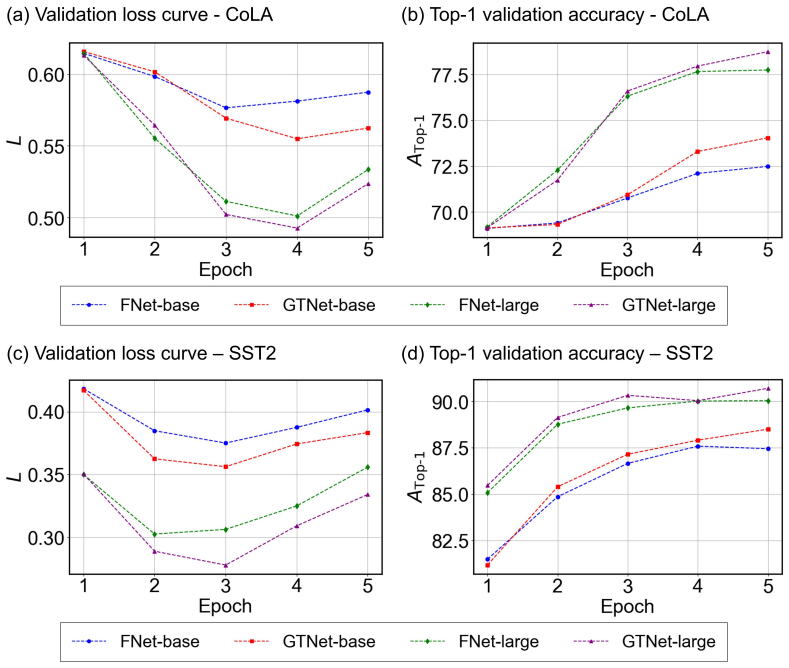
- [3.2.2, Table 3] The NLP fine-tuning results are averaged over 10 runs, but no standard deviations, confidence intervals, or per-run values are reported, and the best validation epoch among the first five is selected for comparison. With gains of 0.66 to 1.56 percentage points, these differences could be within run-to-run variance, especially given the observed over-fitting beyond epoch five. Please report means with standard deviations and, ideally, paired significance tests over the 10 runs, and use a fixed epoch-selection rule for both FNet and GTNet.
- [4.1, Table 2] The claim that optimized p_i values capture meaningful differences across input channels is a post-hoc interpretation of fitted parameters. The observed differences between the Y, Cb, and Cr channels are not validated independently; they could reflect optimization noise or idiosyncrasies of a single run. Please support this claim with an ablation, such as tying parameters across channels and showing a significant performance drop, or evaluating the fitted parameters on held-out data. As written, the contribution bullet that GT is proven to capture meaningful channel differences is not supported.
- [3.2.1-3.2.2] The experimental comparisons are not reproducible as reported: no code, seeds, or checkpoints are provided, and the baselines appear to be reimplementations rather than official released models. Since the conclusion depends on the baselines being fairly tuned, please release code and seeds, or provide exact training configurations and compare against numbers from the original DCTNet and FNet papers where available.
minor comments (5)
- [1, 3.1, Table 2] The statement that GT adds only three additional parameters is inconsistent with Table 2, which lists p1, p2, and p3 separately for each of the Y, Cb, and Cr channels. If the parameters are per channel, the total is three times the number of channels, not three. Please clarify the parameterization of Eq. (11).
- [Figure 2] In the 64-channel panels of Figure 2, the legend refers to DCTNet-48; this should presumably be DCTNet-64.
- [3.2.2] The text states that the primary analysis focuses on the first five epochs because severe over-fitting was observed beyond this point, but no quantitative criterion is given. Please report validation metrics at later epochs to justify the five-epoch cutoff.
- [Eq. (2)] The DCT definition in Eq. (2) omits the conventional normalization factor; this is not harmful for the method but should be stated for reproducibility.
- [5.2.2] The QGT experiments are explicitly a proof of concept with no tuning, which is acceptable, but the section should be clearly separated from the main empirical claim. Additionally, the S1-S4 labels in Figure 5 should match the S-1 to S-4 labels in Table 4.
Circularity Check
No circular derivation: GT is a parameterized combination of fixed transforms defined independently of the accuracy results, and the reported gains are empirical rather than forced by construction.
full rationale
The paper's central claim is that GTNet outperforms fixed-transform baselines, and this claim is supported by measured validation accuracies in Tables 1 and 3. Equation (10) defines GT directly as a weighted sum of discrete transforms, with trainable parameters p_i, and Equations (11) and (17) instantiate it for the vision and NLP tasks. The baseline transforms are special cases of GT at specific parameter values (for example, DCT is recovered with p1=1, p2=0 in Equation (11)), which means GT has at least the expressiveness of the baseline, but nothing in the definition forces the observed accuracy differences. The optimized p_i values in Table 2 are analyzed post hoc as channel-dependent behavior; this is an interpretation of fitted parameters, not a prediction that reduces to its own input. The quantum extension in Section 5 uses standard linear-combination-of-unitaries machinery and cites Kosugi and Matsushita (2020), an overlapping-author reference, but that citation is not load-bearing for the classical GT claim and the QGT results are explicitly described as a proof of concept. Concerns about missing error bars, best-epoch selection, and small accuracy margins are statistical robustness issues, not circularity, and under the hard rules no specific reduction of output to input can be exhibited. Therefore the appropriate finding is no significant circularity.
Assumptions & free parameters
free parameters (3)
- p1 per channel =
Varies by channel and model: e.g., Y-channel GTNet-24 p1=0.84
- p2 per channel =
Varies: e.g., Y-channel GTNet-24 p2=0.15
- p3 per channel =
Varies: e.g., Y-channel GTNet-24 p3=0.65
assumptions (3)
- domain assumption The chosen set of discrete transforms (DCT, DFT, DWT for vision; DFT, DLT, identity for NLP) is sufficient for the optimal transform to be well approximated by their linear combination.
- domain assumption The experimental protocol, including best-epoch selection and reuse of baseline hyperparameters, yields a fair comparison.
- domain assumption For the quantum extension, the simulation assumes ideal LCU postselection and no noise, and that amplitude amplification works as in theory.
Cite this review
Pith. "Pith review of General Transform: A Unified Framework for Adaptive Transform to Enhance Representations." pith.science (2026). https://pith.science/paper/PLLTSP6V
@misc{pith2026250504969,
  author       = {Pith},
  title        = {Pith review of: General Transform: A Unified Framework for Adaptive Transform to Enhance Representations},
  year         = {2026},
  howpublished = {\url{https://pith.science/paper/PLLTSP6V}},
  note         = {Machine review of arXiv:2505.04969}
}
read the original abstract
Discrete transforms, such as the discrete Fourier transform, are widely used in machine learning to improve model performance by extracting meaningful features. However, with numerous transforms available, selecting an appropriate one often depends on understanding the dataset's properties, making the approach less effective when such knowledge is unavailable. In this work, we propose General Transform (GT), an adaptive transform-based representation designed for machine learning applications. Unlike conventional transforms, GT learns data-driven mapping tailored to the dataset and task of interest. Here, we demonstrate that models incorporating GT outperform conventional transform-based approaches across computer vision and natural language processing tasks, highlighting its effectiveness in diverse learning scenarios.
Figures


Figures from the paper (2 more)


Reference graph
Works this paper leans on
-
[1]
author Ahmed, N. , author Natarajan, T. , author Rao, K. , year 1974 . title Discrete cosine transform . journal IEEE Transactions on Computers volume C-23 , pages 90--93 . :10.1109/T-C.1974.223784
arXiv 1974
-
[2]
author Baldini, G. , author Bonavitacola, F. , author Chareau, J.M. , year 2023 . title Fading channel classification with walsh-hadamard transform and convolutional neural network , in: booktitle 2023 International Conference on Smart Applications, Communications and Networking (SmartNets) , publisher IEEE . p. pages 1–6 . http://dx.doi.org/10.1109/Smart...
arXiv 2023
-
[3]
author Bottou, L. , year 2010 . title Large-scale machine learning with stochastic gradient descent , in: editor Lechevallier, Y. , editor Saporta, G. (Eds.), booktitle Proceedings of COMPSTAT'2010 , publisher Physica-Verlag HD , address Heidelberg . pp. pages 177--186
work page 2010
-
[4]
author Bravyi, S. , author Gosset, D. , year 2016 . title Improved classical simulation of quantum circuits dominated by clifford gates . journal Phys. Rev. Lett. volume 116 , pages 250501 . https://link.aps.org/doi/10.1103/PhysRevLett.116.250501, :10.1103/PhysRevLett.116.250501
-
[5]
author Bremner, M.J. , author Montanaro, A. , author Shepherd, D.J. , year 2017 . title Achieving quantum supremacy with sparse and noisy commuting quantum computations . journal Quantum volume 1 , pages 8 . https://doi.org/10.22331/q-2017-04-25-8, :10.22331/q-2017-04-25-8
-
[6]
author Chakraborty, S. , year 2024 . title Implementing any L inear C ombination of U nitaries on I ntermediate-term Q uantum C omputers . journal Quantum volume 8 , pages 1496 . https://doi.org/10.22331/q-2024-10-10-1496, :10.22331/q-2024-10-10-1496
-
[7]
author Childs, A.M. , author Kothari, R. , author Somma, R.D. , year 2017 . title Quantum algorithm for systems of linear equations with exponentially improved dependence on precision . journal SIAM J. Comput. volume 46 , pages 1920–1950 . https://doi.org/10.1137/16M1087072, :10.1137/16M1087072
-
[8]
Acceleration of Convolutional Neural Network Using FFT-Based Split Convolutions
author Chitsaz, K. , author Hajabdollahi, M. , author Karimi, N. , author Samavi, S. , author Shirani, S. , year 2020 . title Acceleration of convolutional neural network using fft-based split convolutions . journal ArXiv volume abs/2003.12621 . https://api.semanticscholar.org/CorpusID:214713959
work page Pith review arXiv 2020
Show all 55 references
-
[9]
, author Tukey, J.W
author Cooley, J.W. , author Tukey, J.W. , year 1965 . title An algorithm for the machine calculation of complex fourier series . journal Mathematics of Computation volume 19 , pages 297--301 . http://www.jstor.org/stable/2003354
1965
-
[10]
, year 1992
author Daubechies, I. , year 1992 . title Ten Lectures on Wavelets . publisher Society for Industrial and Applied Mathematics . https://epubs.siam.org/doi/abs/10.1137/1.9781611970104, :10.1137/1.9781611970104, http://arxiv.org/abs/https://epubs.siam.org/doi/pdf/10.1137/1.97816...
1992 doi
-
[11]
, author Dong, W
author Deng, J. , author Dong, W. , author Socher, R. , author Li, L.J. , author Li, K. , author Fei-Fei, L. , year 2009 . title Imagenet: A large-scale hierarchical image database , in: booktitle 2009 IEEE Conference on Computer Vision and Pattern Recognition , pp. pages 248-...
2009
-
[12]
, author Wang, Q
author Gao, Z. , author Wang, Q. , author Chen, A. , author Liu, Z. , author Wu, B. , author Chen, L. , author Li, J. , year 2024 . title Parameter-efficient fine-tuning with discrete fourier transform , in: booktitle Proceedings of the 41st International Conference on Machine...
2024
-
[13]
, author Ghantasala, S
author Giofré, D. , author Ghantasala, S. , year 2023 . title Legal-hnet: Mixing legal long-context tokens with hartley transform . https://arxiv.org/abs/2311.05089, http://arxiv.org/abs/2311.05089 arXiv:2311.05089
2023 arXiv
-
[14]
, author Mardani, M
author Guibas, J. , author Mardani, M. , author Li, Z. , author Tao, A. , author Anandkumar, A. , author Catanzaro, B. , year 2022 . title Adaptive fourier neural operators: Efficient token mixers for transformers . https://arxiv.org/abs/2111.13587, http://arxiv.org/abs/2111.1...
2022 arXiv
-
[15]
, author Parand, K
author Hajimohammadi, Z. , author Parand, K. , author Ghodsi, A. , year 2021 . title Legendre deep neural network (ldnn) and its application for approximation of nonlinear volterra fredholm hammerstein integral equations . https://arxiv.org/abs/2106.14320, http://arxiv.org/abs...
2021 arXiv
-
[16]
, author Zhang, X
author He, K. , author Zhang, X. , author Ren, S. , author Sun, J. , year 2016 . title Deep residual learning for image recognition , in: booktitle 2016 IEEE Conference on Computer Vision and Pattern Recognition (CVPR) , pp. pages 770--778 . :10.1109/CVPR.2016.90
2016 doi
-
[17]
, author Rodriguez, A
author Highlander, T. , author Rodriguez, A. , year 2016 . title Very efficient training of convolutional neural networks using fast fourier transform and overlap-and-add . journal ArXiv volume abs/1601.06815 . https://api.semanticscholar.org/CorpusID:2543043
2016 arXiv
-
[18]
, author Harte, N
author Jassim, W.A. , author Harte, N. , year 2022 . title Comparison of discrete transforms for deep-neural-networks-based speech enhancement . journal IET Signal Processing volume 16 , pages 438--448 . :https://doi.org/10.1049/sil2.12109
2022 doi
-
[19]
, author Eksioglu, E.M
author Karaoglu, H.H. , author Eksioglu, E.M. , year 2023 . title Dctnet: deep shrinkage denoising via dct filterbanks . journal Signal, Image and Video Processing volume 17 , pages 3665–3676 . http://dx.doi.org/10.1007/s11760-023-02593-0, :10.1007/s11760-023-02593-0
2023 doi
-
[20]
, author Sulaiman, M
author Khan, N.A. , author Sulaiman, M. , author Kumam, P. , author Alarfaj, F.K. , year 2022 . title Application of legendre polynomials based neural networks for the analysis of heat and mass transfer of a non-newtonian fluid in a porous channel . journal Advances in Continu...
2022 doi
-
[21]
, author Matsushita, Y.i
author Kosugi, T. , author Matsushita, Y.i. , year 2020 . title Linear-response functions of molecules on a quantum computer: Charge and spin responses and optical absorption . journal Phys. Rev. Res. volume 2 , pages 033043 . https://link.aps.org/doi/10.1103/PhysRevResearch.2...
2020 doi
-
[22]
, author Richardson, J
author Kudo, T. , author Richardson, J. , year 2018 . title S entence P iece: A simple and language independent subword tokenizer and detokenizer for neural text processing , in: editor Blanco, E. , editor Lu, W. (Eds.), booktitle Proceedings of the 2018 Conference on Empirica...
2018 doi
-
[23]
, author Kansal, S
author Kumar, P. , author Kansal, S. , year 2017 . title Noise removal in speech signal using fractional fourier transform , in: booktitle 2017 International Conference on Information, Communication, Instrumentation and Control (ICICIC) , pp. pages 1--4 . :10.1109/ICOMICON.201...
2017
-
[24]
, author Mustafi, A
author Kumari, R. , author Mustafi, A. , year 2022 . title Denoising of images using fractional fourier transform , in: booktitle 2022 2nd International Conference on Emerging Frontiers in Electrical and Electronic Technologies (ICEFEET) , pp. pages 1--6 . :10.1109/ICEFEET5182...
2022
-
[25]
, author Kim, H
author Lee, J. , author Kim, H. , year 2024 . title Dct-vit: High-frequency pruned vision transformer with discrete cosine transform . journal IEEE Access volume 12 , pages 80386–80396 . http://dx.doi.org/10.1109/ACCESS.2024.3410231, :10.1109/access.2024.3410231
2024
-
[26]
, author Ainslie, J
author Lee-Thorp, J. , author Ainslie, J. , author Eckstein, I. , author Ontanon, S. , year 2022 . title Fnet: Mixing tokens with fourier transforms . https://arxiv.org/abs/2105.03824, http://arxiv.org/abs/2105.03824 arXiv:2105.03824
2022 arXiv
-
[27]
, author Zhang, H
author Liu, P. , author Zhang, H. , author Lian, W. , author Zuo, W. , year 2019 . title Multi-level wavelet convolutional neural networks . journal IEEE Access volume 7 , pages 74973--74985 . :10.1109/ACCESS.2019.2921451
2019
-
[28]
, author Hutter, F
author Loshchilov, I. , author Hutter, F. , year 2019 . title Decoupled weight decay regularization , in: booktitle International Conference on Learning Representations . https://openreview.net/forum?id=Bkg6RiCqY7
2019
-
[29]
, author Park, M
author Lou, T. , author Park, M. , author Ramezanali, M. , author Tang, V. , year 2021 . title Fnetar: Mixing tokens with autoregressive fourier transforms . https://arxiv.org/abs/2107.10932, http://arxiv.org/abs/2107.10932 arXiv:2107.10932
2021 arXiv
-
[30]
, author Clark, J.J
author Mozafari, S.H. , author Clark, J.J. , author Gross, W.J. , author Meyer, B.H. , year 2021 . title Hartley stochastic computing for convolutional neural networks , in: booktitle 2021 IEEE Workshop on Signal Processing Systems (SiPS) , pp. pages 1--6 . :10.1109/SiPS52927....
2021
-
[31]
, author Beng Jin Teoh, A
author Ng, C.J. , author Beng Jin Teoh, A. , year 2015 . title Dctnet: A simple learning-free approach for face recognition , in: booktitle 2015 Asia-Pacific Signal and Information Processing Association Annual Summit and Conference (APSIPA) , pp. pages 761--768 . :10.1109/APS...
2015
-
[32]
, author Chuang, I.L
author Nielsen, M.A. , author Chuang, I.L. , year 2000 . title Quantum Computation and Quantum Information . publisher Cambridge University Press
2000
-
[33]
, author Badawi, D
author Pan, H. , author Badawi, D. , author Cetin, A.E. , year 2022 a. title Block walsh–hadamard transform-based binary layers in deep neural networks . journal ACM Trans. Embed. Comput. Syst. volume 21 . https://doi.org/10.1145/3510026, :10.1145/3510026
2022 doi
-
[34]
, author Badawi, D
author Pan, H. , author Badawi, D. , author Chen, C. , author Watts, A. , author Koyuncu, E. , author Cetin, A.E. , year 2022 b. title Deep neural network with walsh-hadamard transform layer for ember detection during a wildfire , in: booktitle Proceedings of the IEEE/CVF Conf...
2022
-
[35]
, author Hamdan, E
author Pan, H. , author Hamdan, E. , author Zhu, X. , author Biswas, K. , author Cetin, A.E. , author Bagci, U. , year 2024 . title Dct-based decorrelated attention for vision transformers . https://arxiv.org/abs/2405.13901, http://arxiv.org/abs/2405.13901 arXiv:2405.13901
2024 arXiv
-
[36]
, author Yip, P
author Rao, K.R. , author Yip, P. , year 1990 . title Discrete cosine transform: algorithms, advantages, applications . publisher Academic Press Professional, Inc. , address USA
1990
-
[37]
, author Koc, A
author Sahinuc, F. , author Koc, A. , year 2022 . title Fractional fourier transform meets transformer encoder . journal IEEE Signal Processing Letters volume 29 , pages 2258–2262 . http://dx.doi.org/10.1109/LSP.2022.3217975, :10.1109/lsp.2022.3217975
2022
-
[38]
, author Bocharov, A
author Schuld, M. , author Bocharov, A. , author Svore, K.M. , author Wiebe, N. , year 2020 . title Circuit-centric quantum classifiers . journal Phys. Rev. A volume 101 , pages 032308 . https://link.aps.org/doi/10.1103/PhysRevA.101.032308, :10.1103/PhysRevA.101.032308
2020 doi
-
[39]
, author Franchini, G
author Scribano, C. , author Franchini, G. , author Prato, M. , author Bertogna, M. , year 2023 . title Dct-former: Efficient self-attention with discrete cosine transform . journal Journal of Scientific Computing volume 94 . http://dx.doi.org/10.1007/s10915-023-02125-5, :10.1...
2023 doi
-
[40]
, author Bremner, M.J
author Shepherd, D. , author Bremner, M.J. , year 2009 . title Temporally unstructured quantum computation . journal Proceedings of the Royal Society A: Mathematical, Physical and Engineering Sciences volume 465 , pages 1413–1439 . http://dx.doi.org/10.1098/rspa.2008.0443, :10...
2009
-
[41]
, year 1994
author Shor, P. , year 1994 . title Algorithms for quantum computation: discrete logarithms and factoring , in: booktitle Proceedings 35th Annual Symposium on Foundations of Computer Science , pp. pages 124--134 . :10.1109/SFCS.1994.365700
1994
-
[42]
, author Perelygin, A
author Socher, R. , author Perelygin, A. , author Wu, J. , author Chuang, J. , author Manning, C.D. , author Ng, A. , author Potts, C. , year 2013 . title Recursive deep models for semantic compositionality over a sentiment treebank , in: editor Yarowsky, D. , editor Baldwin, ...
2013
-
[43]
, author Cao, L
author Su, K. , author Cao, L. , author Zhao, B. , author Li, N. , author Wu, D. , author Han, X. , author Liu, Y. , year 2024 . title Dctvit: Discrete cosine transform meet vision transformers . journal Neural Networks volume 172 , pages 106139 . https://www.sciencedirect.com...
2024
-
[44]
, author Srinivasan, P
author Tancik, M. , author Srinivasan, P. , author Mildenhall, B. , author Fridovich-Keil, S. , author Raghavan, N. , author Singhal, U. , author Ramamoorthi, R. , author Barron, J. , author Ng, R. , year 2020 . title Fourier features let networks learn high frequency function...
2020
-
[45]
, author Shazeer, N
author Vaswani, A. , author Shazeer, N. , author Parmar, N. , author Uszkoreit, J. , author Jones, L. , author Gomez, A.N. , author Kaiser, L. , author Polosukhin, I. , year 2017 . title Attention is all you need , in: booktitle Proceedings of the 31st International Conference...
2017
-
[46]
, year 1992
author Wallace, G. , year 1992 . title The jpeg still picture compression standard . journal IEEE Transactions on Consumer Electronics volume 38 , pages xviii--xxxiv . :10.1109/30.125072
1992 doi
-
[47]
, author Wu, H
author Wang, S. , author Wu, H. , author Shi, X. , author Hu, T. , author Luo, H. , author Ma, L. , author Zhang, J.Y. , author ZHOU, J. , year 2024 . title Timemixer: Decomposable multiscale mixing for time series forecasting , in: booktitle The Twelfth International Conferen...
2024
-
[48]
, author Singh, A
author Warstadt, A. , author Singh, A. , author Bowman, S.R. , year 2019 . title Neural network acceptability judgments . journal Trans. Assoc. Comput. Linguist. volume 7 , pages 625--641
2019
-
[49]
, author Wang, H
author Wong, K.C.L. , author Wang, H. , author Syeda-Mahmood, T. , year 2023 . title HartleyMHA : Self-attention in frequency domain for resolution-robust and parameter-efficient 3D image segmentation , in: booktitle Lecture Notes in Computer Science . publisher Springer Natur...
2023
-
[50]
, author Qin, M
author Xu, K. , author Qin, M. , author Sun, F. , author Wang, Y. , author Chen, Y.K. , author Ren, F. , year 2020 . title Learning in the frequency domain , in: booktitle 2020 IEEE/CVF Conference on Computer Vision and Pattern Recognition (CVPR) , pp. pages 1737--1746 . :10.1...
2020
-
[51]
, author Hou, M
author Yang, Y. , author Hou, M. , author Sun, H. , author Zhang, T. , author Weng, F. , author Luo, J. , year 2019 . title Neural network algorithm based on legendre improved extreme learning machine for solving elliptic partial differential equations . journal Soft Computing...
2019 doi
-
[52]
, author Zhang, Q
author Yi, K. , author Zhang, Q. , author Fan, W. , author Cao, L. , author Wang, S. , author Long, G. , author Hu, L. , author He, H. , author Wen, Q. , author Xiong, H. , year 2025 . title A survey on deep learning based time series analysis with frequency transformation . h...
2025 arXiv
-
[53]
, author Derpanis, K.G
author Yu, J.J. , author Derpanis, K.G. , author Brubaker, M.A. , year 2020 . title Wavelet flow: Fast training of high resolution normalizing flows , in: editor Larochelle, H. , editor Ranzato, M. , editor Hadsell, R. , editor Balcan, M. , editor Lin, H. (Eds.), booktitle Adv...
2020
- [54]
-
[55]
, author Wang, H
author Zheng, S. , author Wang, H. , year 2024 . title Free-merging: Fourier transform for model merging with lightweight experts . https://arxiv.org/abs/2411.16815, http://arxiv.org/abs/2411.16815 arXiv:2411.16815
2024 arXiv
Reviewed August 15, 2026 · model on record in the stance chip above.
Discussion (0). Continue with ORCID to comment.