REVIEW 4 major objections 5 minor 3 cited by
ClusIR claims that making an all-in-one restorer explicitly recognize degradation clusters before choosing experts yields state-of-the-art unified restoration, with 33.06 dB average PSNR on noise, haze, and rain.
Reviewed by Pith at T0; open to challenge. T0 means a machine referee read the full paper against a public rubric. the ladder, T0–T4 →
T0 review · deepseek-v4-flash
2026-08-03 16:57 UTC pith:PNJNZU6P
load-bearing objection Solid all-in-one restoration paper with real but incremental gains; the central claim about PCGRM is undermined by the paper's own One-by-One results. the 4 major comments →
ClusIR: Towards Cluster-Guided All-in-One Image Restoration
The pith
A machine-rendered reading of the paper's core claim, the machinery that carries it, and where it could break.
Core claim
The paper claims that factorizing the router into two stages — first a degradation-aware cluster posterior p(C=c|x), then a cluster-conditional expert posterior p(E=e|c,x) — separates degradation recognition from expert activation. Flat single-softmax routers, it argues, force a unimodal decision space that entangles mixed degradations and creates unstable global expert competition. The two-stage form yields a multimodal distribution over experts and, combined with cluster-guided frequency modulation, gives the best reported average performance among compared all-in-one methods on the three-task benchmark (33.06 dB / 0.923) and strong composite-degradation results on CDD11 (27.33 dB / 0.878)
What carries the argument
Probabilistic Cluster-Guided Routing Mechanism (PCGRM): a two-stage router that first computes a softmax posterior over learned degradation clusters (spherically normalized, nearly orthogonal prototypes per encoder stage), then computes a cluster-conditional softmax over experts inside the top-K clusters, so expert choice is conditioned on a recognized degradation type. The Degradation-Aware Frequency Modulation Module (DAFMM) takes the cluster-derived prompt and applies a learnable low-pass filter (Frequency Self-Mining Block) plus Fourier amplitude-phase fusion to refine low frequencies and channel-gated modulation for high frequencies. Together they carry the claim that semantic degradati
Load-bearing premise
The load-bearing premise is that two-stage cluster-then-expert routing genuinely disentangles degradation recognition from expert activation rather than re-parameterizing a single softmax; the paper's own Sec. 4.4 concedes that in one-by-one training the cluster prototypes fail to activate yet results remain strong, so the causal role of the clusters is not yet established.
What would settle it
Train the identical architecture but replace PCGRM with a single flat softmax router over the same experts, holding parameter count roughly equal, and compare on CDD11 mixed degradations; if the flat router matches or beats ClusIR, the two-stage factorization is not doing the work. Alternatively, feed images with known single degradations and inspect the cluster posterior: if one cluster dominates regardless of degradation type, the clusters are not encoding degradation semantics.
If this is right
- Unified restoration networks no longer need to trade away per-degradation specialization: the same weights can route differently for noise, haze, and rain while sharing most of the backbone.
- Cluster assignments give a built-in, testable description of what degradation the model thinks it is seeing, which can be read out at inference time.
- Because routing is conditioned on clusters, adding a new degradation type or benchmark may require only a new prototype rather than a retrained router.
- Frequency modulation tied to cluster cues lets the same model emphasize structural low frequencies for blur-like degradations and texture high frequencies for noise-like ones.
Where Pith is reading between the lines
- If the clusters genuinely correspond to degradation types, the mechanism doubles as a degradation classifier; one could use the cluster posterior to report "this image looks hazy" with no extra head. The paper does not exploit this, but it follows directly from the design.
- The two-stage factorization is an instance of a general cost-geometry idea: first partition the input space coarsely, then act within the partition. Similar cluster-conditioned routing could apply to other inverse problems such as super-resolution or compression-artifact removal, where mixed corruptions are common.
- The one-by-one result the paper reports — strong performance even when clusters do not activate — suggests the gains on single degradations may come substantially from added capacity, and the cluster mechanism's distinctive value is probably confined to mixed and composite degradations.
- A controlled test that equalizes parameter count between the two-stage router and a single softmax router over the same expert set would isolate whether the factorization itself, rather than extra parameters, explains the benchmark gaps.
Editorial analysis
A structured set of objections, weighed in public.
Referee Report
Summary. ClusIR proposes a cluster-guided all-in-one image restoration framework. Its two main components are a Probabilistic Cluster-Guided Routing Mechanism (PCGRM), which factorizes expert routing into a degradation-cluster posterior p(C=c|x) and a cluster-conditional expert posterior p(E=e|c,x), and a Degradation-Aware Frequency Modulation Module (DAFMM), which uses cluster prompts with DWT and a learnable Frequency Self-Mining Block for frequency decomposition. The paper reports experiments on three-degradation (N+H+R) and five-degradation (N+H+R+B+L) settings, on the composite CDD11 benchmark in the supplementary material, and on One-by-One single-task training. Table 1 reports an average PSNR/SSIM of 33.06/0.923 for the N+H+R setting, claimed to surpass recent all-in-one methods; Table 2 reports 30.58/0.919 on five tasks. The central claim is that PCGRM's hierarchical two-stage routing disentangles degradation recognition from expert activation and thereby delivers state-of-the-art adaptive restoration.
Significance. If the mechanism's causal role were established, ClusIR would offer a useful design pattern for AiOIR: explicit learnable cluster prototypes with two-stage routing, coupled with frequency-domain modulation. The empirical strengths are the external benchmark evaluations (Tables 1–3 and supplementary CDD11 results), the component ablations, the orthogonal-initialization study, and the efficiency variants (ClusIR-T/S/Base). The gains over strong recent methods such as MoCE-IR, DFPIR, and AdaIR are modest but consistent, especially in average PSNR/SSIM. However, the load-bearing attribution of these gains to PCGRM is not yet supported: the paper's own Sec. 4.4 states that cluster prototypes fail to activate in One-by-One training, and the main ablation in Table 4 adds PCGRM-MoE as a whole package without isolating the two-stage routing from added parameters. The result is promising but needs substantial verification before the 'state-of-the-art via cluster-guided routing' claim is accepted.
major comments (4)
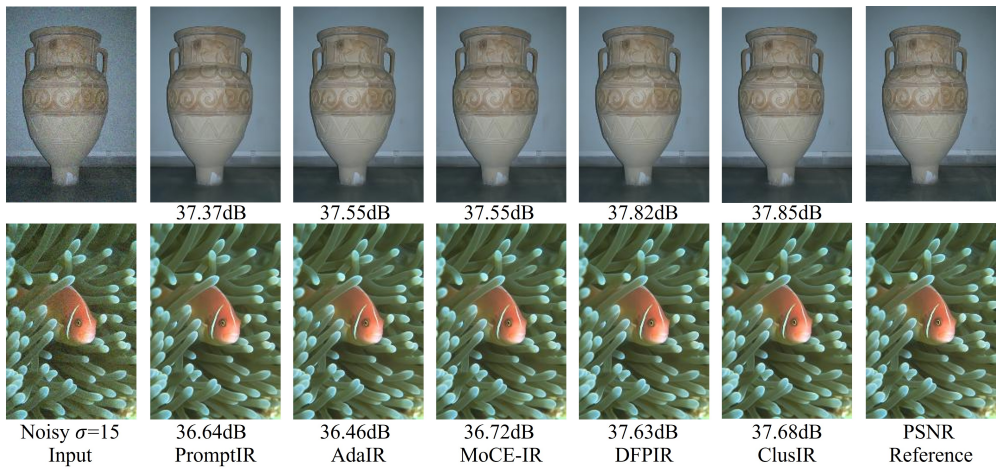
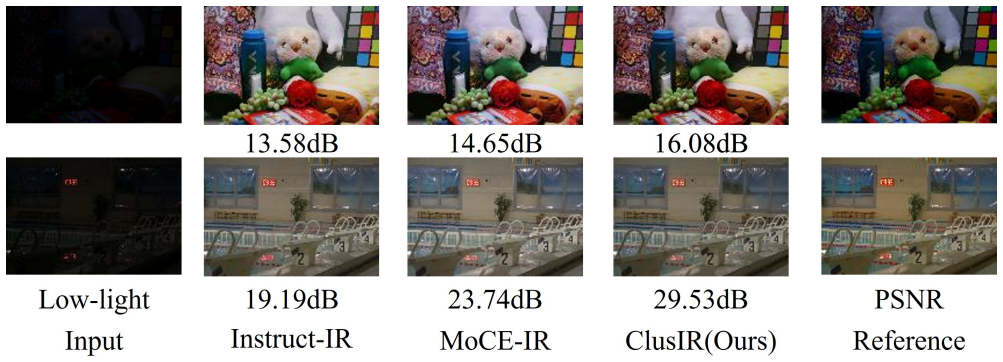
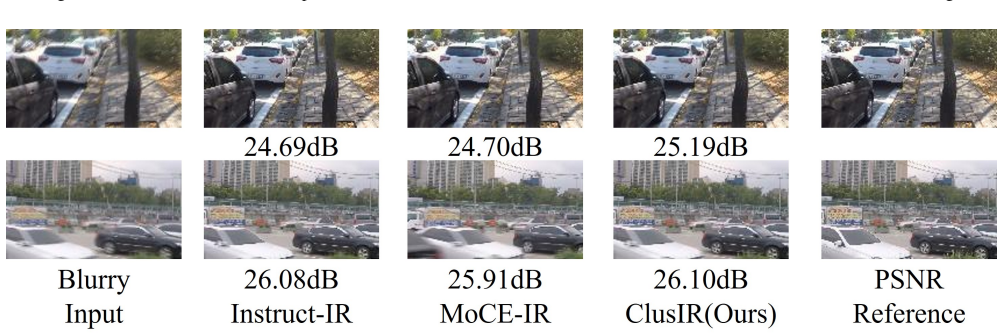
- [§4.4 and Table 3] The paper's own Sec. 4.4 states that in One-by-One training ClusIR 'fails to effectively activate the cluster prototypes, which undermines the PCGRM, prevents reliable degradation discrimination, and consequently limits the generation of semantic prompts.' Table 3 nonetheless reports best AiOIR results for Kodak24 (35.06 dB at sigma=15), SOTS (32.67/0.983), and LOL (23.82/0.852). This is an internal inconsistency that is load-bearing: Contribution (1)/(2) attributes state-of-the-art performance to the cluster-guided design, but the single-task SOTA cannot be attributed to PCGRM if the mechanism is inert. Please add controlled results under One-by-One with PCGRM ablated (WTB+DAFMM only) and with a matched-capacity single-stage MoE, and quantify cluster activation (e.g., entropy or purity against task labels) rather than relying only on t-SNE.
- [§3.2, Eqs. (1)–(2)] The central motivation that a flat softmax router is 'unimodal' and therefore collapses mixed degradations is not established. A softmax over experts is a categorical distribution over the expert set; for different inputs x it can place high mass on different experts, so the router as a function of x can represent multimodal degradation mixtures. The limitation is a capacity/expressivity matter, not a consequence of unimodality. Please provide a formal argument or a controlled experiment comparing the two-stage PCGRM with a single-stage softmax router of matched parameters; otherwise the stated advantage of the factorization is a rhetorical contrast rather than a verified property.
- [Table 4 (ablation)] The ablation from (a) to (b) adds PCGRM-MoE, which includes all expert parameters and gating weights, yielding +0.27 dB. This does not isolate the two-stage probabilistic routing from the increase in model capacity. A single-stage MoE baseline (Eq. (1)) with the same number of experts and parameters would disentangle capacity from the routing structure. Without such a baseline, the result is consistent with the hypothesis that the gain comes from extra parameters rather than from cluster-guided disentanglement.
- [§4.3, Figs. 5–6] The claim that clusters encode degradation semantics rests on t-SNE and affinity maps generated by the same model. These visualizations show separation but not that the clusters correspond to the degradation classes used in training/testing, which would be necessary for 'explicit degradation semantics.' Please report quantitative alignment measures (e.g., cluster purity or NMI with task labels, or confusion between noise levels and tasks) and, ideally, a probe of p(C|x) against held-out degradation labels.
minor comments (5)
- [Table 2] The row labeled 'InstructIR [28] ECCV'24' cites reference [28] (Up-Restorer); InstructIR is reference [8]. Please correct the citation.
- [§3.2, Eq. (7)] Eq. (7) sums the Gaussian prompt over all N prototypes, while Eqs. (5)–(6) normalize over the top-K1 selected clusters. Please make the summation range consistent (selected set vs. full bank) and define sigma_c and epsilon_c precisely.
- [§6.1 / Table 3] The supplementary says denoising is evaluated on CBSD68 and Urban100, while Table 3 of the main text reports Kodak24. Please state which benchmark is used for One-by-One denoising and include Urban100 results or remove the mention.
- [Figs. 6 and 9] The figure captions 'Visual degradation of PCGRM-MoE' likely mean 'Visualization of PCGRM-MoE activations/affinity'; please reword.
- [§3.3] Eq. (14)'s IFFT(,) notation and Eq. (15)'s channel-wise gating are not fully defined; specify dimensions and the activation function used.
Circularity Check
No significant circularity; the central claims rest on external benchmarks and not on fitted parameters or self-citations.
full rationale
Walking the derivation chain, no load-bearing step reduces to its own inputs. The PCGRM factorization in Eqs. (3)-(10) is a strictly more expressive mixture over cluster-conditional expert softmaxes; it is not equivalent by construction to the flat softmax router in Eq. (1). The reported SOTA numbers (e.g., 33.06 dB/0.923 in Table 1) are measured against external benchmarks (CBSD68, SOTS, Rain100L, GoPro, LOL), so no fitted parameter is renamed as a prediction. The ablation in Table 4 attributes +0.27 dB to PCGRM-MoE, but that is a standard component ablation rather than a circular reduction. The paper's own Sec. 4.4 says that under One-by-One training ClusIR 'fails to effectively activate the cluster prototypes' while Table 3 reports strong single-task results; this is an internal mechanistic/attribution inconsistency and a correctness risk, not circularity, because no equation or fitted constant forces the outcome. The self-citations (Perceive-IR [72], ProRes [31]) appear as comparison baselines, with Table 1 noting 'Partial results are referenced from Perceive-IR [72]'; they are not used to justify ClusIR's mechanism or to prohibit alternatives, so they are not load-bearing. The t-SNE and affinity-map analyses are produced by the same trained model and therefore give weak independent support for the semantic-cluster interpretation, but weak evidence is not circular derivation. Overall, the paper's derivations are self-contained and its headline claims are externally checkable.
Axiom & Free-Parameter Ledger
free parameters (6)
- Cluster prototype counts per stage =
[3, 3, 3, 3]
- Active cluster count K1 per stage =
[2, 2, 2, 2]
- Active expert count K2 per cluster =
Not stated
- Data expansion ratios for denoising/deraining/deblurring/low-light =
3, 120, 5, 200
- L1/MS-SSIM loss weights =
Unspecified (equal)
- Orthogonal vs random prototype initialization =
Orthogonal
axioms (6)
- ad hoc to paper A softmax over expert indices is a unimodal distribution that collapses mixed degradations into a single mode.
- domain assumption Learned cluster prototypes capture latent degradation semantics from global average pooled features.
- domain assumption DWT subbands retain residual mid-frequency structure that a learnable low-pass filter (FSB) can separate.
- domain assumption PSNR/SSIM on CBSD68, SOTS, Rain100L, GoPro, LOL, and CDD11 are valid measures of restoration quality and sufficient to compare methods.
- domain assumption Wavelet-based Transformer Block (WTB) from Wave-ViT is a strong base restoration backbone, and adding PCGRM/DAFMM should improve it.
- domain assumption Training with L1 + MS-SSIM for 150 epochs at batch size 48 is sufficient for convergence across all tasks.
invented entities (3)
-
Learnable cluster prototype banks P^(l)
no independent evidence
-
Gaussian semantic prior N(mu_c, diag sigma_c^2) per cluster
no independent evidence
-
Frequency Self-Mining Block (FSB)
no independent evidence
read the original abstract
All-in-One Image Restoration (AiOIR) aims to recover high-quality images from diverse degradations within a unified framework. However, existing methods often fail to explicitly model degradation types and struggle to adapt their restoration behavior to complex or mixed degradations. To address these issues, we propose ClusIR, a Cluster-Guided Image Restoration framework that explicitly models degradation semantics through learnable clustering and propagates cluster-aware cues across spatial and frequency domains for adaptive restoration. Specifically, ClusIR comprises two key components: a Probabilistic Cluster-Guided Routing Mechanism (PCGRM) and a Degradation-Aware Frequency Modulation Module (DAFMM). The proposed PCGRM disentangles degradation recognition from expert activation, enabling discriminative degradation perception and stable expert routing. Meanwhile, DAFMM leverages the cluster-guided priors to perform adaptive frequency decomposition and targeted modulation, collaboratively refining structural and textural representations for higher restoration fidelity. The cluster-guided synergy seamlessly bridges semantic cues with frequency-domain modulation, empowering ClusIR to attain remarkable restoration results across a wide range of degradations. Extensive experiments on diverse benchmarks validate that ClusIR reaches competitive performance under several scenarios.
Figures




Forward citations
Cited by 3 Pith papers
-
SpikeRestormer: Towards Energy-Efficient All-in-One Image Restoration via Unified Event Reasoning
A spiking neural network with subtractive and additive attention performs all-in-one image restoration in one time step, matching older ANN baselines with much lower estimated energy.
-
CoRE-UIR: Prior-guided common and residual experts for efficient all-in-one remote sensing image restoration
CoRE-UIR achieves state-of-the-art all-in-one remote sensing image restoration with a common dense expert plus low-rank routed residual experts, improving PSNR by 1.05 dB over BaryIR at 11.83x lower latency.
-
QuReC: All-in-One Image Restoration with Query-Specific Guidance and Local-Global Response Calibration
Per-pixel degradation prototypes plus calibrated local-global attention improve all-in-one restoration accuracy on three benchmark suites.
Reference graph
Works this paper leans on
-
[1]
Contour detection and hierarchical image seg- mentation.IEEE Trans
Pablo Arbelaez, Michael Maire, Charless Fowlkes, and Ji- tendra Malik. Contour detection and hierarchical image seg- mentation.IEEE Trans. Pattern Anal. Mach. Intell., 33(5): 898–916, 2010. 6, 10
2010
-
[2]
Dehazenet: An end-to-end system for single image haze removal.IEEE Trans
Bolun Cai, Xiangmin Xu, Kui Jia, Chunmei Qing, and Dacheng Tao. Dehazenet: An end-to-end system for single image haze removal.IEEE Trans. Image Process., 25(11): 5187–5198, 2016. 1, 2, 7
2016
-
[3]
Retinexformer: One-stage retinex- based transformer for low-light image enhancement
Yuanhao Cai, Hao Bian, Jing Lin, Haoqian Wang, Radu Tim- ofte, and Yulun Zhang. Retinexformer: One-stage retinex- based transformer for low-light image enhancement. InProc. IEEE/CVF Int. Conf. Comput. Vis. (ICCV), pages 12504– 12513, 2023. 1, 2, 7
2023
-
[4]
Emerg- ing properties in self-supervised vision transformers
Mathilde Caron, Hugo Touvron, Ishan Misra, Herv ´e J´egou, Julien Mairal, Piotr Bojanowski, and Armand Joulin. Emerg- ing properties in self-supervised vision transformers. In Proc. IEEE/CVF Int. Conf. Comput. Vis. (ICCV), pages 9650–9660, 2021. 2
2021
-
[5]
Simple baselines for image restoration
Liangyu Chen, Xiaojie Chu, Xiangyu Zhang, and Jian Sun. Simple baselines for image restoration. InProc. Eur. Conf. Comput. Vis. (ECCV), pages 17–33, 2022. 1, 7
2022
-
[6]
Learn- ing a sparse transformer network for effective image derain- ing
Xiang Chen, Hao Li, Mingqiang Li, and Jinshan Pan. Learn- ing a sparse transformer network for effective image derain- ing. InProc. IEEE/CVF Conf. Comput. Vis. Pattern Recog- nit. (CVPR), pages 5896–5905, 2023. 7
2023
-
[7]
Hierarchical integration diffu- sion model for realistic image deblurring
Zheng Chen, Yulun Zhang, Ding Liu, Bin Xia, Jinjin Gu, Linghe Kong, and Xin Yuan. Hierarchical integration diffu- sion model for realistic image deblurring. InAdv. Neural Inf. Process. Syst. (NeurIPS), pages 29114–29125, 2023. 7
2023
-
[8]
High- quality image restoration following human instructions
Marcos V Conde, Gregor Geigle, and Radu Timofte. High- quality image restoration following human instructions. In Proc. Eur. Conf. Comput. Vis. (ECCV), pages 1–21, 2024. 6, 12
2024
-
[9]
Image restoration via frequency selection.IEEE Trans
Yuning Cui, Wenqi Ren, Xiaochun Cao, and Alois Knoll. Image restoration via frequency selection.IEEE Trans. Pat- tern Anal. Mach. Intell., 46(2):1093–1108, 2023. 1, 7
2023
-
[10]
Hy- brid frequency modulation network for image restoration
Yuning Cui, Mingyu Liu, Wenqi Ren, and Alois Knoll. Hy- brid frequency modulation network for image restoration. In Proc. 33rd Int. Joint Conf. Artif. Intell, pages 722–730, 2024. 2
2024
-
[11]
Khan, Alois Knoll, Mubarak Shah, and Fahad Shahbaz Khan
Yuning Cui, Syed Waqas Zamir, Salman H. Khan, Alois Knoll, Mubarak Shah, and Fahad Shahbaz Khan. Adair: Adaptive all-in-one image restoration via frequency mining and modulation. InInt. Conf. Learn. Represent. (ICLR),
-
[12]
FD-GAN: generative adversarial networks with fusion-discriminator for single image dehazing
Yu Dong, Yihao Liu, He Zhang, Shifeng Chen, and Yu Qiao. FD-GAN: generative adversarial networks with fusion-discriminator for single image dehazing. InProc. AAAI Conf. Artif. Intell. (AAAI), pages 10729–10736, 2020. 1, 7
2020
-
[13]
Kodak Lossless True Color Image Suite,
Rich Franzen. Kodak Lossless True Color Image Suite,
-
[14]
Dy- namic scene deblurring with parameter selective sharing and nested skip connections
Hongyun Gao, Xin Tao, Xiaoyong Shen, and Jiaya Jia. Dy- namic scene deblurring with parameter selective sharing and nested skip connections. InProc. IEEE/CVF Conf. Comput. Vis. Pattern Recognit. (CVPR), pages 3848–3856, 2019. 7
2019
-
[15]
Onerestore: A universal restoration frame- work for composite degradation
Yu Guo, Yuan Gao, Yuxu Lu, Huilin Zhu, Ryan Wen Liu, and Shengfeng He. Onerestore: A universal restoration frame- work for composite degradation. InProc. Eur. Conf. Comput. Vis. (ECCV), pages 255–272. Springer, 2024. 6, 10
2024
-
[16]
Shengkai Hu, Haozhe Qi, Jun Wan, Jiaxing Huang, Lefei Zhang, Hang Sun, and Dacheng Tao. Proto-former: Unified facial landmark detection by prototype transformer.arXiv preprint arXiv:2510.15338, 2025. 1
arXiv 2025
-
[17]
Sin- gle image super-resolution from transformed self-exemplars
Jia-Bin Huang, Abhishek Singh, and Narendra Ahuja. Sin- gle image super-resolution from transformed self-exemplars. InProc. IEEE/CVF Conf. Comput. Vis. Pattern Recognit. (CVPR), pages 5197–5206, 2015. 10
2015
-
[18]
Single target tracking in high-resolution satellite videos: a comprehensive review.Geo-Spatial In- formation Science, 28(3):966–995, 2025
Xin Huang, Ding Wang, Qiqi Zhu, Ying Zheng, and Qingfeng Guan. Single target tracking in high-resolution satellite videos: a comprehensive review.Geo-Spatial In- formation Science, 28(3):966–995, 2025. 1
2025
-
[19]
Cat-air: Content and task-aware all-in-one image restoration.arXiv preprint arXiv:2503.17915, 2025
Jiachen Jiang, Tianyu Ding, Ke Zhang, Jinxin Zhou, Tianyi Chen, Ilya Zharkov, Zhihui Zhu, and Luming Liang. Cat-air: Content and task-aware all-in-one image restoration.arXiv preprint arXiv:2503.17915, 2025. 2
Pith/arXiv arXiv 2025
-
[20]
Deblurgan: Blind motion deblurring using conditional adversarial networks
Orest Kupyn, V olodymyr Budzan, Mykola Mykhailych, Dmytro Mishkin, and Ji ˇr´ı Matas. Deblurgan: Blind motion deblurring using conditional adversarial networks. InProc. IEEE/CVF Conf. Comput. Vis. Pattern Recognit. (CVPR), pages 8183–8192, 2018. 7
2018
-
[21]
Benchmarking single- image dehazing and beyond.IEEE Trans
Boyi Li, Wenqi Ren, Dengpan Fu, Dacheng Tao, Dan Feng, Wenjun Zeng, and Zhangyang Wang. Benchmarking single- image dehazing and beyond.IEEE Trans. Image Process., 28(1):492–505, 2018. 6, 10
2018
-
[22]
All-in-one image restoration for unknown corruption
Boyun Li, Xiao Liu, Peng Hu, Zhongqin Wu, Jiancheng Lv, and Xi Peng. All-in-one image restoration for unknown corruption. InProc. IEEE/CVF Conf. Comput. Vis. Pattern Recognit. (CVPR), pages 17452–17462, 2022. 2, 6, 7, 10, 11
2022
-
[23]
Hybrid agents for image restoration.arXiv preprint arXiv:2503.10120, 2025
Bingchen Li, Xin Li, Yiting Lu, and Zhibo Chen. Hybrid agents for image restoration.arXiv preprint arXiv:2503.10120, 2025. 2
Pith/arXiv arXiv 2025
-
[24]
Ada4dir: An adaptive model-driven all-in-one image restora- tion network for remote sensing images.Information Fusion, 118:102930, 2025
Ziyang Lihe, Qiangqiang Yuan, Jiang He, Xianyu Jin, Yi Xiao, Yuzeng Chen, Huanfeng Shen, and Liangpei Zhang. Ada4dir: An adaptive model-driven all-in-one image restora- tion network for remote sensing images.Information Fusion, 118:102930, 2025. 2
2025
-
[25]
Jingbo Lin, Zhilu Zhang, Wenbo Li, Renjing Pei, Hang Xu, Hongzhi Zhang, and Wangmeng Zuo. Unirestorer: Universal image restoration via adaptively estimating image degrada- tion at proper granularity.arXiv preprint arXiv:2412.20157,
-
[26]
Multi-task image restoration guided by robust dino features.arXiv preprint arXiv:2312.01677, 2023
Xin Lin, Jingtong Yue, Kelvin CK Chan, Lu Qi, Chao Ren, Jinshan Pan, and Ming-Hsuan Yang. Multi-task image restoration guided by robust dino features.arXiv preprint arXiv:2312.01677, 2023. 2
Pith/arXiv arXiv 2023
-
[27]
Tape: Task-agnostic prior embedding for image restoration
Lin Liu, Lingxi Xie, Xiaopeng Zhang, Shanxin Yuan, Xi- angyu Chen, Wengang Zhou, Houqiang Li, and Qi Tian. Tape: Task-agnostic prior embedding for image restoration. InProc. Eur. Conf. Comput. Vis. (ECCV), pages 447–464,
-
[28]
Up- restorer: When unrolling meets prompts for unified image restoration
Minghao Liu, Wenhan Yang, Jinyi Luo, and Jiaying Liu. Up- restorer: When unrolling meets prompts for unified image restoration. InProc. AAAI Conf. Artif. Intell. (AAAI), pages 5513–5522, 2025. 6
2025
-
[29]
Facial expression recognition with heatmap neighbor contrastive learning.IEEE Trans
Tong Liu, Jing Li, Jia Wu, Bo Du, Yibing Zhan, Dapeng Tao, and Jun Wan. Facial expression recognition with heatmap neighbor contrastive learning.IEEE Trans. Multimedia,
-
[30]
Yulin Luo, Rui Zhao, Xiaobao Wei, Jinwei Chen, Yijie Lu, Shenghao Xie, Tianyu Wang, Ruiqin Xiong, Ming Lu, and Shanghang Zhang. Wm-moe: Weather-aware multi-scale mixture-of-experts for blind adverse weather removal.arXiv preprint arXiv:2303.13739, 2023. 2
Pith/arXiv arXiv 2023
-
[31]
Jiaqi Ma, Tianheng Cheng, Guoli Wang, Qian Zhang, Xinggang Wang, and Lefei Zhang. Prores: Exploring degradation-aware visual prompt for universal image restora- tion.arXiv preprint arXiv:2306.13653, 2023. 2, 6
Pith/arXiv arXiv 2023
-
[32]
Waterloo exploration database: New challenges for image quality as- sessment models.IEEE Trans
Kede Ma, Zhengfang Duanmu, Qingbo Wu, Zhou Wang, Hongwei Yong, Hongliang Li, and Lei Zhang. Waterloo exploration database: New challenges for image quality as- sessment models.IEEE Trans. Image Process., 26(2):1004– 1016, 2016. 6, 10
2016
-
[33]
A database of human segmented natural images and its application to evaluating segmentation algorithms and measuring ecological statistics
David Martin, Charless Fowlkes, Doron Tal, and Jitendra Malik. A database of human segmented natural images and its application to evaluating segmentation algorithms and measuring ecological statistics. InProc. IEEE/CVF Int. Conf. Comput. Vis. (ICCV), pages 416–423, 2001. 6, 10
2001
-
[34]
Deep multi-scale convolutional neural network for dynamic scene deblurring
Seungjun Nah, Tae Hyun Kim, and Kyoung Mu Lee. Deep multi-scale convolutional neural network for dynamic scene deblurring. InProc. IEEE/CVF Conf. Comput. Vis. Pattern Recognit. (CVPR), pages 3883–3891, 2017. 6, 10
2017
-
[35]
Understanding ssim.arXiv preprint arXiv:2006.13846, 2020
Jim Nilsson and Tomas Akenine-M ¨oller. Understanding ssim.arXiv preprint arXiv:2006.13846, 2020. 6
Pith/arXiv arXiv 2006
-
[36]
Dinov2: Learning robust visual features without supervision
Maxime Oquab, Timoth ´ee Darcet, Th ´eo Moutakanni, Huy V o, Marc Szafraniec, Vasil Khalidov, Pierre Fernandez, Daniel Haziza, Francisco Massa, Alaaeldin El-Nouby, et al. Dinov2: Learning robust visual features without supervision. arXiv preprint arXiv:2304.07193, 2023. 2
Pith/arXiv arXiv 2023
-
[37]
Restoring vision in adverse weather conditions with patch-based denoising dif- fusion models.IEEE Trans
Ozan ¨Ozdenizci and Robert Legenstein. Restoring vision in adverse weather conditions with patch-based denoising dif- fusion models.IEEE Trans. Pattern Anal. Mach. Intell., 45 (8):10346–10357, 2023. 10, 11
2023
-
[38]
Promptir: Prompting for all-in-one blind image restoration
Vaishnav Potlapalli, Syed Waqas Zamir, Salman Khan, and Fahad Shahbaz Khan. Promptir: Prompting for all-in-one blind image restoration. InAdv. Neural Inf. Process. Syst. (NeurIPS), pages 71275–71293, 2023. 2, 3, 6, 7, 10, 11
2023
-
[39]
Learning transferable visual models from natural language supervi- sion
Alec Radford, Jong Wook Kim, Chris Hallacy, Aditya Ramesh, Gabriel Goh, Sandhini Agarwal, Girish Sastry, Amanda Askell, Pamela Mishkin, Jack Clark, et al. Learning transferable visual models from natural language supervi- sion. InProc. Int. Conf. Mach. Learn. (ICML), pages 8748–
-
[40]
Adaptive dy- namic filtering network for image denoising
Hao Shen, Zhong-Qiu Zhao, and Wandi Zhang. Adaptive dy- namic filtering network for image denoising. InProc. AAAI Conf. Artif. Intell. (AAAI), pages 2227–2235, 2023. 1, 7
2023
-
[41]
Vision transformers for single image dehazing.IEEE Trans
Yuda Song, Zhuqing He, Hui Qian, and Xin Du. Vision transformers for single image dehazing.IEEE Trans. Image Process., 32:1927–1941, 2023. 1, 7
1927
-
[42]
Xiaole Tang, Xiaoyi He, Xiang Gu, and Jian Sun. Baryir: Learning multi-source unified representation in continuous barycenter space for generalizable all-in-one image restora- tion.arXiv preprint arXiv:2505.21637, 2025. 2
Pith/arXiv arXiv 2025
-
[43]
Degradation-aware feature perturbation for all- in-one image restoration
Xiangpeng Tian, Xiangyu Liao, Xiao Liu, Meng Li, and Chao Ren. Degradation-aware feature perturbation for all- in-one image restoration. InProc. IEEE/CVF Conf. Comput. Vis. Pattern Recognit. (CVPR), pages 28165–28175, 2025. 6, 11
2025
-
[44]
Stripformer: Strip transformer for fast image deblurring
Fu-Jen Tsai, Yan-Tsung Peng, Yen-Yu Lin, Chung-Chi Tsai, and Chia-Wen Lin. Stripformer: Strip transformer for fast image deblurring. InProc. Eur. Conf. Comput. Vis. (ECCV), pages 146–162, 2022. 7
2022
-
[45]
Transweather: Transformer-based restoration of im- ages degraded by adverse weather conditions
Jeya Maria Jose Valanarasu, Rajeev Yasarla, and Vishal M Patel. Transweather: Transformer-based restoration of im- ages degraded by adverse weather conditions. InProc. IEEE/CVF Conf. Comput. Vis. Pattern Recognit. (CVPR), pages 2353–2363, 2022. 6
2022
-
[46]
Precise facial landmark detection by reference heatmap transformer.IEEE Trans
Jun Wan, Jun Liu, Jie Zhou, Zhihui Lai, Linlin Shen, Hang Sun, Ping Xiong, and Wenwen Min. Precise facial landmark detection by reference heatmap transformer.IEEE Trans. Image Process., 32:1966–1977, 2023. 1
1966
-
[47]
Sirui Wang, Jiang He, Natalia Blasco Andreo, and Xiao Xi- ang Zhu. Gewdiff: Geometric enhanced wavelet-based diffu- sion model for hyperspectral image super-resolution.arXiv preprint arXiv:2511.07103, 2025. 2
arXiv 2025
-
[48]
Gridformer: Residual dense transformer with grid struc- ture for image restoration in adverse weather conditions.Int
Tao Wang, Kaihao Zhang, Ziqian Shao, Wenhan Luo, Bjorn Stenger, Tong Lu, Tae-Kyun Kim, Wei Liu, and Hongdong Li. Gridformer: Residual dense transformer with grid struc- ture for image restoration in adverse weather conditions.Int. J. Comput. Vis., 132(10):4541–4563, 2024. 6
2024
-
[49]
Yongzhen Wang, Yongjun Li, Zhuoran Zheng, Xiao-Ping Zhang, and Mingqiang Wei. M2restore: Mixture-of-experts- based mamba-cnn fusion framework for all-in-one image restoration.arXiv preprint arXiv:2506.07814, 2025. 2, 3
Pith/arXiv arXiv 2025
-
[50]
Deep retinex decomposition for low-light enhancement
Chen Wei, Wenjing Wang, Wenhan Yang, and Jiaying Liu. Deep retinex decomposition for low-light enhancement. In Proc. Brit. Mach. Vis. Conf. (BMVC), 2018. 6, 10
2018
-
[51]
Dswinir: Rethinking window-based attention for image restoration, 2025
Gang Wu, Junjun Jiang, Kui Jiang, Xianming Liu, and Liqiang Nie. Dswinir: Rethinking window-based attention for image restoration, 2025. 2
2025
-
[52]
Uretinex-net: Retinex-based deep unfolding network for low-light image enhancement
Wenhui Wu, Jian Weng, Pingping Zhang, Xu Wang, Wen- han Yang, and Jianmin Jiang. Uretinex-net: Retinex-based deep unfolding network for low-light image enhancement. InProc. IEEE/CVF Conf. Comput. Vis. Pattern Recognit. (CVPR), pages 5901–5910, 2022. 1, 2, 7
2022
-
[53]
Diffir: Efficient diffusion model for image restoration
Bin Xia, Yulun Zhang, Shiyin Wang, Yitong Wang, Xing- long Wu, Yapeng Tian, Wenming Yang, and Luc Van Gool. Diffir: Efficient diffusion model for image restoration. In Proc. IEEE/CVF Int. Conf. Comput. Vis. (ICCV), pages 13095–13105, 2023. 7
2023
-
[54]
Occlusion-embedded hybrid transformer for light field super-resolution
Zeyu Xiao, Zhuoyuan Li, and Wei Jia. Occlusion-embedded hybrid transformer for light field super-resolution. InAAAI Conf. Artif. Intell. (AAAI), pages 8700–8708, 2025. 1
2025
-
[55]
Low-light image enhancement via structure modeling and guidance
Xiaogang Xu, Ruixing Wang, and Jiangbo Lu. Low-light image enhancement via structure modeling and guidance. InProc. IEEE/CVF Conf. Comput. Vis. Pattern Recognit. (CVPR), pages 9893–9903, 2023. 7 19
2023
-
[56]
Language- driven all-in-one adverse weather removal
Hao Yang, Liyuan Pan, Yan Yang, and Wei Liang. Language- driven all-in-one adverse weather removal. InProc. IEEE/CVF Conf. Comput. Vis. Pattern Recognit. (CVPR), pages 24902–24912, 2024. 2
2024
-
[57]
Deep joint rain detection and removal from a single image
Wenhan Yang, Robby T Tan, Jiashi Feng, Jiaying Liu, Zong- ming Guo, and Shuicheng Yan. Deep joint rain detection and removal from a single image. InProc. IEEE/CVF Conf. Comput. Vis. Pattern Recognit. (CVPR), pages 1357–1366,
-
[58]
Neural degradation representation learning for all-in-one image restoration.IEEE Trans
Mingde Yao, Ruikang Xu, Yuanshen Guan, Jie Huang, and Zhiwei Xiong. Neural degradation representation learning for all-in-one image restoration.IEEE Trans. Image Pro- cess., 33:5408–5423, 2024. 6
2024
-
[59]
Wave-vit: Unifying wavelet and transformers for vi- sual representation learning
Ting Yao, Yingwei Pan, Yehao Li, Chong-Wah Ngo, and Tao Mei. Wave-vit: Unifying wavelet and transformers for vi- sual representation learning. InProc. Eur. Conf. Comput. Vis. (ECCV), pages 328–345. Springer, 2022. 3
2022
-
[60]
Uncertainty guided multi-scale residual learning-using a cycle spinning cnn for single image de-raining
Rajeev Yasarla and Vishal M Patel. Uncertainty guided multi-scale residual learning-using a cycle spinning cnn for single image de-raining. InProc. IEEE/CVF Conf. Comput. Vis. Pattern Recognit. (CVPR), pages 8405–8414, 2019. 7
2019
-
[61]
Multi-expert adaptive selection: Task-balancing for all-in- one image restoration.IEEE Trans
Xiaoyan Yu, Shen Zhou, Huafeng Li, and Liehuang Zhu. Multi-expert adaptive selection: Task-balancing for all-in- one image restoration.IEEE Trans. Circuits Syst. Video Technol., 2024. 2, 3
2024
-
[62]
Com- plexity experts are task-discriminative learners for any image restoration
Eduard Zamfir, Zongwei Wu, Nancy Mehta, Yuedong Tan, Danda Pani Paudel, Yulun Zhang, and Radu Timofte. Com- plexity experts are task-discriminative learners for any image restoration. InProc. IEEE/CVF Conf. Comput. Vis. Pattern Recognit. (CVPR), pages 12753–12763, 2025. 2, 6, 11, 12
2025
-
[63]
Learning enriched features for real image restoration and enhancement
Syed Waqas Zamir, Aditya Arora, Salman Khan, Munawar Hayat, Fahad Shahbaz Khan, Ming-Hsuan Yang, and Ling Shao. Learning enriched features for real image restoration and enhancement. InProc. Eur. Conf. Comput. Vis. (ECCV), pages 492–511, 2020. 1, 7
2020
-
[64]
Khan, Mu- nawar Hayat, Fahad Shahbaz Khan, Ming-Hsuan Yang, and Ling Shao
Syed Waqas Zamir, Aditya Arora, Salman H. Khan, Mu- nawar Hayat, Fahad Shahbaz Khan, Ming-Hsuan Yang, and Ling Shao. Multi-stage progressive image restoration. InProc. IEEE/CVF Conf. Comput. Vis. Pattern Recognit. (CVPR), pages 14816–14826, 2021. 2, 7
2021
-
[65]
Restormer: Efficient transformer for high-resolution image restoration
Syed Waqas Zamir, Aditya Arora, Salman Khan, Mu- nawar Hayat, Fahad Shahbaz Khan, and Ming-Hsuan Yang. Restormer: Efficient transformer for high-resolution image restoration. InProc. IEEE/CVF Conf. Comput. Vis. Pattern Recognit. (CVPR), pages 5728–5739, 2022. 1, 7
2022
-
[66]
Learning enriched features for fast image restoration and enhancement.IEEE Trans
Syed Waqas Zamir, Aditya Arora, Salman Khan, Munawar Hayat, Fahad Shahbaz Khan, Ming-Hsuan Yang, and Ling Shao. Learning enriched features for fast image restoration and enhancement.IEEE Trans. Pattern Anal. Mach. Intell., 45(2):1934–1948, 2022. 1, 2, 7
1934
-
[67]
Ingredient-oriented multi-degradation learning for image restoration
Jinghao Zhang, Jie Huang, Mingde Yao, Zizheng Yang, Hu Yu, Man Zhou, and Feng Zhao. Ingredient-oriented multi-degradation learning for image restoration. InProc. IEEE/CVF Conf. Comput. Vis. Pattern Recognit. (CVPR), pages 5825–5835, 2023. 6, 7
2023
-
[68]
A tale of two features: Stable diffusion complements dino for zero-shot semantic correspondence
Junyi Zhang, Charles Herrmann, Junhwa Hur, Luisa Pola- nia Cabrera, Varun Jampani, Deqing Sun, and Ming-Hsuan Yang. A tale of two features: Stable diffusion complements dino for zero-shot semantic correspondence. InAdv. Neural Inf. Process. Syst. (NeurIPS), 2024. 2
2024
-
[69]
Beyond a gaussian denoiser: Residual learning of deep cnn for image denoising.IEEE Trans
Kai Zhang, Wangmeng Zuo, Yunjin Chen, Deyu Meng, and Lei Zhang. Beyond a gaussian denoiser: Residual learning of deep cnn for image denoising.IEEE Trans. Image Process., 26(7):3142–3155, 2017. 1, 7
2017
-
[70]
Ffdnet: Toward a fast and flexible solution for cnn-based image denoising
Kai Zhang, Wangmeng Zuo, and Lei Zhang. Ffdnet: Toward a fast and flexible solution for cnn-based image denoising. IEEE Trans. Image Process., 27(9):4608–4622, 2018. 1, 7
2018
-
[71]
Efficient deweahter mixture- of-experts with uncertainty-aware feature-wise linear mod- ulation
Rongyu Zhang, Yulin Luo, Jiaming Liu, Huanrui Yang, Zhen Dong, Denis Gudovskiy, Tomoyuki Okuno, Yohei Nakata, Kurt Keutzer, Yuan Du, et al. Efficient deweahter mixture- of-experts with uncertainty-aware feature-wise linear mod- ulation. InAAAI Conf. Artif. Intell. (AAAI), pages 16812– 16820, 2024. 2
2024
-
[72]
Perceive-ir: Learning to perceive degra- dation better for all-in-one image restoration.IEEE Trans
Xu Zhang, Jiaqi Ma, Guoli Wang, Qian Zhang, Huan Zhang, and Lefei Zhang. Perceive-ir: Learning to perceive degra- dation better for all-in-one image restoration.IEEE Trans. Image Process., pages 1–1, 2025. 2, 6, 7
2025
-
[73]
Seeing the unseen: A fre- quency prompt guided transformer for image restoration
Shihao Zhou, Jinshan Pan, Jinglei Shi, Duosheng Chen, Lishen Qu, and Jufeng Yang. Seeing the unseen: A fre- quency prompt guided transformer for image restoration. InProc. Eur. Conf. Comput. Vis. (ECCV), pages 246–264. Springer, 2024. 2
2024
-
[74]
Learn- ing weather-general and weather-specific features for im- age restoration under multiple adverse weather conditions
Yurui Zhu, Tianyu Wang, Xueyang Fu, Xuanyu Yang, Xin Guo, Jifeng Dai, Yu Qiao, and Xiaowei Hu. Learn- ing weather-general and weather-specific features for im- age restoration under multiple adverse weather conditions. InProc. IEEE/CVF Conf. Comput. Vis. Pattern Recognit. (CVPR), pages 21747–21758, 2023. 10, 11 20
2023
-
[1999]
Available:http : / / r0k
[Online]. Available:http : / / r0k . us / graphics/kodak/[Accessed: Oct. 24, 2021]. 6
2021
discussion (0)
Sign in with ORCID, Apple, or X to comment. Anyone can read and Pith papers without signing in.