REVIEW 3 major objections 5 minor 1 cited by
Laser M\"ossbauer spectroscopy of ^{229}Th
T0 review · 3 major / 5 minor · reviewed 2026-08-15 · deepseek-v4-flash
Pith's one-line read This paper reports that a vacuum-ultraviolet laser can resolve the nuclear quadrupole spectrum of thorium-229 in calcium fluoride into four distinct doping sites, each with its own electric field gradient, and assigns the two dominant…
desk verdict Four-site inventory is a real advance, but the completeness claim is weakest at highest concentration and needs uncertainty reporting. read the letter →
The pith
A machine-rendered reading of the paper's core claim, the machinery that carries it, and where it could break.
The reading
What carries the argument
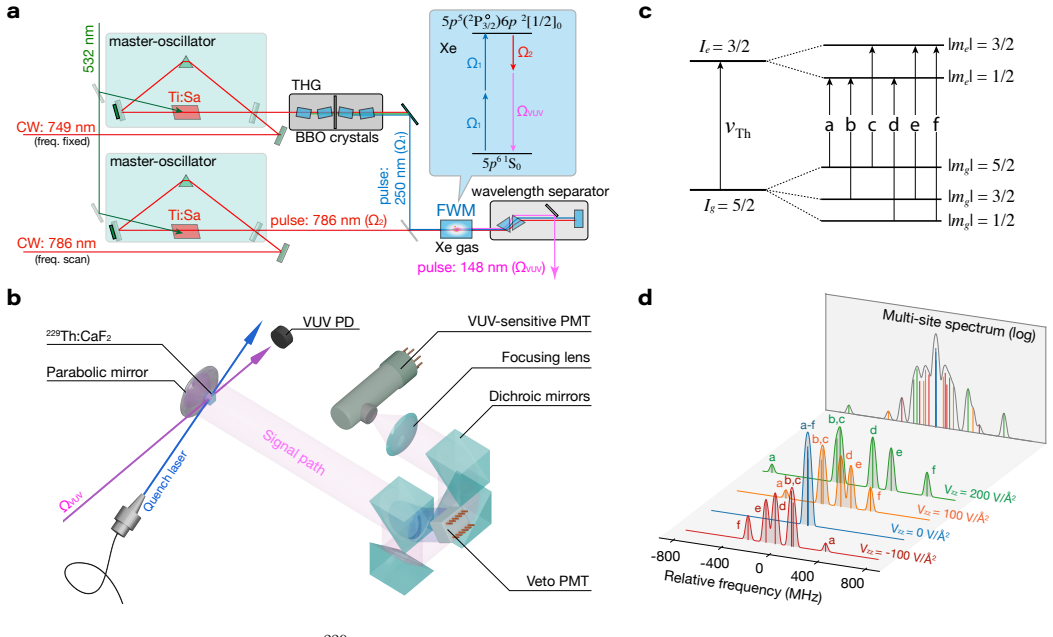
The central mechanism is nuclear quadrupole splitting: the thorium nucleus's electric quadrupole moment $Q$ interacts with the electric field gradient (EFG) tensor of the crystal, splitting the nuclear ground state ($I_g = 5/2$) into three sublevels and the isomeric state ($I_e = 3/2$) into two, so each site contributes up to six transitions. The paper's instrument is a pulsed vacuum-ultraviolet laser at $\sim$148 nm with a $\sim$30 MHz linewidth, narrow enough to resolve those splittings. The load-bearing analysis is a common-width four-site Gaussian fit to the summed spectra, governed by the quadrupole Hamiltonian with site parameters $V_{zz}$, $\eta$, and the fixed moment ratio $Q_e/Q_g$, with relative line intensities fixed by the transition matrix elements.
What would settle it
Cool the X2 crystal to liquid-helium temperature and scan with a sub-megahertz-linewidth VUV source, with long integration to expose weak lines; if the residuals near sites 3 and 4 then require a fifth Gaussian site to fit, the four-site inventory is incomplete.
Extended reading notes
Core claim
On the paper's own terms, the central discovery is that the vacuum-ultraviolet spectrum of $^{229}$Th:CaF$_2$, recorded with a 30 MHz linewidth pulsed laser, is a superposition of six-line quadrupole patterns from four distinct thorium sites. The fit yields $V_{zz} \approx 0$, $+110$, $-320$, and $+260$ V/Å$^2$ for sites 1–4, with site 2 matching the previously characterized site and the other three sites accounting for the transitions earlier work could not assign. Site 1 has a vanishing electric field gradient and thus a locally near-cubic environment; the paper assigns it to a thorium atom on a calcium site with distant charge compensation (Th$_{Ca}$−2e), and site 2 to a nearest-neighbor thorium pair (Th$_{Ca}$−4e), supported by DFT calculations and STEM images showing thorium clustering. The radiative lifetime is about 630 s for all sites, but laser-induced quenching is site-dependent and strongest for site 1, making that high-symmetry site the preferred candidate for a future solid-state nuclear clock.
Load-bearing premise
The whole inventory rests on assuming that every observed line belongs to exactly four sites, each producing Gaussian lines of the same width; if a fifth site (which the paper itself suggests for the highest-concentration crystal) or site-dependent linewidths exist, the extracted field gradients for the weaker sites would be biased.
Editorial extensions
If this is right
- The unassigned transitions in earlier $^{229}$Th:CaF$_2$ spectra are accounted for by three additional doping sites, so future spectra can be analyzed as a sum of four known site patterns.
- Site-selective excitation makes it possible to interrogate each of the four sites independently; the radiative lifetime is the same (about 630 s) for all sites, while the laser-induced quenching rate differs by site, with site 1 quenching most efficiently.
- The structural assignments of the two dominant sites (isolated thorium on a calcium site with distant compensation, and a nearest-neighbor thorium pair) provide the microscopic geometry needed to model how the crystal environment responds to stress, temperature, and strain.
- The technique can be transferred to other VUV-transparent host materials and, with conversion-electron detection, to opaque materials, extending laser Mössbauer spectroscopy beyond $^{229}$Th:CaF$_2$.
- Site 1's near-zero field gradient and strong quenching make it a leading candidate for a solid-state nuclear clock, with site 2 as a built-in cross-check for systematic effects.
Reading between the lines
- If the four-site inventory is complete, crystal growth conditions (dopant concentration, annealing, cooling rate) should be able to shift the site population balance, potentially yielding crystals dominated by a single site for simpler clock operation.
- The concentration scaling of sites 3 and 4 suggests they are also thorium clusters; a growth series varying only concentration could turn site-resolved spectroscopy into a fingerprinting tool for cluster geometries in rare-earth-doped fluorites.
- The site-dependent quenching efficiency implies the nuclear decay path is modulated by the local electronic structure; comparing the same site's quenching across temperatures could separate phonon-assisted from direct electronic mechanisms.
- Going below the current 30 MHz laser linewidth at low temperature might reveal whether site 1's field gradient is exactly zero or merely unresolved, distinguishing a true cubic site from a slightly distorted one and sharpening the DFT-based assignment.
Signed reviews
Editorial analysis
A structured set of objections, weighed in public.
Referee Report
Summary. The manuscript reports vacuum-ultraviolet laser excitation of the 229Th nuclear clock transition in three 229Th:CaF2 crystals with different dopant concentrations. The authors observe many spectral lines and fit them with a model that assumes four distinct thorium doping sites, each characterized by an electric field gradient (Vzz, eta), a common Gaussian linewidth, and a per-crystal ratio of nuclear quadrupole moments Qe/Qg. They extract Vzz values of approximately 0, 106-107, -319 to -320, and 258-261 V/Å^2 for sites 1-4, with eta about 0.6 for site 2, and they report site-selective isomeric lifetimes of about 630 s together with site-dependent laser-induced quenching rates. Combining DFT calculations and STEM imaging, the authors assign the dominant site 1 to a highly symmetric ThCa defect with distant charge compensation and site 2 to a nearest-neighbor pair of thorium atoms without local compensating defects.
Significance. If the four-site interpretation is correct, the work resolves previously unassigned resonances in 229Th:CaF2, provides the first multi-site EFG inventory for this system, and demonstrates a laser-based Mössbauer approach with site selectivity. A notable strength is that the DFT calculation for site 2 predicts Vzz = 95 V/Å^2 and eta = 0.6 without fitting to the measured EFG, in reasonable agreement with the experimental values Vzz = 106-107 V/Å^2 and eta = 0.59-0.61, and the site-2 EFG is consistently reproduced across three crystals and agrees with refs. [7,10]. The lifetime and quenching measurements add practical information for solid-state nuclear clock design. The main risk is that the completeness of the four-site inventory is not fully closed, as discussed below.
major comments (3)
- [§3 and Appendix C] The central claim that the spectra are explained by exactly four doping sites is weakened by the acknowledged poorer fit for the highest-concentration crystal X2. Appendix C states that the agreement between data and fit is lower for X2 and 'might indicate the presence of a fifth or further doping sites.' Because the fit function in Eq. (1) sums over exactly four sites, any fifth site will bias the extracted Vzz and eta, especially for the weak sites 3 and 4 whose relative contributions are only 0.4-3.6% (Table 1). The authors should either include a fifth site in the X2 fit, provide a quantitative upper limit on the amplitude of a fifth site, or explicitly restrict the 'four sites' claim to the two dominant sites.
- [§3.1, Table 3, Eqs. (2)-(6)] Qe/Qg is left as a free parameter per crystal and the fitted values are 0.574 (C10), 0.570 (C13), and 0.563 (X2), while ref. [10] determined Qe/Qg = 0.57003(1). Since Qe/Qg is a nuclear property, the 0.563 value for X2 is a red flag for model misspecification, and because the level splittings scale with Qe/Qg * Vzz (Eqs. 2-6), a missing spectral component or an incorrect linewidth model can bias the extracted EFGs. The authors should test whether fixing Qe/Qg to the precise literature value changes the site 3 and 4 parameters, and should report the resulting systematic shifts.
- [§3.3 and Table 2] The structural assignment of site 1 to a ThCa defect with distant charge compensation is supported only indirectly: Table 2 shows that moving a calcium vacancy farther away drives Vzz toward zero, but the total energy increases with distance, and the manuscript explicitly states that no explicit charge-compensation mechanism is postulated. Since the abstract claims identification of the microscopic structure of the two dominant configurations, this assignment should be presented more cautiously, or additional evidence (e.g., concentration-dependent or annealing-dependent data) should be provided to support the invoked kinetic trapping mechanism.
minor comments (5)
- [Appendix C] Typo: 'dominanted' should be 'dominated'.
- [Appendix A] The phrase 'where no magnetic field is not applied' contains a double negative; it should read 'where no magnetic field is applied'.
- [Table 3 caption] The statement that values in parentheses are 'differences of fitting results of the two spectra' is ambiguous; please clarify whether these are half-differences, standard deviations, or full spreads, and note that they are not statistical uncertainties.
- [§3.3] The sentence 'For η = 0, the transition between m = ±5/2 → m' = ±1/2 is asymptotically forbidden' would be clearer as 'has zero intensity at η = 0'.
- [Appendix B] In the DFT methods paragraph, 'enables efficient simulation evaluation at the Γ-point only in reciprocal space' should be rephrased, for example as 'enables efficient evaluation using only the Γ-point in reciprocal space'.
Circularity Check
No significant circularity: the spectral fit is a forward model, the structural assignments are independently checked by parameter-free DFT, and the key comparisons use external references.
full rationale
The paper's central derivation is self-contained and non-circular. The observed spectra are fitted with a forward model, Eq. (1), that is derived from the standard quadrupole Hamiltonian, Eq. (2), with relative transition intensities computed from Clebsch-Gordan coefficients, Eq. (7). The fit parameters are the EFG components Vzz and eta, the site amplitudes, a common Gaussian width, and Qe/Qg. The EFGs are extracted from the measured line positions and are not defined in terms of the fitted Qe/Qg; they are independent outputs of the same fit. The site-2 EFG and the fitted Qe/Qg values are compared with the independently measured values from ref. [10], which is an external benchmark, not a self-citation. The DFT calculations used for the structural assignment of sites 1 and 2 are parameter-free with respect to the measured EFGs: the authors compute EFGs from relaxed defect geometries and compare them with experiment, and the calculated values (e.g., 95 V/A^2 and eta = 0.6 for site 2) agree with the measured ones without fitting the target values. The assignment of site 1 to a high-symmetry thorium defect without local compensation is supported by a systematic DFT study of distant charge compensation, in which the EFG approaches zero with increasing distance. The only noted weakness is the acknowledged poorer fit for the highest-concentration crystal X2, which the authors attribute to a possible fifth doping site; this is a model-completeness or correctness risk, not a circularity, because the four-site model is not asserted as a consequence of its own assumptions. Self-citations appear in the text, but they are not load-bearing: they refer to prior characterizations, symmetry arguments, or absorption-feature assignments that are corroborated by independent references or by the paper's own DFT and STEM data. No step in the derivation chain reduces to its own inputs by construction.
Assumptions & free parameters
free parameters (2)
- Qe/Qg (ratio of nuclear quadrupole moments) =
0.574 (C10), 0.570 (C13), 0.563 (X2)
- Common Gaussian linewidth sigma =
about 30 MHz (laser linewidth)
assumptions (4)
- standard math Quadrupole interaction Hamiltonian and eigenvalue equations for I=5/2 and I=3/2 (Eqs. 2-6).
- domain assumption Relative transition intensities from Clebsch-Gordan coefficients for M1 transitions (Eq. 7).
- domain assumption The observed spectra are a superposition of Gaussian lines from exactly four sites with a common width.
- domain assumption DFT with the R2SCAN functional and the selected defect geometries predicts EFGs accurately enough for site assignment.
Cite this review
Pith. "Pith review of Laser M\"ossbauer spectroscopy of ^{229}Th." pith.science (2026). https://pith.science/paper/PNWQN44W
@misc{pith2026250900041,
  author       = {Pith},
  title        = {Pith review of: Laser M\"ossbauer spectroscopy of ^229Th},
  year         = {2026},
  howpublished = {\url{https://pith.science/paper/PNWQN44W}},
  note         = {Machine review of arXiv:2509.00041}
}
read the original abstract
M\"ossbauer spectroscopy is widely used in biochemistry, geology, and solid-state physics to obtain structural information on materials. Here, we extend this technique into the optical range using a vacuum ultraviolet laser to probe the low-energy nuclear transitions of thorium-229, doped in calcium fluoride crystals. We discover four distinct doping sites for the thorium ions, determine the characteristic electric field gradients emerging in the interaction with the host crystal, and identify the microscopic structure of the two dominant configurations. Site-selective laser excitation allows to study the isomeric state lifetime and laser-induced quenching for all sites. This laser-based M\"ossbauer spectroscopy provides a powerful probe of the nuclear environment, yielding foundational data for designing future solid-state nuclear clocks.
Figures


Figures from the paper (3 more)


Forward citations
Cited by 1 Pith paper
-
Exploring $\alpha$- and $\beta$-decay-induced quenching of the $^{229}$Th nuclear-clock isomer in solid-state hosts
Alpha and beta radiation quenches the 229mTh isomer's VUV decay in CaF2 and MgF2, with probabilities differing up to two orders of magnitude between samples.
Reference graph
Works this paper leans on
-
[10]
J. S. Higgins et al., Temperature sensitivity of a thorium-229 solid-state nuclear clock. Phys. Rev. Lett. 134, 113801 (2025)
work page 2025
-
[1]
E. Peik and C. Tamm, Nuclear laser spectroscopy of the 3.5 eV transition in Th-229. Euro. Phys. Lett. 61, 181 (2003)
work page 2003
-
[2]
W. G. Rellergert et al., Constraining the evolution of the fundamental constants with a solid-state optical frequency reference based on the nucleus. Phys. Rev. Lett. 104, 200802 (2010)
work page 2010
-
[3]
C. J. Campbell et al., Single-ion nuclear clock for metrology at the 19th decimal place. Phys. Rev. Lett. 108, 120802 (2012)
work page 2012
-
[4]
G. A. Kazakov et al., Performance of a ^ 229 thorium solid-state nuclear clock. New J. Phys. 14, 083019 (2012)
work page 2012
-
[5]
Tiedau et al., Laser excitation of the Th-229 nucleus
J. Tiedau et al., Laser excitation of the Th-229 nucleus. Phys. Rev. Lett. 132, 182501 (2024)
work page 2024
-
[6]
Elwell et al., Laser excitation of the ^ 229 Th nuclear isomeric transition in a solid-state host
R. Elwell et al., Laser excitation of the ^ 229 Th nuclear isomeric transition in a solid-state host. Phys. Rev. Lett. 133, 013201 (2024)
work page 2024
-
[7]
C. Zhang et al., Frequency ratio of the ^ 229m Th nuclear isomeric transition and the ^ 87 Sr atomic clock. Nature 633, 63--70 (2024)
work page 2024
Show all 45 references
-
[8]
Zhang et al., ^ 229 ThF _4 thin films for solid-state nuclear clocks
C. Zhang et al., ^ 229 ThF _4 thin films for solid-state nuclear clocks. Nature 636, 603--608 (2024)
2024
-
[9]
Schaden et al., Laser-induced quenching of the Th-229 nuclear clock isomer in calcium fluoride
F. Schaden et al., Laser-induced quenching of the Th-229 nuclear clock isomer in calcium fluoride. Phys. Rev. Res. 7, L022036 (2025)
2025
-
[11]
Zhang et al., Tunable VUV frequency comb for nuclear spectroscopy
C. Zhang et al., Tunable VUV frequency comb for nuclear spectroscopy. Opt. Lett. 47, 5591 (2022)
2022
-
[12]
Beeks et al., The thorium-229 low-energy isomer and the nuclear clock
K. Beeks et al., The thorium-229 low-energy isomer and the nuclear clock. Nat. Rev. Phys. 3, 238--248 (2021)
2021
-
[13]
Hiraki et al., Controlling ^ 229 Th isomeric state population in a VUV transparent crystal
T. Hiraki et al., Controlling ^ 229 Th isomeric state population in a VUV transparent crystal. Nat. Commun. 15, 5536 (2024)
2024
-
[14]
Guan et al., X-ray induced quenching of the clock isomer in CaF _2
M. Guan et al., X-ray induced quenching of the clock isomer in CaF _2 . Preprint at https://arxiv.org/abs/2505.03852 (2025)
2025 arXiv
-
[15]
J. E. S. Terhune et al., Photo-induced quenching of the isomer in a solid-state host. Phys. Rev. Res. 7, L022062 (2025)
2025
-
[16]
N. N. Greenwood and T. C. Gibb, Mössbauer Spectroscopy. Chapman and Hall Ltd., London (1971)
1971
-
[17]
Dessovic et al., ^ 229 thorium-doped calcium fluoride for nuclear laser spectroscopy
P. Dessovic et al., ^ 229 thorium-doped calcium fluoride for nuclear laser spectroscopy. J. Phys. Condens. Matter 26, 105402 (2014)
2014
-
[18]
Stellmer, M
S. Stellmer, M. Schreitl and T. Schumm, Radioluminescence and photoluminescence of Th:CaF _2 crystals. Sci. Rep. 5, 15580 (2015)
2015
-
[19]
Beeks et al., Growth and characterization of thorium-doped calcium fluoride single crystals
K. Beeks et al., Growth and characterization of thorium-doped calcium fluoride single crystals. Sci. Rep. 13, 3897 (2023)
2023
-
[20]
Beeks et al., Optical transmission enhancement of ionic crystals via superionic fluoride transfer: growing VUV-transparent radioactive crystals
K. Beeks et al., Optical transmission enhancement of ionic crystals via superionic fluoride transfer: growing VUV-transparent radioactive crystals. Phys. Rev. B 109, 094111 (2024)
2024
-
[21]
Kraemer et al., Observation of the radiative decay of the ^ 229 Th nuclear clock isomer
S. Kraemer et al., Observation of the radiative decay of the ^ 229 Th nuclear clock isomer. Nature 617, 706--710 (2023)
2023
-
[22]
S. V. Pineda et al., Radiative decay of the ^ 229m Th nuclear clock isomer in different host materials. Phys. Rev. Res. 7, 013052 (2025)
2025
-
[23]
Nalikowski, V
K. Nalikowski, V. Veryazov, K. Beeks, T. Schumm and M. Krośnicki, Embedded cluster approach for accurate electronic structure calculations of ^ 229 Th:CaF _2 . Phys. Rev. B 111, 115103 (2025)
2025
-
[24]
Beeks et al., Fine-structure constant sensitivity of the Th-229 nuclear clock transition
K. Beeks et al., Fine-structure constant sensitivity of the Th-229 nuclear clock transition. Preprint at https://arxiv.org/abs/2407.17300 (2024)
2024 arXiv
-
[25]
Hiraki et al., Experimental apparatus for detection of radiative decay of isomer from Th-doped CaF _2
T. Hiraki et al., Experimental apparatus for detection of radiative decay of isomer from Th-doped CaF _2 . Interactions 245, 14 (2024)
2024
-
[26]
Guan et al., A method to detect the VUV photons from cooled :CaF _2 crystals
M. Guan et al., A method to detect the VUV photons from cooled :CaF _2 crystals. Nucl. Instrum. Methods Phys. Res. B 562, 165647 (2025)
2025
-
[27]
Hori and A
M. Hori and A. Dax, Chirp-corrected, nanosecond Ti:sapphire laser with 6 MHz linewidth for spectroscopy of antiprotonic helium. Opt. Lett. 34, 1273--1275 (2009)
2009
-
[28]
Thielking et al., Vacuum-ultraviolet laser source for spectroscopy of trapped thorium ions
J. Thielking et al., Vacuum-ultraviolet laser source for spectroscopy of trapped thorium ions. New J. Phys. 25, 083026 (2023)
2023
-
[29]
Beeks, The nuclear excitation of thorium-229 in the CaF _2 environment: Development of a crystalline nuclear clock
K. Beeks, The nuclear excitation of thorium-229 in the CaF _2 environment: Development of a crystalline nuclear clock . Diss. Technische Universität Wien (2022)
2022
-
[30]
S. G. Porsev, M. S. Safronova and M. G. Kozlov, Precision calculation of hyperfine constants for extracting nuclear moments of ^ 229 Th. Phys. Rev. Lett. 127, 253001 (2021)
2021
-
[31]
Takatori et al., Characterization of the thorium-229 defect structure in CaF _2 crystals
S. Takatori et al., Characterization of the thorium-229 defect structure in CaF _2 crystals. New J. Phys. 27, 043024 (2025)
2025
-
[32]
F. A. Kröger and H. J. Vink, Relations between the concentrations of imperfections in crystalline solids. Solid State Phys. 307--435 (1956)
1956
-
[33]
Pimon, A
M. Pimon, A. Grüneis, P. Mohn and T. Schumm, Ab-initio study of calcium fluoride doped with heavy isotopes. Crystals 12, 1128 (2022)
2022
-
[34]
Jiang and J
N. Jiang and J. C. H. Spence, On the dose-rate threshold of beam damage in TEM. Ultramicroscopy 113, 77--82 (2012)
2012
-
[35]
Ma et al., The defect aggregation of RE ^ 3+ (RE = Y, La Lu) in MF _2 (M = Ca, Sr, Ba) fluorites
F. Ma et al., The defect aggregation of RE ^ 3+ (RE = Y, La Lu) in MF _2 (M = Ca, Sr, Ba) fluorites. Mater. Res. Bull. 125, 110788 (2020)
2020
-
[36]
Lacroix et al., Direct imaging of rare-earth ion clusters in Yb:CaF _2
B. Lacroix et al., Direct imaging of rare-earth ion clusters in Yb:CaF _2 . Phys. Rev. B 90, 125124 (2014)
2014
-
[37]
Elwell et al., nuclear spectroscopy in an opaque material: Laser-based conversion electron Mössbauer spectroscopy of ^ 229 ThO _2
R. Elwell et al., nuclear spectroscopy in an opaque material: Laser-based conversion electron Mössbauer spectroscopy of ^ 229 ThO _2 . Preprint at https://arxiv.org/abs/2506.03018 (2025)
2025
-
[38]
Kresse & J
G. Kresse & J. Hafner, Ab initio molecular dynamics for liquid metals. Phys. Rev. B 47, 558--561 (1993)
1993
-
[39]
Kresse & J
G. Kresse & J. Hafner, Ab initio molecular-dynamics simulation of the liquid-metal–amorphous-semiconductor transition in germanium. Phys. Rev. B 49, 14251--14269 (1994)
1994
-
[40]
Kresse & J
G. Kresse & J. Furthmüller, Efficiency of ab-initio total energy calculations for metals and semiconductors using a plane-wave basis set. Comput. Mater. Sci. 6, 15--50 (1996)
1996
-
[41]
Kresse & J
G. Kresse & J. Furthmüller, Efficient iterative schemes for ab initio total-energy calculations using a plane-wave basis set. Phys. Rev. B 54, 11169--11186 (1996)
1996
-
[42]
Kresse & D
G. Kresse & D. Joubert, From ultrasoft pseudopotentials to the projector augmented-wave method. Phys. Rev. B 59, 1758--1775 (1999)
1999
-
[43]
J. W. Furness et al., Accurate and numerically efficient r ^2 SCAN meta-generalized gradient approximation. J. Phys. Chem. Lett. 11, 8208--8215 (2020)
2020
-
[44]
H. W. Cha, M. C. Kang, K. Shin & C. W. Yang, Transmission electron microscopy specimen preparation of delicate materials using Tripod polisher. Appl. Microsc. 46, 110--115 (2016)
2016
-
[45]
Teodorescu, L
V. Teodorescu, L. C. Nistor & S. V. Nistor, Electron microscopy study of pure and doped synthetically grown CaF _2 crystals. Phys. Status Solidi A 52, 711--717 (1979)
1979
Reviewed August 15, 2026 · model on record in the stance chip above.
Discussion (0). Continue with ORCID to comment.