REVIEW 4 major objections 5 minor 1 cited by
Random-Set Large Language Models
T0 review · 4 major / 5 minor · reviewed 2026-08-16 · deepseek-v4-flash
Pith's one-line read Making an LLM output belief functions over token groups—instead of a single probability vector—both improves its answers and gives it a built-in signal for when it is guessing or hallucinating.
desk verdict Extends random-set neural nets to LLM token prediction with a practical clustering budget, but the mass-recovery step breaks the belief-function semantics, so the uncertainty and hallucination claims are unsupported. read the letter →
The pith
A machine-rendered reading of the paper's core claim, the machinery that carries it, and where it could break.
The reading
What carries the argument
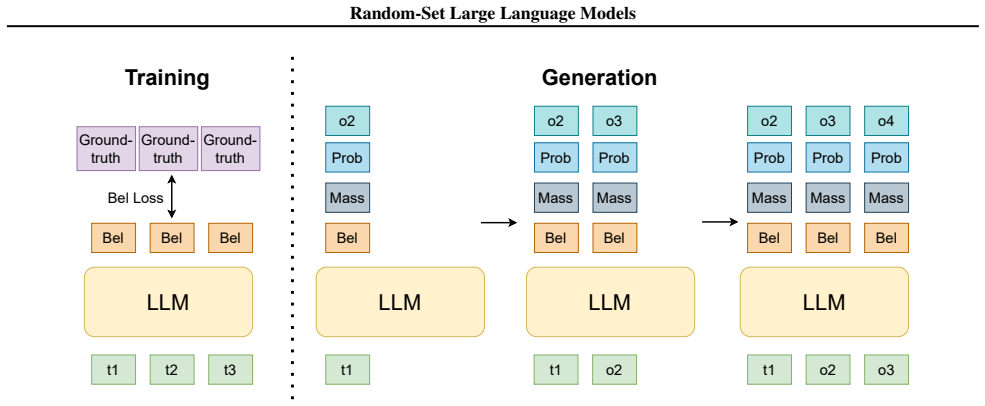
The load-bearing object is a belief function over a budget of focal sets: a non-additive assignment of mass to subsets of tokens, where the belief in a set is the sum of masses of its subsets, and the associated convex set of probability distributions is the credal set. The budget of focal sets is constructed by hierarchical clustering over token embeddings, then unioned with all singleton tokens, making the exponential power set tractable. The machinery also includes a recursive mass-computation formula used in the loss, a pignistic transformation that turns the belief function into a sampling distribution, and credal-set width as the measure of epistemic uncertainty.
What would settle it
Train an RS-LLM on a small vocabulary where the full power set is enumerable, compute the exact Möbius-inverse masses and exact credal sets, and compare them with the recursive budget approximation; if the approximate pignistic probabilities or credal widths differ materially, or if many predicted masses are negative and must be zeroed out by post-processing, the central uncertainty claims are not supported.
Extended reading notes
Core claim
The central claim is that replacing the standard softmax next-token distribution with a predicted finite random set—a belief function over a curated budget of token subsets—improves both answer quality and the model's ability to express epistemic uncertainty. The belief function is trained with a binary cross-entropy loss over belief values plus regularization terms encouraging non-negative masses that sum to one. At generation time, the pignistic probability (the center of mass of the associated credal set) is used to sample the next token, while the size of the credal set, measured by the upper-minus-lower probability bound on the most likely token, acts as a second-level uncertainty estimate. The authors report that RS-LLMs outperform standard LLMs on both CoQA and OBQA across Llama2-7b, Mistral-7b, and Phi-2, and that credal width provides a usable hallucination-detection signal when the model is given incorrect context.
Load-bearing premise
The whole result rests on the assumption that the approximate formula used to convert the model's set-belief scores into mass values, which only uses the limited dictionary of token groups, still yields a mathematically valid belief function; if it does not, the pignistic probability and credal-width uncertainty signals built on it are not well-defined.
Editorial extensions
If this is right
- Any autoregressive LLM can be converted into an RS-LLM by redefining the final layer; the rest of the architecture, including LoRA-based fine-tuning, stays intact.
- Uncertainty and hallucination signals are obtained from a single forward pass, without sampling multiple continuations or maintaining an ensemble.
- Credal width separates correct from incorrect predictions and increases when the context is wrong, giving a direct, trainable hallucination detector.
- The hierarchical-clustering budget makes belief prediction feasible at vocabulary scales of 32K to 51K tokens, with an ablation showing that a medium budget works best.
- The same recipe extends beyond question answering: on the XSum summarization task, RS-Mistral achieved higher cosine similarity than standard Mistral.
Reading between the lines
- The accuracy gains may partly come from the implicit label smoothing and structured regularization induced by training on group memberships; a direct comparison against a label-smoothing baseline would say how much of the improvement is due specifically to the belief-function semantics.
- Because credal width is computed only over the chosen focal-set budget, uncertainty hidden inside larger clusters remains invisible; a testable extension would adapt the budget dynamically, adding clusters where the model is least confident.
- The belief-function representation could be combined with semantic-level uncertainty: instead of measuring width over token groups, one could measure credal width over paraphrased answer sets, which may yield an even stronger hallucination signal.
- The paper fixes the number of focal sets K by hand and finds that both too-small and too-large budgets hurt; an automatic criterion based on cluster overlap or validation uncertainty could remove this hyperparameter and likely improve robustness.
Signed reviews
Editorial analysis
A structured set of objections, weighed in public.
Referee Report
Summary. The paper proposes Random-Set Large Language Models (RS-LLMs), which replace the standard softmax next-token distribution with a belief function defined on a budget of focal sets: the singletons of the vocabulary plus K clusters obtained by hierarchical clustering of token embeddings. The model is trained with a binary cross-entropy loss on belief values plus two mass-regularization terms, and at generation time the predicted belief vector is converted into a mass function via a recursive subtraction (Eq. 11), then into a pignistic probability for token sampling. The authors also propose pignistic entropy and the width of the associated credal set as uncertainty measures, and apply them to hallucination detection. Experiments on CoQA and OBQA with Llama2-7b, Mistral-7b and Phi-2 report that RS-LLMs outperform standard fine-tuned models in accuracy and cosine similarity, and that credal width separates correct from incorrect responses.
Significance. If the claims hold, the paper would offer a single-model, fine-tuning-only method for extracting epistemic uncertainty and hallucination signals from LLMs, which is currently of high interest. The budgeting scheme (hierarchical clustering) is a practical contribution for scaling random-set output layers to large vocabularies, and the use of credal-set width as an uncertainty measure is conceptually appealing. The paper also makes an explicit empirical claim—accuracy improvements over standard fine-tuning on two QA benchmarks across three base architectures—which, if verified with proper statistics, would be a useful result. However, the significance is contingent on the mathematical validity of the predicted belief functions and on the statistical reliability of the reported gains; both need substantial strengthening.
major comments (4)
- [Sec. 4.3, Eq. (11)] The recursive mass computation over the budget O, which is not closed under subsets, does not produce the Möbius inverse of the predicted belief function. For a focal set A, the sum over B⊂A includes only sets present in O, so the masses of all missing proper subsets are silently absorbed into m(A) or produce negative masses. The subsequent post-processing (clipping negatives and adding a universal set) changes the belief values, so the loss L_BCE in Eq. (8) no longer describes the deployed model. Consequently, the predicted object is not a genuine belief function, the credal set in Eq. (6) is not the convex set whose center of mass is the pignistic probability of Eq. (7), and the claim in Sec. 4.4 that BetP(t) lies within [P(t), P(t)] is not guaranteed. This invalidates the pignistic entropy (Eq. 13) and credal width (Eq. 14) as measures of epistemic uncertainty, and therefore undermines the hallucination detection claims in Sec. 5.3 and Fig. 5. The footnote about improper belief functions used in the literature does not rescue these claims, because the quantitative uncertainty interpretation relies on genuine credal-set semantics.
- [Sec. 5.1, Table 1] The central empirical claim that RS-LLMs 'clearly outperform' standard LLMs rests on a single run over a 500-sample test set, with no error bars, significance tests, or multiple seeds. The CoQA cosine-similarity differences are small (0.69 vs 0.71, 0.67 vs 0.72, 0.72 vs 0.73) and may lie within run-to-run variation, especially since the underlying model checkpoints are not specified. The authors should report confidence intervals (e.g., bootstrap over the test set) or results over several seeds, and apply a significance test (e.g., McNemar for OBQA accuracy) to support the accuracy claims.
- [Sec. 5.3, Table 2 and Fig. 5f] The hallucination detection evidence is weak. For OBQA, the credal width under correct vs incorrect context is 0.00±0.04 vs 0.02±0.08, which is negligible in magnitude and likely not statistically significant; the histograms in Fig. 5f appear to overlap heavily. The statement that 'both models exhibit good separability' is not supported by these numbers. In addition, randomly replacing the question or answer choices is not a standard hallucination evaluation; the authors should either use a recognized hallucination benchmark or report a proper detection metric such as AUROC, and they should clarify what notion of hallucination this setup targets.
- [Sec. 4.3, Eq. (8) and Eq. (11)] The loss L_BCE trains each belief value Bel(A) independently, with no constraint enforcing monotonicity (A⊆C ⇒ Bel(A) ≤ Bel(C)). Even if the budget were subset-closed, the predicted vector would not generally be a belief function, so the mass regularization terms (Eqs. 9-10) and post-processing are essential but ad hoc. The trained objective therefore does not describe the deployed post-processed model. The authors should either reparameterize the output to guarantee a valid mass function, or add a projection step that is part of the training objective, so that the loss reflects the actual predictor.
minor comments (5)
- [Eq. (11)] The equation should read m(A) = Bel(A) - Σ_{B⊂A} m(B), not m(A). The current typesetting appears to contain a typo.
- [Abstract and Sec. 1] The abstract says 'high-quality tests' and the introduction says 'allows so efficiently'; both are likely typos for 'texts' and 'allows this efficiently', respectively.
- [Sec. 4.1] The text says a vanilla RS-LLM would have '2N outputs' where N appears to be the vocabulary size; this should be 2^N (or 2^T) outputs, and the notation for the power set P(T) should be defined consistently.
- [Sec. 5.2] The phrase 'RS-LLMs clearly outperform the standard LLMs model on both datasets across all datasets' is confusing; the main table reports only CoQA and OBQA, so 'all datasets' is an overstatement. Also, the text refers to 'both models' while three base models are evaluated.
- [Fig. 5] The subfigure captions contain inconsistent capitalization ('Standard LLama2' vs 'Random-set LLama2') and the OBQA entropy subfigures show no clear separation, which should at least be commented on in the text rather than described as 'no real trend' without discussion.
Circularity Check
No significant circularity: accuracy claims are benchmarked externally and uncertainty metrics are empirical validations of standard belief-function definitions.
full rationale
The paper's central accuracy claim (RS-LLMs outperform standard LLMs on CoQA/OBQA) is evaluated against external datasets and standard baselines; it does not follow by construction from the model definition. The conversion of predicted belief values to masses (Eq. 11) is an algebraic rearrangement of the belief-function definition, and its use over a restricted budget may be an approximation or validity issue, but it is not a circular step: the resulting masses are not fitted to the accuracy or hallucination targets. The pignistic transform and the claim that BetP lies in the credal interval are classical results (Shafer/Smets) invoked for support; while several citations are to the authors' own prior work (Cuzzolin; Manchingal et al.), those results are parameter-free mathematical facts rather than unverified premises whose conclusions are assumed. The uncertainty measures are validated against correctness and against deliberately corrupted contexts, giving the 'epistemic uncertainty' and 'hallucination detection' claims independent empirical content rather than defining them into existence. The acknowledged manual choice of K is a hyperparameter limitation, not circularity. No step in the derivation reduces a predicted quantity to a fitted input or to a self-citation chain.
Assumptions & free parameters
free parameters (2)
- K (number of non-singleton focal sets) =
8000
- alpha and beta (mass regularization weights) =
alpha = beta = 0.01
assumptions (4)
- domain assumption A belief function is equivalent to a convex credal set of probability distributions (Sec. 3, Eq. 6).
- ad hoc to paper Hierarchically clustered token embeddings produce focal sets that capture the model's likely confusions (Sec. 4.2).
- domain assumption Credal set width measures the extent of epistemic uncertainty (Sec. 4.4).
- ad hoc to paper The recursive mass formula m(A)=Bel(A)-sum_{B subset A} m(B) is well-defined and yields a valid mass function on a budget not closed under subsets (Eq. 11, Sec. 4.3).
invented entities (1)
-
Budget of focal token subsets produced by hierarchical clustering
Cite this review
Pith. "Pith review of Random-Set Large Language Models." pith.science (2026). https://pith.science/paper/PWFMKP57
@misc{pith2026250418085,
  author       = {Pith},
  title        = {Pith review of: Random-Set Large Language Models},
  year         = {2026},
  howpublished = {\url{https://pith.science/paper/PWFMKP57}},
  note         = {Machine review of arXiv:2504.18085}
}
read the original abstract
Large Language Models (LLMs) are known to produce very high-quality tests and responses to our queries. But how much can we trust this generated text? In this paper, we study the problem of uncertainty quantification in LLMs. We propose a novel Random-Set Large Language Model (RSLLM) approach which predicts finite random sets (belief functions) over the token space, rather than probability vectors as in classical LLMs. In order to allow so efficiently, we also present a methodology based on hierarchical clustering to extract and use a budget of "focal" subsets of tokens upon which the belief prediction is defined, rather than using all possible collections of tokens, making the method scalable yet effective. RS-LLMs encode the epistemic uncertainty induced in their generation process by the size and diversity of its training set via the size of the credal sets associated with the predicted belief functions. The proposed approach is evaluated on CoQA and OBQA datasets using Llama2-7b, Mistral-7b and Phi-2 models and is shown to outperform the standard model in both datasets in terms of correctness of answer while also showing potential in estimating the second level uncertainty in its predictions and providing the capability to detect when its hallucinating.
Figures


Figures from the paper (3 more)


Forward citations
Cited by 1 Pith paper
-
Epistemic Artificial Intelligence is Essential for Machine Learning Models to Truly 'Know When They Do Not Know'
Machine learning should use second-order uncertainty measures, such as credal sets and random sets, so models can explicitly represent ignorance and avoid overconfident predictions on unfamiliar data.
Reference graph
Works this paper leans on
-
[1]
write newline
" write newline "" before.all 'output.state := FUNCTION n.dashify 't := "" t empty not t #1 #1 substring "-" = t #1 #2 substring "--" = not "--" * t #2 global.max substring 't := t #1 #1 substring "-" = "-" * t #2 global.max substring 't := while if t #1 #1 substring * t #2 global.max substring 't := if while FUNCTION format.date year duplicate empty "emp...
-
[2]
https://www.sbert.net/
sentence-transformers. https://www.sbert.net/. Accessed: 31-01-2025
2025
-
[3]
L., Almeida, D., Altenschmidt, J., Altman, S., Anadkat, S., et al
Achiam, J., Adler, S., Agarwal, S., Ahmad, L., Akkaya, I., Aleman, F. L., Almeida, D., Altenschmidt, J., Altman, S., Anadkat, S., et al. Gpt-4 technical report. arXiv preprint arXiv:2303.08774, 2023
arXiv 2023
-
[4]
R., Bl \"o mer, J., Kuntze, D., and Sohler, C
Ackermann, M. R., Bl \"o mer, J., Kuntze, D., and Sohler, C. Analysis of agglomerative clustering. Algorithmica, 69: 0 184--215, 2014
2014
-
[5]
Anil, R., Dai, A. M., Firat, O., Johnson, M., Lepikhin, D., Passos, A., Shakeri, S., Taropa, E., Bailey, P., Chen, Z., et al. Palm 2 technical report. arXiv preprint arXiv:2305.10403, 2023
arXiv 2023
-
[6]
and Cuzzolin, F
Antonucci, A. and Cuzzolin, F. Credal sets approximation by lower probabilities: application to credal networks. In Computational Intelligence for Knowledge-Based Systems Design: 13th International Conference on Information Processing and Management of Uncertainty, IPMU 2010, Dortmund, Germany, June 28-July 2, 2010. Proceedings 13, pp.\ 716--725. Springer, 2010
2010
-
[7]
Training a helpful and harmless assistant with reinforcement learning from human feedback
Bai, Y., Jones, A., Ndousse, K., Askell, A., Chen, A., DasSarma, N., Drain, D., Fort, S., Ganguli, D., Henighan, T., et al. Training a helpful and harmless assistant with reinforcement learning from human feedback. arXiv preprint arXiv:2204.05862, 2022
arXiv 2022
-
[8]
Balabanov, O. and Linander, H. Uncertainty quantification in fine-tuned llms using lora ensembles. arXiv preprint arXiv:2402.12264, 2024
arXiv 2024
Show all 84 references
-
[9]
Benchmarking llm powered chatbots: methods and metrics
Banerjee, D., Singh, P., Avadhanam, A., and Srivastava, S. Benchmarking llm powered chatbots: methods and metrics. arXiv preprint arXiv:2308.04624, 2023
2023 arXiv
-
[10]
Weight uncertainty in neural network
Blundell, C., Cornebise, J., Kavukcuoglu, K., and Wierstra, D. Weight uncertainty in neural network. In International conference on machine learning, pp.\ 1613--1622. PMLR, 2015
2015
-
[11]
Bouckaert, R. R. Bayesian belief networks: from construction to inference. PhD thesis, 1995
1995
-
[12]
and Klir, G
Bronevich, A. and Klir, G. J. Axioms for uncertainty measures on belief functions and credal sets. In NAFIPS 2008-2008 Annual Meeting of the North American Fuzzy Information Processing Society, pp.\ 1--6. IEEE, 2008
2008
-
[13]
Credal learning theory
Caprio, M., Sultana, M., Elia, E., and Cuzzolin, F. Credal learning theory. arXiv preprint arXiv:2402.00957, 2024
2024 arXiv
-
[14]
Inside: Llms' internal states retain the power of hallucination detection
Chen, C., Liu, K., Chen, Z., Gu, Y., Wu, Y., Tao, M., Fu, Z., and Ye, J. Inside: Llms' internal states retain the power of hallucination detection. arXiv preprint arXiv:2402.03744, 2024
2024 arXiv
-
[15]
Training verifiers to solve math word problems
Cobbe, K., Kosaraju, V., Bavarian, M., Chen, M., Jun, H., Kaiser, L., Plappert, M., Tworek, J., Hilton, J., Nakano, R., et al. Training verifiers to solve math word problems. arXiv preprint arXiv:2110.14168, 2021
2021 arXiv
-
[16]
On the credal structure of consistent probabilities
Cuzzolin, F. On the credal structure of consistent probabilities. In European Workshop on Logics in Artificial Intelligence, pp.\ 126--139. Springer, 2008
2008
-
[17]
Complexes of outer consonant approximations
Cuzzolin, F. Complexes of outer consonant approximations. In Symbolic and Quantitative Approaches to Reasoning with Uncertainty: 10th European Conference, ECSQARU 2009, Verona, Italy, July 1-3, 2009. Proceedings 10, pp.\ 275--286. Springer, 2009
2009
-
[18]
Credal semantics of Bayesian transformations in terms of probability intervals
Cuzzolin, F. Credal semantics of Bayesian transformations in terms of probability intervals . IEEE Transactions on Systems, Man, and Cybernetics, Part B: Cybernetics, 40 0 (2): 0 421--432, 2010 a
2010
-
[19]
Geometric conditioning of belief functions
Cuzzolin, F. Geometric conditioning of belief functions. Proceedings of BELIEF, 10, 2010 b
2010
-
[20]
The geometry of consonant belief functions: simplicial complexes of necessity measures
Cuzzolin, F. The geometry of consonant belief functions: simplicial complexes of necessity measures. Fuzzy Sets and Systems, 161 0 (10): 0 1459--1479, 2010 c
2010
-
[21]
Three alternative combinatorial formulations of the theory of evidence
Cuzzolin, F. Three alternative combinatorial formulations of the theory of evidence. Intelligent Data Analysis, 14 0 (4): 0 439--464, 2010 d
2010
-
[22]
On consistent approximations of belief functions in the mass space
Cuzzolin, F. On consistent approximations of belief functions in the mass space. In European Conference on Symbolic and Quantitative Approaches to Reasoning and Uncertainty, pp.\ 287--298. Springer, 2011 a
2011
-
[23]
Geometric conditional belief functions in the belief space
Cuzzolin, F. Geometric conditional belief functions in the belief space. In Proceedings of the 7th International Symposium on Imprecise Probabilities and Their Applications (ISIPTA’11), 2011 b
2011
-
[24]
Lp consonant approximations of belief functions
Cuzzolin, F. Lp consonant approximations of belief functions. IEEE Transactions on Fuzzy Systems, 22 0 (2): 0 420--436, 2013
2013
-
[25]
Belief functions: theory and applications
Cuzzolin, F. Belief functions: theory and applications. Springer, 2014
2014
-
[26]
Generalised max entropy classifiers
Cuzzolin, F. Generalised max entropy classifiers. In Belief Functions: Theory and Applications: 5th International Conference, BELIEF 2018, Compi \`e gne, France, September 17-21, 2018, Proceedings 5 , pp.\ 39--47. Springer, 2018 a
2018
-
[27]
Visions of a generalized probability theory
Cuzzolin, F. Visions of a generalized probability theory. arXiv preprint arXiv:1810.10341, 2018 b
2018 arXiv
-
[28]
The Geometry of Uncertainty: The Geometry of Imprecise Probabilities
Cuzzolin, F. The Geometry of Uncertainty: The Geometry of Imprecise Probabilities. Artificial Intelligence: Foundations, Theory, and Algorithms. Springer International Publishing, 2020. ISBN 9783030631536. URL https://books.google.co.uk/books?id=jNQPEAAAQBAJ
2020
-
[29]
Reasoning with random sets: An agenda for the future
Cuzzolin, F. Reasoning with random sets: An agenda for the future. arXiv preprint arXiv:2401.09435, 2023
2023 arXiv
-
[30]
Uncertainty measures: A critical survey
Cuzzolin, F. Uncertainty measures: A critical survey. Information Fusion, pp.\ 102609, 2024
2024
-
[31]
and Frezza, R
Cuzzolin, F. and Frezza, R. Integrating feature spaces for object tracking. Proc. of MTNS2000 (21Y25 June 2000), 2000
2000
-
[32]
and Frezza, R
Cuzzolin, F. and Frezza, R. Geometric analysis of belief space and conditional subspaces. In ISIPTA, pp.\ 122--132, 2001
2001
-
[33]
Dempster, A. P. Upper and lower probabilities induced by a multivalued mapping. In Classic works of the Dempster-Shafer theory of belief functions , pp.\ 57--72. Springer, 2008
2008
-
[34]
Distributed combination of belief functions
Denoeux, T. Distributed combination of belief functions. Information Fusion, 65: 0 179--191, 2021
2021
-
[35]
Detecting hallucinations in large language models using semantic entropy
Farquhar, S., Kossen, J., Kuhn, L., and Gal, Y. Detecting hallucinations in large language models using semantic entropy. Nature, 630 0 (8017): 0 625--630, 2024
2024
-
[36]
and Ghahramani, Z
Gal, Y. and Ghahramani, Z. Dropout as a Bayesian approximation: Representing model uncertainty in deep learning. In International Conference on Machine Learning, pp.\ 1050--1059. PMLR, 2016
2016
-
[37]
C., Khan, S., Cuzzolin, F., and Lukasiewicz, T
Giunchiglia, E., Stoian, M. C., Khan, S., Cuzzolin, F., and Lukasiewicz, T. Road-r: The autonomous driving dataset with logical requirements. Machine Learning, 112 0 (9): 0 3261--3291, 2023
2023
-
[38]
Glushkova, T., Zerva, C., Rei, R., and Martins, A. F. Uncertainty-aware machine translation evaluation. arXiv preprint arXiv:2109.06352, 2021
2021 arXiv
-
[39]
and Cuzzolin, F
Gong, W. and Cuzzolin, F. A belief-theoretical approach to example-based pose estimation. IEEE Transactions on Fuzzy Systems, 26 0 (2): 0 598--611, 2017
2017
-
[40]
trlx: A framework for large scale reinforcement learning from human feedback
Havrilla, A., Zhuravinskyi, M., Phung, D., Tiwari, A., Tow, J., Biderman, S., Anthony, Q., and Castricato, L. trlx: A framework for large scale reinforcement learning from human feedback. In Proceedings of the 2023 Conference on Empirical Methods in Natural Language Processing...
2023
-
[41]
J., Shen, Y., Wallis, P., Allen-Zhu, Z., Li, Y., Wang, S., Wang, L., and Chen, W
Hu, E. J., Shen, Y., Wallis, P., Allen-Zhu, Z., Li, Y., Wang, S., Wang, L., and Chen, W. Lora: Low-rank adaptation of large language models. arXiv preprint arXiv:2106.09685, 2021
2021 arXiv
-
[42]
and Waegeman, W
H \"u llermeier, E. and Waegeman, W. Aleatoric and epistemic uncertainty in machine learning: An introduction to concepts and methods. Machine learning, 110 0 (3): 0 457--506, 2021
2021
-
[43]
Javaheripi, M., Bubeck, S., Abdin, M., Aneja, J., Bubeck, S., Mendes, C. C. T., Chen, W., Del Giorno, A., Eldan, R., Gopi, S., et al. Phi-2: The surprising power of small language models. Microsoft Research Blog, 1 0 (3): 0 3, 2023
2023
-
[44]
Q., Sablayrolles, A., Mensch, A., Bamford, C., Chaplot, D
Jiang, A. Q., Sablayrolles, A., Mensch, A., Bamford, C., Chaplot, D. S., de las Casas, D., Bressand, F., Lengyel, G., Lample, G., Saulnier, L., Lavaud, L. R., Lachaux, M.-A., Stock, P., Scao, T. L., Lavril, T., Wang, T., Lacroix, T., and Sayed, W. E. Mistral 7b, 2023. URL http...
2023 arXiv
-
[45]
Language models (mostly) know what they know
Kadavath, S., Conerly, T., Askell, A., Henighan, T., Drain, D., Perez, E., Schiefer, N., Hatfield-Dodds, Z., DasSarma, N., Tran-Johnson, E., et al. Language models (mostly) know what they know. arXiv preprint arXiv:2207.05221, 2022
2022 arXiv
-
[46]
and Gal, Y
Kendall, A. and Gal, Y. What uncertainties do we need in bayesian deep learning for computer vision? Advances in neural information processing systems, 30, 2017
2017
-
[47]
Kolmogorov, A. N. Three approaches to the quantitative definition of information. Problems of information transmission, 1 0 (1): 0 1--7, 1965
1965
-
[48]
Semantic uncertainty: Linguistic invariances for uncertainty estimation in natural language generation
Kuhn, L., Gal, Y., and Farquhar, S. Semantic uncertainty: Linguistic invariances for uncertainty estimation in natural language generation. arXiv preprint arXiv:2302.09664, 2023
2023 arXiv
-
[49]
The enterprise of knowledge: An essay on knowledge, credal probability, and chance
Levi, I. The enterprise of knowledge: An essay on knowledge, credal probability, and chance . The MIT Press, Cambridge, Massachusetts, 1980
1980
-
[50]
Solving quantitative reasoning problems with language models
Lewkowycz, A., Andreassen, A., Dohan, D., Dyer, E., Michalewski, H., Ramasesh, V., Slone, A., Anil, C., Schlag, I., Gutman-Solo, T., et al. Solving quantitative reasoning problems with language models. Advances in Neural Information Processing Systems, 35: 0 3843--3857, 2022
2022
-
[51]
Teaching models to express their uncertainty in words
Lin, S., Hilton, J., and Evans, O. Teaching models to express their uncertainty in words. arXiv preprint arXiv:2205.14334, 2022
2022 arXiv
-
[52]
K., Mubashar, M., Wang, K., Shariatmadar, K., and Cuzzolin, F
Manchingal, S. K., Mubashar, M., Wang, K., Shariatmadar, K., and Cuzzolin, F. Random-set convolutional neural network (RS-CNN) for epistemic deep learning. arXiv preprint arXiv:2307.05772, 2023
2023 arXiv
-
[53]
K., Mubashar, M., Wang, K., Shariatmadar, K., and Cuzzolin, F
Manchingal, S. K., Mubashar, M., Wang, K., Shariatmadar, K., and Cuzzolin, F. Random-set neural networks. In The Thirteenth International Conference on Learning Representations, 2025. URL https://openreview.net/forum?id=pdjkikvCch
2025
-
[54]
Random sets and integral geometry
Matheron, G. Random sets and integral geometry. Wiley Series in Probability and Mathematical Statistics, New York, 1975
1975
-
[55]
On faithfulness and factuality in abstractive summarization
Maynez, J., Narayan, S., Bohnet, B., and McDonald, R. On faithfulness and factuality in abstractive summarization. arXiv preprint arXiv:2005.00661, 2020
2005 arXiv
-
[56]
J., Szlam, A., Boureau, Y.-L., and Dinan, E
Mielke, S. J., Szlam, A., Boureau, Y.-L., and Dinan, E. Linguistic calibration through metacognition: aligning dialogue agent responses with expected correctness. arXiv preprint arXiv:2012.14983, 11, 2020
2012 arXiv
-
[57]
Can a suit of armor conduct electricity? a new dataset for open book question answering
Mihaylov, T., Clark, P., Khot, T., and Sabharwal, A. Can a suit of armor conduct electricity? a new dataset for open book question answering. In EMNLP, 2018
2018
-
[58]
Random sets and random functions
Molchanov, I. Random sets and random functions. Theory of Random Sets, pp.\ 451--552, 2017
2017
-
[59]
Molchanov, I. S. Theory of random sets, volume 19. Springer, 2005
2005
-
[60]
Modern hierarchical, agglomerative clustering algorithms
M \"u llner, D. Modern hierarchical, agglomerative clustering algorithms. arXiv preprint arXiv:1109.2378, 2011
2011 arXiv
-
[61]
B., and Lapata, M
Narayan, S., Cohen, S. B., and Lapata, M. Don't give me the details, just the summary! topic-aware convolutional neural networks for extreme summarization. arXiv preprint arXiv:1808.08745, 2018
2018 arXiv
-
[62]
Nguyen, H. T. On random sets and belief functions. Journal of Mathematical Analysis and Applications, 65: 0 531--542, 1978
1978
-
[63]
M., Van Roy, B., McAleese, N., Aslanides, J., and Irving, G
Osband, I., Asghari, S. M., Van Roy, B., McAleese, N., Aslanides, J., and Irving, G. Fine-tuning language models via epistemic neural networks. arXiv preprint arXiv:2211.01568, 2022
2022 arXiv
-
[64]
Softmax probabilities (mostly) predict large language model correctness on multiple-choice q&a
Plaut, B., Nguyen, K., and Trinh, T. Softmax probabilities (mostly) predict large language model correctness on multiple-choice q&a. arXiv preprint arXiv:2402.13213, 2024
2024 arXiv
-
[65]
Reddy, S., Chen, D., and Manning, C. D. C o QA : A conversational question answering challenge. Transactions of the Association for Computational Linguistics, 7: 0 249--266, 2019. doi:10.1162/tacl_a_00266. URL https://aclanthology.org/Q19-1016
2019 doi
-
[66]
E., Adi, Y., Liu, J., Sauvestre, R., Remez, T., et al
Roziere, B., Gehring, J., Gloeckle, F., Sootla, S., Gat, I., Tan, X. E., Adi, Y., Liu, J., Sauvestre, R., Remez, T., et al. Code llama: Open foundation models for code. arXiv preprint arXiv:2308.12950, 2023
2023 arXiv
-
[67]
Is the volume of a credal set a good measure for epistemic uncertainty? In Uncertainty in Artificial Intelligence, pp.\ 1795--1804
Sale, Y., Caprio, M., and H \"u llermeier, E. Is the volume of a credal set a good measure for epistemic uncertainty? In Uncertainty in Artificial Intelligence, pp.\ 1795--1804. PMLR, 2023
2023
-
[68]
A mathematical theory of evidence, volume 42
Shafer, G. A mathematical theory of evidence, volume 42. Princeton university press, 1976 a
1976
-
[69]
A theory of statistical evidence
Shafer, G. A theory of statistical evidence. In Harper, W. L. and Hooker, C. A. (eds.), Foundations of Probability Theory, Statistical Inference, and Statistical Theories of Science, volume 2, pp.\ 365--436. Reidel, Dordrecht, 1976 b
1976
-
[70]
Decision making in the tbm: the necessity of the pignistic transformation
Smets, P. Decision making in the tbm: the necessity of the pignistic transformation. International Journal of Approximate Reasoning, 38 0 (2): 0 133--147, 2005 a . ISSN 0888-613X. doi:https://doi.org/10.1016/j.ijar.2004.05.003. URL https://www.sciencedirect.com/science/article...
2005 doi
-
[71]
Decision making in the TBM: the necessity of the pignistic transformation
Smets, P. Decision making in the TBM: the necessity of the pignistic transformation . International Journal of Approximate Reasoning, 38 0 (2): 0 133--147, 2005 b
2005
-
[72]
and Kennes, R
Smets, P. and Kennes, R. The transferable belief model. Artificial intelligence, 66 0 (2): 0 191--234, 1994
1994
-
[73]
Llama 2: Open foundation and fine-tuned chat models
Touvron, H., Martin, L., Stone, K., Albert, P., Almahairi, A., Babaei, Y., Bashlykov, N., Batra, S., Bhargava, P., Bhosale, S., et al. Llama 2: Open foundation and fine-tuned chat models. arXiv preprint arXiv:2307.09288, 2023
2023 arXiv
-
[74]
Credal deep ensembles for uncertainty quantification
Wang, K., Cuzzolin, F., Shariatmadar, K., Moens, D., Hallez, H., et al. Credal deep ensembles for uncertainty quantification. Advances in Neural Information Processing Systems, 37: 0 79540--79572, 2024 a
2024
-
[75]
K., Cuzzolin, F., Moens, D., and Hallez, H
Wang, K., Shariatmadar, K., Manchingal, S. K., Cuzzolin, F., Moens, D., and Hallez, H. Creinns: Credal-set interval neural networks for uncertainty estimation in classification tasks. Neural Networks, pp.\ 107198, 2025
2025
-
[76]
Uncertainty estimation and reduction of pre-trained models for text regression
Wang, Y., Beck, D., Baldwin, T., and Verspoor, K. Uncertainty estimation and reduction of pre-trained models for text regression. Transactions of the Association for Computational Linguistics, 10: 0 680--696, 2022
2022
-
[77]
Blob: Bayesian low-rank adaptation by backpropagation for large language models
Wang, Y., Shi, H., Han, L., Metaxas, D., and Wang, H. Blob: Bayesian low-rank adaptation by backpropagation for large language models. arXiv preprint arXiv:2406.11675, 2024 b
2024 arXiv
-
[78]
V., Zhou, D., et al
Wei, J., Wang, X., Schuurmans, D., Bosma, M., Xia, F., Chi, E., Le, Q. V., Zhou, D., et al. Chain-of-thought prompting elicits reasoning in large language models. Advances in neural information processing systems, 35: 0 24824--24837, 2022
2022
-
[79]
Williams, R. J. and Zipser, D. A learning algorithm for continually running fully recurrent neural networks. Neural computation, 1 0 (2): 0 270--280, 1989
1989
-
[80]
A brief overview of chatgpt: The history, status quo and potential future development
Wu, T., He, S., Liu, J., Sun, S., Liu, K., Han, Q.-L., and Tang, Y. A brief overview of chatgpt: The history, status quo and potential future development. IEEE/CAA Journal of Automatica Sinica, 10 0 (5): 0 1122--1136, 2023
2023
-
[81]
Yager, R. R. Entropy and specificity in a mathematical theory of evidence. Classic works of the Dempster-Shafer theory of belief functions, pp.\ 291--310, 2008
2008
-
[82]
X., Robeyns, M., Wang, X., and Aitchison, L
Yang, A. X., Robeyns, M., Wang, X., and Aitchison, L. Bayesian low-rank adaptation for large language models. arXiv preprint arXiv:2308.13111, 2023
2023 arXiv
-
[83]
H., Kolehmainen, J., Shivakumar, P
Yu, Y., Yang, C.-H. H., Kolehmainen, J., Shivakumar, P. G., Gu, Y., Ren, S. R. R., Luo, Q., Gourav, A., Chen, I.-F., Liu, Y.-C., et al. Low-rank adaptation of large language model rescoring for parameter-efficient speech recognition. In 2023 IEEE Automatic Speech Recognition a...
2023
-
[84]
and Fagiuoli, E
Zaffalon, M. and Fagiuoli, E. Tree-based credal networks for classification. Reliable computing, 9 0 (6): 0 487--509, 2003
2003
Reviewed August 16, 2026 · model on record in the stance chip above.
Discussion (0). Continue with ORCID to comment.