REVIEW 3 major objections 4 minor 101 references
Towards a theory of baryon resonances
T0 review · 3 major / 4 minor · reviewed 2026-08-14 · deepseek-v4-flash
Pith's one-line read The paper claims that a resonance is an S-matrix pole and that chiral-symmetric analysis finds two poles in the $D_0^\ast(2400)$ region.
desk verdict A competent and readable expert review of resonance methods, but the PDG-change call on D*0(2400) rests on a single model-dependent continuation and would need stability tests to carry that weight. read the letter →
The pith
A machine-rendered reading of the paper's core claim, the machinery that carries it, and where it could break.
The reading
What carries the argument
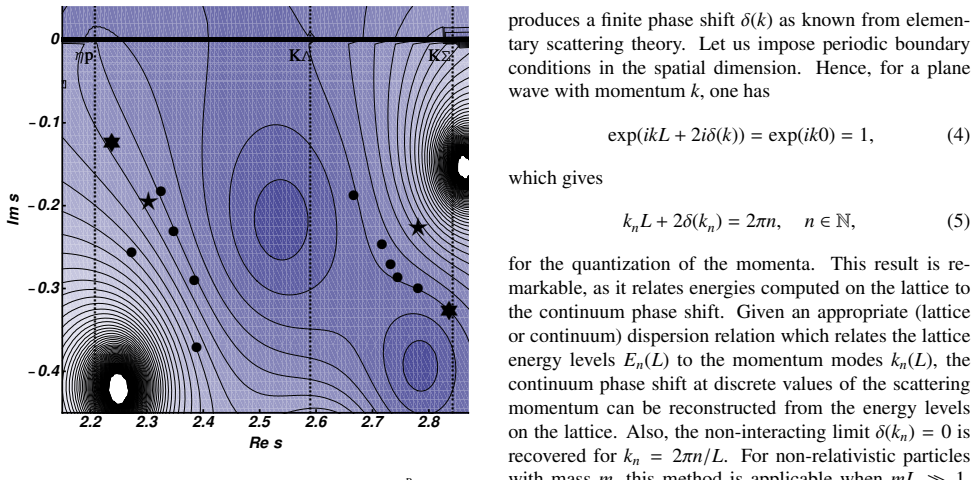
The load-bearing object is the S-matrix pole on an unphysical Riemann sheet, located by analytic continuation of the scattering amplitude. The operational machinery is unitarized chiral perturbation theory (UCHPT), whose $T$-matrix satisfies $T^{-1}=V^{-1}-G$, with $V$ the chiral potential and $G$ the two-point loop function; chiral symmetry fixes which channels couple and how the potential behaves as masses move. In finite volume, $G$ is replaced by a modified loop function $\tilde G(s,L)$ that encodes the quantization of momenta, so lattice energy levels can be postdicted and poles found in the complex plane. For baryon widths, the talk uses the complex-mass scheme at two loops, treating unstable-particle masses as complex pole positions, with a power counting in which $m_R-m_N\sim\epsilon$, $m_R-m_\Delta\sim\epsilon^2$, and $M_\pi\sim\epsilon^2$.
What would settle it
Two concrete tests: an SU(3)-symmetric lattice calculation with $M_\phi>575$ MeV should show the sextet pole becoming a bound state, and a direct lattice determination of the Roper couplings $g_R$ and $h_R$ should find them consistent with $g_A$ and $h_A$; failure of either would undercut the corresponding claim.
Extended reading notes
Core claim
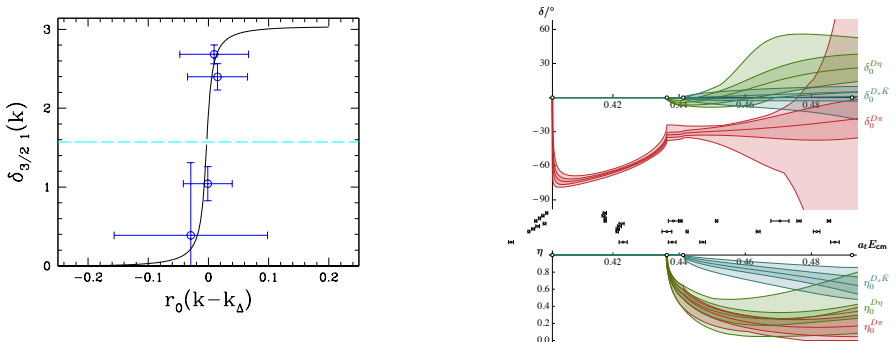
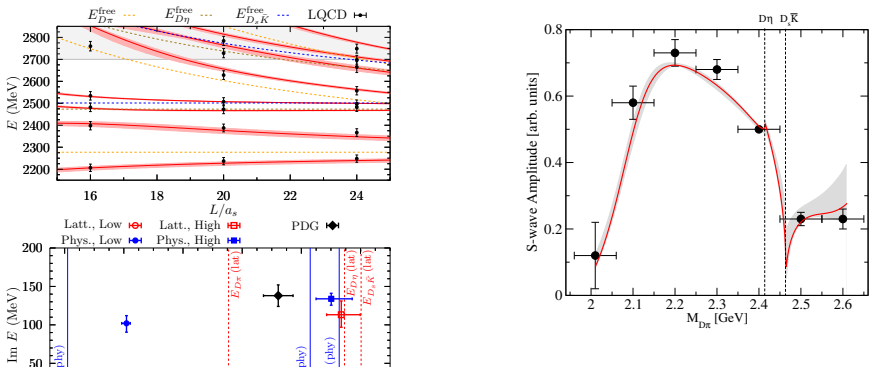
The paper's central claim is that every resonance is an S-matrix pole on an unphysical Riemann sheet, so resonance parameters are meaningless unless extracted from a pole search in the complex energy plane. Applying that rule to the coupled channels $D\pi$, $D\eta$, $D_s\bar K$ with isospin $I=1/2$, the talk reports that a chiral-symmetric reanalysis of existing lattice data yields two poles in the $D_0^\ast(2400)$ region, at about $2105$ MeV and $2451$ MeV, with the lower pole falling below the $D_{s0}^\ast(2317)$; this dissolves the puzzle that the charm-strange state is lighter than its charm-light counterpart. The two poles follow from the SU(3) decomposition $\bar 3\otimes 8 = \bar 3 \oplus 6 \oplus 15$, where the anti-triplet and sextet are attractive. The same machinery predicts two-pole structures for the $D_1$, $B_0^\ast$, and $B_1$ states, and the talk states that the time is ripe to change the listings for the $D_0^\ast$ and $D_1$ accordingly.
Load-bearing premise
The Roper width prediction assumes the Roper–pion and $\Delta$–Roper–pion couplings equal the nucleon axial couplings (the maximal-mixing assumption); if they differ, the quoted $\Gamma(R\to N\pi\pi)$ shifts and the agreement with the measured value is not guaranteed.
Editorial extensions
If this is right
- If the two-pole claim is right, the standard listings should show two states for $D_0^\ast$ and $D_1$, with the lower $D_0^\ast$ pole below $D_{s0}^\ast(2317)$.
- The predicted two-pole structures for $B_0^\ast$ and $B_1$ give a direct test: future measurements should see a near-threshold pole plus a higher pole, with cusp structures at the $D\eta$ and $D_s\bar K$ thresholds.
- A lattice calculation with SU(3)-symmetric quark masses and $M_\phi>575$ MeV should turn the sextet pole into a bound state, testing the group-theoretic origin of the double pole.
- The two-loop widths for $\Delta(1232)$ and the Roper, obtained without model assumptions, tie the hadron spectrum to chiral EFT parameters that lattice QCD can determine.
Reading between the lines
- Extension: if the two-pole pattern is as generic as the talk suggests, single-entry listings in other heavy-light channels may also conceal pole pairs; re-running the same chiral-symmetric pole search on those channels would reveal them.
- Extension: the talk's insistence on complex-plane poles implies a methodological standard: lattice analyses should report pole locations, not just phase shifts, and should use chiral-symmetric extrapolations when moving below the real axis.
- Extension: the Roper width prediction's dependence on maximal mixing suggests a concrete lattice program: determine $g_R$ and $h_R$ directly; if they deviate from $g_A$ and $h_A$, the $\pi\pi$ width would likely move outside the current error bars.
- Extension: the same finite-volume UCHPT machinery could be applied to open-charm baryons, where similar threshold-coupled channels may show analogous two-pole structures.
Signed reviews
Editorial analysis
A structured set of objections, weighed in public.
Referee Report
Summary. This manuscript, written as a talk summary, argues that a systematic and model-independent theory of hadron resonances must be built on lattice QCD and effective field theories, with resonances defined as S-matrix poles on unphysical Riemann sheets. It reviews the Luescher formalism for finite-volume spectra, its extension to coupled channels via unitarized chiral perturbation theory (UCHPT), and uses these tools to present a two-pole structure for the D*0(2400) from a re-analysis of Hadron Spectrum Collaboration lattice data, supported by LHCb angular-moment data. The later sections discuss hadroproduction of molecular states such as the X(3872), the calculation of the Delta(1232) and Roper N*(1440) widths in the complex-mass scheme of baryon chiral perturbation theory, and ambiguities in isolating 'pion cloud' effects. The paper concludes with take-home lessons emphasizing pole-structure analysis, chiral-symmetry constraints on extrapolations, and the role of hadronic molecules.
Significance. If the claims hold, the paper would strengthen the case that finite-volume lattice data, when continued to the complex plane with chiral-symmetric amplitudes, reveal a two-sheet structure for heavy-light scalar/axial mesons that should be reflected in the PDG listings. The presentation has real virtues: it states a crisp and widely accepted definition of resonances, emphasizes the necessity of coupled-channel analyses, and provides concrete falsifiable tests, notably the SU(3)-limit sextet bound state for M_phi > 575 MeV and the confrontation with LHCb angular-moment data. At the same time, the strongest quantitative claims are not accompanied in this manuscript by the stability and sensitivity analyses needed to make them archival-level results; they are summaries of already-published work. The paper therefore serves well as an expert overview, but its evidence base for the PDG recommendation is thinner than the rhetoric.
major comments (3)
- [Sec. 4, Fig. 6 and Table 1] The assertion that 'time is ripe to change these entries in the PDG' for the D*0 and D1 relies on a second pole near 2451 MeV that arises from a single UCHPT continuation of the HSC lattice levels at M_pi ~ 390 MeV. The manuscript does not demonstrate that this pole is stable under variations of the subtraction constant a(mu) in G(s), under inclusion of N2LO chiral corrections to V(s), or under alternative unitarization prescriptions. Since the HSC's own eleven K-matrix parametrizations found only one S-wave pole (Sec. 4), this second pole is a model-dependent outcome. To support the PDG recommendation, please provide a stability analysis of the pole trajectory, or clearly soften the claim to a scenario that requires further checks.
- [Sec. 6.2, Eqs. (29)-(30)] The prediction for the Roper two-pion width uses g_R = g_A and h_R = h_A, the 'maximal mixing assumption', and the paper itself acknowledges that improved determinations of g_R and h_R are needed. Equation (29) contains terms quadratic and quartic in these couplings, so deviations of order 10-20% from g_A and h_A can shift the central value by an amount comparable to the quoted LEC and higher-order uncertainties. The claim that Eq. (30) is consistent with the PDG value of (67 +/- 10) MeV is thus contingent on an untested assumption. Please quantify the sensitivity by varying g_R and h_R over a physically reasonable range, or present the result explicitly as conditional on maximal mixing.
- [Sec. 4, LEC fitting and data overlap] The LECs h_2,...,h_5 are stated to be 'obtained from a fit to lattice data' in Ref. [32], and the same UCHPT framework is then used to postdict the HSC finite-volume levels (upper panel of Fig. 6) and to extract the poles. The manuscript does not state whether the lattice data used to fix the LECs are independent of the HSC data set [24] being re-analyzed. If there is overlap, the agreement in the upper panel is a fit rather than a postdiction, and the poles inherit the fit's assumptions. Please clarify the data sets and, if they are independent, state that explicitly; if they are not, the pole extraction should be reframed as an interpolation within a single framework.
minor comments (4)
- [References] Reference [85] is missing a closing parenthesis in the year: it reads 'Phys. Lett. B 760, 736 (2016.'
- [Sec. 2] The phrase 'with very few exception of well-isolated' should be 'with very few exceptions'.
- [Table 2] The table header 'sigma(pp/bar-p) -> X(3872))' contains an unmatched parenthesis.
- [Sec. 6.1, Eq. (23)] Equation (23) is quoted without an uncertainty estimate, yet Fig. 13 uses it to draw a quantitative correlation band; please either provide the uncertainty or explicitly refer to the error analysis in the original publication.
Circularity Check
No significant circularity: the D*0 two-pole and Roper width claims are predictions from fixed inputs, not refits of the target observables.
full rationale
The paper does not exhibit any derivation that reduces by construction to its own inputs. The D*0 two-pole claim is based on finite-volume UCHPT (Eqs. 9-11) with LECs fixed in Ref. [32] from lattice channels, after which the HSC energy levels of Ref. [24] are postdicted with no new parameters and the poles are located by analytic continuation. Although Refs. [33] and [39] are from the same collaboration, the result is independently testable: the higher pole is checked against LHCb angular moments, a lattice test is proposed (sextet pole becoming a bound state for Mphi > 575 MeV), and Table 1 predicts B*0 and B1 states, so the self-citations carry external falsifiability rather than circular force. The Roper width in Sec. 6.2 is likewise not a disguised fit: g_piNR is fixed from the PDG one-pion width, gR=gA and hR=hA are adopted under the explicitly named maximal mixing assumption, and the resulting Gamma(R -> N pi pi) is a genuinely different observable not used in any fit. The paper even states that improved determinations of gR and hR are needed, which is a transparent limitation rather than a circular step. The Delta-width parameter reduction of Eq. (22) is renormalization-group content, and the resulting correlation is compared to an independent analysis of pion-nucleon scattering. No self-definitional identification, fitted-input-as-prediction, uniqueness-theorem importation, or ansatz-smuggling-by-citation is present; the proceedings-level self-citations are normal and non-load-bearing in the circularity sense.
Assumptions & free parameters
free parameters (6)
- gπNR (Roper-nucleon-pion coupling) =
0.47 ± 0.04
- g_R (Roper-pion coupling) =
set equal to g_A = 1.27
- h_R (Delta-Roper-pion coupling) =
set equal to h_A = 1.42 ± 0.02
- h1 (heavy-light chiral LEC) =
0.42
- h2, h3, h4, h5 (heavy-light chiral LECs) =
from fit to lattice data (Ref [32])
- cutoff Λ for X(3872) hadroproduction =
range [0.5, 1.0] GeV
assumptions (7)
- domain assumption SU(3) chiral symmetry breaking pattern with eight pseudo-Goldstone bosons and spontaneous symmetry breaking.
- domain assumption Unitarized CHPT T-matrix form T^{-1} = V^{-1} - G (Eq. 9) is a valid resummation of the chiral potential.
- domain assumption The complex-mass scheme preserves symmetry and unitarity order-by-order when applied to unstable particles.
- ad hoc to paper The chiral power counting near the Roper pole: m_R-m_N~ε, m_R-m_Δ~ε^2, m_Δ-m_N~ε^2, M_π~ε^2 (Eq. 26).
- ad hoc to paper Maximal mixing assumption g_R = g_A and h_R = h_A.
- domain assumption The deuteron and X(3872) share the same range of forces, R ~ 300 MeV (two-pion exchange).
- domain assumption The 3bar and 6 channels in the SU(3) decomposition 3bar⊗8 = 3bar ⊕ 6 ⊕ 15 are attractive, leading to two zero-width poles.
Cite this review
Pith. "Pith review of Towards a theory of baryon resonances." pith.science (2026). https://pith.science/paper/PWQYJLET
@misc{pith2026190806706,
  author       = {Pith},
  title        = {Pith review of: Towards a theory of baryon resonances},
  year         = {2026},
  howpublished = {\url{https://pith.science/paper/PWQYJLET}},
  note         = {Machine review of arXiv:1908.06706}
}
read the original abstract
In this talk, I discuss methods that allow for a systematic and model-independent calculation of the hadron spectrum. These are lattice QCD and/or its corresponding Effective Field Theories. Assorted results are shown and I take the opportunity to discuss some misconceptions often found in the literature.
Figures


Figures from the paper (6 more)



Reference graph
Works this paper leans on
- [32]
- [24]
-
[1]
R. G. Moorhouse, quote from the 1960ties
-
[2]
F. K. Guo et al., Rev. Mod. Phys. 90, 015004 (2018)
2018
-
[3]
P. C. Bruns et al., Phys. Lett. B 697, 254 (2011)
2011
-
[4]
J. A. Oller et al., Phys. Lett. B 500, 263 (2001)
2001
-
[5]
Cieplý et al., Nucl
A. Cieplý et al., Nucl. Phys. A 954, 17 (2016)
2016
-
[6]
Lüscher, Commun
M. Lüscher, Commun. Math. Phys. 105, 153 (1986)
1986
Show all 101 references
-
[7]
U. J. Wiese, Nucl. Phys. Proc. Suppl. 9, 609 (1989)
1989
-
[8]
Rummukainen et al
K. Rummukainen et al. , Nucl. Phys. B 450, 397 (1995)
1995
-
[9]
Bonn-Jülich-QCDSF collaboration, unpublished (2010)
2010
-
[10]
Morningstar, these proceedings
C. Morningstar, these proceedings
-
[11]
Petschlies, these proceedings
M. Petschlies, these proceedings
-
[12]
C. B. Lang et al., Phys. Rev. D 87, 054502 (2013)
2013
-
[13]
Verduciet al., PoS LATTICE 2014, 121 (2014)
V . Verduciet al., PoS LATTICE 2014, 121 (2014)
2014
-
[14]
Leskovec et al., Few Body Syst
L. Leskovec et al., Few Body Syst. 59, 95 (2018)
2018
- [15]
-
[16]
He et al., JHEP 0507, 011 (2005)
S. He et al., JHEP 0507, 011 (2005)
2005
-
[17]
Lage et al., Phys
M. Lage et al., Phys. Lett. B 681, 439 (2009)
2009
-
[18]
Bernardet al., JHEP 1101, 019 (2011)
V . Bernardet al., JHEP 1101, 019 (2011)
2011
-
[19]
R. A. Brice ˜no et al., Phys. Rev. D88, 094507 (2013)
2013
-
[20]
R. A. Brice ˜no et al., Phys. Rev. D88, 034502 (2013)
2013
-
[21]
Döring et al., Eur
M. Döring et al., Eur. Phys. J. A 47, 139 (2011)
2011
-
[22]
Döring et al., Eur
M. Döring et al., Eur. Phys. J. A 48, 114 (2012)
2012
-
[23]
R. A. Brice ˜no et al., Phys. Rev. D95, 074510 (2017)
2017
-
[25]
see http://pdg.lbl.gov/
-
[26]
J. M. M. Hall et al., Phys. Rev. Lett. 114, 132002 (2015)
2015
-
[27]
Molina et al
R. Molina et al. , Phys. Rev. D 94, 056010 (2016) Addendum: [Phys. Rev. D 94, 079901 (2016)]
2016
-
[28]
Kaiser et al., Nucl
N. Kaiser et al., Nucl. Phys. A 594, 325 (1995)
1995
-
[29]
Oset et al., Nucl
E. Oset et al., Nucl. Phys. A 635, 99 (1998)
1998
-
[30]
M. F. M. Lutz et al., Nucl. Phys. A 700, 193 (2002)
2002
-
[31]
F. K. Guo et al., Phys. Lett. B 666, 251 (2008)
2008
-
[33]
Albaladejo et al., Phys
M. Albaladejo et al., Phys. Lett. B 767, 465 (2017)
2017
-
[34]
Jido et al., Nucl
D. Jido et al., Nucl. Phys. A 725, 181 (2003)
2003
-
[35]
E. E. Kolomeitsev et al. , Phys. Lett. B 582, 39 (2004)
2004
-
[36]
F. K. Guo et al., Phys. Lett. B 641, 278 (2006)
2006
-
[37]
F. K. Guo et al., Eur. Phys. J. A 40, 171 (2009)
2009
-
[38]
Z. H. Guo et al., Phys. Rev. D 92, 094008 (2015)
2015
-
[39]
M. L. Du et al., Phys. Rev. D 98, 094018 (2018)
2018
-
[40]
Aaij et al
R. Aaij et al. [LHCb Collaboration], Phys. Rev. D 92, 012012 (2015)
2015
-
[41]
Aaij et al
R. Aaij et al. [LHCb Collaboration], Phys. Rev. D 91, 092002 (2015) Erratum: [Phys. Rev. D 93, 119901 (2016)]
2015
-
[42]
Aaij et al
R. Aaij et al. [LHCb Collaboration], Phys. Rev. D 94, 072001 (2016)
2016
-
[43]
M. L. Du et al., Phys. Rev. D 99, 114002 (2019)
2019
-
[44]
Weinberg, Phys
S. Weinberg, Phys. Rev. 137, B672 (1965)
1965
-
[45]
Morgan et al., Phys
D. Morgan et al., Phys. Lett. B 258, 444 (1991)
1991
-
[46]
N. A. Tornqvist, Phys. Rev. D 51, 5312 (1995)
1995
-
[47]
Baruet al., Phys
V . Baruet al., Phys. Lett. B 586, 53 (2004)
2004
-
[48]
Braaten et al., Phys
E. Braaten et al., Phys. Rev. D 76, 094028 (2007)
2007
-
[49]
Aceti et al., Phys
F. Aceti et al., Phys. Rev. D 86, 014012 (2012)
2012
-
[50]
Z. H. Guo et al., Phys. Rev. D 93, 096001 (2016)
2016
-
[51]
Mai, these proceedings
M. Mai, these proceedings
-
[52]
Oset, these proceedings
E. Oset, these proceedings
-
[53]
Aaij et al
R. Aaij et al. [LHCb Collaboration], Phys. Rev. Lett. 115 072001 (2015)
2015
-
[54]
Aaij et al
R. Aaij et al. [LHCb Collaboration], Phys. Rev. Lett. 122, 222001 (2019)
2019
-
[55]
J. J. Wu et al., Phys. Rev. Lett. 105, 232001 (2010)
2010
-
[56]
Chen et al., Phys
R. Chen et al., Phys. Rev. Lett. 115 132002 (2015)
2015
-
[57]
T. J. Burns, Eur. Phys. J. A 51, 152 (2015)
2015
-
[58]
Roca et al., Phys
L. Roca et al., Phys. Rev. D 92, 094003 (2015)
2015
-
[59]
Chen et al., Phys
R. Chen et al., Phys. Rev. D 100, 011502 (2019)
2019
-
[60]
F. K. Guo et al., Phys. Rev. D 99 091501 (2019)
2019
-
[61]
T. J. Burns et al., arXiv:1908.03528 [hep-ph] (2019)
2019 arXiv
-
[62]
Bignamini et al
C. Bignamini et al. , Phys. Rev. Lett. 103, 162001 (2009)
2009
-
[63]
Albaladejo et al
M. Albaladejo et al. , Chin. Phys. C 41, 121001 (2017)
2017
-
[64]
Artoisenet et al., Phys
P. Artoisenet et al., Phys. Rev. D 81, 114018 (2010)
2010
-
[65]
F. K. Guo et al. , Commun. Theor. Phys. 61, 354 (2014)
2014
-
[66]
F. K. Guo et al., Eur. Phys. J. C 74, 3063 (2014)
2014
-
[67]
F. K. Guo et al., Phys. Rev. D 88, 054007 (2013)
2013
-
[68]
F. K. Guo et al., JHEP 1405, 138 (2014)
2014
-
[69]
Bauer [CDF Collaboration], Int
G. Bauer [CDF Collaboration], Int. J. Mod. Phys. A 20, 3765 (2005)
2005
-
[70]
Chatrchyan et al
S. Chatrchyan et al. [CMS Collaboration], JHEP 1304, 154 (2013)
2013
-
[71]
Fleming et al., Phys
S. Fleming et al., Phys. Rev. D 76, 034006 (2007)
2007
-
[72]
P. F. Bedaque et al., Ann. Rev. Nucl. Part. Sci. 52, 339 (2002)
2002
-
[73]
D. L. Canham et al., Phys. Rev. D80 014009 (2009)
2009
-
[74]
Z0 Physics
R. G. Stuart, in “Z0 Physics”, ed. J. Tran Thanh Van (Editions Frontieres, Gif-sur-Yvette, 1990), p. 41
1990
-
[75]
Denner et al., Nucl
A. Denner et al., Nucl. Phys. B 560, 33 (1999)
1999
-
[76]
Djukanovic et al., Phys
D. Djukanovic et al., Phys. Lett. B 680, 235 (2009)
2009
-
[77]
Denner et al., Nucl
A. Denner et al., Nucl. Phys. Proc. Suppl. 160, 22 (2006)
2006
-
[78]
Beenakker et al., Nucl
W. Beenakker et al., Nucl. Phys. B 338, 349 (1990)
1990
-
[79]
Gegelia et al., Phys
J. Gegelia et al., Phys. Lett. B 763, 1 (2016)
2016
-
[80]
H. B. Tang et al., Phys. Lett. B 387, 9 (1996)
1996
-
[81]
Krebs et al., Phys
H. Krebs et al., Phys. Lett. B 683, 222 (2010)
2010
-
[82]
M. J. G. Veltman, Physica 29, 186 (1963)
1963
-
[83]
Siemens et al., Phys
D. Siemens et al., Phys. Lett. B 770, 27 (2017)
2017
-
[84]
D. L. Yao et al., JHEP 1605, 038 (2016)
2016
-
[85]
Gegelia et al., Phys
J. Gegelia et al., Phys. Lett. B 760, 736 (2016
2016
-
[86]
Borasoy et al., Phys
B. Borasoy et al., Phys. Lett. B 641, 294 (2006)
2006
-
[87]
Djukanovic et al., Phys
D. Djukanovic et al., Phys. Lett. B 690, 123 (2010)
2010
-
[88]
Long et al., Nucl
B. Long et al., Nucl. Phys. A 870-871, 72 (2011)
2011
-
[89]
S. R. Beane et al., J. Phys. G 31, 921 (2005)
2005
-
[90]
Gelenava, Eur
M. Gelenava, Eur. Phys. J. A 54, 88 (2018)
2018
-
[91]
Burkert,these proceedings
V . Burkert,these proceedings
-
[92]
Pagels, Phys
H. Pagels, Phys. Rept. 16, 219 (1975)
1975
-
[93]
Bernardet al., Phys
V . Bernardet al., Phys. Rev. Lett. 67, 1515 (1991)
1991
-
[94]
Bernard et al
V . Bernard et al. , Nucl. Phys. A 635, 121 (1998) [Erratum-ibid. A 642, 563 (1998) 563]
1998
-
[95]
Meißner, AIP Conf
U.-G. Meißner, AIP Conf. Proc. 904, 142 (2007)
2007
-
[96]
E. M. Henley et al., 100 Years of Subatomic Physics (World Scientific, Singapore, 2013) 199–229
2013
-
[97]
M. B. V oloshin et al. , JETP Lett. 23, 333 (1976) [Pisma Zh. Eksp. Teor. Fiz. 23, 369 (1976)]
1976
-
[98]
N. A. Tornqvist, Z. Phys. C 61, 525 (1994)
1994
-
[99]
R. A. Brice ˜no, et al., Phys. Rev. Lett. 118, 022002 (2017)
2017
-
[100]
Guo et al., Phys
D. Guo et al., Phys. Rev. D 98, 014507 (2018)
2018
-
[101]
Pang,these proceedings
J.-Y . Pang,these proceedings
Reviewed August 14, 2026 · model on record in the stance chip above.
Discussion (0). Continue with ORCID to comment.