REVIEW 5 major objections 6 minor 1 cited by
Physics-Guided Dual Implicit Neural Representations for Source Separation
T0 review · 5 major / 6 minor · reviewed 2026-08-06 · deepseek-v4-flash
Pith's one-line read A self-supervised dual implicit-neural-network method separates the single-magnon signal from background in 4D neutron scattering data without labels.
desk verdict Promising physics-guided INR decomposition, but the synthetic validation is circular and the experimental claim lacks independent support. read the letter →
The pith
A machine-rendered reading of the paper's core claim, the machinery that carries it, and where it could break.
The reading
What carries the argument
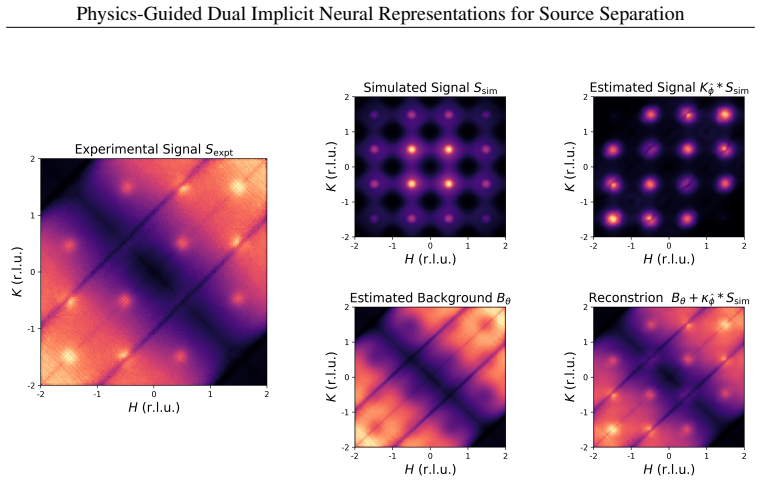
The central object is the physics-guided dual-INR decomposition with a learnable convolutional pathway. A pre-trained network evaluates the simulated spin-wave spectrum $S_\mathrm{sim}$ at neighboring coordinates; a kernel network (a sinusoidal-activation INR) outputs a localized, $Q,\omega$-dependent kernel $\kappa_{r,\hat\phi}$; and the distorted signal of interest is the convolution $\hat{S}^{(1)}_\mathrm{sig} = S_\mathrm{sim} * \kappa_{\hat\phi}$. A second INR, the background network $B_{\hat\theta}$, represents everything else. The objective $L = \|S^*_\mathrm{expt} - \bar{S}^\mathrm{pred}_\mathrm{expt}\|^2 + \lambda\|B_{\hat\theta}\|^2$ is minimized jointly, and the inductive bias that each INR is efficient for its own component but inefficient for the other, together with the injected physics model, produces the separation.
What would settle it
Generate a synthetic 4D inelastic-neutron dataset from the same spin-wave model but distort the signal with an operation that cannot be expressed as convolution with a local kernel, for example an intensity-dependent peak shift or an extra magnon branch absent from the simulation; train the dual INR, and compare the recovered signal to the known ground truth. A systematic failure to recover it would falsify the central claim.
Extended reading notes
Core claim
The central claim is that the dual-INR framework successfully separates physically meaningful signals from a complex or structured background even when signal characteristics vary across all four dimensions of the parameter space. In the demonstration, the signal of interest is the single-magnon excitation spectrum of the square-lattice spin-1 antiferromagnet La2NiO4. It is reconstructed as the convolution of a simulated spin-wave spectrum $S_\mathrm{sim}(Q,\omega;J,J_p)$ with a learnable, spatially varying kernel $\kappa_{r,\hat\phi}$, while a separate background INR $B_{\hat\theta}$ captures all other sample-related signals. Training minimizes a reconstruction loss plus a $\lambda$-weighted penalty on the background magnitude, with no labels and no pre-defined dictionaries. The paper reports quantitative recovery on synthetic data and physically consistent separation on experimental data, and identifies the analytically derived $\lambda^*$ as the setting that best recovers the signal component.
Load-bearing premise
The load-bearing premise is that the measured data can be written as a convolution of the simulated spin-wave spectrum with a spatially varying learnable kernel plus a smooth network background; if the true single-magnon response departs from this form, the separation will be biased.
Editorial extensions
If this is right
- The single-magnon signal in La2NiO4 inelastic neutron scattering data can be extracted without manual background subtraction, revealing features in momentum-energy space that are otherwise hidden.
- The analytical formula for $\lambda^*$ lets practitioners set the regularization weight from data outside the signal support instead of relying on cross-validation.
- Because the decomposition uses compact INRs, it simultaneously denoises the data and compresses it; the paper reports a 792:1 compression ratio for the La2NiO4 dataset.
- The same dual-INR structure, with the signal pathway replaced by an appropriate forward model, is proposed as a general tool for source separation in astronomy, biomedical imaging, and other experimental fields.
- The framework naturally extends to more than two sources by adding further INRs, allowing multi-component decompositions of the measured signal.
Reading between the lines
- An implication the authors leave implicit is that the same scheme could separate other excitation channels, such as the multi-magnon continuum, by choosing a different simulated spectrum for the signal pathway; whether the background INR then absorbs the targeted channel is an open question.
- The paper's analytical $\lambda$ recipe assumes the background is smooth and the signal has finite support; in settings with spatially varying noise or overlapping spectral peaks, a data-driven $\lambda$ schedule or a spatially weighted loss would be a natural testable extension.
- If the assumption of a local convolutional distortion fails, the kernel window $r$ would have to grow with the correlation length of the distortion, which could make the method expensive; replacing the local kernel with a nonlocal or conditional kernel is a direct extension.
- The success in 4D suggests the INR basis could be especially effective for other high-dimensional scientific measurements with low intrinsic dimensionality, but the paper only demonstrates one instance; applying the method to a different spectroscopy with known ground truth would test the generality.
Editorial analysis
A structured set of objections, weighed in public.
Referee Report
Summary. The paper proposes a self-supervised source-separation method based on a dual implicit neural representation (INR) architecture. One INR represents the signal of interest as a spatially varying convolution of a pre-trained simulated spectrum with a learnable kernel, while a second INR represents the background; the two are trained jointly by minimizing a reconstruction loss with a background-magnitude penalty. The method is demonstrated on four-dimensional inelastic neutron scattering (INS) data of La2NiO4, with the goal of extracting the single-magnon signal from a heterogeneous background. The authors also propose an analytic estimator for the regularization parameter and report that the trained INRs provide a 792:1 compression of the experimental data.
Significance. If the central claim is correct, the method would be a practically useful tool for extracting weak, physically meaningful signals from high-dimensional scattering data without labels or manual background subtraction. The combination of a physics-guided pre-trained forward model with a dual-INR decomposition is a sensible and potentially generalizable idea, and the analytic regularization-parameter estimate is a useful practical contribution. However, the current evidence does not establish the central claim: the synthetic validation is circular because the ground truth is generated from the same model family and even the same reconstructed background used by the method, and the experimental demonstration lacks any quantitative ground truth. The absence of baseline comparisons further weakens the claim of superiority over conventional approaches. The paper also misses an opportunity to test robustness to model mismatch, which is the main risk for real experimental use.
major comments (5)
- [Section 3.2, Eq. (8)] The synthetic validation is circular. In Eq. (8), the synthetic background is the reconstructed background B_hat obtained by training the method on the experimental data, the signal is the same S_sim used in the forward model, and the distortion is generated by the same learnable-kernel convolution as Eq. (3). The benchmark therefore verifies only that the dual-INR can invert its own generative process when the model is exactly correct. It does not test whether the decomposition remains accurate when the true single-magnon response deviates from S_sim (for example, due to an incomplete spin-wave Hamiltonian, neglected interactions, or non-Gaussian broadening), nor whether a non-smooth background can be absorbed by the signal pathway. I recommend adding a synthetic experiment in which the ground truth is generated from an independent forward model with known perturbations that are not available to the method, and reporting the separation error against that independent ground truth.
- [Section 2.2, Eq. (3); Section 4] The central physical claim on experimental data rests on the assumption that the true distorted single-magnon signal is exactly a convolution of the simulated signal S_sim with a spatially varying learnable kernel. The paper itself acknowledges in Section 4 that the work relies on simulated signals S_sim, but it never analyzes the bias induced if this convolutional model is wrong. For example, if the real single-magnon response has an additional component not representable by the parametric spin-wave model, the background INR could absorb it, or the signal pathway could be forced to fit a biased decomposition. The authors should provide a concrete robustness test, such as injecting a known non-convolutional distortion or an added spectral mode into a synthetic background and measuring how well the signal pathway recovers the known component.
- [Table 2] The reported chi-squared p-value of 1.0 for the supposedly optimal configuration (r = 2, lambda = 0.0005, chi-squared = 6828.510) is statistically implausible unless the number of degrees of freedom is incorrectly specified or the statistic is computed in a nonstandard way. Since Table 2 is used to support the claim that this configuration is optimal according to 'statistical analysis,' this anomaly undermines the hyperparameter-selection evidence. The authors should specify the exact chi-squared statistic, the number of degrees of freedom, and the fitting procedure used, or replace this criterion with a calibrated test such as reduced chi-squared.
- [Table 1 and Section 3.4.1] The hyperparameter optimization is not internally consistent. In Table 1, the configuration {r = 2, lambda = 0.0005} has the best reconstruction loss (RMSE, PSNR, SSIM), while {r = 3, lambda = 0.005} has the best signal-component recovery (MSLE-sig = 0.001). The analytic lambda estimator in Eq. (7) yields lambda* = 0.005, which matches one optimum but not the other. The paper does not explain which criterion should be used for the physical separation task, nor does it reconcile the discrepancy. This weakens the claim that the analytic estimator provides a reliable default choice.
- [Section 3 and Section 1] The paper criticizes conventional source-separation methods but provides no quantitative comparison against any baseline, such as global background subtraction, ICA, RPCA, Double-DIP, or a simple deconvolution with a Gaussian kernel. Without at least one baseline comparison on the synthetic data with known ground truth, the claim that the proposed method 'more effectively' handles heterogeneous backgrounds and unknown distortions is unsupported. Adding such a comparison would also help calibrate the practical significance of the reported reconstruction metrics.
minor comments (6)
- [Figure 3 caption] The caption labels the background panel as P_{L,omega} hat{S}^{(1)}_{sig}, but based on the text this should be P_{L,omega} hat{S}^{(2)}_{sig}; the same mislabel appears to affect the caption for panel (b).
- [Equation (7)] The typesetting of Eq. (7) is malformed: the denominator lacks explicit norm bars, and the symbols Omega, Omega^c, f_approx, and LPF are not defined in the immediately surrounding text. These should be defined to make the estimator reproducible.
- [Section 2.3] The stated approximation lambda approximately ||N||^2 / ||S^{(2)}_{sig}||^2 is asserted without derivation. Since this expression is the basis for the analytic estimator, a short derivation or a reference is needed.
- [Section 3.1] There is a typo in 'Voigt profiles' (rendered as 'V oigt'), and the sentence beginning 'Furthermore, in many experimental scenarios...' is a run-on that should be split.
- [Appendix B, Table B1] The SIREN frequency scaling w0 = 30 and the use of Softmax on the kernel output are not discussed in the main text; a brief sensitivity analysis or justification for these choices would improve reproducibility.
- [Throughout] No code or trained model is released. Given the reliance on pre-trained components from Ref. [5] and the detailed hyperparameter choices, releasing the pipeline would substantially strengthen the reproducibility of the results.
Circularity Check
Synthetic validation is circular: the 'known' background is the pipeline's own fitted output and the synthetic signal uses the same convolution model being tested.
-
fitted input called prediction
[Section 3.2, Eq. (8) and Table 1 caption]
"We generated the background component using the reconstructed background obtained from training on the experimental raw data. The synthetic data is then constructed as: Ssyn(Q, omega) = B_hat(Q, omega) + Integral_Omega Ssim(Q, omega; J, Jp) kappa_r,phi(Q' - Q, omega' - omega, Q, omega) dQ' domega'. (8) Since both the background component B_hat and the physical signal Ssim used to create the synthetic data are known, we can directly quantify the reconstruction accuracy of our method for each component."
The 'known' background is not an independent ground truth: B_hat is the background INR trained on the experimental raw data, i.e., a fitted output of the same dual-INR pipeline under evaluation. The signal term Ssim * kappa_r,phi is the same pre-trained surrogate and the same learnable-kernel convolution used in the reconstruction model, Eq. (5). Eq. (8) is therefore structurally identical to Eq. (5), so the synthetic benchmark only verifies that the method can invert its own generative process when the model is exactly correct. Table 1's 'known simulated 4D background' mislabels a fitted reconstruction as ground truth.
full rationale
The central quantitative support for the separation claim is the synthetic experiment of Section 3.2. That experiment constructs its ground truth with Eq. (8), which is the same B_hat + Ssim * kappa_r,phi form as the reconstruction model Eq. (5), using the pipeline's own trained background as the 'known' background. This is a fitted-input-called-prediction loop: the benchmark measures the method's ability to recover components that were produced by the method itself. The paper acknowledges reliance on simulations and proof-of-concept status in Section 4, but those statements do not break the loop. The self-citation to Reference [5] for the pre-trained Ssim is a normal citation to an earlier surrogate of linear spin-wave theory; it is an input prior rather than a circular prediction, so it does not independently raise the score. The unusual chi-squared p-value of 1.0 in Table 2 is a statistical concern rather than a circularity. Overall the derivation is not wholly tautological: there are non-circular elements such as hyperparameter sensitivity, experimental consistency checks, and compression. However, because the main validation used to support the physical-signal claim reduces by construction to the tested model family, a score of 6 is appropriate.
Assumptions & free parameters
free parameters (4)
- r (kernel window size) =
2 (experimental), 3 (synthetic best signal recovery)
- lambda (regularization weight) =
0.0005 (experimental), 0.005 (synthetic/analytic estimate)
- LPF standard deviation for lambda estimation =
5
- SIREN frequency scaling w0 =
30
assumptions (6)
- domain assumption Measured signal is a linear mixture of a signal and a background source plus Poisson noise (Eq. 1)
- ad hoc to paper The distorted physical signal equals the ideal simulated signal convolved with a spatially-varying learnable kernel (Eq. 3)
- domain assumption INRs have a low-frequency/smoothness inductive bias that makes them efficient at representing background but inefficient at representing noise and the target signal
- domain assumption The pre-trained SpecNeuralRepr accurately represents the linear spin wave theory spectrum Ssim(Q, omega; J, Jp) (from Ref [5])
- domain assumption Linear spin wave theory with fixed J=32.0 meV, Jp=-2.6 meV correctly describes the single-magnon spectrum of La2NiO4
- domain assumption The target signal has finite support Omega and the background is smooth; noise is approximately uniform outside Omega (Section 2.3)
Cite this review
Pith. "Pith review of Physics-Guided Dual Implicit Neural Representations for Source Separation." pith.science (2026). https://pith.science/paper/Q2TPSHKX
@misc{pith2026250705249,
  author       = {Pith},
  title        = {Pith review of: Physics-Guided Dual Implicit Neural Representations for Source Separation},
  year         = {2026},
  howpublished = {\url{https://pith.science/paper/Q2TPSHKX}},
  note         = {Machine review of arXiv:2507.05249}
}
read the original abstract
Significant challenges exist in efficient data analysis of most advanced experimental and observational techniques because the collected signals often include unwanted contributions--such as background and signal distortions--that can obscure the physically relevant information of interest. To address this, we have developed a self-supervised machine-learning approach for source separation using a dual implicit neural representation framework that jointly trains two neural networks: one for approximating distortions of the physical signal of interest and the other for learning the effective background contribution. Our method learns directly from the raw data by minimizing a reconstruction-based loss function without requiring labeled data or pre-defined dictionaries. We demonstrate the effectiveness of our framework by considering a challenging case study involving large-scale simulated as well as experimental momentum-energy-dependent inelastic neutron scattering data in a four-dimensional parameter space, characterized by heterogeneous background contributions and unknown distortions to the target signal. The method is found to successfully separate physically meaningful signals from a complex or structured background even when the signal characteristics vary across all four dimensions of the parameter space. An analytical approach that informs the choice of the regularization parameter is presented. Our method offers a versatile framework for addressing source separation problems across diverse domains, ranging from superimposed signals in astronomical measurements to structural features in biomedical image reconstructions.
Figures


Figures from the paper (2 more)

Forward citations
Cited by 1 Pith paper
-
Multi-resolution Enhancement for Full Spectrum Neural Representations
A wavelet-based multi-scale neural network with a local kernel enhancement module achieves better rate-distortion on scientific datasets than standard implicit neural representations.
Reference graph
Works this paper leans on
-
[1]
J. Berg and K. Nyström. Neural Networks as Smooth Priors for Inverse Problems for PDEs. Journal of Computational Mathematics and Data Science , 1:100008, Sept. 2021
work page 2021
-
[2]
C.-X. Bi, Y . Liu, Y .-B. Zhang, and L. Xu. Extension of Sound Field Separation Technique Based on the Equivalent Source Method in a Sparsity Framework. Journal of Sound and Vibration, 442:125–137, 2019
work page 2019
-
[3]
T. Bouwmans, A. Sobral, S. Javed, S. Jung, and E. Zahzah. Decomposition into Low- rank plus Additive Matrices for Background/Foreground Separation: A Review for a Comparative Evaluation with a Large-Scale Dataset. Computer Science Review, 23:1–71, 2017
work page 2017
-
[4]
E. J. Candès, X. Li, Y . Ma, and J. Wright. Robust Principal Component Analysis?Journal of the ACM, 58(3):1–37, 2011
work page 2011
-
[5]
Z. Chen, A. N. Petsch, Z. Ji, S. R. Chitturi, C. Peng, C. Jia, A. I. Kolesnikov, J. B. Thayer, and J. J. Turner. Implicit Neural Representations for Experimental Steering of Advanced Experiments. Cell Reports Physical Science , 6(1), 2025
work page 2025
-
[6]
S. R. Chitturi, Z. Ji, A. N. Petsch, C. Peng, Z. Chen, R. Plumley, M. Dunne, S. Mardanya, S. Chowdhury, H. Chen, et al. Capturing Dynamical Correlations Using Implicit Neural Representations. Nature Communications, 14(1):5852, 2023
work page 2023
-
[7]
P. Comon. Independent Component Analysis, A New Concept? Signal Processing, 36(3):287–314, 1994
work page 1994
-
[8]
A. B. Crummy, C. M. Strother, and C. A. Mistretta. The History of Digital Subtraction Angiography. Journal of V ascular and Interventional Radiology, 29(8):1138–1141, 2018
work page 2018
Show all 23 references
-
[9]
Ehlert, C
S. Ehlert, C. Chen, D. Swartz, R. Hickox, A. Lutovinov, A. Semena, R. Krivonos, A. Shtykovsky, and A. Tkachenko. A Probabilistic Method of Background Removal for High Energy Astrophysics Data. Monthly Notices of the Royal Astronomical Society , 2022. 14 Physics-Guided Dual Imp...
2022
-
[10]
Essakine, Y
A. Essakine, Y . Cheng, C.-W. Cheng, L. Zhang, Z. Deng, L. Zhu, C.-B. Schönlieb, and A. I. Aviles-Rivero. Where Do We Stand with Implicit Neural Representations? A Technical and Performance Survey. arXiv preprint arXiv:2411.03688, 2024
2024 arXiv
-
[11]
Gandelsman, A
Y . Gandelsman, A. Shocher, and M. Irani. Double-DIP: Unsupervised Image Decompo- sition via Coupled Deep-Image-Priors. In Proceedings of the IEEE/CVF Conference on Computer Vision and Pattern Recognition (CVPR), pages 11026–11035, 2019
2019
-
[12]
E. E. Kuruoglu and F. J. Theis. Dependent Component Analysis. EURASIP J. Adv. Signal Process., 2013:185, 2013
2013
-
[13]
K. Lee, S. Tak, and J. C. Ye. A Data-Driven Sparse GLM for fMRI Analysis Using Sparse Dictionary Learning With MDL Criterion. IEEE Transactions on Medical Imaging, 30:1076–1089, 2011
2011
-
[14]
Liu and X
Q. Liu and X. Li. Efficient Low-Rank Matrix Factorization Based on ℓ1,ϵ-Norm for Online Background Subtraction. IEEE Transactions on Circuits and Systems for Video Technology, 32:4900–4904, 2022
2022
-
[15]
Petsch, N
A. Petsch, N. Headings, D. Prabhakaran, A. Kolesnikov, C. Frost, A. Boothroyd, R. Coldea, and S. Hayden. High-energy Spin Waves in the Spin-1 Square-lattice Antiferromagnet La2NiO4. Physical Review Research, 5(3):033113, 2023
2023
-
[16]
Piccardi
M. Piccardi. Background subtraction techniques: A review. In 2004 IEEE International Conference on Systems, Man and Cybernetics (IEEE Cat. No.04CH37583) , volume 4, pages 3099–3104 vol.4, 2004
2004
-
[17]
T. M. Roddenberry, V . Saragadam, M. V . de Hoop, and R. G. Baraniuk. Implicit Neural Representations and the Algebra of Complex Wavelets, 2023
2023
-
[18]
E. Sarradj. Three-Dimensional Acoustic Source Mapping with Different Beamforming Steering Vector Formulations. Advances in Acoustics and Vibration, 2012, 06 2012
2012
-
[19]
Sitzmann, J
V . Sitzmann, J. N. P. Martel, A. W. Bergman, D. B. Lindell, and G. Wetzstein. Implicit Neural Representations with Periodic Activation Functions. CoRR, abs/2006.09661, 2020
2006 arXiv
-
[20]
Starck, M
J.-L. Starck, M. Elad, and D. Donoho. Image Decomposition: Separation of Texture from Piecewise Smooth Content. Proceedings of SPIE - The International Society for Optical Engineering, 5207, 11 2003
2003
-
[21]
Tougaard
S. Tougaard. Practical Algorithm for Background Subtraction. Surface Science , 216(3):343–360, 1989
1989
-
[22]
J. Végh. The Shirley Background Revised. Journal of Electron Spectroscopy and Related Phenomena, 151(3):159–164, 2006
2006
-
[23]
W. Yin, D. Goldfarb, and S. Osher. A Comparison of Three Total Variation Based Texture Extraction Models. Journal of Visual Communication and Image Representation , 18(3):240–252, 2007. 15 Physics-Guided Dual Implicit Neural Representations for Source Separation Appendix A Fig...
2007
Reviewed August 6, 2026 · model on record in the stance chip above.
Discussion (0). Sign in to comment.