REVIEW 4 major objections 5 minor 19 cited by
Between Underthinking and Overthinking: An Empirical Study of Reasoning Length and correctness in LLMs
T0 review · 4 major / 5 minor · reviewed 2026-08-16 · deepseek-v4-flash
Pith's one-line read For a fixed question, accuracy rises with reasoning length up to a point, then falls; models overthink easy problems, underthink hard ones, and length-only preference optimization cuts output by 30–60%.
desk verdict A useful empirical study whose headline fixed-question non-monotonicity claim is not supported by the aggregate curve, but whose length-only preference optimization experiment is solid and deserves a serious referee. read the letter →
The pith
A machine-rendered reading of the paper's core claim, the machinery that carries it, and where it could break.
The reading
What carries the argument
The central tool is a length-ranking construction: for each question, ten sampled responses are sorted by token length, and average length and accuracy are computed at each rank, isolating the effect of length from question difficulty. At the question level, the machinery is a cross-model difficulty partition into shared-easy and shared-hard sets plus model-specific advantage sets, compared with t-tests; this separates 'the model sees difficulty and adapts' from 'the model fails to recognize difficulty.' The optimization machinery is SimPO, a reference-free preference optimization algorithm that uses average sequence log-probability as an implicit reward, applied here to preference pairs that prefer shorter responses without checking correctness.
What would settle it
Truncate long responses on solvable questions to the median length of correct responses; if accuracy does not fall, extra reasoning is not the cause of the decline. Conversely, force additional reasoning steps on hard questions that currently get short wrong answers; if accuracy does not rise, those failures are not caused by insufficient thinking.
Extended reading notes
Core claim
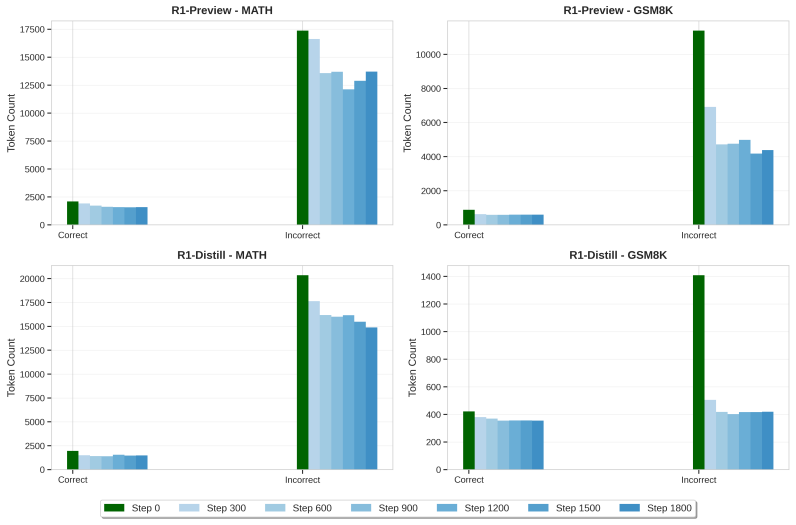
At the sample level, when a single question is answered multiple times, accuracy is non-monotonic in response length: the shortest response is often already correct, accuracy peaks early, and the longest samples are less accurate. At the question level, incorrect answers are on average far longer than correct ones—on the harder benchmark, more than twice as long—and length correlates negatively with accuracy. The authors partition questions into easy, medium, and hard by a model's own consistency, and use cross-model comparisons to show that models detect small difficulty increases on questions they can solve, generating longer responses, but on questions beyond their ability they often produce shorter-than-needed responses, a pattern they call underthinking. Finally, using preference optimization that always prefers the shorter of two unlabeled responses, they cut average generation length by roughly 30–60% with only mild accuracy loss, with most of the reduction coming from incorrect responses.
Load-bearing premise
The interpretation that short incorrect answers are 'underthinking' assumes the model's response length tracks its perceived difficulty of the question, an assumption the paper does not directly test and whose alternative—longer responses themselves introducing errors—it explicitly acknowledges.
Editorial extensions
If this is right
- For a fixed question, accuracy peaks at an interior response length, so both minimal and maximal reasoning are risky; a token-budget-aware sampler that avoids the longest chains should match or beat unconstrained sampling.
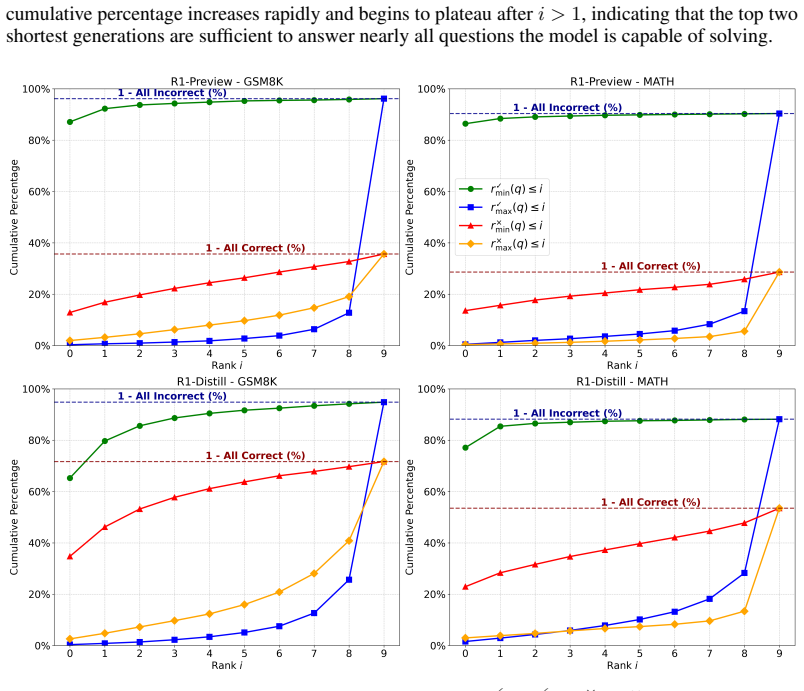
- Because over 60% of questions are solved by the shortest sampled response when they are solvable at all, much of the compute spent generating long chains is wasted.
- Preference optimization with only length preferences, and no ground-truth correctness, reduces generation length by 30–60% while keeping accuracy in an acceptable range; most savings come from shortening incorrect responses, but correct responses also shrink by 10–25%.
- Length reduction does not require labeled preference pairs, so unlabeled corpora can be used to make reasoning models cheaper at inference time.
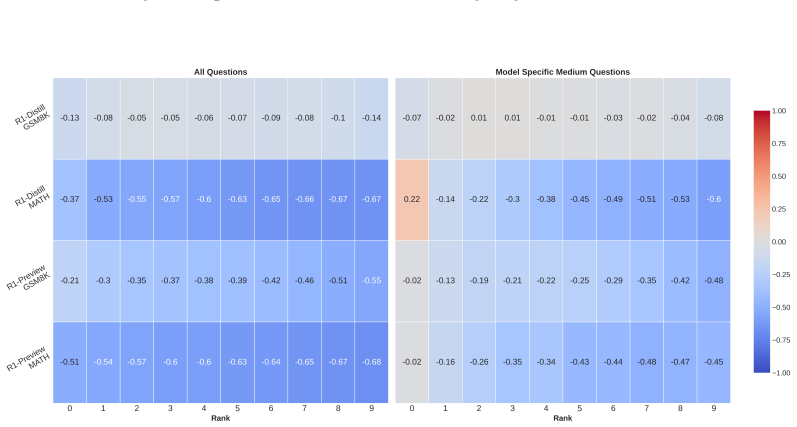
- Incorrect responses are markedly longer than correct ones and correlate negatively with accuracy, making length a usable signal for detecting likely-failed reasoning.
Reading between the lines
- A length-aware self-consistency vote that discards the longest samples could improve accuracy and cut cost; the paper only notes this direction as motivation.
- The peaked length–accuracy curve implies a model- and dataset-specific optimal length; an unlabeled-data controller that predicts the plateau would be a natural next step beyond the paper's experiments.
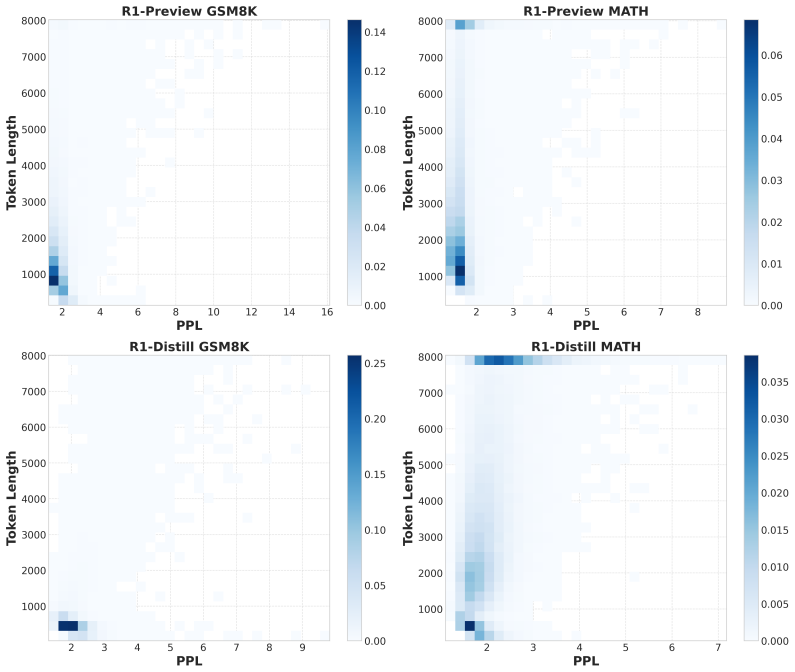
- Because length diverges from perceived difficulty mainly on questions beyond a model's ability, calibration or perplexity outliers might flag when self-correction is unlikely to help—a connection the paper raises but does not test.
Signed reviews
Editorial analysis
A structured set of objections, weighed in public.
Referee Report
Summary. The paper empirically studies how reasoning length relates to answer correctness for two 1.5B reasoning models, DeepSeek-R1-Distill and DeepScaler-R1-Preview, on GSM8K and MATH. For each question it samples N=10 responses, ranks them by length, and analyzes the averaged accuracy at each length rank. The authors claim three main findings: (1) for a fixed question, accuracy is non-monotonic in reasoning length, rising then falling; (2) models overthink easy questions and underthink hard ones, indicating poor calibration of reasoning length to perceived difficulty; and (3) applying SimPO with a length-only preference signal on unlabeled data reduces generation length by roughly 30-60% while maintaining acceptable accuracy. The paper includes sample-level rank statistics, question-level difficulty splits with t-tests, and a preference-optimization intervention.
Significance. If the central claims were fully supported, the paper would make a useful contribution to the growing literature on reasoning-length calibration in LLMs. The strengths include a transparent sampling protocol with stated hyperparameters, rank-based metrics that are easy to reproduce, explicit t-test tables, and an honest acknowledgment in Section 5 that the causal interpretation of length-correctness correlations is ambiguous. The SimPO intervention is a concrete, falsifiable test of whether length-only preferences can reduce cost without large accuracy loss. However, the headline fixed-question non-monotonicity claim is not directly tested by the reported aggregated curves, and the under/overthinking interpretation rests on correlational and between-set comparisons that do not establish the claimed difficulty-miscalibration mechanism. These issues are load-bearing for the paper's main conclusions, so the manuscript needs additional analysis before the claims can be accepted.
major comments (4)
- [Section 4.1, Figure 1, and Appendix A.2] The claim that 'for a fixed question, accuracy is non-monotonic in reasoning length' is not established by the reported Acc_r curve. Acc_r is the fraction of questions whose r-th shortest sample is correct, averaged over all questions. This is an aggregate over questions of widely different difficulty, so the curve can be non-monotonic even if every individual question has a monotone or flat length-accuracy relationship. For example, the early rise can be driven by Medium questions whose correct samples are comparatively longer, and the later decline can be driven by Easy questions whose shortest samples are already correct. The final rank is also an extreme order statistic and may be affected by the 8k token cap. To support the fixed-question claim, the authors should condition on within-question outcome variability: for instance, plot Acc_r restricted to Medium questions, compute a per-question measure of whether correctness improves or degrades with length rank, or fit a mixed-effects logistic regression with a question-level random intercept. The existing correlations in Appendix B.2 on Medium questions are related but do not directly replace this analysis.
- [Section 4.1, text after Figure 1] The text states that 'a consistent non-monotonic trend' is observed across models and datasets, but the same paragraph reports that R1-Preview on MATH achieves its best accuracy at r*=0 with accuracy declining at higher ranks. That is a monotonically decreasing pattern, not a non-monotonic one. The blanket claim should be qualified to the model-dataset pairs where a rise-then-fall pattern is actually observed, and the single decreasing case should be discussed as an important exception rather than folded into the general statement.
- [Section 5.1, Tables 2 and 3] The underthinking/overthinking interpretation is not supported by the t-test comparisons as presented. For hard questions, Table 3 shows several non-significant or directionally inconsistent comparisons, and the conclusion that models 'do not consistently recognize or reflect increased difficulty' is drawn from the absence of a predicted pattern across sets that differ in intrinsic difficulty. Since the sets are defined by N=10 all-correct/all-incorrect outcomes, the split is arbitrary and the 'needed length' for a question is never measured. The paper itself acknowledges in Section 5 that longer responses may make a question appear more difficult than it truly is, which undermines the causal story. I recommend reframing these results as exploratory evidence or hypotheses, and adding a direct within-question test: for Medium questions with at least one correct sample, compare the lengths of correct versus incorrect samples, and check whether the probability of error increases with relative length after controlling for question difficulty.
- [Section 6, Figures 4 and 5] The claim that length-only SimPO preference optimization 'significantly reduces' length while maintaining 'acceptable accuracy' is based on a single training run without confidence intervals, multiple seeds, or a precise definition of acceptable accuracy. Figure 4 shows accuracy fluctuating during training, so it is unclear which training step is used for the headline 30-60% reduction and what the corresponding accuracy is. The authors should report exact numbers at a selected checkpoint, include error bars over at least three seeds, and state the accuracy drop relative to the base model. Without this, the practical recommendation that length-only preferences can replace correctness-based preferences is not robustly supported.
minor comments (5)
- [Table 1] The 'Mean ± Std' entries, such as 1374.82 ± 92.34, appear to be standard errors rather than standard deviations given the sample sizes; if so, please relabel the column as 'Mean ± SE' or report standard deviations.
- [Section 4.1 vs. Appendix B.1] The main text says that for over 60% of questions across all model-dataset combinations the shortest sample is correct, but Appendix B.1 reports over 80% for R1-Preview on both datasets and over 60% for R1-Distill. Please reconcile these numbers.
- [Related Work] The citation 'Fu et al. proposes Dynasor-CoT...' is missing a year and is incomplete; please provide the full reference.
- [Table 3 caption] The caption contains a typo: 'shared-sard set' should be 'shared-hard set'.
- [Section 5.1, Tables 2 and 3] The naming of 'M1-Advantage' and 'M2-Advantage' sets is confusing, especially in the hard-question table where a set that is hard for one model but not the other is labeled as the other model's advantage set. Consider using explicit set definitions such as Q^hard_i \ Q^hard_j in each panel.
Circularity Check
No significant circularity: the paper's claims are empirical measurements, and the SimPO experiment is an independent intervention rather than a fitted derivation.
full rationale
The paper does not derive its headline findings from fitted parameters or from definitions that presuppose them. Section 4 defines L_r and Acc_r as averages over length-ranked samples and reports an observed non-monotonic pattern; sorting responses by length makes L_r increasing by construction, but it does not force Acc_r to rise and then fall, so the empirical claim has independent content. The difficulty tiers (Easy/Medium/Hard) are defined by the model's own correctness over N=10 samples, and the cross-model length comparisons in Section 5 are separate measurements used interpretively; the paper itself flags the causal ambiguity ('it remains unclear whether the increased length reflects the model's ability to recognize the intrinsic complexity of the question... or whether the longer responses themselves introduce additional errors', Section 5), so the over/underthinking labels are presented as interpretations rather than as consequences of the definitions. The SimPO length-reduction experiment (Section 6) is an intervention that optimizes only for shorter responses and then measures accuracy and length on test data; its success is not assumed by the earlier analysis. There are no load-bearing self-citations and no fitted parameter is relabeled as a prediction. Potential concerns about the aggregate Acc_r curve mixing question difficulties are validity or correctness issues about whether the data support the 'fixed question' claim, not circularity in the derivation chain.
Assumptions & free parameters
free parameters (3)
- Number of samples per question N =
10
- Sampling temperature T and top-p =
1.0, 1.0
- SimPO hyperparameters (learning rate, beta, gamma) =
5e-7, 2, 1
assumptions (5)
- domain assumption Ground-truth labels in GSM8K and MATH are correct and answer matching is a valid correctness measure.
- domain assumption The two models, DeepSeek-1.5B-Distill and DeepScaler-1.5B-Preview, are representative of reasoning LLMs.
- domain assumption Temperature sampling with T=1.0 produces diverse, independent reasoning paths for a fixed question.
- domain assumption Shared-easy and shared-hard question sets are comparable in intrinsic difficulty across the two models.
- domain assumption Response length in tokens is a meaningful proxy for the amount of reasoning.
Cite this review
Pith. "Pith review of Between Underthinking and Overthinking: An Empirical Study of Reasoning Length and correctness in LLMs." pith.science (2026). https://pith.science/paper/Q35CKXYE
@misc{pith2026250500127,
  author       = {Pith},
  title        = {Pith review of: Between Underthinking and Overthinking: An Empirical Study of Reasoning Length and correctness in LLMs},
  year         = {2026},
  howpublished = {\url{https://pith.science/paper/Q35CKXYE}},
  note         = {Machine review of arXiv:2505.00127}
}
read the original abstract
Large language models (LLMs) are increasingly optimized for long reasoning, under the assumption that more reasoning leads to better performance. However, emerging evidence suggests that longer responses can sometimes degrade accuracy rather than improve it. In this paper, we conduct a systematic empirical study of the relationship between reasoning length and answer correctness. We find that LLMs tend to overthink simple problems, generating unnecessarily long outputs, and underthink harder ones, failing to extend their reasoning when it is most needed. This indicates that models might misjudge problem difficulty and fail to calibrate their response length appropriately. Furthermore, we investigate the effects of length reduction with a preference optimization algorithm when simply preferring the shorter responses regardless of answer correctness. Experiments show that the generation length can be significantly reduced while maintaining acceptable accuracy. Our findings highlight generation length as a meaningful signal for reasoning behavior and motivate further exploration into LLMs' self-awareness in reasoning length adaptation.
Figures


Figures from the paper (13 more)








Forward citations
Cited by 19 Pith papers
-
Shorter Reasoning, Earlier Answers? An Evaluation of Reasoning Interfaces
Matched-horizon comparisons show that a numeric/concision prompt shortens Qwen3 reasoning without consistent accuracy gains, while lower gpt-oss effort wins early mainly by finishing sooner, not by reasoning better.
-
Cognitive Demand Steering for Adaptive Meta-Reasoning in Large Language Models
A training-free meta-reasoning loop that tracks remaining cognitive demand and steers an LLM's next action improves average accuracy by about 9 percent over chain-of-thought across three models and six benchmarks.
-
Mitigating Factual Hallucination in Large Reasoning Models via Mixed-Mode Advantage Regularization
MARGO mitigates thinking-induced hallucination in large reasoning models by using mixed-mode GRPO rollout groups that compare thinking trajectories against same-model non-thinking references.
-
Towards Efficient Large Language Reasoning Models via Extreme-Ratio Chain-of-Thought Compression
Extra-CoT trains a semantic compressor on math CoT data, applies mixed-ratio SFT, and uses CHRPO reinforcement learning to achieve over 73% token reduction on MATH-500 with 0.6% accuracy gain on Qwen3-1.7B.
-
The Shape of Reasoning: Topological Analysis of Reasoning Traces in Large Language Models
Topological features of reasoning-trace embeddings correlate with Smith-Waterman alignment to expert AIME solutions more than graph metrics do, but the paper does not validate this out of sample.
-
AdaThink-Med: Optimizing Inference-Time Compute for Medical Reasoning via Uncertainty Quantification
An entropy-guided reward that shortens answers to easy, confident questions and extends reasoning on hard ones reduces medical QA tokens by 4.7x to 6.4x with minimal accuracy loss.
-
Which LLMs Get the Joke? Probing Non-STEM Reasoning Abilities with HumorBench
HumorBench scores LLM explanations of cartoon jokes against expert-written objective elements and finds reasoning skills transfer from STEM benchmarks, while extra thinking tokens help only some models.
-
Overclocking LLM Reasoning: Monitoring and Controlling Thinking Path Lengths in LLMs
A fitted progress vector in LLM hidden states can monitor and, when added during decoding, shorten the thinking phase, often improving accuracy and cutting tokens.
-
AlphaOne: Reasoning Models Thinking Slow and Fast at Test Time
A stochastic scheduling framework that modulates slow-to-fast reasoning in large reasoning models at test time, improving accuracy while reducing token usage.
-
Thinking Fast and Right: Balancing Accuracy and Reasoning Length with Adaptive Rewards
An adaptive length-penalty reward for RL-trained LLMs reduces reasoning length by over 50% with small accuracy loss by automatically tightening and relaxing the penalty based on the model's current accuracy.
-
LARES: Latent Reasoning for Sequential Recommendation
LARES applies depth-recurrent latent reasoning to sequential recommendation, refining all item tokens at each step, and reports consistent gains across four Amazon benchmarks.
-
Lost in Context: Addressing Context Anxiety in Large Language Models
Context anxiety — abandoning solvable tasks over perceived token limits — is measurable and reducible by fine-tuning on anxiety-free reasoning traces, but the paper's causal mechanism is not actually tested.
-
EDGE-GRPO: Entropy-Driven GRPO with Guided Error Correction for Advantage Diversity
EDGE-GRPO reduces advantage collapse in GRPO by injecting reference solutions into response groups and scaling advantages by policy entropy, achieving competitive math reasoning with only 1K training samples.
-
SynapseRoute: An Auto-Route Switching Framework on Dual-State Large Language Model
A learned router for a dual-mode LLM raises medical QA accuracy from 0.827 to 0.839 while cutting inference time by 36.8% and tokens by 39.7% versus always using thinking mode.
-
CP-Router: An Uncertainty-Aware Router Between LLM and LRM
CP-Router uses conformal prediction set sizes from an LLM to decide whether to route a prompt to that LLM or to a more expensive reasoning model, cutting token use with minimal or no accuracy loss.
-
Thinking Short and Right Over Thinking Long: Serving LLM Reasoning Efficiently and Accurately
SART reduces LLM serving latency by combining redundant branch sampling with early stopping and PRM-based dynamic branch pruning, while keeping answer accuracy comparable to baseline methods.
-
A Comprehensive Survey on Trustworthiness in Reasoning with Large Language Models
A structured literature survey concluding that reasoning capabilities do not automatically make LLMs more trustworthy and can introduce new vulnerabilities in safety, robustness, and privacy.
-
CoreThink: A Symbolic Reasoning Layer to reason over Long Horizon Tasks with LLMs
The paper claims a symbolic orchestration layer, CoreThink, achieves state-of-the-art results on seven coding and reasoning benchmarks with no training, but provides no verifiable implementation or method details.
-
Towards Concise and Adaptive Thinking in Large Reasoning Models: A Survey
A comprehensive review that categorizes methods for shortening and adaptively triggering chain-of-thought reasoning in large language models.
Reference graph
Works this paper leans on
-
[1]
L1: Controlling how long a reasoning model thinks with reinforcement learning
Pranjal Aggarwal and Sean Welleck. L1: Controlling how long a reasoning model thinks with reinforcement learning. arXiv preprint arXiv:2503.04697,
-
[3]
Towards reasoning era: A survey of long chain-of- thought for reasoning large language models
Qiguang Chen, Libo Qin, Jinhao Liu, Dengyun Peng, Jiannan Guan, Peng Wang, Mengkang Hu, Yuhang Zhou, Te Gao, and Wangxiang Che. Towards reasoning era: A survey of long chain-of- thought for reasoning large language models. arXiv preprint arXiv:2503.09567,
-
[4]
Do not think that much for 2+ 3=? on the overthinking of o1-like llms
Xingyu Chen, Jiahao Xu, Tian Liang, Zhiwei He, Jianhui Pang, Dian Yu, Linfeng Song, Qiuzhi Liu, Mengfei Zhou, Zhuosheng Zhang, et al. Do not think that much for 2+ 3=? on the overthinking of o1-like llms. arXiv preprint arXiv:2412.21187,
-
[8]
Deepseek-r1: Incentivizing reasoning capability in llms via reinforcement learning
Daya Guo, Dejian Yang, Haowei Zhang, Junxiao Song, Ruoyu Zhang, Runxin Xu, Qihao Zhu, Shirong Ma, Peiyi Wang, Xiao Bi, et al. Deepseek-r1: Incentivizing reasoning capability in llms via reinforcement learning. arXiv preprint arXiv:2501.12948,
-
[9]
Token- budget-aware llm reasoning
Tingxu Han, Zhenting Wang, Chunrong Fang, Shiyu Zhao, Shiqing Ma, and Zhenyu Chen. Token- budget-aware llm reasoning. arXiv preprint arXiv:2412.18547,
-
[10]
Measuring mathematical problem solving with the math dataset
Dan Hendrycks, Collin Burns, Saurav Kadavath, Akul Arora, Steven Basart, Eric Tang, Dawn Song, and Jacob Steinhardt. Measuring mathematical problem solving with the math dataset. arXiv preprint arXiv:2103.03874,
-
[11]
The impact of reasoning step length on large language models
Mingyu Jin, Qinkai Yu, Dong Shu, Haiyan Zhao, Wenyue Hua, Yanda Meng, Yongfeng Zhang, and Mengnan Du. The impact of reasoning step length on large language models. arXiv preprint arXiv:2401.04925,
-
[12]
Escape sky-high cost: Early-stopping self-consistency for multi-step reasoning
Yiwei Li, Peiwen Yuan, Shaoxiong Feng, Boyuan Pan, Xinglin Wang, Bin Sun, Heda Wang, and Kan Li. Escape sky-high cost: Early-stopping self-consistency for multi-step reasoning. arXiv preprint arXiv:2401.10480,
Show all 27 references
-
[13]
From system 1 to system 2: A survey of reasoning large language models
10 Zhong-Zhi Li, Duzhen Zhang, Ming-Liang Zhang, Jiaxin Zhang, Zengyan Liu, Yuxuan Yao, Haotian Xu, Junhao Zheng, Pei-Jie Wang, Xiuyi Chen, et al. From system 1 to system 2: A survey of reasoning large language models. arXiv preprint arXiv:2502.17419,
-
[14]
O1-pruner: Length-harmonizing fine-tuning for o1-like reasoning pruning
Haotian Luo, Li Shen, Haiying He, Yibo Wang, Shiwei Liu, Wei Li, Naiqiang Tan, Xiaochun Cao, and Dacheng Tao. O1-pruner: Length-harmonizing fine-tuning for o1-like reasoning pruning. arXiv preprint arXiv:2501.12570, 2025a. Michael Luo, Sijun Tan, Justin Wong, Xiaoxiang Shi, Wi...
-
[15]
s1: Simple test-time scaling
Niklas Muennighoff, Zitong Yang, Weijia Shi, Xiang Lisa Li, Li Fei-Fei, Hannaneh Hajishirzi, Luke Zettlemoyer, Percy Liang, Emmanuel Candès, and Tatsunori Hashimoto. s1: Simple test-time scaling. arXiv preprint arXiv:2501.19393,
-
[16]
Self- training elicits concise reasoning in large language models
Tergel Munkhbat, Namgyu Ho, Seohyun Kim, Yongjin Yang, Yujin Kim, and Se-Young Yun. Self- training elicits concise reasoning in large language models. arXiv preprint arXiv:2502.20122 ,
-
[17]
Dynathink: Fast or slow? a dynamic decision-making framework for large language models
Jiabao Pan, Yan Zhang, Chen Zhang, Zuozhu Liu, Hongwei Wang, and Haizhou Li. Dynathink: Fast or slow? a dynamic decision-making framework for large language models. arXiv preprint arXiv:2407.01009,
-
[18]
Optimizing test-time compute via meta reinforcement fine- tuning
Yuxiao Qu, Matthew YR Yang, Amrith Setlur, Lewis Tunstall, Edward Emanuel Beeching, Ruslan Salakhutdinov, and Aviral Kumar. Optimizing test-time compute via meta reinforcement fine- tuning. arXiv preprint arXiv:2503.07572,
-
[19]
Dast: Difficulty-adaptive slow-thinking for large reasoning models
Yi Shen, Jian Zhang, Jieyun Huang, Shuming Shi, Wenjing Zhang, Jiangze Yan, Ning Wang, Kai Wang, and Shiguo Lian. Dast: Difficulty-adaptive slow-thinking for large reasoning models. arXiv preprint arXiv:2503.04472,
-
[20]
Kimi Team, Angang Du, Bofei Gao, Bowei Xing, Changjiu Jiang, Cheng Chen, Cheng Li, Chenjun Xiao, Chenzhuang Du, Chonghua Liao, et al. Kimi k1. 5: Scaling reinforcement learning with llms. arXiv preprint arXiv:2501.12599,
-
[21]
Make every penny count: Difficulty-adaptive self-consistency for cost-efficient reasoning
Xinglin Wang, Shaoxiong Feng, Yiwei Li, Peiwen Yuan, Yueqi Zhang, Chuyi Tan, Boyuan Pan, Yao Hu, and Kan Li. Make every penny count: Difficulty-adaptive self-consistency for cost-efficient reasoning. arXiv preprint arXiv:2408.13457,
-
[22]
Self-consistency improves chain of thought reasoning in language models
Xuezhi Wang, Jason Wei, Dale Schuurmans, Quoc Le, Ed Chi, Sharan Narang, Aakanksha Chowdh- ery, and Denny Zhou. Self-consistency improves chain of thought reasoning in language models. arXiv preprint arXiv:2203.11171,
-
[24]
Logic-rl: Unleashing llm reasoning with rule-based reinforcement learning
11 Tian Xie, Zitian Gao, Qingnan Ren, Haoming Luo, Yuqian Hong, Bryan Dai, Joey Zhou, Kai Qiu, Zhirong Wu, and Chong Luo. Logic-rl: Unleashing llm reasoning with rule-based reinforcement learning. arXiv preprint arXiv:2502.14768,
-
[25]
Adaption-of-thought: Learning question difficulty improves large language models for reasoning
Mayi Xu, Yongqi Li, Ke Sun, and Tieyun Qian. Adaption-of-thought: Learning question difficulty improves large language models for reasoning. InProceedings of the 2024 Conference on Empirical Methods in Natural Language Processing, pp. 5468–5495,
2024
-
[26]
Towards thinking-optimal scaling of test-time compute for llm reasoning
Wenkai Yang, Shuming Ma, Yankai Lin, and Furu Wei. Towards thinking-optimal scaling of test-time compute for llm reasoning. arXiv preprint arXiv:2502.18080,
-
[27]
Demystifying long chain-of-thought reasoning in llms
Edward Yeo, Yuxuan Tong, Morry Niu, Graham Neubig, and Xiang Yue. Demystifying long chain-of-thought reasoning in llms. arXiv preprint arXiv:2502.03373,
-
[28]
Grpo-lead: A difficulty-aware reinforcement learning approach for concise mathematical reasoning in language models
Jixiao Zhang and Chunsheng Zuo. Grpo-lead: A difficulty-aware reinforcement learning approach for concise mathematical reasoning in language models. arXiv preprint arXiv:2504.09696,
-
[2021]
Learning how hard to think: Input-adaptive allocation of lm computation
Mehul Damani, Idan Shenfeld, Andi Peng, Andreea Bobu, and Jacob Andreas. Learning how hard to think: Input-adaptive allocation of lm computation. arXiv preprint arXiv:2410.04707,
-
[2022]
When more is less: Under- standing chain-of-thought length in llms
Yuyang Wu, Yifei Wang, Tianqi Du, Stefanie Jegelka, and Yisen Wang. When more is less: Under- standing chain-of-thought length in llms. arXiv preprint arXiv:2502.07266,
-
[2024]
Training verifiers to solve math word problems
Karl Cobbe, Vineet Kosaraju, Mohammad Bavarian, Mark Chen, Heewoo Jun, Lukasz Kaiser, Matthias Plappert, Jerry Tworek, Jacob Hilton, Reiichiro Nakano, Christopher Hesse, and John Schulman. Training verifiers to solve math word problems. arXiv preprint arXiv:2110.14168 ,
-
[2025]
The relationship between reasoning and performance in large language models–o3 (mini) thinks harder, not longer
Marthe Ballon, Andres Algaba, and Vincent Ginis. The relationship between reasoning and performance in large language models–o3 (mini) thinks harder, not longer. arXiv preprint arXiv:2502.15631,
Reviewed August 16, 2026 · model on record in the stance chip above.
Discussion (0). Continue with ORCID to comment.