REVIEW 3 major objections 4 minor 76 references
The paper claims that engineered fast and slow relaxation—the many-body quantum Mpemba effect—turns a quantum simulator's own noise into a measurement-frugal validation and calibration tool.
Reviewed by Pith at T0; open to challenge. T0 means a machine referee read the full paper against a public rubric. the ladder, T0–T4 →
T0 review · deepseek-v4-flash
2026-08-04 20:49 UTC pith:Q36SZZHT
load-bearing objection The Mpemba validation crossover on two neutral-atom devices is real and worth publishing; the calibration improvement is in-sample and needs an out-of-sample check before it should be sold as actionable. the 3 major comments →
Validation and calibration of quantum hardware through the many-body quantum Mpemba effect
The pith
A machine-rendered reading of the paper's core claim, the machinery that carries it, and where it could break.
Core claim
The central claim is that the many-body quantum Mpemba effect is not just a phenomenon to observe but a usable hardware diagnostic. On a six-atom ring of Rydberg atoms subject to local dephasing and amplitude damping, a preprocessing pulse chosen to minimize or maximize overlap with the slowest-decaying mode of the open-system Liouvillian (the generator of the noisy dynamics) produces fast and slow relaxation trajectories. Measuring these trajectories in the computational basis yields a configuration vector P(t); the Bhattacharyya coefficient with theory satisfies F(ρ,ρ_th) ≤ BC²(P,P_th), so classical bit-string statistics give an upper bound on quantum fidelity. Minimizing the average loss
What carries the argument
The engine is the many-body quantum Mpemba effect: the counterintuitive crossover in which a state starting farther from equilibrium relaxes faster than one starting closer. Concretely, the paper builds the Liouville superoperator of the noisy six-atom Ising ring and tunes the overlap χ₂=|Tr[L₂ρ′₀]| between a preprocessed state and the slowest-decaying relaxation mode L₂, using identical single-qubit rotations U(θ,φ)=⊗Z_i(φ)X_i(θ). Minimizing that overlap gives the fast pathway; maximizing it gives the slow pathway. The pair's complementary responses define the calibration loss, whose contour lines cross in the (δ,Ω) plane, allowing detuning and amplitude errors to be corrected separately.
Load-bearing premise
The load-bearing premise is that each device's noise is fully captured by a local GKSL master equation with exactly two decoherence channels—z-basis dephasing and amplitude damping—whose rates are fitted to the data; the paper's own slow-sequence data on one processor are already incompatible with that model beyond about 2 microseconds, a mismatch attributed to unmonitored laser-frequency drift.
What would settle it
Run the same six-atom protocol while independently monitoring the control-laser frequency (or while applying a known deliberate detuning offset): if the inferred calibration minimum does not track the known drift, or if the slow-sequence data remain outside the model's error bars after calibration, the assumed two-channel noise model is missing relevant structure.
If this is right
- A few hundred shots per keyframe in the computational basis bound quantum fidelity and locate control errors, so the primitive sidesteps exponential tomography and works on very large registers where exact reconstruction is impossible.
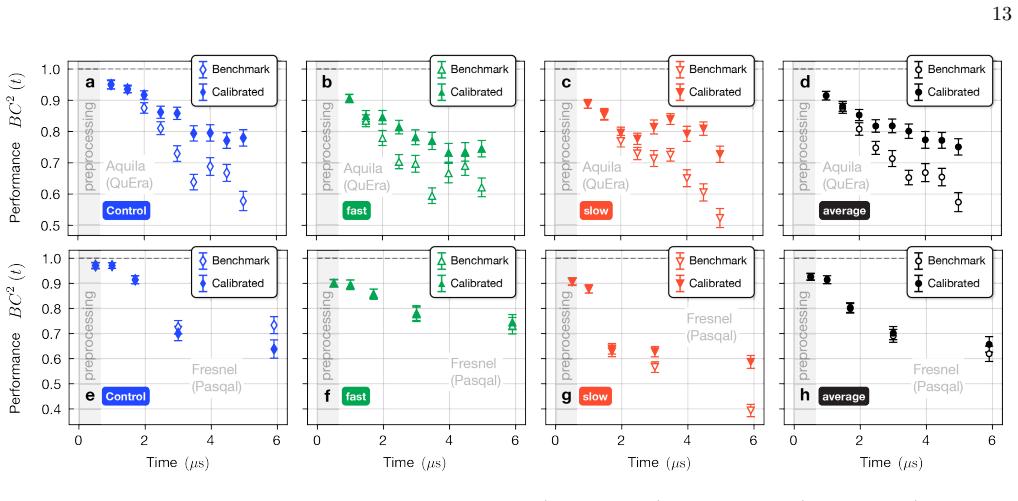
- The slow sequence acts as the decisive stress test: both devices score well on the control task but degrade markedly on the slow task, exposing preparation and control imperfections that coherent-regime fidelity alone hides.
- The fast/slow pair unambiguously separates the two control drifts—roughly 20% amplitude error on one device and 10% detuning error on the other—because their error contours cross transversely in the (δ,Ω) plane.
- Applying the time-resolved calibration corrections raises each device's benchmark score, and on one device the fast sequence gives a 2.5-fold speedup toward a 12%-error equilibrium sample, a target otherwise unreachable within the device's maximum schedule length.
- The method scales by design for this model: the transverse-field Ising chain with local dephasing has an exactly solvable relaxation spectrum, so fast and slow preprocessing can be designed for larger registers using only local measurements.
Where Pith is reading between the lines
- The protocol's reach depends on how well the assumed two-channel GKSL noise model matches reality: if the true noise has extra structure, the inferred corrections absorb model error rather than physical drift. The paper's own slow-sequence data on one processor are already incompatible with the model after about 2 µs, attributed to unmonitored laser-frequency drift—so an independent drift measurem
- The two devices' orthogonal drift profiles suggest that fast/slow relaxation data could serve as a per-device fingerprint, letting operators track slow environmental drift between calibration sessions without changing their measurement routine.
- A natural next test is to port the primitive to a platform with different decoherence channels—trapped ions or superconducting circuits—where the slowest-decaying mode is known; if the transfer works, the same pair of preprocessings could become a common cross-platform benchmark.
Editorial analysis
A structured set of objections, weighed in public.
Referee Report
Summary. The manuscript introduces a validation and calibration primitive for quantum simulators based on engineering the many-body quantum Mpemba effect. A global preprocessing unitary U(θ,φ) is applied to a six-atom Rydberg ring, with angles chosen by minimizing/maximizing the overlap with the slowest-decaying Liouvillian mode. The Bhattacharyya coefficient BC²(P,P_th) between measured and predicted computational-basis distributions is used as an upper bound on the quantum fidelity (Eq. 9). On QuEra Aquila and Pasqal Fresnel, the authors report a fast sequence overtaking a slow sequence despite starting farther from equilibrium (the Mpemba crossover), and use time-averaged (Eq. 10) and time-resolved (Eq. S.25) minimization to infer amplitude/detuning corrections, reporting roughly 20% amplitude error on Aquila and 10% detuning error on Fresnel.
Significance. The qualitative Mpemba crossover in Fig. 3a is model-agnostic, clearly presented, and convincing on both devices; this part of the paper is a solid experimental demonstration. The validation idea is attractive and measurement-frugal: it uses only computational-basis data, the Eq. (9) fidelity bound is correct, and the paper includes exact numerical diagonalization plus a data/code availability statement. If the calibration claim can be supported by out-of-sample evidence, the protocol would be a valuable transferable diagnostic. However, the central calibration conclusion currently rests on in-sample minimization and on a two-channel noise model whose rates are fitted to the same data, so the validation component is substantially more robust than the calibration component.
major comments (3)
- [Sequence calibration; Eq. (S.25), Fig. 4b] The time-resolved calibration is demonstrated only in-sample. Eq. (S.25) minimizes O(t_k) at keyframes t_k that are then re-scored in Fig. 4b and Fig. 9. Unless the corrected pulses were re-run on hardware, the improvement shown is a fit-quality measure on training data and is expected from minimization. The penalty weight p is not reported, and the magnitude of the inferred corrections depends on it. An out-of-sample hardware re-run, or at minimum a clear train/test split and the p value, is needed to support the claims of 'significant quality improvement' and 'directly actionable corrections'.
- [Table I caption; Eq. (10), Fig. 4c–d] The inferred drift profiles are model-dependent. The rates γ↓ and γ0 are fitted to the data (Table I), and P_th(t;δ,Ω) is constructed from this fitted two-channel GKSL model. Minimizing ε(δ,Ω) therefore yields parameters that make the data agree with the model, not necessarily physical control drifts. The headline 'complementary drift profiles' (Ω*/Ω0≈0.8, δ*/δ0≈0.9) may partly absorb model error. Independent characterization of the decoherence channels, or a robustness analysis varying γ↓ and γ0, is required before these numbers can be interpreted as control calibrations.
- [Fig. 3b and following paragraph] The Fresnel slow-sequence mismatch is explained by slow laser-frequency drift attributed to thermal fluctuations, but no independent drift measurement is presented. This attribution is load-bearing because drift is also the quantity the calibration procedure claims to correct. Please provide a direct drift measurement, or show that a time-dependent δ(t) fitted to the data resolves the discrepancy without introducing additional noise channels. Without this, the Fresnel calibration results remain one possible interpretation among several.
minor comments (4)
- [Eq. (S.15)] The target Hamiltonian contains σ_i^z σ_i^z; it should presumably be σ_i^z σ_j^z. Please correct.
- [Abstract/Conclusions] There are typos: 'where where' appears in the Main text after Eq. (1), and 'Frensel' appears in the Conclusions. The phrase 'first demonstration in many-body open quantum system' should be carefully qualified, since Refs. [30,31] already discuss the quantum Mpemba effect; specify exactly what is claimed as first.
- [Eq. (10)] The number of keyframes m in Eq. (10) is not explicitly defined in the main text; define it explicitly.
- [Fig. 8 and Fig. 9] Fig. 8 shows time-resolved drifts for Aquila only, while the text says the routine was applied to both devices. Clarify whether Fresnel time-resolved results are available and, if so, where they are shown.
Circularity Check
Calibration improvement is demonstrated in-sample: Eq. (S.25) minimizes loss on the same keyframes later re-scored, and theory curves use noise rates fitted to the same data.
specific steps
-
fitted input called prediction
[Sequence calibration; Methods: Calibration, Eq. (S.25); Figs. 4b and 9]
"To perform time-resolved calibration, we use a greedy minimization method. Starting from the first measurement keyframe t1, we minimize the objective function O(tk) := 1−BC2[P(tk), Pth(tk)] + p(δ2(tk)+Ω2(tk)) ... at each measurement keyframe tk ∈ {t1,···,tm} ... we obtain the time-resolved calibrated pulses ... and use them to re-evaluate the quality of each device, as shown in Fig. 4 and in Fig. 9 ... Notably, calibration results in significant quality improvement on each device."
The objective minimized in Eq. (S.25) is exactly the loss 1−BC2 evaluated at the same keyframes tk that are then re-scored after calibration in Fig. 4b and Fig. 9. As written, the calibrated pulses are selected to make BC2 large on the training keyframes; the improvement is an in-sample fit-quality consequence of the minimization, not an out-of-sample prediction. The text does not state that the corrected pulses were re-run on hardware, and the penalty weight p is unreported, so the magnitude of the 'significant quality improvement' is not independently constrained.
-
fitted input called prediction
[Table I caption; Fig. 3 caption; Eqs. (8)–(10)]
"The relaxation and dephasing rate parameters γ↓ and γ0 ... cannot be programmed. Their values are fitted to the data starting from the rates reported by QuEra and Pasqal, with an excellent agreement to their nominal value. ... The dashed lines represent expected excitation density dynamics obtained by exact numerical solution of the simulated sequence calibrated to each device (see Tab. I and II)."
Pth(t) and Pth(∞) are the reference objects in the benchmark BC(P,Pth), in the Mpemba distance ∥P(t)−Pth(∞)∥, and in the calibration loss ε(δ,Ω). These reference configurations are generated by the GKSL model after fitting γ↓ and γ0 to the measured data (Table I). Thus the benchmark partly measures self-consistency with a data-fitted model rather than agreement with independent first-principles predictions. The model-agnostic excitation-density crossover in Fig. 3a is not affected, so this is a partial, not total, circularity.
-
other
[Evidence of quantum Mpemba effect; Sequence calibration]
"We attribute deviations from theory in of the slow sequence on Fresnel to frequency drift in the control laser fields likely due to thermal fluctuations of the device [50–53]. ... Instead, amplitude and detuning calibration results shown in Fig. 4 indicate that the effect is compatible with frequency drifts of the control lasers."
The existence and magnitude of the drift are inferred from the same dataset via the calibration minima (δ*, Ω*) and then invoked to explain the slow-sequence mismatch; no independent drift measurement is reported. The explanation is therefore a consistency check with the fitted model, not independent confirmation. This weakens the claim that the inferred 'complementary drift profiles' are real control errors rather than absorbed model error.
full rationale
Most of the derivation is not circular: Eq. (9) is a known information-theoretic inequality, the raw excitation-density crossover in Fig. 3a is a model-agnostic Mpemba signature, and the preprocessing construction is defined from the model without being equivalent to the final benchmark. However, the central calibration claim is partially circular. Eq. (S.25) minimizes the same loss on the same keyframes that are later re-scored; the paper does not state that the calibrated pulses were re-run on hardware, so the reported 'quality improvement' is an in-sample fit outcome. Likewise, the theoretical reference Pth used for benchmarking and calibration is computed with γ↓ and γ0 fitted to the same data (Table I), so the BC2 score partly measures agreement with a data-calibrated model. The Fresnel slow-sequence drift explanation also leans on the fitted calibration results. There is no load-bearing self-citation chain; the issue is fitted parameters renamed as predictions. Score 5 reflects a real but partial circularity: the validation component has independent content, while the headline calibration improvement and drift profiles are not yet out-of-sample validated.
Axiom & Free-Parameter Ledger
free parameters (10)
- Relaxation rate gamma_down (Aquila) =
0.013 MHz
- Dephasing rate gamma_0 (Aquila) =
0.10782 MHz
- Relaxation rate gamma_down (Fresnel) =
0.010 MHz
- Dephasing rate gamma_0 (Fresnel) =
0.22222 MHz
- Calibrated amplitude Omega* (Aquila) =
0.46(3) MHz (target 0.58(4))
- Calibrated detuning delta* (Aquila) =
0.84(9) MHz (target 0.86(4))
- Calibrated amplitude Omega* (Fresnel) =
0.57(2) MHz (target 0.58(4))
- Calibrated detuning delta* (Fresnel) =
0.74(4) MHz (target 0.86(5))
- Preprocessing angles (theta, phi) for fast and slow sequences =
Not stated numerically; encoded in Fig. 6 sequences
- Time-resolved calibration penalty weight p =
Unspecified
axioms (5)
- domain assumption The devices' noise is accurately described by a local GKSL master equation with amplitude damping and dephasing in the z-basis (Eqs. 2-4).
- standard math The Liouvillian superoperator L is diagonalizable (spectral decomposition Eq. (S.11) holds with right/left eigen-matrices).
- domain assumption The mapping (Omega, delta, C6/r0^6, gamma0, gamma_down) -> (2Gamma, 4V, 4V, gamma0, gamma_down) (Eq. S.16) implements the target dissipative Ising model under global addressing.
- domain assumption The master-equation equilibrium P_th(infinity) (Eq. S.24) is the true asymptotic state of the device, i.e., the device is ergodic under its actual noise.
- ad hoc to paper The Fresnel slow-sequence discrepancy is caused by slow laser frequency drift (thermal), not by unmodeled noise or atom loss.
Cite this review
Pith. "Pith review of Validation and calibration of quantum hardware through the many-body quantum Mpemba effect." pith.science (2026). https://pith.science/paper/Q36SZZHT
@misc{pith2026260801788,
  author       = {Pith},
  title        = {Pith review of: Validation and calibration of quantum hardware through the many-body quantum Mpemba effect},
  year         = {2026},
  howpublished = {\url{https://pith.science/paper/Q36SZZHT}},
  note         = {Machine review of arXiv:2608.01788}
}
read the original abstract
We introduce a validation process that harnesses engineered many-body relaxation to control and calibrate quantum hardware. On two independently developed neutral-atom processors, we realize the many-body quantum Mpemba effect in an open system for the first time. Initial-state engineering creates fast and slow relaxation pathways: the fast pathway opens access to unreachable mixed-state physics before hardware noise obscures the target dynamics, whereas the slow pathway amplifies hidden imperfections in preparation and control. Computational-basis measurements directly and independently benchmark dynamical reliability, revealing each processor's actual operating window as a many-body simulator. The processors are thus judged by the very dynamics they are built to reproduce. Complementary responses disentangle control errors and drive an adaptive, time-resolved scheme that supplies hardware developers directly actionable corrections, enhancing faithful reproduction of the target dynamics. These results establish many-body relaxation as a transferable validation and calibration tool for programmable quantum processors.
Figures



Reference graph
Works this paper leans on
-
[1]
T. Haigh and P. E. Ceruzzi,A New History of Modern Computing(MIT Press, Cambridge, MA, 2021). 12 FIG. 7.Error landscape for time-averaged calibration.Heatmap of the mean error landscapes ε(δ,Ω) defined in Eq. (10) for each control (blue), fast (green) and slow (red) sequences, as well as for their average (white), on both Aquila (a) and Fresnel (b). The l...
work page 2021
-
[2]
J. Bardeen and W. H. Brattain, The transistor, a semi- conductor triode, Physical Review74, 230 (1948)
work page 1948
-
[3]
M. Riordan, L. Hoddeson, and C. Herring, The invention of the transistor, Rev. Mod. Phys.71, S336 (1999)
work page 1999
-
[4]
T. D. Ladd, F. Jelezko, R. Laflamme, Y. Nakamura, C. Monroe, and J. L. O’Brien, Quantum computers, Na- ture464, 45 (2010)
2010
-
[5]
N. P. de Leon, K. M. Itoh, D. Kim, K. K. Mehta, T. E. Northup, H. Paik, B. S. Palmer, N. Samarth, S. Sangtawesin, and D. W. Steuerman, Materials chal- lenges and opportunities for quantum computing hard- ware, Science372, eabb2823 (2021)
2021
-
[6]
Y. Kim, A. Eddins, S. Anand, K. X. Wei, E. van den Berg, S. Rosenblatt, H. Nayfeh, Y. Wu, M. Zaletel, K. Temme, and A. Kandala, Evidence for the utility of quantum computing before fault tolerance, Nature618, 500 (2023)
2023
-
[7]
K. R. Brown, J. Chiaverini, J. M. Sage, and H. H¨ affner, Materials challenges for trapped-ion quantum computers, Nature Reviews Materials6, 892 (2021)
work page 2021
-
[8]
M. Malinowski, D. Allcock, and C. Ballance, How to wire a 1000-qubit trapped-ion quantum computer, PRX Quantum4, 040313 (2023)
work page 2023
-
[9]
Foss-Feig, G
M. Foss-Feig, G. Pagano, A. C. Potter, and N. Y. Yao, Progress in trapped-ion quantum simulation, Annual Re- view of Condensed Matter Physics16, 145 (2025)
2025
-
[10]
Kjaergaard, M
M. Kjaergaard, M. E. Schwartz, J. Braum¨ uller, P. Krantz, J. I.-J. Wang, S. Gustavsson, and W. D. Oliver, Superconducting qubits: Current state of play, Annual Review of Condensed Matter Physics11, 369 (2020)
2020
-
[11]
S. Bravyi, O. Dial, J. M. Gambetta, D. Gil, and Z. Nazario, The future of quantum computing with su- perconducting qubits, Journal of Applied Physics132, 13 FIG. 9.Benchmarking and calibration results.Benchmark (open markers) and calibrated (filled markers) results for Aquila (top row) and Fresnel (bottom row) under three preprocessing regimes, control (b...
work page 2022
-
[12]
R. Acharya, D. A. Abanin, L. Aghababaie-Beni, I. Aleiner, T. I. Andersen, M. Ansmann, F. Arute, K. Arya, A. Asfaw, Astrakhantsev,et al., Quantum error correction below the surface code threshold, Nature638, 920 (2025)
work page 2025
-
[13]
Slussarenko and G
S. Slussarenko and G. J. Pryde, Photonic quantum in- formation processing: A concise review, Applied Physics Reviews6, 41303 (2019)
2019
-
[14]
J. Wang, F. Sciarrino, A. Laing, and M. G. Thompson, Integrated photonic quantum technologies, Nature Pho- tonics14, 273 (2020)
2020
- [15]
-
[16]
Henriet, L
L. Henriet, L. Beguin, A. Signoles, T. Lahaye, A. Browaeys, G.-O. Reymond, and C. Jurczak, Quantum computing with neutral atoms, Quantum4, 327 (2020)
2020
-
[18]
Radnaev, W
A. Radnaev, W. Chung, D. Cole, D. Mason, T. Bal- lance, M. Bedalov, D. Belknap, M. Berman, M. Blakely, I. Bloomfield, P. Buttler, C. Campbell, A. Chopinaud, E. Copenhaver, M. Dawes, S. Eubanks, A. Friss, D. Gar- cia, J. Gilbert, M. Gillette, P. Goiporia, P. Gokhale, J. Goldwin, D. Goodwin, T. Graham, C. Guttormsson, G. Hickman, L. Hurtley, M. Iliev, E. Jo...
2025
-
[19]
M. Christandl and R. Renner, Reliable quantum state tomography, Phys. Rev. Lett.109, 120403 (2012). 14
work page 2012
-
[20]
Q. H. Tran and K. Nakajima, Learning temporal quan- tum tomography, Phys. Rev. Lett.127, 260401 (2021)
work page 2021
-
[21]
Caprotti, J
A. Caprotti, J. Morris, and B. Daki´ c, Optimizing quan- tum tomography via shadow inversion, Phys. Rev. Res. 6, 033301 (2024)
2024
-
[22]
Knill, D
E. Knill, D. Leibfried, R. Reichle, J. Britton, R. B. Blakestad, J. D. Jost, C. Langer, R. Ozeri, S. Seidelin, and D. J. Wineland, Randomized benchmarking of quan- tum gates, Phys. Rev. A77, 012307 (2008)
2008
-
[23]
M. P. da Silva, O. Landon-Cardinal, and D. Poulin, Prac- tical characterization of quantum devices without tomog- raphy, Phys. Rev. Lett.107, 210404 (2011)
2011
-
[24]
Proctor, S
T. Proctor, S. Seritan, K. Rudinger, E. Nielsen, R. Blume-Kohout, and K. Young, Scalable randomized benchmarking of quantum computers using mirror cir- cuits, Phys. Rev. Lett.129, 150502 (2022)
2022
-
[25]
Eisert, D
J. Eisert, D. Hangleiter, N. Walk, I. Roth, D. Markham, R. Parekh, U. Chabaud, and E. Kashefi, Quantum cer- tification and benchmarking, Nature Reviews Physics2, 382 (2020)
2020
-
[26]
M. Cattaneo, M. A. Rossi, G. Garc ´ ıa-P´ erez, R. Zam- brini, and S. Maniscalco, Quantum simulation of dissipa- tive collective effects on noisy quantum computers, PRX Quantum4, 010324 (2023)
work page 2023
-
[27]
J. D. Guimar˜ aes, J. Lim, M. I. Vasilevskiy, S. F. Huelga, and M. B. Plenio, Noise-assisted digital quantum simu- lation of open systems using partial probabilistic error cancellation, PRX Quantum4, 040329 (2023)
2023
-
[28]
Fazio, J
R. Fazio, J. Keeling, L. Mazza, and M. Schir` o, Many- body open quantum systems, SciPost Phys. Lect. Notes , 99 (2025)
2025
-
[29]
K. Macieszczak, D. C. Rose, I. Lesanovsky, and J. P. Gar- rahan, Theory of classical metastability in open quantum systems, Physical Review Research3, 1 (2021)
work page 2021
-
[30]
Moroder, O
M. Moroder, O. Culhane, K. Zawadzki, and J. Goold, Thermodynamics of the quantum mpemba effect, Phys. Rev. Lett.133, 140404 (2024)
2024
-
[31]
F. Ares, P. Calabrese, and S. Murciano, The quantum mpemba effects, Nature Reviews Physics , 1 (2025)
2025
-
[32]
G. Teza, J. Bechhoefer, A. Lasanta, O. Raz, and M. Vucelja, Speedups in nonequilibrium thermal relax- ation: Mpemba and related effects, Physics Reports 1164, 1 (2026)
2026
-
[33]
Beato and G
N. Beato and G. Teza, Relaxation control of open quan- tum systems, Phys. Rev. Lett.136, 070401 (2026)
2026
-
[34]
J. Wurtz, A. Bylinskii, B. Braverman, J. Amato-Grill, S. H. Cantu, F. Huber, A. Lukin, F. Liu, P. Weinberg, J. Long,et al., Aquila: Quera’s 256-qubit neutral-atom quantum computer, arXiv:2306.11727 (2023)
Pith/arXiv arXiv 2023
-
[35]
Silv´ erio, S
H. Silv´ erio, S. Grijalva, C. Dalyac, L. Leclerc, P. J. Kar- alekas, N. Shammah, M. Beji, L.-P. Henry, and L. Hen- riet, Pulser: An open-source package for the design of pulse sequences in programmable neutral-atom arrays, Quantum6, 629 (2022)
2022
-
[36]
M. A. Nielsen and I. L. Chuang,Quantum Computation and Quantum Information(Cambridge University Press,
-
[37]
J. M. Renes, R. Blume-Kohout, A. J. Scott, and C. M. Caves, Symmetric informationally complete quantum measurements, Journal of Mathematical Physics45, 2171 (2004)
work page 2004
-
[38]
Mori, Floquet states in open quantum systems, An- nual Review of Condensed Matter Physics14, 35 (2023)
T. Mori, Floquet states in open quantum systems, An- nual Review of Condensed Matter Physics14, 35 (2023)
2023
- [39]
-
[40]
T. Kadowaki and H. Nishimori, Quantum annealing in the transverse ising model, Physical Review E58, 5355 (1998)
work page 1998
-
[41]
Peruzzo, J
A. Peruzzo, J. McClean, P. Shadbolt, M.-H. Yung, X.-Q. Zhou, P. J. Love, A. Aspuru-Guzik, and J. L. O’Brien, A variational eigenvalue solver on a photonic quantum processor, Nature Communications5, 4213 (2014)
2014
-
[42]
H. Erbin, P.-L. Burdeau, C. Bertrand, T. Ayral, and G. Misguich, Many-body quantum score: a scalable benchmark for digital and analog quantum processors and first test on a commercial neutral atom device, arXiv:2601.03461 (2026)
arXiv 2026
-
[43]
Watrous,The Theory of Quantum Information(Cam- bridge University Press, 2018)
J. Watrous,The Theory of Quantum Information(Cam- bridge University Press, 2018)
2018
-
[44]
O. G¨ uhne, C.-Y. Lu, W.-B. Gao, and J.-W. Pan, Tool- box for entanglement detection and fidelity estimation, Physical Review A76, 030305(R) (2007)
work page 2007
-
[45]
M. Seevinck and J. Uffink, Partial separability and entan- glement criteria for multiqubit quantum states, Physical Review A78, 032101 (2008)
work page 2008
-
[46]
S. T. Flammia and Y.-K. Liu, Direct fidelity estima- tion from few pauli measurements, Phys. Rev. Lett.106, 230501 (2011)
2011
-
[47]
S. Kochsiek, F. Carollo, and I. Lesanovsky, Accelerat- ing the approach of dissipative quantum spin systems towards stationarity through global spin rotations, Phys- ical Review A106, 012207 (2022)
work page 2022
-
[48]
Breuer and F
H.-P. Breuer and F. Petruccione,The Theory of Open Quantum Systems(Oxford University Press, 2002)
2002
-
[49]
Campaioli,Tightening Time-Energy Uncertainty Re- lations, Ph.D
F. Campaioli,Tightening Time-Energy Uncertainty Re- lations, Ph.D. thesis, Monash University (2020)
work page 2020
-
[50]
J. Yang, X. He, R. Guo, P. Xu, K. Wang, C. Sheng, M. Liu, J. Wang, A. Derevianko, and M. Zhan, Coherence preservation of a single neutral atom qubit transferred between magic-intensity optical traps, Phys. Rev. Lett. 117, 123201 (2016)
work page 2016
-
[51]
Proctor, M
T. Proctor, M. Revelle, E. Nielsen, K. Rudinger, D. Lob- ser, P. Maunz, R. Blume-Kohout, and K. Young, Detect- ing and tracking drift in quantum information processors, Nature Communications11, 5396 (2020)
2020
-
[52]
S. J. Evered, D. Bluvstein, M. Kalinowski, S. Ebadi, T. Manovitz, H. Zhou, S. H. Li, A. A. Geim, T. T. Wang, N. Maskara, H. Levine, G. Semeghini, M. Greiner, V. Vuleti´ c, and M. D. Lukin, High-fidelity parallel entan- gling gates on a neutral-atom quantum computer, Nature 622, 268 (2023)
2023
-
[53]
J.-R. Chen, Y.-H. Chang, and Y.-W. Liu, A custom-built high-finesse reference cavity for cold Rydberg atom exci- tation, Applied Physics B131, 169 (2025)
work page 2025
- [54]
-
[55]
P. C. Lotshaw, G. Siopsis, J. Ostrowski, R. Herrman, R. Alam, S. Powers, and T. S. Humble, Approximate boltzmann distributions in quantum approximate opti- mization, Phys. Rev. A108, 042411 (2023)
work page 2023
-
[56]
N. Al-Kayed, C. St-Arnault, H. Morison, A. Aadhi, C. Huang, A. N. Tait, D. V. Plant, and B. J. Shastri, Pro- grammable 200 GOPS Hopfield-inspired photonic Ising machine, Nature648, 576 (2025). 15
work page 2025
- [57]
- [58]
-
[59]
Zhang, G
J. Zhang, G. Pagano, P. W. Hess, A. Kyprianidis, P. Becker, H. Kaplan, A. V. Gorshkov, Z.-X. Gong, and C. Monroe, Observation of a many-body dynamical phase transition with a 53-qubit quantum simulator, Nature 551, 601 (2017)
2017
-
[60]
T. I. Andersen, N. Astrakhantsev, A. H. Karamlou, J. Berndtsson, J. Motruk, A. Szasz, J. A. Gross, A. Schuckert, T. Westerhout, Y. Zhang, E. Forati, Rossi,et al., Thermalization and criticality on an ana- logue–digital quantum simulator, Nature638, 79 (2025)
work page 2025
-
[61]
G. Teza, F. Campaioli, M. Avesani, and O. Raz, Finite-temperature criticality through quantum anneal- ing, arXiv:2507.07167 (2025)
Pith/arXiv arXiv 2025
-
[62]
M. H. Amin, E. Andriyash, J. Rolfe, B. Kulchytskyy, and R. Melko, Quantum boltzmann machine, Phys. Rev. X 8, 021050 (2018)
2018
-
[63]
C. A. Fuchs,Distinguishability and Accessible Informa- tion in Quantum Theory, Ph.D. thesis, University of New Mexico, Albuquerque, NM (1996)
work page 1996
-
[64]
M. Rossignolo, T. Reisser, A. Marshall, P. Rembold, A. Pagano, P. J. Vetter, R. S. Said, M. M. M¨ uller, F. Mot- zoi, T. Calarco, F. Jelezko, and S. Montangero, Quocs: The quantum optimal control suite, Computer Physics Communications291, 108782 (2023)
work page 2023
-
[65]
Ansel, E
Q. Ansel, E. Dionis, F. Arrouas, B. Peaudecerf, S. Gu´ erin, D. Gu´ ery-Odelin, and D. Sugny, Introduction to theoretical and experimental aspects of quantum op- timal control, Journal of Physics B: Atomic, Molecular and Optical Physics57, 133001 (2024)
2024
- [66]
-
[67]
Prosen, Third quantization: a general method to solve master equations for quadratic open fermi systems, New Journal of Physics10, 043026 (2008)
T. Prosen, Third quantization: a general method to solve master equations for quadratic open fermi systems, New Journal of Physics10, 043026 (2008)
2008
-
[68]
D. Roberts and A. A. Clerk, Exact solution of the infinite- range dissipative transverse-field ising model, Phys. Rev. Lett.131, 190403 (2023)
work page 2023
-
[69]
M. Foss-Feig, K. R. A. Hazzard, J. J. Bollinger, and A. M. Rey, Nonequilibrium dynamics of arbitrary-range ising models with decoherence: An exact analytic solution, Phys. Rev. A87, 042101 (2013)
work page 2013
-
[70]
Pawsey Supercomputing Research Centre, Setonix Su- percomputer (2023)
work page 2023
-
[71]
F. Campaioli, J. H. Cole, and H. Hapuarachchi, Quantum Master Equations: Tips and Tricks for Quantum Optics, Quantum Computing, and Beyond, PRX Quantum5, 020202 (2024)
work page 2024
-
[72]
Koch, Christiane P., Boscain, Ugo, Calarco, Tom- maso, Dirr, Gunther, Filipp, Stefan, Glaser, Stef- fen J., Kosloff, Ronnie, Montangero, Simone, Schulte- Herbr¨ uggen, Thomas, Sugny, Dominique, and Wilhelm, Frank K., Quantum optimal control in quantum tech- nologies. Strategic report on current status, visions and goals for research in Europe, EPJ Quantum...
work page 2022
-
[73]
K. Macieszczak, M. Guta, I. Lesanovsky, and J. P. Gar- rahan, Towards a Theory of Metastability in Open Quan- tum Dynamics, Physical Review Letters116, 1 (2016)
work page 2016
-
[74]
Carollo, A
F. Carollo, A. Lasanta, and I. Lesanovsky, Exponentially accelerated approach to stationarity in markovian open quantum systems through the mpemba effect, Phys. Rev. Lett.127, 060401 (2021)
2021
-
[75]
Nava and R
A. Nava and R. Egger, Mpemba effects in open nonequi- librium quantum systems, Phys. Rev. Lett.133, 136302 (2024)
2024
-
[76]
J. R. Johansson, P. D. Nation, and F. Nori, QuTiP: An open-source Python framework for the dynamics of open quantum systems, Computer Physics Communications 183, 1760 (2012)
2012
-
[77]
Qadence: a differentiable interface for digital-analog programs
D. Seitz, N. Heim, Jo˜ ao P. Moutinho, R. Guichard, V. Abramavicius, A. Wennersteen, G. Both, A. Quelle, C. de Groot, Gergana V. Velikova, Vincent E. Elfving, and Mario Dagrada, Qadence: a differentiable interface for digital-analog programs., arXiv:2401.09915 (2024)
work page internal anchor Pith review Pith/arXiv arXiv 2024
discussion (0)
Sign in with ORCID, Apple, or X to comment. Anyone can read and Pith papers without signing in.