REVIEW 4 major objections 5 minor 3 cited by
Why Does ChatGPT "Delve" So Much? Exploring the Sources of Lexical Overrepresentation in Large Language Models
T0 review · 4 major / 5 minor · reviewed 2026-08-11 · deepseek-v4-flash
Pith's one-line read Recent spikes in words like 'delve' in scientific abstracts are likely LLM-driven, and a new method isolates 21 such words.
desk verdict A genuinely transferable method for spotting LLM-typical words; the causal story is plausible but the missing pre-LLM control keeps it from being settled. read the letter →
The pith
A machine-rendered reading of the paper's core claim, the machinery that carries it, and where it could break.
The reading
What carries the argument
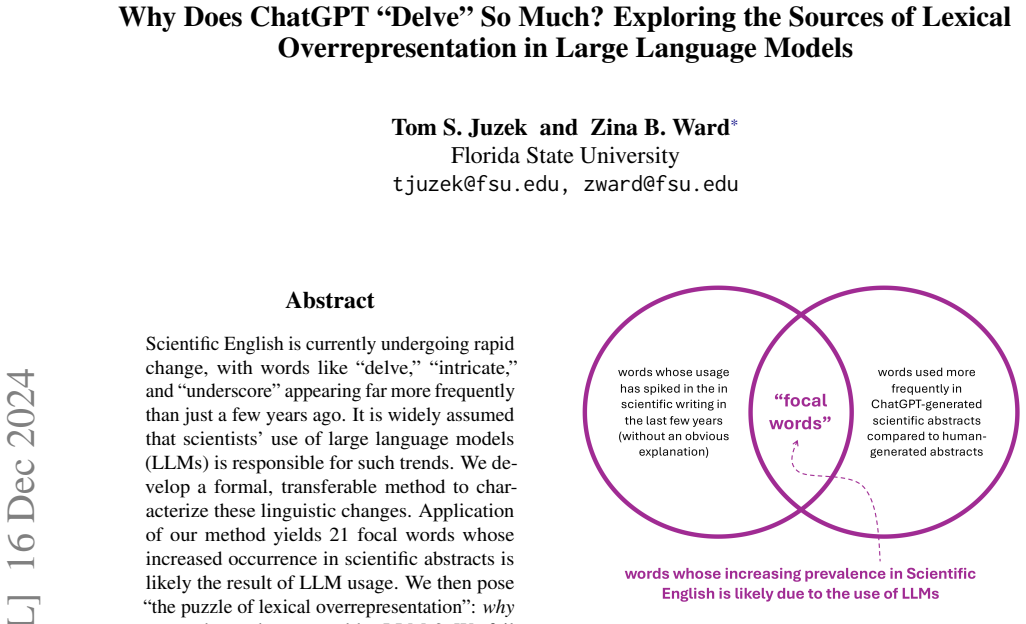
The load-bearing mechanism is a three-step screening pipeline. Step 1 counts occurrences per million tokens in PubMed abstracts for 1975 through May 2024 and keeps roughly 7,300 tokens with a significant $\chi^2$ increase between 2020 and 2024. Step 2 filters this list by hand to 50 tokens whose spike lacks an obvious explanation in science or world events. Step 3 generates 9,953 AI abstracts from 10,000 real 2020 PubMed abstracts using a two-stage ChatGPT-3.5 prompt (summarize, then write an abstract from the summary), tests each candidate token for significant overuse with a $\chi^2$ comparison against the human originals, and keeps the 21 tokens that pass all three gates. A secondary instrument is per-word entropy, computed for Llama 2-Base and Llama 2-Chat on the same human and AI abstracts; the entropy gap between the two models is used to isolate fine-tuning and RLHF as the factor that differs.
What would settle it
The cleanest test: rerun the three-step pipeline on the same PubMed years but with a different way of generating AI abstracts, for example feeding ChatGPT-3.5 the full abstract text instead of a summary, or prompting it to paraphrase rather than expand notes. If the 21 focal words no longer emerge as overused, the focal list is an artifact of the specific two-stage prompt rather than a property of LLM-assisted scientific writing. A second decisive observation would be a transparency audit of an RLHF training run showing whether responses containing 'delve' actually received higher human feedback scores than matched responses without it; if they did not, RLHF cannot be the cause.
Extended reading notes
Core claim
On the paper's own terms, the central discovery is that a substantial share of the recent lexical shift in biomedical abstracts can be attributed to LLM assistance, embodied in 21 focal words whose increase is significant, unexplained by external events, and mirrored by statistically significant overuse in ChatGPT-3.5-generated abstracts. The authors do not claim to have fully solved 'the puzzle of lexical overrepresentation': they find no evidence that architecture, tokenization or other algorithms, or training and fine-tuning data explain the overuse. Comparison of Llama 2-Base with Llama 2-Chat, which differ mainly in fine-tuning and RLHF, shows that the chat model is considerably less 'surprised' (lower per-word entropy) by AI-generated abstracts containing focal words, which is consistent with RLHF contributing to the overuse. Their online preference study failed to show an overall preference for abstracts containing focal words and found that when 'delve' opened the abstract, participants significantly preferred the version without it, which the authors interpret as public wariness toward that particular word.
Load-bearing premise
The load-bearing premise is that the authors' hand-screening of 'unexplained' spikes is reliable, and that their two-stage ChatGPT-3.5 summarize-then-expand task approximates how scientists actually used LLMs in 2022-2024; the authors state this only as a suspicion, and if real usage differed, the 21 focal words could be an artifact of their pipeline rather than a genuine LLM-driven shift.
Editorial extensions
If this is right
- If the method is sound, the 21 focal words give a concrete, measurable fingerprint of LLM-assisted writing in biomedical abstracts; the same fingerprint can be computed for other corpora and years.
- Because almost all focal words were already rising before ChatGPT, the paper implies LLMs are accelerating an existing lexical drift rather than inventing it from scratch.
- If RLHF- or fine-tuning-driven overuse is real, then the preference of human raters for certain words has directly shaped machine vocabulary, and future rounds of feedback will reshape it again.
- The 'delve' effect suggests public discourse about AI-typical words can feed back into human preferences, potentially changing the next round of RLHF data.
- The method can be transferred to LLMs other than ChatGPT-3.5, and the paper's appendix shows GPT-4o-mini behaves similarly for most focal words.
Reading between the lines
- The method could be run on non-English scientific corpora to see whether LLM-driven lexical overrepresentation is a universal phenomenon of current models or an artifact of English-language training.
- If 'delve' is becoming socially marked, one testable prediction is that its frequency in LLM outputs should decline over time as RLHF raters begin to penalize it; monitoring deployed model versions would settle this.
- The paper's 'decoupling of form and content' hypothesis implies that other stylistic tics of LLMs, such as bullet-point structure or hedging phrases, might be detectable by the same spike-and-overuse screening, extending the tool beyond single words.
- A stronger experiment would compare preference ratings for focal words embedded in otherwise identical abstracts varying only the word, avoiding the forced-insertion artifacts the authors identify; that design would directly estimate the RLHF reward signal.
Signed reviews
Editorial analysis
A structured set of objections, weighed in public.
Referee Report
Summary. This paper develops a formal, transferable method for identifying lexical items whose increased occurrence in scientific abstracts is plausibly attributable to LLM usage. The method combines (a) a chi-square-based spike in PubMed abstracts between 2020 and 2024, (b) a manual 'unexplained spike' annotation, and (c) significant overuse by ChatGPT-3.5 in a two-stage summarize-then-expand abstract-generation task, yielding 21 focal words. The paper then explores why these words are overused, finding no supporting evidence for architecture, algorithms, or training data, and mixed evidence regarding RLHF: a Llama 2-Base vs. Llama 2-Chat entropy comparison is consistent with an RLHF contribution, while an exploratory Prolific study shows a significant aversion to 'delve' when it appears in the first sentence but no overall preference for focal-word abstracts.
Significance. If the central claim holds, the paper provides a reproducible and transferable method for detecting LLM-driven lexical change in scientific writing, and it offers a clearly posed 'puzzle of lexical overrepresentation' with initial probes into causal factors. The manuscript is unusually transparent: the full pipeline is described, code and stimuli are on GitHub, the authors explicitly acknowledge the limitations of the Llama entropy comparison and the exploratory nature of the human study, and the absence of evidence for architecture- or data-based explanations is honestly reported. The empirical finding that human participants react differently to 'delve' than to other focal words is a useful, falsifiable observation for future work. The main weakness is that the causal attribution of the 21 focal words to LLM usage is not calibrated against a pre-LLM negative control, and the manual annotation and prompt-design choices are load-bearing but unvalidated.
major comments (4)
- [Section 2] The three-step method has no negative control. Applying the same pipeline to a pre-LLM pair of years (e.g., 2016 vs. 2018) would presumably produce a set of words that show an unexplained spike and are overused by ChatGPT-3.5, yet those words' increased occurrence would not be caused by LLM usage. Because the central claim is that the 21 focal words' increased occurrence is 'likely the result of LLM usage,' the paper needs to report such a control and estimate the false-positive rate of the pipeline; without it, the causal attribution is not yet supported.
- [Section 2] The manual annotation of 'unexplained' spikes is load-bearing but lacks reliability evidence. The authors state that they 'independently reviewed' the list and 'in cases of disagreement, we included the word on our list,' but no inter-annotator agreement statistic is reported and the criteria for excluding words with 'an obvious explanation' are not operationalized. The maximally lenient disagreement rule is likely to bias the list toward false positives; please report agreement rates and provide a transparent, reproducible criterion for what counts as an unexplained spike.
- [Section 2] The two-stage prompt (summarize then expand) is justified only by the sentence, 'We suspect that the most common way of using an LLM to generate an abstract... involved providing important fragments of a paper.' This suspicion is load-bearing because the ChatGPT-overuse list in step 3 is entirely a function of the specific prompt design. If real LLM-assisted writing was done differently (e.g., direct generation, editing human prose, or other prompt styles), the 21 focal words could be artifacts of the pipeline. Please validate the assumption with evidence about actual usage, or at least show that the focal-word list is stable across plausible alternative prompt designs.
- [Section 5, Table 1] The Llama 2-Base vs. Llama 2-Chat entropy comparison does not isolate focal-word overrepresentation. The large drop in per-word entropy for AI abstracts in the chat model could be driven by any number of other stylistic properties of ChatGPT-generated text (e.g., formulaic sentence frames, reduced syntactic variety, or repetition of non-focal function words). The paper acknowledges this limitation in principle, but the conclusion that 'fine-tuning and RLHF... might be important contributors' to lexical overrepresentation specifically requires a test that controls for focal-word density, for example by comparing entropy for human abstracts with and without artificially inserted focal words, or by regressing entropy differences on focal-word frequency.
minor comments (5)
- [Section 2] The corpus description says 'more than 5.2 billion tokens (inflected forms)' but does not specify the tokenization or normalization procedure used on PubMed abstracts; please provide these details for reproducibility.
- [Appendix A and Table 2] The focal-word list appears both in Appendix A and in Table 2 with inconsistent column naming; please harmonize the two presentations or make one a cross-reference.
- [Section 6] The statement that 'considerably more than half' of the focal-word abstracts were delve-initial should be replaced with the exact proportion, and the criterion for 'first sentence' should be defined (e.g., the first sentence of the generated abstract).
- [Equation (1)] In the per-word entropy formula, the variables L, n, and the conditioning context are not defined; please clarify whether this is the average per-token entropy over a sequence and how the probability p(x_i) is computed.
- [Appendix D] The table rows labeled '8b Llama 3-Base' and '8b Llama 3.1-Base' are hard to parse; please format model names consistently (e.g., Llama 3 8B).
Circularity Check
No significant circularity: the focal-word list is an intersection of independent spike, annotation, and ChatGPT-overuse criteria, and the causal claim is an interpretation, not a fitted prediction.
full rationale
The paper's derivation chain is not circular. In Section 2, focal words are defined by three independent criteria: (a) a significant 2020–2024 opm spike in PubMed abstracts, (b) a manual judgment that the spike lacks an obvious explanation, and (c) significant overuse by ChatGPT-3.5 in a two-stage summarize-then-expand abstract-generation task. The central claim that these words' increased occurrence is likely due to LLM usage is an abductive interpretation of this intersection, not a logical consequence of the definition. The paper explicitly distinguishes unexplained spikes from LLM-induced spikes using the 'mash' example, so the causal conclusion is not forced by construction. The ChatGPT-overuse comparison is generated from 2020 abstracts and compared against those same abstracts, but the spike data come from the independent PubMed corpus; no parameter is fitted to the 2024 data and then renamed as a prediction. The RLHF comparisons in Section 5 and the preference experiment in Section 6 treat the focal words as fixed inputs and probe external behavior; their acknowledged limitations (e.g., 'delve-initial' items, prompting artifacts, and the necessarily limited Llama comparison) concern internal validity and evidential strength, not circularity. The only self-citation (Häussler and Juzek 2017, used for excluding excessively fast rating times) is a minor methodological reference and is not load-bearing. The absence of a pre-LLM negative control is a calibration concern for the causal claim, but it does not make the derivation circular because the method does not define the conclusion into its inputs.
Assumptions & free parameters
free parameters (1)
- Manual stop criterion for unexplained spiking words =
50 words
assumptions (5)
- domain assumption 2020 is a pre-LLM baseline for scientific abstract writing; LLM use before 2021 was negligible.
- domain assumption PubMed abstracts are representative enough of Scientific English to define focal words.
- domain assumption The two-stage ChatGPT-3.5 generation procedure approximates how researchers used LLMs to write abstracts in 2022-early 2024.
- domain assumption Llama 2-Base vs Llama 2-Chat differ mainly by fine-tuning and RLHF, so entropy differences can be attributed to those stages.
- ad hoc to paper Lower per-word entropy for AI abstracts in the chat model reflects focal-word overrepresentation rather than other stylistic properties.
Cite this review
Pith. "Pith review of Why Does ChatGPT "Delve" So Much? Exploring the Sources of Lexical Overrepresentation in Large Language Models." pith.science (2026). https://pith.science/paper/Q4NVFRZR
@misc{pith2026241211385,
  author       = {Pith},
  title        = {Pith review of: Why Does ChatGPT "Delve" So Much? Exploring the Sources of Lexical Overrepresentation in Large Language Models},
  year         = {2026},
  howpublished = {\url{https://pith.science/paper/Q4NVFRZR}},
  note         = {Machine review of arXiv:2412.11385}
}
read the original abstract
Scientific English is currently undergoing rapid change, with words like "delve," "intricate," and "underscore" appearing far more frequently than just a few years ago. It is widely assumed that scientists' use of large language models (LLMs) is responsible for such trends. We develop a formal, transferable method to characterize these linguistic changes. Application of our method yields 21 focal words whose increased occurrence in scientific abstracts is likely the result of LLM usage. We then pose "the puzzle of lexical overrepresentation": WHY are such words overused by LLMs? We fail to find evidence that lexical overrepresentation is caused by model architecture, algorithm choices, or training data. To assess whether reinforcement learning from human feedback (RLHF) contributes to the overuse of focal words, we undertake comparative model testing and conduct an exploratory online study. While the model testing is consistent with RLHF playing a role, our experimental results suggest that participants may be reacting differently to "delve" than to other focal words. With LLMs quickly becoming a driver of global language change, investigating these potential sources of lexical overrepresentation is important. We note that while insights into the workings of LLMs are within reach, a lack of transparency surrounding model development remains an obstacle to such research.
Figures


Figures from the paper (5 more)


Forward citations
Cited by 3 Pith papers
-
Artificial Epanorthosis: Why large language models overuse a classical rhetorical figure, and how to mitigate it
LLMs overuse the 'not X, but Y' self-correction pattern in persuasive registers and underuse it in informal Q&A; a prompt or a detachable LoRA dial adjusts it to human levels.
-
Word Overuse and Alignment in Large Language Models: The Influence of Learning from Human Feedback
People prefer text containing the words that an instruction-tuned model uses far more than its base version, linking human feedback training to LLM word overuse.
-
Domain Regeneration: How well do LLMs match syntactic properties of text domains?
LLM regenerations of Wikipedia, news, and ELI5 text show shifted means, lower variance, and reduced long tails on syntactic complexity metrics relative to human text.
Reference graph
Works this paper leans on
-
[1]
Sina Alemohammad, Josue Casco-Rodriguez, Lorenzo Luzi, Ahmed Imtiaz Humayun, Hossein Babaei, Daniel LeJeune, Ali Siahkoohi, and Richard G Baraniuk. 2023. Self-consuming generative models go mad. arXiv preprint arXiv:2307.01850
arXiv 2023
-
[2]
David Banks. 2017. The extent to which the passive voice is used in the scientific journal article, 1985--2015, functional linguistic, 4 (12), 2-17
work page 2017
-
[3]
Yuri Bizzoni, Stefania Degaetano-Ortlieb, Peter Fankhauser, and Elke Teich. 2020. Linguistic variation and change in 250 years of english scientific writing: A data-driven approach. Frontiers in Artificial Intelligence, 3:73
work page 2020
-
[4]
Martin Briesch, Dominik Sobania, and Franz Rothlauf. 2023. Large language models suffer from their own output: An analysis of the self-consuming training loop. arXiv preprint arXiv:2311.16822
arXiv 2023
-
[5]
Huzi Cheng, Bin Sheng, Aaron Lee, Varun Chaudhary, Atanas G Atanasov, Nan Liu, Yue Qiu, Tien Yin Wong, Yih-Chung Tham, and Ying-Feng Zheng. 2024. Have ai-generated texts from llm infiltrated the realm of scientific writing? a large-scale analysis of preprint platforms. bioRxiv, pages 2024--03
work page 2024
-
[6]
Wei-Lin Chiang, Lianmin Zheng, Ying Sheng, Anastasios Nikolas Angelopoulos, Tianle Li, Dacheng Li, Hao Zhang, Banghua Zhu, Michael Jordan, Joseph E. Gonzalez, and Ion Stoica. 2024. https://arxiv.org/abs/2403.04132 Chatbot arena: An open platform for evaluating llms by human preference . Preprint, arXiv:2403.04132
arXiv 2024
-
[7]
Paul F Christiano, Jan Leike, Tom Brown, Miljan Martic, Shane Legg, and Dario Amodei. 2017. Deep reinforcement learning from human preferences. Advances in neural information processing systems, 30
2017
-
[8]
Stefania Degaetano-Ortlieb, Hannah Kermes, Ashraf Khamis, and Elke Teich. 2018. An information-theoretic approach to modeling diachronic change in scientific english. In From data to evidence in English language research, pages 258--281. Brill
work page 2018
Show all 57 references
-
[9]
Stefania Degaetano-Ortlieb and Elke Teich. 2018. Using relative entropy for detection and analysis of periods of diachronic linguistic change. In Proceedings of the second joint SIGHUM workshop on computational linguistics for cultural heritage, social sciences, humanities and...
2018
-
[10]
Wikimedia Foundation. 2024. https://dumps.wikimedia.org/ Wikipedia dump . Accessed: 4 August 2024
2024
-
[11]
Mingmeng Geng, Caixi Chen, Yanru Wu, Dongping Chen, Yao Wan, and Pan Zhou. 2024. The impact of large language models in academia: from writing to speaking. arXiv preprint arXiv:2409.13686
2024 arXiv
-
[12]
Dirk Goldhahn, Thomas Eckart, Uwe Quasthoff, et al. 2012. Building large monolingual dictionaries at the leipzig corpora collection: From 100 to 200 languages. In LREC, volume 29, pages 31--43
2012
-
[13]
contamination
Andrew Gray. 2024. Chatgpt" contamination": estimating the prevalence of llms in the scholarly literature. arXiv preprint arXiv:2403.16887
2024 arXiv
-
[14]
Ryuichiro Hataya, Han Bao, and Hiromi Arai. 2023. Will large-scale generative models corrupt future datasets? In Proceedings of the IEEE/CVF International Conference on Computer Vision, pages 20555--20565
2023
-
[15]
a ussler and Tom Juzek. 2017. https://publikationen.uni-tuebingen.de/xmlui/handle/10900/77066 Hot topics surrounding acceptability judgement tasks . In S. Featherston, R. H \
Jana H \"a ussler and Tom Juzek. 2017. https://publikationen.uni-tuebingen.de/xmlui/handle/10900/77066 Hot topics surrounding acceptability judgement tasks . In S. Featherston, R. H \"o rnig, R. Steinberg, B. Umbreit, and J. Wallis, editors, Proceedings of Linguistic Evidence ...
2017
-
[16]
Alex Hern. 2024. https://www.theguardian.com/technology/2024/apr/16/techscape-ai-gadgest-humane-ai-pin-chatgpt TechScape: How cheap, outsourced labour in Africa is shaping AI English . Accessed: 2024-08-12
2024
-
[17]
Dan Jurafsky and James H. Martin. 2024. https://web.stanford.edu/ jurafsky/slp3/ Speech and Language Processing . Online draft. 3rd ed. draft, Feb 3, 2024 release
2024
-
[18]
Minkyung Kim and Scott A Crossley. 2018. Modeling second language writing quality: A structural equation investigation of lexical, syntactic, and cohesive features in source-based and independent writing. Assessing Writing, 37:39--56
2018
-
[19]
John Kirk and Gerald Nelson. 2018. The international corpus of english project: A progress report. World Englishes, 37(4):697--716
2018
-
[20]
Will Knight. 2017. The dark secret at the heart of ai
2017
-
[21]
Dmitry Kobak, Rita Gonz \'a lez M \'a rquez, Em o ke- \'A gnes Horv \'a t, and Jan Lause. 2024. Delving into chatgpt usage in academic writing through excess vocabulary. arXiv preprint arXiv:2406.07016
2024 arXiv
-
[22]
Patrick Koppenburg. 2024. Tweet on 01 april 2024. https://x.com/PKoppenburg/status/1774757167045788010. Accessed: 2024-08-12
2024
-
[23]
Marie-Pauline Krielke. 2024. Cross-linguistic dependency length minimization in scientific language: Syntactic complexity reduction in english and german in the late modern period. Languages in Contrast, 24(1):133--163
2024
-
[24]
Michael Kwet. 2019. Digital colonialism: Us empire and the new imperialism in the global south. Race & Class, 60(4):3--26
2019
-
[25]
Christoph Leiter, Ran Zhang, Yanran Chen, Jonas Belouadi, Daniil Larionov, Vivian Fresen, and Steffen Eger. 2024. Chatgpt: A meta-analysis after 2.5 months. Machine Learning with Applications, 16:100541
2024
-
[26]
Alvin Ping Leong. 2020. The passive voice in scientific writing through the ages: A diachronic study. Text & Talk, 40(4):467--489
2020
-
[27]
Weixin Liang, Zachary Izzo, Yaohui Zhang, Haley Lepp, Hancheng Cao, Xuandong Zhao, Lingjiao Chen, Haotian Ye, Sheng Liu, Zhi Huang, et al. 2024 a . Monitoring ai-modified content at scale: A case study on the impact of chatgpt on ai conference peer reviews. arXiv preprint arXi...
2024 arXiv
-
[28]
Weixin Liang, Yaohui Zhang, Zhengxuan Wu, Haley Lepp, Wenlong Ji, Xuandong Zhao, Hancheng Cao, Sheng Liu, Siyu He, Zhi Huang, et al. 2024 b . Mapping the increasing use of llms in scientific papers. arXiv preprint arXiv:2404.01268
2024 arXiv
-
[29]
Jialin Liu and Yi Bu. 2024. Towards the relationship between aigc in manuscript writing and author profiles: evidence from preprints in llms. arXiv preprint arXiv:2404.15799
2024 arXiv
-
[30]
Shayne Longpre, Robert Mahari, Anthony Chen, Naana Obeng-Marnu, Damien Sileo, William Brannon, Niklas Muennighoff, Nathan Khazam, Jad Kabbara, Kartik Perisetla, et al. 2024. A large-scale audit of dataset licensing and attribution in ai. Nature Machine Intelligence, 6(8):975--987
2024
-
[31]
Kentaro Matsui. 2024. Delving into pubmed records: Some terms in medical writing have drastically changed after the arrival of chatgpt. medRxiv, pages 2024--05
2024
-
[32]
Danielle S McNamara, Scott A Crossley, and Philip M McCarthy. 2010. Linguistic features of writing quality. Written communication, 27(1):57--86
2010
-
[33]
Katrin Menzel. 2022. Medical discourse in late modern english: Insights from a multidisciplinary corpus of scientific journal articles. In Corpus pragmatic studies on the history of medical discourse, pages 79--104. John Benjamins
2022
-
[34]
National Library of Medicine . 2023. PubMed Database . https://pubmed.ncbi.nlm.nih.gov/. Accessed: 2024-08-12
2023
-
[35]
Jeremy Nguyen. 2024. Tweet on 30 march 2024. https://x.com/JeremyNguyenPhD/status/1774021645709295840. Accessed: 2024-08-12
2024
-
[36]
Michael Novick. 2023. https://change-links.org/a-i-s-dirty-secret-its-powered-by-digital-sweatshops/ A.i.’s dirty secret: It’s powered by digital sweatshops . Blog post
2023
-
[37]
OpenAI. 2024. Tweet on 08 april 2024. https://x.com/ChatGPTapp/status/1777221658807521695. Accessed: 2024-08-12
2024
-
[38]
Katrin Ortmann, Adam Roussel, and Stefanie Dipper. 2021. Computational Historical Linguistics: Annotations, Tools & Corpora. Ruhr-Universit \"a t Bochum
2021
-
[39]
Long Ouyang, Jeffrey Wu, Xu Jiang, Diogo Almeida, Carroll Wainwright, Pamela Mishkin, Chong Zhang, Sandhini Agarwal, Katarina Slama, Alex Ray, et al. 2022. Training language models to follow instructions with human feedback. Advances in neural information processing systems, 3...
2022
-
[40]
Billy Perrigo. 2023. Exclusive: Openai used kenyan workers on less than \ 2 per hour to make chatgpt less toxic. Time Magazine, 18:2023
2023
-
[41]
Python Software Foundation . 2024. https://www.python.org/ Python 3
2024
-
[42]
Jennafer Roberts. 2022. https://www.accel.ai/anthology/2023/5/22/jyzu7sbpzyxufu5l1ekidxj0g7jafh The precarious human work behind ai . Blog post
2022
-
[43]
Friederike Rohde, Josephin Wagner, Andreas Meyer, Philipp Reinhard, Marcus Voss, Ulrich Petschow, and Anne Mollen. 2024. Broadening the perspective for sustainable artificial intelligence: sustainability criteria and indicators for artificial intelligence systems. Current Opin...
2024
-
[44]
Sujan Sarkar. 2023. AI Industry Analysis: 50 Most Visited AI Tools and Their 24B+ Traffic Behavior . https://writerbuddy.ai/blog/ai-industry-analysis. Accessed: 2024-08-12
2023
-
[45]
David Sculley, Gary Holt, Daniel Golovin, Eugene Davydov, Todd Phillips, Dietmar Ebner, Vinay Chaudhary, Michael Young, Jean-Francois Crespo, and Dan Dennison. 2015. Hidden technical debt in machine learning systems. Advances in neural information processing systems, 28
2015
-
[46]
Claude Elwood Shannon. 1948. A mathematical theory of communication. The Bell system technical journal, 27(3):379--423
1948
-
[47]
Philip Shapira. 2024. https://pshapira.net/2024/03/31/delving-into-delve/ Delving into "delve" . Accessed: 2024-09-21
2024
-
[48]
Ilia Shumailov, Zakhar Shumaylov, Yiren Zhao, Yarin Gal, Nicolas Papernot, and Ross Anderson. 2023. The curse of recursion: Training on generated data makes models forget. arXiv preprint arXiv:2305.17493
2023 arXiv
-
[49]
Adly Templeton. 2024. Scaling monosemanticity: Extracting interpretable features from claude 3 sonnet. Anthropic
2024
-
[50]
Hugo Touvron, Louis Martin, Kevin Stone, Peter Albert, Amjad Almahairi, Yasmine Babaei, Nikolay Bashlykov, Soumya Batra, Prajjwal Bhargava, Shruti Bhosale, et al. 2023. Llama 2: Open foundation and fine-tuned chat models. arXiv preprint arXiv:2307.09288
2023 arXiv
-
[51]
Carlos Toxtli, Siddharth Suri, and Saiph Savage. 2021. Quantifying the invisible labor in crowd work. Proceedings of the ACM on human-computer interaction, 5(CSCW2):1--26
2021
-
[52]
Jason Wei, Xuezhi Wang, Dale Schuurmans, Maarten Bosma, Fei Xia, Ed Chi, Quoc V Le, Denny Zhou, et al. 2022. Chain-of-thought prompting elicits reasoning in large language models. Advances in neural information processing systems, 35:24824--24837
2022
-
[53]
Hiromu Yakura, Ezequiel Lopez-Lopez, Levin Brinkmann, Ignacio Serna, Prateek Gupta, and Iyad Rahwan. 2024. Empirical evidence of large language model's influence on human spoken communication. arXiv preprint arXiv:2409.01754
2024 arXiv
-
[54]
Denny Zhou, Nathanael Sch \"a rli, Le Hou, Jason Wei, Nathan Scales, Xuezhi Wang, Dale Schuurmans, Claire Cui, Olivier Bousquet, Quoc Le, et al. 2022. Least-to-most prompting enables complex reasoning in large language models. arXiv preprint arXiv:2205.10625
2022 arXiv
-
[55]
Daniel M Ziegler, Nisan Stiennon, Jeffrey Wu, Tom B Brown, Alec Radford, Dario Amodei, Paul Christiano, and Geoffrey Irving. 2019. Fine-tuning language models from human preferences. arXiv preprint arXiv:1909.08593
2019 arXiv
-
[56]
online" 'onlinestring :=
ENTRY address archivePrefix author booktitle chapter edition editor eid eprint eprinttype howpublished institution journal key month note number organization pages publisher school series title type volume year doi pubmed url lastchecked label extra.label sort.label short.list...
-
[57]
write newline
" write newline "" before.all 'output.state := FUNCTION n.dashify 't := "" t empty not t #1 #1 substring "-" = t #1 #2 substring "--" = not "--" * t #2 global.max substring 't := t #1 #1 substring "-" = "-" * t #2 global.max substring 't := while if t #1 #1 substring * t #2 gl...
Reviewed August 11, 2026 · model on record in the stance chip above.
Discussion (0). Continue with ORCID to comment.