REVIEW 3 minor 76 references
Subsystem Thermalization and Work Statistical Characterizations of Floquet Dynamics
T0 review · 0 major / 3 minor · reviewed 2026-07-02 · grok-4.3
Pith's one-line read Reduced density matrices of small subsystems and work statistics both resolve the frequency-dependent thermalization crossovers in Floquet-driven Ising chains.
desk verdict The paper runs numerics on one driven Ising chain and shows that subsystem RDMs and work statistics track the same prethermal crossover, which is a clean consistency check but adds little beyond that. read the letter →
The pith
A machine-rendered reading of the paper's core claim, the machinery that carries it, and where it could break.
The reading
What carries the argument
The dual diagnostic of subsystem reduced density matrices combined with work characteristic functions and fluctuation theorems in the driven Ising chain, which together identify the dynamical regimes.
What would settle it
A calculation or simulation showing that the reduced density matrix evolution or work distribution does not exhibit distinct plateaus or crossovers at low, intermediate, and high driving frequencies in this model.
Extended reading notes
Core claim
In the periodically driven non-integrable Ising chain, the reduced density matrices of small subsystems serve as a precise local probe of equilibration that resolves prethermal plateaus, while the work statistics over a Floquet cycle, analyzed via characteristic functions with and without two-point measurements and the associated fluctuation theorem, capture coherent contributions and deviations from equilibrium; both diagnostics reveal the crossover from infinite-temperature heating at low frequencies through a prethermal regime to finite-temperature states at high frequencies.
Load-bearing premise
That the chosen non-integrable Ising chain and driving protocol exhibit the three distinct regimes of infinite-temperature, prethermal, and finite-temperature behavior as expected for generic interacting Floquet systems.
Editorial extensions
If this is right
- Small subsystems can be used to detect prethermal states without full tomography.
- Work statistics provide an alternative probe that includes coherent effects.
- The same crossover governs both local thermalization and energy absorption statistics.
- This holds for the specific non-integrable model studied.
Reading between the lines
- Similar diagnostics might apply to other Floquet systems or different driving protocols.
- Experimental implementations could use this to verify prethermal regimes in quantum simulators.
- Connections to fluctuation theorems suggest broader links to nonequilibrium thermodynamics in driven systems.
Signed reviews
Editorial analysis
A structured set of objections, weighed in public.
Referee Report
Summary. The manuscript presents a numerical study of Floquet thermalization in a periodically driven non-integrable Ising chain. It combines two diagnostics: reduced density matrices of small subsystems to measure local equilibration and resolve prethermal plateaus, and work statistics (characteristic function of work with/without two-point measurements, plus the fluctuation theorem) to track the same dynamical crossover. The central claim is that these diagnostics are consistent and together provide a unified, experimentally accessible framework for the three regimes (infinite-T heating at low frequency, prethermal crossover, finite-T at high frequency) in generic interacting Floquet systems.
Significance. If the numerical results hold, the work supplies a practical, dual-diagnostic approach to characterizing prethermal regimes and coherent energy absorption in driven many-body systems. The direct side-by-side comparison of subsystem RDMs and work statistics on the same model is a strength, as is the focus on experimentally relevant observables.
minor comments (3)
- [Abstract] The abstract states the main claims without reference to system size, driving parameters, or quantitative metrics (e.g., distance to thermal state or crossover frequency values); adding one sentence with these details would improve readability.
- Figure captions and axis labels should explicitly indicate which regime (low-frequency, crossover, high-frequency) each panel corresponds to, to make the resolution of prethermal plateaus immediately visible.
- Notation for the characteristic function of work should be introduced once with a clear equation reference and then used consistently; minor inconsistencies in the use of 'with and without two-point measurements' appear in the text.
Simulated Author's Rebuttal
We thank the referee for the careful reading and positive assessment of our work, including the recognition of the dual-diagnostic approach and its experimental relevance. The recommendation for minor revision is noted; we will incorporate any editorial or presentational improvements in the revised version.
Circularity Check
No significant circularity detected
full rationale
The paper is a numerical study of a driven non-integrable Ising chain that reports simulation results for subsystem RDMs and work statistics (characteristic function and fluctuation theorem) tracking the same dynamical crossover. No derivation chain, parameter fitting, or first-principles result is described that reduces by construction to its own inputs. No self-citations, ansatzes, or uniqueness theorems are invoked in the provided text to justify load-bearing claims. The diagnostics are applied directly to the model output and compared internally, which is self-contained against external benchmarks.
Assumptions & free parameters
Cite this review
Pith. "Pith review of Subsystem Thermalization and Work Statistical Characterizations of Floquet Dynamics." pith.science (2026). https://pith.science/paper/Q6MI4QBG
@misc{pith2026260700381,
  author       = {Pith},
  title        = {Pith review of: Subsystem Thermalization and Work Statistical Characterizations of Floquet Dynamics},
  year         = {2026},
  howpublished = {\url{https://pith.science/paper/Q6MI4QBG}},
  note         = {Machine review of arXiv:2607.00381}
}
read the original abstract
We study Floquet thermalization in a periodically driven quantum non-integrable Ising chain by combining two operational diagnostics: subsystem thermalization and work statistics. For generic interacting Floquet systems, stroboscopic dynamics lead to heating toward an infinite-temperature state at low driving frequencies, to a prethermal state during the crossover regime, and then to a finite-temperature state at high driving frequencies. We show that reduced density matrices of small subsystems provide a precise measure of local equilibration and clearly resolve prethermal plateaus. In parallel, we analyze the statistics of work performed over a Floquet cycle using both the characteristic function of work with and without the two-point measurements, and the related fluctuation theorem, which captures coherent contributions and deviations from thermal equilibrium. By comparing these two diagnostics within the same Floquet setting, we demonstrate that work statistics encode the same dynamical crossover that governs subsystem thermalization. Our results establish a unified and experimentally accessible framework for characterizing Floquet thermalization, prethermal regimes, and coherent energy absorption in interacting quantum systems.
Figures
Figures from the paper (5 more)

Reference graph
Works this paper leans on
-
[1]
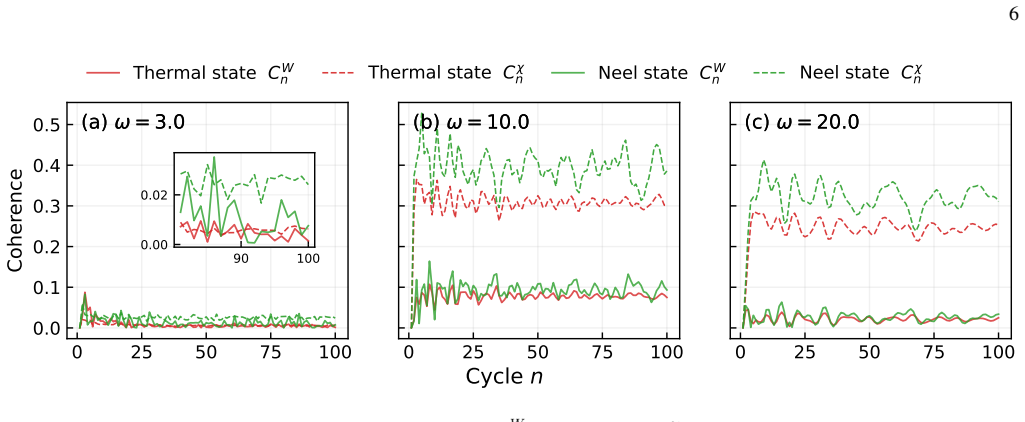
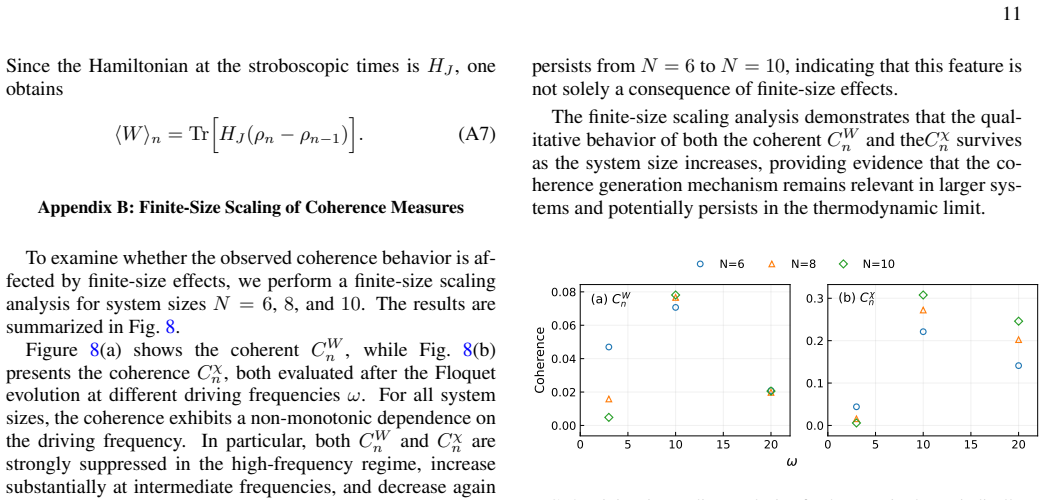
If the stateρ n−1 is not incoherent, it can be detected by the quantity C W n := 1 N ⟨W⟩ TPM n − ⟨W⟩ n ,(28) = 1 N Tr[HJ UF (ρn−1 −ρ n−1)U † F ],(29) which characterizes how the average work per site done by the driving force is affected by the coherence of the initial state
-
[2]
Since the quantum coherence will be destroyed by TPM, yieldingχ TPM n (u)to differ fromχ n(u), so that the quantum coherence ofρ n−1 can also be character- ized by the coherent part ofχ n(u), denoted by χcoh n (u) =χ n(u)−χ TPM n (u).(30) 5 Thus, the deviation from the Floquet thermalization at then-th cycle can be measured by C χ n = Z ∞ −∞ du|χ coh n (u...
-
[3]
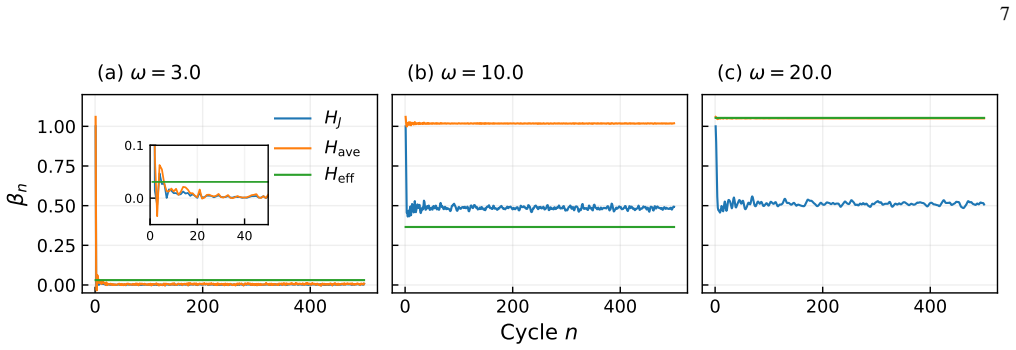
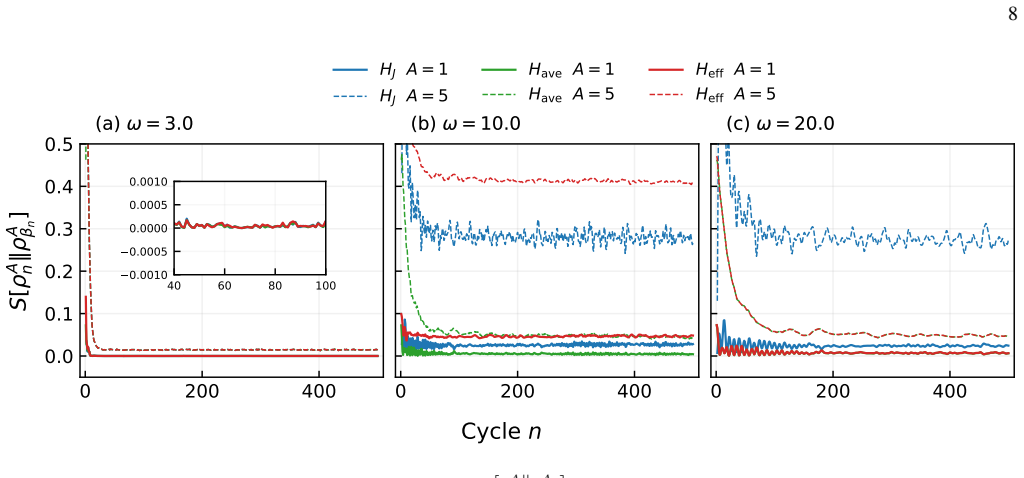
For initial thermal state The stroboscopic evolution under Floquet dynamics can start with either a thermal state or a N ´eel state. Since a pure state remains pure under unitary evolution, global ther- malization cannot occur without coarse-graining, so we will consider the evolution from a thermal state with unit inverse temperature (ρβ=1), which may ev...
-
[4]
The results for the stroboscopic evolution of relative entropyS[ρ A n ρA βn]are pre- sented in Fig
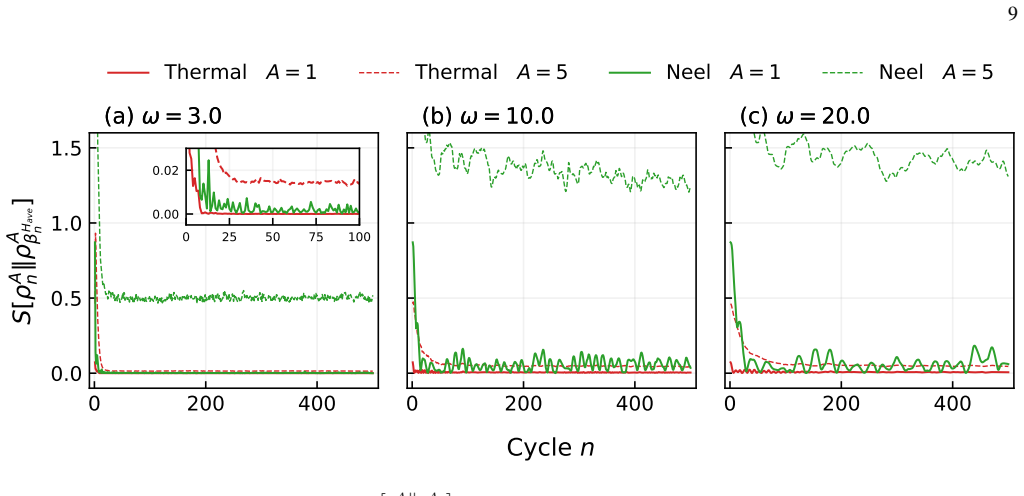
For initial N ´eel state We now adopt the ansatz thermal state (37) to study Floquet thermalization starting from a N ´eel state. The results for the stroboscopic evolution of relative entropyS[ρ A n ρA βn]are pre- sented in Fig. 5. For comparison, we also present the results with the initial state beingρ β=1. We first focus on the case where the initial ...
-
[5]
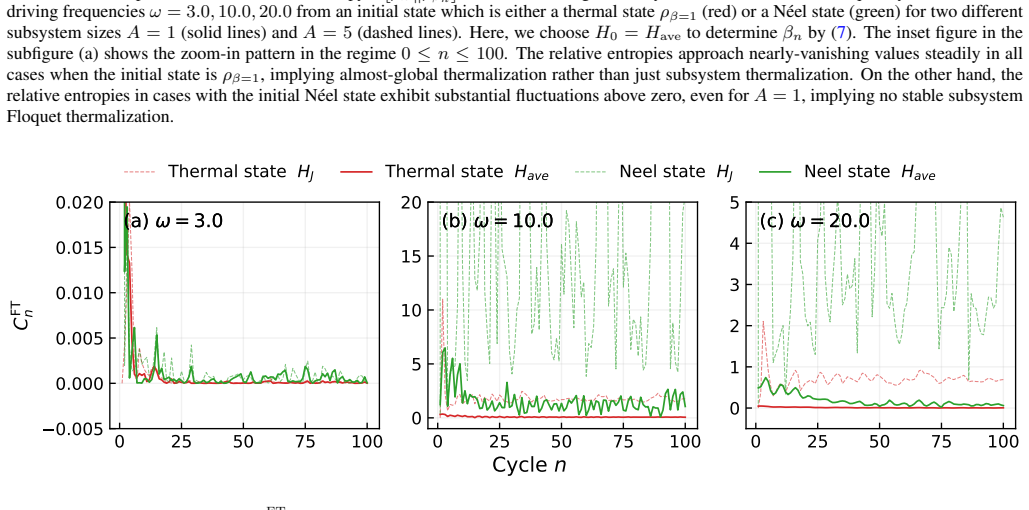
Stroboscopic evolution of fluctuation-theorem deviation An alternative way to characterize global thermalization of the large-nFloquet states is to examine deviations from the fluctuation theorem. We perform the checks by again adopting the ansatz thermal state (37) to determineβ n by (7), and then to evaluateC FT n of (36) for the cases with the initial ...
-
[6]
We first focus on the results by using the ansatz thermal state (37)
For comparison, we also show the results for a different ansatz thermal state constructed by usingH J. We first focus on the results by using the ansatz thermal state (37). For the case withρ β=1 as the initial state, we see that the large-n C FT n approaches zero for all three frequen- cies. It implies the global Floquet thermalization. On the other hand...
-
[7]
Coarse-graining fluctuatuin-theorem deviation The significant fluctuation patterns ofC FT n shown in Fig. 6 motivate us to introduce the coarse-graining version ofC FT n , such as the following quantity: C FT H0 = 1 20 100X n=81 CFT n (38) whereH 0 =H mod can be eitherH J orH ave, and we have just taken the average ofC FT n over the last 20 Floquet cycles...
-
[9]
L. D’Alessio and M. Rigol, Long-time behavior of isolated pe- riodically driven interacting lattice systems, Phys. Rev. X4, 041048 (2014)
work page 2014
Show all 76 references
-
[10]
Ponte, A
P. Ponte, A. Chandran, Z. Papic, and D. A. Abanin, Period- ically driven ergodic and many-body localized quantum sys- tems, Ann. Phys.353, 196 (2015)
2015
-
[11]
Kuwahara, T
T. Kuwahara, T. Mori, and K. Saito, Floquet-magnus theory and generic transient dynamics in periodically driven many-body quantum systems, Ann. Phys.367, 96 (2016)
2016
-
[12]
D. A. Abanin, W. De Roeck, W. W. Ho, and F. Huveneers, Ef- fective hamiltonians, prethermalization, and slow energy ab- sorption in periodically driven many-body systems, Physical Review B95, 014112 (2017)
2017
-
[13]
Srednicki, The approach to thermal equilibrium in quantized chaotic systems, Journal of Physics A: Mathematical and Gen- eral32, 1163–1175 (1999)
M. Srednicki, The approach to thermal equilibrium in quantized chaotic systems, Journal of Physics A: Mathematical and Gen- eral32, 1163–1175 (1999)
1999
-
[14]
Srednicki, Thermal fluctuations in quantized chaotic sys- tems, J
M. Srednicki, Thermal fluctuations in quantized chaotic sys- tems, J. Phys. A29, L75 (1996), arXiv:chao-dyn/9511001
1996 arXiv
-
[15]
Srednicki, Chaos and quantum thermalization, Phys
M. Srednicki, Chaos and quantum thermalization, Phys. Rev. E 50, 888 (1994)
1994
-
[16]
J. M. Deutsch, Quantum statistical mechanics in a closed sys- tem, Phys. Rev. A43, 2046 (1991)
-
[17]
D’Alessio, Y
L. D’Alessio, Y . Kafri, A. Polkovnikov, and M. Rigol, From quantum chaos and eigenstate thermalization to statistical me- chanics and thermodynamics, Adv. Phys.65, 239 (2016), arXiv:1509.06411 [cond-mat.stat-mech]
2016 arXiv
-
[18]
J. M. Deutsch, Eigenstate thermalization hypothesis, Reports on Progress in Physics81(2018)
2018
-
[19]
Bukov, L
M. Bukov, L. D’Alessio, and A. Polkovnikov, Universal high- frequency behavior of periodically driven systems: from dy- namical stabilization to floquet engineering, Adv. Phys.64, 139 (2015)
2015
-
[20]
T. Mori, T. Kuwahara, and K. Saito, Rigorous Bound on Energy Absorption and Generic Relaxation in Periodically Driven Quantum Systems, Phys. Rev. Lett.116, 120401 (2016), arXiv:1509.03968 [cond-mat.stat-mech]
2016 arXiv
-
[21]
D. V . Else, B. Bauer, and C. Nayak, Floquet time crystals, Phys. Rev. Lett.117, 090402 (2016)
2016
-
[22]
Abanin, W
D. Abanin, W. De Roeck, W. W. Ho, and F. Huveneers, A rig- orous theory of many-body prethermalization for periodically driven and closed quantum systems, Communications in Math- ematical Physics354, 809 (2017)
2017
-
[23]
S. A. Weidinger and M. Knap, Floquet prethermalization and slow energy absorption in periodically driven quantum systems, SciPost Phys.2, 014 (2017)
2017
-
[24]
Ponte, Z
P. Ponte, Z. Papic, F. Huveneers, and D. A. Abanin, Many- body localization in periodically driven systems, Phys. Rev. Lett.114, 140401 (2015)
2015
-
[25]
Lazarides, A
A. Lazarides, A. Das, and R. Moessner, Fate of many-body lo- calization under periodic driving, Phys. Rev. Lett.115, 030402 (2015)
2015
-
[26]
D. A. Abanin, E. Altman, I. Bloch, and M. Serbyn, Collo- quium: Many-body localization, thermalization, and entangle- ment, Rev. Mod. Phys.91, 021001 (2019)
2019
-
[27]
Khemani, A
V . Khemani, A. Lazarides, R. Moessner, and S. L. Sondhi, Phase structure of driven quantum systems, Phys. Rev. Lett. 116, 250401 (2016)
2016
-
[28]
Dymarsky, N
A. Dymarsky, N. Lashkari, and H. Liu, Subsystem ETH, Phys. Rev. E97, 012140 (2018), arXiv:1611.08764 [cond-mat.stat- 12 mech]
2018 arXiv
-
[29]
Lashkari, A
N. Lashkari, A. Dymarsky, and H. Liu, Eigenstate Thermal- ization Hypothesis in Conformal Field Theory, J. Stat. Mech. 1803, 033101 (2018), arXiv:1610.00302 [hep-th]
2018 arXiv
-
[30]
He, F.-L
S. He, F.-L. Lin, and J.-j. Zhang, Subsystem eigenstate thermal- ization hypothesis for entanglement entropy in CFT, Journal of High Energy Physics08, 126 (2017), arXiv:1703.08724 [hep- th]
2017 arXiv
-
[31]
He, F.-L
S. He, F.-L. Lin, and J.-j. Zhang, Dissimilarities of reduced density matrices and eigenstate thermalization hypothesis, Jour- nal of High Energy Physics12, 073 (2017), arXiv:1708.05090 [hep-th]
2017 arXiv
-
[32]
Lin, J.-J
F.-L. Lin, J.-J. Hong, and C.-Y . Huang, Subsystem thermaliza- tion hypothesis in quantum spin chains with conserved charges, Phys. Rev. E112, 034107 (2025), arXiv:2412.09905 [quant- ph]
2025
-
[33]
Rigol, V
M. Rigol, V . Dunjko, and M. Olshanii, Thermalization and its mechanism for generic isolated quantum systems, Nature452, 854 (2008)
2008
-
[34]
Linden, S
N. Linden, S. Popescu, A. J. Short, and A. Winter, Quantum mechanical evolution towards thermal equilibrium, Phys. Rev. E79, 061103 (2009)
2009
-
[35]
Gogolin and J
C. Gogolin and J. Eisert, Equilibration, thermalisation, and the emergence of statistical mechanics in closed quantum systems, Rep. Prog. Phys.79, 056001 (2016)
2016
-
[36]
D’Alessio, Y
L. D’Alessio, Y . Kafri, A. Polkovnikov, and M. Rigol, From quantum chaos and eigenstate thermalization to statistical me- chanics and thermodynamics, Adv. Phys.65, 239 (2016)
2016
-
[37]
Lin and C.-Y
F.-L. Lin and C.-Y . Huang, Work statistics for quantum spin chains: Characterizing quantum phase transitions, benchmark- ing time evolution, and examining passivity of quantum states, Phys. Rev. Res.6, 023169 (2024), arXiv:2308.13366 [cond- mat.stat-mech]
2024
-
[38]
Jarzynski, Nonequilibrium equality for free energy differ- ences, Phys
C. Jarzynski, Nonequilibrium equality for free energy differ- ences, Phys. Rev. Lett.78, 2690 (1997)
1997
-
[39]
G. E. Crooks, Entropy production fluctuation theorem and the nonequilibrium work relation for free energy differences, Phys. Rev. E60, 2721 (1999)
1999
-
[40]
Kurchan, A quantum fluctuation theorem (2000), arXiv:cond- mat/0007360
J. Kurchan, A quantum fluctuation theorem (2000), arXiv:cond- mat/0007360
2000
-
[41]
Talkner, E
P. Talkner, E. Lutz, and P. H¨anggi, Fluctuation theorems: Work is not an observable, Phys. Rev. E75, 050102 (2007)
2007
-
[42]
Campisi, P
M. Campisi, P. H ¨anggi, and P. Talkner, Colloquium: Quantum fluctuation relations: Foundations and applications, Rev. Mod. Phys.83, 771 (2011)
2011
-
[44]
Y . V . Nazarov and M. Kindermann, Full counting statistics of a general quantum mechanical variable, The European Physi- cal Journal B-Condensed Matter and Complex Systems35, 413 (2003)
2003
-
[45]
Tobiska and Y
J. Tobiska and Y . V . Nazarov, Inelastic interaction corrections and universal relations for full counting statistics in a quantum contact, Phys. Rev. B72, 235328 (2005)
2005
-
[46]
Esposito, U
M. Esposito, U. Harbola, and S. Mukamel, Nonequilibrium fluctuations, fluctuation theorems, and counting statistics in quantum systems, Rev. Mod. Phys.81, 1665 (2009)
2009
-
[47]
Solinas and S
P. Solinas and S. Gasparinetti, Full distribution of work done on a quantum system for arbitrary initial states, Phys. Rev. E 92, 042150 (2015), arXiv:1504.01574 [quant-ph]
2015 arXiv
-
[48]
Mukamel, Quantum extension of the jarzynski relation: Analogy with stochastic dephasing, Phys
S. Mukamel, Quantum extension of the jarzynski relation: Analogy with stochastic dephasing, Phys. Rev. Lett.90, 170604 (2003)
2003
-
[49]
Solinas and S
P. Solinas and S. Gasparinetti, Full distribution of work done on a quantum system for arbitrary initial states, Phys. Rev. A94, 052103 (2016)
2016
-
[50]
Perarnau-Llobet, E
M. Perarnau-Llobet, E. B ¨aumer, K. V . Hovhannisyan, M. Hu- ber, and A. Ac ´ın, No-go theorem for the characterization of work fluctuations in coherent quantum systems, Phys. Rev. Lett. 118, 070601 (2017)
2017
-
[51]
Perarnau-Llobet, E
M. Perarnau-Llobet, E. B ¨aumer, K. V . Hovhannisyan, M. Hu- ber, and A. Acin, No-Go Theorem for the Characterization of Work Fluctuations in Coherent Quantum Systems, Phys. Rev. Lett.118, 070601 (2017), arXiv:1606.08368 [quant-ph]
2017 arXiv
-
[52]
Alonso, E
J. Alonso, E. Lutz, and A. Romito, Work and time-reversal asymmetry in quantum systems, Phys. Rev. Lett.116, 080403 (2016)
2016
-
[53]
Funo and H
K. Funo and H. T. Quan, Path-integral approach to quantum thermodynamics, Phys. Rev. Lett.121, 040602 (2018)
2018
-
[54]
Lostaglio, Quantum fluctuation theorems, contextuality and work quasi-probabilities, Phys
M. Lostaglio, Quantum fluctuation theorems, contextuality and work quasi-probabilities, Phys. Rev. Lett.120, 040602 (2018), arXiv:1705.05397 [quant-ph]
2018 arXiv
-
[55]
Zhang and J
K. Zhang and J. Wang, Quasiprobability fluctuation theorem behind the spread of quantum information, Commun. Phys.7, 91 (2024), arXiv:2201.00385 [quant-ph]
2024
-
[56]
Levy and M
A. Levy and M. Lostaglio, Quasiprobability Distribution for Heat Fluctuations in the Quantum Regime, PRX Quantum1, 010309 (2020), arXiv:1909.11116 [quant-ph]
2020
-
[57]
Gherardini and G
S. Gherardini and G. De Chiara, Quasiprobabilities in Quantum Thermodynamics and Many-Body Systems, PRX Quantum5, 030201 (2024), arXiv:2403.17138 [quant-ph]
2024
-
[58]
D’Alessio and A
L. D’Alessio and A. Polkovnikov, Many-body energy localiza- tion transition in periodically driven systems, Annals of Physics 333, 19 (2013), arXiv:1210.2791 [cond-mat.stat-mech]
2013 arXiv
-
[59]
D’Alessio and M
L. D’Alessio and M. Rigol, Long-time Behavior of Isolated Pe- riodically Driven Interacting Lattice Systems, Phys. Rev. X4, 041048 (2014), arXiv:1402.5141 [cond-mat.stat-mech]
2014 arXiv
-
[60]
Lazarides, A
A. Lazarides, A. Das, and R. Moessner, Equilibrium states of generic quantum systems subject to periodic driving, Phys. Rev. E90, 012110 (2014)
2014
-
[61]
H. Kim, T. N. Ikeda, and D. A. Huse, Testing whether all eigen- states obey the eigenstate thermalization hypothesis, Phys. Rev. E90, 052105 (2014), arXiv:1408.0535 [cond-mat.stat-mech]
2014 arXiv
-
[62]
Ponte, A
P. Ponte, A. Chandran, Z. Papi´c, and D. A. Abanin, Periodically driven ergodic and many-body localized quantum systems, An- nals of Physics353, 196 (2015)
2015
-
[63]
D. V . Else, B. Bauer, and C. Nayak, Prethermal Phases of Mat- ter Protected by Time-Translation Symmetry, Phys. Rev. X7, 011026 (2017), arXiv:1607.05277 [cond-mat.stat-mech]
2017 arXiv
-
[64]
D. A. Abanin, W. De Roeck, W. W. Ho, and F. m. c. Huveneers, Effective hamiltonians, prethermalization, and slow energy ab- sorption in periodically driven many-body systems, Phys. Rev. B95, 014112 (2017)
2017
-
[65]
Mori, Floquet prethermalization in periodically driven clas- sical spin systems, Phys
T. Mori, Floquet prethermalization in periodically driven clas- sical spin systems, Phys. Rev. B98, 104303 (2018)
2018
-
[66]
W. W. Ho, T. Mori, D. A. Abanin, and E. G. D. Torre, Quan- tum and classical Floquet prethermalization, Annals Phys.454, 169297 (2023), arXiv:2212.00041 [cond-mat.stat-mech]
2023
-
[67]
Viebahn, Introduction to Floquet theory, Institute for Quan- tum Electronics, ETH Zurich8093(2020)
K. Viebahn, Introduction to Floquet theory, Institute for Quan- tum Electronics, ETH Zurich8093(2020)
2020
-
[68]
M. P. Mueller, E. Adlam, L. Masanes, and N. Wiebe, Thermal- ization and canonical typicality in translation-invariant quan- tum lattice systems, Commun. Math. Phys.340, 499 (2015), arXiv:1312.7420 [quant-ph]
2015
-
[69]
Dorner, S
R. Dorner, S. R. Clark, L. Heaney, R. Fazio, J. Goold, and V . Vedral, Extracting Quantum Work Statistics and Fluctuation Theorems by Single-Qubit Interferometry, Phys. Rev. Lett.110, 13 230601 (2013), arXiv:1301.7021 [quant-ph]
2013 arXiv
-
[70]
Mazzola, G
L. Mazzola, G. De Chiara, and M. Paternostro, Measuring the Characteristic Function of the Work Distribution, Phys. Rev. Lett.110, 230602 (2013), arXiv:1301.7030 [quant-ph]
2013 arXiv
-
[71]
Mazzola, G
L. Mazzola, G. De Chiara, and M. Paternostro, Detecting the work statistics through Ramsey-like interferometry, Int. J. Quant. Inf.12, 1461007 (2014), arXiv:1401.0566 [quant-ph]
2014 arXiv
-
[72]
Jarzynski, Nonequilibrium equality for free energy differ- ences, Physical Review Letters78, 2690 (1997)
C. Jarzynski, Nonequilibrium equality for free energy differ- ences, Physical Review Letters78, 2690 (1997)
1997
-
[73]
G. E. Crooks, Entropy production fluctuation theorem and the nonequilibrium work relation for free energy differences, Phys- ical Review E60, 2721 (1999)
1999
-
[74]
G. E. Crooks, Path-ensemble averages in systems driven far from equilibrium, Physical Review E61, 2361 (2000)
2000
-
[75]
Pusz and S
W. Pusz and S. L. Woronowicz, Passive States and KMS States for General Quantum Systems, Commun. Math. Phys.58, 273 (1978)
1978
-
[76]
Lenard, Thermodynamical proof of the gibbs formula for elementary quantum systems, Journal of Statistical Physics19, 575 (1978)
A. Lenard, Thermodynamical proof of the gibbs formula for elementary quantum systems, Journal of Statistical Physics19, 575 (1978)
1978
-
[77]
Benoist, L
T. Benoist, L. Bruneau, V . Jaksic, A. Panati, and C.-A. Pillet, A note on two-times measurement entropy production and modu- lar theory, Lett. Math. Phys.114, 32 (2024), arXiv:2310.10582 [math-ph]
2024
-
[78]
Cirafici, Fluctuation theorems, quantum channels and grav- itational algebras, JHEP11, 089, arXiv:2408.04219 [hep-th]
M. Cirafici, Fluctuation theorems, quantum channels and grav- itational algebras, JHEP11, 089, arXiv:2408.04219 [hep-th]
Reviewed July 2, 2026 · model on record in the stance chip above.
Discussion (0). Continue with ORCID to comment.