REVIEW 3 major objections 5 minor 16 cited by
A Survey on Bias and Fairness in Machine Learning
T0 review · 3 major / 5 minor · reviewed 2026-08-14 · deepseek-v4-flash
Pith's one-line read The paper maps machine-learning bias onto a data-algorithm-user feedback loop and taxonomizes fairness definitions, arguing that unfairness enters and persists through the whole cycle.
desk verdict Useful reference survey, not a research contribution; the feedback-loop taxonomy needs a reproducible placement rule and Table 1 contains a concrete labeling error. read the letter →
The pith
A machine-rendered reading of the paper's core claim, the machinery that carries it, and where it could break.
The reading
What carries the argument
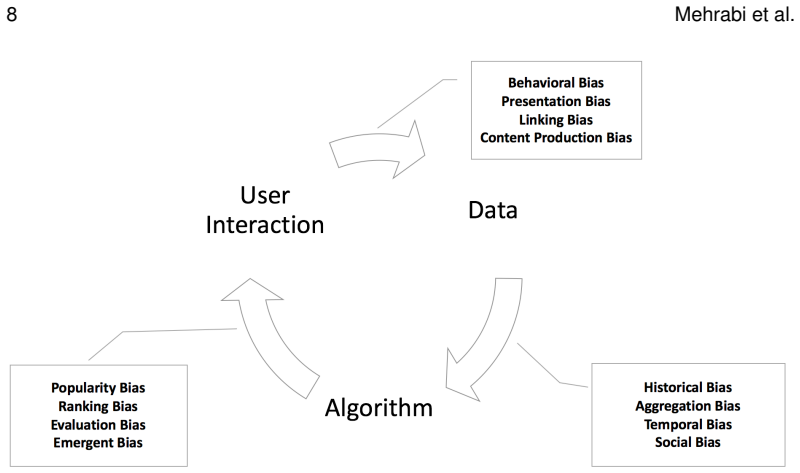
The load-bearing device is a three-node feedback loop: data, algorithm, and user interaction, with bias types placed on the arrows where the authors judge them most active. Around this loop the paper organizes a second device: a taxonomy of fairness definitions split into group and individual fairness, plus mitigation strategies categorized as pre-processing, in-processing, and post-processing. Together these devices do the argument's work: they turn scattered observations about biased systems into a map that shows where bias enters, which fairness target each definition addresses, and where existing methods intervene.
What would settle it
Ask an independent panel to place the 23 bias types from Section 3.1 onto the three-node feedback loop in Figure 2; if the placements diverge sharply across raters, the taxonomy's organizing assumption fails. Equally, a systematic sweep of the fairness literature that turns up a widely used definition absent from Table 1 would falsify the survey's claim of coverage.
Extended reading notes
Core claim
On the paper's own terms, the central discovery is a structured inventory: there is no one bias, but a family of distinct bias mechanisms—historical, representation, measurement, aggregation, sampling, behavioral, linking, popularity, algorithmic, and others—and no one fairness notion, but competing formal definitions such as demographic parity, equalized odds, equal opportunity, fairness through awareness and unawareness, and counterfactual fairness. The paper claims that these are not independent: biases are coupled through the feedback loop in which a model's decisions shape future data and user behavior, so a fair system must be examined as a cycle rather than a static artifact. On this view, whether a system is fair cannot be read off a single metric; it depends on the context, the protected attributes, and the stage at which intervention is possible.
Load-bearing premise
The survey's claim to be a useful map depends on the authors' judgment in assigning each bias type to one arrow of the data-algorithm-user loop and in choosing which papers to include; if these assignments or selections are unrepresentative, the taxonomy could mislead rather than organize.
Editorial extensions
If this is right
- Because biases are coupled in a feedback loop, removing bias from training data alone will not guarantee fair decisions if the algorithm or the user interface re-introduces it.
- No single fairness definition can serve every application: equalized odds, demographic parity, and calibration can be mutually incompatible, so fairness must be chosen per context.
- The pre/in/post-processing distinction gives practitioners a practical way to select mitigation methods based on what they are allowed to modify.
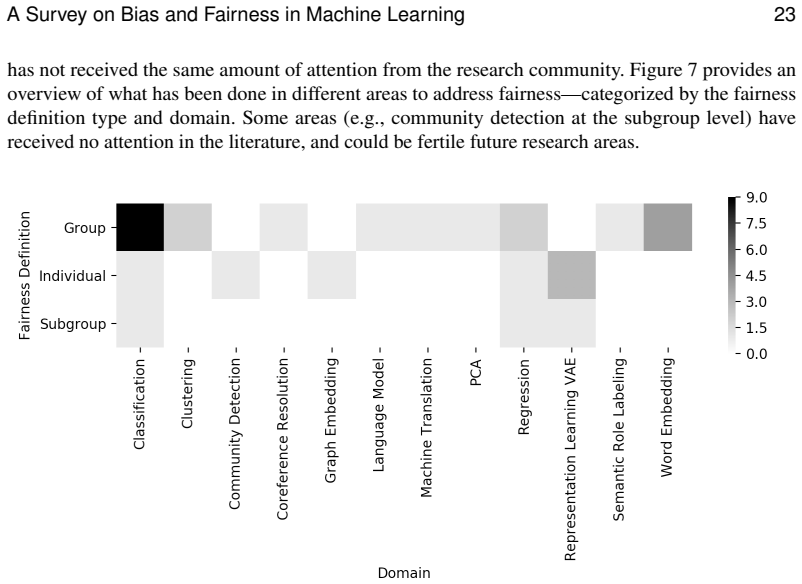
- The survey's mapping of domains to fairness definitions points to under-studied areas such as subgroup-level fairness in community detection.
Reading between the lines
- Editorial inference: the feedback-loop framing predicts that fairness interventions will decay over time unless they account for future data collection; an A/B test comparing a debiased model retrained on its own outputs against one retrained on a fixed dataset would test this.
- Editorial inference: the taxonomy invites a matching exercise between bias types and fairness definitions—for example, measurement bias is most naturally addressed by equalized-odds-style criteria—which could turn the survey's categories into an actionable checklist for model audits.
- Editorial inference: the same loop applies to generative AI and recommendation systems, where the user interaction arrow is strongest; the survey's categories could be extended to cover biases introduced by human feedback, which the paper mentions only indirectly.
Signed reviews
Editorial analysis
A structured set of objections, weighed in public.
Referee Report
Summary. This survey maps the landscape of bias and fairness in machine learning. It begins with real-world cases of algorithmic unfairness (COMPAS, ad delivery, facial recognition), then catalogs twenty-three types of bias in data and algorithms, proposes a feedback-loop organization of these bias types in Figure 2, reviews ten fairness definitions and classifies them as group or individual notions, summarizes mitigation approaches under pre-/in-/post-processing categories, and surveys domain-specific work in classification, regression, PCA, community detection, causal inference, representation learning, and natural language processing. It also lists commonly used fairness datasets and discusses open challenges such as synthesizing fairness definitions and moving from equality to equity. The paper offers no new experimental results but aims to provide a broad reference taxonomy of the field.
Significance. If its organizational claims held, the survey would be a useful entry point for researchers: it aggregates a large literature, connects bias types to concrete examples, gives a table of protected attributes, and catalogs datasets and toolkits. The paper is honest about the breadth of the area and identifies underexplored directions. Its main weaknesses are that the central taxonomy is not reproducible from the text and that at least one fairness classification in Table 1 is incorrect. The survey remains potentially valuable as a reference, but its central organizational claim needs to be made checkable before the taxonomy can be relied upon.
major comments (3)
- [Section 3.1 / Figure 2] The central organizational claim of the survey is not independently checkable. After listing the bias types, the text says the authors "grouped these definitions on the arrows of the loop where we thought they were most effective," but no placement criterion is given and no table or list maps each of the twenty-three definitions to a specific arrow of Figure 2. Because several definitions overlap (e.g., sampling bias vs. self-selection bias, representation bias vs. population bias), different readers could plausibly place the same definition on different arrows. Since the paper's stated contribution is "a taxonomy for fairness definitions" and a valid organization of bias sources, the assignment rule and the full mapping should be made explicit.
- [Section 4.2 / Table 1] Table 1 marks fairness through unawareness as an individual fairness notion, but this is inconsistent with Definition 5 in the same section. Fairness through unawareness only requires that protected attributes not be explicitly used in the decision, and it does not require similar predictions for similar individuals, which is what fairness through awareness (Definition 4) and individual fairness demand. This misclassification is a concrete symptom that the fairness taxonomy is a set of subjective judgments rather than a derivable classification. The table should be corrected, or the entry should be explicitly classified as a process-based notion separate from individual and group fairness.
- [Section 5.2.2] The reproduced formal definitions in the fair regression subsection are garbled to the point that the reader cannot verify the claims about the three fairness penalties. The displayed formulas for f1, f2, and f3 contain missing or misplaced parentheses and unclear summation scopes. Since a survey's reliability depends on the fidelity of its reproduced definitions, these equations should be typeset cleanly and checked against the cited source.
minor comments (5)
- [Section 4.2 / Definition 8] The statement of counterfactual fairness contains a typo ("(or all y") and the probability notation is incomplete; it should be rewritten to match the cited source.
- [Section 5.4.3 / Equation 2] Equation 2 uses a Cyrillic "loд" instead of "log", and the conditioning notation P(w|f), P(w|m) is not defined precisely enough to distinguish female and male word sets.
- [Section 2] The phrase "in [41], authors also argued" and several similar constructions could be smoothed; more importantly, the article sometimes alternates between numbered citations and inline URLs, which should be unified.
- [Section 6.2 / Figure 7] The heatmap in Figure 7 is mentioned only briefly; the reader is not told how the entries were scored, which fairness definitions were used, or how the domain categorization was performed.
- [Section 3.1] The list of bias types is useful, but several definitions draw on a non-academic web source (footnote 4); citing a peer-reviewed taxonomy for these entries would strengthen the survey.
Circularity Check
No circular derivation found: the survey's taxonomy is presented as an explicit subjective grouping, and the self-citations are ordinary literature references, not load-bearing inputs.
full rationale
This is a survey paper and makes no experimental claim or formal derivation; there is no chain of equations in which an output is equivalent to an input. The central organizational contribution, the placement of bias definitions on the data-algorithm-user feedback loop in Figure 2, is explicitly offered as the authors' judgment: 'we grouped these definitions on the arrows of the loop where we thought they were most effective.' This is an acknowledged editorial choice, not a derived result, and therefore cannot be circular in the technical sense. The paper also lists fairness definitions from [55], [43], [73], etc., and categorizes them in Table 1; that categorization is a literature classification. One entry, 'fairness through unawareness,' is arguably mislabeled as an individual fairness notion since the definition only requires non-use of protected attributes, but this is a classification error, not a self-referential reduction. Several references are to the authors' own work ([2], [77], [85], [91], [92], [112], [113]), but these are used as examples of bias types, datasets, or mitigation methods within the surveyed literature, and the survey's validity as a map of the field does not depend on any one of these citations in a load-bearing way. No fitted parameter is renamed as a prediction, and no uniqueness theorem or ansatz is imported from the authors' prior work. The paper is thus self-contained as a survey; the main risks are completeness and subjective taxonomy placement, which fall under correctness and quality concerns rather than circularity.
Assumptions & free parameters
assumptions (3)
- domain assumption The cited papers are accurately represented and their results are reliable.
- ad hoc to paper The placement of bias types on the data-algorithm-user interaction feedback loop (Figure 2) is a meaningful and valid organizational scheme.
- domain assumption The selection of papers reflects the important work in the field.
Cite this review
Pith. "Pith review of A Survey on Bias and Fairness in Machine Learning." pith.science (2026). https://pith.science/paper/Q7WBOGAA
@misc{pith2026190809635,
  author       = {Pith},
  title        = {Pith review of: A Survey on Bias and Fairness in Machine Learning},
  year         = {2026},
  howpublished = {\url{https://pith.science/paper/Q7WBOGAA}},
  note         = {Machine review of arXiv:1908.09635}
}
read the original abstract
With the widespread use of AI systems and applications in our everyday lives, it is important to take fairness issues into consideration while designing and engineering these types of systems. Such systems can be used in many sensitive environments to make important and life-changing decisions; thus, it is crucial to ensure that the decisions do not reflect discriminatory behavior toward certain groups or populations. We have recently seen work in machine learning, natural language processing, and deep learning that addresses such challenges in different subdomains. With the commercialization of these systems, researchers are becoming aware of the biases that these applications can contain and have attempted to address them. In this survey we investigated different real-world applications that have shown biases in various ways, and we listed different sources of biases that can affect AI applications. We then created a taxonomy for fairness definitions that machine learning researchers have defined in order to avoid the existing bias in AI systems. In addition to that, we examined different domains and subdomains in AI showing what researchers have observed with regard to unfair outcomes in the state-of-the-art methods and how they have tried to address them. There are still many future directions and solutions that can be taken to mitigate the problem of bias in AI systems. We are hoping that this survey will motivate researchers to tackle these issues in the near future by observing existing work in their respective fields.
Figures


Figures from the paper (4 more)


Forward citations
Cited by 16 Pith papers
-
Prototypicality Bias Reveals Blindspots in Multimodal Evaluation Metrics
Prototypicality bias: common text-to-image metrics systematically prefer plausible-but-wrong images over correct non-prototypical ones; PROTOSCORE mitigates but does not eliminate the failure.
-
A Theory of Inference Compute Scaling: Reasoning through Directed Stochastic Skill Search
A skill-graph random-walk model gives closed-form accuracy-versus-compute formulas for four reasoning strategies and connects them to training scaling.
-
Local Statistical Parity for the Estimation of Fair Decision Trees
A decision tree satisfies statistical parity if every node split is independent of the protected attribute, a condition C-LRT approximates with constrained logistic splits.
-
Explanatory Debiasing: Involving Domain Experts in the Data Generation Process to Mitigate Representation Bias in AI Systems
Involving domain experts in AI data generation can reduce representation bias while maintaining or slightly improving model accuracy, according to a 35-participant healthcare user study.
-
Safe and Certifiable AI Systems: Concepts, Challenges, and Lessons Learned
The paper presents the TÜV AUSTRIA Trusted AI audit catalog, a statistical framework based on the Stochastic Application Domain Definition, minimum performance requirements, and independent-sample testing for certifyi...
-
Diversity and Inclusion in AI: Insights from a Survey of AI/ML Practitioners
A survey of 61 AI/ML practitioners finds that while most believe diverse teams and data reduce bias, actual practices like bias audits and post-development D&I checks are inconsistent and often missing.
-
Mitigating Spatial Disparity in Urban Prediction Using Residual-Aware Spatiotemporal Graph Neural Networks: A Chicago Case Study
A residual-aware attention block and spatial-disparity loss are reported to reduce prediction-error clustering across Chicago neighborhoods, but the gains are partly artifacts of training on the same metrics used for ...
-
How to Evaluate Automatic Speech Recognition: Comparing Different Performance and Bias Measures
On Dutch end-to-end ASR systems, average word error rate hides large performance gaps across speaker groups, and bias mitigation can lower the average while increasing bias.
-
Testing Individual Fairness in Graph Neural Networks
A doctoral proposal to adapt individual fairness testing techniques to graph neural networks, containing no experimental results.
-
Bias Analysis of AI Models for Undergraduate Student Admissions
A case study showing that AI admissions models can have persistent specificity and sensitivity bias by race and first-generation status, even when overall accuracy is high and common fairness metrics look satisfied.
-
Chatbot Deployment Considerations for Application-Agnostic Human-Machine Dialogues
Microsoft's Tay chatbot failed after learning offensive Twitter content within 16 hours, and the paper draws deployment lessons from that incident.
-
The Role of AI in Early Detection of Life-Threatening Diseases: A Retinal Imaging Perspective
This is a narrative review of AI-enhanced retinal imaging for detecting systemic diseases; it presents no new data and is undermined by multiple citation errors.
-
A Critical Field Guide for Working with Machine Learning Datasets
A field guide from the Knowing Machines project that turns existing critical dataset studies scholarship into lifecycle questions for practitioners, with no new empirical or formal results.
-
DeepHealth: Review and challenges of artificial intelligence in health informatics
A literature review of AI health informatics spanning imaging, EHRs, genomics, sensing, and online health, cataloging methods and open challenges.
-
The State of Post-Hoc Local XAI Techniques for Image Processing: Challenges and Motivations
A review of post-hoc local XAI techniques for images, covering motivations, challenges, and suggested future directions.
-
A Comprehensive Guide to Explainable AI: From Classical Models to LLMs
A survey-style XAI book with code examples, covering standard interpretability methods and models, but no new scientific contributions.
Reference graph
Works this paper leans on
-
[1]
Alekh Agarwal, Miroslav Dudik, and Zhiwei Steven Wu. 2019. Fair Regression: Quantitative Definitions and Reduction- Based Algorithms. In International Conference on Machine Learning. 120–129
2019
-
[2]
Nazanin Alipourfard, Peter G Fennell, and Kristina Lerman. 2018. Can you Trust the Trend?: Discovering Simpson’s Paradoxes in Social Data. In Proceedings of the Eleventh ACM International Conference on Web Search and Data Mining. ACM, 19–27
2018
-
[3]
Nazanin Alipourfard, Peter G Fennell, and Kristina Lerman. 2018. Using Simpsonâ ˘A ´Zs Paradox to Discover Interesting Patterns in Behavioral Data. In Twelfth International AAAI Conference on Web and Social Media
2018
-
[4]
Alexander Amini, Ava Soleimany, Wilko Schwarting, Sangeeta Bhatia, and Daniela Rus. 2019. Uncovering and Mitigating Algorithmic Bias through Learned Latent Structure. (2019)
2019
-
[5]
Julia Angwin, Jeff Larson, Surya Mattu, and Lauren Kirchner. 2016. Machine Bias: thereâ ˘A ´Zs software used across the country to predict future criminals. And itâ ˘A ´Zs biased against blacks. ProPublica 2016. (2016)
2016
-
[6]
Asuncion and D.J
A. Asuncion and D.J. Newman. 2007. UCI Machine Learning Repository. (2007). http://www.ics.uci.edu/$\sim$mlearn/
2007
-
[7]
Arturs Backurs, Piotr Indyk, Krzysztof Onak, Baruch Schieber, Ali Vakilian, and Tal Wagner. 2019. Scalable Fair Clustering. In Proceedings of the 36th International Conference on Machine Learning (Proceedings of Machine Learning Research), Kamalika Chaudhuri and Ruslan Salakhutdinov (Eds.), V ol. 97. PMLR, Long Beach, California, USA, 405–413. http://proc...
2019
-
[8]
Ricardo Baeza-Yates. 2018. Bias on the Web.Commun. ACM 61, 6 (May 2018), 54–61. https://doi.org/10.1145/3209581
doi:10.1145/3209581 2018
Show all 142 references
-
[9]
Cesar-Jr
Samuel Barbosa, Dan Cosley, Amit Sharma, and Roberto M. Cesar-Jr. 2016. Averaging Gone Wrong: Using Time-Aware Analyses to Better Understand Behavior. (April 2016), 829–841
2016
-
[10]
Rachel KE Bellamy, Kuntal Dey, Michael Hind, Samuel C Hoffman, Stephanie Houde, Kalapriya Kannan, Pranay Lohia, Jacquelyn Martino, Sameep Mehta, Aleksandra Mojsilovic, et al. 2018. Ai fairness 360: An extensible toolkit for detecting, understanding, and mitigating unwanted alg...
2018 arXiv
-
[11]
Bender and Batya Friedman
Emily M. Bender and Batya Friedman. 2018. Data Statements for Natural Language Processing: Toward Mitigating System Bias and Enabling Better Science. Transactions of the Association for Computational Linguistics 6 (2018), 587–604. https://doi.org/10.1162/tacl_a_00041
2018 doi
-
[12]
Misha Benjamin, Paul Gagnon, Negar Rostamzadeh, Chris Pal, Yoshua Bengio, and Alex Shee. [n. d.]. TOWARDS STANDARDIZATION OF DATA LICENSES: THE MONTREAL DATA LICENSE. ([n. d.])
-
[13]
Richard Berk, Hoda Heidari, Shahin Jabbari, Matthew Joseph, Michael Kearns, Jamie Morgenstern, Seth Neel, and Aaron Roth. 2017. A Convex Framework for Fair Regression. (2017). arXiv:cs.LG/1706.02409
2017 arXiv
-
[14]
Richard Berk, Hoda Heidari, Shahin Jabbari, Michael Kearns, and Aaron Roth. [n. d.]. Fairness in criminal justice risk assessments: The state of the art. Sociological Methods & Research ([n. d.]), 0049124118782533
-
[15]
Peter J Bickel, Eugene A Hammel, and J William O’Connell. 1975. Sex bias in graduate admissions: Data from Berkeley. Science 187, 4175 (1975), 398–404
1975
-
[16]
RDP Binns. 2018. Fairness in machine learning: Lessons from political philosophy. Journal of Machine Learning Research (2018)
2018
-
[17]
Colin R Blyth. 1972. On Simpson’s paradox and the sure-thing principle. J. Amer. Statist. Assoc. 67, 338 (1972), 364–366
1972
-
[18]
Miranda Bogen and Aaron Rieke. 2018. Help wanted: an examination of hiring algorithms, equity. Technical Report. and bias. Technical report, Upturn. 26 Mehrabi et al
2018
-
[19]
Tolga Bolukbasi, Kai-Wei Chang, James Y Zou, Venkatesh Saligrama, and Adam T Kalai. 2016. Man is to computer programmer as woman is to homemaker? debiasing word embeddings. In Advances in neural information processing systems. 4349–4357
2016
-
[20]
Shikha Bordia and Samuel Bowman. 2019. Identifying and Reducing Gender Bias in Word-Level Language Models. In Proceedings of the 2019 Conference of the North American Chapter of the Association for Computational Linguistics: Student Research Workshop. 7–15
2019
-
[21]
Avishek Bose and William Hamilton. 2019. Compositional Fairness Constraints for Graph Embeddings. In International Conference on Machine Learning. 715–724
2019
-
[22]
Marc-Etienne Brunet, Colleen Alkalay-Houlihan, Ashton Anderson, and Richard Zemel. 2019. Understanding the Origins of Bias in Word Embeddings. In Proceedings of the 36th International Conference on Machine Learning (Proceedings of Machine Learning Research), Kamalika Chaudhuri...
2019
-
[23]
Joy Buolamwini and Timnit Gebru. 2018. Gender Shades: Intersectional Accuracy Disparities in Commercial Gender Classification. In Proceedings of the 1st Conference on Fairness, Accountability and Transparency (Proceedings of Machine Learning Research), Sorelle A. Friedler and ...
2018
-
[24]
Toon Calders and Sicco Verwer. 2010. Three naive Bayes approaches for discrimination-free classification.Data Mining and Knowledge Discovery 21, 2 (2010), 277–292
2010
-
[25]
Aylin Caliskan, Joanna J Bryson, and Arvind Narayanan. 2017. Semantics derived automatically from language corpora contain human-like biases. Science 356, 6334 (2017), 183–186
2017
-
[26]
Flavio Calmon, Dennis Wei, Bhanukiran Vinzamuri, Karthikeyan Natesan Ramamurthy, and Kush R Varshney. 2017. Optimized Pre-Processing for Discrimination Prevention. In Advances in Neural Information Processing Systems 30, I. Guyon, U. V . Luxburg, S. Bengio, H. Wallach, R. Ferg...
2017
-
[27]
Manel Capdevila, Marta Ferrer, and Eulália Luque. 2005. La reincidencia en el delito en la justicia de menores. Centro de estudios jurídicos y formación especializada, Generalitat de Catalunya. Documento no publicado (2005)
2005
-
[28]
Allison JB Chaney, Brandon M Stewart, and Barbara E Engelhardt. 2018. How algorithmic confounding in recommenda- tion systems increases homogeneity and decreases utility. In Proceedings of the 12th ACM Conference on Recommender Systems. ACM, 224–232
2018
-
[29]
Jiahao Chen, Nathan Kallus, Xiaojie Mao, Geoffry Svacha, and Madeleine Udell. 2019. Fairness Under Unawareness: Assessing Disparity When Protected Class Is Unobserved. In Proceedings of the Conference on Fairness, Accountability, and Transparency. ACM, 339–348
2019
-
[30]
Xingyu Chen, Brandon Fain, Liang Lyu, and Kamesh Munagala. 2019. Proportionally Fair Clustering. In International Conference on Machine Learning. 1032–1041
2019
-
[31]
Alexandra Chouldechova. 2017. Fair prediction with disparate impact: A study of bias in recidivism prediction instruments. Big data 5, 2 (2017), 153–163
2017
-
[32]
Alexandra Chouldechova, Diana Benavides-Prado, Oleksandr Fialko, and Rhema Vaithianathan. 2018. A case study of algorithm-assisted decision making in child maltreatment hotline screening decisions. In Proceedings of the 1st Conference on Fairness, Accountability and Transparen...
2018
-
[33]
Alexandra Chouldechova and Aaron Roth. 2018. The frontiers of fairness in machine learning. arXiv preprint arXiv:1810.08810 (2018)
2018 arXiv
-
[34]
Chuang, Olivier Rivoire, and Stanislas Leibler
John S. Chuang, Olivier Rivoire, and Stanislas Leibler. 2009. Simpson’s Paradox in a Synthetic Microbial System. Science 323, 5911 (2009), 272–275. https://doi.org/10.1126/science.1166739 arXiv:https://science.sciencemag.org/content/323/5911/272.full.pdf
2009 doi
-
[35]
Lipton, and Yishay Mansour
Lee Cohen, Zachary C. Lipton, and Yishay Mansour. 2019. Efficient candidate screening under multiple tests and implications for fairness. (2019). arXiv:cs.LG/1905.11361
2019 arXiv
-
[36]
Equal Employment Opportunity Commission
United States. Equal Employment Opportunity Commission. [n. d.]. EEOC compliance manual.[Washington, D.C.] : U.S. Equal Employment Opportunity Commission,[1992]
1992
-
[37]
Sam Corbett-Davies, Emma Pierson, Avi Feller, Sharad Goel, and Aziz Huq. 2017. Algorithmic decision making and the cost of fairness. In Proceedings of the 23rd ACM SIGKDD International Conference on Knowledge Discovery and Data Mining. ACM, 797–806
2017
-
[38]
Elliot Creager, David Madras, Joern-Henrik Jacobsen, Marissa Weis, Kevin Swersky, Toniann Pitassi, and Richard Zemel. 2019. Flexibly Fair Representation Learning by Disentanglement. In International Conference on Machine Learning. 1436–1445. A Survey on Bias and Fairness in Ma...
2019
-
[39]
Brian d’Alessandro, Cathy O’Neil, and Tom LaGatta. 2017. Conscientious classification: A data scientist’s guide to discrimination-aware classification. Big data 5, 2 (2017), 120–134
2017
-
[40]
Shai Danziger, Jonathan Levav, and Liora Avnaim-Pesso. 2011. Extraneous factors in judicial decisions. Proceedings of the National Academy of Sciences 108, 17 (2011), 6889–6892
2011
-
[41]
Julia Dressel and Hany Farid. 2018. The accuracy, fairness, and limits of predicting recidivism. Science Advances 4, 1 (2018). https://doi.org/10.1126/sciadv.aao5580 arXiv:https://advances.sciencemag.org/content/4/1/eaao5580.full.pdf
2018 doi
-
[42]
Dheeru Dua and Casey Graff. 2017. UCI Machine Learning Repository. (2017). http://archive.ics.uci.edu/ml
2017
-
[43]
Cynthia Dwork, Moritz Hardt, Toniann Pitassi, Omer Reingold, and Richard Zemel. 2012. Fairness Through Awareness. In Proceedings of the 3rd Innovations in Theoretical Computer Science Conference (ITCS ’12). ACM, New York, NY , USA, 214–226. https://doi.org/10.1145/2090236.2090255
2012
-
[44]
Golnoosh Farnadi, Behrouz Babaki, and Lise Getoor. 2018. Fairness in Relational Domains. In Proceedings of the 2018 AAAI/ACM Conference on AI, Ethics, and Society (AIES ’18) . ACM, New York, NY , USA, 108–114. https: //doi.org/10.1145/3278721.3278733
2018
-
[45]
Joel Escudé Font and Marta R Costa-jussà. 2019. Equalizing Gender Biases in Neural Machine Translation with Word Embeddings Techniques. arXiv preprint arXiv:1901.03116 (2019)
2019 arXiv
-
[46]
Batya Friedman and Helen Nissenbaum. 1996. Bias in Computer Systems. ACM Trans. Inf. Syst. 14, 3 (July 1996), 330–347. https://doi.org/10.1145/230538.230561
1996
-
[47]
Anna Fry, Thomas J Littlejohns, Cathie Sudlow, Nicola Doherty, Ligia Adamska, Tim Sprosen, Rory Collins, and Naomi E Allen. 2017. Comparison of Sociodemographic and Health-Related Characteristics of UK Biobank Participants With Those of the General Population. American Journal...
2017 doi
-
[48]
Timnit Gebru, Jamie Morgenstern, Briana Vecchione, Jennifer Wortman Vaughan, Hanna Wallach, Hal Daumé III, and Kate Crawford. [n. d.]. Datasheets for Datasets. ([n. d.])
-
[49]
Naman Goel, Mohammad Yaghini, and Boi Faltings. 2018. Non-discriminatory machine learning through convex fairness criteria. In Thirty-Second AAAI Conference on Artificial Intelligence
2018
-
[50]
Hila Gonen and Yoav Goldberg. 2019. Lipstick on a Pig: Debiasing Methods Cover up Systematic Gender Biases in Word Embeddings But do not Remove Them. arXiv preprint arXiv:1903.03862 (2019)
2019 arXiv
-
[51]
Sandra González-Bailón, Ning Wang, Alejandro Rivero, Javier Borge-Holthoefer, and Yamir Moreno. 2014. Assessing the bias in samples of large online networks. Social Networks 38 (2014), 16–27
2014
-
[52]
Susan T Gooden. 2015. Race and social equity: A nervous area of government. Routledge
2015
-
[53]
Nina Grgic-Hlaca, Muhammad Bilal Zafar, Krishna P Gummadi, and Adrian Weller. 2016. The case for process fairness in learning: Feature selection for fair decision making. In NIPS Symposium on Machine Learning and the Law, V ol. 1. 2
2016
-
[54]
Hajian and J
S. Hajian and J. Domingo-Ferrer. 2013. A Methodology for Direct and Indirect Discrimination Prevention in Data Mining. IEEE Transactions on Knowledge and Data Engineering 25, 7 (July 2013), 1445–1459. https://doi.org/10. 1109/TKDE.2012.72
2013
-
[55]
Moritz Hardt, Eric Price, Nati Srebro, et al. 2016. Equality of opportunity in supervised learning. In Advances in neural information processing systems. 3315–3323
2016
-
[56]
Eszter Hargittai. 2007. Whose Space? Differences among Users and Non-Users of Social Network Sites. Journal of Computer-Mediated Communication 13, 1 (10 2007), 276–297. https://doi.org/10.1111/j.1083-6101.2007.00396.x arXiv:http://oup.prod.sis.lan/jcmc/article-pdf/13/1/276/223...
2007
-
[57]
Sarah Holland, Ahmed Hosny, Sarah Newman, Joshua Joseph, and Kasia Chmielinski. 2018. The dataset nutrition label: A framework to drive higher data quality standards. arXiv preprint arXiv:1805.03677 (2018)
2018 arXiv
-
[58]
Ayanna Howard and Jason Borenstein. 2018. The ugly truth about ourselves and our robot creations: the problem of bias and social inequity. Science and engineering ethics 24, 5 (2018), 1521–1536
2018
-
[59]
Lingxiao Huang and Nisheeth Vishnoi. 2019. Stable and Fair Classification. In International Conference on Machine Learning. 2879–2890
2019
-
[60]
Ben Hutchinson and Margaret Mitchell. 2019. 50 Years of Test (Un) fairness: Lessons for Machine Learning. In Proceedings of the Conference on Fairness, Accountability, and Transparency. ACM, 49–58
2019
-
[61]
Introna and H
L. Introna and H. Nissenbaum. 2000. Defining the Web: the politics of search engines. Computer 33, 1 (Jan 2000), 54–62. https://doi.org/10.1109/2.816269
2000 doi
-
[62]
Ayush Jaiswal, Yue Wu, Wael AbdAlmageed, and Premkumar Natarajan. 2018. Unsupervised Adversarial Invariance. (2018). arXiv:cs.LG/1809.10083
2018 arXiv
-
[63]
Faisal Kamiran and Toon Calders. 2012. Data preprocessing techniques for classification without discrimination. Knowledge and Information Systems 33, 1 (01 Oct 2012), 1–33. https://doi.org/10.1007/s10115-011-0463-8
2012 doi
-
[64]
Faisal Kamiran and Indr˙e Žliobait˙e. 2013. Explainable and Non-explainable Discrimination in Classification. Springer Berlin Heidelberg, Berlin, Heidelberg, 155–170. https://doi.org/10.1007/978-3-642-30487-3_8 28 Mehrabi et al
2013 doi
-
[65]
Toshihiro Kamishima, Shotaro Akaho, Hideki Asoh, and Jun Sakuma. 2012. Fairness-aware classifier with prejudice remover regularizer. In Joint European Conference on Machine Learning and Knowledge Discovery in Databases . Springer, 35–50
2012
-
[66]
Michael Kearns, Seth Neel, Aaron Roth, and Zhiwei Steven Wu. 2018. Preventing Fairness Gerrymandering: Auditing and Learning for Subgroup Fairness. In International Conference on Machine Learning. 2569–2577
2018
-
[67]
Michael Kearns, Seth Neel, Aaron Roth, and Zhiwei Steven Wu. 2019. An empirical study of rich subgroup fairness for machine learning. In Proceedings of the Conference on Fairness, Accountability, and Transparency. ACM, 100–109
2019
-
[68]
Rogier Kievit, Willem Eduard Frankenhuis, Lourens Waldorp, and Denny Borsboom. 2013. Simpson’s paradox in psychological science: a practical guide. Frontiers in psychology4 (2013), 513
2013
-
[69]
Niki Kilbertus, Mateo Rojas Carulla, Giambattista Parascandolo, Moritz Hardt, Dominik Janzing, and Bernhard Schölkopf. 2017. Avoiding discrimination through causal reasoning. In Advances in Neural Information Processing Systems. 656–666
2017
-
[70]
Jon Kleinberg, Sendhil Mullainathan, and Manish Raghavan. 2016. Inherent trade-offs in the fair determination of risk scores. arXiv preprint arXiv:1609.05807 (2016)
2016 arXiv
-
[71]
Philipp Koehn. 2005. Europarl: A parallel corpus for statistical machine translation. In MT summit, V ol. 5. 79–86
2005
-
[72]
Emmanouil Krasanakis, Eleftherios Spyromitros-Xioufis, Symeon Papadopoulos, and Yiannis Kompatsiaris. 2018. Adaptive Sensitive Reweighting to Mitigate Bias in Fairness-aware Classification. InProceedings of the 2018 World Wide Web Conference (WWW ’18). International World Wide...
2018
-
[73]
Matt J Kusner, Joshua Loftus, Chris Russell, and Ricardo Silva. 2017. Counterfactual Fairness. In Advances in Neural Information Processing Systems 30, I. Guyon, U. V . Luxburg, S. Bengio, H. Wallach, R. Fergus, S. Vishwanathan, and R. Garnett (Eds.). Curran Associates, Inc., ...
2017
-
[74]
Anja Lambrecht and Catherine E Tucker. 2018. Algorithmic bias? An empirical study into apparent gender-based discrimination in the display of STEM career ads. An Empirical Study into Apparent Gender-Based Discrimination in the Display of STEM Career Ads (March 9, 2018) (2018)
2018
-
[75]
J Larson, S Mattu, L Kirchner, and J Angwin. 2016. Compas analysis. GitHub, available at: https://github. com/propublica/compas-analysis[Google Scholar] (2016)
2016
-
[76]
Blake Lemoine, Brian Zhang, and M Mitchell. 2018. Mitigating Unwanted Biases with Adversarial Learning. (2018)
2018
-
[77]
Kristina Lerman. 2018. Computational social scientist beware: Simpsonâ ˘A ´Zs paradox in behavioral data. Journal of Computational Social Science 1, 1 (2018), 49–58
2018
-
[78]
Kristina Lerman and Tad Hogg. 2014. Leveraging position bias to improve peer recommendation. PloS one 9, 6 (2014), e98914
2014
-
[79]
Zachary C Lipton, Alexandra Chouldechova, and Julian McAuley. 2017. Does mitigating MLâ˘A ´Zs disparate impact require disparate treatment? stat 1050 (2017), 19
2017
-
[80]
Lydia T Liu, Sarah Dean, Esther Rolf, Max Simchowitz, and Moritz Hardt. 2018. Delayed Impact of Fair Machine Learning. In Proceedings of the 35th International Conference on Machine Learning
2018
-
[81]
Joshua R Loftus, Chris Russell, Matt J Kusner, and Ricardo Silva. 2018. Causal reasoning for algorithmic fairness. arXiv preprint arXiv:1805.05859 (2018)
2018 arXiv
-
[82]
Christos Louizos, Kevin Swersky, Yujia Li, Max Welling, and Richard Zemel. 2016. THE V ARIATIONAL FAIR AUTOENCODER. stat 1050 (2016), 4
2016
-
[83]
Manrai, Birgit H
Arjun K. Manrai, Birgit H. Funke, Heidi L. Rehm, Morten S. Olesen, Bradley A. Maron, Peter Szolovits, David M. Margulies, Joseph Loscalzo, and Isaac S. Kohane. 2016. Genetic Misdiagnoses and the Potential for Health Dis- parities. New England Journal of Medicine 375, 7 (2016),...
2016 doi
-
[84]
Chandler May, Alex Wang, Shikha Bordia, Samuel R Bowman, and Rachel Rudinger. 2019. On measuring social biases in sentence encoders. arXiv preprint arXiv:1903.10561 (2019)
2019 arXiv
-
[85]
Ninareh Mehrabi, Fred Morstatter, Nanyun Peng, and Aram Galstyan. 2019. Debiasing Community Detection: The Importance of Lowly-Connected Nodes. arXiv preprint arXiv:1903.08136 (2019)
2019 arXiv
-
[86]
Aditya Krishna Menon and Robert C Williamson. 2018. The cost of fairness in binary classification. In Proceedings of the 1st Conference on Fairness, Accountability and Transparency (Proceedings of Machine Learning Research) , Sorelle A. Friedler and Christo Wilson (Eds.), V ol...
2018
-
[87]
Michele Merler, Nalini Ratha, Rogerio S Feris, and John R Smith. 2019. Diversity in Faces. arXiv preprint arXiv:1901.10436 (2019)
2019 arXiv
-
[88]
Hannah Jean Miller, Jacob Thebault-Spieker, Shuo Chang, Isaac Johnson, Loren Terveen, and Brent Hecht. 2016. â ˘AIJBlissfully Happyâ ˘A˙I or â ˘AIJReady toFightâ ˘A˙I: Varying Interpretations of Emoji. In Tenth International AAAI Conference on Web and Social Media. A Survey on...
2016
-
[89]
I Minchev, G Matijevic, DW Hogg, G Guiglion, M Steinmetz, F Anders, C Chiappini, M Martig, A Queiroz, and C Scannapieco. 2019. Yule-Simpson’s paradox in Galactic Archaeology. arXiv preprint arXiv:1902.01421 (2019)
2019 arXiv
-
[90]
Margaret Mitchell, Simone Wu, Andrew Zaldivar, Parker Barnes, Lucy Vasserman, Ben Hutchinson, Elena Spitzer, Inioluwa Deborah Raji, and Timnit Gebru. 2019. Model Cards for Model Reporting. In Proceedings of the Conference on Fairness, Accountability, and Transparency (FAT* ’19...
2019
-
[91]
Fred Morstatter, Jürgen Pfeffer, Huan Liu, and Kathleen M Carley. 2013. Is the sample good enough? Comparing data from twitter’s streaming API with Twitter’s firehose. In 7th International AAAI Conference on Weblogs and Social Media, ICWSM 2013. AAAI press
2013
-
[92]
Daniel Moyer, Shuyang Gao, Rob Brekelmans, Aram Galstyan, and Greg Ver Steeg. 2018. Invariant Representations without Adversarial Training. In Advances in Neural Information Processing Systems. 9084–9093
2018
-
[93]
Amitabha Mukerjee, Rita Biswas, Kalyanmoy Deb, and Amrit P Mathur. 2002. Multi–objective evolutionary algorithms for the risk–return trade–off in bank loan management. International Transactions in operational research9, 5 (2002), 583–597
2002
-
[94]
Razieh Nabi, Daniel Malinsky, and Ilya Shpitser. 2018. Learning Optimal Fair Policies.arXiv preprint arXiv:1809.02244 (2018)
2018 arXiv
-
[95]
Razieh Nabi and Ilya Shpitser. 2018. Fair inference on outcomes. In Thirty-Second AAAI Conference on Artificial Intelligence
2018
-
[96]
Azadeh Nematzadeh, Giovanni Luca Ciampaglia, Filippo Menczer, and Alessandro Flammini. 2017. How algorithmic popularity bias hinders or promotes quality. arXiv preprint arXiv:1707.00574 (2017)
2017 arXiv
-
[97]
How old do you think I am?
Dong-Phuong Nguyen, Rilana Gravel, Rudolf Berend Trieschnigg, and Theo Meder. 2013. "How old do you think I am?": A study of language and age in Twitter. In Proceedings of the Seventh International AAAI Conference on Weblogs and Social Media, ICWSM 2013. AAAI Press, 439–448. e...
2013
-
[98]
Anne O’Keeffe and Michael McCarthy. 2010. The Routledge handbook of corpus linguistics. Routledge
2010
-
[99]
Alexandra Olteanu, Carlos Castillo, Fernando Diaz, and Emre Kiciman. 2016. Social data: Biases, methodological pitfalls, and ethical boundaries. (2016)
2016
-
[100]
Cathy O’Neil. 2016. Weapons of Math Destruction: How Big Data Increases Inequality and Threatens Democracy. Crown Publishing Group, New York, NY , USA
2016
-
[101]
2017.An intelligence in our image: The risks of bias and errors in artificial intelligence
Osonde A Osoba and William Welser IV . 2017.An intelligence in our image: The risks of bias and errors in artificial intelligence. Rand Corporation
2017
-
[102]
Edmund S Phelps. 1972. The statistical theory of racism and sexism. The american economic review 62, 4 (1972), 659–661
1972
-
[103]
Geoff Pleiss, Manish Raghavan, Felix Wu, Jon Kleinberg, and Kilian Q Weinberger. 2017. On Fairness and Cali- bration. In Advances in Neural Information Processing Systems 30, I. Guyon, U. V . Luxburg, S. Bengio, H. Wallach, R. Fergus, S. Vishwanathan, and R. Garnett (Eds.). Cu...
2017
-
[104]
Marcelo OR Prates, Pedro H Avelar, and Luís C Lamb. 2018. Assessing gender bias in machine translation: a case study with Google Translate. Neural Computing and Applications (2018), 1–19
2018
-
[105]
Bilal Qureshi, Faisal Kamiran, Asim Karim, and Salvatore Ruggieri. 2016. Causal discrimination discovery through propensity score analysis. arXiv preprint arXiv:1608.03735 (2016)
2016 arXiv
-
[106]
Inioluwa Deborah Raji and Joy Buolamwini. 2019. Actionable auditing: Investigating the impact of publicly naming biased performance results of commercial ai products
2019
-
[107]
M Redmond. 2011. Communities and crime unnormalized data set. UCI Machine Learning Repository. In website: http://www. ics. uci. edu/mlearn/MLRepository. html(2011)
2011
-
[108]
Lauren A Rivera. 2012. Hiring as cultural matching: The case of elite professional service firms. American sociological review 77, 6 (2012), 999–1022
2012
-
[109]
Rachel Rudinger, Jason Naradowsky, Brian Leonard, and Benjamin Van Durme. 2018. Gender Bias in Coreference Resolution. In Proceedings of the 2018 Conference of the North American Chapter of the Association for Computational Linguistics: Human Language Technologies, Volume 2 (S...
2018 doi
-
[110]
Pedro Saleiro, Benedict Kuester, Abby Stevens, Ari Anisfeld, Loren Hinkson, Jesse London, and Rayid Ghani. 2018. Aequitas: A Bias and Fairness Audit Toolkit. arXiv preprint arXiv:1811.05577 (2018)
2018 arXiv
-
[111]
Samira Samadi, Uthaipon Tantipongpipat, Jamie Morgenstern, Mohit Singh, and Santosh Vempala. 2018. The Price of Fair PCA: One Extra Dimension. InProceedings of the 32Nd International Conference on Neural Information Processing Systems (NIPS’18). Curran Associates Inc., USA, 10...
2018
-
[112]
Nripsuta Ani Saxena. 2019. Perceptions of Fairness. In Proceedings of the 2019 AAAI/ACM Conference on AI, Ethics, and Society (AIES ’19). ACM, New York, NY , USA, 537–538. https://doi.org/10.1145/3306618.3314314 30 Mehrabi et al
2019
-
[113]
Nripsuta Ani Saxena, Karen Huang, Evan DeFilippis, Goran Radanovic, David C Parkes, and Yang Liu. 2019. How Do Fairness Definitions Fare?: Examining Public Attitudes Towards Algorithmic Definitions of Fairness. In Proceedings of the 2019 AAAI/ACM Conference on AI, Ethics, and ...
2019
-
[114]
Tobias Schnabel, Adith Swaminathan, Ashudeep Singh, Navin Chandak, and Thorsten Joachims. 2016. Recom- mendations as Treatments: Debiasing Learning and Evaluation. In International Conference on Machine Learning . 1670–1679
2016
-
[115]
Andrew D Selbst, Danah Boyd, Sorelle A Friedler, Suresh Venkatasubramanian, and Janet Vertesi. 2019. Fairness and abstraction in sociotechnical systems. In Proceedings of the Conference on Fairness, Accountability, and Transparency. ACM, 59–68
2019
-
[116]
Shreya Shankar, Yoni Halpern, Eric Breck, James Atwood, Jimbo Wilson, and D Sculley. 2017. No Classification without Representation: Assessing Geodiversity Issues in Open Data Sets for the Developing World. stat 1050 (2017), 22
2017
-
[117]
Richard Shaw and Manuel Corpas. [n. d.]. Further bias in personal genomics? ([n. d.])
-
[118]
Harini Suresh and John V Guttag. 2019. A Framework for Understanding Unintended Consequences of Machine Learning. arXiv preprint arXiv:1901.10002 (2019)
2019 arXiv
-
[119]
Songül Tolan, Marius Miron, Emilia Gómez, and Carlos Castillo. 2019. Why Machine Learning May Lead to Unfairness: Evidence from Risk Assessment for Juvenile Justice in Catalonia. (2019)
2019
-
[120]
Zeynep Tufekci. 2014. Big questions for social media big data: Representativeness, validity and other methodological pitfalls. In Eighth International AAAI Conference on Weblogs and Social Media
2014
-
[121]
Berk Ustun, Yang Liu, and David Parkes. 2019. Fairness without Harm: Decoupled Classifiers with Preference Guarantees. In Proceedings of the 36th International Conference on Machine Learning (Proceedings of Machine Learning Research), Kamalika Chaudhuri and Ruslan Salakhutdino...
2019
-
[122]
Eva Vanmassenhove, Christian Hardmeier, and Andy Way. 2018. Getting gender right in neural machine translation. In Proceedings of the 2018 Conference on Empirical Methods in Natural Language Processing. 3003–3008
2018
-
[123]
Sahil Verma and Julia Rubin. 2018. Fairness definitions explained. In 2018 IEEE/ACM International Workshop on Software Fairness (FairWare). IEEE, 1–7
2018
-
[124]
Selwyn Vickers, Mona Fouad, and Moon S Chen Jr. 2014. Enhancing Minority Participation in Clinical Trials (EMPaCT): laying the groundwork for improving minority clinical trial accrual. Cancer 120 (2014), vi–vii
2014
-
[125]
Ting Wang and Dashun Wang. 2014. Why Amazon’s ratings might mislead you: The story of herding effects. Big data 2, 4 (2014), 196–204
2014
-
[126]
Christo Wilson, Bryce Boe, Alessandra Sala, Krishna PN Puttaswamy, and Ben Y Zhao. 2009. User interactions in social networks and their implications. In Proceedings of the 4th ACM European conference on Computer systems. Acm, 205–218
2009
-
[127]
Blake Woodworth, Suriya Gunasekar, Mesrob I Ohannessian, and Nathan Srebro. 2017. Learning non-discriminatory predictors. arXiv preprint arXiv:1702.06081 (2017)
2017 arXiv
-
[128]
Yongkai Wu, Lu Zhang, and Xintao Wu. 2018. Fairness-aware Classification: Criterion, Convexity, and Bounds. (2018). arXiv:cs.LG/1809.04737
2018 arXiv
-
[129]
Depeng Xu, Shuhan Yuan, Lu Zhang, and Xintao Wu. 2018. Fairgan: Fairness-aware generative adversarial networks. In 2018 IEEE International Conference on Big Data (Big Data). IEEE, 570–575
2018
-
[130]
Irene Y Chen, Peter Szolovits, and Marzyeh Ghassemi. 2019. Can AI Help Reduce Disparities in General Medical and Mental Health Care? AMA journal of ethics 21 (02 2019), E167–179. https://doi.org/10.1001/amajethics.2019.167
2019 doi
-
[131]
Muhammad Bilal Zafar, Isabel Valera, Manuel Gomez Rodriguez, and Krishna P Gummadi. 2015. Fairness constraints: Mechanisms for fair classification. arXiv preprint arXiv:1507.05259 (2015)
2015 arXiv
-
[132]
Lu Zhang and Xintao Wu. 2017. Anti-discrimination learning: a causal modeling-based framework. International Journal of Data Science and Analytics 4, 1 (01 Aug 2017), 1–16. https://doi.org/10.1007/s41060-017-0058-x
2017 doi
-
[133]
Lu Zhang, Yongkai Wu, and Xintao Wu. 2016. On Discrimination Discovery Using Causal Networks. In Social, Cultural, and Behavioral Modeling, Kevin S. Xu, David Reitter, Dongwon Lee, and Nathaniel Osgood (Eds.). Springer International Publishing, Cham, 83–93
2016
-
[134]
Lu Zhang, Yongkai Wu, and Xintao Wu. 2016. Situation Testing-based Discrimination Discovery: A Causal Inference Approach. In Proceedings of the Twenty-Fifth International Joint Conference on Artificial Intelligence (IJCAI’16). AAAI Press, 2718–2724. http://dl.acm.org/citation....
2016
-
[135]
Lu Zhang, Yongkai Wu, and Xintao Wu. 2017. Achieving non-discrimination in data release. InProceedings of the 23rd ACM SIGKDD International Conference on Knowledge Discovery and Data Mining. ACM, 1335–1344
2017
-
[136]
Lu Zhang, Yongkai Wu, and Xintao Wu. 2017. A Causal Framework for Discovering and Removing Direct and Indirect Discrimination. In Proceedings of the Twenty-Sixth International Joint Conference on Artificial Intelligence, IJCAI-17. 3929–3935. https://doi.org/10.24963/ijcai.2017...
2017 doi
-
[137]
Zhang, Y
L. Zhang, Y . Wu, and X. Wu. 2018. Causal Modeling-Based Discrimination Discovery and Removal: Criteria, Bounds, and Algorithms. IEEE Transactions on Knowledge and Data Engineering (2018), 1–1. https://doi.org/10.1109/TKDE. 2018.2872988
2018
-
[138]
Jieyu Zhao, Tianlu Wang, Mark Yatskar, Ryan Cotterell, Vicente Ordonez, and Kai-Wei Chang. 2019. Gender Bias in Contextualized Word Embeddings. In Proceedings of the 2019 Conference of the North American Chapter of the Association for Computational Linguistics: Human Language ...
2019
-
[139]
Jieyu Zhao, Tianlu Wang, Mark Yatskar, Vicente Ordonez, and Kai-Wei Chang. 2017. Men Also Like Shopping: Reducing Gender Bias Amplification using Corpus-level Constraints. In Proceedings of the 2017 Conference on Empirical Methods in Natural Language Processing
2017
-
[140]
Jieyu Zhao, Tianlu Wang, Mark Yatskar, Vicente Ordonez, and Kai-Wei Chang. 2018. Gender Bias in Coreference Resolution: Evaluation and Debiasing Methods. (2018). arXiv:cs.CL/1804.06876
2018 arXiv
-
[141]
Jieyu Zhao, Yichao Zhou, Zeyu Li, Wei Wang, and Kai-Wei Chang. 2018. Learning Gender-Neutral Word Embeddings. In Proceedings of the 2018 Conference on Empirical Methods in Natural Language Processing. 4847–4853
2018
-
[142]
James Zou and Londa Schiebinger. 2018. AI can be sexist and racist it’s time to make it fair. (2018)
2018
Reviewed August 14, 2026 · model on record in the stance chip above.
Discussion (0). Continue with ORCID to comment.