REVIEW 2 major objections 5 minor 92 references
MESH, a new benchmark, measures hallucinations in large video models by testing the three perceptual levels at which humans watch video—setting, characters, and their actions—and shows that models hallucinate most on fine details and long c
Reviewed by Pith at T0; open to challenge. T0 means a machine referee read the full paper against a public rubric. the ladder, T0–T4 →
T0 review · deepseek-v4-flash
2026-08-04 20:28 UTC pith:QAN6UD3K
load-bearing objection MESH is a genuinely novel hallucination benchmark with a sensible perception-based hierarchy, but the unverified absence of trap instances makes its difficulty trends partly suspect. the 2 major comments →
MESH -- Understanding Videos Like Human: Measuring Hallucinations in Large Video Models
The pith
A machine-rendered reading of the paper's core claim, the machinery that carries it, and where it could break.
Core claim
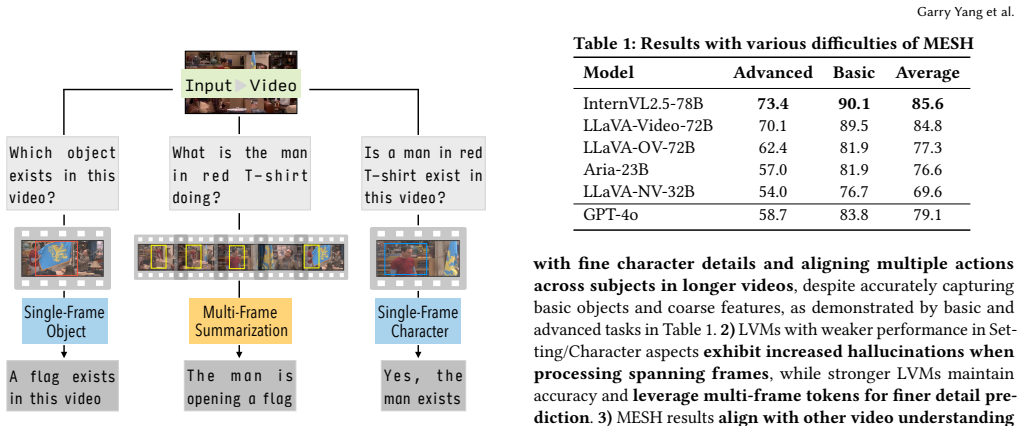
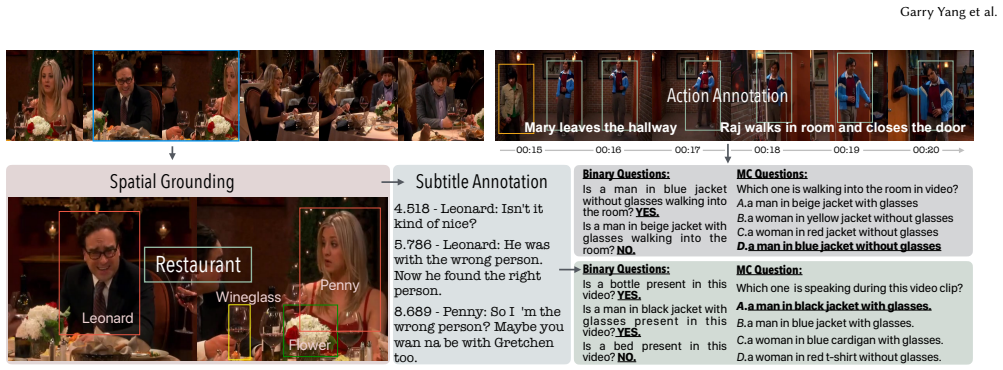
MESH's central claim: hallucination in video models grows predictably as questions move from coarse to fine along a setting–character–stage ladder. Models that recognize basic objects and coarse features fail on fine character details, and fail most on stage questions that bind several subjects to their actions across many frames. MESH exposes this by building positive targets from TVQA+'s spatial, subtitle, and action annotations, and negative traps absent or mismatched by construction: objects from other locations, swapped features, imported actions. The authors claim this difficulty ordering is stable across sixteen open and closed models, separates models that exploit multi-frame tokens
What carries the argument
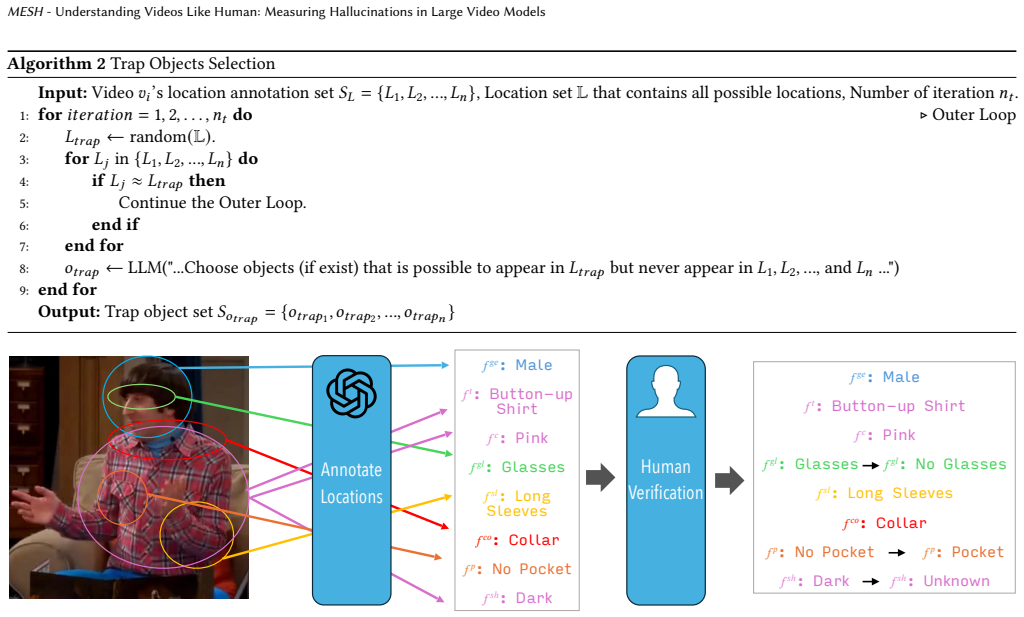
The load-bearing object is the mise-en-scène decomposition: every clip is probed at three levels—Setting (environment and objects), Character (each subject encoded as an eight-feature vector: gender, garment type and color, glasses, sleeve type, collar, pocket, garment shade), and Stage (subject-action pairs and dialogue attribution). Difficulty is graded by granularity masks that hide or reveal features and by clip length. Negatives are built by substitution and then filtered by text-embedding cosine similarity so traps stay distinguishable from targets. This target-trap machinery, in binary and multi-choice formats, is what ranks hallucination difficulty rather than just counting errors.
Load-bearing premise
The benchmark's ground truth assumes each trap item is genuinely absent from (or mismatched to) its video, resting on sparse TVQA+ annotations, LLM-generated object sets, and a text-embedding filter, with no reported human-agreement or error rates for verification.
What would settle it
Hand-check a random sample of rejected Setting traps (say 200 'no' questions) against the full video frames rather than just the annotated frames: if a visible object such as a bed or bottle turns up in an unannotated frame, then refusing the trap is not evidence of non-hallucination and Setting accuracy numbers would be inflated. Likewise, re-derive the eight-feature character vectors for the same clips with two independent annotation teams and measure agreement; low agreement on features like collar or pocket presence would weaken the fine-grained difficulty ladder.
If this is right
- MESH's basic-versus-advanced score gap predicts performance on general video QA benchmarks (Video-MME, MLVU), so cutting fine-grained hallucinations should improve high-level video understanding.
- Model scale helps on fine details in long videos but not on coarse questions, indicating fine-grained perception, not raw parameter count, is the current bottleneck.
- The benchmark separates models that leverage multi-frame tokens from those that are distracted by more frames: stronger models gain accuracy from longer clips while weaker ones lose up to 20 points.
- The annotation pipeline transfers to other datasets, demonstrated on UCF101 and a concatenated UCF101-COMBINE, reproducing the same coarse-to-fine difficulty trend.
- Aggressive token reduction (e.g., LLaMA-VID's two tokens per frame) correlates with the largest hallucination rates, linking architectural design choices to hallucination.
Where Pith is reading between the lines
- One testable extension is to use MESH's target/trap pairs as contrastive training data—teaching models to reject near-miss characters and imported actions—and check whether VQA gains follow; the paper reports correlation but does not test causation.
- The trap-absence assumption is the risk point: traps come from sparse TVQA+ spatial groundings plus LLM-generated object sets, so a trap object may appear in a frame that was never annotated. Re-verifying negative questions against full videos, and reporting inter-annotator agreement on character features, would firm up or refute the ground truth.
- Similar-action and role-mix traps are the hardest categories, suggesting they isolate the subject-action binding step and could serve as a dedicated stress test for future models.
- Closed-source general models underperform open video-specific models on stage questions; a follow-up could determine whether that gap comes from missing video fine-tuning or from frame-sampling strategy, which the paper's data cannot separate.
Editorial analysis
A structured set of objections, weighed in public.
Referee Report
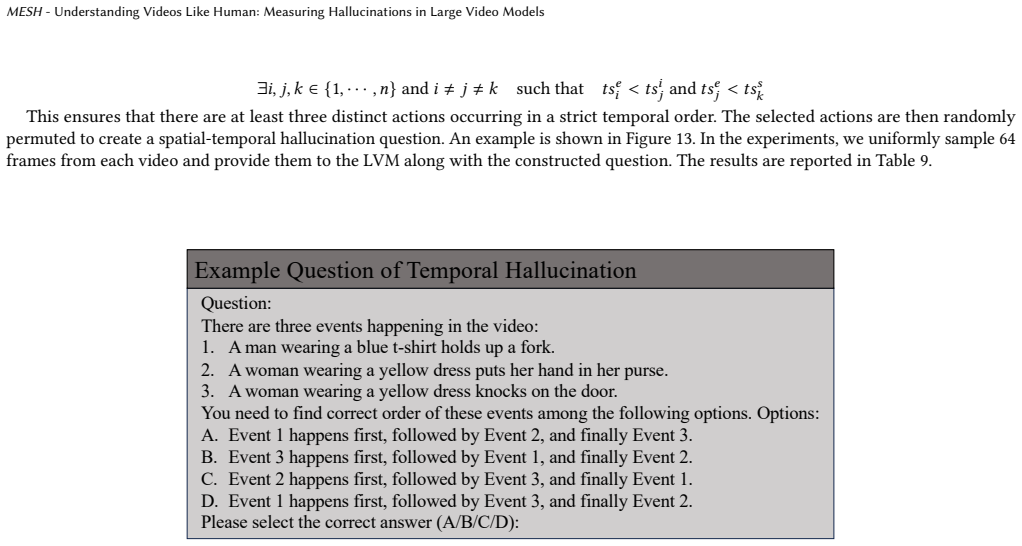
Summary. The paper introduces MESH, a video hallucination benchmark built on TVQA+. It organizes questions along a bottom-up mise-en-scène taxonomy — Setting (objects), Character (coarse-to-fine person features), and Stage (subject–action and dialogue pairs) — and generates both binary and four-option multiple-choice questions pairing a target instance with trap instances. The benchmark is evaluated on a wide range of open- and closed-source LVMs. The main reported findings are that LVMs perform well on basic object/coarse-feature questions but degrade markedly on fine-grained character details and on subject–action alignment in longer clips; that SA/MI and CI/CO categories are harder than EA/CO/AO; and that MESH scores correlate with V-MME and MLVU. The paper also reports image-vs-video ablations, temporal-order experiments, and a generalization study on UCF101 and UCF101-COMBINE.
Significance. If the benchmark's ground-truth labels are trustworthy, MESH is a useful diagnostic resource: it is perception-motivated, publicly released, evaluated on 20+ models with diverse backbones, and it includes balance metrics (OB/COB, JSD) that go beyond raw accuracy. The attempt to separate setting/character/stage and to construct fine-grained traps is a genuine contribution. However, the central validity of every negative question depends on trap absence or mismatch being verified, and the paper currently provides only weak, indirect filters for this. Because false-negative labels could be correlated with the very trends the paper highlights, the empirical conclusions are not yet fully load-bearing.
major comments (2)
- [3.3.1–3.3.3, B.2.1, B.4.6] The validity of each trap question relies on the trap instance being truly absent from (or mismatched to) the video, but the construction pipeline never verifies this. Setting traps are sampled from object sets of other space labels (Eq. 3), yet the paper itself states that TVQA+ object annotations are sparse (B.2.1). Character traps are feature vectors from other videos, filtered only by feature-group dissimilarity and an embedding similarity criterion (Eq. 5); a trap descriptor could match an unannotated bystander or a real character with the same 8-feature vector. Stage traps are produced by substituting subjects/actions, and the only quality gate is text-embedding cosine distance > 0.65 (B.4.6). Human verification is reported for location names and character features, but not for trap absence, and no inter-annotator agreement or error rate is given. This is not cosmetic: false-negati
- [4.3.2 / Table 7] The claim that MESH results 'align with' V-MME and MLVU is supported only by six models and no quantitative measure. The ordering is not even monotone: e.g., LLaVA-OV-72B has a higher Advanced MESH score than Aria-23B but a lower VMME score, and GPT-4o has a lower Advanced score than LLaVA-OV-72B yet a higher VMME score. Without a Spearman/Kendall correlation, confidence intervals, or an explicit regression, the alignment claim is not established. Since this is one of the three advertised findings, please compute a correlation statistic or clearly label the comparison as qualitative.
minor comments (5)
- [Section 3.3.3] Typo: 'devide' should be 'divide'.
- [Appendix B.4.5] In the MI example, the swapped result is given twice as 'A man in a blue jacket without glasses is sitting'; the second should refer to the other subject (e.g., the man in a gray t-shirt) for the role swap to be coherent.
- [Table 2 vs Appendix C.1.2] There are small numeric inconsistencies in the Stage Action binary counts: Table 2 reports Yes/EA = 2491, while Appendix C.1.2 reports 2488. Please reconcile.
- [Notation / Table 3] Model naming is inconsistent: LLaVA-NV-32B, LLaVA-NeXT-Video-32B, and LLaVA-NeXT-Video-7B are used interchangeably; stage tables also mix 'COV/AOV/MIV' with the main text's 'CO/AO/MI'. Please standardize.
- [Appendix B.4.6] The embedding model 'text-embedding-3-small' is used as a quality gate but no version or reference is given; also the 0.65 threshold is not justified. Please document the model version and provide a sensitivity analysis or rationale for the threshold.
Circularity Check
No significant circularity: the benchmark's measurements are empirical evaluations of LVM behavior, not derivations from its own construction.
full rationale
The paper constructs a video-hallucination benchmark (MESH) and reports LVM accuracies across settings, character-feature granularities, action/dialogue categories, and clip lengths. I walked the construction chain in Sections 3.2-3.3 and Appendices B.2-B.4. No parameter is fitted to the evaluated models, and no headline result is derived from an equation that already contains that result. The difficulty ladder (coarse/medium/fine, basic/advanced) is set by construction—masking more character features or choosing harder trap types—but this only defines the question granularity; the reported finding that LVMs do worse on fine-grained or longer-video questions is an empirical measurement of model behavior, not a logical consequence of the benchmark definitions. Target/trap instances come from TVQA+ annotations and LLM-generated object/feature/action sets; the trap selections (Eqs. 3, 5, 8-10, Algorithms 2-5) use similarity filters and space/feature/action dissimilarity rules, but those rules do not encode the measured accuracies. The one self-citation by an author (ref. [52]) concerns graph contrastive learning and is not load-bearing. A potential concern that trap absence is never fully verified would be an annotation-validity or label-noise issue, not circularity: answering 'no' to a trap measures whether the model rejects that instance, and whether the instance truly is absent affects benchmark validity, but the paper does not reduce its predictions to its inputs by definition. Therefore no circular step can be exhibited, and the appropriate finding is no significant circularity.
Axiom & Free-Parameter Ledger
free parameters (3)
- Semantic similarity threshold for trap retention =
0.65 cosine distance
- Granularity mask levels =
coarse=3 features, medium=5, mixed/fine=8 (with random masking)
- Frame sampling budgets =
8/16/32/64 frames for character; 32 default elsewhere; 1 fps for dialogue
axioms (4)
- domain assumption Humans understand videos bottom-up through Setting, then Characters, then Stage
- domain assumption TVQA+ spatial grounding plus LLM-generated object lists are complete enough to declare trap objects absent
- domain assumption LLM annotation outputs (DeepSeek-v3 objects, GPT-4o features, Qwen2-VL locations) are correct after human verification
- ad hoc to paper Text-embedding cosine distance is a valid proxy for how distinguishable a trap is from a target
invented entities (2)
-
Mise-en-scene hallucination taxonomy (Setting/Character/Stage)
no independent evidence
-
Stage trap categories CO, CI, AO, SA, MI
no independent evidence
Cite this review
Pith. "Pith review of MESH -- Understanding Videos Like Human: Measuring Hallucinations in Large Video Models." pith.science (2026). https://pith.science/paper/QAN6UD3K
@misc{pith2026250908538,
  author       = {Pith},
  title        = {Pith review of: MESH -- Understanding Videos Like Human: Measuring Hallucinations in Large Video Models},
  year         = {2026},
  howpublished = {\url{https://pith.science/paper/QAN6UD3K}},
  note         = {Machine review of arXiv:2509.08538}
}
read the original abstract
Large Video Models (LVMs) build on the semantic capabilities of Large Language Models (LLMs) and vision modules by integrating temporal information to better understand dynamic video content. Despite their progress, LVMs are prone to hallucinations-producing inaccurate or irrelevant descriptions. Current benchmarks for video hallucination depend heavily on manual categorization of video content, neglecting the perception-based processes through which humans naturally interpret videos. We introduce MESH, a benchmark designed to evaluate hallucinations in LVMs systematically. MESH uses a Question-Answering framework with binary and multi-choice formats incorporating target and trap instances. It follows a bottom-up approach, evaluating basic objects, coarse-to-fine subject features, and subject-action pairs, aligning with human video understanding. We demonstrate that MESH offers an effective and comprehensive approach for identifying hallucinations in videos. Our evaluations show that while LVMs excel at recognizing basic objects and features, their susceptibility to hallucinations increases markedly when handling fine details or aligning multiple actions involving various subjects in longer videos.
Figures




Reference graph
Works this paper leans on
-
[1]
Aakanksha and A. N. Rajagopalan. 2023. Improving Robustness of Semantic Segmentation to Motion-Blur Using Class-Centric Augmentation. InIEEE/CVF Conference on Computer Vision and Pattern Recognition, CVPR 2023, Vancouver, BC, Canada, June 17-24, 2023. IEEE, 10470–10479. doi:10.1109/CVPR52729.2023.01009
arXiv 2023
-
[2]
Anthropic. 2024. Introducing Claude 3.5 Sonnet. https://www.anthropic.com/ news/claude-3-5-sonnet
2024
-
[3]
Jinze Bai, Shuai Bai, Yunfei Chu, Zeyu Cui, Kai Dang, Xiaodong Deng, Yang Fan, Wenbin Ge, Yu Han, Fei Huang, Binyuan Hui, Luo Ji, Mei Li, Junyang Lin, Runji Lin, Dayiheng Liu, Gao Liu, Chengqiang Lu, Keming Lu, Jianxin Ma, Rui Men, Xingzhang Ren, Xuancheng Ren, Chuanqi Tan, Sinan Tan, Jianhong Tu, Peng Wang, Shijie Wang, Wei Wang, Shengguang Wu, Benfeng X...
-
[4]
Hritik Bansal, Yonatan Bitton, Idan Szpektor, Kai-Wei Chang, and Aditya Grover
-
[5]
2020.The visual story: Creating the visual structure of film, TV, and digital media
Bruce Block. 2020.The visual story: Creating the visual structure of film, TV, and digital media. Routledge
2020
-
[6]
2005.Figures traced in light: On cinematic staging
David Bordwell. 2005.Figures traced in light: On cinematic staging. Univ of California Press
2005
-
[7]
Bordwell and K
D. Bordwell and K. Thompson. 2008.Film Art: An Introduction. McGraw Hill. https://books.google.com.hk/books?id=g6ZAAQAAIAAJ
2008
-
[8]
Paulo Vinicius Koerich Borges, Nicola Conci, and Andrea Cavallaro. 2013. Video- based human behavior understanding: A survey.IEEE transactions on circuits and systems for video technology23, 11 (2013), 1993–2008
2013
-
[9]
Zheng Cai, Maosong Cao, Haojiong Chen, Kai Chen, Keyu Chen, Xin Chen, Xun Chen, Zehui Chen, Zhi Chen, Pei Chu, Xiaoyi Dong, Haodong Duan, Qi Fan, Zhaoye Fei, Yang Gao, Jiaye Ge, Chenya Gu, Yuzhe Gu, Tao Gui, Aijia Guo, Qipeng Guo, Conghui He, Yingfan Hu, Ting Huang, Tao Jiang, Penglong Jiao, Zhenjiang Jin, Zhikai Lei, Jiaxing Li, Jingwen Li, Linyang Li, S...
-
[10]
Guangyi Chen, Xiao Liu, Guangrun Wang, Kun Zhang, Philip H. S. Torr, Xiao- Ping Zhang, and Yansong Tang. 2023. Tem-adapter: Adapting Image-Text Pre- training for Video Question Answer. InIEEE/CVF International Conference on Computer Vision, ICCV 2023, Paris, France, October 1-6, 2023. IEEE, 13899–13909. doi:10.1109/ICCV51070.2023.01282
arXiv 2023
- [11]
-
[12]
Zhe Chen, Jiannan Wu, Wenhai Wang, Weijie Su, Guo Chen, Sen Xing, Muyan Zhong, Qinglong Zhang, Xizhou Zhu, Lewei Lu, et al. 2024. Internvl: Scaling up vision foundation models and aligning for generic visual-linguistic tasks. InPro- ceedings of the IEEE/CVF Conference on Computer Vision and Pattern Recognition. 24185–24198
2024
-
[13]
Zhe Chen, Weiyun Wang, Yue Cao, Yangzhou Liu, Zhangwei Gao, Erfei Cui, Jinguo Zhu, Shenglong Ye, Hao Tian, Zhaoyang Liu, et al . 2024. Expanding Performance Boundaries of Open-Source Multimodal Models with Model, Data, and Test-Time Scaling.arXiv preprint arXiv:2412.05271(2024)
Pith/arXiv arXiv 2024
-
[14]
Gonzalez, Ion Stoica, and Eric P
Wei-Lin Chiang, Zhuohan Li, Zi Lin, Ying Sheng, Zhanghao Wu, Hao Zhang, Lianmin Zheng, Siyuan Zhuang, Yonghao Zhuang, Joseph E. Gonzalez, Ion Stoica, and Eric P. Xing. 2023. Vicuna: An Open-Source Chatbot Impressing GPT-4 with 90%* ChatGPT Quality. https://lmsys.org/blog/2023-03-30-vicuna/
2023
-
[15]
Zesen Cheng, Sicong Leng, Hang Zhang, Yifei Xin, Xin Li, Guanzheng Chen, Yongxin Zhu, Wenqi Zhang, Ziyang Luo, Deli Zhao, and Lidong Bing. 2024. VideoLLaMA 2: Advancing Spatial-Temporal Modeling and Audio Understanding in Video-LLMs.arXiv preprint arXiv:2406.07476(2024). https://arxiv.org/abs/ 2406.07476
Pith/arXiv arXiv 2024
-
[16]
2013.Human information processing: Vision, memory, and attention.American Psychological Association
Charles Ed Chubb, Barbara A Dosher, Zhong-Lin Ed Lu, and Richard M Shiffrin. 2013.Human information processing: Vision, memory, and attention.American Psychological Association
2013
-
[17]
Wey Yeh Choong, Yangyang Guo, and Mohan S. Kankanhalli. 2024. VidHal: Benchmarking Temporal Hallucinations in Vision LLMs.CoRRabs/2411.16771 (2024). arXiv:2411.16771 doi:10.48550/ARXIV.2411.16771
-
[18]
LMDeploy Contributors. 2023. LMDeploy: A Toolkit for Compressing, Deploying, and Serving LLM. https://github.com/InternLM/lmdeploy
2023
-
[20]
Navneet Dalal and Bill Triggs. 2005. Histograms of oriented gradients for human detection. In2005 IEEE computer society conference on computer vision and pattern recognition (CVPR’05), Vol. 1. Ieee, 886–893
2005
-
[21]
Daniel Cores, Michael Dorkenwald, Manuel Mucientes, Cees G. M. Snoek, and Yuki M. Asano. 2025. Lost in Time: A New Temporal Benchmark for VideoLLMs. arXiv:2410.07752 [cs.CV] https://arxiv.org/abs/2410.07752
Pith/arXiv arXiv 2025
-
[22]
Yue Fan, Xiaojian Ma, Rujie Wu, Yuntao Du, Jiaqi Li, Zhi Gao, and Qing Li. 2025. Videoagent: A memory-augmented multimodal agent for video understanding. InEuropean Conference on Computer Vision. Springer, 75–92
2025
-
[23]
DeepSeek-AI, Aixin Liu, Bei Feng, Bing Xue, Bingxuan Wang, Bochao Wu, Chengda Lu, Chenggang Zhao, Chengqi Deng, Chenyu Zhang, Chong Ruan, Damai Dai, Daya Guo, Dejian Yang, Deli Chen, Dongjie Ji, Erhang Li, Fangyun Lin, Fucong Dai, Fuli Luo, Guangbo Hao, Guanting Chen, Guowei Li, H. Zhang, Han Bao, Hanwei Xu, Haocheng Wang, Haowei Zhang, Honghui Ding, Huaj...
Pith/arXiv arXiv 2024
-
[24]
2002.Mise-en-scène: Film style and interpre- tation
John Gibbs and John Edward Gibbs. 2002.Mise-en-scène: Film style and interpre- tation. Vol. 10. Wallflower Press
2002
-
[25]
Chaoyou Fu, Yuhan Dai, Yondong Luo, Lei Li, Shuhuai Ren, Renrui Zhang, Zihan Wang, Chenyu Zhou, Yunhang Shen, Mengdan Zhang, Peixian Chen, Yanwei Li, Shaohui Lin, Sirui Zhao, Ke Li, Tong Xu, Xiawu Zheng, Enhong Chen, Rongrong Ji, and Xing Sun. 2024. Video-MME: The First-Ever Comprehensive Evaluation Benchmark of Multi-modal LLMs in Video Analysis.CoRRabs/...
-
[26]
Jiaming Han, Renrui Zhang, Wenqi Shao, Peng Gao, Peng Xu, Han Xiao, Kaipeng Zhang, Chris Liu, Song Wen, Ziyu Guo, Xudong Lu, Shuai Ren, Yafei Wen, Xiaoxin Chen, Xiangyu Yue, Hongsheng Li, and Yu Qiao. 2023. ImageBind-LLM: Multi- modality Instruction Tuning.CoRRabs/2309.03905 (2023). arXiv:2309.03905 doi:10.48550/ARXIV.2309.03905
-
[29]
Berthold KP Horn and Brian G Schunck. 1981. Determining optical flow.Artificial intelligence17, 1-3 (1981), 185–203
1981
-
[30]
Aaron Hurst, Adam Lerer, Adam P. Goucher, Adam Perelman, Aditya Ramesh, Aidan Clark, AJ Ostrow, Akila Welihinda, Alan Hayes, Alec Radford, Aleksander Madry, Alex Baker-Whitcomb, Alex Beutel, Alex Borzunov, Alex Carney, Alex Chow, Alex Kirillov, Alex Nichol, Alex Paino, Alex Renzin, Alex Tachard Passos, Alexander Kirillov, Alexi Christakis, Alexis Conneau,...
-
[31]
Lei Huang, Weijiang Yu, Weitao Ma, Weihong Zhong, Zhangyin Feng, Hao- tian Wang, Qianglong Chen, Weihua Peng, Xiaocheng Feng, Bing Qin, and Ting Liu. 2023. A Survey on Hallucination in Large Language Models: Princi- ples, Taxonomy, Challenges, and Open Questions.CoRRabs/2311.05232 (2023). arXiv:2311.05232 doi:10.48550/ARXIV.2311.05232
-
[32]
A Comprehensive Survey on Visual Question Answering Datasets and Algorithms
Raihan Kabir, Naznin Haque, Md. Saiful Islam, and Marium-E-Jannat. 2024. A Comprehensive Survey on Visual Question Answering Datasets and Algorithms. CoRRabs/2411.11150 (2024). arXiv:2411.11150 doi:10.48550/ARXIV.2411.11150
work page internal anchor Pith review Pith/arXiv arXiv doi:10.48550/arxiv.2411.11150 2024
-
[33]
Ziwei Ji, Nayeon Lee, Rita Frieske, Tiezheng Yu, Dan Su, Yan Xu, Etsuko Ishii, Yejin Bang, Andrea Madotto, and Pascale Fung. 2023. Survey of Hallucination in Natural Language Generation.ACM Comput. Surv.55, 12 (2023), 248:1–248:38. doi:10.1145/3571730
doi:10.1145/3571730 2023
-
[34]
Gonzalez, Hao Zhang, and Ion Stoica
Woosuk Kwon, Zhuohan Li, Siyuan Zhuang, Ying Sheng, Lianmin Zheng, Cody Hao Yu, Joseph E. Gonzalez, Hao Zhang, and Ion Stoica. 2023. Efficient Memory Management for Large Language Model Serving with PagedAtten- tion. InProceedings of the ACM SIGOPS 29th Symposium on Operating Systems Principles
2023
-
[35]
Serpil Kocdar, Nejdet Karadag, and Murat Dogan Sahin. 2016. Analysis of the Difficulty and Discrimination Indices of Multiple-Choice Questions According to Cognitive Levels in an Open and Distance Learning Context.Turkish Online Journal of Educational Technology-TOJET15, 4 (2016), 16–24
2016
-
[36]
Bo Li, Yuanhan Zhang, Dong Guo, Renrui Zhang, Feng Li, Hao Zhang, Kaichen Zhang, Yanwei Li, Ziwei Liu, and Chunyuan Li. 2024. Llava-onevision: Easy visual task transfer.arXiv preprint arXiv:2408.03326(2024)
Pith/arXiv arXiv 2024
-
[37]
Jie Lei, Licheng Yu, Tamara L. Berg, and Mohit Bansal. 2020. TVQA+: Spatio- Temporal Grounding for Video Question Answering. InProceedings of the 58th Annual Meeting of the Association for Computational Linguistics, ACL 2020, Online, July 5-10, 2020, Dan Jurafsky, Joyce Chai, Natalie Schluter, and Joel R. Tetreault (Eds.). Association for Computational Li...
doi:10.18653/v1/ 2020
-
[38]
Dongxu Li, Yudong Liu, Haoning Wu, Yue Wang, Zhiqi Shen, Bowen Qu, Xinyao Niu, Guoyin Wang, Bei Chen, and Junnan Li. 2024. Aria: An Open Multimodal Native Mixture-of-Experts Model.arXiv preprint arXiv:2410.05993(2024)
Pith/arXiv arXiv 2024
-
[39]
Chaoyu Li, Eun Woo Im, and Pooyan Fazli. 2024. VidHalluc: Evaluating Temporal Hallucinations in Multimodal Large Language Models for Video Understanding. arXiv:2412.03735 [cs.CV] https://arxiv.org/abs/2412.03735
Pith/arXiv arXiv 2024
-
[40]
Yifan Li, Yifan Du, Kun Zhou, Jinpeng Wang, Wayne Xin Zhao, and Ji-Rong Wen. 2023. Evaluating Object Hallucination in Large Vision-Language Models. InProceedings of the 2023 Conference on Empirical Methods in Natural Language Processing, EMNLP 2023, Singapore, December 6-10, 2023, Houda Bouamor, Juan Pino, and Kalika Bali (Eds.). Association for Computati...
-
[42]
Yanwei Li, Chengyao Wang, and Jiaya Jia. 2025. Llama-vid: An image is worth 2 tokens in large language models. InEuropean Conference on Computer Vision. Springer, 323–340
2025
-
[43]
Yanyang Li, Shuo Liang, Michael R Lyu, and Liwei Wang. 2024. Making long-context language models better multi-hop reasoners.arXiv preprint arXiv:2408.03246(2024)
Pith/arXiv arXiv 2024
-
[44]
Ji Lin, Hongxu Yin, Wei Ping, Yao Lu, Pavlo Molchanov, Andrew Tao, Huizi Mao, Jan Kautz, Mohammad Shoeybi, and Song Han. 2023. VILA: On Pre-training for Visual Language Models. arXiv:2312.07533 [cs.CV]
Pith/arXiv arXiv 2023
-
[45]
Bin Lin, Yang Ye, Bin Zhu, Jiaxi Cui, Munan Ning, Peng Jin, and Li Yuan. 2024. Video-LLaVA: Learning United Visual Representation by Alignment Before Pro- jection. InProceedings of the 2024 Conference on Empirical Methods in Natural Language Processing, EMNLP 2024, Miami, FL, USA, November 12-16, 2024, Yaser Al-Onaizan, Mohit Bansal, and Yun-Nung Chen (Ed...
-
[46]
Belongie, James Hays, Pietro Perona, Deva Ramanan, Piotr Dollár, and C
Tsung-Yi Lin, Michael Maire, Serge J. Belongie, James Hays, Pietro Perona, Deva Ramanan, Piotr Dollár, and C. Lawrence Zitnick. 2014. Microsoft COCO: Common Objects in Context. InComputer Vision - ECCV 2014 - 13th European Conference, Zurich, Switzerland, September 6-12, 2014, Proceedings, Part V (Lecture Notes in Computer Science, Vol. 8693), David J. Fl...
-
[47]
Kevin Lin, Faisal Ahmed, Linjie Li, Chung-Ching Lin, Ehsan Azarnasab, Zhengyuan Yang, Jianfeng Wang, Lin Liang, Zicheng Liu, Yumao Lu, Ce Liu, and Lijuan Wang. 2023. MM-VID: Advancing Video Understanding with GPT- 4V(ision).CoRRabs/2310.19773 (2023). arXiv:2310.19773 doi:10.48550/ARXIV. 2310.19773
-
[48]
Fuxiao Liu, Tianrui Guan, Zongxia Li, Lichang Chen, Yaser Yacoob, Dinesh Manocha, and Tianyi Zhou. 2023. HallusionBench: You See What You Think? Or You Think What You See? An Image-Context Reasoning Benchmark Chal- lenging for GPT-4V(ision), LLaVA-1.5, and Other Multi-modality Models.CoRR abs/2310.14566 (2023). arXiv:2310.14566 doi:10.48550/ARXIV.2310.14566
-
[49]
Yuanze Lin, Xun Guo, and Yan Lu. 2021. Self-Supervised Video Representation Learning with Meta-Contrastive Network. In2021 IEEE/CVF International Con- ference on Computer Vision, ICCV 2021, Montreal, QC, Canada, October 10-17, 2021. IEEE, 8219–8229. doi:10.1109/ICCV48922.2021.00813
arXiv 2021
-
[50]
Yuanxin Liu, Shicheng Li, Yi Liu, Yuxiang Wang, Shuhuai Ren, Lei Li, Sishuo Chen, Xu Sun, and Lu Hou. 2024. TempCompass: Do Video LLMs Really Understand Videos?. InFindings of the Association for Computational Linguistics, ACL 2024, Bangkok, Thailand and virtual meeting, August 11-16, 2024, Lun-Wei Ku, Andre Martins, and Vivek Srikumar (Eds.). Association...
-
[51]
Jiazhen Liu, Yuhan Fu, Ruobing Xie, Runquan Xie, Xingwu Sun, Fengzong Lian, Zhanhui Kang, and Xirong Li. 2024. PhD: A Prompted Visual Hallucination Evaluation Dataset.CoRRabs/2403.11116 (2024). arXiv:2403.11116 doi:10.48550/ ARXIV.2403.11116
-
[52]
Kaili Ma, Garry Yang, Han Yang, Yongqiang Chen, and James Cheng. 2023. Calibrating and Improving Graph Contrastive Learning.Trans. Mach. Learn. Res. 2023 (2023). https://openreview.net/forum?id=LdSP6cvTS4
2023
-
[53]
Zuyan Liu, Yuhao Dong, Ziwei Liu, Winston Hu, Jiwen Lu, and Yongming Rao
-
[54]
Oryx MLLM: On-Demand Spatial-Temporal Understanding at Arbitrary Resolution.arXiv preprint arXiv:2409.12961(2024)
Pith/arXiv arXiv 2024
-
[55]
Mayug Maniparambil, Raiymbek Akshulakov, Yasser Abdelaziz Dahou Dji- lali, Mohamed El Amine Seddik, Sanath Narayan, Karttikeya Mangalam, and Noel E. O’Connor. 2024. Do Vision and Language Encoders Represent the World Similarly?. InIEEE/CVF Conference on Computer Vision and Pattern Recognition, CVPR 2024, Seattle, W A, USA, June 16-22, 2024. IEEE, 14334–14...
arXiv 2024
-
[56]
Neelu Madan, Andreas Møgelmose, Rajat Modi, Yogesh S. Rawat, and Thomas B. Moeslund. 2024. Foundation Models for Video Understanding: A Survey.CoRR abs/2405.03770 (2024). arXiv:2405.03770 doi:10.48550/ARXIV.2405.03770
-
[57]
2016.From Human Attention to Computational Attention
Matei Mancas, Vincent P Ferrera, Nicolas Riche, and John G Taylor. 2016.From Human Attention to Computational Attention. Vol. 2. Springer
2016
-
[58]
Thong Nguyen, Yi Bin, Junbin Xiao, Leigang Qu, Yicong Li, Jay Zhangjie Wu, Cong-Duy Nguyen, See-Kiong Ng, and Anh Tuan Luu. 2024. Video-Language Understanding: A Survey from Model Architecture, Model Training, and Data Perspectives. InFindings of the Association for Computational Linguistics, ACL 2024, Bangkok, Thailand and virtual meeting, August 11-16, ...
-
[59]
1999.Foundations of statistical natural language processing
Christopher Manning and Hinrich Schutze. 1999.Foundations of statistical natural language processing. MIT press
1999
-
[60]
Shervin Minaee, Tomás Mikolov, Narjes Nikzad, Meysam Chenaghlu, Richard Socher, Xavier Amatriain, and Jianfeng Gao. 2024. Large Language Models: A Survey.CoRRabs/2402.06196 (2024). arXiv:2402.06196 doi:10.48550/ARXIV.2402. 06196
-
[61]
Viorica Patraucean, Lucas Smaira, Ankush Gupta, Adrià Recasens, Larisa Markeeva, Dylan Banarse, Skanda Koppula, Joseph Heyward, Mateusz Ma- linowski, Yi Yang, Carl Doersch, Tatiana Matejovicova, Yury Sulsky, An- toine Miech, Alexandre Fréchette, Hanna Klimczak, Raphael Koster, Junlin Zhang, Stephanie Winkler, Yusuf Aytar, Simon Osindero, Dima Damen, An- d...
2023
-
[62]
Munan Ning, Bin Zhu, Yujia Xie, Bin Lin, Jiaxi Cui, Lu Yuan, Dongdong Chen, and Li Yuan. 2023. Video-Bench: A Comprehensive Benchmark and Toolkit for Evaluating Video-based Large Language Models.CoRRabs/2311.16103 (2023). arXiv:2311.16103 doi:10.48550/ARXIV.2311.16103
-
[63]
OpenAI. 2023. GPT-4 Technical Report.CoRRabs/2303.08774 (2023). arXiv:2303.08774 doi:10.48550/ARXIV.2303.08774
-
[64]
G. Rose. 2007.Visual Methodologies: An Introduction to the Interpretation of Visual Materials. SAGE Publications. https://books.google.com.hk/books?id= gnUPNcnYjcIC
2007
-
[65]
Alec Radford, Jong Wook Kim, Chris Hallacy, Aditya Ramesh, Gabriel Goh, Sandhini Agarwal, Girish Sastry, Amanda Askell, Pamela Mishkin, Jack Clark, Gretchen Krueger, and Ilya Sutskever. 2021. Learning Transferable Visual Mod- els From Natural Language Supervision. InProceedings of the 38th International Conference on Machine Learning, ICML 2021, 18-24 Jul...
2021
-
[66]
Girshick, and Ali Farhadi
Joseph Redmon, Santosh Kumar Divvala, Ross B. Girshick, and Ali Farhadi
-
[67]
Darshana Saravanan, Darshan Singh S, Varun Gupta, Zeeshan Khan, Vineet Gandhi, and Makarand Tapaswi. 2024. VELOCITI: Can Video-Language Mod- els Bind Semantic Concepts through Time?CoRRabs/2406.10889 (2024). arXiv:2406.10889 doi:10.48550/ARXIV.2406.10889
work page internal anchor Pith review Pith/arXiv arXiv doi:10.48550/arxiv.2406.10889 2024
-
[68]
Yan Shu, Peitian Zhang, Zheng Liu, Minghao Qin, Junjie Zhou, Tiejun Huang, and Bo Zhao. 2024. Video-xl: Extra-long vision language model for hour-scale video understanding.arXiv preprint arXiv:2409.14485(2024)
Pith/arXiv arXiv 2024
-
[69]
Pranab Sahoo, Prabhash Meharia, Akash Ghosh, Sriparna Saha, Vinija Jain, and Aman Chadha. 2024. A Comprehensive Survey of Hallucination in Large Lan- guage, Image, Video and Audio Foundation Models. InFindings of the Association for Computational Linguistics: EMNLP 2024, Miami, Florida, USA, November 12-16, 2024, Yaser Al-Onaizan, Mohit Bansal, and Yun-Nu...
2024
-
[70]
Pranab Sahoo, Prabhash Meharia, Akash Ghosh, Sriparna Saha, Vinija Jain, and Aman Chadha. 2024. Unveiling Hallucination in Text, Image, Video, and Audio Foundation Models: A Comprehensive Survey.CoRRabs/2405.09589 (2024). arXiv:2405.09589 doi:10.48550/ARXIV.2405.09589
-
[71]
Matteo Stefanini, Marcella Cornia, Lorenzo Baraldi, Silvia Cascianelli, Giuseppe Fiameni, and Rita Cucchiara. 2023. From Show to Tell: A Survey on Deep Learning-Based Image Captioning.IEEE Trans. Pattern Anal. Mach. Intell.45, 1 (2023), 539–559. doi:10.1109/TPAMI.2022.3148210
arXiv 2023
-
[72]
Yunlong Tang, Jing Bi, Siting Xu, Luchuan Song, Susan Liang, Teng Wang, Daoan Zhang, Jie An, Jingyang Lin, Rongyi Zhu, Ali Vosoughi, Chao Huang, Zeliang Zhang, Feng Zheng, Jianguo Zhang, Ping Luo, Jiebo Luo, and Chenliang Xu
-
[74]
Khurram Soomro, Amir Roshan Zamir, and Mubarak Shah. 2012. UCF101: A Dataset of 101 Human Actions Classes From Videos in The Wild. arXiv:1212.0402 [cs.CV] https://arxiv.org/abs/1212.0402
Pith/arXiv arXiv 2012
-
[75]
Hugo Touvron, Thibaut Lavril, Gautier Izacard, Xavier Martinet, Marie-Anne Lachaux, Timothée Lacroix, Baptiste Rozière, Naman Goyal, Eric Hambro, Faisal Azhar, Aurélien Rodriguez, Armand Joulin, Edouard Grave, and Guillaume Lam- ple. 2023. LLaMA: Open and Efficient Foundation Language Models.CoRR abs/2302.13971 (2023). arXiv:2302.13971 doi:10.48550/ARXIV....
-
[76]
2013.The Oxford handbook of sound and image in digital media
Carol Vernallis, Amy Herzog, and John Richardson. 2013.The Oxford handbook of sound and image in digital media. OUP USA
2013
-
[77]
Peng Wang, Shuai Bai, Sinan Tan, Shijie Wang, Zhihao Fan, Jinze Bai, Keqin Chen, Xuejing Liu, Jialin Wang, Wenbin Ge, Yang Fan, Kai Dang, Mengfei Du, Xuancheng Ren, Rui Men, Dayiheng Liu, Chang Zhou, Jingren Zhou, and Junyang Lin. 2024. Qwen2-VL: Enhancing Vision-Language Model’s Perception of the World at Any Resolution. arXiv:2409.12191 [cs.CV] https://...
Pith/arXiv arXiv 2024
-
[78]
Gemini Team, Petko Georgiev, Ving Ian Lei, Ryan Burnell, Libin Bai, Anmol Gulati, Garrett Tanzer, Damien Vincent, Zhufeng Pan, Shibo Wang, et al. 2024. Gemini 1.5: Unlocking multimodal understanding across millions of tokens of context.arXiv preprint arXiv:2403.05530(2024)
Pith/arXiv arXiv 2024
-
[79]
2009.Multimodal Sig- nal Processing: Theory and applications for human-computer interaction
Jean-Philippe Thiran, Ferran Marques, and Hervé Bourlard. 2009.Multimodal Sig- nal Processing: Theory and applications for human-computer interaction. Academic Press
2009
-
[80]
Chenyu Yang, Xuan Dong, Xizhou Zhu, Weijie Su, Jiahao Wang, Hao Tian, Zhe Chen, Wenhai Wang, Lewei Lu, and Jifeng Dai. 2024. PVC: Progressive Visual Token Compression for Unified Image and Video Processing in Large Vision- Language Models. arXiv:2412.09613 [cs.CV] https://arxiv.org/abs/2412.09613
Pith/arXiv arXiv 2024
-
[81]
Dongjie Yang, Suyuan Huang, Chengqiang Lu, Xiaodong Han, Haoxin Zhang, Yan Gao, Yao Hu, and Hai Zhao. 2024. Vript: A Video Is Worth Thousands of Words. CoRRabs/2406.06040 (2024). arXiv:2406.06040 doi:10.48550/ARXIV.2406.06040
-
[82]
Shukang Yin, Chaoyou Fu, Sirui Zhao, Ke Li, Xing Sun, Tong Xu, and En- hong Chen. 2023. A Survey on Multimodal Large Language Models.CoRR abs/2306.13549 (2023). arXiv:2306.13549 doi:10.48550/ARXIV.2306.13549
-
[83]
Yuxuan Wang, Yueqian Wang, Dongyan Zhao, Cihang Xie, and Zilong Zheng
-
[84]
VideoHallucer: Evaluating Intrinsic and Extrinsic Hallucinations in Large Video-Language Models.CoRRabs/2406.16338 (2024). arXiv:2406.16338 doi:10. 48550/ARXIV.2406.16338
-
[85]
T Wolf. 2019. Huggingface’s transformers: State-of-the-art natural language processing.arXiv preprint arXiv:1910.03771(2019)
Pith/arXiv arXiv 2019
discussion (0)
Sign in with ORCID, Apple, or X to comment. Anyone can read and Pith papers without signing in.