REVIEW 4 major objections 5 minor 1 cited by
XiHeFusion: Harnessing Large Language Models for Science Communication in Nuclear Fusion
T0 review · 4 major / 5 minor · reviewed 2026-08-08 · deepseek-v4-flash
Pith's one-line read The paper introduces XiHeFusion, the first large language model tuned for nuclear fusion science communication, and shows it answers a 184-question expert quiz in Chinese and English.
desk verdict The paper ships a real fusion-domain chatbot and a large QA corpus, but never scores its own 184-question benchmark, leaving the central performance claim unsupported. read the letter →
The pith
A machine-rendered reading of the paper's core claim, the machinery that carries it, and where it could break.
The reading
What carries the argument
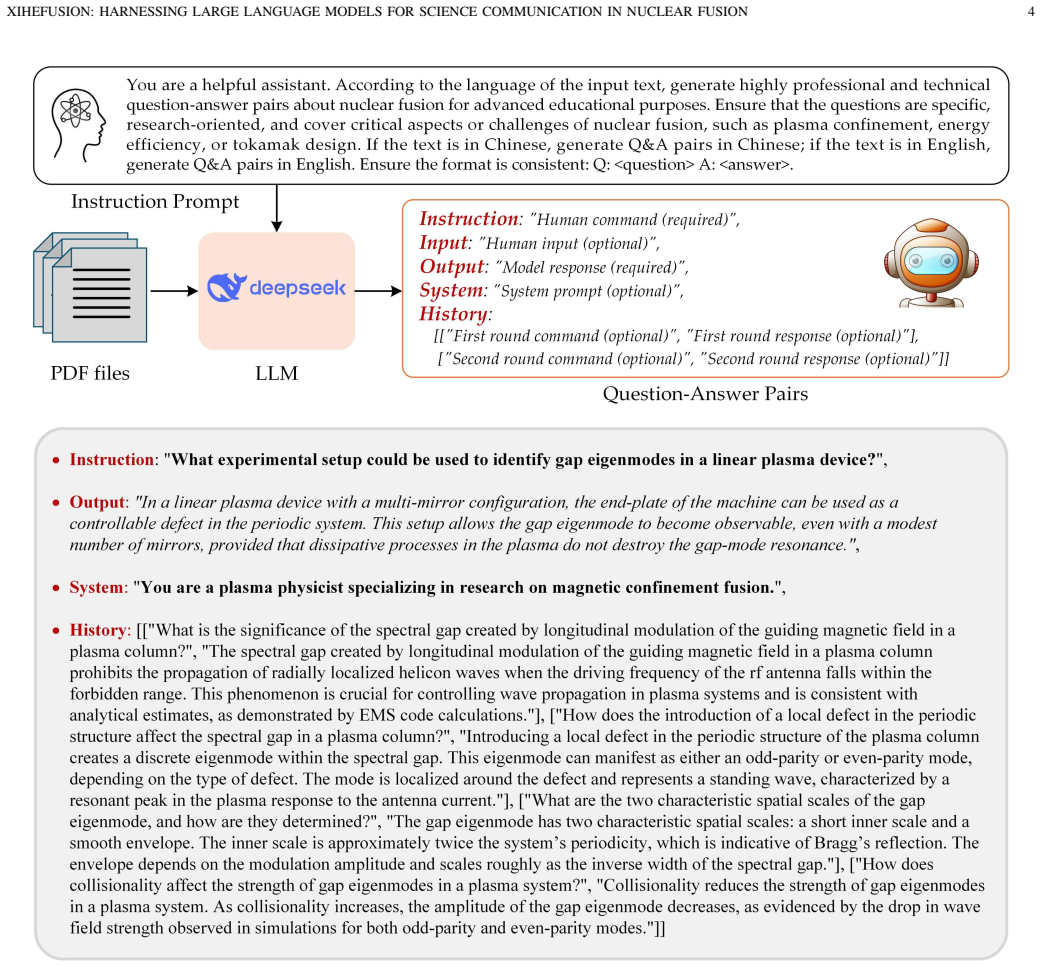
The mechanism is the combination of a teacher-generated Q&A corpus and a structured prompting template. DeepSeek V3 converts raw fusion text into 1.2 million instruction-style pairs (about 370 million tokens) spanning five fields: instruction, input, output, system prompt, and history. Supervised fine-tuning on these pairs transfers domain knowledge into the Qwen2.5-14B Transformer decoder (48 layers, 40 attention heads, 128K context). The chain-of-thought component is an eight-sample prompt that instructs the model to answer in five stages, from background and definitions through multi-angle reasoning to verification and summary. Together these two pieces are what the paper credits for making answers 'more accurate and logical.'
What would settle it
Have fusion experts score a random sample of XiHeFusion answers against the original source documents, recording the fraction containing substantive physics errors. If, say, more than 10% of sampled answers contain wrong numbers, misattributed concepts, or unsafe operational advice, the claim that the model reliably supports science communication would be falsified.
Extended reading notes
Core claim
The central claim is that XiHeFusion is the first large language model built specifically for nuclear fusion and that it can serve as an effective science popularizer. The claim is carried by a data pipeline that collects fusion material from CommonCrawl, CNKI, eBooks, arXiv, and dissertations; feeds it to DeepSeek V3 with a prompt demanding 'highly professional and technical question-answer pairs'; and uses the resulting 1.2 million pairs to fine-tune Qwen2.5-14B. Chain-of-thought prompting then restructures answers into five parts: background, term definitions with case analysis, multi-angle reasoning, verification with real cases, and a summary with interactive guidance. The paper's evidence consists of case studies showing longer, more detailed answers with CoT, comparisons against Baichuan 2, DeepSeek V3, GLM-4, Llama 3.3, and Qwen2 where XiHeFusion 'achieves a similar even better response,' and a 184-question quiz designed with domain experts. The paper itself acknowledges in its limitation section that some responses are not accurate, so the claim is about useful fluency rather than guaranteed factual correctness.
Load-bearing premise
The load-bearing premise is that the automatically generated 1.2 million question-answer pairs are accurate and representative of fusion knowledge; the paper provides no audit of these synthetic pairs, and its own Fig. 14 shows an example of an inaccurate response.
Editorial extensions
If this is right
- A bilingual Chinese–English fusion Q&A assistant with structured, multi-part answers is achievable by fine-tuning an open-source 14B model on synthetic Q&A data.
- Chain-of-thought prompting changes answer style from concise to detailed, five-part explanations on the same model.
- The 184-question expert quiz offers a domain-specific benchmark for measuring science-popularization ability in fusion.
- The released model can be used directly by newcomers to learn fusion basics, with the caveat that some answers are inaccurate.
Reading between the lines
- The pipeline's lack of a quality gate on the 1.2M synthetic pairs means the model's accuracy ceiling is set by DeepSeek V3's generation quality; a future version with expert filtering or retrieval-augmented grounding would likely reduce the observed inaccuracies.
- The same teacher-student Q&A distillation recipe could transfer to other niche scientific domains where expert-curated datasets are scarce, but only if a similar expert quiz is built to catch hallucinations.
- The CoT effect shown here is about response structure, not necessarily about factual accuracy; the paper does not show that CoT increases correctness on the quiz, only that answers get longer and more detailed.
- A natural testable extension is measuring XiHeFusion's answers against a fact-checked gold set in both languages, which would separate language-transfer ability from domain mastery.
Editorial analysis
A structured set of objections, weighed in public.
Referee Report
Summary. The paper introduces XiHeFusion, a supervised fine-tuned version of Qwen2.5-14B trained on 1.2 million question-answer pairs generated by DeepSeek V3 from nuclear-fusion-related web pages, books, and academic papers, with chain-of-thought prompting used to structure answers. The authors claim this is the first large language model for nuclear fusion, that it supports bilingual science-popularization Q&A, and that it provides more accurate and logical answers than its base model. They also present a 184-question expert-built questionnaire for evaluating fusion conversational ability. The experimental section, however, consists entirely of selected qualitative examples; no numerical scores on the questionnaire or on any other evaluation are reported.
Significance. If validated, XiHeFusion and its released resources could be a useful tool for nuclear-fusion science communication, and the domain-specific questionnaire could be a modest benchmark. The authors are to be credited for open-sourcing the model and for assembling a multi-source fusion corpus. However, the central claims of the paper are not established: the evaluation is purely qualitative and hand-picked, the introduced benchmark is never scored, and the automatically generated training corpus is not audited. The contribution is therefore a potential resource rather than a demonstrated working system.
major comments (4)
- [Sections IV and V] The 184-question expert questionnaire introduced in Section IV is never used in the evaluation. Section V reports only a handful of selected example conversations, with no accuracy, no scores, no error rates, and no comparison to the base model on the full test set. Consequently, the abstract's claim that XiHeFusion 'can perform well in answering science popularization knowledge' and the conclusion's claim that the questionnaire 'has effectively evaluated' the model are unsupported. The authors should report quantitative results on all 184 questions, together with a clear scoring protocol and a comparison against Qwen2.5-14B and at least the other LLMs listed in Section V.C.
- [Sections V.B and V.C] The chain-of-thought ablation (Fig. 10) and the comparisons with Baichuan 2, DeepSeek V3, GLM-4, Llama 3.3, and Qwen2 (Figs. 11-13) are each based on one or two hand-selected questions. No scoring rubric, no blinded evaluation, no inter-annotator agreement, and no aggregate statistics are provided. The statement that XiHeFusion achieves 'a similar even better response than these strong LLM models' is therefore not established by the presented evidence. A multi-question evaluation with human ratings or a predefined metric is needed before claims of improved accuracy and logicality can be assessed.
- [Section III.A] The 1.2 million training question-answer pairs are generated automatically by DeepSeek V3 from crawled web pages, books, and papers, but the paper provides no quality audit of this synthetic dataset: no random sampling, no error-rate measurement, no human verification, and no filtering procedure. Since supervised fine-tuning will propagate hallucinations and factual errors from the training data into the model, and since Section V.D and Fig. 14 explicitly demonstrate that some model responses are inaccurate, the quality of the automatically generated corpus is load-bearing for the paper's central claim. The authors should report a quantitative audit of the generated Q&A pairs, including examples of errors and the steps taken to remove or correct them.
- [Section III.B, Section III.C, and Fig. 4] Fig. 4 shows only that the supervised fine-tuning loss decreases over iterations, which is expected during training and says nothing about mastery of nuclear-fusion knowledge. The text in Section III.C claims 'notable improvements in long-text generation, domain-specific knowledge representation, logical reasoning, and multilingual capabilities,' but no metric or experiment in the paper tests these claims. These assertions should either be removed or supported with evaluation results.
minor comments (5)
- [Section II.A and References] Reference [8] is cited for GPT-3.0, but the reference list entry [8] is Kojima et al., 'Large language models are zero-shot reasoners'; the GPT-3.0 citation appears to be incorrect and should be fixed.
- [Abstract and Section IV] The number of test questions is inconsistently reported: the abstract says '180+', Section IV says 'over 180', and the introduction says 184. Please use one consistent number.
- [Section II.A] The sentence 'Llama-1 [11], offers four parameter sizes: 7B, 13B, 30B, and 65B, was trained on 1T+ tokens' is grammatically incomplete and should be rewritten.
- [Section V.A] The phrase 'the XiHeFusion model supports the chat in English well' is informal; consider rewording to 'handles English conversation' or similar.
- [References] The bibliography contains duplicates: references [23] and [37] are identical (Bonotto et al.), as are references [30] and [38] (Sun et al.). These should be merged and the in-text citations renumbered.
Circularity Check
No significant circularity: the training and evaluation chain is not closed by construction, though the evaluation evidence is weak.
full rationale
The paper's central pipeline—crawling fusion sources, generating QA pairs with DeepSeek V3, supervised fine-tuning of Qwen2.5-14B, and testing on a 184-question expert questionnaire—contains no step in which a predicted quantity is defined in terms of, or fitted to, the same quantity it is claimed to predict. The expert questionnaire is external to the training corpus (even though the scores are never reported), so in principle it could falsify the model; the absence of quantitative results is an evidence/rigor gap, not circularity. Self-citations such as [4], [5], [6], [7], [18], and [19] appear only in related-work and application contexts and are not load-bearing for the central 'perform well' claim. The qualitative claim that CoT responses are 'more detailed and precise' is weak because the CoT prompt explicitly demands comprehensiveness, making longer answers partly a consequence of the instruction; however, this is an unsupported comparison rather than a derivation that reduces to its own input by construction. Under the hard rule that circularity requires an exhibited reduction (e.g., an equation that equals its input by construction, or a fitted parameter renamed as a prediction), the appropriate finding is no significant circularity.
Assumptions & free parameters
free parameters (3)
- Data source sampling proportions =
CommonCrawl 73%, CNKI 4%, eBooks 3%, arXiv 10%, Dissertation 10%
- DeepSeek V3 QA generation prompt =
Instruction prompt quoted in Section III-A
- CoT 5-aspect answer structure =
Background, definition, multi-angle reasoning, verification, summary
assumptions (4)
- domain assumption The 1.2M DeepSeek-generated QA pairs are factually correct and represent high-quality fusion knowledge.
- ad hoc to paper Longer, more structured chain-of-thought answers are better science-communication answers.
- domain assumption The 184 expert-written questions are a valid measure of fusion science-communication ability.
- ad hoc to paper Smoothly decreasing training loss implies the model has mastered fusion knowledge.
invented entities (2)
-
XiHeFusion model
independent evidence
-
1.2M fusion QA corpus
Cite this review
Pith. "Pith review of XiHeFusion: Harnessing Large Language Models for Science Communication in Nuclear Fusion." pith.science (2026). https://pith.science/paper/QCQSCR4S
@misc{pith2026250205615,
  author       = {Pith},
  title        = {Pith review of: XiHeFusion: Harnessing Large Language Models for Science Communication in Nuclear Fusion},
  year         = {2026},
  howpublished = {\url{https://pith.science/paper/QCQSCR4S}},
  note         = {Machine review of arXiv:2502.05615}
}
read the original abstract
Nuclear fusion is one of the most promising ways for humans to obtain infinite energy. Currently, with the rapid development of artificial intelligence, the mission of nuclear fusion has also entered a critical period of its development. How to let more people to understand nuclear fusion and join in its research is one of the effective means to accelerate the implementation of fusion. This paper proposes the first large model in the field of nuclear fusion, XiHeFusion, which is obtained through supervised fine-tuning based on the open-source large model Qwen2.5-14B. We have collected multi-source knowledge about nuclear fusion tasks to support the training of this model, including the common crawl, eBooks, arXiv, dissertation, etc. After the model has mastered the knowledge of the nuclear fusion field, we further used the chain of thought to enhance its logical reasoning ability, making XiHeFusion able to provide more accurate and logical answers. In addition, we propose a test questionnaire containing 180+ questions to assess the conversational ability of this science popularization large model. Extensive experimental results show that our nuclear fusion dialogue model, XiHeFusion, can perform well in answering science popularization knowledge. The pre-trained XiHeFusion model is released on https://github.com/Event-AHU/XiHeFusion.
Figures


Figures from the paper (11 more)


Forward citations
Cited by 1 Pith paper
-
Visible-Light Imaging Diagnosis of Neutral Particle Emission Tomography in the Tokamak Divertor: An Efficient Transformer-based Surrogate Model
A transformer-based network predicts 2D neutral-particle emission distributions in the EAST tokamak divertor from consecutive visible-light frames, achieving roughly 20 FPS with accuracy comparable to slower tomograph...
Reference graph
Works this paper leans on
-
[1]
Deepseek-v3 technical report,
DeepSeek-AI, A. Liu, and B. F. et al., “Deepseek-v3 technical report,”
-
[2]
A. Yang, B. Yang, B. Zhang, B. Hui, B. Zheng, B. Yu, C. Li, D. Liu, F. Huang, H. Wei et al. , “Qwen2.5 technical report,” arXiv preprint arXiv:2412.15115, 2024
arXiv 2024
-
[3]
Chain-of-thought prompting elicits reasoning in large language models,
J. Wei, X. Wang, D. Schuurmans, M. Bosma, F. Xia, E. Chi, Q. V . Le, D. Zhou et al. , “Chain-of-thought prompting elicits reasoning in large language models,” Advances in neural information processing systems , vol. 35, pp. 24 824–24 837, 2022
2022
-
[4]
Large-scale multi-modal pre-trained models: A comprehensive survey,
X. Wang, G. Chen, G. Qian, P. Gao, X.-Y . Wei, Y . Wang, Y . Tian, and W. Gao, “Large-scale multi-modal pre-trained models: A comprehensive survey,” Machine Intelligence Research , vol. 20, no. 4, pp. 447–482, 2023
2023
-
[5]
J. Jin, X. Wang, Q. Zhu, H. Wang, and C. Li, “Pedestrian attribute recognition: A new benchmark dataset and a large language model augmented framework,” arXiv preprint arXiv:2408.09720 , 2024
arXiv 2024
-
[6]
X. Wang, Y . Li, F. Wang, S. Wang, C. Li, and B. Jiang, “R2gencsr: Re- trieving context samples for large language model based x-ray medical report generation,” arXiv preprint arXiv:2408.09743 , 2024
arXiv 2024
-
[7]
Activating associative disease-aware vision token memory for llm-based x-ray report generation,
X. Wang, F. Wang, H. Wang, B. Jiang, C. Li, Y . Wang, Y . Tian, and J. Tang, “Activating associative disease-aware vision token memory for llm-based x-ray report generation,” arXiv preprint arXiv:2501.03458 , 2025
arXiv 2025
-
[8]
Large lan- guage models are zero-shot reasoners,
T. Kojima, S. S. Gu, M. Reid, Y . Matsuo, and Y . Iwasawa, “Large lan- guage models are zero-shot reasoners,” Advances in neural information processing systems, vol. 35, pp. 22 199–22 213, 2022
2022
Show all 54 references
-
[9]
Gpt-4 technical report,
J. Achiam, S. Adler, S. Agarwal, L. Ahmad, I. Akkaya, F. L. Aleman, D. Almeida, J. Altenschmidt, S. Altman, S. Anadkat et al. , “Gpt-4 technical report,” arXiv preprint arXiv:2303.08774 , 2023
2023 arXiv
-
[10]
Gpqa: A graduate-level google-proof q&a benchmark,
D. Rein, B. L. Hou, A. C. Stickland, J. Petty, R. Y . Pang, J. Dirani, J. Michael, and S. R. Bowman, “Gpqa: A graduate-level google-proof q&a benchmark,” arXiv preprint arXiv:2311.12022 , 2023
2023 arXiv
-
[11]
Llama: Open and efficient foundation language models,
H. Touvron, T. Lavril, G. Izacard, X. Martinet, M.-A. Lachaux, T. Lacroix, B. Rozière, N. Goyal, E. Hambro, F. Azhar et al. , “Llama: Open and efficient foundation language models,” arXiv preprint arXiv:2302.13971, 2023
2023 arXiv
-
[12]
Llama 2: Open foundation and fine-tuned chat models,
H. Touvron, L. Martin, K. Stone, P. Albert, A. Almahairi, Y . Babaei, N. Bashlykov, S. Batra, P. Bhargava, S. Bhosale et al. , “Llama 2: Open foundation and fine-tuned chat models,” arXiv preprint arXiv:2307.09288, 2023. XIHEFUSION: HARNESSING LARGE LANGUAGE MODELS FOR SCIENCE...
2023 arXiv
-
[13]
The llama 3 herd of models,
A. Grattafiori, A. Dubey, A. Jauhri, A. Pandey, A. Kadian, A. Al-Dahle, A. Letman, A. Mathur, A. Schelten, A. Vaughan et al. , “The llama 3 herd of models,” arXiv e-prints, pp. arXiv–2407, 2024
2024
-
[14]
Gemini: a family of highly capable multimodal models,
G. Team, R. Anil, S. Borgeaud, J.-B. Alayrac, J. Yu, R. Soricut, J. Schalkwyk, A. M. Dai, A. Hauth, K. Millican et al., “Gemini: a family of highly capable multimodal models,”arXiv preprint arXiv:2312.11805, 2023
2023 arXiv
-
[15]
Qwen technical report,
J. Bai, S. Bai, Y . Chu, Z. Cui, K. Dang, X. Deng, Y . Fan, W. Ge, Y . Han, F. Huang et al. , “Qwen technical report,” arXiv preprint arXiv:2309.16609, 2023
2023 arXiv
-
[16]
Baichuan 2: Open large-scale language models,
A. Yang, B. Xiao, B. Wang, B. Zhang, C. Bian, C. Yin, C. Lv, D. Pan, D. Wang, D. Yanet al., “Baichuan 2: Open large-scale language models,” arXiv preprint arXiv:2309.10305 , 2023
2023 arXiv
-
[17]
Ernie: Enhanced representation through knowledge integration,
Y . Sun, S. Wang, Y . Li, S. Feng, X. Chen, H. Zhang, X. Tian, D. Zhu, H. Tian, and H. Wu, “Ernie: Enhanced representation through knowledge integration,” arXiv preprint arXiv:1904.09223 , 2019
1904 arXiv
-
[18]
Multi-modal fusion based q-distribution prediction for controlled nuclear fusion,
S. Wang, Y . Wang, Q. Ma, X. Wang, N. Yan, Q. Yang, G. Xu, and J. Tang, “Multi-modal fusion based q-distribution prediction for controlled nuclear fusion,” arXiv preprint arXiv:2410.08879 , 2024
2024 arXiv
-
[19]
Exploiting memory-aware q-distribution prediction for nuclear fusion via modern hopfield network,
Q. Ma, S. Wang, T. Zheng, X. Dai, Y . Wang, Q. Yang, and X. Wang, “Exploiting memory-aware q-distribution prediction for nuclear fusion via modern hopfield network,” arXiv preprint arXiv:2410.08889 , 2024
2024 arXiv
-
[20]
Optimization of modular and helical coils applying genetic algorithm and fully-three-dimensional b-spline curves,
H. Yamaguchi, S. Satake, M. Nakata, A. Shimizu, Y . Suzuki et al. , “Optimization of modular and helical coils applying genetic algorithm and fully-three-dimensional b-spline curves,” Nuclear Fusion , vol. 61, no. 10, p. 106004, 2021
2021
-
[21]
Real-time prediction of high-density east disruptions using random forest,
W. Hu, C. Rea, Q. Yuan, K. Erickson, D. Chen, B. Shen, Y . Huang, J. Xiao, J. Chen, Y . Duan et al., “Real-time prediction of high-density east disruptions using random forest,” Nuclear Fusion, vol. 61, no. 6, p. 066034, 2021
2021
-
[22]
Neural networks for reconstruction and uncertainty quantification of fast-ion phase-space distributions using fild and inpa measurements,
B. Schmidt, J. Rueda-Rueda, J. Galdon-Quíroga, M. García-Muñoz, P. Schneider, M. Salewski, A. U. Team et al. , “Neural networks for reconstruction and uncertainty quantification of fast-ion phase-space distributions using fild and inpa measurements,” Nuclear Fusion, vol. 65, n...
2024
-
[24]
Vertical instability prediction and its direction control using a support vector machine in integrated commissioning of jt-60sa solely based on mag- netics,
S. Inoue, S. Kojima, Y . Miyata, T. Wakatsuki, T. Yokoyama, M. Takechi, H. Urano, M. Yoshida, T. Suzuki, J.-S. I. P. Team et al. , “Vertical instability prediction and its direction control using a support vector machine in integrated commissioning of jt-60sa solely based on m...
2024
-
[25]
Surrogate model of turbulent transport in fusion plasmas using machine learning,
H. Li, L. Wang, Y . Fu, Z. Wang, T. Wang, and J. Li, “Surrogate model of turbulent transport in fusion plasmas using machine learning,” Nuclear Fusion, vol. 65, no. 1, p. 016015, 2024
2024
-
[26]
Experimental identification of ion cyclotron emission on hl-2a using yolo neural network algorithm,
J. Zhang, J. Zhao, L. Liu, R. Tong, W. Zhong, and Y . Luo, “Experimental identification of ion cyclotron emission on hl-2a using yolo neural network algorithm,” Nuclear Fusion, vol. 64, no. 12, p. 126070, 2024
2024
-
[27]
You only look once: Unified, real-time object detection,
J. Redmon, “You only look once: Unified, real-time object detection,” in Proceedings of the IEEE conference on computer vision and pattern recognition, 2016
2016
-
[28]
Yolo9000: better, faster, stronger,
J. Redmon and A. Farhadi, “Yolo9000: better, faster, stronger,” in Proceedings of the IEEE conference on computer vision and pattern recognition, 2017, pp. 7263–7271
2017
-
[29]
Yolov3: An incremental improvement,
A. Farhadi and J. Redmon, “Yolov3: An incremental improvement,” in Computer vision and pattern recognition , vol. 1804. Springer Berlin/Heidelberg, Germany, 2018, pp. 1–6
2018
-
[31]
A machine-learning-based tool for last closed-flux surface reconstruction on tokamaks,
C. Wan, Z. Yu, A. Pau, O. Sauter, X. Liu, Q. Yuan, and J. Li, “A machine-learning-based tool for last closed-flux surface reconstruction on tokamaks,” Nuclear Fusion, vol. 63, no. 5, p. 056019, 2023
2023
-
[32]
Neural networks for estimation of divertor conditions in diii-d using c iii imaging,
M. D. Boyer, F. Scotti, and V . Gajaraj, “Neural networks for estimation of divertor conditions in diii-d using c iii imaging,” Nuclear Fusion , vol. 64, no. 10, p. 106056, 2024
2024
-
[33]
Avoiding fusion plasma tearing instability with deep reinforcement learning,
J. Seo, S. Kim, A. Jalalvand, R. Conlin, A. Rothstein, J. Abbate, K. Erickson, J. Wai, R. Shousha, and E. Kolemen, “Avoiding fusion plasma tearing instability with deep reinforcement learning,” Nature, vol. 626, no. 8000, pp. 746–751, 2024
2024
-
[34]
Prediction of plasma rotation velocity and ion temperature profiles in east tokamak using artificial neural network models,
Z. Lin, H. Zhang, F. Wang, C. Bae, J. Fu, Y . Shen, S. Dai, Y . Jin, D. Lu, S. Fu et al., “Prediction of plasma rotation velocity and ion temperature profiles in east tokamak using artificial neural network models,” Nuclear Fusion, vol. 64, no. 10, p. 106061, 2024
2024
-
[35]
Efficient training sets for surrogate models of tokamak turbulence with active deep ensembles,
L. Zanisi, A. Ho, J. Barr, T. Madula, J. Citrin, S. Pamela, J. Buchanan, F. Casson, V . Gopakumar, and J. Contributors, “Efficient training sets for surrogate models of tokamak turbulence with active deep ensembles,” Nuclear Fusion, vol. 64, no. 3, p. 036022, 2024
2024
-
[36]
Tokamak edge localized mode onset prediction with deep neural network and pedestal turbulence,
S. Joung, D. R. Smith, G. McKee, Z. Yan, K. Gill, J. Zimmerman, B. Geiger, R. Coffee, F. O’Shea, A. Jalalvand et al. , “Tokamak edge localized mode onset prediction with deep neural network and pedestal turbulence,” Nuclear Fusion, vol. 64, no. 6, p. 066038, 2024
2024
-
[37]
Reconstruction of plasma equilibrium and separatrix using convolutional physics-informed neural operator,
M. Bonotto, D. Abate, and L. Pigatto, “Reconstruction of plasma equilibrium and separatrix using convolutional physics-informed neural operator,” Fusion Engineering and Design , vol. 200, p. 114193, 2024
2024
-
[38]
Impact of various diii-d diag- nostics on the accuracy of neural network surrogates for kinetic efit reconstructions,
X. Sun, C. Akcay, T. B. Amara, S. E. Kruger, L. L. Lao, Y . Liu, S. Madireddy, J. McClenaghan et al. , “Impact of various diii-d diag- nostics on the accuracy of neural network surrogates for kinetic efit reconstructions,” Nuclear Fusion, vol. 64, no. 8, p. 086065, 2024
2024
-
[39]
Real-time capable modeling of icrf heating on nstx and west via machine learning approaches,
Á. Sánchez-Villar, Z. Bai, N. Bertelli, E. Bethel, J. Hillairet, T. Perciano, S. Shiraiwa, G. Wallace, and J. Wright, “Real-time capable modeling of icrf heating on nstx and west via machine learning approaches,” Nuclear Fusion, vol. 64, no. 9, p. 096039, 2024
2024
-
[40]
Automated experimental design of safe rampdowns via probabilistic machine learning,
V . Mehta, J. Barr, J. Abbate, M. D. Boyer, I. Char, W. Neiswanger, E. Kolemen, and J. Schneider, “Automated experimental design of safe rampdowns via probabilistic machine learning,” Nuclear Fusion, vol. 64, no. 4, p. 046014, 2024
2024
-
[41]
Towards practical reinforcement learning for tokamak magnetic control,
B. D. Tracey, A. Michi, Y . Chervonyi, I. Davies, C. Paduraru, N. Lazic, F. Felici, T. Ewalds, C. Donner, C. Galperti et al. , “Towards practical reinforcement learning for tokamak magnetic control,” Fusion Engineer- ing and Design , vol. 200, p. 114161, 2024
2024
-
[42]
Disruption prediction on east with different wall conditions based on a multi-scale deep hybrid neural network,
B. Guo, D. Chen, C. Rea, M. Wu, B. Shen, R. Granetz, Z. Zhang, Y . Huang, Y . Duan, L. Zenget al., “Disruption prediction on east with different wall conditions based on a multi-scale deep hybrid neural network,” Nuclear Fusion, vol. 63, no. 9, p. 094001, 2023
2023
-
[43]
Preemptive rmp-driven elm crash suppression automated by a real-time machine-learning classifier in kstar,
G. Shin, H. Han, M. Kim, S.-H. Hahn, W. Ko, G. Park, Y . Lee, M. Lee, M. Kim, J.-W. Juhnet al., “Preemptive rmp-driven elm crash suppression automated by a real-time machine-learning classifier in kstar,” Nuclear Fusion, vol. 62, no. 2, p. 026035, 2022
2022
-
[44]
Towards revealing the mystery behind chain of thought: a theoretical perspective,
G. Feng, B. Zhang, Y . Gu, H. Ye, D. He, and L. Wang, “Towards revealing the mystery behind chain of thought: a theoretical perspective,” Advances in Neural Information Processing Systems , vol. 36, 2024
2024
-
[45]
Training large language models to reason in a continuous latent space,
S. Hao, S. Sukhbaatar, D. Su, X. Li, Z. Hu, J. Weston, and Y . Tian, “Training large language models to reason in a continuous latent space,” arXiv preprint arXiv:2412.06769 , 2024
2024 arXiv
-
[46]
When do you need chain- of-thought prompting for chatgpt?
J. Chen, L. Chen, H. Huang, and T. Zhou, “When do you need chain- of-thought prompting for chatgpt?” arXiv preprint arXiv:2304.03262 , 2023
2023 arXiv
-
[47]
What makes chain- of-thought prompting effective? a counterfactual study,
A. Madaan, K. Hermann, and A. Yazdanbakhsh, “What makes chain- of-thought prompting effective? a counterfactual study,” in Findings of the Association for Computational Linguistics: EMNLP 2023 , 2023, pp. 1448–1535
2023
-
[48]
Towards understanding chain-of-thought prompting: An empirical study of what matters,
B. Wang, S. Min, X. Deng, J. Shen, Y . Wu, L. Zettlemoyer, and H. Sun, “Towards understanding chain-of-thought prompting: An empirical study of what matters,” arXiv preprint arXiv:2212.10001 , 2022
2022 arXiv
-
[49]
Analyzing chain-of-thought prompting in large language models via gradient-based feature attributions,
S. Wu, E. M. Shen, C. Badrinath, J. Ma, and H. Lakkaraju, “Analyzing chain-of-thought prompting in large language models via gradient-based feature attributions,” arXiv preprint arXiv:2307.13339 , 2023
2023 arXiv
-
[50]
Chain of thought prompt tuning in vision language models,
J. Ge, H. Luo, S. Qian, Y . Gan, J. Fu, and S. Zhang, “Chain of thought prompt tuning in vision language models,” arXiv preprint arXiv:2304.07919, 2023
2023 arXiv
-
[51]
Chain-of-thought prompting for speech translation,
K. Hu, Z. Chen, C.-H. H. Yang, P. ˙Zelasko, O. Hrinchuk, V . Lavrukhin, J. Balam, and B. Ginsburg, “Chain-of-thought prompting for speech translation,” arXiv preprint arXiv:2409.11538 , 2024
2024 arXiv
-
[52]
A chain-of-thought prompting approach with llms for evaluating students’ formative assess- ment responses in science,
C. Cohn, N. Hutchins, T. Le, and G. Biswas, “A chain-of-thought prompting approach with llms for evaluating students’ formative assess- ment responses in science,” in Proceedings of the AAAI Conference on Artificial Intelligence, vol. 38, no. 21, 2024, pp. 23 182–23 190
2024
-
[53]
Chain-of- thought prompting of large language models for discovering and fixing software vulnerabilities,
Y . Nong, M. Aldeen, L. Cheng, H. Hu, F. Chen, and H. Cai, “Chain-of- thought prompting of large language models for discovering and fixing software vulnerabilities,” arXiv preprint arXiv:2402.17230 , 2024
2024 arXiv
-
[54]
Structured chain-of-thought prompting for code generation,
J. Li, G. Li, Y . Li, and Z. Jin, “Structured chain-of-thought prompting for code generation,” ACM Transactions on Software Engineering and Methodology, 2023
2023
-
[55]
Chatglm: A family of large language models from glm-130b to glm-4 all tools,
T. GLM, A. Zeng, B. Xu, B. Wang, C. Zhang, D. Yin, D. Zhang, D. Rojas, G. Feng, H. Zhao et al. , “Chatglm: A family of large language models from glm-130b to glm-4 all tools,” arXiv preprint arXiv:2406.12793, 2024
2024 arXiv
-
[2024]
Available: https://arxiv.org/abs/2412.19437
[Online]. Available: https://arxiv.org/abs/2412.19437
Reviewed August 8, 2026 · model on record in the stance chip above.
Discussion (0). Continue with ORCID to comment.