REVIEW 2 major objections 4 minor 299 references
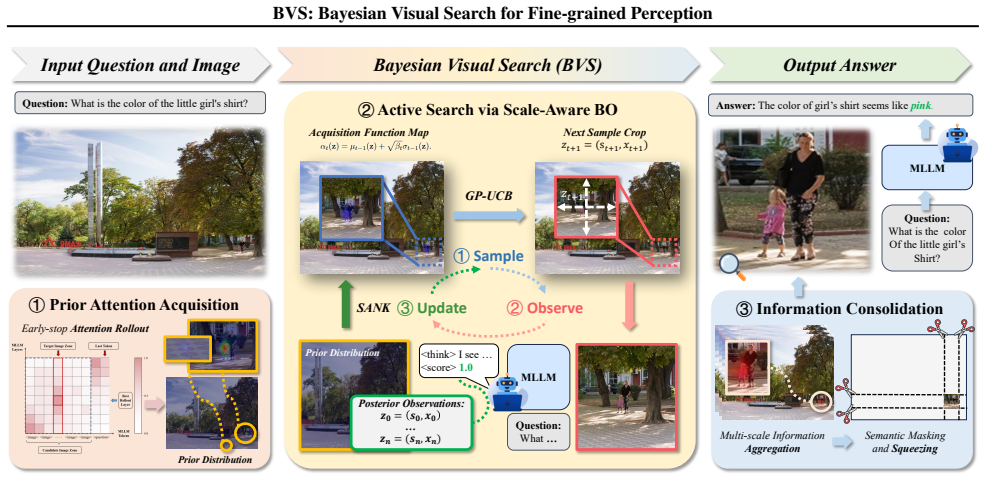
Bayesian search over a continuous spatial-scale space lets MLLMs find tiny objects in huge images more accurately and with fewer queries than prior methods.
Reviewed by Pith at T0; open to challenge. T0 means a machine referee read the full paper against a public rubric. the ladder, T0–T4 →
T0 review · grok-4.5
2026-07-12 04:16 UTC pith:QCTUHGEJ
load-bearing objection Solid training-free BO search for UHR MLLMs with a real continuous kernel and strong numbers; the RKHS residual assumption is untested but the empirical case still stands. the 2 major comments →
BVS: Bayesian Visual Search with Multimodal Large Language Model for Fine-grained Perception
The pith
A machine-rendered reading of the paper's core claim, the machinery that carries it, and where it could break.
Core claim
Perception of tiny objects in ultra-high-resolution scenes can be cast as Bayesian optimization of an unknown relevance function over a continuous spatial-scale manifold; an early-stop attention prior plus a scale-aware non-stationary kernel and GP-UCB acquisition yields both higher accuracy and a theoretically guaranteed sub-linear regret compared with discrete or static heuristics.
What carries the argument
Scale-Aware Non-stationary Kernel (SANK) together with GP-UCB: the kernel lets spatial correlation length grow with observation scale so that coarse and fine crops interact correctly, while GP-UCB balances exploration of unseen regions against exploitation of the current posterior.
Load-bearing premise
The residual relevance function after subtracting the attention prior must lie in the reproducing-kernel Hilbert space of the proposed kernel with a bounded norm; if the true residual is highly discontinuous or the prior is badly mis-calibrated, both the regret bound and the acquisition function lose their justification.
What would settle it
On a held-out set of ultra-high-resolution images, replace the continuous Bayesian loop with a matched number of random or pure-greedy crops; if accuracy and coverage remain statistically identical to BVS, the claimed advantage of posterior correction and the scale-aware kernel disappears.
If this is right
- Tiny-object questions on multi-megapixel images become answerable with only a handful of MLLM forward passes rather than dozens.
- Search no longer has to discretize the image into fixed grids or trust a single noisy prior; missing or noisy regions can still be recovered.
- The same continuous spatial-scale formulation can be reused by any MLLM that can return a scalar relevance score for a crop.
- Training-free methods can now match or exceed several trained visual-search agents while remaining model-agnostic.
Where Pith is reading between the lines
- Because the method is training-free and only needs a scoring oracle, it can be dropped in front of future larger MLLMs without re-collecting search trajectories.
- The early-stop attention construction may be useful as a cheap saliency prior even outside the Bayesian loop, for example in ordinary image cropping or captioning pipelines.
- If the residual RKHS assumption fails systematically on certain long-tail object classes, one could replace the Matérn kernel with a deep-kernel GP or a non-GP acquisition rule while keeping the continuous manifold formulation.
Editorial analysis
A structured set of objections, weighed in public.
Referee Report
Summary. The paper proposes BVS, a training-free Bayesian optimization framework that treats fine-grained perception in ultra-high-resolution images as global optimization of a relevance function over a continuous spatial-scale manifold. It constructs a reasoning-aware prior via early-stop attention rollout of an MLLM, then iteratively refines a Gaussian-process posterior with a proposed scale-aware non-stationary Matérn-style kernel and GP-UCB acquisition, finally consolidating high-posterior regions into a compact visual input. Theoretical claims include positive-definiteness of the kernel (via Paciorek–Schervish) and a sub-linear regret bound under an RKHS residual assumption. Empirically, BVS is shown to outperform recent training-free (ZoomEye, RAP, ViCrop) and several training-based visual-search methods on V* Bench and HR-Bench 4K/8K across InternVL3.5 and Qwen3-VL 4B/8B models, with a favorable accuracy-vs-forward-pass trade-off and supporting ablations.
Significance. If the empirical gains hold under broader scrutiny, BVS offers a practical, training-free route that unifies prior guidance with posterior correction and demonstrably improves both accuracy and efficiency on established fine-grained UHR benchmarks. The continuous multi-scale formulation and scale-aware kernel are genuine technical contributions relative to discrete-grid or static-prior baselines. The Mercer argument is correctly grounded; the regret analysis follows the standard Srinivas et al. template and is therefore a useful formalization even if the RKHS assumption remains unverified. Reproducible public-benchmark comparisons and component ablations strengthen the case for adoption as an inference-time module.
major comments (2)
- [Section 3.5, Assumption 3.4, Theorem 3.5] Section 3.5, Assumption 3.4 and Theorem 3.5: the sub-linear regret guarantee and the validity of the GP-UCB intervals (Eq. 4) rest on the residual f−μ0 lying in the RKHS of the scale-aware kernel with bounded norm. MLLM relevance scores are produced by a discrete token-generation prompt (Appendix C.1) and are therefore typically discontinuous in continuous crop coordinates (s,x). No residual-norm estimates, posterior-calibration plots, leave-one-out checks, or other diagnostics are reported. Without evidence that the assumption holds, both the theoretical claim advertised in the abstract and the justification for using GP-UCB remain unsupported; the observed gains could be explained by the early-stop prior plus multi-scale sampling alone.
- [Section 3.4] Section 3.4: the acquisition step is written as zt+1=argmax αt(z) over the continuous manifold X=S×Ω, yet no optimizer, multi-start strategy, discretization, or gradient-based procedure is described. Continuous Bayesian optimization is non-trivial; without this detail the method is not fully reproducible and it is unclear whether the reported efficiency (≤5 forward passes) includes the cost of the continuous maximizer.
minor comments (4)
- [Section 4.3] Table 5 and Figure 2: the efficiency claims would be clearer if wall-clock time or total FLOPs (including acquisition maximization) were reported alongside forward-pass counts.
- [Section 3.2] Section 3.2 / Figure 4: the early-stop layer is fixed at L/2; a short sensitivity plot over stop-layer fraction would strengthen the claim that the choice is robust rather than dataset-specific.
- [Section 3.3 / Appendix B] Notation and typesetting: repeated spacing artifacts appear around Matérn (“Mat ´ern”), and the MIG exponent in the proof sketch of Theorem 3.5 is rendered ambiguously; both should be cleaned for camera-ready.
- [Section 4.4] Table 3 (MMStar): the modest overall drop is acknowledged, yet a brief discussion of when the consolidation step can harm pure-reasoning items would help readers decide when to apply BVS.
Circularity Check
No load-bearing circularity; empirical claims rest on external public benchmarks and the regret bound is standard GP-UCB under an explicit (non-fitted) RKHS residual assumption. Only a minor non-load-bearing self-citation of the authors' prior DyFo baseline appears.
full rationale
The derivation chain is self-contained and non-circular. The early-stop attention prior (Eq. 1, Section 3.2) is extracted from the MLLM's own intermediate layers and used only as a non-zero mean function μ0; it is never fitted to the evaluation labels. The Scale-Aware Non-stationary Kernel (Def. 3.1, Eq. 2) is proved PSD by direct reduction to the external Paciorek-Schervish non-stationary construction (Theorem 3.2, Appendix B.1); no parameter is estimated from the target benchmarks. The sub-linear regret claim (Theorem 3.5) is the classical Srinivas et al. GP-UCB bound applied to the residual f̃ = f - μ0 under the explicit Assumption 3.4 (∥f̃∥k ≤ B); the paper does not fit B or any other constant on the test data and then call the result a prediction. All accuracy numbers (Tables 1-2) are obtained by running the training-free procedure on the public V*, HR-Bench and MMStar suites against independently published baselines. The sole self-citation (DyFo, Li et al. 2025) appears only as one among several prior-free baselines in Related Work and is not invoked to justify any theorem, kernel property or experimental claim. Consequently no step reduces by construction to a fitted input or to an unverified self-citation chain.
Axiom & Free-Parameter Ledger
free parameters (5)
- confidence threshold τ =
0.2
- maximum search steps T =
5
- prior strength θ
- scale length-scale function ℓ(s) and λs
- GP-UCB exploration schedule βt
axioms (4)
- domain assumption Residual relevance f−μ0 belongs to the RKHS of the scale-aware kernel with bounded norm (Assumption 3.4).
- domain assumption MLLM crop scores are noisy observations of a latent continuous relevance function (yt=f(zt)+ε).
- ad hoc to paper Early-stopping attention rollout at layer L/2 yields a useful reasoning-aware prior (Section 3.2).
- standard math Paciorek–Schervish non-stationary construction yields a valid PSD kernel when Σ(z) is block-diagonal with scale-dependent spatial length (Theorem 3.2).
invented entities (2)
-
Scale-Aware Non-stationary Kernel (SANK)
no independent evidence
-
Early-stop Attention Rollout prior
no independent evidence
read the original abstract
While Multimodal Large Language Models (MLLMs) demonstrate impressive general capabilities, they struggle with fine-grained perception in ultra-high-resolution (UHR) images, particularly for tiny objects in cluttered scenes. Existing methods face a dilemma: they either rely on inefficient prior-free scanning, or depend on static prior-driven heuristics that lack posterior correction to rectify initial model biases. To address this, we propose BVS (Bayesian Visual Search), a framework that formulates perception as a global optimization problem over a continuous spatial-scale manifold. Specifically, BVS bridges prior guidance with posterior correction: it utilizes an early-stop attention rollout of MLLM to construct reasoning-aware priors, while employing a scale-aware non-stationary kernel and GP-UCB to dynamically rectify noise and recover missing information in the prior through iterative local observations. We provide theoretical guarantees via sub-linear regret bounds, and extensive experiments demonstrate that BVS significantly outperforms state-of-the-art baselines with a superior trade-off between accuracy and efficiency.
Figures


Reference graph
Works this paper leans on
-
[1]
Langley , title =
P. Langley , title =. Proceedings of the 17th International Conference on Machine Learning (ICML 2000) , address =. 2000 , pages =
2000
-
[2]
T. M. Mitchell. The Need for Biases in Learning Generalizations. 1980
1980
-
[3]
M. J. Kearns , title =
-
[4]
Machine Learning: An Artificial Intelligence Approach, Vol. I. 1983
1983
-
[5]
R. O. Duda and P. E. Hart and D. G. Stork. Pattern Classification. 2000
2000
-
[6]
Suppressed for Anonymity , author=
-
[7]
Newell and P
A. Newell and P. S. Rosenbloom. Mechanisms of Skill Acquisition and the Law of Practice. Cognitive Skills and Their Acquisition. 1981
1981
-
[8]
A. L. Samuel. Some Studies in Machine Learning Using the Game of Checkers. IBM Journal of Research and Development. 1959
1959
-
[9]
FirstName LastName , title =
-
[10]
FirstName Alpher , title =
-
[11]
Journal of Foo , volume = 13, number = 1, pages =
FirstName Alpher and FirstName Fotheringham-Smythe , title =. Journal of Foo , volume = 13, number = 1, pages =
-
[12]
Journal of Foo , volume = 14, number = 1, pages =
FirstName Alpher and FirstName Fotheringham-Smythe and FirstName Gamow , title =. Journal of Foo , volume = 14, number = 1, pages =
-
[13]
FirstName Alpher and FirstName Gamow , title =
-
[14]
International conference on machine learning , pages=
Learning transferable visual models from natural language supervision , author=. International conference on machine learning , pages=. 2021 , organization=
2021
-
[15]
Advances in Neural Information Processing Systems , volume=
Flamingo: a visual language model for few-shot learning , author=. Advances in Neural Information Processing Systems , volume=
-
[16]
Advances in Neural Information Processing Systems , volume=
Visual instruction tuning , author=. Advances in Neural Information Processing Systems , volume=
-
[17]
Yuan-Fang Li Ye and Wen-Qi Wang and Kun-Hu Wang and Xiang-Rong Zhang and Zhen-Hui Liu and Jian-Wei Niu and Guang-Xuan Xiao and Wen-Gao Pu and Yu-Jie Zhang , year=. 2311.08294 , archivePrefix=
-
[18]
Proceedings of the 2023 Conference on Empirical Methods in Natural Language Processing , pages=
Evaluating object hallucination in large vision-language models , author=. Proceedings of the 2023 Conference on Empirical Methods in Natural Language Processing , pages=
2023
-
[19]
Zhengyuan Yang and Linjie Li and Jianfeng Wang and Kevin Lin and Ehsan Azarnasab and Faisal Ahmed and Zicheng Liu and Ce Liu and Michael Zeng and Lijuan Wang , year=. 2303.11381 , archivePrefix=
-
[20]
Proceedings of the IEEE/CVF Conference on Computer Vision and Pattern Recognition , pages=
Visual-programming: Compositional visual reasoning without training , author=. Proceedings of the IEEE/CVF Conference on Computer Vision and Pattern Recognition , pages=
-
[21]
Proceedings of the IEEE/CVF International Conference on Computer Vision , pages=
ViperGPT: Visual inference via python execution for reasoning , author=. Proceedings of the IEEE/CVF International Conference on Computer Vision , pages=
-
[22]
Pan Lu and Baolin Peng and Haoitsu Cheng and Michel Galley and Kai-Wei Chang and Ying Nian Wu and Yoon Kim and Jianfeng Gao , year=. 2304.09842 , archivePrefix=
-
[23]
Proceedings of the IEEE conference on computer vision and pattern recognition , pages=
Making the V in VQA matter: Elevating the role of image understanding in visual question answering , author=. Proceedings of the IEEE conference on computer vision and pattern recognition , pages=
-
[24]
Chaoyou Fu and Peixian Chen and Yunhang Shen and Yulei Qin and Mengdan Zhang and Xu Lin and Zhenyu Mok and Qinghao Ye and Haoran Wei and Jingren Zhou and Ke Li and Jun-Jie-Jagger Huang , year=. 2306.13394 , archivePrefix=
-
[25]
Bohao Li and Yuanhan Zhang and Chunyuan Li and Ruoxi Chen and Chongjian Ge and Song-Chun Zhu and Jianfeng Gao and Yizhou Wang , year=. 2307.16125 , archivePrefix=
-
[26]
Scaling Learning Algorithms Towards
Bengio, Yoshua and LeCun, Yann , booktitle =. Scaling Learning Algorithms Towards
-
[27]
and Osindero, Simon and Teh, Yee Whye , journal =
Hinton, Geoffrey E. and Osindero, Simon and Teh, Yee Whye , journal =. A Fast Learning Algorithm for Deep Belief Nets , volume =
-
[28]
2016 , publisher=
Deep learning , author=. 2016 , publisher=
2016
-
[29]
arXiv preprint arXiv:2503.01222 , year=
Retrieval-augmented perception: High-resolution image perception meets visual rag , author=. arXiv preprint arXiv:2503.01222 , year=
-
[30]
arXiv preprint , year=
How far are we to gpt-4v? closing the gap to commercial multimodal models with open-source suites , author=. arXiv preprint , year=
-
[31]
LLaVA-NeXT: Improved reasoning, OCR, and world knowledge , url=
Liu, Haotian and Li, Chunyuan and Li, Yuheng and Li, Bo and Zhang, Yuanhan and Shen, Sheng and Lee, Yong Jae , year=. LLaVA-NeXT: Improved reasoning, OCR, and world knowledge , url=
-
[32]
arXiv preprint , year=
Feast Your Eyes: Mixture-of-Resolution Adaptation for Multimodal Large Language Models , author=. arXiv preprint , year=
-
[33]
2023 , journal=
CogVLM: Visual Expert for Pretrained Language Models , author=. 2023 , journal=
2023
-
[34]
arXiv preprint , year=
Phi-3 technical report: A highly capable language model locally on your phone , author=. arXiv preprint , year=
-
[35]
ai , author=
Yi: Open foundation models by 01. ai , author=. arXiv preprint , year=
-
[36]
arXiv preprint , year=
InternLM-XComposer2: Mastering Free-form Text-Image Composition and Comprehension in Vision-Language Large Model , author=. arXiv preprint , year=
-
[37]
2023 , journal=
InternLM-XComposer: A Vision-Language Large Model for Advanced Text-image Comprehension and Composition , author=. 2023 , journal=
2023
-
[38]
Introducing our Multimodal Models , url =
Bavishi, Rohan and Elsen, Erich and Hawthorne, Curtis and Nye, Maxwell and Odena, Augustus and Somani, Arushi and Ta. Introducing our Multimodal Models , url =
-
[39]
Xu, Haiyang and Ye, Qinghao and Yan, Ming and Shi, Yaya and Ye, Jiabo and Xu, Yuanhong and Li, Chenliang and Bi, Bin and Qian, Qi and Wang, Wei and Xu, Guohai and Zhang, Ji and Huang, Songfang and Huang, Fei and Zhou, Jingren , booktitle =. m. 2023 , url =
2023
-
[40]
2024 , journal=
DeepSeek-VL: Towards Real-World Vision-Language Understanding , author=. 2024 , journal=
2024
-
[41]
NeurIPS , title =
Lauren. NeurIPS , title =. 2023 , volume =
2023
-
[42]
arXiv preprint , year=
Qwen-VL: A Versatile Vision-Language Model for Understanding, Localization, Text Reading, and Beyond , author=. arXiv preprint , year=
-
[43]
arXiv preprint , year=
Gemini 1.5: Unlocking multimodal understanding across millions of tokens of context , author=. arXiv preprint , year=
-
[44]
arXiv preprint , year=
Gpt-4 technical report , author=. arXiv preprint , year=
-
[45]
OpenCompass: A Universal Evaluation Platform for Foundation Models , author=
-
[46]
CVPR , url=
Monkey: Image resolution and text label are important things for large multi-modal models , author=. CVPR , url=
-
[47]
arXiv preprint , year=
ConvLLaVA: Hierarchical Backbones as Visual Encoder for Large Multimodal Models , author=. arXiv preprint , year=
-
[48]
arXiv preprint , year=
Beyond LLaVA-HD: Diving into High-Resolution Large Multimodal Models , author=. arXiv preprint , year=
-
[49]
arXiv preprint , year=
Accelerating Transformers with Spectrum-Preserving Token Merging , author=. arXiv preprint , year=
-
[50]
ICML , year=
Blip-2: Bootstrapping language-image pre-training with frozen image encoders and large language models , author=. ICML , year=
-
[51]
ICLR , year=
Analyzing and Mitigating Object Hallucination in Large Vision-Language Models , author=. ICLR , year=
-
[52]
ICCVW , year=
Div8k: Diverse 8k resolution image dataset , author=. ICCVW , year=
-
[53]
arXiv preprint , year=
Dragonfly: Multi-Resolution Zoom Supercharges Large Visual-Language Model , author=. arXiv preprint , year=
-
[54]
arXiv preprint , year=
InfiMM-HD: A Leap Forward in High-Resolution Multimodal Understanding , author=. arXiv preprint , year=
-
[55]
arXiv preprint , year=
Vary: Scaling up the vision vocabulary for large vision-language models , author=. arXiv preprint , year=
-
[56]
ICCV , year=
Segment anything , author=. ICCV , year=
-
[57]
arXiv preprint , year=
Mini-gemini: Mining the potential of multi-modality vision language models , author=. arXiv preprint , year=
-
[58]
CVPR , year=
A convnet for the 2020s , author=. CVPR , year=
-
[59]
EMNLP , year=
Evaluating Object Hallucination in Large Vision-Language Models , author=. EMNLP , year=
-
[60]
ECCV , year=
A Diagram is Worth a Dozen Images , author=. ECCV , year=
-
[61]
CVPR , year=
MMMU: A Massive Multi-discipline Multimodal Understanding and Reasoning Benchmark for Expert AGI , author=. CVPR , year=
-
[62]
C hart QA : A Benchmark for Question Answering about Charts with Visual and Logical Reasoning
Masry, Ahmed and Long, Do and Tan, Jia Qing and Joty, Shafiq and Hoque, Enamul. C hart QA : A Benchmark for Question Answering about Charts with Visual and Logical Reasoning. ACL. 2022
2022
-
[63]
WACV , year=
Docvqa: A dataset for vqa on document images , author=. WACV , year=
-
[64]
arXiv preprint , year=
InternLM-XComposer2-4KHD: A Pioneering Large Vision-Language Model Handling Resolutions from 336 Pixels to 4K HD , author=. arXiv preprint , year=
-
[65]
ICLR , year=
An Image is Worth 16x16 Words: Transformers for Image Recognition at Scale , author=. ICLR , year=
-
[66]
ICLR , year=
Large language models are not robust multiple choice selectors , author=. ICLR , year=
-
[67]
Token Merging: Your
Bolya, Daniel and Fu, Cheng-Yang and Dai, Xiaoliang and Zhang, Peizhao and Feichtenhofer, Christoph and Hoffman, Judy , booktitle=. Token Merging: Your. 2023 , url=
2023
-
[68]
TMLR , year=
Unsupervised Dense Information Retrieval with Contrastive Learning , author=. TMLR , year=
-
[69]
arXiv preprint , year=
MME: A Comprehensive Evaluation Benchmark for Multimodal Large Language Models , author=. arXiv preprint , year=
-
[70]
Neural computation , volume=
Backpropagation applied to handwritten zip code recognition , author=. Neural computation , volume=. 1989 , url=
1989
-
[71]
CVPR , year=
Deep residual learning for image recognition , author=. CVPR , year=
-
[72]
arXiv preprint , year=
Are We on the Right Way for Evaluating Large Vision-Language Models? , author=. arXiv preprint , year=
-
[73]
ICML , year=
Learning transferable visual models from natural language supervision , author=. ICML , year=
-
[74]
arXiv preprint , year=
Llama 2: Open foundation and fine-tuned chat models , author=. arXiv preprint , year=
-
[75]
arXiv preprint , year=
Llama: Open and efficient foundation language models , author=. arXiv preprint , year=
-
[76]
arXiv preprint , year=
Qwen technical report , author=. arXiv preprint , year=
-
[77]
2024 , journal=
InternLM2 Technical Report , author=. 2024 , journal=
2024
-
[78]
2024 , journal=
ChatGLM: A Family of Large Language Models from GLM-130B to GLM-4 All Tools , author=. 2024 , journal=
2024
-
[79]
MMBench: Is Your Multi-modal Model an All-around Player? , year =
Yuan, Liu and Haodong, Duan and Yuanhan, Zhang and Bo, Li and Songyang, Zhang and Wangbo, Zhao and Yike, Yuan and Jiaqi, Wang and Conghui, He and Ziwei Liu and Kai, Chen and Dahua, Lin , journal =. MMBench: Is Your Multi-modal Model an All-around Player? , year =
-
[80]
ICML , year=
Mm-vet: Evaluating large multimodal models for integrated capabilities , author=. ICML , year=
discussion (0)
Sign in with ORCID, Apple, or X to comment. Anyone can read and Pith papers without signing in.