REVIEW 4 major objections 6 minor 5 cited by
High-Order Matching for One-Step Shortcut Diffusion Models
T0 review · 4 major / 6 minor · reviewed 2026-08-09 · deepseek-v4-flash
Pith's one-line read HOMO claims that adding acceleration and jerk supervision to one-step shortcut diffusion yields provably better trajectory approximation and empirically sharper matches of high-curvature distributions than the velocity-only Shortcut model.
desk verdict The theoretical claim of superior approximation is not proven because the bounds are strictly looser than first-order, but the empirical idea has merit and the paper deserves a serious referee. read the letter →
The pith
A machine-rendered reading of the paper's core claim, the machinery that carries it, and where it could break.
The reading
What carries the argument
The load-bearing mechanism is high-order Taylor supervision of the transport trajectory. Sampling advances by $x_{t+d}=x_t+d\,u_1(x_t,t,d)+\frac{d^2}{2}u_2(u_1(x_t,t,d),x_t,t,d)$, so the second network $u_2$ corrects curvature rather than only slope. Training minimizes three terms: velocity matching $\|u_1-\dot x_t^{\mathrm{true}}\|^2$, acceleration matching $\|u_2-\ddot x_t^{\mathrm{true}}\|^2$, and a self-consistency loss that averages $u_1$ at $x_t$ and $x_{t+d}$ to stabilize long-horizon prediction. The proofs approximate the true velocity and acceleration fields by B-spline-based ReLU networks in Besov spaces, transferring known approximation rates; an induction step extends the argument from second order to arbitrary fixed order $K$, at the cost of an uncontrolled residual term measuring the gap between consecutive time-derivatives.
What would settle it
Measure $\mathbb{E}_{x\sim P_t}[\|\dot x_t^{\mathrm{true}}-\ddot x_t^{\mathrm{true}}\|^2]$ under the paper's VP schedule $\alpha_t=\exp(-19.9(1-t)^2/4-0.1(1-t)/2)$; if this residual is comparable to or larger than the claimed $N^{-2s/d}$ rate, the theorems' additive term dominates and the approximation guarantee is vacuous. A second decisive check is a seeded re-run of the eight-mode Gaussian experiment comparing M1+SC with M1+M2+SC: if the Euclidean-distance losses are statistically tied, the central empirical claim fails.
Extended reading notes
Core claim
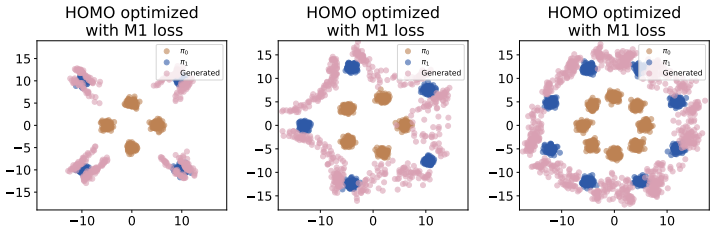
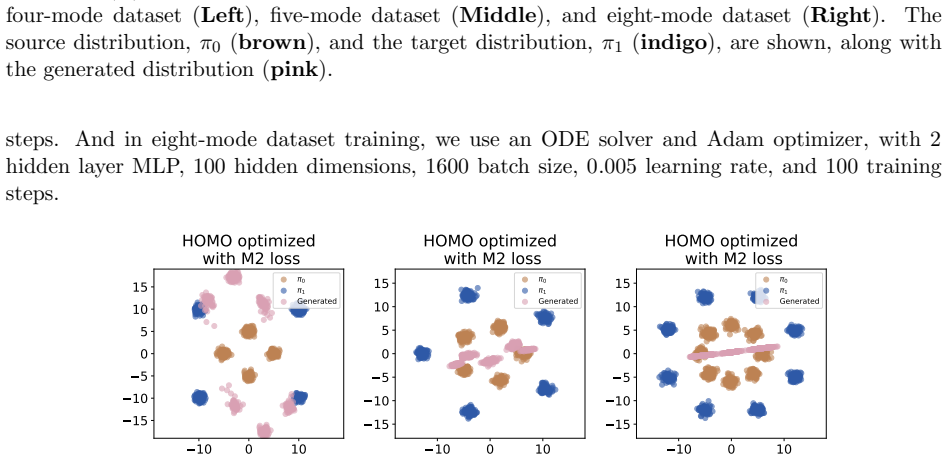
The central claim is that for the interpolation $x_t = \alpha_t x_0 + \beta_t x_1$ used by Shortcut models, supervising a network pair $(\phi_1,\phi_2)$ against both the true velocity $\dot x_t$ and true acceleration $\ddot x_t$ gives an approximation bound of the form $\int (\|\phi_1-\dot x_t\|^2+\|\phi_2-\ddot x_t\|^2)p_t(x)\,dx \lesssim (\dot\alpha_t^2\log N + \dot\beta_t^2)N^{-2s/d} + \mathbb{E}_{x\sim P_t}[\|\dot x_t-\ddot x_t\|^2]$, with an analogous large-$t$ bound replacing $N^{-2s/d}$ by $N^{-\eta}$. The training objective combines velocity matching, acceleration matching, and a self-consistency term that averages the model's velocity at two nearby states; sampling iterates $x_{t+d}=x_t+d\,u_1+\frac{d^2}{2}u_2$. Empirically, the combination of first-order, second-order, and self-consistency losses beats every ablation and the Shortcut baseline on the reported Euclidean-distance losses, and third-order HOMO continues that trend on the tested synthetic distributions.
Load-bearing premise
The proof never bounds the additive term $\mathbb{E}_{x\sim P_t}[\|\dot x_t-\ddot x_t\|^2]$ left in Theorems 5.1 and 5.2, and the paper's experimental schedule $\alpha_t=\exp(-19.9(1-t)^2/4-0.1(1-t)/2)$ lies outside Assumption C.15's $\alpha_t\sim b_0 t^\kappa$ regime.
Editorial extensions
If this is right
- For the same number of sampling steps, HOMO's update includes an explicit curvature correction, so trajectories should follow the underlying transport ODE more closely than the velocity-only Shortcut update.
- If the ablations generalize, the second-order loss and the self-consistency loss carry different information: self-consistency sharpens the learned distribution, while acceleration matching supplies the geometric detail needed for outer boundaries and spiral arms.
- The theoretical bounds imply that the advantage of high-order supervision is strongest when the velocity field changes rapidly but the gap between velocity and acceleration stays small relative to the $N^{-2s/d}$ rate.
- Third-order HOMO extends the same Taylor correction to jerk and shows continued quantitative improvement on the reported spin and dot-circle benchmarks.
- The computational-cost section indicates that the added accuracy comes with a measurable but not prohibitive increase in FLOPs and parameters relative to the base Shortcut configuration.
Reading between the lines
- Editorial inference: the same second-order Taylor loss could be grafted onto other flow-matching or rectified-flow objectives, not just Shortcut models, since the theoretical framework is written for the general field $x_t=\alpha_t x_0+\beta_t x_1$.
- Editorial inference: because the residual term in the theorems is uncontrolled, the clearest way to test the proof's regime is to measure $\mathbb{E}_{x\sim P_t}[\|\dot x_t-\ddot x_t\|^2]$ under the paper's actual VP schedule; the paper does not report this quantity.
- Editorial inference: the empirical evidence is limited to low-dimensional synthetic distributions, so whether the benefit transfers to high-dimensional image or video generation remains an open extension.
- Editorial inference: the claim that high-order supervision outperforms first-order supervision is about matching a chosen analytic interpolation; it does not by itself establish that the learned transport map matches the true data-generating distribution, since the acceleration target inherits the coupling $(x_0,x_1)$ used to define the trajectory.
Signed reviews
Editorial analysis
A structured set of objections, weighed in public.
Referee Report
Summary. The paper proposes HOMO, an extension of one-step Shortcut diffusion models that adds higher-order trajectory supervision (acceleration, jerk, and beyond) to the training objective and uses a second-order Taylor-style update at inference. The main theoretical claims are Theorems 5.1 and 5.2 (and their formal versions in Appendix D), which bound the combined velocity and acceleration approximation error, and the paper argues that this establishes superiority over first-order methods. Experiments on synthetic Gaussian-mixture and spiral datasets compare ablations of the first-order, second-order, and self-consistency losses, and a third-order variant is also tested.
Significance. If the claimed superiority were actually established, high-order supervision for shortcut diffusion models could be a meaningful contribution to one-step generative modeling. The paper does provide a clear algorithmic framework and a fairly extensive set of synthetic ablations. However, the central theoretical result does not deliver the claimed high-order advantage: it reduces to the first-order bound from prior work plus an uncontrolled additive term. The experimental schedule used in Section 6.1 also falls outside the assumptions required by the theory. The self-consistency loss, which is central to the algorithm, is absent from the theoretical analysis. The empirical evaluation is limited to low-dimensional synthetic distributions, so the broader claims about vision generation are not supported by the presented experiments. Overall, the paper's main claim is not established by its own theorems.
major comments (4)
- [Theorem 5.1 / Appendix D.1, Eq. (3)] The proof of Theorem 5.1 bounds the acceleration approximation error by applying the triangle inequality to the first-order approximation error plus the term E_{x~P_t}[||\dot{x}_t^{true} - \ddot{x}_t^{true}||^2]. Since this additive term is nonnegative and is never controlled, the theorem's right-hand side is not smaller than the first-order bound of Lemma C.18; it is the first-order bound plus an uncontrolled bias. Consequently, the abstract's claim that "HOMO's high-order supervision ensures superior approximation accuracy, outperforming first-order methods" does not follow from the theorem. The same issue propagates through Theorems D.2 and D.4 by induction, so the higher-order guarantees inherit the same limitation.
- [Assumption C.15 vs Section 6.1] Assumption C.15 requires alpha_t = b0 t^kappa for sufficiently small t, which implies alpha_t tends to 0 as t tends to 0. The experiments in Section 6.1 use the VP schedule alpha_t = exp(-a(1-t)^2/4 - b(1-t)/2) with a=19.9 and b=0.1, for which alpha_0 = exp(-5.025) approximately 0.0066, which is strictly positive. The theoretical regime therefore does not contain the experimental setting, and Theorems 5.1 and 5.2 do not apply to the reported experiments. Moreover, for this schedule the uncontrolled term E[||\dot{x}_t^{true} - \ddot{x}_t^{true}||^2] does not vanish as N grows: at t=0, |\dot{alpha}(0) - \ddot{alpha}(0)| is approximately 0.525, so this term is on the order of the dimension d, while the first-order term is O(N^{-2s/d}).
- [Definitions 4.2 and 4.3 vs Algorithm 1] The self-consistency target in Definition 4.2 is defined as the average of the network's own outputs u_{1,theta1}(x_t, t, d) and u_{1,theta1}(x_{t+d}, t, d). As written, the loss in Definition 4.3 uses this target without any stop-gradient, so the objective is a moving target that depends on the same parameters being trained; such a loss can be trivially minimized by a constant prediction. Algorithm 1 applies stopgrad, but the formal definitions do not state this, and the theoretical analysis in Section 5 and Appendix D does not analyze the self-consistency loss at all. The method whose properties are proved is therefore not exactly the method whose empirical performance is reported.
- [Section 5 and abstract] Theorems 5.1 and 5.2 are presented as "informal versions" with "some mild assumptions," yet the abstract and conclusion treat them as establishing a definitive superiority guarantee. The formal statements in Appendix D require a specific set of assumptions (Besov smoothness of p0, support conditions, the alpha_t form of Assumption C.15, and Lipschitz conditions) that are not verified for the experimental Gaussian-mixture or spiral datasets. Given that the informal theorem statements omit these conditions, the current presentation overstates the strength and scope of the theoretical results.
minor comments (6)
- [Abstract and introduction] The abstract and introduction use promotional language such as "game-changing," "revolutionary leap," "unprecedented," and "shatters these barriers," which is inappropriate for a scientific paper and should be replaced with neutral, precise claims.
- [Section 6.1 and Appendix A] Section 6.1 states that M1+SC is equal to the original One-step Shortcut model, but Algorithm 3 in Appendix A defines the Shortcut model with the linear interpolation x_t = (1-t)x_0 + t x_1, whereas the HOMO experiments use the VP ODE schedule with alpha_t and beta_t. The equivalence is therefore not immediate and should be clarified.
- [Theorem 5.1 and Remark C.10] Theorem 5.1 says "Let N be a value associated with sample size n" without defining the relationship; Remark C.10 later sets N = n^{d/(2s+d)}, but this should be stated in the main text where the theorem is used.
- [Appendix D.1 and D.3] There are typographical errors in the proofs: in D.1 the expectation E_{x~P_t}[||\dot{x}_t^{true} - \ddot{x}_t^{true}||^2] is missing a closing bracket, and in D.3 the term "||2 \dot{x}_t^{true} - \ddot{x}_t^{true}||" appears where the intended expression is "||\dot{x}_t^{true} - \ddot{x}_t^{true}||." These should be corrected.
- [Table 5] The computational cost table lists M1+M2 as 16.960 MFLOPS but M1+M2+SC as 68.480 MFLOPS, the same value as M2+SC. It is unclear why adding the M1 term to M2+SC does not increase the FLOP count; this inconsistency should be explained.
- [Section 2 and Appendix B] The related-work sections contain many citations to large-language-model and foundation-model papers that are not connected to the present topic of shortcut diffusion or higher-order flow matching; this material should be removed or substantially trimmed.
Circularity Check
The high-order approximation theorem reduces to the prior first-order bound plus an uncontrolled gap, so the claimed superiority is assumed rather than derived.
-
renaming known result
[Appendix D.1, Theorem D.1 proof (informal Theorem 5.1)]
"Next, we can show that there exists some phi2 in M(L,W,S,B) such that integral ||phi2(x,t) - xtrue_t_ddot||^2 pt(x)dx = integral ||phi2(x,t) - xtrue_t_dot + xtrue_t_dot - xtrue_t_ddot||^2 pt(x)dx <= integral 2(||phi2(x,t) - xtrue_t_dot||^2 + ||xtrue_t_dot - xtrue_t_ddot||^2) pt(x)dx = 2 integral ||phi2(x,t) - xtrue_t_dot||^2 pt(x)dx + 2 E_{x~Pt}[||xtrue_t_dot - xtrue_t_ddot||^2] <= (alpha_t_dot^2 log N + beta_t_dot^2) N^{-2s/d} + E_{x~Pt}[||xtrue_t_dot - xtrue_t_ddot||^2] where the last step follows from Lemma C.18."
The proof constructs phi2 as the same first-order approximator from Lemma C.18 and bounds the second-order error by the velocity error plus the velocity-acceleration gap via the triangle inequality. No second-order structure or second-order loss is used. The theorem's right-hand side is exactly the first-order bound from prior work (Lemma C.18) plus an uncontrolled positive term E[||velocity - acceleration||^2], which is never shown to vanish and is in fact O(d) for the experimental VP schedule.
full rationale
The only candidate circular step is the theoretical core. Theorems 5.1/5.2 (formal versions D.1/D.3) prove that the high-order approximation error is bounded by the first-order approximation error imported from Lemma C.18 [FSI+24] plus E[||velocity - acceleration||^2], which is never controlled and, for the VP schedule used in the experiments (alpha_t = exp(-a(1-t)^2/4 - b(1-t)/2), a=19.9, b=0.1), does not vanish as N grows; moreover alpha(0)>0 violates Assumption C.15, so the theoretical regime does not contain the experiments. Because the proof constructs phi2 as the first-order approximator, the 'high-order' theorem is a renaming and relaxation of the prior first-order bound, not a demonstration of superiority. The self-consistency target (Definition 4.2) is indeed defined as an average of the same network's own outputs, but it is used with stop-gradient as a regularizer and is not part of the theoretical claims, so it does not by itself make the derivation circular. The paper's many self-citations appear in related work and are not load-bearing; the approximation lemmas come from external prior work. Overall, the central theoretical claim reduces by construction to the first-order result plus an uncontrolled gap, so partial circularity is present, while the empirical comparisons remain self-contained.
Assumptions & free parameters
free parameters (3)
- VP ODE schedule parameters a and b =
a = 19.9, b = 0.1
- Discretization step delta_t =
1/128
- Number of sampling steps M =
not reported
assumptions (4)
- standard math Lemma C.18 (Theorem 7 in FSI+24): first-order flow approximation error bound for small t.
- standard math Lemma C.19 (Theorem 7 in FSI+24): first-order flow approximation error bound for large t.
- domain assumption Assumptions C.13-C.17 (Besov smoothness, bounded density away from 0, specific form of alpha_t and beta_t, and Lipschitz first moment).
- ad hoc to paper The bias term E[||v_t - a_t||^2] in Theorems 5.1 and 5.2 is small enough to preserve the claimed superiority.
Cite this review
Pith. "Pith review of High-Order Matching for One-Step Shortcut Diffusion Models." pith.science (2026). https://pith.science/paper/QD4OJWE5
@misc{pith2026250200688,
  author       = {Pith},
  title        = {Pith review of: High-Order Matching for One-Step Shortcut Diffusion Models},
  year         = {2026},
  howpublished = {\url{https://pith.science/paper/QD4OJWE5}},
  note         = {Machine review of arXiv:2502.00688}
}
read the original abstract
One-step shortcut diffusion models [Frans, Hafner, Levine and Abbeel, ICLR 2025] have shown potential in vision generation, but their reliance on first-order trajectory supervision is fundamentally limited. The Shortcut model's simplistic velocity-only approach fails to capture intrinsic manifold geometry, leading to erratic trajectories, poor geometric alignment, and instability-especially in high-curvature regions. These shortcomings stem from its inability to model mid-horizon dependencies or complex distributional features, leaving it ill-equipped for robust generative modeling. In this work, we introduce HOMO (High-Order Matching for One-Step Shortcut Diffusion), a game-changing framework that leverages high-order supervision to revolutionize distribution transportation. By incorporating acceleration, jerk, and beyond, HOMO not only fixes the flaws of the Shortcut model but also achieves unprecedented smoothness, stability, and geometric precision. Theoretically, we prove that HOMO's high-order supervision ensures superior approximation accuracy, outperforming first-order methods. Empirically, HOMO dominates in complex settings, particularly in high-curvature regions where the Shortcut model struggles. Our experiments show that HOMO delivers smoother trajectories and better distributional alignment, setting a new standard for one-step generative models.
Figures


Figures from the paper (18 more)



Forward citations
Cited by 5 Pith papers
-
T2VTextBench: A Human Evaluation Benchmark for Textual Control in Video Generation Models
T2VTextBench is a new 73-prompt human benchmark showing that ten leading text-to-video models score below 0.44/1.0 on on-screen text fidelity, exposing a consistent weakness in current generators.
-
Fast RoPE Attention: Combining the Polynomial Method and Fast Fourier Transform
A new algorithm computes RoPE attention in n^{1+o(1)} time under bounded entries by decomposing the attention matrix into a small sum of rescaled Toeplitz matrices, then using FFT.
-
T2VWorldBench: A Benchmark for Evaluating World Knowledge in Text-to-Video Generation
A 1,200-prompt benchmark across six world-knowledge domains reports that ten state-of-the-art text-to-video models average below 0.70 on a 0 to 1 scale for producing videos consistent with real-world knowledge.
-
Only Large Weights (And Not Skip Connections) Can Prevent the Perils of Rank Collapse
A residual self-attention network with all weight entries bounded by a small η can be approximated by one layer to error O(η)‖X‖∞, so skip connections do not prevent layer collapse.
-
Universal Approximation of Visual Autoregressive Transformers
The paper's headline claim that VAR transformers universally approximate all Lipschitz image maps is not supported, because the theorem restricts the target class and its key lemma has an invalid linearity step.
Reference graph
Works this paper leans on
-
[1]
Sparks of artificial general intelligence: Early experiments with gpt-4
[BCE+23] S´ ebastien Bubeck, Varun Chandrasekaran, Ronen Eldan, Johannes Gehrke, Eric Horvitz, Ece Kamar, Peter Lee, Yin Tat Lee, Yuanzhi Li, Scott Lundberg, et al. Sparks of artificial general intelligence: Early experiments with gpt-4. arXiv preprint arXiv:2303.12712,
-
[3]
Federated empirical risk minimization via second-order method
[BSY23] Song Bian, Zhao Song, and Junze Yin. Federated empirical risk minimization via second-order method. arXiv preprint arXiv:2305.17482 ,
-
[5]
Scaling instruction-finetuned language models
[CHL+22] Hyung Won Chung, Le Hou, Shayne Longpre, Barret Zoph, Yi Tay, William Fe- dus, Eric Li, Xuezhi Wang, Mostafa Dehghani, Siddhartha Brahma, et al. Scaling instruction-finetuned language models. arXiv preprint arXiv:2210.11416 ,
-
[8]
[CLL+24b] Bo Chen, Xiaoyu Li, Yingyu Liang, Zhenmei Shi, and Zhao Song. Bypassing the exponential dependency: Looped transformers efficiently learn in-context by multi- step gradient descent. arXiv preprint arXiv:2410.11268 ,
-
[9]
The compu- tational limits of state-space models and mamba via the lens of circuit complexity
[CLL+24c] Yifang Chen, Xiaoyu Li, Yingyu Liang, Zhenmei Shi, and Zhao Song. The compu- tational limits of state-space models and mamba via the lens of circuit complexity. arXiv preprint arXiv:2412.06148 ,
-
[11]
Hsr-enhanced sparse attention acceleration
[CLS+24b] Bo Chen, Yingyu Liang, Zhizhou Sha, Zhenmei Shi, and Zhao Song. Hsr-enhanced sparse attention acceleration. arXiv preprint arXiv:2410.10165 ,
-
[12]
Palm: Scaling language modeling with pathways
[CND+22] Aakanksha Chowdhery, Sharan Narang, Jacob Devlin, Maarten Bosma, Gaurav Mishra, Adam Roberts, Paul Barham, Hyung Won Chung, Charles Sutton, Sebastian Gehrmann, et al. Palm: Scaling language modeling with pathways. arXiv preprint arXiv:2204.02311,
-
[13]
BERT: Pre- training of deep bidirectional transformers for language understanding
15 [DCLT19] Jacob Devlin, Ming-Wei Chang, Kenton Lee, and Kristina Toutanova. BERT: Pre- training of deep bidirectional transformers for language understanding. In Proceed- ings of the 2019 Conference of the North American Chapter of the Association for Computational Linguistics: Human Language Technologies . Association for Compu- tational Linguistics,
work page 2019
Show all 64 references
-
[15]
Taylor-Lagrange Neural Ordinary Differential Equations: Toward Fast Training and Evaluation of Neural ODEs
[DNG+22] Franck Djeumou, Cyrus Neary, Eric Goubault, Sylvie Putot, and Ufuk Topcu. Taylor-Lagrange Neural Ordinary Differential Equations: Toward Fast Training and Evaluation of Neural ODEs. arXiv:2201.05715,
-
[16]
A nearly optimal size coreset algorithm with nearly linear time
[DSWY22] Yichuan Deng, Zhao Song, Yitan Wang, and Yuanyuan Yang. A nearly optimal size coreset algorithm with nearly linear time. arXiv preprint arXiv:2210.08361 ,
-
[17]
Flow matching for scalable simulation-based infer- ence
[DWB+23] Maximilian Dax, Jonas Wildberger, Simon Buchholz, Stephen R Green, Jakob H Macke, and Bernhard Scholkopf. Flow matching for scalable simulation-based infer- ence. arXiv preprint arXiv:2305.17161 ,
-
[18]
How far are we from agi
[FJL+24] Tao Feng, Chuanyang Jin, Jingyu Liu, Kunlun Zhu, Haoqin Tu, Zirui Cheng, Guanyu Lin, and Jiaxuan You. How far are we from agi. arXiv preprint arXiv:2405.10313 ,
-
[19]
Flow matching achieves minimax optimal convergence
[FSI+24] Kenji Fukumizu, Taiji Suzuki, Noboru Isobe, Kazusato Oko, and Masanori Koyama. Flow matching achieves minimax optimal convergence. arXiv preprint arXiv:2405.20879,
-
[20]
Ffjord: Free-form continuous dynamics for scalable reversible generative models
[GCB+18] Will Grathwohl, Ricky TQ Chen, Jesse Bettencourt, Ilya Sutskever, and David Du- venaud. Ffjord: Free-form continuous dynamics for scalable reversible generative models. arXiv preprint arXiv:1810.01367 ,
-
[22]
An over-parameterized exponential regression
[GMS23] Yeqi Gao, Sridhar Mahadevan, and Zhao Song. An over-parameterized exponential regression. arXiv preprint arXiv:2303.16504 ,
-
[24]
Gradientcoin: A peer-to-peer decentralized large language models
[GSY23a] Yeqi Gao, Zhao Song, and Junze Yin. Gradientcoin: A peer-to-peer decentralized large language models. arXiv preprint arXiv:2308.10502 ,
-
[25]
An iterative algorithm for rescaled hyperbolic functions regression
[GSY23b] Yeqi Gao, Zhao Song, and Junze Yin. An iterative algorithm for rescaled hyperbolic functions regression. arXiv preprint arXiv:2305.00660 ,
-
[26]
Improved noise schedule for diffusion training
[HG24] Tiankai Hang and Shuyang Gu. Improved noise schedule for diffusion training. arXiv preprint arXiv:2407.03297,
-
[27]
Fundamental limits of prompt tuning transformers: Universality, capacity and efficiency
[HWG+24] Jerry Yao-Chieh Hu, Wei-Po Wang, Ammar Gilani, Chenyang Li, Zhao Song, and Han Liu. Fundamental limits of prompt tuning transformers: Universality, capacity and efficiency. arXiv preprint arXiv:2411.16525 ,
-
[28]
On statistical rates of conditional diffusion transformers: Approximation, estimation and minimax optimality
[HWL+24] Jerry Yao-Chieh Hu, Weimin Wu, Yi-Chen Lee, Yu-Chao Huang, Minshuo Chen, and Han Liu. On statistical rates of conditional diffusion transformers: Approximation, estimation and minimax optimality. arXiv preprint arXiv:2411.17522 ,
-
[29]
On statistical rates and provably efficient criteria of latent diffusion transformers (dits)
[HWSL24] Jerry Yao-Chieh Hu, Weimin Wu, Zhao Song, and Han Liu. On statistical rates and provably efficient criteria of latent diffusion transformers (dits). arXiv preprint arXiv:2407.01079,
-
[30]
Advancing the understanding of fixed point iterations in deep neural networks: A detailed analytical study
[KLL+24] Yekun Ke, Xiaoyu Li, Yingyu Liang, Zhenmei Shi, and Zhao Song. Advancing the understanding of fixed point iterations in deep neural networks: A detailed analytical study. arXiv preprint arXiv:2410.11279 ,
-
[31]
On computational limits and provably efficient criteria of visual autoregressive models: A fine-grained complexity analysis
[KLL+25a] Yekun Ke, Xiaoyu Li, Yingyu Liang, Zhizhou Sha, Zhenmei Shi, and Zhao Song. On computational limits and provably efficient criteria of visual autoregressive models: A fine-grained complexity analysis. arXiv preprint arXiv:2501.04377 ,
-
[32]
Circuit complexity bounds for visual autoregressive model
[KLL+25b] Yekun Ke, Xiaoyu Li, Yingyu Liang, Zhenmei Shi, and Zhao Song. Circuit complexity bounds for visual autoregressive model. arXiv preprint arXiv:2501.04299 ,
-
[34]
Flow matching for generative modeling
[LCBH+22] Yaron Lipman, Ricky TQ Chen, Heli Ben-Hamu, Maximilian Nickel, and Matt Le. Flow matching for generative modeling. arXiv preprint arXiv:2210.02747 ,
-
[36]
Flow straight and fast: Learning to generate and transfer data with rectified flow
[LGL22b] Xingchao Liu, Chengyue Gong, and Qiang Liu. Flow straight and fast: Learning to generate and transfer data with rectified flow. arXiv preprint arXiv:2209.03003 ,
-
[37]
Fine-grained at- tention i/o complexity: Comprehensive analysis for backward passes
18 [LLS+24a] Xiaoyu Li, Yingyu Liang, Zhenmei Shi, Zhao Song, and Yufa Zhou. Fine-grained at- tention i/o complexity: Comprehensive analysis for backward passes. arXiv preprint arXiv:2410.09397,
-
[38]
On the computational capability of graph neural networks: A circuit complexity bound perspective
[LLS+25] Xiaoyu Li, Yingyu Liang, Zhenmei Shi, Zhao Song, Wei Wang, and Jiahao Zhang. On the computational capability of graph neural networks: A circuit complexity bound perspective. arXiv preprint arXiv:2501.06444 ,
-
[39]
A tighter complexity analysis of sparsegpt
[LLSS24] Xiaoyu Li, Yingyu Liang, Zhenmei Shi, and Zhao Song. A tighter complexity analysis of sparsegpt. arXiv preprint arXiv:2408.12151 ,
-
[40]
Fast second-order method for neural network under small treewidth setting
[LLSZ24] Xiaoyu Li, Jiangxuan Long, Zhao Song, and Tianyi Zhou. Fast second-order method for neural network under small treewidth setting. In 2024 IEEE International Con- ference on Big Data (BigData) . IEEE,
2024
-
[41]
Looped relu mlps may be all you need as practical programmable computers
[LSS+24a] Yingyu Liang, Zhizhou Sha, Zhenmei Shi, Zhao Song, and Yufa Zhou. Looped relu mlps may be all you need as practical programmable computers. arXiv preprint arXiv:2410.09375,
-
[42]
Multi-layer transformers gradient can be approximated in almost linear time
[LSS+24b] Yingyu Liang, Zhizhou Sha, Zhenmei Shi, Zhao Song, and Yufa Zhou. Multi-layer transformers gradient can be approximated in almost linear time. arXiv preprint arXiv:2408.13233,
-
[43]
Differential privacy mech- anisms in neural tangent kernel regression
[LSSS24] Yingyu Liang, Zhizhou Sha, Zhenmei Shi, and Zhao Song. Differential privacy mech- anisms in neural tangent kernel regression. arXiv preprint arXiv:2407.13621 ,
-
[44]
Unraveling the smooth- ness properties of diffusion models: A gaussian mixture perspective
[LSSZ24] Yingyu Liang, Zhenmei Shi, Zhao Song, and Yufa Zhou. Unraveling the smooth- ness properties of diffusion models: A gaussian mixture perspective. arXiv preprint arXiv:2405.16418,
-
[45]
Quantum speedups for approximating the john ellipsoid
[LSY24] Xiaoyu Li, Zhao Song, and Junwei Yu. Quantum speedups for approximating the john ellipsoid. arXiv preprint arXiv:2408.14018 ,
-
[46]
Score-based gener- ative diffusion models for social recommendations
[LZW+24] Chengyi Liu, Jiahao Zhang, Shijie Wang, Wenqi Fan, and Qing Li. Score-based gener- ative diffusion models for social recommendations. arXiv preprint arXiv:2412.15579,
-
[47]
Show your work: Scratchpads for intermediate computation with language models
19 [NAA+21] Maxwell Nye, Anders Johan Andreassen, Gur AriGuy, Henryk Michalewski, Jacob Austin, David Bieber, David Dohan, Aitor Lewkowycz, Maarten Bosma, David Luan, et al. Show your work: Scratchpads for intermediate computation with language models. arXiv preprint arXiv:211...
-
[48]
Gpt-4 technical report
[Ope23] OpenAI. Gpt-4 technical report. arXiv preprint arXiv:2303.08774 ,
-
[49]
Multisample flow matching: Straight- ening flows with minibatch couplings
[PBHDE+23] Aram-Alexandre Pooladian, Heli Ben-Hamu, Carles Domingo-Enrich, Brandon Amos, Yaron Lipman, and Ricky TQ Chen. Multisample flow matching: Straight- ening flows with minibatch couplings. arXiv preprint arXiv:2304.14772 ,
-
[50]
Is solving graph neural tangent kernel equivalent to training graph neural network? arXiv preprint arXiv:2309.07452,
[QSS23] Lianke Qin, Zhao Song, and Baocheng Sun. Is solving graph neural tangent kernel equivalent to training graph neural network? arXiv preprint arXiv:2309.07452,
-
[51]
Denoising diffusion implicit mod- els
[SME20] Jiaming Song, Chenlin Meng, and Stefano Ermon. Denoising diffusion implicit mod- els. arXiv preprint arXiv:2010.02502 ,
2010 arXiv
-
[52]
A theoretical analysis of nearest neighbor search on approximate near neighbor graph
[SSX23] Anshumali Shrivastava, Zhao Song, and Zhaozhuo Xu. A theoretical analysis of nearest neighbor search on approximate near neighbor graph. arXiv preprint arXiv:2303.06210,
-
[54]
Lazydit: Lazy learning for the acceleration of diffusion transformers
[SSZ+24b] Xuan Shen, Zhao Song, Yufa Zhou, Bo Chen, Yanyu Li, Yifan Gong, Kai Zhang, Hao Tan, Jason Kuen, Henghui Ding, et al. Lazydit: Lazy learning for the acceleration of diffusion transformers. arXiv preprint arXiv:2412.12444 ,
-
[56]
Numerical pruning for efficient autoregressive models
[SSZ+24d] Xuan Shen, Zhao Song, Yufa Zhou, Bo Chen, Jing Liu, Ruiyi Zhang, Ryan A Rossi, Hao Tan, Tong Yu, Xiang Chen, et al. Numerical pruning for efficient autoregressive models. arXiv preprint arXiv:2412.12441 ,
-
[57]
A unified scheme of resnet and softmax
[SWY23] Zhao Song, Weixin Wang, and Junze Yin. A unified scheme of resnet and softmax. arXiv preprint arXiv:2309.13482 ,
-
[58]
Llama: Open and efficient foundation language models
[TLI+23] Hugo Touvron, Thibaut Lavril, Gautier Izacard, Xavier Martinet, Marie-Anne Lachaux, Timoth´ ee Lacroix, Baptiste Rozi` ere, Naman Goyal, Eric Hambro, Faisal Azhar, et al. Llama: Open and efficient foundation language models. arXiv preprint arXiv:2302.13971,
-
[60]
Dolfin: Diffusion layout transformers without autoencoder
[WCZ+23] Yilin Wang, Zeyuan Chen, Liangjun Zhong, Zheng Ding, Zhizhou Sha, and Zhuowen Tu. Dolfin: Diffusion layout transformers without autoencoder. arXiv preprint arXiv:2310.16305,
-
[61]
An investigation of noise robustness for flow-matching-based zero-shot tts
[WET+24] Xiaofei Wang, Sefik Emre Eskimez, Manthan Thakker, Hemin Yang, Zirun Zhu, Min Tang, Yufei Xia, Jinzhu Li, Sheng Zhao, Jinyu Li, et al. An investigation of noise robustness for flow-matching-based zero-shot tts. arXiv preprint arXiv:2406.05699 ,
-
[62]
Symbol tun- ing improves in-context learning in language models
[WHL+23] Jerry Wei, Le Hou, Andrew Kyle Lampinen, Xiangning Chen, Da Huang, Yi Tay, Xinyun Chen, Yifeng Lu, Denny Zhou, Tengyu Ma, and Quoc V Le. Symbol tun- ing improves in-context learning in language models. In The 2023 Conference on Empirical Methods in Natural Language Pr...
2023
-
[63]
Tokencompose: Grounding diffusion with token-level supervision
[WSD+23] Zirui Wang, Zhizhou Sha, Zheng Ding, Yilin Wang, and Zhuowen Tu. Tokencompose: Grounding diffusion with token-level supervision. arXiv preprint arXiv:2312.03626 ,
-
[64]
Improving founda- tion models for few-shot learning via multitask finetuning
[XSW+23] Zhuoyan Xu, Zhenmei Shi, Junyi Wei, Yin Li, and Yingyu Liang. Improving founda- tion models for few-shot learning via multitask finetuning. In ICLR 2023 Workshop on Mathematical and Empirical Understanding of Foundation Models ,
2023
-
[65]
Llama-adapter: Efficient fine-tuning of language models with zero-init attention
[ZHZ+23] Renrui Zhang, Jiaming Han, Aojun Zhou, Xiangfei Hu, Shilin Yan, Pan Lu, Hong- sheng Li, Peng Gao, and Yu Qiao. Llama-adapter: Efficient fine-tuning of language models with zero-init attention. arXiv preprint arXiv:2303.16199 ,
-
[66]
We can show that, for any t ∈ [2t∗, 1], there exists ϕ ∈ M(L, S, W, B) such that Z ∥ϕ(x, t) − dk+1 dtk+1 xtrue t ∥2 2pt(x)dx = Z ∥ϕ(x, t) − dk dtk xtrue t + dk dtk xtrue t − dk+1 dtk+1 xtrue t ∥2 2pt(x)dx ≤ Z (∥ϕ(x, t) − dk dtk xtrue t ∥2 + ∥ dk dtk xtrue t − dk+1 dtk+1 xtrue ...
2000
-
[67]
2 Round 3 Round Dot- Loss terms spin spin Circle SC 41.265 48.201 87.407 M1 + SC 14.926 18.376 30.027 M1 + M2 + SC 11.435 12.422 24.712 M1 + M2 + SC + M3 4.701 9.261 21.968 hidden layer MLP, 100 hidden dimensions, 1000 batch size, 0 .005 learning rate, and 180 training steps. ...
-
[1992]
The power of scale for parameter- efficient prompt tuning
[LARC21] Brian Lester, Rami Al-Rfou, and Noah Constant. The power of scale for parameter- efficient prompt tuning. In Proceedings of the 2021 Conference on Empirical Methods in Natural Language Processing. Association for Computational Linguistics,
2021
-
[1994]
On the importance of noise scheduling for diffusion models
14 [Che23] Ting Chen. On the importance of noise scheduling for diffusion models. arXiv preprint arXiv:2301.10972,
-
[2014]
A fast optimization view: Reformulating single layer attention in llm based on tensor and svm trick, and solving it in matrix multiplication time
[GSWY23] Yeqi Gao, Zhao Song, Weixin Wang, and Junze Yin. A fast optimization view: Reformulating single layer attention in llm based on tensor and svm trick, and solving it in matrix multiplication time. arXiv preprint arXiv:2309.07418 ,
-
[2017]
Modeling the trade-off of privacy preservation and activity recognition on low-resolution images
21 [WCY+23] Yuntao Wang, Zirui Cheng, Xin Yi, Yan Kong, Xueyang Wang, Xuhai Xu, Yukang Yan, Chun Yu, Shwetak Patel, and Yuanchun Shi. Modeling the trade-off of privacy preservation and activity recognition on low-resolution images. In Proceedings of the 2023 CHI Conference on ...
2023
-
[2019]
Randomized and deterministic attention sparsification algorithms for over-parameterized feature dimension
[DMS23] Yichuan Deng, Sridhar Mahadevan, and Zhao Song. Randomized and deterministic attention sparsification algorithms for over-parameterized feature dimension. arXiv preprint arXiv:2304.04397,
-
[2021]
Llama-adapter v2: Parameter- efficient visual instruction model
16 [GHZ+23] Peng Gao, Jiaming Han, Renrui Zhang, Ziyi Lin, Shijie Geng, Aojun Zhou, Wei Zhang, Pan Lu, Conghui He, Xiangyu Yue, et al. Llama-adapter v2: Parameter- efficient visual instruction model. arXiv preprint arXiv:2304.15010 ,
-
[2022]
Fast gradient computation for rope attention in almost linear time
[CHL+24] Yifang Chen, Jiayan Huo, Xiaoyu Li, Yingyu Liang, Zhenmei Shi, and Zhao Song. Fast gradient computation for rope attention in almost linear time. arXiv preprint arXiv:2412.17316,
-
[2023]
On the opportunities and risks of foundation models
[BHA+21] Rishi Bommasani, Drew A Hudson, Ehsan Adeli, Russ Altman, Simran Arora, Syd- ney von Arx, Michael S Bernstein, Jeannette Bohg, Antoine Bosselut, Emma Brun- skill, et al. On the opportunities and risks of foundation models. arXiv preprint arXiv:2108.07258,
-
[2024]
Circuit complexity bounds for rope-based transformer architecture
[CLL+24a] Bo Chen, Xiaoyu Li, Yingyu Liang, Jiangxuan Long, Zhenmei Shi, and Zhao Song. Circuit complexity bounds for rope-based transformer architecture. arXiv preprint arXiv:2411.07602,
-
[2025]
Grams: Gradient descent with adaptive momentum scaling
[CLS24a] Yang Cao, Xiaoyu Li, and Zhao Song. Grams: Gradient descent with adaptive momentum scaling. arXiv preprint arXiv:2412.17107 ,
Reviewed August 9, 2026 · model on record in the stance chip above.
Discussion (0). Continue with ORCID to comment.