REVIEW 4 major objections 5 minor 1 cited by
Visual Lexicon: Rich Image Features in Language Space
T0 review · 4 major / 5 minor · reviewed 2026-08-11 · deepseek-v4-flash
Pith's one-line read ViLex asks whether a single image representation can both reconstruct pixels and understand scenes, and answers by mapping images into the text-token space of a frozen text-to-image diffusion model.
desk verdict A useful continuous-token alternative to DeDiffusion with convincing reconstruction results, but the VLM gains need a matched training control before the understanding claim is fully established. read the letter →
The pith
A machine-rendered reading of the paper's core claim, the machinery that carries it, and where it could break.
The reading
What carries the argument
The load-bearing object is the ViLex token sequence, produced by attention pooling over ViT patch features and placed into the text-embedding lookup space of a frozen text encoder, so a frozen diffusion U-Net treats the tokens exactly like text. The training loss is the standard diffusion denoising objective through that frozen decoder; TailDrop randomly drops the last k tokens during training to push semantic information into the earlier tokens; and Text-Free Guidance interpolates between ViLex-only and ViLex-plus-text conditioning at inference. The frozen decoder is a 64x64 Imagen model, which sets a hard resolution bottleneck on the visual information the representation must carry.
What would settle it
Train the same ViLex pipeline with a higher-resolution base T2I model, for example a 256x256 Imagen, and measure small-object recall and fine-detail reconstruction; if the representation quality stays flat despite the richer decoder, the encoder objective is the bottleneck, while a sharp increase would tie the current claims to the 64x64 teacher. Alternatively, probe a frozen single-token ViLex embedding on the Describable Textures dataset: if it cannot discriminate texture classes above chance, the claim that one ViLex token preserves fine visual detail is falsified.
Extended reading notes
Core claim
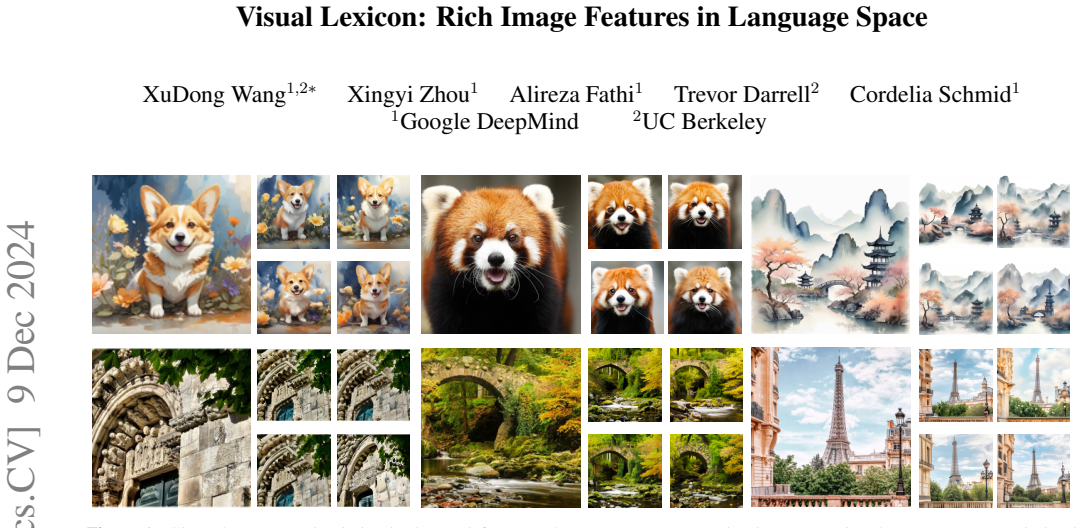
ViLex is a 'visual lexicon': a sequence of continuous tokens that behave like text tokens for a frozen text-to-image model but encode visual content that words cannot express. The encoder, a ViT initialized from SigLIP followed by five attention-pooling blocks, projects patch features into the index-to-embedding lookup space of the T2I model's text encoder, so the frozen diffusion U-Net can consume them as if they were text. Training minimizes a standard denoising objective, backpropagating through the frozen text encoder and U-Net into the vision encoder; a TailDrop schedule randomly drops trailing tokens, forcing the leading tokens to carry the semantic core. At inference the token count becomes a dial between coarse semantics (one token) and fine detail (75 tokens). The paper claims this setup beats text-based image inversion in reconstruction fidelity, enables zero-shot DreamBooth-style personalization by concatenating ViLex tokens with natural-language prompts, and improves a SigLIP-initialized vision encoder on captioning, visual question answering, and referring segmentation.
Load-bearing premise
The paper assumes that training only to reconstruct images through a frozen 64x64 text-to-image model forces the embeddings to carry both semantic and detailed visual information that transfers to understanding tasks; if the reconstruction loss instead biases the encoder toward low-level memorization, or if the low-resolution decoder drops information such as small objects, the claimed gains over SigLIP would be overstated.
Editorial extensions
If this is right
- ViLex tokens can be typed directly into any text prompt, turning subject-driven generation into a zero-shot operation that needs no per-object fine-tuning.
- Vision encoders trained with the ViLex objective improve in both reconstruction and understanding, so the same objective can upgrade existing encoders such as SigLIP.
- The token count becomes a user-settable fidelity dial, letting systems trade semantic compactness for fine detail as the task requires.
- Because ViLex tokens share a space with text, a single sequence can interleave visual and textual content for a frozen T2I model, enabling re-contextualization, art rendition, and accessorization without adapter modules.
- Representation learning for understanding can draw its training signal from a frozen generative decoder alone, with image-only training barely hurting downstream vision-language performance.
Reading between the lines
- If ViLex transfers to other frozen generative models, the apparent dichotomy between understanding features and generative features becomes a matter of training target rather than architecture, suggesting a general recipe for visual-language pretraining.
- The paper's FID comparison uses different token counts for DeDiffusion and ViLex; a fairer bit-budget-equal test would hold the total token count constant, and the paper's one-token result predicts ViLex would still win.
- The 64x64 base model is a likely ceiling: a higher-resolution frozen T2I decoder should improve small-object recall and fine-detail reconstruction, a testable extension the supplement itself gestures toward.
- ViLex tokens could double as a retrieval index, since images become searchable in text space by cosine similarity to caption embeddings, yielding a text-to-image retrieval procedure that inherits the T2I model's semantic granularity.
Editorial analysis
A structured set of objections, weighed in public.
Referee Report
Summary. The paper introduces ViLex, a ViT-based image encoder with attention pooling that maps images into n continuous embeddings in the token-embedding space of a frozen text encoder (OpenCLIP ViT-H/14) that conditions a frozen 64x64 Imagen text-to-image model. Training uses the diffusion denoising reconstruction loss plus a TailDrop strategy that randomly drops the last k tokens to encourage earlier tokens to carry richer semantics. The authors report three main results: (i) image reconstruction with lower FID/IS than DeDiffusion and image-guided DALL-E 3, including single-token reconstructions; (ii) zero-shot DreamBooth-style editing by concatenating ViLex tokens with natural-language prompts; and (iii) improved vision-language understanding when replacing SigLIP in the PaliGemma VLM with ViLex features, reported across 15 benchmarks. The supplement provides human-study instructions, ablations over training steps, pooling layers, and encoder initializations, and explicitly acknowledges that small objects can be missed because the base T2I model operates at 64x64 resolution.
Significance. If the central claims hold, ViLex offers an appealing unification: a single continuous token sequence in language space that can serve both as a prompt for a frozen text-to-image model and as a vision representation for downstream understanding. The reconstruction comparison against DeDiffusion is well posed, since DeDiffusion uses the same encoder architecture and the same Imagen decoder; the TailDrop mechanism is simple and makes the token budget adaptive; and the supplement contains useful ablations. However, the paper's central 'simultaneous reconstruction and understanding' claim is not yet established: the understanding gains in Section 4.3 are confounded with additional fine-tuning, and the state-of-the-art claim in Table 5 rests on unmatched comparisons. The paper would still be significant as a representation-learning recipe even if the mechanism is not fully isolated, but the current evidence requires revision.
major comments (4)
- [§4.3, Table 3 and Supplement Table A1] The headline claim that ViLex improves a strong SigLIP vision encoder across 15 benchmarks is confounded by the amount of additional training. Table 3 compares an untouched official SigLIP checkpoint with a checkpoint that was further trained for 300K or 600K steps on WebLI through a frozen Imagen decoder; the main text in §4.1 says 300K steps, while Supplement Table A1 reports 150K and 600K checkpoints. Supplement Table A1 itself shows that extending the ViLex fine-tuning from 150K to 600K steps raises many downstream scores (e.g., SciQA from 86.1 to 89.3 and RefCOCOg-test from 60.2 to 62.6), so training duration alone is a known confound. A matched control is missing: the same initialization, data, and step budget should be trained with an alternative objective (e.g., continued SigLIP contrastive pretraining or a pixel-space/VAE reconstruction objective) and evaluated with identical hyperparameter sweeps. In addition, the features used for Table 3 are the pre-pooling ViT patch features, not the ViLex text-space tokens; the results therefore establish that ViLex-style fine-tuning does not destroy semantic usefulness, but they do not establish that the language-space/T2I-decoder mechanism is responsible for the reported gains.
- [§4.3, Table 5] The claim of 'SOTA performance across multiple visual question answering tasks' is not supported by the comparisons shown. ViLex is evaluated in a frozen-encoder PaliGemma-2B setup with 336 tokens at 224px, whereas the competing models use 7B-13B language models, higher resolutions (336–448px), 576–1280 tokens, and are fine-tuned on the target datasets, as the asterisks in Table 5 indicate. These differences in model scale, input resolution, token budget, and training data dominate the VQA score differences, so no conclusion about state-of-the-art status can be drawn without matched ablations at a fixed scale. The claim should be softened to 'competitive with much larger systems' or supported with controlled comparisons.
- [§4.2, Tables 1 and 2] The quantitative reconstruction results are reported without uncertainty estimates. Table 1 gives FID and IS for single runs, and Table 2 reports 91–98% human win rates without stating the number of participants, the number of image-prompt pairs, how stimuli were sampled, or inter-annotator agreement. Since the central 'higher fidelity' claim rests on these numbers, the paper should report standard errors or confidence intervals for FID/IS (e.g., across multiple random subsets or generation seeds) and full human-study statistics. Without these details, the magnitude of the reported margins is difficult to assess.
- [Supplement A3, Table A2 and main Tables 1 and 3] The FID values reported for ViLex are mutually inconsistent across tables. Table 3 reports FID 2.38 for ViLex SigLIP, Table 1 reports FID 2.07 for the 75-token ViLex configuration, and Supplement Table A2 reports FID 2.58 for the 5-layer attention-pooling configuration described in the main text. The reconstruction protocol (token count, input resolution, evaluation set, whether the pooling layer is used, and the number of generation seeds) is not specified consistently across these tables, so the reader cannot reconcile the numbers. Please state the exact protocol for each FID column or remove the redundant values.
minor comments (5)
- [§4.1 and Supplement A1] The image encoder is described in the main text as 'SigLIP@224 [88] ... ViT-base' but in the supplement as 'SigLIP-So400M@224'; these are different models, so the architecture actually used must be stated consistently.
- [§4.1 and Supplement A1] The main text says training runs for 300K steps, while the supplement says doubling from 300K to 600K improves performance and Table A1 evaluates 150K and 600K checkpoints; the main-text tables should identify which checkpoint underlies each reported number.
- [§3.1] The symbol k is used both for the number of patch tokens and for the number of tokens dropped by TailDrop; please use distinct notation for these two quantities.
- [§4.3, Table 3] The text states that ViLex improves the baseline 'by over 1 point margin on a variety' of tasks, but Table 3 shows several tasks with gains below 1 point (e.g., VQAv2 +0.2, OKVQA +1.3, MSRVTT +1.3); the wording should match the data.
- [§4.3, Table 4] The VAE baseline in Table 4 is not described: the table does not state which VAE tokenization is used, how many tokens are fed to the VLM, or whether the VAE encoder is frozen; without this information the '>8 times lower' comparison is hard to interpret.
Circularity Check
No significant circularity: ViLex's reconstruction objective and downstream evaluations are externally grounded.
full rationale
The paper's central derivation is the ViLex encoder, trained with a denoising reconstruction loss through a frozen Imagen text-to-image model (Eq. 3, Section 4.1). The representation is not defined in terms of the downstream metrics; reconstruction FID is measured on MS-COCO images not used to train the encoder, and the understanding evaluations in Tables 3-5 use frozen ViLex features with only the PaliGemma language model fine-tuned. The same frozen T2I model serves as both training supervisor and evaluation decoder, but this is the intended autoencoder design rather than a circular argument: the encoder must generalize to held-out images, and the text-embedding baseline (DeDiffusion) uses the same decoder for comparison. No load-bearing self-citation appears; the only self-citation is reference [75], which sits in a background list of feature-learning methods and does not justify any central premise. The design choices (diffusion-as-decoder, TailDrop, TFG) are introduced and ablated in the paper rather than justified by prior work of the same authors, so the ansatz-smuggling and uniqueness-import patterns do not apply. The supplement's limitation about missing small objects is an honest acknowledgment of a resolution-dependent failure mode, not circularity. A remaining concern is that Table 3 compares a SigLIP encoder fine-tuned by ViLex for 300K-600K steps against the untouched official SigLIP checkpoint, so the gains could partly reflect continued pretraining rather than the language-space mechanism; this is a correctness or interpretation risk, not a reduction of the result to its inputs by construction.
Assumptions & free parameters
free parameters (3)
- Number of ViLex tokens at inference =
1, 4, 16, 75 (user-selected)
- TailDrop drop count k =
not specified (randomly chosen during training)
- TFG guidance scale wtfg =
not specified
assumptions (4)
- domain assumption Frozen T2I diffusion models capture both semantic and visual information in their denoising process.
- domain assumption The text encoder embedding space (CLIP token embeddings) can host continuous multi-token visual representations that are composable with natural language tokens.
- domain assumption The standard diffusion denoising objective is a suitable representation learning loss when the decoder is frozen.
- ad hoc to paper TailDrop encourages earlier tokens to capture richer semantic information.
invented entities (1)
-
ViLex token embeddings
Cite this review
Pith. "Pith review of Visual Lexicon: Rich Image Features in Language Space." pith.science (2026). https://pith.science/paper/QDUTESFM
@misc{pith2026241206774,
  author       = {Pith},
  title        = {Pith review of: Visual Lexicon: Rich Image Features in Language Space},
  year         = {2026},
  howpublished = {\url{https://pith.science/paper/QDUTESFM}},
  note         = {Machine review of arXiv:2412.06774}
}
read the original abstract
We present Visual Lexicon, a novel visual language that encodes rich image information into the text space of vocabulary tokens while retaining intricate visual details that are often challenging to convey in natural language. Unlike traditional methods that prioritize either high-level semantics (e.g., CLIP) or pixel-level reconstruction (e.g., VAE), ViLex simultaneously captures rich semantic content and fine visual details, enabling high-quality image generation and comprehensive visual scene understanding. Through a self-supervised learning pipeline, ViLex generates tokens optimized for reconstructing input images using a frozen text-to-image (T2I) diffusion model, preserving the detailed information necessary for high-fidelity semantic-level reconstruction. As an image embedding in the language space, ViLex tokens leverage the compositionality of natural languages, allowing them to be used independently as "text tokens" or combined with natural language tokens to prompt pretrained T2I models with both visual and textual inputs, mirroring how we interact with vision-language models (VLMs). Experiments demonstrate that ViLex achieves higher fidelity in image reconstruction compared to text embeddings--even with a single ViLex token. Moreover, ViLex successfully performs various DreamBooth tasks in a zero-shot, unsupervised manner without fine-tuning T2I models. Additionally, ViLex serves as a powerful vision encoder, consistently improving vision-language model performance across 15 benchmarks relative to a strong SigLIP baseline.
Figures


Figures from the paper (4 more)


Forward citations
Cited by 1 Pith paper
-
Vision-Language-Vision Auto-Encoder: Scalable Knowledge Distillation from Diffusion Models
An image autoencoder compresses pictures into caption-like embeddings via a frozen diffusion decoder, and a fine-tuned LLM reads those embeddings into captions claimed to rival GPT-4o at under $1,000 training cost.
Reference graph
Works this paper leans on
-
[1]
Qwen-vl: A frontier large vision-language model with versatile abilities
Jinze Bai, Shuai Bai, Shusheng Yang, Shijie Wang, Sinan Tan, Peng Wang, Junyang Lin, Chang Zhou, and Jingren Zhou. Qwen-vl: A frontier large vision-language model with versatile abilities. arXiv:2308.12966, 2023. 8, 9
arXiv 2023
-
[2]
BEit: BERT pre-training of image transformers
Hangbo Bao, Li Dong, Songhao Piao, and Furu Wei. BEit: BERT pre-training of image transformers. In ICLR, 2022. 3
2022
-
[3]
Label-efficient se- mantic segmentation with diffusion models
Dmitry Baranchuk, Andrey V oynov, Ivan Rubachev, Valentin Khrulkov, and Artem Babenko. Label-efficient se- mantic segmentation with diffusion models. In ICLR, 2022. 2, 3
2022
-
[4]
Generalized denoising auto-encoders as generative models
Yoshua Bengio, Li Yao, Guillaume Alain, and Pascal Vin- cent. Generalized denoising auto-encoders as generative models. Advances in neural information processing systems, 26, 2013. 2, 3
2013
-
[5]
Improving image generation with better captions
James Betker, Gabriel Goh, Li Jing, Tim Brooks, Jianfeng Wang, Linjie Li, Long Ouyang, Juntang Zhuang, Joyce Lee, Yufei Guo, et al. Improving image generation with better captions. Computer Science. https://cdn. openai. com/papers/dall-e-3. pdf, 2(3):8, 2023. 2, 5, 7
2023
-
[6]
Paligemma: A versatile 3b vlm for trans- fer
Lucas Beyer, Andreas Steiner, Andr ´e Susano Pinto, Alexan- der Kolesnikov, Xiao Wang, Daniel Salz, Maxim Neumann, Ibrahim Alabdulmohsin, Michael Tschannen, Emanuele Bugliarello, et al. Paligemma: A versatile 3b vlm for trans- fer. arXiv:2407.07726, 2024. 2, 3, 8, 13, 14
arXiv 2024
-
[7]
Language models are few-shot learners
Tom B Brown. Language models are few-shot learners. arXiv preprint arXiv:2005.14165, 2020. 4
arXiv 2005
-
[8]
Emerg- ing properties in self-supervised vision transformers
Mathilde Caron, Hugo Touvron, Ishan Misra, Herv ´e J´egou, Julien Mairal, Piotr Bojanowski, and Armand Joulin. Emerg- ing properties in self-supervised vision transformers. In CVPR, 2021. 1, 3
2021
Show all 89 references
-
[9]
Generative pre- training from pixels
Mark Chen, Alec Radford, Rewon Child, Jeffrey Wu, Hee- woo Jun, David Luan, and Ilya Sutskever. Generative pre- training from pixels. In International conference on machine learning, pages 1691–1703. PMLR, 2020. 3
2020
-
[10]
Microsoft coco captions: Data collection and evaluation server
Xinlei Chen, Hao Fang, Tsung-Yi Lin, Ramakrishna Vedan- tam, Saurabh Gupta, Piotr Doll ´ar, and C Lawrence Zitnick. Microsoft coco captions: Data collection and evaluation server. arXiv:1504.00325, 2015. 2
2015 arXiv
-
[11]
Pali: A jointly-scaled multilingual language-image model
Xi Chen, Xiao Wang, Soravit Changpinyo, AJ Piergio- vanni, Piotr Padlewski, Daniel Salz, Sebastian Good- man, Adam Grycner, Basil Mustafa, Lucas Beyer, et al. Pali: A jointly-scaled multilingual language-image model. arXiv:2209.06794, 2022. 6, 13
2022 arXiv
-
[12]
De- constructing denoising diffusion models for self-supervised learning
Xinlei Chen, Zhuang Liu, Saining Xie, and Kaiming He. De- constructing denoising diffusion models for self-supervised learning. arXiv:2401.14404, 2024. 3
2024 arXiv
-
[13]
Reproducible scal- ing laws for contrastive language-image learning
Mehdi Cherti, Romain Beaumont, Ross Wightman, Mitchell Wortsman, Gabriel Ilharco, Cade Gordon, Christoph Schuh- mann, Ludwig Schmidt, and Jenia Jitsev. Reproducible scal- ing laws for contrastive language-image learning. In CVPR,
-
[14]
Imagenet: A large-scale hierarchical image database
Jia Deng, Wei Dong, Richard Socher, Li-Jia Li, Kai Li, and Li Fei-Fei. Imagenet: A large-scale hierarchical image database. In CVPR, 2009. 1, 3
2009
-
[15]
Large scale adversarial representation learning
Jeff Donahue and Karen Simonyan. Large scale adversarial representation learning. NeurIPS, 32, 2019. 3
2019
-
[16]
An image is worth 16x16 words: Transformers for image recognition at scale
Alexey Dosovitskiy, Lucas Beyer, Alexander Kolesnikov, Dirk Weissenborn, Xiaohua Zhai, Thomas Unterthiner, Mostafa Dehghani, Matthias Minderer, Georg Heigold, Syl- vain Gelly, Jakob Uszkoreit, and Neil Houlsby. An image is worth 16x16 words: Transformers for image recognition ...
2021
-
[17]
A new algorithm for data compression
Philip Gage. A new algorithm for data compression. The C Users Journal, 12(2):23–38, 1994. 4
1994
-
[18]
An image is worth one word: Personalizing text-to-image gen- eration using textual inversion
Rinon Gal, Yuval Alaluf, Yuval Atzmon, Or Patashnik, Amit H Bermano, Gal Chechik, and Daniel Cohen-Or. An image is worth one word: Personalizing text-to-image gen- eration using textual inversion. ICLR, 2023. 3, 16 9
2023
-
[19]
Instructcv: Instruction- tuned text-to-image diffusion models as vision generalists
Yulu Gan, Sungwoo Park, Alexander Marcel Schubert, An- thony Philippakis, and Ahmed Alaa. Instructcv: Instruction- tuned text-to-image diffusion models as vision generalists. In The Twelfth International Conference on Learning Repre- sentations, 2024. 2, 3
2024
-
[20]
Imagebind: One embedding space to bind them all
Rohit Girdhar, Alaaeldin El-Nouby, Zhuang Liu, Mannat Singh, Kalyan Vasudev Alwala, Armand Joulin, and Ishan Misra. Imagebind: One embedding space to bind them all. In Proceedings of the IEEE/CVF Conference on Computer Vision and Pattern Recognition, pages 15180–15190, 2023. 3
2023
-
[21]
Making the v in vqa matter: Elevating the role of image understanding in visual question answer- ing
Yash Goyal, Tejas Khot, Douglas Summers-Stay, Dhruv Ba- tra, and Devi Parikh. Making the v in vqa matter: Elevating the role of image understanding in visual question answer- ing. In CVPR, 2017. 2, 13
2017
-
[22]
Vizwiz grand challenge: Answering visual questions from blind people
Danna Gurari, Qing Li, Abigale J Stangl, Anhong Guo, Chi Lin, Kristen Grauman, Jiebo Luo, and Jeffrey P Bigham. Vizwiz grand challenge: Answering visual questions from blind people. In Proceedings of the IEEE conference on computer vision and pattern recognition, pages 3608–3617,
-
[23]
Masked autoencoders are scalable vision learners
Kaiming He, Xinlei Chen, Saining Xie, Yanghao Li, Piotr Doll´ar, and Ross Girshick. Masked autoencoders are scalable vision learners. In CVPR, 2022. 1, 2, 3
2022
-
[24]
Gans trained by a two time-scale update rule converge to a local nash equilib- rium
Martin Heusel, Hubert Ramsauer, Thomas Unterthiner, Bernhard Nessler, and Sepp Hochreiter. Gans trained by a two time-scale update rule converge to a local nash equilib- rium. Advances in neural information processing systems , 30, 2017. 7
2017
-
[25]
Autoencoders, mini- mum description length and helmholtz free energy.Advances in neural information processing systems, 6, 1993
Geoffrey E Hinton and Richard Zemel. Autoencoders, mini- mum description length and helmholtz free energy.Advances in neural information processing systems, 6, 1993. 2, 3, 8
1993
-
[26]
Classifier-free diffusion guidance
Jonathan Ho and Tim Salimans. Classifier-free diffusion guidance. In NeurIPS 2021 Workshop on Deep Generative Models and Downstream Applications, 2021. 4
2021
-
[27]
Denoising dif- fusion probabilistic models
Jonathan Ho, Ajay Jain, and Pieter Abbeel. Denoising dif- fusion probabilistic models. Advances in neural information processing systems, 33:6840–6851, 2020. 2, 5
2020
-
[28]
Scicap: Generating captions for scientific figures
Ting-Yao Hsu, C Lee Giles, and Ting-Hao’Kenneth’ Huang. Scicap: Generating captions for scientific figures. arXiv preprint arXiv:2110.11624, 2021. 13
2021 arXiv
-
[29]
Lora: Low-rank adaptation of large language mod- els
Edward J Hu, Yelong Shen, Phillip Wallis, Zeyuan Allen- Zhu, Yuanzhi Li, Shean Wang, Lu Wang, and Weizhu Chen. Lora: Low-rank adaptation of large language mod- els. arXiv:2106.09685, 2021. 5, 6, 7, 16
2021 arXiv
-
[30]
Gqa: A new dataset for real-world visual reasoning and compositional question answering
Drew A Hudson and Christopher D Manning. Gqa: A new dataset for real-world visual reasoning and compositional question answering. In Proceedings of the IEEE/CVF con- ference on computer vision and pattern recognition , pages 6700–6709, 2019. 14
2019
-
[31]
Soda: Bottleneck diffusion models for representation learning
Drew A Hudson, Daniel Zoran, Mateusz Malinowski, An- drew K Lampinen, Andrew Jaegle, James L McClelland, Loic Matthey, Felix Hill, and Alexander Lerchner. Soda: Bottleneck diffusion models for representation learning. In CVPR, 2024. 3
2024
-
[32]
Open- clip, 2021
Gabriel Ilharco, Mitchell Wortsman, Ross Wightman, Cade Gordon, Nicholas Carlini, Rohan Taori, Achal Dave, Vaishaal Shankar, Hongseok Namkoong, John Miller, Han- naneh Hajishirzi, Ali Farhadi, and Ludwig Schmidt. Open- clip, 2021. 6, 13
2021
-
[33]
Referitgame: Referring to objects in pho- tographs of natural scenes
Sahar Kazemzadeh, Vicente Ordonez, Mark Matten, and Tamara Berg. Referitgame: Referring to objects in pho- tographs of natural scenes. In Proceedings of the 2014 con- ference on empirical methods in natural language processing (EMNLP), pages 787–798, 2014. 14
2014
-
[34]
Auto-encoding variational bayes
Diederik P Kingma. Auto-encoding variational bayes. arXiv preprint arXiv:1312.6114, 2013. 1, 2, 3, 8
2013 arXiv
-
[35]
Your diffusion model is secretly a zero-shot classifier
Alexander C Li, Mihir Prabhudesai, Shivam Duggal, Ellis Brown, and Deepak Pathak. Your diffusion model is secretly a zero-shot classifier. In Proceedings of the IEEE/CVF Inter- national Conference on Computer Vision, pages 2206–2217,
-
[36]
Llava-onevision: Easy visual task transfer
Bo Li, Yuanhan Zhang, Dong Guo, Renrui Zhang, Feng Li, Hao Zhang, Kaichen Zhang, Yanwei Li, Ziwei Liu, and Chunyuan Li. Llava-onevision: Easy visual task transfer. arXiv:2408.03326, 2024. 3
2024 arXiv
-
[37]
Blip: Bootstrapping language-image pre-training for uni- fied vision-language understanding and generation
Junnan Li, Dongxu Li, Caiming Xiong, and Steven Hoi. Blip: Bootstrapping language-image pre-training for uni- fied vision-language understanding and generation. In ICLR. PMLR, 2022. 3
2022
-
[38]
Imagefolder: Autoregressive im- age generation with folded tokens
Xiang Li, Hao Chen, Kai Qiu, Jason Kuen, Jiuxiang Gu, Bhiksha Raj, and Zhe Lin. Imagefolder: Autoregressive im- age generation with folded tokens. arXiv:2410.01756, 2024. 3
2024 arXiv
-
[39]
Vila: On pre-training for visual language models
Ji Lin, Hongxu Yin, Wei Ping, Pavlo Molchanov, Moham- mad Shoeybi, and Song Han. Vila: On pre-training for visual language models. In CVPR, 2024. 9
2024
-
[40]
Microsoft coco: Common objects in context
Tsung-Yi Lin, Michael Maire, Serge Belongie, James Hays, Pietro Perona, Deva Ramanan, Piotr Doll´ar, and C Lawrence Zitnick. Microsoft coco: Common objects in context. In ECCV, 2014. 13, 15
2014
-
[41]
Improved baselines with visual instruction tuning
Haotian Liu, Chunyuan Li, Yuheng Li, and Yong Jae Lee. Improved baselines with visual instruction tuning. In CVPR,
-
[42]
Llava-next: Im- proved reasoning, ocr, and world knowledge, 2024
Haotian Liu, Chunyuan Li, Yuheng Li, Bo Li, Yuanhan Zhang, Sheng Shen, and Yong Jae Lee. Llava-next: Im- proved reasoning, ocr, and world knowledge, 2024. 8, 9
2024
-
[43]
Learn to explain: Multimodal reasoning via thought chains for science question answering
Pan Lu, Swaroop Mishra, Tanglin Xia, Liang Qiu, Kai-Wei Chang, Song-Chun Zhu, Oyvind Tafjord, Peter Clark, and Ashwin Kalyan. Learn to explain: Multimodal reasoning via thought chains for science question answering. Advances in Neural Information Processing Systems , 35:2507–2521,
-
[44]
Prompting hard or hardly prompting: Prompt inversion for text-to-image diffusion models
Shweta Mahajan, Tanzila Rahman, Kwang Moo Yi, and Leonid Sigal. Prompting hard or hardly prompting: Prompt inversion for text-to-image diffusion models. In CVPR,
-
[45]
Generation and comprehension of unambiguous object descriptions
Junhua Mao, Jonathan Huang, Alexander Toshev, Oana Camburu, Alan L Yuille, and Kevin Murphy. Generation and comprehension of unambiguous object descriptions. In Proceedings of the IEEE conference on computer vision and pattern recognition, pages 11–20, 2016. 14
2016
-
[46]
Ok-vqa: A visual question answering 10 benchmark requiring external knowledge
Kenneth Marino, Mohammad Rastegari, Ali Farhadi, and Roozbeh Mottaghi. Ok-vqa: A visual question answering 10 benchmark requiring external knowledge. In Proceedings of the IEEE/cvf conference on computer vision and pattern recognition, pages 3195–3204, 2019. 13
2019
-
[47]
Finite scalar quantization: Vq-vae made simple
Fabian Mentzer, David Minnen, Eirikur Agustsson, and Michael Tschannen. Finite scalar quantization: Vq-vae made simple. ICLR, 2024. 3
2024
-
[48]
Null-text inversion for editing real im- ages using guided diffusion models
Ron Mokady, Amir Hertz, Kfir Aberman, Yael Pritch, and Daniel Cohen-Or. Null-text inversion for editing real im- ages using guided diffusion models. In Proceedings of the IEEE/CVF Conference on Computer Vision and Pattern Recognition, pages 6038–6047, 2023. 3
2023
-
[49]
Improved denoising diffusion probabilistic models
Alexander Quinn Nichol and Prafulla Dhariwal. Improved denoising diffusion probabilistic models. In ICML. PMLR,
-
[50]
Dinov2: Learning robust visual features without supervision
Maxime Oquab, Timoth ´ee Darcet, Th ´eo Moutakanni, Huy V o, Marc Szafraniec, Vasil Khalidov, Pierre Fernandez, Daniel Haziza, Francisco Massa, Alaaeldin El-Nouby, et al. Dinov2: Learning robust visual features without supervision. arXiv:2304.07193, 2023. 1, 3
2023 arXiv
-
[51]
Styleclip: Text-driven manipulation of stylegan imagery
Or Patashnik, Zongze Wu, Eli Shechtman, Daniel Cohen-Or, and Dani Lischinski. Styleclip: Text-driven manipulation of stylegan imagery. In Proceedings of the IEEE/CVF inter- national conference on computer vision , pages 2085–2094,
-
[52]
Sdxl: Improving latent diffusion models for high-resolution image synthesis
Dustin Podell, Zion English, Kyle Lacey, Andreas Blattmann, Tim Dockhorn, Jonas M ¨uller, Joe Penna, and Robin Rombach. Sdxl: Improving latent diffusion models for high-resolution image synthesis. In The Twelfth Inter- national Conference on Learning Representations, 2023. 3, 5
2023
-
[53]
Learn- ing transferable visual models from natural language super- vision
Alec Radford, Jong Wook Kim, Chris Hallacy, Aditya Ramesh, Gabriel Goh, Sandhini Agarwal, Girish Sastry, Amanda Askell, Pamela Mishkin, Jack Clark, et al. Learn- ing transferable visual models from natural language super- vision. In ICLR, 2021. 1, 2, 3, 4, 6, 13
2021
-
[54]
Exploring the limits of transfer learning with a unified text-to-text transformer
Colin Raffel, Noam Shazeer, Adam Roberts, Katherine Lee, Sharan Narang, Michael Matena, Yanqi Zhou, Wei Li, and Peter J Liu. Exploring the limits of transfer learning with a unified text-to-text transformer. Journal of machine learning research, 2020. 2, 4
2020
-
[55]
Hierarchical text-conditional image gen- eration with clip latents
Aditya Ramesh, Prafulla Dhariwal, Alex Nichol, Casey Chu, and Mark Chen. Hierarchical text-conditional image gen- eration with clip latents. arXiv preprint arXiv:2204.06125,
-
[56]
High-resolution image syn- thesis with latent diffusion models
Robin Rombach, Andreas Blattmann, Dominik Lorenz, Patrick Esser, and Bj¨orn Ommer. High-resolution image syn- thesis with latent diffusion models. In CVPR, 2022. 2, 3, 8
2022
-
[57]
U-net: Convolutional networks for biomedical image segmentation
Olaf Ronneberger, Philipp Fischer, and Thomas Brox. U-net: Convolutional networks for biomedical image segmentation. In MICCAI, 2015. 5, 13
2015
-
[58]
Dreambooth: Fine tuning text-to-image diffusion models for subject-driven generation
Nataniel Ruiz, Yuanzhen Li, Varun Jampani, Yael Pritch, Michael Rubinstein, and Kfir Aberman. Dreambooth: Fine tuning text-to-image diffusion models for subject-driven generation. In CVPR, 2023. 2, 3, 6, 7, 16
2023
-
[59]
Hyperdreambooth: Hypernetworks for fast personalization of text-to-image models
Nataniel Ruiz, Yuanzhen Li, Varun Jampani, Wei Wei, Tingbo Hou, Yael Pritch, Neal Wadhwa, Michael Rubinstein, and Kfir Aberman. Hyperdreambooth: Hypernetworks for fast personalization of text-to-image models. InCVPR, 2024. 3, 16
2024
-
[60]
Photorealistic text-to-image diffusion models with deep language understanding
Chitwan Saharia, William Chan, Saurabh Saxena, Lala Li, Jay Whang, Emily L Denton, Kamyar Ghasemipour, Raphael Gontijo Lopes, Burcu Karagol Ayan, Tim Salimans, et al. Photorealistic text-to-image diffusion models with deep language understanding. Advances in neural information...
2022
-
[61]
Progressive distillation for fast sampling of diffusion models
Tim Salimans and Jonathan Ho. Progressive distillation for fast sampling of diffusion models. In ICLR, 2021. 13
2021
-
[62]
Neural machine translation of rare words with subword units
Rico Sennrich. Neural machine translation of rare words with subword units. arXiv preprint arXiv:1508.07909, 2015. 4
2015 arXiv
-
[63]
Adafactor: Adaptive learning rates with sublinear memory cost
Noam Shazeer and Mitchell Stern. Adafactor: Adaptive learning rates with sublinear memory cost. In ICML. PMLR,
-
[64]
Textcaps: a dataset for image caption- ing with reading comprehension
Oleksii Sidorov, Ronghang Hu, Marcus Rohrbach, and Amanpreet Singh. Textcaps: a dataset for image caption- ing with reading comprehension. In Computer Vision–ECCV 2020: 16th European Conference, Glasgow, UK, August 23– 28, 2020, Proceedings, Part II 16, pages 742–758. Springer,
2020
-
[65]
Towards vqa models that can read
Amanpreet Singh, Vivek Natarajan, Meet Shah, Yu Jiang, Xinlei Chen, Dhruv Batra, Devi Parikh, and Marcus Rohrbach. Towards vqa models that can read. InProceedings of the IEEE/CVF conference on computer vision and pattern recognition, pages 8317–8326, 2019. 13
2019
-
[66]
Deep unsupervised learning using nonequilibrium thermodynamics
Jascha Sohl-Dickstein, Eric Weiss, Niru Maheswaranathan, and Surya Ganguli. Deep unsupervised learning using nonequilibrium thermodynamics. In ICML. PMLR, 2015. 5
2015
-
[67]
Generative modeling by esti- mating gradients of the data distribution
Yang Song and Stefano Ermon. Generative modeling by esti- mating gradients of the data distribution. Advances in neural information processing systems, 32, 2019. 5
2019
-
[68]
Rethinking the inception archi- tecture for computer vision
Christian Szegedy, Vincent Vanhoucke, Sergey Ioffe, Jon Shlens, and Zbigniew Wojna. Rethinking the inception archi- tecture for computer vision. In Proceedings of the IEEE con- ference on computer vision and pattern recognition , pages 2818–2826, 2016. 7
2016
-
[69]
Gemma: Open models based on gemini research and tech- nology
Gemma Team, Thomas Mesnard, Cassidy Hardin, Robert Dadashi, Surya Bhupatiraju, Shreya Pathak, Laurent Sifre, Morgane Rivi `ere, Mihir Sanjay Kale, Juliette Love, et al. Gemma: Open models based on gemini research and tech- nology. arXiv preprint arXiv:2403.08295, 2024. 8
2024 arXiv
-
[70]
Crossmodal-3600: A massively multilingual multi- modal evaluation dataset
Ashish V Thapliyal, Jordi Pont-Tuset, Xi Chen, and Radu Soricut. Crossmodal-3600: A massively multilingual multi- modal evaluation dataset. arXiv preprint arXiv:2205.12522,
-
[71]
Visual autoregressive modeling: Scalable image generation via next-scale prediction
Keyu Tian, Yi Jiang, Zehuan Yuan, Bingyue Peng, and Li- wei Wang. Visual autoregressive modeling: Scalable image generation via next-scale prediction. NeurIPS, 2024. 3
2024
-
[72]
Con- trastive multiview coding
Yonglong Tian, Dilip Krishnan, and Phillip Isola. Con- trastive multiview coding. In ECCV, 2020. 3
2020
-
[73]
Extracting and composing robust features with denoising autoencoders
Pascal Vincent, Hugo Larochelle, Yoshua Bengio, and Pierre-Antoine Manzagol. Extracting and composing robust features with denoising autoencoders. In Proceedings of the 11 25th international conference on Machine learning , pages 1096–1103, 2008. 2, 3
2008
-
[74]
Diffusion feedback helps clip see better
Wenxuan Wang, Quan Sun, Fan Zhang, Yepeng Tang, Jing Liu, and Xinlong Wang. Diffusion feedback helps clip see better. arXiv:2407.20171, 2024. 3
2024 arXiv
-
[75]
Unsupervised feature learning by cross-level instance-group discrimina- tion
Xudong Wang, Ziwei Liu, and Stella X Yu. Unsupervised feature learning by cross-level instance-group discrimina- tion. In CVPR, 2021. 3
2021
-
[76]
De-diffusion makes text a strong cross- modal interface
Chen Wei, Chenxi Liu, Siyuan Qiao, Zhishuai Zhang, Alan Yuille, and Jiahui Yu. De-diffusion makes text a strong cross- modal interface. In Proceedings of the IEEE/CVF Confer- ence on Computer Vision and Pattern Recognition , pages 13492–13503, 2024. 2, 3, 5, 6, 7, 13
2024
-
[77]
Unsupervised feature learning via non-parametric instance discrimination
Zhirong Wu, Yuanjun Xiong, Stella X Yu, and Dahua Lin. Unsupervised feature learning via non-parametric instance discrimination. In CVPR, 2018. 3
2018
-
[78]
Msr-vtt: A large video description dataset for bridging video and language
Jun Xu, Tao Mei, Ting Yao, and Yong Rui. Msr-vtt: A large video description dataset for bridging video and language. In CVPR, 2016. 2, 14, 16
2016
-
[79]
Open-vocabulary panop- tic segmentation with text-to-image diffusion models
Jiarui Xu, Sifei Liu, Arash Vahdat, Wonmin Byeon, Xiao- long Wang, and Shalini De Mello. Open-vocabulary panop- tic segmentation with text-to-image diffusion models. In Proceedings of the IEEE/CVF Conference on Computer Vi- sion and Pattern Recognition , pages 2955–2966, 2023. 2, 3
2023
-
[80]
Diffusion model as repre- sentation learner
Xingyi Yang and Xinchao Wang. Diffusion model as repre- sentation learner. In ICCV, 2023. 3
2023
-
[81]
Vector-quantized image modeling with improved vqgan
Jiahui Yu, Xin Li, Jing Yu Koh, Han Zhang, Ruoming Pang, James Qin, Alexander Ku, Yuanzhong Xu, Jason Baldridge, and Yonghui Wu. Vector-quantized image modeling with improved vqgan. ICLR, 2022. 3
2022
-
[82]
Coca: Contrastive captioners are image-text foundation models
Jiahui Yu, Zirui Wang, Vijay Vasudevan, Legg Yeung, Mo- jtaba Seyedhosseini, and Yonghui Wu. Coca: Contrastive captioners are image-text foundation models. Transactions on Machine Learning Research, 2022. 4, 15, 16
2022
-
[83]
Modeling context in referring expres- sions
Licheng Yu, Patrick Poirson, Shan Yang, Alexander C Berg, and Tamara L Berg. Modeling context in referring expres- sions. In ECCV, 2016. 2, 14
2016
-
[84]
Spae: Semantic pyramid autoencoder for multimodal generation with frozen llms
Lijun Yu, Yong Cheng, Zhiruo Wang, Vivek Kumar, Wolf- gang Macherey, Yanping Huang, David Ross, Irfan Essa, Yonatan Bisk, Ming-Hsuan Yang, et al. Spae: Semantic pyramid autoencoder for multimodal generation with frozen llms. NeurIPS, 2024. 3
2024
-
[85]
Language model beats diffusion–tokenizer is key to visual generation
Lijun Yu, Jos ´e Lezama, Nitesh B Gundavarapu, Luca Ver- sari, Kihyuk Sohn, David Minnen, Yong Cheng, Vighnesh Birodkar, Agrim Gupta, Xiuye Gu, et al. Language model beats diffusion–tokenizer is key to visual generation. ICLR,
-
[86]
An image is worth 32 tokens for reconstruction and generation
Qihang Yu, Mark Weber, Xueqing Deng, Xiaohui Shen, Daniel Cremers, and Liang-Chieh Chen. An image is worth 32 tokens for reconstruction and generation. NeurIPS, 2024. 1, 3
2024
-
[87]
Soundstream: An end- to-end neural audio codec
Neil Zeghidour, Alejandro Luebs, Ahmed Omran, Jan Skoglund, and Marco Tagliasacchi. Soundstream: An end- to-end neural audio codec. IEEE/ACM Transactions on Au- dio, Speech, and Language Processing, 2021. 5
2021
-
[88]
Sigmoid loss for language image pre-training
Xiaohua Zhai, Basil Mustafa, Alexander Kolesnikov, and Lucas Beyer. Sigmoid loss for language image pre-training. In CVPR, 2023. 2, 3, 6, 8, 13, 15, 16
2023
-
[89]
Method A
Yue Zhao, Yuanjun Xiong, and Philipp Kr ¨ahenb¨uhl. Image and video tokenization with binary spherical quantization. arXiv:2406.07548, 2024. 3 12 Visual Lexicon: Rich Image Features in Language Space Supplementary Material A1. Technical Details We introduced the main technical...
2024 arXiv
Reviewed August 11, 2026 · model on record in the stance chip above.
Discussion (0). Continue with ORCID to comment.