REVIEW 3 major objections 6 minor 8 cited by
Pangu Embedded: An Efficient Dual-system LLM Reasoner with Metacognition
T0 review · 3 major / 6 minor · reviewed 2026-08-07 · deepseek-v4-flash
Pith's one-line read The paper claims that a single 7-billion-parameter model can switch between fast and slow reasoning and beat similar-size rivals at both, using a two-stage distillation-plus-RL training framework.
desk verdict Serious engineering report, but the AIME 2024 result is tuned, and the headline gaps are within sampling noise under the paper's own rule; needs a serious referee and major revision before the outperformance claim is credible. read the letter →
The pith
A machine-rendered reading of the paper's core claim, the machinery that carries it, and where it could break.
The reading
What carries the argument
The load-bearing object is the dual-system training dataset and the fusion-training curriculum built on it: roughly 300K fast-mode and 300K slow-mode samples, where easy queries are paired with concise answers and hard queries with <think>...</think> chains, and where training starts from the already capable slow reasoner and replays slow data while adding fast data. The model learns to emit or omit the thinking block, which makes the mode switch observable and lets a meta-prompt or natural-language instruction select the behaviour at inference time. Supporting machinery includes the model-aware complexity score $C(x,y;G_{t-1})=1-\frac{1}{k}\sum_i I(\mathrm{Eq}(y_i,y))$ that selects distillation data, the inter-iteration merging rule $\Theta^t_{\mathrm{merged}}=\Theta^{t-1}_{\mathrm{merged}}+\lambda_t\bar{\delta}^t$, and the Multi-source Adaptive Reward System (MARS) with rule-based and LLM-based verifiers.
What would settle it
Rerun the Table 2 comparison under one fixed protocol: identical prompts, identical decoding settings (including sampling temperature and top-p), identical few-shot counts, and at least 500 effective samples per benchmark, for Pangu Embedded and for Qwen3-8B and GLM-4-9B in both modes. If the rival models reproduce or exceed 81.9, 68.0, and 67.1 under those matched conditions, the claimed lead would be a measurement artifact rather than a model property.
Extended reading notes
Core claim
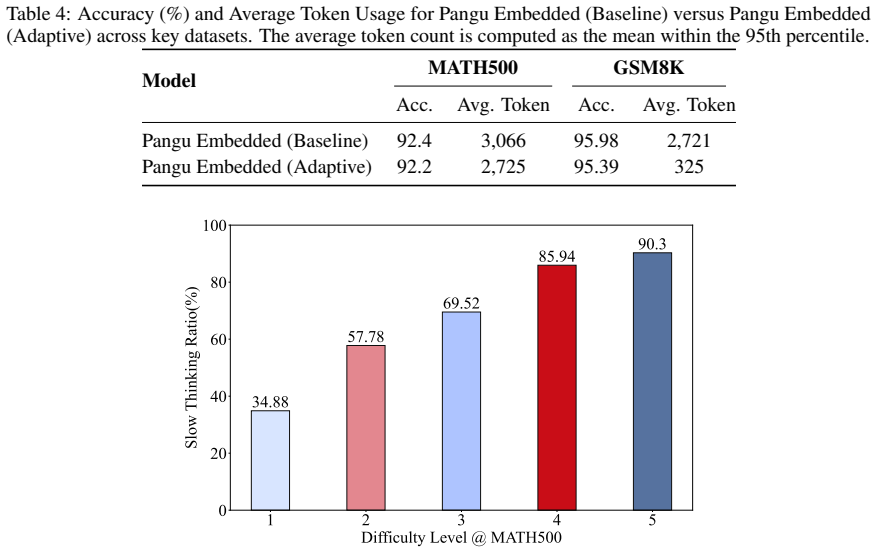
Pangu Embedded is a 7-billion-parameter reasoner whose central claim is that one set of weights can deliver both System 1 and System 2 behaviour without sacrificing either. In slow mode the authors report 81.9 on AIME 2024, 68.0 on GPQA Diamond, and 67.1 on LiveCodeBench, edging out Qwen3-8B (79.4, 62.0, 61.8) and GLM-4-9B (76.4, 58.5, 51.8); in fast mode the model remains competitive, and an adaptive variant holds accuracy nearly constant on GSM8K while reducing average output tokens from 2,721 to 325. The mechanism is a two-stage training framework: model-aware iterative distillation with inter-iteration checkpoint merging followed by GRPO reinforcement learning under a Multi-source Adaptive Reward System (MARS), and then a fusion-training stage that replays mastered slow-thinking data while introducing fast-thinking exemplars, so the presence or absence of the <think>...</think> block becomes the model's learned switch between cognitive modes.
Load-bearing premise
The load-bearing premise is that the comparison numbers for Qwen3-8B and GLM-4-9B were measured under equally favorable, comparable settings; some baseline cells in Table 2 come from the authors' own internal evaluation rather than the rivals' official reports.
Editorial extensions
If this is right
- In slow mode, the 7B model reports higher scores than Qwen3-8B and GLM-4-9B on AIME 2024, GPQA Diamond, and LiveCodeBench, which would put a 7B-class model at the front of the 8-9B reasoning pack.
- In fast mode the same checkpoint stays within a few points of those rivals while generating far shorter outputs, so one deployed model can serve both low-latency and high-accuracy traffic.
- The adaptive mode reduces average output tokens by about 88 percent on GSM8K at nearly unchanged accuracy, implying most efficiency gains come from routing simple queries to fast responses.
- Fusion training with replay beats naive co-training across all reported benchmarks, indicating that the sequencing of fast and slow data matters as much as the data themselves.
- Domain adaptation on legal data raises LawBench average accuracy from 49.97 to 54.59, suggesting the post-training recipe transfers beyond math and code.
Reading between the lines
- Because adaptive mode was trained only on mathematics, an obvious extension is to build difficulty-labelled datasets for code, legal, and general QA and test whether the token-reduction effect transfers.
- The mode selector is learned by imitating labels rather than optimized for a latency-accuracy trade-off; adding an efficiency-aware reward to the RL stage could push the frontier further.
- The manual-switch design implies a practical serving architecture: one checkpoint can offer a cheap 'quick answer' tier and a premium 'show your work' tier with the same weights.
Signed reviews
Editorial analysis
A structured set of objections, weighed in public.
Referee Report
Summary. The manuscript describes Pangu Embedded, a 7B-parameter LLM reasoner trained on Ascend NPUs. Stage 1 combines model-aware iterative distillation with inter-iteration model merging, followed by GRPO-style reinforcement learning guided by the Multi-source Adaptive Reward System (MARS). Stage 2 adds fast/slow thinking modes via fusion SFT, supporting both manual mode switching and automatic complexity-aware mode selection. The central claim is that Pangu Embedded outperforms similarly sized models such as Qwen3-8B and GLM-4-9B on AIME 2024, GPQA, LiveCodeBench, and other benchmarks (Abstract, Table 2).
Significance. If the central comparison were fully established, the result would be practically significant: a single 7B model delivering reasoning quality competitive with 8-9B rivals while also offering an efficient fast mode. The paper also contains genuinely useful engineering contributions: model-aware data complexity selection, inter-iteration merging, a repetition self-repair mechanism, detailed RL infrastructure for Ascend NPUs, and informative internal ablations (Tables 3-7, Figures 13-14). These parts are described with enough specificity to be partially reimplemented, which is a strength. However, the headline 'outperforms' claim is not yet statistically grounded: several baseline cells in Table 2 are internal and protocol-free, no confidence intervals are reported, and AIME 2024 is used both as a tuning target and as a headline result. No code, weights, or evaluation harness are released, which further limits independent verification.
major comments (3)
- [Table 2, Section 4.2] The central comparison against Qwen3-8B and GLM-4-9B mixes daggered official numbers with 'our internal evaluation' cells, but Section 4.2 does not report the prompt templates, few-shot counts, decoding temperatures, top-n-sigma/top-p settings, max tokens, or answer-extraction rules for the internal baseline cells, nor whether the same harness was used as for Pangu Embedded. Under the paper's own Eq. (11) sampling rule, AIME24 (M=30) receives 17 stochastic runs per problem, so the reported 2.5-point Thinking-mode gap (81.9 vs 79.4) is about one standard error (roughly 2.5 points at 510 effective samples per model) and is not statistically significant; the GPQA gap is borderline. No per-cell N, standard errors, or confidence intervals are provided anywhere. Because the abstract's 'outperforms' claim rests on these margins, the evaluation needs either per-cell protocols with uncertainty quantification or a weakened claim.
- [Section 4.5, Figure 12, Table 5] AIME 2024 is used to select the data-complexity mean mu in Eq. (2) via the experiments in Figure 12, and Table 5 uses AIME 2024 to decide that three SFT iterations suffice. Consequently the reported AIME24 Thinking score (81.9) is a selected maximum over configurations, not an unbiased estimate; the same benchmark is both a tuning target and a headline result. The paper should either perform selection on a separate development set or explicitly adjust for this selection when presenting AIME24 as evidence of superiority.
- [Section 4.2, 'Evaluation Baselines and Metrics'] The text states that 'the majority of our assessments employ few-shot inputs, with a minority using zero-shot prompts,' but does not specify which benchmark uses which setting or how many shots. This matters because baseline numbers from official reports may use different few-shot protocols than the internally measured cells, and the paper claims exact matching for gold-answer benchmarks without stating the extraction rules. This lack of protocol detail makes it impossible for a reader to reproduce any single cell of Table 2, including the Pangu Embedded cells.
minor comments (6)
- [Section 2.5.2] The paragraph on 'Other Rewards' contains editorial artifacts '(Changed from to sentence start)' that should be removed before publication.
- [Figure 10] The axis labels in Figure 10 are rendered as raw unicode escape sequences (e.g., '/uni0000002a/uni00000033/...'), making the figure unreadable; the figure needs to be regenerated with proper text.
- [Section 2.3.2] The 'Data Synthesis' paragraph appears twice with near-identical wording, once after the description of the pipeline and once after Eq. (2); the duplication should be removed.
- [Section 2.5.1] There is a typo in 'In GRPO algirithm' that should read 'algorithm'.
- [Reference [29]] Reference [29] lists 'Codeforces' as the title of the AIME 2024 citation, which appears to be an error; the correct source title should be used.
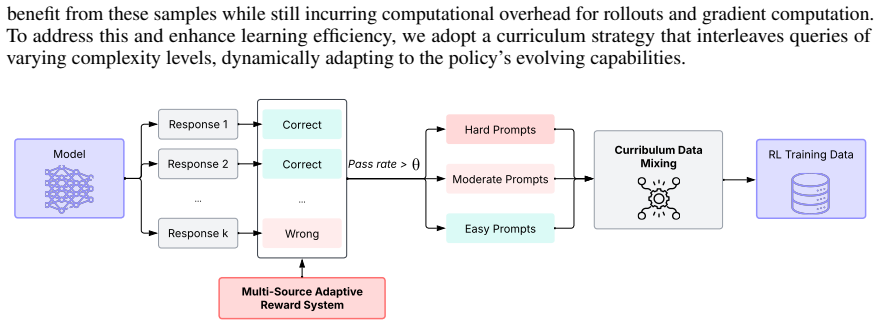
- [Figure 5] The figure caption contains the typo 'Curribulum Data Mixing' instead of 'Curriculum Data Mixing'.
Circularity Check
AIME24 is used to set the distillation complexity mean and the SFT stopping iteration, then reported as headline evidence; other benchmark claims retain independent content, so partial rather than pervasive circularity.
-
fitted input called prediction
[Section 4.5, 'Data Selection based on Complexity Score', Figure 12]
"we conduct five experiments during the second iteration, labeled EXP0 to EXP4. In these experiments, we progressively increase the µ value in Eq. (2). Notably, EXP0 excludes highly complex samples, while EXP4 excludes overly simple ones. The data distribution and performance on AIME 2024 are illustrated in Figure 12."
Eq. (2) defines the distillation selection probability with hyperparameter mu; Figure 12 uses AIME 2024 as the selection criterion to pick EXP1 (mu slightly below 0.5). The same AIME 2024 score is later reported in Table 2 and the Abstract as evidence that Pangu Embedded outperforms Qwen3-8B and GLM-4-9B. The benchmark result is therefore partly a fitted value chosen on the evaluation set, not an independent out-of-sample prediction, for the AIME24 component of the headline claim.
-
fitted input called prediction
[Section 4.5, 'Iteration Effects', Table 5]
"We present the results on AIME 2024 of our Pangu Embedded (SFT version) after each iteration of the supervised fine-tuning process in Table 5. As shown, the performance improves significantly with each iteration... Subsequent iterations beyond the third yielded only marginal improvements, leading us to conclude the process after three iterations for this set of experiments."
The decision to stop iterative SFT after three iterations is made by inspecting AIME 2024 scores in Table 5, and the final model's AIME 2024 score (81.9) is then reported in Table 2. Stopping on the same benchmark used for the headline comparison selects the training configuration to maximize that metric; the reported AIME24 margin is thus partially a product of test-set-based model selection rather than a purely first-principles or out-of-sample result.
full rationale
The main logical chain of the paper — iterative distillation, model merging, RL with MARS, and dual-system fast/slow thinking — is not circular: each stage is defined independently and evaluated on external benchmarks, and the self-citations to Pangu Ultra and Pangu-Pi are background references to the base model rather than load-bearing justification of the reported improvements. The central circularity concern is narrower: the distillation complexity mean mu and the SFT stopping rule are selected using AIME 2024, and the same AIME 2024 score is then presented as headline evidence that the model outperforms Qwen3-8B and GLM-4-9B. This makes the AIME24 component of the claim partly a fitted value, though the GPQA, LiveCodeBench, ArenaHard, and MMLU-Pro results are not selected on their own benchmarks and provide independent content. The paper also leaves baseline measurement protocols for internally evaluated cells unspecified, and the 500-sample rule implies the AIME24 gap is within statistical noise; those are correctness risks rather than circularity under the stated rules. Overall: partial circularity from test-set-based selection on AIME24, but not full derivation-by-definition circularity.
Assumptions & free parameters
free parameters (7)
- mu (selection mean in Eq. 2) =
slightly less than 0.5
- sigma (selection spread in Eq. 2) =
not specified
- lambda_t (inter-iteration merging weight, Eq. 4) =
not specified
- RL hyperparameters (beta, epsilon, temperature, learning rate, mini-batch) =
beta=1e-2, epsilon=0.28, temp=0.9, LR=1e-6, mini-batch=256x8
- Curriculum mix ratio (easy:medium:hard) =
1:7:2
- Complexity thresholds for adaptive mode (Cc, Tc) =
Cc<=2, Tc<=2
- Repetition detection parameters =
n=512, window=1024, Jaccard=0.6, t_detect=2048
assumptions (5)
- domain assumption The teacher model Pangu Ultra provides high-quality reasoning traces for distillation.
- domain assumption The MARS LLM-based math verifier is approximately 95% precise.
- standard math GRPO with advantage normalization and KL penalty behaves as in prior work.
- domain assumption Pre-training data and tokenizer from Pangu Ultra produce a strong base model.
- domain assumption Benchmark scores are stable under the multi-run averaging in Eq. (11).
Cite this review
Pith. "Pith review of Pangu Embedded: An Efficient Dual-system LLM Reasoner with Metacognition." pith.science (2026). https://pith.science/paper/QFTSVFZB
@misc{pith2026250522375,
  author       = {Pith},
  title        = {Pith review of: Pangu Embedded: An Efficient Dual-system LLM Reasoner with Metacognition},
  year         = {2026},
  howpublished = {\url{https://pith.science/paper/QFTSVFZB}},
  note         = {Machine review of arXiv:2505.22375}
}
read the original abstract
This work presents Pangu Embedded, an efficient Large Language Model (LLM) reasoner developed on Ascend Neural Processing Units (NPUs), featuring flexible fast and slow thinking capabilities. Pangu Embedded addresses the significant computational costs and inference latency challenges prevalent in existing reasoning-optimized LLMs. We propose a two-stage training framework for its construction. In Stage 1, the model is finetuned via an iterative distillation process, incorporating inter-iteration model merging to effectively aggregate complementary knowledge. This is followed by reinforcement learning on Ascend clusters, optimized by a latency-tolerant scheduler that combines stale synchronous parallelism with prioritized data queues. The RL process is guided by a Multi-source Adaptive Reward System (MARS), which generates dynamic, task-specific reward signals using deterministic metrics and lightweight LLM evaluators for mathematics, coding, and general problem-solving tasks. Stage 2 introduces a dual-system framework, endowing Pangu Embedded with a "fast" mode for routine queries and a deeper "slow" mode for complex inference. This framework offers both manual mode switching for user control and an automatic, complexity-aware mode selection mechanism that dynamically allocates computational resources to balance latency and reasoning depth. Experimental results on benchmarks including AIME 2024, GPQA, and LiveCodeBench demonstrate that Pangu Embedded with 7B parameters, outperforms similar-size models like Qwen3-8B and GLM4-9B. It delivers rapid responses and state-of-the-art reasoning quality within a single, unified model architecture, highlighting a promising direction for developing powerful yet practically deployable LLM reasoners.
Figures


Figures from the paper (14 more)





Forward citations
Cited by 8 Pith papers
-
Selective Left-Shift: Turning Test-Time Compute and Difficulty-based Curation into Training Data for Low-Resource Code Generation
Left-shifting iterative compiler/test refinement into verified SFT data, then GRPO on difficulty-curated IO rewards, lifts Qwen3-8B Julia pass@1 past prior SOTA at 1/3 data and 1/6 cost, and bootstraps Ballerina.
-
Universal Inclusion of Prescribed Primes in 3x3 Magic Squares
Every prime q0 at least 5 appears in some 3x3 magic square with nine distinct prime entries.
-
Towards Efficient Large Language Reasoning Models via Extreme-Ratio Chain-of-Thought Compression
Extra-CoT trains a semantic compressor on math CoT data, applies mixed-ratio SFT, and uses CHRPO reinforcement learning to achieve over 73% token reduction on MATH-500 with 0.6% accuracy gain on Qwen3-1.7B.
-
Behavioral Controllability of Agentic Models for Information Extraction: From Fixed Workflows to Reflective Agents
Reflective agents extract slightly more dataset records than a fixed LLM workflow but mostly change process observability, not extraction quality or link accuracy.
-
A Cybersecurity MLPS Large Language Model with Multi-Path Retrieval Fusion
A RAG pipeline that fuses BM25, RAPTOR, and hierarchical retrieval scores slightly higher than plain RAG on ten MLPS compliance questions, but the evaluation is small and partly circular.
-
Strategic Reflectivism In Intelligent Systems
Strategic Reflectivism holds that intelligent systems should allocate reflective reasoning tactically, weighing its benefits against its costs.
-
PGN: Design and Implementation of a Vision-Language Navigation System Based on Pangu Multimodal Foundation Model
PGN adapts OpenPangu-7B with Q-Former alignment and LoRA to offline vision-language navigation action prediction, reaching 62.29% normalized action match on 500 held-out expert trajectories.
-
Towards Concise and Adaptive Thinking in Large Reasoning Models: A Survey
A comprehensive review that categorizes methods for shortening and adaptively triggering chain-of-thought reasoning in large language models.
Reference graph
Works this paper leans on
-
[1]
https://e.huawei.com/cn/products/computing/ascend/ atlas-800t-a2
Huawei atlas 800t a2. https://e.huawei.com/cn/products/computing/ascend/ atlas-800t-a2
-
[2]
Huawei atlas 800t a2 technical specifications. https://support.huawei.com/enterprise/ en/doc/EDOC1100349804/2bf2c017/technical-specifications?idPath=23710424| 251366513|22892968|252309113|254184887
-
[3]
Josh Achiam, Steven Adler, Sandhini Agarwal, Lama Ahmad, Ilge Akkaya, Florencia Leoni Aleman, Diogo Almeida, Janko Altenschmidt, Sam Altman, Shyamal Anadkat, et al. Gpt-4 technical report. arXiv preprint arXiv:2303.08774, 2023
arXiv 2023
-
[4]
Training a helpful and harmless assistant with reinforcement learning from human feedback
Yuntao Bai, Saurav Kadavath, Sandipan Kundu, Amanda Askell, Jackson Kernion, Andy Jones, Anna Chen, Anna Goldie, Azalia Mirhoseini, Cameron McKinnon, et al. Training a helpful and harmless assistant with reinforcement learning from human feedback. arXiv preprint arXiv:2204.05862, 2022
arXiv 2022
-
[5]
Llama-nemotron: Efficient reasoning models
Akhiad Bercovich, Itay Levy, Izik Golan, Mohammad Dabbah, Ran El-Yaniv, Omri Puny, Ido Galil, Zach Moshe, Tomer Ronen, Najeeb Nabwani, et al. Llama-nemotron: Efficient reasoning models. arXiv preprint arXiv:2505.00949, 2025
arXiv 2025
-
[6]
Forest-of-thought: Scaling test-time compute for enhancing llm reasoning
Zhenni Bi, Kai Han, Chuanjian Liu, Yehui Tang, and Yunhe Wang. Forest-of-thought: Scaling test-time compute for enhancing llm reasoning. In ICML, 2025
work page 2025
-
[7]
Mods: Model-oriented data selection for instruction tuning
Qianlong Du, Chengqing Zong, and Jiajun Zhang. Mods: Model-oriented data selection for instruction tuning. arXiv preprint arXiv:2311.15653, 2023
arXiv 2023
-
[8]
Lawbench: Benchmarking legal knowledge of large language models
Zhiwei Fei, Xiaoyu Shen, Dawei Zhu, Fengzhe Zhou, Zhuo Han, Songyang Zhang, Kai Chen, Zongwen Shen, and Jidong Ge. Lawbench: Benchmarking legal knowledge of large language models. arXiv preprint arXiv:2309.16289, 2023
arXiv 2023
Show all 61 references
-
[9]
Efficient reasoning models: A survey
Sicheng Feng, Gongfan Fang, Xinyin Ma, and Xinchao Wang. Efficient reasoning models: A survey. arXiv preprint arXiv:2504.10903, 2025
2025
-
[10]
Are we done with mmlu? arXiv preprint arXiv:2406.04127, 2024
Aryo Pradipta Gema, Joshua Ong Jun Leang, Giwon Hong, Alessio Devoto, Alberto Carlo Maria Mancino, Rohit Saxena, Xuanli He, Yu Zhao, Xiaotang Du, Mohammad Reza Ghasemi Madani, et al. Are we done with mmlu? arXiv preprint arXiv:2406.04127, 2024
2024 arXiv
-
[11]
Direct bulk-synchronous parallel algorithms
Alexandros V Gerbessiotis and Leslie G Valiant. Direct bulk-synchronous parallel algorithms. Journal of parallel and distributed computing, 22(2):251–267, 1994
1994
-
[12]
Deepseek-r1: Incentivizing reasoning capability in llms via reinforcement learning
Daya Guo, Dejian Yang, Haowei Zhang, Junxiao Song, Ruoyu Zhang, Runxin Xu, Qihao Zhu, Shirong Ma, Peiyi Wang, Xiao Bi, et al. Deepseek-r1: Incentivizing reasoning capability in llms via reinforcement learning. arXiv preprint arXiv:2501.12948, 2025
2025 arXiv
-
[13]
Training large language models to reason in a continuous latent space
Shibo Hao, Sainbayar Sukhbaatar, DiJia Su, Xian Li, Zhiting Hu, Jason Weston, and Yuandong Tian. Training large language models to reason in a continuous latent space. arXiv preprint arXiv:2412.06769, 2024
2024 arXiv
-
[14]
More effective distributed ml via a stale synchronous parallel parameter server
Qirong Ho, James Cipar, Henggang Cui, Seunghak Lee, Jin Kyu Kim, Phillip B Gibbons, Garth A Gibson, Greg Ganger, and Eric P Xing. More effective distributed ml via a stale synchronous parallel parameter server. In Advances in Neural Information Processing Systems, volume 26, 2013
2013
-
[15]
O1 replication journey–part 2: Surpassing o1-preview through simple distillation, big progress or bitter lesson? arXiv preprint arXiv:2411.16489, 2024
Zhen Huang, Haoyang Zou, Xuefeng Li, Yixiu Liu, Yuxiang Zheng, Ethan Chern, Shijie Xia, Yiwei Qin, Weizhe Yuan, and Pengfei Liu. O1 replication journey–part 2: Surpassing o1-preview through simple distillation, big progress or bitter lesson? arXiv preprint arXiv:2411.16489, 2024
2024 arXiv
-
[16]
Openai o1 system card
Aaron Jaech, Adam Kalai, Adam Lerer, Adam Richardson, Ahmed El-Kishky, Aiden Low, Alec Hel- yar, Aleksander Madry, Alex Beutel, Alex Carney, et al. Openai o1 system card. arXiv preprint arXiv:2412.16720, 2024
2024 arXiv
-
[17]
Livecodebench: Holistic and contamination free evaluation of large language models for code
Naman Jain, King Han, Alex Gu, Wen-Ding Li, Fanjia Yan, Tianjun Zhang, Sida Wang, Armando Solar-Lezama, Koushik Sen, and Ion Stoica. Livecodebench: Holistic and contamination free evaluation of large language models for code. arXiv preprint arXiv:2403.07974, 2024. 27
2024 arXiv
-
[18]
Efficient memory management for large language model serving with vllm
Woosuk Kwon, Zhuohan Li, Lianmin Xie, Mu Zheng, Cody Youxiang Yu, Joseph E Gonzalez, Ion Stoica, and Hao Zhang. Efficient memory management for large language model serving with vllm. arXiv preprint arXiv:2309.06180, 2023
2023 arXiv
-
[19]
Efficient memory management for large language model serving with pagedattention
Woosuk Kwon, Zhuohan Li, Siyuan Zhuang, Ying Sheng, Lianmin Zheng, Cody Hao Yu, Joseph Gonzalez, Hao Zhang, and Ion Stoica. Efficient memory management for large language model serving with pagedattention. In Proceedings of the 29th Symposium on Operating Systems Principles , ...
2023
-
[20]
Hybridflow: A flexible and efficient rlhf framework
ByteDance AI Lab. Hybridflow: A flexible and efficient rlhf framework. In USENIX Symposium on Operating Systems Design and Implementation, 2023
2023
-
[21]
From quantity to quality: Boosting LLM performance with self-guided data selection for instruction tuning
Ming Li, Yong Zhang, Zhitao Li, Jiuhai Chen, Lichang Chen, Ning Cheng, Jianzong Wang, Tianyi Zhou, and Jing Xiao. From quantity to quality: Boosting LLM performance with self-guided data selection for instruction tuning. In Kevin Duh, Helena Gomez, and Steven Bethard, editors,...
2024
-
[22]
Gonzalez, and Ion Stoica
Tianle Li, Wei-Lin Chiang, Evan Frick, Lisa Dunlap, Banghua Zhu, Joseph E. Gonzalez, and Ion Stoica. From live data to high-quality benchmarks: The arena-hard pipeline, April 2024
2024
-
[23]
Small models struggle to learn from strong reasoners
Yuetai Li, Xiang Yue, Zhangchen Xu, Fengqing Jiang, Luyao Niu, Bill Yuchen Lin, Bhaskar Ramasubra- manian, and Radha Poovendran. Small models struggle to learn from strong reasoners. arXiv preprint arXiv:2502.12143, 2025
2025
-
[24]
Rllib: Abstractions for distributed reinforcement learning.International Conference on Machine Learning, 2018
Eric Liang, Richard Liaw, Robert Nishihara, Philipp Moritz, Roy Fox, Ken Goldberg, Joseph E Gonzalez, Michael I Jordan, and Ion Stoica. Rllib: Abstractions for distributed reinforcement learning.International Conference on Machine Learning, 2018
2018
-
[25]
Let’s verify step by step
Hunter Lightman, Vineet Kosaraju, Yuri Burda, Harrison Edwards, Bowen Baker, Teddy Lee, Jan Leike, John Schulman, Ilya Sutskever, and Karl Cobbe. Let’s verify step by step. In The Twelfth International Conference on Learning Representations, 2023
2023
-
[26]
Deepseek-v3 technical report.arXiv preprint arXiv:2412.19437, 2024
Aixin Liu, Bei Feng, Bing Xue, Bingxuan Wang, Bochao Wu, Chengda Lu, Chenggang Zhao, Chengqi Deng, Chenyu Zhang, Chong Ruan, et al. Deepseek-v3 technical report.arXiv preprint arXiv:2412.19437, 2024
2024 arXiv
-
[27]
What makes good data for alignment? a comprehensive study of automatic data selection in instruction tuning
Wei Liu, Weihao Zeng, Keqing He, Yong Jiang, and Junxian He. What makes good data for alignment? a comprehensive study of automatic data selection in instruction tuning. In The Twelfth International Conference on Learning Representations
-
[28]
O1-pruner: Length-harmonizing fine-tuning for o1-like reasoning pruning
Haotian Luo, Li Shen, Haiying He, Yibo Wang, Shiwei Liu, Wei Li, Naiqiang Tan, Xiaochun Cao, and Dacheng Tao. O1-pruner: Length-harmonizing fine-tuning for o1-like reasoning pruning. arXiv preprint arXiv:2501.12570, 2025
2025 arXiv
-
[29]
Codeforces
MAA. Codeforces. American Invitational Mathematics Examination - AIME 2024, 2024. https:// maa.org/math-competitions/american-invitational-mathematics-examination-aime
2024
-
[30]
Teaching small language models to reason
Lucie Charlotte Magister, Jonathan Mallinson, Jakub Dominik Adamek, Eric Malmi, and Aliaksei Severyn. Teaching small language models to reason. In The 61st Annual Meeting Of The Association For Computational Linguistics, 2023
2023
-
[31]
s1: Simple test-time scaling
Niklas Muennighoff, Zitong Yang, Weijia Shi, Xiang Lisa Li, Li Fei-Fei, Hannaneh Hajishirzi, Luke Zettlemoyer, Percy Liang, Emmanuel Candès, and Tatsunori Hashimoto. s1: Simple test-time scaling. arXiv preprint arXiv:2501.19393, 2025
2025 arXiv
-
[32]
Introducing openai o1, 2024
OpenAI. Introducing openai o1, 2024
2024
-
[33]
Training language models to follow instructions with human feedback
Long Ouyang, Jeffrey Wu, Xu Jiang, Diogo Almeida, Carroll Wainwright, Pamela Mishkin, Chong Zhang, Sandhini Agarwal, Katarina Slama, Alex Ray, et al. Training language models to follow instructions with human feedback. Advances in Neural Information Processing Systems, 35:2773...
2022
-
[34]
Gpqa: A graduate-level google-proof q&a benchmark
David Rein, Betty Li Hou, Asa Cooper Stickland, Jackson Petty, Richard Yuanzhe Pang, Julien Dirani, Julian Michael, and Samuel R Bowman. Gpqa: A graduate-level google-proof q&a benchmark. In First Conference on Language Modeling, 2024
2024
-
[35]
Learning or Self-aligning? Rethinking Instruction Fine-tuning, August 2024
Mengjie Ren, Boxi Cao, Hongyu Lin, Cao Liu, Xianpei Han, Ke Zeng, Guanglu Wan, Xunliang Cai, and Le Sun. Learning or Self-aligning? Rethinking Instruction Fine-tuning, August 2024. arXiv:2402.18243 [cs]. 28
2024 arXiv
-
[36]
Code llama: Open foundation models for code
Baptiste Roziere, Jonas Gehring, Fabian Gloeckle, Sten Sootla, Itai Gat, Xiaoqing Ellen Tan, Yossi Adi, Jingyu Liu, Romain Sauvestre, Tal Remez, et al. Code llama: Open foundation models for code. arXiv preprint arXiv:2308.12950, 2023
2023 arXiv
-
[37]
Proximal policy optimization algorithms
John Schulman, Filip Wolski, Prafulla Dhariwal, Alec Radford, and Oleg Klimov. Proximal policy optimization algorithms. arXiv preprint arXiv:1707.06347, 2017
2017 arXiv
-
[38]
Deepseekmath: Pushing the limits of mathematical reasoning in open language models
Zhihong Shao, Peiyi Wang, Qihao Zhu, Runxin Xu, Junxiao Song, Xiao Bi, Haowei Zhang, Mingchuan Zhang, YK Li, Y Wu, et al. Deepseekmath: Pushing the limits of mathematical reasoning in open language models. arXiv preprint arXiv:2402.03300, 2024
2024 arXiv
-
[39]
Llm pruning and distillation in practice: The minitron approach
Sharath Turuvekere Sreenivas, Saurav Muralidharan, Raviraj Joshi, Marcin Chochowski, Ameya Sunil Mahabaleshwarkar, Gerald Shen, Jiaqi Zeng, Zijia Chen, Yoshi Suhara, Shizhe Diao, et al. Llm pruning and distillation in practice: The minitron approach. arXiv preprint arXiv:2408....
2024 arXiv
-
[40]
Fast best-of-n decoding via speculative rejection
Hanshi Sun, Momin Haider, Ruiqi Zhang, Huitao Yang, Jiahao Qiu, Ming Yin, Mengdi Wang, Peter Bartlett, and Andrea Zanette. Fast best-of-n decoding via speculative rejection. In The Thirty-eighth Annual Conference on Neural Information Processing Systems, 2024
2024
-
[41]
Top- nσ: Not all logits are you need, 2024
Chenxia Tang, Jianchun Liu, Hongli Xu, and Liusheng Huang. Top- nσ: Not all logits are you need, 2024
2024
-
[42]
Qwq: Reflect deeply on the boundaries of the unknown
Qwen Team. Qwq: Reflect deeply on the boundaries of the unknown. https://qwenlm.github.io/blog/qwq- 32b-preview/. Accessed 28-11-2024
2024
-
[43]
Llama: Open and efficient foundation language models
Hugo Touvron, Thibaut Lavril, Gautier Izacard, Xavier Martinet, Marie-Anne Lachaux, Timothée Lacroix, Baptiste Rozière, Naman Goyal, Eric Hambro, Faisal Azhar, et al. Llama: Open and efficient foundation language models. arXiv preprint arXiv:2302.13971, 2023
2023 arXiv
-
[44]
Learning when to think: Shaping adaptive reasoning in r1-style models via multi-stage rl
Songjun Tu, Jiahao Lin, Qichao Zhang, Xiangyu Tian, Linjing Li, Xiangyuan Lan, and Dongbin Zhao. Learning when to think: Shaping adaptive reasoning in r1-style models via multi-stage rl. arXiv preprint arXiv:2505.10832, 2025
2025
-
[45]
A survey on large language model based autonomous agents
Lei Wang, Chen Ma, Xueyang Feng, Zeyu Zhang, Hao Yang, Jingsen Zhang, Zhiyuan Chen, Jiakai Tang, Xu Chen, Yankai Lin, et al. A survey on large language model based autonomous agents. Frontiers of Computer Science, 18(6):186345, 2024
2024
-
[46]
Pangu-pi: Enhancing language model architectures via nonlinearity compensation
Yunhe Wang, Hanting Chen, Yehui Tang, Tianyu Guo, Kai Han, Ying Nie, Xutao Wang, Hailin Hu, Zheyuan Bai, Yun Wang, et al. Pangu-pi: Enhancing language model architectures via nonlinearity compensation. arXiv preprint arXiv:2312.17276, 2023
2023 arXiv
-
[47]
Chain-of-thought prompting elicits reasoning in large language models
Jason Wei, Xuezhi Wang, Dale Schuurmans, Maarten Bosma, Fei Xia, Ed Chi, Quoc V Le, Denny Zhou, et al. Chain-of-thought prompting elicits reasoning in large language models. Advances in neural information processing systems, 35:24824–24837, 2022
2022
-
[48]
Fast-slow thinking for large vision-language model reasoning
Wenyi Xiao, Leilei Gan, Weilong Dai, Wanggui He, Ziwei Huang, Haoyuan Li, Fangxun Shu, Zhelun Yu, Peng Zhang, Hao Jiang, et al. Fast-slow thinking for large vision-language model reasoning. arXiv preprint arXiv:2504.18458, 2025
2025
-
[49]
A survey on knowledge distillation of large language models
Xiaohan Xu, Ming Li, Chongyang Tao, Tao Shen, Reynold Cheng, Jinyang Li, Can Xu, Dacheng Tao, and Tianyi Zhou. A survey on knowledge distillation of large language models. arXiv preprint arXiv:2402.13116, 2024
2024 arXiv
-
[50]
Qwen3 technical report
An Yang, Anfeng Li, Baosong Yang, Beichen Zhang, Binyuan Hui, Bo Zheng, Bowen Yu, Chang Gao, Chengen Huang, Chenxu Lv, et al. Qwen3 technical report. arXiv preprint arXiv:2505.09388, 2025
2025 arXiv
-
[51]
Survey on knowledge distillation for large language models: methods, evaluation, and application
Chuanpeng Yang, Yao Zhu, Wang Lu, Yidong Wang, Qian Chen, Chenlong Gao, Bingjie Yan, and Yiqiang Chen. Survey on knowledge distillation for large language models: methods, evaluation, and application. ACM Transactions on Intelligent Systems and Technology, 2024
2024
-
[52]
Limo: Less is more for reasoning
Yixin Ye, Zhen Huang, Yang Xiao, Ethan Chern, Shijie Xia, and Pengfei Liu. Limo: Less is more for reasoning. arXiv preprint arXiv:2502.03387, 2025
2025 arXiv
-
[53]
Towards widening the distillation bottleneck for reasoning models
Huifeng Yin, Yu Zhao, Minghao Wu, Xuanfan Ni, Bo Zeng, Hao Wang, Tianqi Shi, Liangying Shao, Chenyang Lyu, Longyue Wang, et al. Towards widening the distillation bottleneck for reasoning models. arXiv preprint arXiv:2503.01461, 2025
2025 arXiv
-
[54]
Entropy law: The story behind data compression and llm performance
Mingjia Yin, Chuhan Wu, Yufei Wang, Hao Wang, Wei Guo, Yasheng Wang, Yong Liu, Ruiming Tang, Defu Lian, and Enhong Chen. Entropy law: The story behind data compression and llm performance. arXiv preprint arXiv:2407.06645, 2024. 29
2024 arXiv
-
[55]
Pangu ultra: Pushing the limits of dense large language models on ascend npus
Yichun Yin, Wenyong Huang, Kaikai Song, Yehui Tang, Xueyu Wu, Wei Guo, Peng Guo, Yaoyuan Wang, Xiaojun Meng, Yasheng Wang, et al. Pangu ultra: Pushing the limits of dense large language models on ascend npus. arXiv preprint arXiv:2504.07866, 2025
2025 arXiv
-
[56]
Distilling system 2 into system 1
Ping Yu, Jing Xu, Jason Weston, and Ilia Kulikov. Distilling system 2 into system 1. arXiv preprint arXiv:2407.06023, 2024
2024 arXiv
-
[57]
Dapo: An open-source llm reinforcement learning system at scale
Qiying Yu, Zheng Zhang, Ruofei Zhu, Yufeng Yuan, Xiaochen Zuo, Yu Yue, Tiantian Fan, Gaohong Liu, Lingjun Liu, Xin Liu, et al. Dapo: An open-source llm reinforcement learning system at scale. arXiv preprint arXiv:2503.14476, 2025
2025 arXiv
-
[58]
Simplerl-zoo: Investigating and taming zero reinforcement learning for open base models in the wild
Weihao Zeng, Yuzhen Huang, Qian Liu, Wei Liu, Keqing He, Zejun Ma, and Junxian He. Simplerl-zoo: Investigating and taming zero reinforcement learning for open base models in the wild. arXiv preprint arXiv:2503.18892, 2025
2025 arXiv
-
[59]
Adaptthink: Reasoning models can learn when to think
Jiajie Zhang, Nianyi Lin, Lei Hou, Ling Feng, and Juanzi Li. Adaptthink: Reasoning models can learn when to think. arXiv preprint arXiv:2505.13417, 2025
2025 arXiv
-
[60]
Am deepseek r1 distilled 1.4m, 2025
Han Zhao, Haotian Wang, Yiping Peng, Sitong Zhao, Xiaoyu Tian, Shuaiting Chen, Yunjie Ji, and Xiangang Li. Am deepseek r1 distilled 1.4m, 2025
2025
-
[61]
铁路部门没有过错
Chunting Zhou, Pengfei Liu, Puxin Xu, Srini Iyer, Jiao Sun, Yuning Mao, Xuezhe Ma, Avia Efrat, Ping Yu, Lili Yu, Susan Zhang, Gargi Ghosh, Mike Lewis, Luke Zettlemoyer, and Omer Levy. LIMA: Less Is More for Alignment, May 2023. arXiv:2305.11206 [cs]. 30 A Contributions and Ack...
2023 arXiv
Reviewed August 7, 2026 · model on record in the stance chip above.
Discussion (0). Continue with ORCID to comment.