REVIEW 3 major objections 4 minor 4 cited by
Dynamical Dark Energy at Late Time $\Lambda$CDM
T0 review · 3 major / 4 minor · reviewed 2026-08-07 · deepseek-v4-flash
Pith's one-line read Using the FLRW equations and recent baryon-acoustic-oscillation measurements, the paper derives a present-day dark energy equation of state w ≈ −0.7, a statistically significant departure from the cosmological constant value −1, with no…
desk verdict The claimed dynamical dark energy signal is an artifact of dropping the matter term from the exact equation of state, and the paper's own caveat at Eq. (30) gives away the error. read the letter →
The pith
A machine-rendered reading of the paper's core claim, the machinery that carries it, and where it could break.
The reading
What carries the argument
The load-bearing object is the identity $w_{\mathrm{DE}}(z) = -1 + \frac{2(1+z)}{3H(z)}\frac{dH}{dz}$, obtained from the Friedmann equations after dropping the matter density from the denominator, combined with the flat $\Lambda$CDM Hubble law. Inserting that Hubble law turns the identity into the closed form $w_{\mathrm{DE}}(z) = -1 + \frac{\Omega_m(1+z)^3}{\Omega_m(1+z)^3 + 1 - \Omega_m}$, which the paper uses to map observed expansion rates into an equation of state, to fit the CPL parameters $w_0 = -1 + \Omega_m$ and $w_a = 3\Omega_m(1-\Omega_m)$, and to compare against DESI DR2 parametrized fits.
What would settle it
Take the flat $\Lambda$CDM Hubble law used in the paper, compute the exact dark energy equation of state from Eq. (18) without dropping $8\pi G\rho_m$, and check whether it equals $-1$ at all redshifts; if it does, the claimed $w_{\mathrm{DE}}(0)\approx -0.7$ is an artifact of the approximation rather than a property of the data.
Extended reading notes
Core claim
The central claim is that, in a flat universe whose expansion follows the standard $\Lambda$CDM Hubble law $H(z) = H_0\sqrt{\Omega_m(1+z)^3 + 1 - \Omega_m}$, the dark energy equation of state inferred from $w_{\mathrm{DE}}(z) = -1 + \frac{2(1+z)}{3H(z)}\frac{dH}{dz}$ is $w_{\mathrm{DE}}(z) = -1 + \frac{\Omega_m(1+z)^3}{\Omega_m(1+z)^3 + 1 - \Omega_m}$. Evaluated at $z=0$ this gives $w_{\mathrm{DE}}(0) = -1 + \Omega_m$, which with the DESI DR2 matter-density priors is about $-0.7$ with small quoted uncertainties; the paper interprets this as a statistically significant departure from a pure cosmological constant. The same formula makes $w_{\mathrm{DE}}(z)$ monotonic, always greater than $-1$, and asymptotic to $-1$ at both high redshift and future times, so the model keeps the $\Lambda$CDM trajectory while making dark energy dynamical at late times.
Load-bearing premise
The central deviation from $w = -1$ rests on the approximation in Eq. (22), which drops the matter density $8\pi G\rho_m$ from the denominator of $w_{\mathrm{DE}}$; at redshifts $z \lesssim 1$ matter and dark energy are still comparable, and if the matter term is retained the same $\Lambda$CDM Hubble law gives $w_{\mathrm{DE}} = -1$ exactly.
Editorial extensions
If this is right
- Today's dark energy equation of state is pinned to the matter density by $w_0 \approx -1 + \Omega_m$, so any independent measurement of $\Omega_m$ fixes the present deviation from $-1$.
- Cosmic acceleration is slower at late times than in a pure cosmological-constant model, consistent with DESI DR2 hints of weaker late-time acceleration.
- The equation of state never crosses the phantom divide: $w_{\mathrm{DE}}(z) > -1$ for all redshifts and approaches $-1$ in the future, so no Big Rip occurs.
- The deceleration-to-acceleration transition lands near $z \approx 0.7$, matching the standard $\Lambda$CDM timeline.
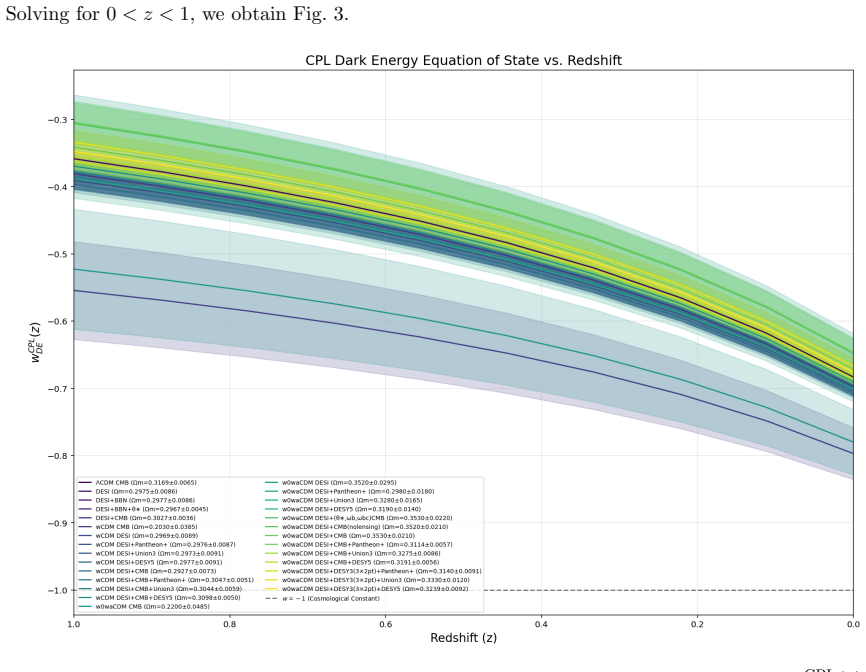
- Within the approximation, the CPL form with $w_0 = -1 + \Omega_m$ and $w_a = 3\Omega_m(1-\Omega_m)$ reproduces the model's evolution for $0 < z < 1$ and can be compared directly with DESI fits.
Reading between the lines
- If the exact Eq. (18) is used instead of the matter-neglected approximation, a flat $\Lambda$CDM $H(z)$ yields $w_{\mathrm{DE}} = -1$ exactly, so the paper's deviation may be an artifact of dropping $8\pi G\rho_m$ below $z \approx 1$; testing that drop is the natural next step.
- The same machinery could be applied to non-flat models, interacting dark sectors, or evolving matter densities; each choice of $H(z)$ produces a different inferred $w_{\mathrm{DE}}(z)$, so the method is more a mapping from expansion history to equation of state than a prediction of a specific dark energy model.
- A direct observational falsifier would be to reconstruct $w_{\mathrm{DE}}(z)$ from combined geometric probes at $z < 1$ without assuming $\Lambda$CDM $H(z)$; if the reconstructed value at $z=0$ is compatible with $-1$ at the few-percent level, the claimed deviation disappears.
Editorial analysis
A structured set of objections, weighed in public.
Referee Report
Summary. The paper claims to derive the dark-energy equation of state w_DE(z) from the Friedmann equations and, using the flat ΛCDM Hubble rate H(z), obtains w_DE(z) ≈ -1 + Ωm(1+z)^3/[Ωm(1+z)^3 + 1 - Ωm]. From this it derives w0 = -1 + Ωm and wa = 3Ωm(1-Ωm), compares these with DESI DR2 CPL constraints, and concludes that w_DE(0) ≈ -0.7 is a statistically significant deviation from ΛCDM. The manuscript asserts that dark energy is dynamical today while asymptotically approaching w=-1, avoiding phantom behaviour.
Significance. If the central claim were correct, a model with only Ωm as input would predict a present-day dark-energy equation of state w0 ≈ -0.7 and a specific CPL slope wa ≈ 0.6, which would be a striking and falsifiable result. However, the central claim is internally inconsistent with the paper's own exact equations: Eq. (30) is not the dark-energy equation of state but the total effective equation of state of flat ΛCDM, and the exact Eq. (18) yields w_DE = -1 when the same ΛCDM H(z) is inserted. The 'predictions' in Eqs. (35) and (38) are deterministic reparametrizations of the Ωm priors taken from DESI, so the comparison to DESI is circular rather than an independent test. The paper is transparent about the limitation immediately after Eq. (30), but then proceeds to use the mislabelled quantity as its main prediction. No new data, code, or machine-checked derivation is provided. The paper therefore does not establish dynamical dark energy.
major comments (3)
- [§2, Eqs. (18), (22), (30)] The central claim that Eq. (30) gives the dark-energy equation of state is not supported. Eq. (18) is exact for a flat universe with pressureless matter plus dark energy. Inserting the flat ΛCDM H(z) of Eq. (25), one has Hdot = -4πG ρm(z) and 3H^2/(8πG) = ρm(z) + ρΛ, so the numerator of Eq. (18) equals -ρΛ and the denominator equals ρΛ; hence w_DE = -1 exactly at every redshift. Eq. (22) follows from Eq. (18) only after dropping the 8πGρm term in the denominator, which requires ρDE >> ρm. At z ≲ 1, matter is not negligible (Ωm ≈ 0.3), so this step is invalid. The manuscript itself states after Eq. (30) that the formula 'does not represent the dark energy equation of state in a general cosmology' and instead represents what one would infer for w_DE in a universe with a cosmological constant. Indeed, Eq. (30) is exactly the total effective equation of state w_tot = -ρΛ/(ρm+ρΛ) = -1 + Ωm(z) for flat ΛCDM. The claimed deviation w0 = -1 + Ωm ≈ -0.7 is therefore an artifact of the dropped denominator term, not a prediction about dark energy.
- [§3, Eqs. (35), (38), Table 3] The quantities presented as predictions, w0 = -1 + Ωm and wa = 3Ωm(1-Ωm), are deterministic functions of the Ωm priors taken from DESI in Table 1. Comparing these functions with DESI's CPL constraints is comparing a reparametrization of the input prior with the same dataset, not an independent model test. The claim in Section 3 that 'the majority of best-fit curves across all models and datasets converge around wDE(0) ≈ -0.7' is also not supported by Table 3, whose entries span roughly -0.648 to -0.797 depending on the model and dataset. For example, the DESI-only wCDM row gives w0 = -0.916 ± 0.078 in Table 1, while Eq. (35) with the same Ωm prior gives -0.703 ± 0.009; this difference is not a small scatter but a dataset/model dependence that the paper does not address.
- [§3, Eq. (39), Figs. 3–4] The comparison with DESI CPL constraints is not quantitatively supported. For Ωm ≈ 0.3, Eq. (39) gives wa ≈ +0.6, whereas the DESI w0waCDM constraints in Table 1 have wa negative for most combinations, e.g., -0.62 ± 0.22 for DESI+CMB+Pantheon+. The paper acknowledges a mismatch Δw ≈ 0.1-0.2 at z ≈ 0.5 but provides no likelihood or significance calculation demonstrating agreement; a model whose wa has the opposite sign from the best-fit data cannot be described as consistent with those fits. The 'statistically significant deviation' claim in Section 3 is likewise unsupported because the error bars quoted in Table 3 merely propagate the Ωm prior uncertainties and do not represent a test against the ΛCDM hypothesis.
minor comments (4)
- [§2, Eq. (7)] Equation (7) is algebraically inconsistent with Eq. (8): solving Eq. (7) as written gives w = -1 - 2Hdot/H^2, not w = -1 - 2Hdot/(3H^2). The correct intermediate relation is Hdot = -(3H^2/2)(1+w) for the total fluid, which does lead to Eq. (8). Please correct the factor in Eq. (7).
- [§2, Eq. (13)] The signs of the pm and pr terms in Eq. (13) appear incorrect. From the acceleration equation, p_DE = -(2Hdot + 3H^2)/(8πG) - pm - pr. The plus signs shown in Eq. (13) give the wrong result for a mixture of radiation and a cosmological constant, although the error does not affect the later analysis because radiation is neglected and pm = 0 for pressureless matter.
- [Abstract and Eq. (33)] The CPL parametrization is written inconsistently: the abstract has w(z) = -1 + wa/(1+z), while the standard form used in Eq. (33) is w(z) = w0 + wa z/(1+z). Please ensure the same definition is used throughout; the abstract formula is missing the w0 term and the redshift factor.
- [References] Reference [4] is cited for the CPL parametrization, but [4] is a later test of CPL by Linden and Virey. The original parametrization should be credited to Chevallier and Polarski (2001) and Linder (2003), which are already listed as references [6] and [7].
Circularity Check
Claimed w_DE deviation is the total effective EOS of ΛCDM relabeled as dark energy, with w0 and wa deterministic functions of the DESI Ωm priors.
-
self definitional
[Section 2, Eqs. (19), (22), (30)]
"For the dark energy dominated and matter negligible case ρDE > ρm, we have at late time for z <1: wDE = −1 − 2 ˙H/3H^2 . ... wDE(z) = −1 + 2(1+z)/3H(z) dH/dz . ... We can now approximate wDE for z ≲ 1: wDE(z) ≈ −1 + Ωm(1+z)^3/(Ωm(1+z)^3 + 1 − Ωm)."
Eq. (22) is Eq. (8), the equation of state of the total fluid, not of dark energy; it equals w_DE only if the matter term in the denominator of Eq. (18) is dropped. Substituting flat-ΛCDM H(z) into Eq. (22) gives Eq. (30), which is precisely the total effective equation of state of ΛCDM, w_eff = −Ω_Λ/[Ω_m(1+z)^3 + Ω_Λ]. Putting the same H(z) into the exact Eq. (18) returns w_DE = −1 identically. The claimed deviation of w_DE from −1 is therefore generated by the dropped matter term, i.e. by construction, not by the DESI data.
-
fitted input called prediction
[Section 3, Eqs. (34)–(35) and Table 3]
"We use (22) taking the Ωm priors provided by the DESI measurements and compute for various redshifts how our model deviates from ΛCDM. ... This gives us w0 = −1 + Ωm."
The 'prediction' w0 is simply the DESI Ωm prior shifted by −1; the claimed convergence around w0 ≈ −0.7 is just the input Ωm ≈ 0.3 rewritten. Comparing these w0 values to DESI CPL constraints on (w0, wa) is not an independent test but a re-parametrization of the same fitted parameter.
1 more flagged steps
-
fitted input called prediction
[Section 3, Eqs. (37)–(39), Fig. 4]
"Evaluating this expression at z = 0 yields dwDE/dZ |_{z=0} = 3Ωm(1 − Ωm) = wa."
wa is also a deterministic function of the DESI Ωm prior. The reconstructed CPL model, Eq. (39), has no free parameter other than Ωm; the plotted 'theoretical CPL' curves are a relabeling of the ΛCDM total-EOS formula evaluated at the DESI Ωm values. Agreement or disagreement with DESI w0–wa fits is therefore forced algebraically rather than constituting a falsifiable prediction of dynamical dark energy.
full rationale
The paper contains no load-bearing self-citation; the circularity is algebraic and definitional. The central derivation takes the total-fluid equation of state from Eq. (8), relabels it as the dark-energy equation of state in Eq. (22), and substitutes the flat-ΛCDM Hubble history. The resulting Eq. (30) is the total effective w of ΛCDM, not w_DE: for a cosmological constant, the exact dark-energy EOS from Eq. (18) remains −1. The paper even concedes this at Eq. (30): 'This formula does not represent the dark energy equation of state in a general cosmology. It represents what you would infer for w_DE(z), if you apply the formula derived for dark energy to a universe that has a cosmological constant w = −1,' before proceeding to use it as a prediction. The subsequent w0 = −1 + Ωm and wa = 3Ωm(1 − Ωm) are one-to-one functions of the DESI Ωm priors, so comparing them with DESI CPL constraints is comparing a re-parametrization of the input prior to the same data. The claimed statistically significant deviation of w0 from −1 is thus forced by the choice of formula and priors rather than derived from independent physics. Score 8 reflects that the central claim reduces by definition.
Assumptions & free parameters
free parameters (1)
- Omega_m (matter density parameter prior) =
0.203 to 0.357 across DESI DR2 model and dataset combinations (Table 1)
assumptions (7)
- standard math FLRW metric and Friedmann equations describe the background cosmology
- domain assumption Spatial flatness (k=0, Omega_K=0)
- domain assumption Radiation is negligible for z < 1
- domain assumption Perfect fluid with p = w rho
- domain assumption Energy conditions (NEC, WEC, SEC) are physical requirements
- domain assumption CPL parametrization is a faithful approximation for z < 1
- ad hoc to paper The matter term in Eq. (18) can be dropped for z < 1
Cite this review
Pith. "Pith review of Dynamical Dark Energy at Late Time $\Lambda$CDM." pith.science (2026). https://pith.science/paper/QIADUHEF
@misc{pith2026250518900,
  author       = {Pith},
  title        = {Pith review of: Dynamical Dark Energy at Late Time $\Lambda$CDM},
  year         = {2026},
  howpublished = {\url{https://pith.science/paper/QIADUHEF}},
  note         = {Machine review of arXiv:2505.18900}
}
abstract
We investigate the dynamical properties of dark energy through a detailed analysis of its equation of state parameter $w(z)$ as a function of redshift. We derive a general expression for $w(z)$ from the Friedmann-Lema\^itre-Robertson-Walker (FLRW) equations, establishing a direct relationship between the dark energy equation of state and the observable Hubble parameter $H(z)$ and its derivative. Using the relation $w(z) = -1 + \frac{2(1+z)}{3H(z)} \frac{dH}{dz}$, we develop an approximation method valid for $z \lesssim 1$ that accounts for the changing balance between matter and dark energy contributions to cosmic expansion. We compare our theoretical framework with recent observational data from the Dark Energy Spectroscopic Instrument (DESI) DR2, analysing how well the commonly used Chevallier-Polarski-Linder (CPL) parametrization $w(z) = -1 + w_a \frac{z}{1+z}$ captures the evolution of dark energy. Our results indicate that the dark energy equation of state exhibits a monotonic evolution with redshift, transitioning from deceleration to acceleration around $z \approx 0.7$. Notably, our predicted $w_{\mathrm{DE}}$ remains greater than $-1$ across all redshifts, avoiding phantom energy scenarios that would violate the null energy condition. This work demonstrates how precise measurements of the cosmic expansion history can constrain the nature of dark energy and provides a framework for testing dynamical dark energy models against current and future cosmological observations.
Figures


Figures from the paper (3 more)


Forward citations
Cited by 4 Pith papers
-
Simple quintessence models in light of DESI-BAO observations
Thawing quintessence with linear or quadratic potentials is favored over LambdaCDM only when the DESY5 supernova catalog is used; with Pantheon+ or Union3 the preference is mild.
-
Dynamical dark energy in the Bianchi Type-V Universe with DESI DR2 BAO, SNIa compilation and RSD measurements
Bianchi-V models with constant-w or CPL dynamical dark energy accommodate DESI DR2 + SNIa + RSD data and reduce H0/S8 tensions relative to flat ΛCDM, though BIC still prefers ΛCDM.
-
Topological defects as effective dynamical dark energy
A few percent domain-wall component gives a mild (Δχ² = -1.72) improvement over ΛCDM when fitting DESI DR2 BAO and DESY5 supernovae, but the evidence is inconclusive.
-
Comment on "Dynamical Dark Energy at Late Time $\Lambda$CDM"
Cline shows that Moffat and Thompson's apparent dynamical dark energy in Lambda-CDM comes from neglecting the matter density term in the equation of state formula.
Reference graph
Works this paper leans on
-
[1]
DESI DR2 Results II: Measurements of Baryon Acoustic Oscillations and Cosmological Constraints,
DESI Collaboration (M. Abdul-Karim, J. Aguilar, et al.), “DESI DR2 Results II: Measurements of Baryon Acoustic Oscillations and Cosmological Constraints,” arXiv preprint arXiv:2503.14738 [astro- ph.CO], 2025, 40 pages, 18 figures. doi:10.48550/arXiv.2503.14738
-
[2]
Validation of the DESI DR2 Ly α BAO Analysis Using Synthetic Datasets,
DESI Collaboration (L. Casas, H. K. Herrera-Alcantar, et al.), “Validation of the DESI DR2 Ly α BAO Analysis Using Synthetic Datasets,” arXiv preprint arXiv:2503.14741 [astro-ph.IM], 2025. Part of the DESI DR2 publication series. doi:10.48550/arXiv.2503.14741
-
[3]
Extended Dark Energy Analysis Using DESI DR2 BAO Measurements,
DESI Collaboration (K. Lodha, R. Calderon, et al.), “Extended Dark Energy Analysis Using DESI DR2 BAO Measurements,” arXiv preprint arXiv:2503.14743 [astro-ph.CO], 2025, 27 pages, 18 figures. Part of the DESI DR2 publication series. doi:10.48550/arXiv.2503.14743
-
[4]
A test of the CPL parameterization for rapid dark energy equation of state transitions,
S. Linden and J.-M. Virey, “A test of the CPL parameterization for rapid dark energy equation of state transitions,” Phys. Rev. D78, 023526 (2008), doi:10.1103/PhysRevD.78.023526, arXiv:0804.0389 [astro-ph]
arXiv 2008
-
[5]
Comparison of dynamical dark energy with ΛCDM in light of DESI DR2,
A. N. Ormondroyd, W. J. Handley, M. P. Hobson, and A. N. Lasenby, “Comparison of dynamical dark energy with ΛCDM in light of DESI DR2,” arXiv preprint arXiv:2503.17342 [astro-ph.CO], 2025. doi:10.48550/arXiv.2503.17342
-
[6]
Accelerating Universes with Scaling Dark Matter,
M. Chevallier and D. Polarski, “Accelerating Universes with Scaling Dark Matter,” Int. J. Mod. Phys. D 10, 213–224 (2001), doi:10.1142/S0218271801000822, arXiv:gr-qc/0009008
arXiv 2001
-
[7]
Exploring the Expansion History of the Universe,
E. V. Linder, “Exploring the Expansion History of the Universe,” Phys. Rev. Lett.90, 091301 (2003), doi:10.1103/PhysRevLett.90.091301, arXiv:astro-ph/0208512
arXiv 2003
-
[8]
M. Moresco, L. Pozzetti, A. Cimatti, R. Jimenez, C. Maraston, L. Verde, D. Thomas, A. Citro, R. Tojeiro, and D. Wilkinson, “A 6% measurement of the Hubble parameter at z ∼ 0.45: direct evidence of the epoch of cosmic re-acceleration,” Journal of Cosmology and Astroparticle Physics, vol. 2016, no. 05, p. 014, 2016, doi:10.1088/1475-7516/2016/05/014, arXiv:...
arXiv 2016
Show all 11 references
-
[9]
Mapping the Cosmological Expansion,
E. V. Linder, “Mapping the Cosmological Expansion,” Reports on Progress in Physics, vol. 71, no. 5, p. 056901, 2008, doi:10.1088/0034-4885/71/5/056901, arXiv:0801.2968 [astro-ph]
2008 arXiv
-
[10]
Testing General Relativity in Cosmology,
M. Ishak, “Testing General Relativity in Cosmology,” Living Reviews in Relativity, vol. 22, no. 1, 2019, doi:10.1007/s41114-018-0017-4
2019 doi
-
[11]
Cosmology in Extended Parameter Space with DESI DR2 BAO: A 2 σ+ Detection of Non-zero Neutrino Masses with an Update on Dynamical Dark Energy and Lensing Anomaly,
S. R. Choudhury, “Cosmology in Extended Parameter Space with DESI DR2 BAO: A 2 σ+ Detection of Non-zero Neutrino Masses with an Update on Dynamical Dark Energy and Lensing Anomaly,” arXiv preprint, arXiv:2504.15340 [astro-ph.CO], 2024, doi:10.48550/arXiv.2504.15340. 16
2024 doi
Reviewed August 7, 2026 · model on record in the stance chip above.
Discussion (0). Sign in to comment.