REVIEW 5 major objections 6 minor 3 cited by
ReinforceGen combines motion planning, imitation learning, and RL fine-tuning to solve five long-horizon manipulation tasks at 80% success using just 10 human demonstrations and visuomotor observations.
Reviewed by Pith at T0; open to challenge. T0 means a machine referee read the full paper against a public rubric. the ladder, T0–T4 →
T0 review · deepseek-v4-flash
2026-08-03 15:23 UTC pith:QIC7UZOD
load-bearing objection ReinforceGen is a credible incremental advance in hybrid planning/learning for manipulation, but the headline success numbers rest on hand-crafted termination conditions shared between RL reward and evaluation, so treat the 80% with some reserve. the 5 major comments →
ReinforceGen: Hybrid Skill Policies with Automated Data Generation and Reinforcement Learning
The pith
A machine-rendered reading of the paper's core claim, the machinery that carries it, and where it could break.
Core claim
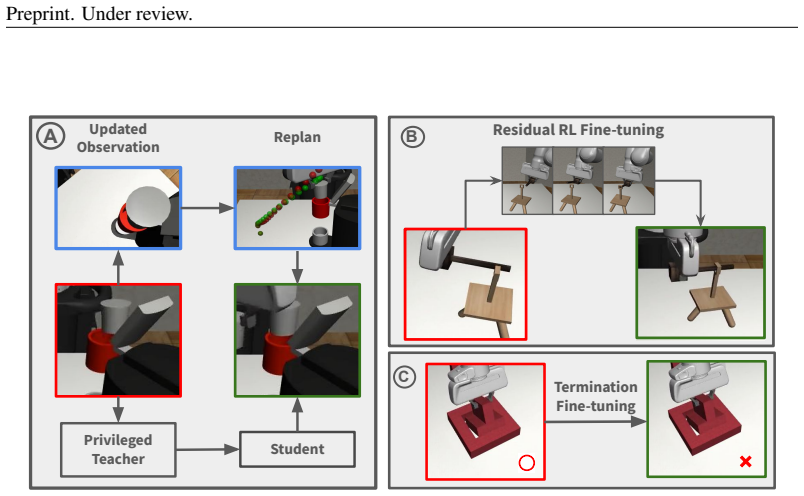
The paper's central claim is that an automated demonstration-generation system can be made to outperform its own source demonstrations by closing the loop with reinforcement learning. ReinforceGen starts from 10 human demos, adapts them into 1,000 demonstrations through object-centric pose transformation, and behavior-clones a hybrid skill policy. It then fine-tunes the policy's pose predictor, skill policy, and termination classifier with online data: the pose predictor is refined by replanning during execution and distilling from a privileged teacher; the skill policy is improved with residual RL using a 0-1 stage-success reward; and the termination classifier is hardened by rejecting low-
What carries the argument
The central object is the Hybrid Skill Policy (HSP), a sequence of parameterized skills ψθi = ⟨Iθi, πθi, Tθi⟩, where Iθi predicts the end-effector pose at which the skill must start, πθi controls the robot through the contact-rich segment, and Tθi decides when the stage is done. ReinforceGen's contribution is a fine-tuning pipeline for each piece: initiation poses are improved by re-predicting during motion planning and by distilling from a privileged teacher that knows true object poses; skill policies are refined with residual RL (DrQ-v2 outputting additive action corrections with a quadratic penalty on deviation from the base policy); and termination conditions are cleaned by multiplying
Load-bearing premise
The load-bearing premise is that the hand-crafted stage-termination conditions, with thresholds 'assigned by experience,' correctly identify when each subtask is truly done; if those thresholds are miscalibrated, the RL reward can push the agent toward spurious terminal states and the reported success rates can be inflated.
What would settle it
Re-run the five Robosuite tasks with the same pipeline but replace the hand-crafted stage terminations with exact ground-truth subtask checks (e.g., measured object-pose tolerances for each assembly step) as both the RL reward and the evaluation criterion. If overall success drops significantly below the reported 84.6%, the central claim depends on termination-threshold calibration rather than on the fine-tuning method.
If this is right
- Demonstration quality no longer caps agent performance: RL fine-tuning can discover behaviors that succeed where the source human demos fail, which addresses a key limitation of open-loop data generation.
- Visuomotor-only agents can match or slightly exceed state-informed baselines on these contact-rich benchmarks, suggesting that privileged object-pose estimation can be replaced by learned predictors plus online replanning.
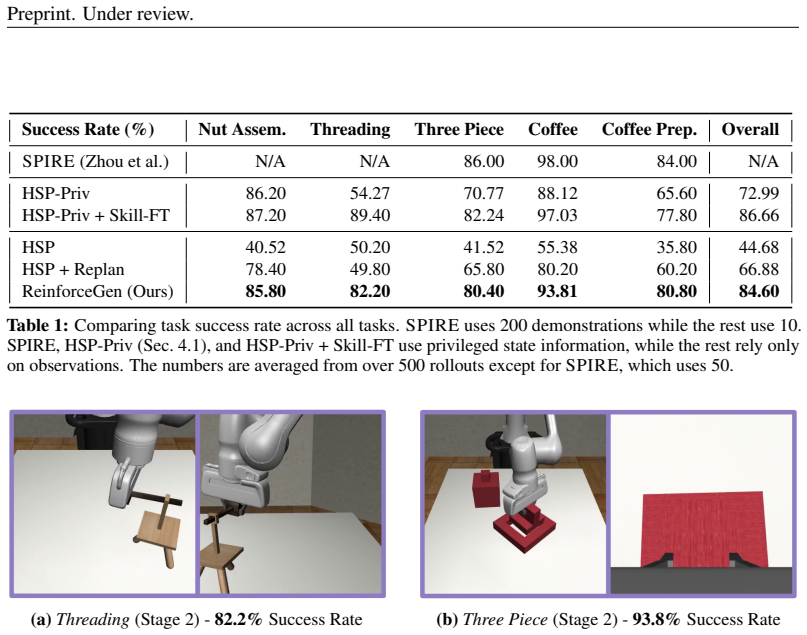
- Each fine-tuning component is independently valuable: adding real-time replanning to the baseline HSP raises overall success from 44.68% to 66.88%, and skill fine-tuning adds a further 24.41% on average.
- Termination fine-tuning repairs cross-stage causal failures: in Three Piece, rejecting premature stage terminations raises success from 72.60% to 82.24% after skill fine-tuning, showing stage-local success is not sufficient for task-level success.
- Hybrid policies can be distilled into end-to-end visuomotor policies, removing the need for a motion planner at deployment in tasks where the distilled policy does not suffer from lock-up during long-range transfers.
Where Pith is reading between the lines
- A testable extension is to apply the same per-component fine-tuning to skills without object-centric reference frames (e.g., sweeping granular media), where the paper itself expects its data generation to struggle; the termination-rejection mechanism may be even more valuable there because stage success is harder to specify.
- Because the performance numbers rely on hand-crafted stage terminations, an audit that replaces those thresholds with exact object-pose-based success verification would settle whether the 80% figures reflect true task completion or optimization toward the thresholds.
- The residual-RL-with-planner-reset recipe suggests a general design principle: decompose a long-horizon task into local skills, then fine-tune each skill only from the states the planner actually produces. This may transfer to other hierarchical planners beyond the Robosuite suite.
- The end-to-end distillation results imply the motion planner's role in ReinforceGen is primarily to generate clean training data and localize exploration; as distillation improves, the deploy-time reliance on a planner and collision model may shrink further.
Editorial analysis
A structured set of objections, weighed in public.
Referee Report
Summary. ReinforceGen is a system that starts from 10 human demonstrations per task, uses object-centric data generation (MimicGen-style) to create a 1,000-demo BC dataset, trains a Hybrid Skill Policy (HSP) composed of an initiation pose predictor, skill policy, and termination predictor, and then fine-tunes components with online replanning, distillation from a privileged teacher, residual RL, and termination rejection. On five Robosuite D2 tasks, the paper reports over 80% success on all tasks using visuomotor observations, roughly doubling the non-privileged HSP baseline (44.68% to 84.60%) and slightly exceeding privileged HSP-Priv (72.99%). It also provides ablations of replanning, skill fine-tuning, termination fine-tuning, and an end-to-end distillation study, plus detailed reproducibility materials (pseudocode, thresholds, hyperparameters, and per-stage fine-tuning usage).
Significance. If the reported numbers are trustworthy, ReinforceGen is a meaningful step toward bootstrapping long-horizon contact-rich manipulation from very few demonstrations. The strongest assets are the clean decomposition (planning + localized skills + RL fine-tuning), the explicit per-stage configuration table, and the falsifiable ablations: replanning alone lifts HSP from 44.68% to 66.88%, and skill fine-tuning adds substantial further gains. However, the headline result rests on hand-crafted stage terminations that also serve as the RL reward; the paper itself admits it lacks ground-truth terminations, so the 80% figure could be inflated by permissive thresholds. The comparison is also almost entirely against the authors' own prior HSP/SPIRE/MimicGen line, which is a completeness issue rather than circularity; an independent baseline would strengthen the claims. The paper is transparent about many limitations, which is a credit, but one abstract claim (real-world evaluation) has no supporting section in the manuscript.
major comments (5)
- [Sec. 4.2-4.3, Sec. 5 (Table 1)] The success rates in Table 1 are computed with the same hand-crafted stage terminations T_i that provide the RL reward (r_i(s)=[s in T_i], Sec. 4.2). Sec. 4.3 first states "We opt to use ground-truth termination in training" and then immediately concedes "we do not have access to the actual 'ground-truth' terminations. Instead, we use hand-crafted conditions... which inevitably introduces inaccuracies." Sec. 5 confirms: "We use hand-crafted stage terminations in our evaluations for all hybrid policies." Since false positives "can be exploited in RL training," the reward and evaluation share a potentially biased signal, so Table 1 may count rollouts as successful that did not truly complete the task. The learned termination predictor (Table 3) inherits the same labels via Eq. (3). Please validate against an independent task-completion oracle (e.g., Robosuite's task-level success checks or
- [App. B] The paper claims evaluation on the D2 (largest initialization range) tasks but then reduces the Nut Assembly x-range to (-0.15, 0.15) "since the original range produces unreachable initial positions." If the prior HSP/HSP-Priv numbers in Table 1 (or those in Garrett et al. 2024) used the full D2 range, the Nut Assembly comparison is not apples-to-apples. Please state the range used by each baseline, rerun baselines under the reduced range, or present full-range results separately.
- [Sec. 5 (Evaluation setup), Table 6] The evaluation "partially disable[s] fine-tuning on stages that already have high baseline success rates," and Table 6 shows many stages without skill or termination fine-tuning (e.g., Coffee stage 1, Nut Assembly stages 1 and 4, Coffee Preparation stage 1). The headline ReinforceGen results therefore correspond to a selective application of the proposed method, making it harder to attribute the gains to the full pipeline. Please either run all stages through all proposed fine-tuning components or provide per-stage saturation evidence to justify the selective usage.
- [Abstract vs. body] The abstract states ReinforceGen "demonstrates significant improvement through fine-tuning in our real-world evaluations." No real-world experiment appears in the main text or appendices; there is no task, setup, protocol, or quantitative result. This claim is unsupported as written. Either add a real-world experiment section or remove the sentence from the abstract.
- [Sec. 5.3, Table 4, Contribution #4] The contribution "train proficient end-to-end imitation agents with ReinforceGen" is contradicted by Table 4: the ReinforceGen-distilled policy is worse than the HSP-Priv-distilled policy on Nut Assembly (28.0 vs 35.0) and Three Piece (18.6 vs 20.2), and Sec. 5.3 concedes "both agents struggle." Please temper the claim to reflect the two tasks where distillation is effective, or provide additional evidence and analysis for the other two.
minor comments (6)
- [Table 1] Report standard errors or 95% confidence intervals; with over 500 rollouts this is inexpensive and would help readers judge the significance of reported gains.
- [Abstract] "Additional ablation studies show that our fine-tuning approaches contribute to an 89% average performance increase" is misleading: the 89% is the relative gain of full ReinforceGen over HSP in Table 1, while the ablation in Table 2 shows a 24.41% average gain. Rephrase.
- [Sec. 3.1] Typo: "deducted" should be "derived".
- [Table 1] SPIRE is not a matched baseline (200 demos vs 10, and N/A for two tasks); add a footnote to prevent direct comparison.
- [Table 3] "Oracle Termination" overstates the status of the hand-crafted state thresholds; rename to "Hand-crafted Termination" or similar, since Sec. 4.3 admits they are not ground truth.
- [Table 2] Table 2 omits Coffee Preparation even though skill fine-tuning is applied to that task (Table 6); include it or explain the omission.
Circularity Check
Headline success rate is defined by the same hand-crafted stage terminations used as the RL reward; reported absolute success reduces to reward optimization.
specific steps
-
self definitional
[Sec. 4.2 reward definition; Sec. 4.3 termination caveat; Sec. 5 evaluation setup]
"The 0-1 reward function r_i(s) := [s∈ T_i] is determined by the ground-truth termination condition T_i ... In reality, we do not have access to the actual “ground-truth” terminations. Instead, we use hand-crafted conditions with thresholds assigned by experience, which inevitably introduces inaccuracies. ... We use hand-crafted stage terminations in our evaluations for all hybrid policies despite it requiring state information."
The quantity reported as task success in Table 1 is the same hand-crafted stage-termination predicate T_i that is used as the RL reward: r_i(s) := [s∈T_i]. By construction, a policy trained to maximize this reward is scored as successful exactly when it satisfies the reward predicate; no independent task-completion check is applied. The paper concedes in Sec. 4.3 that T_i is not ground truth and that false positives can be exploited in RL training. The learned termination predictor in Table 3 does not break this circularity, since it is trained on labels derived from the same hand-crafted terminations. Thus the absolute 80% claim measures reward optimization rather than verified task completion.
full rationale
The central circularity is in the evaluation metric rather than in the method's internal learning loop. A policy that optimizes r_i(s)=[s∈T_i] is then rated by that same T_i, so the headline success rate is self-definitional with respect to the reward. The paper itself flags that these are hand-crafted, inaccurate proxies, strengthening the reduction. I did not find further constructional circularity: the pose distillation from a privileged teacher, residual RL fine-tuning, and end-to-end distillation are not defined in terms of their own outputs; self-citations to HSP/SPIRE are ordinary prior work and are not load-bearing for the derivation. The relative comparisons and ablations (e.g., HSP vs. HSP+Replan vs. ReinforceGen) are still meaningful under a shared metric, which is why the score is not higher. However, the paper's headline absolute success-rate claim is not independent of the optimized objective.
Axiom & Free-Parameter Ledger
free parameters (5)
- Replanning threshold epsilon =
0.05
- Termination rejection threshold epsilon_term =
0.4
- Residual RL regularization coefficient alpha =
5.0
- Nut Assembly x-range reduction =
(-0.15, 0.15)
- End-to-end distillation action noise sigma =
0.01
axioms (5)
- domain assumption The stage sequence and per-stage reference objects R_i are annotated by a human for each task.
- domain assumption Object-centric transformation of source trajectories (MimicGen) produces valid demonstrations in new object poses.
- domain assumption The hand-crafted termination conditions T_i approximate ground-truth subgoal completion.
- domain assumption The privileged teacher predictor I_Priv provides a correct initiation pose from object states.
- domain assumption The motion planner's collision model (observed point cloud) is sufficient for planning connect segments.
read the original abstract
Long-horizon manipulation has been a long-standing challenge in the robotics community. We propose ReinforceGen, a system that combines task decomposition, data generation, imitation learning, and motion planning to form an initial solution, and improves each component through reinforcement-learning-based fine-tuning. ReinforceGen first segments the task into multiple localized skills, which are connected through motion planning. The skills and motion planning targets are trained with imitation learning on a dataset generated from 10 human demonstrations, and then fine-tuned through online adaptation and reinforcement learning. When benchmarked on the Robosuite dataset, ReinforceGen reaches 80% success rate on all tasks with visuomotor controls in the highest reset range setting. Additional ablation studies show that our fine-tuning approaches contribute to an 89% average performance increase. Finally, ReinforceGen demonstrates significant improvement through fine-tuning in our real-world evaluations. More results and videos are available at https://reinforcegen.github.io.
Figures





Forward citations
Cited by 3 Pith papers
-
MoRI: Mixture of RL and IL Experts for Long-Horizon Manipulation Tasks
MoRI dynamically mixes RL and IL experts with variance-based switching and IL regularization to reach 97.5% success in four real-world robotic tasks while cutting human intervention by 85.8%.
-
ExpertGen: Scalable Sim-to-Real Expert Policy Learning from Imperfect Behavior Priors
ExpertGen generates high-success expert policies in simulation from imperfect priors by freezing a diffusion behavior model and optimizing its initial noise via RL, then distills them for real-robot deployment.
-
HumanoidMimicGen: Data Generation for Loco-Manipulation via Whole-Body Planning
HumanoidMimicGen automatically generates large loco-manipulation datasets from few source demonstrations using whole-body planning, enabling visuomotor policies that outperform real-data-only training by 20% on a new ...
Reference graph
Works this paper leans on
-
[5]
Chengshu Li, Mengdi Xu, Arpit Bahety, Hang Yin, Yunfan Jiang, Huang Huang, Josiah Wong, Sujay Garlanka, Cem Gokmen, Ruohan Zhang, et al. Momagen: Generating demonstrations under soft and hard constraints for multi-step bimanual mobile manipulation. InRSS 2025 Workshop on Whole-body Control and Bimanual Manipulation: Applications in Humanoids and Beyond. 1...
Pith/arXiv arXiv 2025
-
[7]
Tom Silver, Kelsey R. Allen, Joshua B. Tenenbaum, and Leslie Pack Kaelbling. Residual policy learning.ArXiv, abs/1812.06298,
-
[8]
Bradly C. Stadie, Sergey Levine, and P. Abbeel. Incentivizing exploration in reinforcement learning with deep predictive models.ArXiv, abs/1507.00814,
-
[9]
Chen Tang, Ben Abbatematteo, Jiaheng Hu, Rohan Chandra, Roberto Martín-Martín, and Peter Stone
URLhttps://arxiv.org/pdf/2310.17274. Chen Tang, Ben Abbatematteo, Jiaheng Hu, Rohan Chandra, Roberto Martín-Martín, and Peter Stone. Deep reinforcement learning for robotics: A survey of real- world successes.Annual Review of Control, Robotics, and Autonomous Systems, 8 (V olume 8, 2025):153–188,
Pith/arXiv arXiv 2025
-
[10]
doi: https://doi.org/10.1146/ annurev-control-030323-022510
ISSN 2573-5144. doi: https://doi.org/10.1146/ annurev-control-030323-022510. URL https://www.annualreviews.org/content/ journals/10.1146/annurev-control-030323-022510. Haoran Tang, Rein Houthooft, Davis Foote, Adam Stooke, Xi Chen, Yan Duan, John Schulman, Filip De Turck, and P. Abbeel. #exploration: A study of count-based exploration for deep reinforceme...
-
[11]
Zhengrong Xue, Shuying Deng, Zhenyang Chen, Yixuan Wang, Zhecheng Yuan, and Huazhe Xu
URL https: //api.semanticscholar.org/CorpusID:250088882. Zhengrong Xue, Shuying Deng, Zhenyang Chen, Yixuan Wang, Zhecheng Yuan, and Huazhe Xu. Demogen: Synthetic demonstration generation for data-efficient visuomotor policy learning.arXiv preprint arXiv:2502.16932,
-
[12]
11 Preprint. Under review. Denis Yarats, Rob Fergus, Alessandro Lazaric, and Lerrel Pinto. Mastering visual continuous control: Improved data-augmented reinforcement learning.arXiv preprint arXiv:2107.09645,
-
[14]
Yuke Zhu, Josiah Wong, Ajay Mandlekar, and Roberto Martín-Martín
URL https://openreview.net/forum? id=cvUXoou8iz. Yuke Zhu, Josiah Wong, Ajay Mandlekar, and Roberto Martín-Martín. robosuite: A modular simulation framework and benchmark for robot learning. InarXiv preprint arXiv:2009.12293,
Pith/arXiv arXiv 2009
-
[16]
(Fig. 6). We use the largest initiation range version (D2) for all tasks. The only exception isNut Assembly, where we reduce the x-range of the nuts placement to (−0.15,0.15) since the original range produces unreachable initial positions. (a)Coffee (2 stages) (b)Threading (2 stages) (c)Nut Assembly (4 stages) (d)Three Piece Assembly (4 stages) (e)Coffee ...
2024
-
[2018]
Openvla: An open-source vision-language-action model.arXiv preprint arXiv:2406.09246,
Moo Jin Kim, Karl Pertsch, Siddharth Karamcheti, Ted Xiao, Ashwin Balakrishna, Suraj Nair, Rafael Rafailov, Ethan Foster, Grace Lam, Pannag Sanketi, Quan Vuong, Thomas Kollar, Benjamin Burchfiel, Russ Tedrake, Dorsa Sadigh, Sergey Levine, Percy Liang, and Chelsea Finn. Openvla: An open-source vision-language-action model.arXiv preprint arXiv:2406.09246,
-
[2020]
Under review
12 Preprint. Under review. A OVERVIEW • Appendix B shows the details of the benchmark task set. • Appendix C lists the details to reproduce our results. • Appendix D includes additional experiment results. • Appendix E includes additional implementation details. 13 Preprint. Under review. B TASKS We choose the five tasks from Robosuite (Zhu et al., 2020; ...
2020
-
[2021]
Language to rewards for robotic skill synthesis.Arxiv preprint arXiv:2306.08647,
Wenhao Yu, Nimrod Gileadi, Chuyuan Fu, Sean Kirmani, Kuang-Huei Lee, Montse Gonzalez Arenas, Hao-Tien Lewis Chiang, Tom Erez, Leonard Hasenclever, Jan Humplik, Brian Ichter, Ted Xiao, Peng Xu, Andy Zeng, Tingnan Zhang, Nicolas Heess, Dorsa Sadigh, Jie Tan, Yuval Tassa, and Fei Xia. Language to rewards for robotic skill synthesis.Arxiv preprint arXiv:2306.08647,
-
[2022]
Ashvin Nair, Bob McGrew, Marcin Andrychowicz, Wojciech Zaremba, and P. Abbeel. Overcoming exploration in reinforcement learning with demonstrations.2018 IEEE International Conference on Robotics and Automation (ICRA), pp. 6292–6299,
2018
-
[2023]
Imitating task and motion planning with visuomotor transformers.arXiv preprint arXiv:2305.16309,
Murtaza Dalal, Ajay Mandlekar, Caelan Garrett, Ankur Handa, Ruslan Salakhutdinov, and Di- eter Fox. Imitating task and motion planning with visuomotor transformers.arXiv preprint arXiv:2305.16309,
-
[2024]
Diffusion policy: Visuomotor policy learning via action diffusion.arXiv preprint arXiv:2303.04137,
Cheng Chi, Siyuan Feng, Yilun Du, Zhenjia Xu, Eric Cousineau, Benjamin Burchfiel, and Shu- ran Song. Diffusion policy: Visuomotor policy learning via action diffusion.arXiv preprint arXiv:2303.04137,
-
[2025]
Residual reinforcement learning for robot control.2019 International Conference on Robotics and Automation (ICRA), pp
Tobias Johannink, Shikhar Bahl, Ashvin Nair, Jianlan Luo, Avinash Kumar, Matthias Loskyll, Juan Aparicio Ojea, Eugen Solowjow, and Sergey Levine. Residual reinforcement learning for robot control.2019 International Conference on Robotics and Automation (ICRA), pp. 6023–6029,
2019
discussion (0)
Sign in with ORCID, Apple, or X to comment. Anyone can read and Pith papers without signing in.