REVIEW 4 major objections 5 minor 22 references
Learning Interactive Behaviors for Musculoskeletal Robots Using Bayesian Interaction Primitives
T0 review · 4 major / 5 minor · reviewed 2026-08-14 · deepseek-v4-flash
Pith's one-line read Bayesian Interaction Primitives, trained on 108 demonstrations, let a musculoskeletal robot with no analytical model produce handshakes that adapt in real time to new positions, speeds, and partners.
desk verdict First real-time BIP on a musculoskeletal robot with a clever teaching protocol; the application is credible but the evaluation lacks a replay baseline. read the letter →
The pith
A machine-rendered reading of the paper's core claim, the machinery that carries it, and where it could break.
The reading
What carries the argument
The central object is the Bayesian Interaction Primitive, a probabilistic latent-variable model in which an interaction is the time series of $D$ sensor dimensions written as a weighted sum of Gaussian basis functions of a phase variable $\phi(t)$. The state is augmented to $s=[\phi,\dot{\phi},w]$, where $w$ collects the basis weights; a recursive filter with a constant-velocity phase model propagates and updates this state given partial human observations, yielding simultaneous estimates of temporal phase, phase velocity, and the latent interaction weights. The learned cross-covariance between human and robot weight dimensions is what lets the robot generate its side of the interaction from the human's motion alone. An equally load-bearing piece of machinery is the training protocol: because the musculoskeletal robot cannot be kinesthetically taught, demonstrations are collected by letting the robot execute a fixed open-loop hand-crafted pressure trajectory while the human adapts, and BIP captures the human-robot correlation from those pairings.
What would settle it
Track the robot's end-effector position with an external motion-capture or vision system during BIP handshakes with participants who never trained the model, and require the robot's hand to physically converge to each participant's chosen endpoint; if the robot's physical hand does not converge across new partners and endpoints, the spatial-generalization claim fails. A second check: have a participant deliberately move their hand in a non-handshake trajectory, such as a fast upward swipe, and observe whether the robot still produces a sensible response; a method that truly estimates interaction phase and weights should not confidently execute a handshake on out-of-distribution input.
Extended reading notes
Core claim
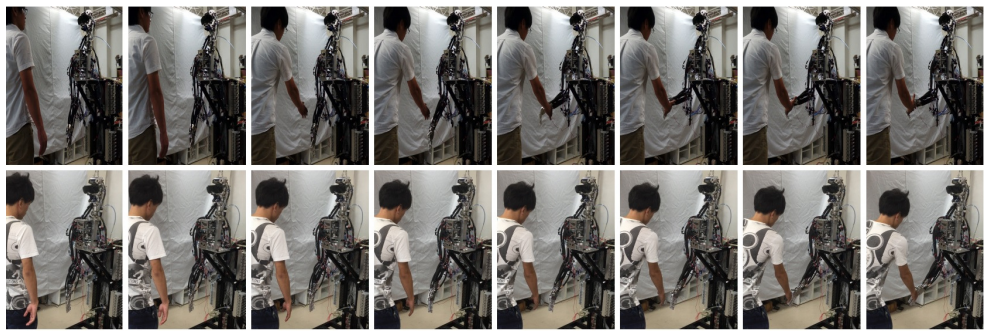
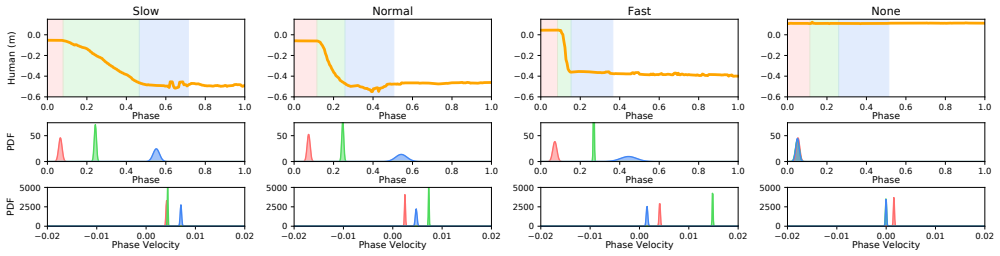
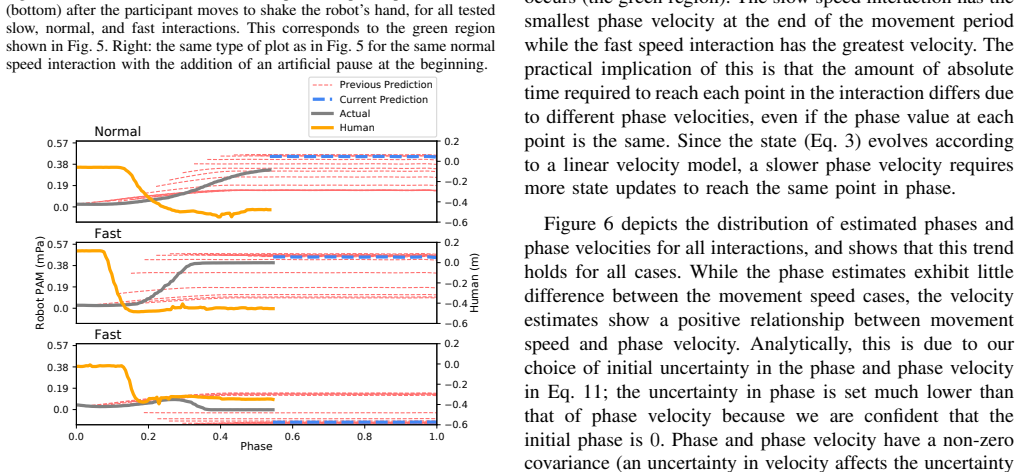
On the paper's own terms, the discovery is that the correlation between a human partner's observed hand trajectory and the pressure trajectories of a musculoskeletal robot's pneumatic actuators, learned from demonstrations, is enough to drive a physical interactive behavior in real time. BIP represents each demonstration as a weighted combination of basis functions over an internal phase variable, so that trajectory shape is decoupled from its speed; the latent weights, phase, and phase velocity are estimated online with a recursive linear state-space filter. At each update, the robot receives a full response trajectory from the current phase to the end, which is smoothed by an alpha-beta filter before being sent to the PID pressure controllers. In experiments, the resulting handshake adapts spatially to different endpoints, temporally to fast, normal, and slow speeds and to an artificial pause, and it generalizes to five participants who never trained the model; the only scenario where BIP did not outperform the static baseline was for participants who had already trained, where the static and BIP completion times were statistically indistinguishable. The paper also states the approach's limitations: it ignores control lag and mechanical constraints, so predicted pressures may be unreachable by the physical system.
Load-bearing premise
The approach rests on the assumption that the human-robot correlation learned while the robot repeats a fixed open-loop script and the human matches it still holds when the robot actively responds to a human's self-chosen motion, so that the learned responses are not just interpolations of the scripted trajectories.
Editorial extensions
If this is right
- Robots with no analytical model and no joint encoders can still acquire interactive skills from a relatively small number of demonstrations, as long as the correlations between interaction partners are captured.
- Interactive behaviors can be made temporally adaptive: the same latent model covers fast, normal, slow, and even zero-velocity interactions by adjusting the estimated phase velocity rather than reshaping the trajectory.
- The approach generalizes to interaction partners unseen in training, so a single set of demonstrations can serve a population of users.
- Because no inverse kinematics or dynamics model is used, the approach is not tied to this particular robot's geometry.
- The reported Time-to-Completion results suggest that an actively responding robot converges to steady-state interaction faster than one executing a pre-scripted trajectory, for naive users.
Reading between the lines
- If the core result transfers, the same BIP machinery could be applied to other physical human-robot interactions such as handovers, co-assembly, or guided motion, as long as matched demonstrations of one observable partner and the other partner's actuation setpoints can be collected.
- The paper's spatial-generalization claim could be made directly testable by adding external tracking of the robot end-effector, which the current pressure-only measurement cannot provide.
- Because training has the human adapt to a fixed robot script, the learned correlation may be biased toward that script; an alternative test would train on demonstrations where the human leads and the robot follows, and check whether the same latent model still produces interactive responses.
- The phase-velocity adaptation suggests a diagnostic: plotting estimated phase velocity against human hand speed across many participants could reveal whether BIP's temporal generalization is scale-invariant or limited to the speed range seen in training.
Signed reviews
Editorial analysis
A structured set of objections, weighed in public.
Referee Report
Summary. The paper applies Bayesian Interaction Primitives (BIP) to a musculoskeletal robot with 27 pneumatic artificial muscles, using a handshake task as the test scenario. The robot has no analytical model, so the authors collect demonstrations in which the robot executes manually crafted open-loop pressure trajectories while human participants adapt their hand motion to the robot. BIP learns a joint distribution over human hand position (3 DoF) and robot pressure setpoints (27 DoF) in a latent basis-function space, and at run time uses an extended Kalman filter to estimate the phase, phase velocity, and latent weights from partial observations of the human, generating pressure trajectories at 3 Hz. Experiments with three training participants and five additional participants compare BIP against static open-loop handshake trajectories across fast, normal, slow, and no-movement conditions. The paper reports qualitative evidence of spatial and temporal generalization, phase/phase-velocity estimation results, correlation analyses, and a quantitative Time-to-Completion comparison in Table I. The authors conclude that BIP can successfully generate responsive, legible handshakes on a musculoskeletal robot and generalizes to new partners, endpoints, and speeds.
Significance. If the empirical claims are sustained, this is a valuable demonstration: BIP provides a way to generate reactive, real-time behaviors for a compliant musculoskeletal robot for which no analytical model exists, using only demonstration data. The paper's strengths are the physical robot experiments with eight participants, the explicit treatment of temporal adaptation including an artificial-pause and no-movement edge case, the analysis of phase and phase-velocity uncertainty, and the honest acknowledgment of limitations such as control lag and unmodeled mechanical constraints. The use of held-out participants for the generalization claim is also a positive design choice. However, the central quantitative evidence rests on a proxy metric whose thresholds were chosen post hoc, and the training protocol couples human motion to scripted robot trajectories in a way that has not been separated from a simple replay-interpolation explanation. The significance of the contribution therefore depends on additional baselines and more rigorous reporting of the experimental parameters.
major comments (4)
- [Section III-C and Section IV-A] The training demonstrations are collected while the robot executes a fixed open-loop trajectory and the human is instructed to match the robot. The learned joint distribution over human and robot basis weights may therefore be dominated by the correlation between human motion and the scripted robot trajectories. At test time, conditioning on a human trajectory can produce a robot trajectory that behaves like a phase- and endpoint-warped interpolation of the 12 scripted training trajectories. To support the claim that BIP learns a responsive interaction policy rather than a replay mechanism, the authors should compare against a non-learning baseline that replays the most similar training trajectory with a phase or temporal rescaling, and report the same quantitative metrics for that baseline in Table I.
- [Section IV-B3, Table I] The Time-to-Completion thresholds are stated to be 'chosen such that all scenarios yield a completion time.' This makes the primary quantitative comparison potentially circular: trajectories that never reach steady state are excluded by construction, and the mean differences between BIP and static trajectories may reflect the threshold tuning rather than interaction quality. The authors should report the raw convergence times, the number of trajectories that reach completion under fixed thresholds, a sensitivity analysis over threshold values, and statistical comparisons with appropriate correction for multiple comparisons.
- [Section III-B, Eqs. (4), (6), (11)] The filter's behavior depends critically on the values of the process noise Q_t, measurement noise R_t, and initial covariance Sigma_0, as well as on the basis-function parameters, but these values are not reported. This prevents reproduction of the phase and phase-velocity estimates in Figures 5 and 6 and of the real-time response trajectories. The authors should provide the exact matrices or a sensitivity analysis. In addition, Eq. (4) is not written consistently: the bottom-right block is shown as a scalar 1, but for a state vector containing the full weight vector it should be a covariance matrix, and the process noise for the weights is otherwise unspecified.
- [Section IV-B3 and Section V] The quantitative support for generalization to new interaction partners is weaker than the qualitative figures suggest. In Table I, the NT (non-trained) subset has lower mean Time-to-Completion under BIP in most conditions, but there is no per-participant analysis, no confidence intervals, and no comparison of effect sizes across conditions. Because the metric itself is a proxy for physical interaction quality and the thresholds were tuned, the claim that BIP 'generalizes to new human partners' should be supported by more detailed per-participant results, including distributions of completion times rather than only means and variances.
minor comments (5)
- [Section IV-A] The units are reported as 'mPa'; given that the robot's pressure sensors and PID controllers typically operate in MPa, the authors should clarify whether this is millipascal or megapascal, and use consistent notation throughout.
- [Figures 5 and 6] The PDF labels on the phase and phase-velocity plots do not specify what distribution is being shown or what normalization is used; adding axis labels with units and a description of the kernel/estimation window would improve interpretability.
- [Table I] The green and gray cell formatting is not self-explanatory in the text-only version; the authors should include explicit p-values or significance markers, and report the Mann-Whitney U test results with a multiple-comparison correction.
- [References] Reference [4] is cited as 'To Appear'; the authors should update the citation with the published venue and details, since the current manuscript relies on this prior work for the core filter derivation.
- [Section IV-B2, Figure 6] The artificial-pause experiment is described only briefly; reporting the duration of the inserted pause and the number of trials would make the recovery behavior easier to interpret.
Circularity Check
No significant circularity; the empirical generalization claims are evaluated on held-out participants and conditions and do not reduce to fitted inputs.
full rationale
The paper's central claim is that Bayesian Interaction Primitives can generate real-time, spatially and temporally adaptive handshakes on a musculoskeletal robot and generalize to new human partners, endpoints, and speeds. This claim is supported by experiments with eight test participants, five of whom did not contribute training demonstrations, and by a no-movement edge case. The BIP algorithm is described explicitly in Section III with Kalman-filter equations, and the prior parameters are computed from demonstrations (Eqs. 9-11); the robot response at run time is the result of Bayesian inference conditioned on live human observations, not a restatement of a fitted value. Although the BIP framework is cited to the authors' prior work [4], the load-bearing validation here is the physical robot experiment, not the self-citation. The open-loop training protocol described in Section III-C means that the learned conditional could conceivably act as a time-warped replay of scripted trajectories, but that is a generalizability/identifiability concern rather than circularity: no predicted quantity is equal by construction to a fitted parameter, and no alternative is ruled out by a self-cited uniqueness theorem. The paper's stated limitations (control lag and physical constraints) further indicate that the evaluation is empirical rather than tautological. Therefore, no specific circular step can be identified from the paper's equations or claims.
Assumptions & free parameters
free parameters (5)
- Time-to-Completion variance thresholds =
0.001 m (human), 0.001 mPa (robot)
- Process noise covariance Q_t =
not specified
- Measurement noise covariance R_t =
not specified
- Initial covariance phase and phase-velocity variances in Sigma_0 =
not specified; phase variance set much lower than phase-velocity variance
- Number of basis functions per degree of freedom B_d =
15
assumptions (4)
- domain assumption Interaction trajectories are representable as weighted sums of Gaussian basis functions in phase, with i.i.d. Gaussian noise.
- domain assumption Phase and phase velocity evolve according to a linear constant-velocity model with Gaussian process noise.
- domain assumption The interaction satisfies the Markov property with Gaussian state and observation noise, so recursive linear state-space filtering applies.
- ad hoc to paper Demonstrations recorded while the human adapts to a fixed open-loop robot trajectory are representative of natural interactive handshakes.
Cite this review
Pith. "Pith review of Learning Interactive Behaviors for Musculoskeletal Robots Using Bayesian Interaction Primitives." pith.science (2026). https://pith.science/paper/QIJY6ABH
@misc{pith2026190805552,
  author       = {Pith},
  title        = {Pith review of: Learning Interactive Behaviors for Musculoskeletal Robots Using Bayesian Interaction Primitives},
  year         = {2026},
  howpublished = {\url{https://pith.science/paper/QIJY6ABH}},
  note         = {Machine review of arXiv:1908.05552}
}
read the original abstract
Musculoskeletal robots that are based on pneumatic actuation have a variety of properties, such as compliance and back-drivability, that render them particularly appealing for human-robot collaboration. However, programming interactive and responsive behaviors for such systems is extremely challenging due to the nonlinearity and uncertainty inherent to their control. In this paper, we propose an approach for learning Bayesian Interaction Primitives for musculoskeletal robots given a limited set of example demonstrations. We show that this approach is capable of real-time state estimation and response generation for interaction with a robot for which no analytical model exists. Human-robot interaction experiments on a 'handshake' task show that the approach generalizes to new positions, interaction partners, and movement velocities.
Figures


Figures from the paper (7 more)




Reference graph
Works this paper leans on
-
[1]
Mckibben artificial muscles: pneumatic actuators with biomechanical intelli- gence,
G. K. Klute, J. M. Czerniecki, and B. Hannaford, “Mckibben artificial muscles: pneumatic actuators with biomechanical intelli- gence,” in Advanced Intelligent Mechatronics, 1999. Proceedings. 1999 IEEE/ASME International Conference on . IEEE, 1999, pp. 221–226
work page 1999
-
[2]
A seven-degrees- of-freedom robot-arm driven by pneumatic artificial muscles for humanoid robots,
B. Tondu, S. Ippolito, J. Guiochet, and A. Daidie, “A seven-degrees- of-freedom robot-arm driven by pneumatic artificial muscles for humanoid robots,” The International Journal of Robotics Research , vol. 24, no. 4, pp. 257–274, 2005
work page 2005
-
[3]
Proxy-based sliding mode control of a planar pneumatic manipulator,
M. Van Damme, B. Vanderborght, B. Verrelst, R. Van Ham, F. Daer- den, and D. Lefeber, “Proxy-based sliding mode control of a planar pneumatic manipulator,” The International Journal of Robotics Re- search, vol. 28, no. 2, pp. 266–284, 2009
work page 2009
-
[4]
Bayesian interaction primitives: A slam approach to human-robot interaction,
J. Campbell and H. Ben Amor, “Bayesian interaction primitives: A slam approach to human-robot interaction,” in To Appear: Proceedings of the 1st Conference on Robot Learning (CoRL) , pp. 1–9
-
[5]
Interaction primitives for human-robot cooperation tasks,
H. B. Amor, G. Neumann, S. Kamthe, O. Kroemer, and J. Peters, “Interaction primitives for human-robot cooperation tasks,” inRobotics and Automation (ICRA), 2014 IEEE International Conference on . IEEE, 2014, pp. 2831–2837
work page 2014
-
[6]
Learning interaction for collaborative tasks with prob- abilistic movement primitives,
G. Maeda, M. Ewerton, R. Lioutikov, H. B. Amor, J. Peters, and G. Neumann, “Learning interaction for collaborative tasks with prob- abilistic movement primitives,” in Humanoid Robots (Humanoids), 2014 14th IEEE-RAS International Conference on . IEEE, 2014, pp. 527–534
work page 2014
-
[7]
Application of rubber artificial muscle manipulator as a rehabilitation robot,
T. Noritsugu and T. Tanaka, “Application of rubber artificial muscle manipulator as a rehabilitation robot,” IEEE/ASME Transactions On Mechatronics, vol. 2, no. 4, pp. 259–267, 1997
1997
-
[8]
Development and control of a soft-actuatedexoskeleton for use in physiotherapy and training,
N. G. Tsagarakis and D. G. Caldwell, “Development and control of a soft-actuatedexoskeleton for use in physiotherapy and training,” Autonomous Robots , vol. 15, no. 1, pp. 21–33, 2003
work page 2003
Show all 22 references
-
[9]
Computational human- robot interaction,
A. Thomaz, G. Hoffman, M. Cakmak, et al. , “Computational human- robot interaction,” F oundations and Trends R© in Robotics , vol. 4, no. 2-3, pp. 105–223, 2016
2016
-
[10]
Anthropo- morphic musculoskeletal 10 degrees-of-freedom robot arm driven by pneumatic artificial muscles,
A. Hitzmann, H. Masuda, S. Ikemoto, and K. Hosoda, “Anthropo- morphic musculoskeletal 10 degrees-of-freedom robot arm driven by pneumatic artificial muscles,” Advanced Robotics, vol. 32, no. 15, pp. 865–878, 2018
2018
-
[11]
Static and dynamic characteristics of mckibben pneumatic artificial muscles,
C.-P. Chou and B. Hannaford, “Static and dynamic characteristics of mckibben pneumatic artificial muscles,” in Proceedings of the 1994 IEEE international conference on robotics and automation . IEEE, 1994, pp. 281–286
1994
-
[12]
Direct teaching method for musculoskeletal robots driven by pneumatic artificial muscles,
S. Ikemoto, Y . Nishigori, and K. Hosoda, “Direct teaching method for musculoskeletal robots driven by pneumatic artificial muscles,” in Robotics and Automation (ICRA), 2012 IEEE International Conference on. IEEE, 2012, pp. 3185–3191
2012
-
[13]
Cas- caded control concept of a robot with two degrees of freedom driven by four artificial pneumatic muscle actuators,
A. Hildebrandt, O. Sawodny, R. Neumann, and A. Hartmann, “Cas- caded control concept of a robot with two degrees of freedom driven by four artificial pneumatic muscle actuators,” in Proceedings of the 2005, American Control Conference, 2005. IEEE, 2005, pp. 680–685
2005
-
[14]
Robot program- ming by demonstration,
A. Billard, S. Calinon, R. Dillmann, and S. Schaal, “Robot program- ming by demonstration,” in Springer handbook of robotics . Springer, 2008, pp. 1371–1394
2008
-
[15]
A survey of robot learning from demonstration,
B. D. Argall, S. Chernova, M. Veloso, and B. Browning, “A survey of robot learning from demonstration,” Robotics and autonomous systems, vol. 57, no. 5, pp. 469–483, 2009
2009
-
[16]
Dynamic movement primitives-a framework for motor control in humans and humanoid robotics,
S. Schaal, “Dynamic movement primitives-a framework for motor control in humans and humanoid robotics,” in Adaptive motion of animals and machines . Springer, 2006, pp. 261–280
2006
-
[17]
Learning multiple collaborative tasks with a mixture of interaction primitives,
M. Ewerton, G. Neumann, R. Lioutikov, H. B. Amor, J. Peters, and G. Maeda, “Learning multiple collaborative tasks with a mixture of interaction primitives,” in Robotics and Automation (ICRA), 2015 IEEE International Conference on . IEEE, 2015, pp. 1535–1542
2015
-
[18]
Incremental learning of full body motion primitives and their sequencing through human motion observation,
D. Kuli ´c, C. Ott, D. Lee, J. Ishikawa, and Y . Nakamura, “Incremental learning of full body motion primitives and their sequencing through human motion observation,” The International Journal of Robotics Research, vol. 31, no. 3, pp. 330–345, 2012
2012
-
[19]
Learning physical collaborative robot behaviors from human demon- strations,
L. Rozo, S. Calinon, D. G. Caldwell, P. Jimenez, and C. Torras, “Learning physical collaborative robot behaviors from human demon- strations,” IEEE Transactions on Robotics, vol. 32, no. 3, pp. 513–527, 2016
2016
-
[20]
Thrun, W
S. Thrun, W. Burgard, and D. Fox, Probabilistic robotics. MIT press, 2005
2005
-
[21]
Legibility and predictability of robot motion,
A. D. Dragan, K. C. Lee, and S. S. Srinivasa, “Legibility and predictability of robot motion,” in Proceedings of the 8th ACM/IEEE international conference on Human-robot interaction . IEEE Press, 2013, pp. 301–308
2013
-
[22]
Trajectories of human multi-joint arm movements: Evidence of joint level planning,
J. R. Flanagan and D. J. Ostry, “Trajectories of human multi-joint arm movements: Evidence of joint level planning,” in Experimental Robotics I . Springer, 1990, pp. 594–613
1990
Reviewed August 14, 2026 · model on record in the stance chip above.
Discussion (0). Continue with ORCID to comment.