REVIEW 2 major objections 6 minor 18 cited by
Cosmological implications of DESI DR2 BAO measurements in light of the latest ACT DR6 CMB data
T0 review · 2 major / 6 minor · reviewed 2026-08-16 · deepseek-v4-flash
Pith's one-line read This paper argues that DESI's evidence for evolving dark energy—about 3 sigma with CMB data and above 4 sigma when supernovae are added—survives the inclusion of the ACT DR6 measurements, and that a Planck+ACT combination gives the…
desk verdict A careful, transparent robustness check that confirms DESI DR2's evolving-dark-energy preference survives ACT DR6 at about 3 sigma, with the tightest neutrino limit still conditional on the cut-based Planck+ACT splice. read the letter →
The pith
A machine-rendered reading of the paper's core claim, the machinery that carries it, and where it could break.
The reading
What carries the argument
The argument runs on the two-parameter dark-energy equation of state $w(a) = w_0 + w_a(1-a)$, with the cosmological constant represented by $(w_0, w_a) = (-1, 0)$, combined with a multipole-cut recipe that joins Planck and ACT power spectra without modeling an inter-survey covariance: Planck supplies $\ell < 2000$ temperature and $\ell < 1000$ polarization, ACT supplies the higher multipoles up to $\ell = 8500$. The cut recipe matters because the value of the cold-dark-matter density $\Omega_{\mathrm{cdm}} h^2$ that the CMB combination returns controls how far the dark-energy contours are pulled from $\Lambda$CDM; ACT alone measures $\Omega_{\mathrm{cdm}} h^2$ higher than Planck and is over $3\sigma$ inconsistent with DESI, while the combined datasets land at a lower $\Omega_{\mathrm{cdm}} h^2$ that is only about $2\sigma$ from DESI, which is what keeps the evolving-dark-energy preference alive.
What would settle it
Recompute the baseline fit with a modeled Planck–ACT cross-survey covariance, or vary ACT's polarization-efficiency calibration within its quoted uncertainty, and check whether the inferred cold-dark-matter density $\Omega_{\mathrm{cdm}} h^2$ shifts enough to move the $w_0w_a$CDM significance below $2\sigma$; a direct version is an independent higher-precision measurement of $\Omega_{\mathrm{cdm}} h^2$ that lands closer to ACT's high value than to the combined PR4+ACT value.
Extended reading notes
Core claim
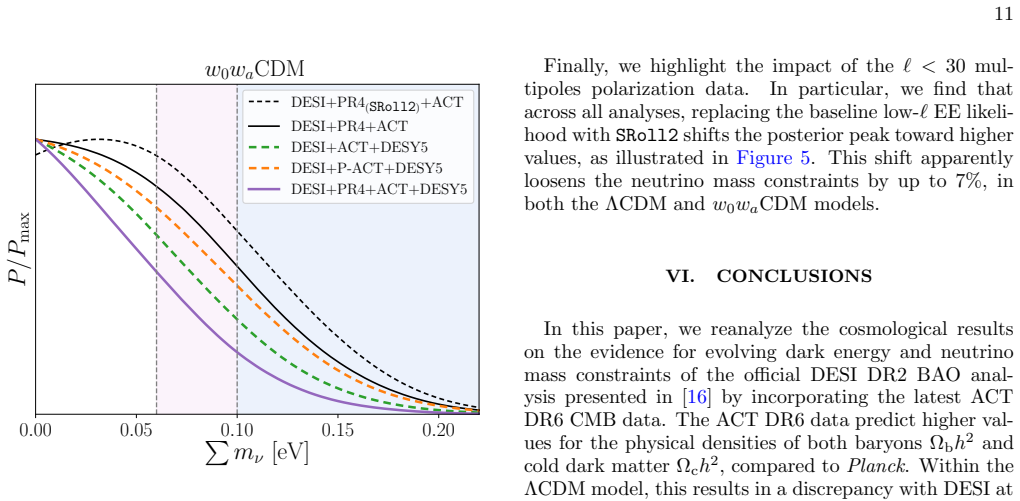
In the $w_0w_a$CDM parameterization, $w(a) = w_0 + w_a(1-a)$, the baseline CMB combination—Planck PR4 for multipoles below $\ell = 2000$ in temperature and $\ell = 1000$ in polarization, ACT DR6 above those cuts—shifts DESI's dark-energy constraint to a $3.0\sigma$ preference for $(w_0, w_a)$ away from $(-1, 0)$, and to $2.8\sigma$, $3.7\sigma$, and $4.2\sigma$ when Pantheon+, Union3, and DESY5 supernova samples are added. Across all tested Planck+ACT cut schemes the dark-energy significance changes by at most $0.3\sigma$, which is the basis for the authors' conclusion that the DESI DR2 results are robust in light of the new ACT data. The neutrino-mass bound is more fragile: under $\Lambda$CDM with a physical $\sum m_\nu > 0$ prior it ranges from $\sum m_\nu < 0.061$ eV for the baseline combination to $0.077$ eV for the ACT-preferred P-ACT combination, and the low-multipole polarization likelihood choice can relax limits by up to 7%. These are reported as the tightest BAO+CMB-only neutrino-mass constraints to date.
Load-bearing premise
The paper's central results depend on the assumption that Planck and ACT can be combined by simply cutting each data set to non-overlapping angular scales and treating the two measurements as independent, with no shared calibration error or correlated noise between them.
Editorial extensions
If this is right
- If the central claim is right, the DESI DR2 dark-energy hint is not an artifact of outdated CMB data: adding ACT to Planck keeps the preference for varying dark energy near $3\sigma$, and above $4\sigma$ when Union3 or DESY5 supernovae are included.
- The multipole-cut Planck+ACT combination sharpens CMB parameter constraints by roughly 14% on the scalar spectral index and 23% on the baryon density compared with Planck alone, so future BAO+CMB analyses can expect modest gains from this combination style.
- The tightest BAO+CMB-only neutrino-mass bound becomes $\sum m_\nu < 0.061$ eV at 95% confidence under $\Lambda$CDM, about 5% tighter than the DESI DR2 baseline.
- The neutrino-mass result is the fragile part: the 95% upper limit ranges from 0.061 to 0.077 eV depending on which Planck+ACT combination and low-$\ell$ polarization likelihood is used.
- The positive-neutrino-mass preference seen in DESI+CMB data disappears when supernovae are added, in both the Bayesian posterior and the profile-likelihood analysis.
Reading between the lines
- Going beyond the paper: a full covariance between Planck and ACT, including their shared sky fraction and correlated calibration noise, could move $\Omega_{\mathrm{cdm}} h^2$ by more than the cut-choice spread the paper sees, and that could in turn shift the $3\sigma$ dark-energy significance beyond the $0.3\sigma$ variation reported here.
- The cut locations are not determined by a formal optimization, so a fair test of the robustness claim would be to scan the temperature and polarization cut positions and map how the $w_0w_a$CDM significance responds; the paper tests two cut schemes, but the surface between them is unexplored.
- Because the dark-energy preference tracks $\Omega_{\mathrm{cdm}} h^2$, a higher-precision independent measurement of that density—from small-scale CMB data or from large-scale structure—would either corroborate the evolving-dark-energy interpretation or locate the systematic in the CMB combination.
Signed reviews
Editorial analysis
A structured set of objections, weighed in public.
Referee Report
Summary. The paper combines DESI DR2 BAO measurements with the ACT DR6 CMB likelihood and several Planck PR3/PR4 likelihoods, spliced at multipole cuts, to test whether the DESI DR2 dark-energy and neutrino-mass conclusions survive the inclusion of ACT. The baseline DESI+PR4+ACT combination prefers w0waCDM over LambdaCDM at about 3.0 sigma without supernovae and up to 4.2 sigma with DESY5 supernovae; across CMB combinations the preference ranges from 2.4 to 3.0 sigma (2.5 to 4.2 sigma with SNe). The same analysis yields sum m_nu < 0.061 eV at 95% CL in LambdaCDM for the baseline combination, compared with < 0.077 eV for the P-ACT combination. The authors conclude that the DESI DR2 results are robust to the inclusion of ACT DR6, while noting that the neutrino-mass constraints are sensitive to the CMB likelihood combination and to the physical prior sum m_nu > 0.
Significance. The paper is a timely and useful cross-check of a high-impact cosmological claim, and it is transparent about the main choices and limitations: several Planck+ACT splice rules are compared, the prior-dependence of the neutrino bound is studied with a profile likelihood in Appendix B, and the dataset variations are clearly tabulated. If the results hold, the 0.061 eV bound is the tightest BAO+CMB neutrino-mass limit reported to date, and the persistence of the w0waCDM preference across CMB combinations strengthens the DESI DR2 evidence. The analysis is not circular: the dark-energy significance comes from fitting external data, and the ACT-based check is a genuine robustness test. The main caveat is that the spliced CMB likelihood contains no cross-survey covariance or relative calibration term, so the headline robustness claim is conditional on that approximation being unbiased.
major comments (2)
- [Section II, Table I, Appendix A] The baseline PR4+ACT combination is constructed by splicing independent Planck PR4 and ACT DR6 likelihoods at hard multipole cuts, and Section II states that this is done 'without modeling a covariance between the surveys.' All of the headline numbers (the 3.0 sigma w0waCDM preference and the 0.061 eV neutrino bound) come from this spliced likelihood, and the central conclusion that the DESI DR2 results are robust to ACT is a statement about the stability of those numbers. Appendix A and Section V show that the inferred Omega_ch2 and the neutrino upper limit shift with the cut choice (0.061 vs 0.077 eV; a 1.4 sigma vs 2.0 sigma DESI tension), so an unmodeled relative calibration error or inter-survey covariance at the roughly 0.5 sigma level in Omega_ch2 could move the baseline 3.0 sigma significance below the conventional threshold. A quantitative robustness test, for example marginalizing over a relative calibration amplitude or adding an inter-survey covariance term, is needed before the 'robust' conclusion can be regarded as fully load-bearing.
- [Section V and Appendix B] The neutrino-mass limits are prior-dominated rather than central measurements. Appendix B reports profile-likelihood minima of mu0 = -0.036 eV for DESI+PR4 and mu0 = -0.038 eV for DESI+ACT-lite in LambdaCDM, i.e., in the unphysical negative region, so the Bayesian 95% upper limits quoted in the abstract (0.061-0.077 eV) are intersections of a downward-sloping profile with the prior boundary at sum m_nu = 0. The paper states this caveat in Section V and Appendix B, but the abstract and the Section VI discussion do not carry the same qualification, and the phrase 'tightest constraints on the total neutrino mass to date' overstates the robustness of a prior-boundary limit. The abstract and conclusions should be reworded, and the profile-likelihood values in Table IV should be referenced alongside the Bayesian limits so that readers can see the prior dependence directly.
minor comments (6)
- [Abstract and Section III] The abstract says the ACT-only tension with DESI 'exceeds 3 sigma,' but Section III reports 2.7 sigma with CMB lensing and 3.2 sigma without it; please clarify that the 'exceeding 3 sigma' statement refers to the no-lensing ACT-only configuration.
- [Table II] The 'Significance' column would benefit from a footnote stating that the n-sigma values are obtained from Delta chi^2 assuming two additional degrees of freedom for w0waCDM relative to LambdaCDM, or from a direct citation of the definition in Ref. [29], so that readers can reproduce the conversion.
- [Section IV] The statement that 'the errors on w0 and wa remain unchanged compared to P-ACT' should specify that this refers to the 68% uncertainties in Table III, because the contours in Figure 2 have different shapes for DESI+ACT.
- [Appendix B] Appendix B uses ACT-lite instead of the full MFLike likelihood; this is disclosed in a footnote, but the main text of Section V should mention that the profile-likelihood check is approximate so that readers do not mistake it for a full-likelihood result.
- [Abstract and Table II] The abstract's phrase 'increasing to over 4 sigma with the inclusion of Type Ia supernova data' is only literally true for DESY5; Pantheon+ gives 2.8 sigma and Union3 gives 3.7 sigma for the baseline PR4+ACT combination, so the wording should be 'up to over 4 sigma' or 'for the DESY5 sample.'
- [Figure 6 caption] The phrase 'contain more information from ACT' is slightly misleading because those combinations also differ in the Planck multipole range; rephrase to 'use ACT over a wider multipole range' for precision.
Circularity Check
No significant circularity: the w0waCDM preference is an output from independent ACT+Planck+DESI fits, not an input.
full rationale
The paper's central claim is that the DESI DR2 BAO preference for evolving dark energy is robust when the latest ACT DR6 CMB data are included. The derivation chain is a standard likelihood analysis: published DESI DR2 BAO measurements, ACT DR6 spectra, Planck PR3/PR4 likelihoods, and external SNe samples are combined under explicit multipole cuts; the w0waCDM posterior and its significance versus ΛCDM are then outputs of fresh Monte Carlo fits. No target result is inserted into the inputs: the DESI DR2 BAO data are reused as data, not as a summary of the evolving-dark-energy conclusion, and the ACT data are external to the analysis being tested. The citations to the DESI collaboration's [16] provide the BAO measurements, prior choices, and tension metrics, but the paper recomputes all constraints, including the 3.0σ baseline significance, rather than importing them. The choice of the PR4+ACT baseline is motivated by precision comparisons from ACT [31], not by the w0wa result, and alternative cuts are explicitly tested. The admitted limitation that Planck and ACT are spliced without modeling inter-survey covariance affects the robustness of the headline significance but is a modeling caveat, not a circular step. Accordingly, no self-definitional, fitted-input-as-prediction, or self-citation-driven reduction of the central claim is exhibited.
Assumptions & free parameters
free parameters (4)
- Omega_ch2 (physical cold dark matter density) =
about 0.120 to 0.125 depending on CMB combination (Figure 6)
- w0 (CPL dark energy equation of state parameter) =
about -0.43 +/- 0.21 for DESI+PR4+ACT (Table III)
- wa (CPL dark energy slope parameter) =
about -1.68 +/- 0.58 for DESI+PR4+ACT (Table III)
- Sum of neutrino masses (Sigma m_nu) =
95% upper limit <0.0606 eV for DESI+PR4+ACT, <0.0768 eV for DESI+P-ACT
assumptions (5)
- domain assumption The universe is spatially flat.
- domain assumption The CPL parameterization w(a)=w0+wa(1-a) captures possible dark energy evolution.
- domain assumption Planck and ACT DR6 likelihoods are statistically independent after multipole cuts.
- domain assumption The sum of neutrino masses obeys the physical prior Sigma m_nu > 0 eV, with three degenerate states.
- domain assumption The published noise models, covariances, and calibrations of DESI BAO, Planck, and ACT DR6 likelihoods are correct as provided.
Cite this review
Pith. "Pith review of Cosmological implications of DESI DR2 BAO measurements in light of the latest ACT DR6 CMB data." pith.science (2026). https://pith.science/paper/QK4KAIWB
@misc{pith2026250418464,
  author       = {Pith},
  title        = {Pith review of: Cosmological implications of DESI DR2 BAO measurements in light of the latest ACT DR6 CMB data},
  year         = {2026},
  howpublished = {\url{https://pith.science/paper/QK4KAIWB}},
  note         = {Machine review of arXiv:2504.18464}
}
abstract
We report cosmological results from the Dark Energy Spectroscopic Instrument (DESI) measurements of baryon acoustic oscillations (BAO) when combined with recent data from the Atacama Cosmology Telescope (ACT). By jointly analyzing ACT and Planck data and applying conservative cuts to overlapping multipole ranges, we assess how different Planck+ACT dataset combinations affect consistency with DESI. While ACT alone exhibits a tension with DESI exceeding 3$\sigma$ within the $\Lambda$CDM model, this discrepancy is reduced when ACT is analyzed in combination with Planck. For our baseline DESI DR2 BAO+Planck PR4+ACT likelihood combination, the preference for evolving dark energy over a cosmological constant is about 3$\sigma$, increasing to over 4$\sigma$ with the inclusion of Type Ia supernova data. While the dark energy results remain quite consistent across various combinations of Planck and ACT likelihoods with those obtained by the DESI collaboration, the constraints on neutrino mass are more sensitive, ranging from $\sum m_\nu < 0.061$ eV in our baseline analysis, to $\sum m_\nu < 0.077$ eV (95\% confidence level) in the CMB likelihood combination chosen by ACT when imposing the physical prior $\sum m_\nu>0$ eV.
Figures


Figures from the paper (4 more)



Forward citations
Cited by 18 Pith papers
-
DESI DR2 Results IV: Alcock-Paczy\'nski Measurements from the Lyman Alpha Forest and Cosmological Constraints
The full shape of DESI DR2 Lyman-alpha forest correlations constrains the distance ratio DM/DH at z=2.33 to 1.0%, twice as precise as BAO alone.
-
Measuring Cosmic Neutrino Masses Independently of Dark Energy
Two dark-energy-robust cosmological routes bound ∑mν to <0.152 eV (marginalized) and <0.41 eV (late-Universe-free), with the latter independent of tested w(a) models by construction.
-
Cosmological Concordance in an Especially Opaque Universe: A Tentative Cosmological Detection of Physical Neutrino Mass in $\Lambda$CDM
Imposing a high prior on τ = 0.11 ± 0.006 produces a 2σ positive neutrino mass sum of 0.10 eV and restores concordance between CMB and DESI data inside ΛCDM.
-
Sound Mode and Scale-Dependent Growth in Two-Fluid Dynamical Dark Energy
DDE sound modes induce scale-dependent growth and halo bias comparable to massless neutrinos; multi-tracer P+B forecasts detect it for c_s^{2} ~ 10^{-2}–10^{-4}, while lower speeds produce ~10% drag on cluster growth-...
-
Reanalyzing DESI DR1: 4. Percent-Level Cosmological Constraints from Combined Probes and Robust Evidence for the Normal Neutrino Mass Hierarchy
A combined-analysis of DESI galaxy clustering, CMB lensing, BAO, CMB, and supernovae yields percent-level Lambda-CDM parameters, improved dark-energy figure-of-merit, and neutrino-mass bounds that disfavor the inverte...
-
Rapid late-time reionization: constraints and cosmological implications
Reionization is inferred to be rapid and late (midpoint z≈7, duration Δz50≈1.1), yielding an optical depth τ=0.0492 from Lyman-alpha + BAO + BBN, independent of CMB data.
-
Cosmological neutrino mass: a frequentist overview in light of DESI
A frequentist profile-likelihood analysis of DESI, Planck, ACT, and eBOSS Lyman-alpha data yields Σmν < 53 meV (95% C.L.) in flat ΛCDM and a CMB-independent bound of 285 meV.
-
Quantum stress-energy at timelike boundaries: testing a new beyond-$\Lambda$CDM parameter with cosmological data
Timelike boundaries sourcing negative, 1/a-scaling vacuum energy fit CMB+BAO data slightly better than LCDM and relax the neutrino-mass constraint, though the preference is only about 2 sigma.
-
Baryon Acoustic Oscillations from a Different Angle
Using rotated BAO coordinates, DESI DR2 distance measurements are consistent with Planck LCDM, and the reported 3.1 sigma evidence for evolving dark energy is attributed to statistical methodology and prior choices.
-
Impact of CMB low-$\ell$ EE polarization data on dark energy parameterizations
Removing Planck's low-ℓ EE polarization data shifts A_s and τ_reio upward and makes three dark-energy parameterizations look more quintessence-like, with model-selection evidence depending on the dataset and prior.
-
Probing non-unitarity of the PMNS matrix in P2SO and comparison with DUNE
Projected GLoBES sensitivities show DUNE constrains the non-unitarity parameters α11 and |α21| better, while P2SO wins on α33 (and marginally α22); non-unitarity also distorts mass-hierarchy, octant, and CP-violation ...
-
The BAO-CMB Tension and Implications for Inflation
The upward shift in the scalar spectral index n_s in CMB+BAO analyses is driven by the combined effects of a known CMB degeneracy and the tension between CMB and DESI BAO data, not by new information about n_s itself.
-
Bayesian and frequentist perspectives agree on dynamical dark energy
Frequentist profile-likelihood constraints on the CPL dark-energy parameters w0 and wa agree with Bayesian posteriors across DESI, CMB, and SN datasets, corroborating the evidence for dynamical dark energy.
-
On the tension between DESI DR2 BAO and CMB
A approximately 2 sigma tension between DESI DR2 BAO and CMB is confirmed with two Bayesian metrics, and a simple argument shows that dynamical dark energy resolving it must cross the phantom divide near z=0.45.
-
It's All ${\tt Ok}$: Curvature in Light of BAO from DESI DR2
DESI and CMB data jointly prefer a small negative spatial curvature, which would ease the BAO-CMB tension and can be tested with future high-redshift surveys.
-
Challenging $\Lambda$CDM: 5$\sigma$ Evidence for a Dynamical Dark Energy Late-Time Transition
Fitting a step transition in dark energy's equation of state to Planck+DESI DR2+DESY5 data gives a reported ~5 sigma preference for a phantom-to-quintessence transition at z about 0.49.
-
Implicit Likelihood Inference of the Neutrino Mass Hierarchy from Cosmological Data
A simulation-based neural-likelihood analysis of Planck 2018 and DESI DR2 data reports a weak preference (tilde_Delta = 0.12, 68% CL interval spanning both signs) for the normal neutrino mass hierarchy.
-
Looking beyond lambda
A perspective piece argues that LambdaCDM is showing cracks and that cosmologists should prepare for a beyond-LambdaCDM era with more complex dark energy models.
Reference graph
Works this paper leans on
-
[16]
it was pointed out that DESI DR2 BAO data show a discrepancy of 2.3σ with PR4. It is interesting to assess how this discrepancy stands with the latest CMB spectra from ACT, which provide precision measurements of the small-scale CMB anisotropies in temperature and polar- ization, as well as tight constraints on the CMB damping tail. At the cosmological pa...
-
[1]
BAO data DESI DR2 BAO measurements from DESI DR2 in the range 0.1<z <4.2 [16, 19]
-
[2]
SNe Ia data Pantheon+ A compilation of 1550 spectroscopically-confirmed SNe Ia in the range 0.001<z <2.26 [34]. Union3 A compilation of 2087 SNe-Ia (among which 1363 SNe Ia are common to Pantheon+) that were analyzed through an updated Bayesian framework [35]. DESY5 A compilation of 1635 SNe Ia in the redshift range 0.10<z <1.13 complemented by an externa...
-
[3]
low-ℓ EESimAll Planck2018 PR3 low-ℓ SimAlllikelihood for EE in the range 2≤ℓ< 30 [37, 38]
CMB standalone likelihoods (including CMB lensing) low-ℓ TT Planck2018 PR3 low-ℓ Commanderlikelihood for TT in the range 2≤ℓ< 30 [37, 38]. low-ℓ EESimAll Planck2018 PR3 low-ℓ SimAlllikelihood for EE in the range 2≤ℓ< 30 [37, 38]. low-ℓ EESRoll2 Alternative low-ℓ likelihood for EE based on theSRoll2code in the range 2≤ℓ< 30 [39]. high-ℓ PR3 PlanckPR3Plikli...
-
[4]
Main CMB combinations ACT low-ℓ EESRoll2+ ACT DR6 + CMB lensing P-ACT low-ℓ TT + low-ℓ EESRoll2+ high-ℓ PR3 (ℓ< 1000 TT,ℓ< 600 TE, EE) + ACT DR6 + CMB lensing PR4+ACT low-ℓ TT + low-ℓ EESimAll+ high-ℓ PR4 (ℓ< 2000 TT,ℓ< 1000 TE, EE) + ACT DR6 (ℓ≥2000 TT,ℓ≥1000 TE, EE) + CMB lensing
work page 2000
-
[5]
Summary of the primary data sets (1-3) and CMB combinations (4-5) used in this work
Additional CMB combinations studied ACT (no CMB lensing)low-ℓ EESRoll2+ ACT DR6 (same as ACT base in [31]) ACT (low-ℓ TT, EE) low-ℓ TT + low-ℓ EESimAll+ ACT DR6 + CMB lensing PR4 low-ℓ TT + low-ℓ EESimAll+ high-ℓ PR4 + CMB lensing (same as baseline CMB in [16]) PR4(1000,600)+ACT low-ℓ TT + low-ℓ EESimAll+ high-ℓ PR4 (ℓ< 1000 TT,ℓ< 600 TE, EE) + ACT DR6 + ...
work page 2000
-
[6]
DESI Collaboration, B. Abareshi, J. Aguilar, S. Ahlen, S. Alam, D. M. Alexander, R. Alfarsy, L. Allen, C. Al- lende Prieto, O. Alves, J. Ameel, E. Armengaud, J. Asorey, A. Aviles, S. Bailey, and others, AJ 164, 207 (2022), arXiv:2205.10939 [astro-ph.IM]
arXiv 2022
-
[7]
J. H. Silber, P. Fagrelius, K. Fanning, M. Schubnell, J. N. Aguilar, S. Ahlen, J. Ameel, O. Ballester, C. Baltay, C. Bebek, D. Benton Beard, R. Besuner, L. Cardiel-Sas, R. Casas, F. J. Castander, and others, AJ 165, 9 (2023), arXiv:2205.09014 [astro-ph.IM]
arXiv 2023
Show all 66 references
-
[8]
A. G. Riess, A. V. Filippenko, P. Challis, A. Clocchiatti, A. Diercks, P. M. Garnavich, R. L. Gilliland, C. J. Hogan, S. Jha, R. P. Kirshner, B. Leibundgut, M. M. Phillips, D. Reiss, B. P. Schmidt, R. A. Schommer, and others, AJ 116, 1009 (1998), arXiv:astro-ph/9805201 [astro-ph]
1998 arXiv
-
[9]
Perlmutter, G
S. Perlmutter, G. Aldering, G. Goldhaber, R. A. Knop, P. Nugent, P. G. Castro, S. Deustua, S. Fabbro, A. Goo- bar, D. E. Groom, I. M. Hook, A. G. Kim, M. Y. Kim, J. C. Lee, N. J. Nunes, and others, ApJ 517, 565 (1999), arXiv:astro-ph/9812133 [astro-ph]
1999 arXiv
-
[10]
M. Levi, C. Bebek, T. Beers, R. Blum, R. Cahn, D. Eisen- stein, B. Flaugher, K. Honscheid, R. Kron, O. Lahav, P. McDonald, N. Roe, D. Schlegel, and representing the DESI collaboration, arXiv e-prints , arXiv:1308.0847 (2013), arXiv:1308.0847 [astro-ph.CO]
2013 arXiv
-
[11]
Aghamousa, J
DESI Collaboration, A. Aghamousa, J. Aguilar, S. Ahlen, S. Alam, L. E. Allen, C. Allende Prieto, J. Annis, S. Bailey, C. Balland, O. Ballester, C. Baltay, L. Beaufore, C. Bebek, T. C. Beers, and others, arXiv e-prints , arXiv:1611.00036 (2016), arXiv:1611.00036 [astro-ph.IM]
2016 arXiv
-
[12]
Aghamousa, J
DESI Collaboration, A. Aghamousa, J. Aguilar, S. Ahlen, S. Alam, L. E. Allen, C. Allende Prieto, J. Annis, S. Bailey, C. Balland, O. Ballester, C. Baltay, L. Beaufore, C. Bebek, T. C. Beers, and others, arXiv e-prints , arXiv:1611.00037 (2016), arXiv:1611.00037 [astro-ph.IM]
2016 arXiv
-
[13]
DESI Collaboration, A. G. Adame, J. Aguilar, S. Ahlen, S. Alam, G. Aldering, D. M. Alexander, R. Alfarsy, C. Allende Prieto, M. Alvarez, O. Alves, A. Anand, F. Andrade-Oliveira, E. Armengaud, J. Asorey, and oth- ers, AJ 168, 58 (2024), arXiv:2306.06308 [astro-ph.CO]
2024 arXiv
-
[14]
Abdul-Karim, A
DESI Collaboration, M. Abdul-Karim, A. G. Adame, D. Aguado, J. Aguilar, S. Ahlen, S. Alam, G. Aldering, D. M. Alexander, R. Alfarsy, L. Allen, C. Allende Pri- eto, O. Alves, A. Anand, U. Andrade, and others, arXiv e-prints , arXiv:2503.14745 (2025), arXiv:2503.14745 [astro-ph.CO]
2025 arXiv
-
[15]
Poppett, L
C. Poppett, L. Tyas, J. Aguilar, C. Bebek, D. Bra- mall, T. Claybaugh, J. Edelstein, P. Fagrelius, H. Heet- derks, P. Jelinsky, S. Jelinsky, R. Lafever, A. Lambert, 13 M. Lampton, M. E. Levi, and others, AJ168, 245 (2024)
2024
-
[17]
T. N. Miller, P. Doel, G. Gutierrez, R. Besuner, D. Brooks, G. Gallo, H. Heetderks, P. Jelinsky, S. M. Kent, M. Lampton, M. E. Levi, M. Liang, A. Meisner, M. J. Sholl, J. H. Silber, and others, AJ 168, 95 (2024), arXiv:2306.06310 [astro-ph.IM]
2024 arXiv
-
[18]
J. Guy, S. Bailey, A. Kremin, S. Alam, D. M. Alexander, C. Allende Prieto, S. BenZvi, A. S. Bolton, D. Brooks, E. Chaussidon, A. P. Cooper, K. Dawson, A. de la Ma- corra, A. Dey, B. Dey, and others, AJ 165, 144 (2023), arXiv:2209.14482 [astro-ph.IM]
2023 arXiv
-
[19]
E. F. Schlafly, D. Kirkby, D. J. Schlegel, A. D. Myers, A. Raichoor, K. Dawson, J. Aguilar, C. Allende Prieto, S. Bailey, S. BenZvi, J. Bermejo-Climent, D. Brooks, A. de la Macorra, A. Dey, P. Doel, and others, AJ 166, 259 (2023), arXiv:2306.06309 [astro-ph.CO]
2023 arXiv
-
[20]
DESI Collaboration, A. G. Adame, J. Aguilar, S. Ahlen, S. Alam, G. Aldering, D. M. Alexander, R. Alfarsy, C. Allende Prieto, M. Alvarez, O. Alves, A. Anand, F. Andrade-Oliveira, E. Armengaud, J. Asorey, and oth- ers, AJ 167, 62 (2024), arXiv:2306.06307 [astro-ph.CO]
2024 arXiv
-
[21]
F. J. Qu, B. D. Sherwin, M. S. Madhavacheril, D. Han, K. T. Crowley, I. Abril-Cabezas, P. A. R. Ade, S. Aiola, T. Alford, M. Amiri, S. Amodeo, R. An, Z. Atkins, J. E. Austermann, N. Battaglia, and others, ApJ 962, 112 (2024), arXiv:2304.05202 [astro-ph.CO]
2024 arXiv
-
[22]
Andrade, E
U. Andrade, E. Paillas, J. Mena-Fern´ andez, Q. Li, A. J. Ross, S. Nadathur, M. Rashkovetskyi, A. P´ erez- Fern´ andez, H. Seo, N. Sanders, O. Alves, X. Chen, N. Deiosso, M. Abdul-Karim, S. Ahlen, and others, arXiv e-prints , arXiv:2503.14742 (2025), arXiv:2503.14742 [astro-ph.CO]
2025 arXiv
-
[23]
Abdul-Karim, J
DESI Collaboration, M. Abdul-Karim, J. Aguilar, S. Ahlen, S. Alam, L. Allen, C. Allende Prieto, O. Alves, A. Anand, U. Andrade, E. Armengaud, A. Aviles, S. Bailey, C. Baltay, P. Bansal, and others, arXiv e-prints , arXiv:2503.14738 (2025), arXiv:2503.14738 [astro-ph.CO]
2025 arXiv
-
[24]
Casas, H
L. Casas, H. K. Herrera-Alcantar, J. Chaves-Montero, A. Cuceu, A. Font-Ribera, M. Lokken, M. Abdul- Karim, C. Ram´ ırez-P´ erez, J. Aguilar, S. Ahlen, U. An- drade, E. Armengaud, A. Aviles, S. Bailey, S. BenZvi, and others, arXiv e-prints , arXiv:2503.14741 (2025), arXiv:2503....
2025 arXiv
-
[25]
Brodzeller, M
A. Brodzeller, M. Wolfson, D. M. Santos, M. Ho, T. Tan, M. M. Pieri, A. Cuceu, M. Abdul-Karim, J. Aguilar, S. Ahlen, A. Anand, U. Andrade, E. Ar- mengaud, A. Aviles, S. Bailey, and others, arXiv e-prints , arXiv:2503.14740 (2025), arXiv:2503.14740 [astro-ph.CO]
2025 arXiv
-
[26]
Abdul-Karim, J
DESI Collaboration, M. Abdul-Karim, J. Aguilar, S. Ahlen, C. Allende Prieto, O. Alves, A. Anand, U. An- drade, E. Armengaud, A. Aviles, S. Bailey, A. Bault, S. BenZvi, D. Bianchi, C. Blake, and others, arXiv e-prints , arXiv:2503.14739 (2025), arXiv:2503.14739 [astro-ph.CO]
2025 arXiv
-
[27]
Elbers, A
W. Elbers, A. Aviles, H. E. Noriega, D. Chebat, A. Menegas, C. S. Frenk, C. Garcia-Quintero, D. Gon- zalez, M. Ishak, O. Lahav, K. Naidoo, G. Niz, C. Y` eche, M. Abdul-Karim, S. Ahlen, and others, arXiv e-prints , arXiv:2503.14744 (2025), arXiv:2503.14744 [astro-ph.CO]
2025 arXiv
-
[28]
E. V. Linder, Phys. Rev. Lett. 90, 091301 (2003), arXiv:astro-ph/0208512 [astro-ph]
2003 arXiv
-
[29]
DESI Collaboration, A. G. Adame, J. Aguilar, S. Ahlen, S. Alam, D. M. Alexander, M. Alvarez, O. Alves, A. Anand, U. Andrade, E. Armengaud, S. Avila, A. Aviles, H. Awan, S. Bailey, and others, arXiv e-prints , arXiv:2411.12020 (2024), arXiv:2411.12020 [astro-ph.CO]
2024 arXiv
-
[30]
DESI Collaboration, A. G. Adame, J. Aguilar, S. Ahlen, S. Alam, D. M. Alexander, M. Alvarez, O. Alves, A. Anand, U. Andrade, E. Armengaud, S. Avila, A. Aviles, H. Awan, S. Bailey, and others, arXiv e-prints , arXiv:2404.03000 (2024), arXiv:2404.03000 [astro-ph.CO]
2024 arXiv
-
[31]
DESI Collaboration, A. G. Adame, J. Aguilar, S. Ahlen, S. Alam, D. M. Alexander, M. Alvarez, O. Alves, A. Anand, U. Andrade, E. Armengaud, S. Avila, A. Aviles, H. Awan, S. Bailey, and others, J. Cosmol- ogy Astropart. Phys. 2025, 124 (2025), arXiv:2404.03001 [astro-ph.CO]
2025 arXiv
-
[32]
DESI Collaboration, A. G. Adame, J. Aguilar, S. Ahlen, S. Alam, D. M. Alexander, M. Alvarez, O. Alves, A. Anand, U. Andrade, E. Armengaud, S. Avila, A. Aviles, H. Awan, B. Bahr-Kalus, and others, J. Cosmology Astropart. Phys. 2025, 021 (2025), arXiv:2404.03002 [astro-ph.CO]
2025 arXiv
-
[33]
DESI Collaboration, A. G. Adame, J. Aguilar, S. Ahlen, S. Alam, D. M. Alexander, C. Allende Prieto, M. Al- varez, O. Alves, A. Anand, U. Andrade, E. Armen- gaud, S. Avila, A. Aviles, H. Awan, and others, arXiv e-prints , arXiv:2411.12022 (2024), arXiv:2411.12022 [astro-ph.CO]
2024 arXiv
-
[34]
Chevallier and D
M. Chevallier and D. Polarski, International Journal of Modern Physics D 10, 213 (2001), arXiv:gr-qc/0009008 [gr-qc]
2001 arXiv
-
[35]
Rubin, G
D. Rubin, G. Aldering, M. Betoule, A. Fruchter, X. Huang, A. G. Kim, C. Lidman, E. Linder, S. Perl- mutter, P. Ruiz-Lapuente, and N. Suzuki, arXiv e-prints , arXiv:2311.12098 (2023), arXiv:2311.12098 [astro- ph.CO]
2023 arXiv
-
[36]
Lodha, R
K. Lodha, R. Calderon, W. L. Matthewson, A. Shafieloo, M. Ishak, J. Pan, C. Garcia-Quintero, D. Huterer, G. Val- ogiannis, L. A. Ure˜ na-L´ opez, N. V. Kamble, D. Parkin- son, A. G. Kim, G. B. Zhao, J. L. Cervantes-Cota, and others, arXiv e-prints , arXiv:2503.14743 (2025), ar...
2025 arXiv
-
[37]
DES Collaboration, T. M. C. Abbott, M. Acevedo, M. Adamow, M. Aguena, A. Alarcon, S. Allam, O. Alves, F. Andrade-Oliveira, J. Annis, P. Armstrong, S. Avila, D. Bacon, K. Bechtol, J. Blazek, and others, arXiv e-prints , arXiv:2503.06712 (2025), arXiv:2503.06712 [astro-ph.CO]
2025
-
[38]
Louis, A
T. Louis, A. La Posta, Z. Atkins, H. T. Jense, I. Abril- Cabezas, G. E. Addison, P. A. R. Ade, S. Aiola, T. Alford, D. Alonso, M. Amiri, R. An, J. E. Auster- mann, E. Barbavara, N. Battaglia, and others, arXiv e-prints , arXiv:2503.14452 (2025), arXiv:2503.14452 [astro-ph.CO]
2025 arXiv
-
[39]
Naess, Y
S. Naess, Y. Guan, A. J. Duivenvoorden, M. Has- selfield, Y. Wang, I. Abril-Cabezas, G. E. Addison, 14 P. A. R. Ade, S. Aiola, T. Alford, D. Alonso, M. Amiri, R. An, Z. Atkins, J. E. Austermann, and others, arXiv e-prints , arXiv:2503.14451 (2025), arXiv:2503.14451 [astro-ph.CO]
2025 arXiv
-
[40]
Calabrese and others (ACT), arXiv:2503.14454 [astro- ph.CO] (2025)
E. Calabrese and others (ACT), arXiv:2503.14454 [astro- ph.CO] (2025)
2025 arXiv
-
[41]
Scolnic, D
D. Scolnic, D. Brout, A. Carr, A. G. Riess, T. M. Davis, A. Dwomoh, D. O. Jones, N. Ali, P. Charvu, R. Chen, E. R. Peterson, B. Popovic, B. M. Rose, C. M. Wood, P. J. Brown, and others, ApJ 938, 113 (2022), arXiv:2112.03863 [astro-ph.CO]
2022 arXiv
-
[42]
Carron, M
J. Carron, M. Mirmelstein, and A. Lewis, J. Cosmol- ogy Astropart. Phys. 2022, 039 (2022), arXiv:2206.07773 [astro-ph.CO]
2022 arXiv
-
[43]
DES Collaboration, T. M. C. Abbott, M. Acevedo, M. Aguena, A. Alarcon, S. Allam, O. Alves, A. Amon, F. Andrade-Oliveira, J. Annis, P. Armstrong, J. Asorey, S. Avila, D. Bacon, B. A. Bassett, and others, ApJ 973, L14 (2024), arXiv:2401.02929 [astro-ph.CO]
2024 arXiv
-
[44]
Aghanim, Y
Planck Collaboration, N. Aghanim, Y. Akrami, M. Ash- down, J. Aumont, C. Baccigalupi, M. Ballardini, A. J. Banday, R. B. Barreiro, N. Bartolo, S. Basak, K. Ben- abed, J. P. Bernard, M. Bersanelli, P. Bielewicz, and oth- ers, A&A 641, A5 (2020), arXiv:1907.12875 [astro- ph.CO]
2020 arXiv
-
[45]
Aghanim, Y
Planck Collaboration, N. Aghanim, Y. Akrami, M. Ash- down, J. Aumont, C. Baccigalupi, M. Ballardini, A. J. Banday, R. B. Barreiro, N. Bartolo, S. Basak, R. Battye, K. Benabed, J. P. Bernard, M. Bersanelli, and others, A&A 641, A6 (2020), arXiv:1807.06209 [astro-ph.CO]
2020 arXiv
-
[46]
Pagano, J
L. Pagano, J. M. Delouis, S. Mottet, J. L. Puget, and L. Vibert, A&A 635, A99 (2020), arXiv:1908.09856 [astro-ph.CO]
2020 arXiv
-
[47]
Efstathiou and S
G. Efstathiou and S. Gratton, The Open Journal of As- trophysics 4, 8 (2021)
2021
-
[48]
Rosenberg, S
E. Rosenberg, S. Gratton, and G. Efstathiou, MNRAS 517, 4620 (2022), arXiv:2205.10869 [astro-ph.CO]
2022 arXiv
-
[49]
Brout, D
D. Brout, D. Scolnic, B. Popovic, A. G. Riess, A. Carr, J. Zuntz, R. Kessler, T. M. Davis, S. Hinton, D. Jones, W. D. Kenworthy, E. R. Peterson, K. Said, G. Taylor, N. Ali, and others, ApJ 938, 110 (2022), arXiv:2202.04077 [astro-ph.CO]
2022 arXiv
-
[50]
M. S. Madhavacheril, F. J. Qu, B. D. Sherwin, N. Mac- Crann, Y. Li, I. Abril-Cabezas, P. A. R. Ade, S. Aiola, T. Alford, M. Amiri, S. Amodeo, R. An, Z. Atkins, J. E. Austermann, N. Battaglia, and others, ApJ 962, 113 (2024), arXiv:2304.05203 [astro-ph.CO]
2024 arXiv
-
[51]
Aghanim, Y
Planck Collaboration, N. Aghanim, Y. Akrami, F. Ar- roja, M. Ashdown, J. Aumont, C. Baccigalupi, M. Ballar- dini, A. J. Banday, R. B. Barreiro, N. Bartolo, S. Basak, R. Battye, K. Benabed, J. P. Bernard, and others, A&A 641, A1 (2020), arXiv:1807.06205 [astro-ph.CO]
2020 arXiv
-
[52]
Aghanim, Y
Planck Collaboration, N. Aghanim, Y. Akrami, M. Ash- down, J. Aumont, C. Baccigalupi, M. Ballardini, A. J. Banday, R. B. Barreiro, N. Bartolo, S. Basak, K. Ben- abed, J. P. Bernard, M. Bersanelli, P. Bielewicz, and oth- ers, A&A 641, A8 (2020), arXiv:1807.06210 [astro- ph.CO]
2020 arXiv
-
[53]
Akrami, K
Planck Collaboration, Y. Akrami, K. J. Andersen, M. Ashdown, C. Baccigalupi, M. Ballardini, A. J. Ban- day, R. B. Barreiro, N. Bartolo, S. Basak, K. Benabed, J. P. Bernard, M. Bersanelli, P. Bielewicz, J. R. Bond, and others, A&A 643, A42 (2020), arXiv:2007.04997 [astro-ph.CO]
2020 arXiv
-
[54]
J. M. Delouis, L. Pagano, S. Mottet, J. L. Puget, and L. Vibert, Astron. Astrophys. 629, A38 (2019), arXiv:1901.11386 [astro-ph.CO]
2019 arXiv
-
[55]
de Belsunce, S
R. de Belsunce, S. Gratton, W. Coulton, and G. Efs- tathiou, Mon. Not. Roy. Astron. Soc. 507, 1072 (2021), arXiv:2103.14378 [astro-ph.CO]
2021 arXiv
-
[56]
Aiola, E
S. Aiola, E. Calabrese, L. Maurin, S. Naess, B. L. Schmitt, M. H. Abitbol, G. E. Addison, P. A. R. Ade, D. Alonso, M. Amiri, S. Amodeo, E. Angile, J. E. Auster- mann, T. Baildon, N. Battaglia, and others, J. Cosmol- ogy Astropart. Phys. 2020, 047 (2020), arXiv:2007.07288 [astro-ph.CO]
2020 arXiv
-
[57]
W. J. Percival, W. Sutherland, J. A. Peacock, C. M. Baugh, J. Bland-Hawthorn, T. Bridges, R. Cannon, S. Cole, M. Colless, C. Collins, W. Couch, G. Dalton, R. De Propris, S. P. Driver, G. Efstathiou, and oth- ers, MNRAS 337, 1068 (2002), arXiv:astro-ph/0206256 [astro-ph]
2002 arXiv
-
[58]
Calabrese and others, PRD 77, 123531 (2008), arXiv:0803.2309 [astro-ph]
E. Calabrese and others, PRD 77, 123531 (2008), arXiv:0803.2309 [astro-ph]
2008 arXiv
-
[59]
Hamidreza Mirpoorian, K
S. Hamidreza Mirpoorian, K. Jedamzik, and L. Pogosian, arXiv e-prints , arXiv:2504.15274 (2025), arXiv:2504.15274 [astro-ph.CO]
2025
-
[60]
Green and J
D. Green and J. Meyers, arXiv e-prints , arXiv:2407.07878 (2024), arXiv:2407.07878 [astro- ph.CO]
2024 arXiv
-
[61]
Craig, D
N. Craig, D. Green, J. Meyers, and S. Rajendran, Journal of High Energy Physics 2024, 97 (2024), arXiv:2405.00836 [astro-ph.CO]
2024 arXiv
-
[62]
Elbers, C
W. Elbers, C. S. Frenk, A. Jenkins, B. Li, and S. Pas- coli, Phys. Rev. D 111, 063534 (2025), arXiv:2407.10965 [astro-ph.CO]
2025 arXiv
-
[64]
G. J. Feldman and R. D. Cousins, Phys. Rev. D 57, 3873 (1998), arXiv:physics/9711021
1998 arXiv
-
[65]
James and M
F. James and M. Roos, Comput. Phys. Commun. 10, 343 (1975)
1975
-
[66]
Dembinski and P
H. Dembinski and P. O. et al. 10.5281/zenodo.3949207 (2020). Appendix A: Combining Planck and ACT We describe how the CMB variations used in this work affect the cosmological parameters within ΛCDM, un- der the different multipole cuts used to combine Planck and ACT DR6. Figur...
2020 doi
-
[202]
Ciudad de M´ exico C
Magdalena Contreras. Ciudad de M´ exico C. P. 10720, M´ exico 57Department of Physics and Astronomy, University of Waterloo, 200 University Ave W, Waterloo, ON N2L 3G1, Canada 58Perimeter Institute for Theoretical Physics, 31 Caroline St. North, Waterloo, ON N2L 2Y5, Canada 59...
2000
Reviewed August 16, 2026 · model on record in the stance chip above.
Discussion (0). Continue with ORCID to comment.