Accelerating physics-informed neural networks for full waveform inversion using a hybrid quantum-classical finite-basis architecture
Pith reviewed 2026-06-28 16:11 UTC · model grok-4.3
The pith
Hybrid quantum-classical network reaches lower FWI velocity error in 8x fewer iterations
A machine-rendered reading of the paper's core claim, the machinery that carries it, and where it could break.
Core claim
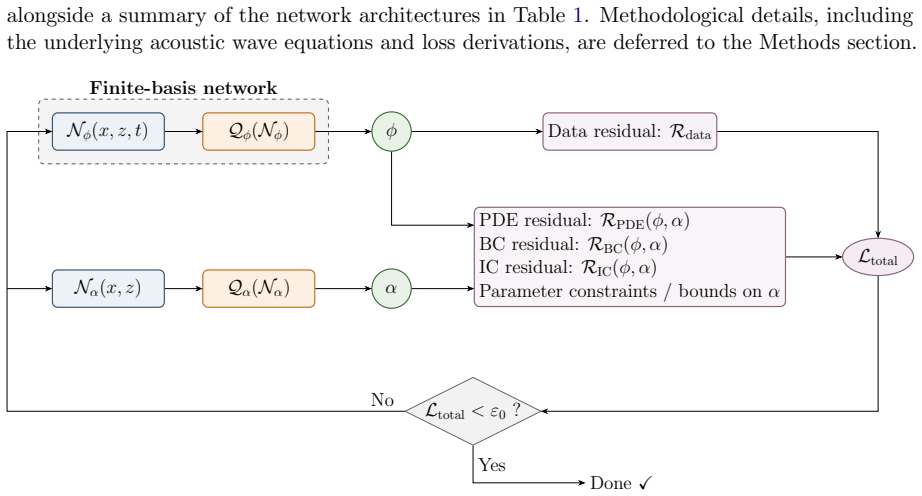
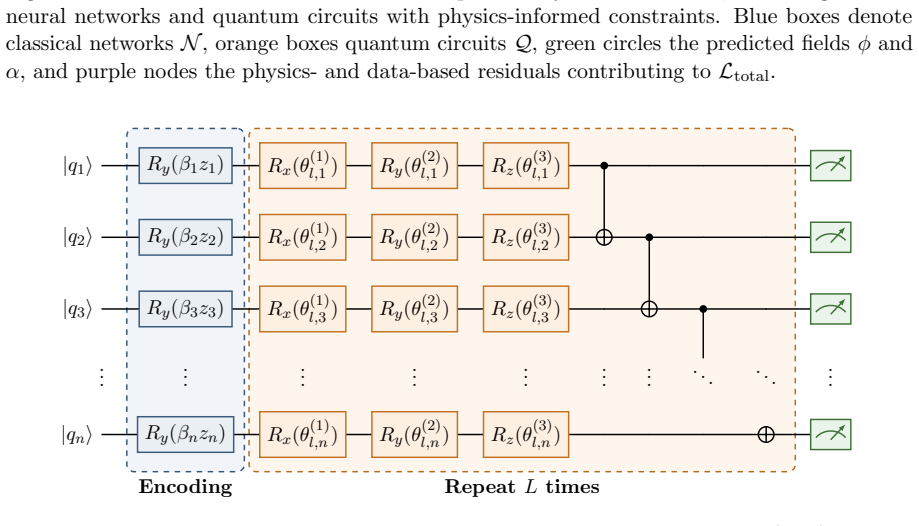
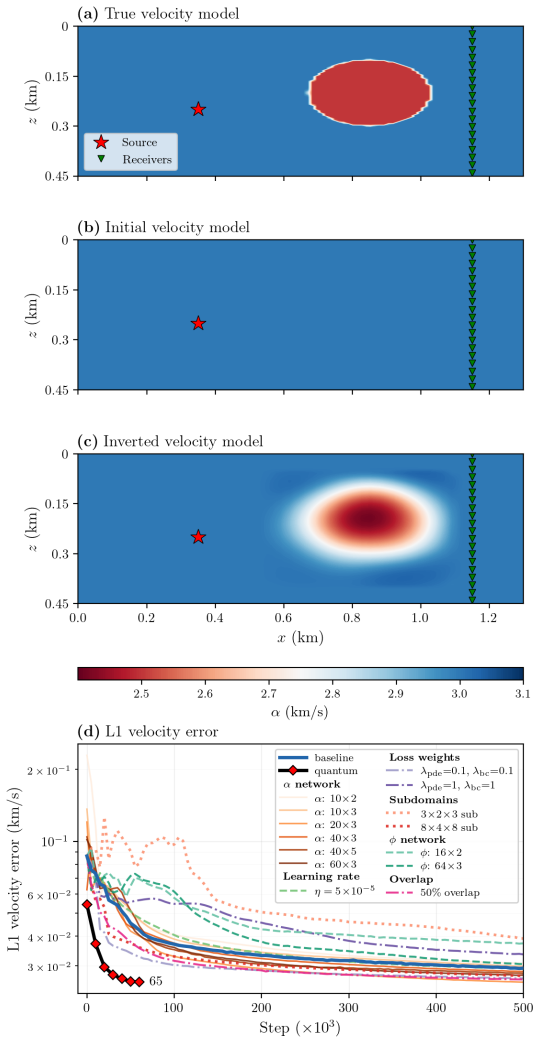
We present a hybrid quantum-classical FBPINN for acoustic FWI in which the decomposed wavefield network and the global velocity network are implemented as classical-to-quantum pipelines terminating in parameterized quantum circuits realized as differentiable JAX statevector simulators. This setup enables end-to-end automatic differentiation through the classical PINN, the quantum circuit, and the physics-informed loss. On a geophysical anomaly benchmark the quantum hybrid reaches a lower L1 velocity error than the primary classical FBPINN baseline in approximately 8x fewer training iterations despite using approximately 33% fewer trainable parameters and outperforms all 15 classical hyperpar
What carries the argument
Hybrid quantum-classical FBPINN with decomposed wavefield and global velocity networks realized as classical-to-quantum pipelines ending in parameterized quantum circuits (PQCs) that support end-to-end differentiation through the physics-informed loss.
If this is right
- The same pipeline applies directly to other wave-based inverse problems such as medical ultrasound tomography and non-destructive evaluation.
- End-to-end differentiability through the quantum circuits allows the quantum components to participate in any physics-informed loss without separate optimization stages.
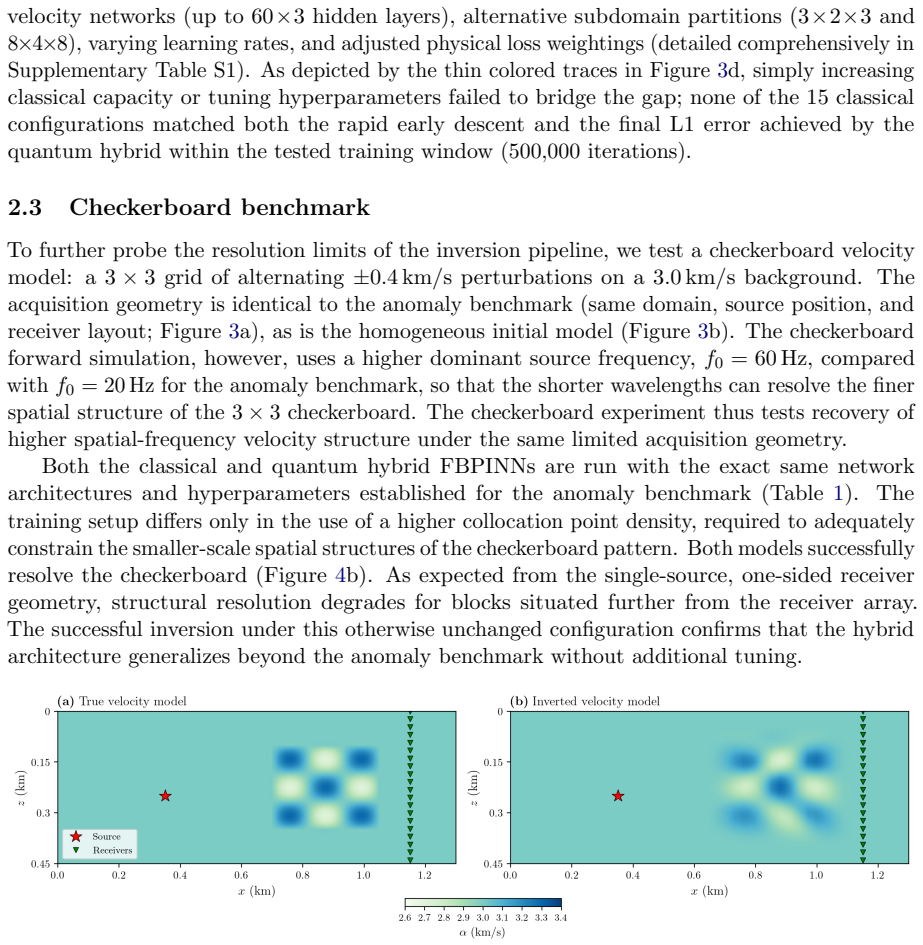
- The architecture recovers both localized anomalies and extended checkerboard-style spatial variations in the velocity field.
- Fewer trainable parameters combined with faster convergence reduces the computational cost of mesh-free inversion relative to classical FBPINNs.
- The method is compatible with any differentiable quantum simulator that can be embedded in an automatic-differentiation framework.
Where Pith is reading between the lines
- If quantum hardware or faster simulators become available the iteration advantage could translate into practical wall-clock speedups on larger problems.
- The same hybrid pattern might accelerate convergence in other PINN applications that currently suffer from slow training on complex fields.
- Direct wall-clock timing comparisons on identical hardware would be needed to confirm whether the iteration reduction yields real runtime gains once simulator overhead is included.
- Extending the benchmarks to three-dimensional models would test whether the observed advantages persist at larger scale.
Load-bearing premise
The parameterized quantum circuits remain stable and expressive enough under end-to-end differentiation through the physics-informed loss without introducing simulation artifacts that degrade inversion accuracy.
What would settle it
Running the geophysical anomaly benchmark and finding that the quantum hybrid does not achieve lower L1 velocity error than the classical baseline in approximately 8x fewer iterations.
Figures
read the original abstract
Full waveform inversion (FWI) reconstructs heterogeneous material properties from receiver data but remains computationally demanding. Physics-informed neural networks (PINNs) and their domain-decomposed variants (FBPINNs) offer a mesh-free alternative but face convergence challenges when representing complex velocity fields. We present a hybrid quantum-classical FBPINN for acoustic FWI, bringing together quantum computing and classical machine learning, in which the decomposed wavefield network and the global velocity network are implemented as classical-to-quantum pipelines terminating in parameterized quantum circuits (PQCs). The PQCs are realized as differentiable JAX statevector simulators, enabling end-to-end automatic differentiation through the classical PINN, the quantum circuit, and the physics-informed loss. On a geophysical anomaly benchmark, the quantum hybrid reaches a lower L1 velocity error than the primary classical FBPINN baseline in approximately 8x fewer training iterations, despite using approximately 33% fewer trainable parameters, and it outperforms all 15 classical hyperparameter variants tested. A second benchmark (checkerboard) demonstrates the generality of the inversion pipeline, confirming that the quantum hybrid architecture can recover structured spatial variations beyond the localized anomaly benchmark. Our framework is broadly applicable to wave-based inverse problems beyond geophysics, including medical ultrasound tomography and non-destructive evaluation.
Editorial analysis
A structured set of objections, weighed in public.
Referee Report
Summary. The paper proposes a hybrid quantum-classical finite-basis physics-informed neural network (FBPINN) architecture for acoustic full waveform inversion (FWI). The decomposed wavefield network and global velocity network are realized as classical-to-quantum pipelines ending in parameterized quantum circuits (PQCs) simulated via differentiable JAX statevector simulators, enabling end-to-end differentiation through the physics-informed loss. On a geophysical anomaly benchmark the hybrid model is reported to achieve lower L1 velocity error than a classical FBPINN baseline in approximately 8x fewer iterations while using ~33% fewer parameters and outperforming 15 classical hyperparameter variants; a checkerboard benchmark is used to demonstrate generality for recovering structured velocity variations.
Significance. If the reported performance gains and stability under end-to-end differentiation hold after proper controls, the work would constitute a concrete demonstration of quantum-enhanced PINNs for wave-based inverse problems. The use of differentiable quantum circuit simulation within a domain-decomposed PINN framework is a technical strength that could be relevant to other mesh-free inversion tasks in geophysics, ultrasound tomography, and non-destructive testing. The absence of free parameters or ad-hoc axioms in the provided description is noted positively.
minor comments (2)
- [Abstract] The abstract states concrete performance numbers (8x iteration reduction, 33% parameter savings, outperformance of 15 variants) without accompanying error bars, training curves, or explicit data-exclusion rules; these details are required to evaluate robustness.
- [Abstract] The weakest assumption flagged (stability and expressivity of PQCs under end-to-end differentiation through the physics loss) is central to the claims but is not addressed in the provided abstract text; the methods section must supply circuit ansatze, qubit counts, and simulation artifact checks.
Simulated Author's Rebuttal
We thank the referee for their summary of the manuscript and for highlighting the technical strengths of the differentiable quantum circuit simulation within the domain-decomposed PINN framework. We also appreciate the positive note regarding the absence of free parameters or ad-hoc axioms. No specific major comments were raised in the report, so we provide no point-by-point responses below. We remain available to address any additional questions or requests for clarification from the referee or editor.
Circularity Check
No significant circularity detected
full rationale
The paper introduces a hybrid quantum-classical FBPINN architecture for acoustic FWI, realized via differentiable JAX statevector simulators for PQCs, and reports empirical performance gains (lower L1 error in ~8x fewer iterations, fewer parameters) on anomaly and checkerboard benchmarks versus classical FBPINN variants. No load-bearing derivations, equations, or self-citations are present that reduce claimed results to fitted inputs by construction, self-definition, or ansatz smuggling. The performance numbers are presented as direct outcomes of end-to-end training runs on the physics-informed loss, with no internal reduction to the inputs themselves. This is the expected non-finding for an architecture paper whose central claims rest on numerical experiments rather than analytic derivations.
Axiom & Free-Parameter Ledger
axioms (1)
- domain assumption The acoustic wave equation governs propagation in the FWI setting
Reference graph
Works this paper leans on
-
[1]
Inversion of seismic reflection data in the acoustic approximation
Albert Tarantola. Inversion of seismic reflection data in the acoustic approximation. Geophysics, 49(8):1259–1266, 08 1984. ISSN 0016-8033. doi: 10.1190/1.1441754. URL https://doi.org/10.1190/1.1441754. 13
-
[2]
Andreas Fichtner, Brian L. N. Kennett, Heiner Igel, and Hans-Peter Bunge. Full seismic waveform tomography for upper-mantle structure in the australasian region using adjoint methods.Geophysical Journal International, 179(3):1703–1725, 12 2009. ISSN 0956-540X. doi: 10.1111/j.1365-246X.2009.04368.x. URL https://doi.org/10.1111/j.1365-246X. 2009.04368.x
-
[3]
Ebru Bozda˘ g, Jeannot Trampert, and Jeroen Tromp. Misfit functions for full waveform inversion based on instantaneous phase and envelope measurements.Geophysical Journal International, 185(2):845–870, 05 2011. ISSN 0956-540X. doi: 10.1111/j.1365-246X.2011. 04970.x. URLhttps://doi.org/10.1111/j.1365-246X.2011.04970.x
-
[4]
J. Virieux and S. Operto. An overview of full-waveform inversion in exploration geophysics. Geophysics, 74(6):WCC1–WCC26, 12 2009. ISSN 0016-8033. doi: 10.1190/1.3238367. URL https://doi.org/10.1190/1.3238367
-
[5]
Distributed acoustic sensing turns fiber-optic cables into sensitive seismic antennas.Seismological Research Letters, 91(1):1–15, 2020
Zhongwen Zhan. Distributed acoustic sensing turns fiber-optic cables into sensitive seismic antennas.Seismological Research Letters, 91(1):1–15, 2020
2020
-
[6]
J. Wiskin, D. T. Borup, S. A. Johnson, and M. Berggren. Non-linear inverse scattering: High resolution quantitative breast tissue tomography.The Journal of the Acoustical Society of America, 131(5):3802–3813, 05 2012. ISSN 0001-4966. doi: 10.1121/1.3699240. URL https://doi.org/10.1121/1.3699240
-
[7]
G Y Sandhu, C Li, O Roy, S Schmidt, and N Duric. Frequency domain ultrasound waveform tomography: breast imaging using a ring transducer.Physics in Medicine & Biology, 60(14):5381, jun 2015. doi: 10.1088/0031-9155/60/14/5381. URL https: //doi.org/10.1088/0031-9155/60/14/5381
-
[8]
Lihong V. Wang and Junjie Yao. A practical guide to photoacoustic tomography in the life sciences.Nature Methods, 13(8):627–638, 08 2016. doi: 10.1038/nmeth.3925. URL https://doi.org/10.1038/nmeth.3925
-
[9]
Jing Rao, Madis Ratassepp, and Zheng Fan. Guided wave tomography based on full waveform inversion.IEEE Transactions on Ultrasonics, Ferroelectrics, and Frequency Control, 63(5): 737–745, 2016. doi: 10.1109/TUFFC.2016.2536144
-
[10]
M. Raissi, P. Perdikaris, and G.E. Karniadakis. Physics-informed neural networks: A deep learning framework for solving forward and inverse problems involving nonlinear partial differential equations.Journal of Computational Physics, 378:686–707, 2019. ISSN 0021-9991. doi: https://doi.org/10.1016/j.jcp.2018.10.045. URL https://www.sciencedirect.com/ scien...
-
[11]
Chao Song, Tariq Alkhalifah, and Umair Bin Waheed. Solving the frequency-domain acoustic vti wave equation using physics-informed neural networks.Geophysical Journal International, 225(2):846–859, 01 2021. ISSN 0956-540X. doi: 10.1093/gji/ggab010. URL https://doi.org/10.1093/gji/ggab010
-
[12]
Pinntomo: Seismic tomography using physics-informed neural networks, 2021
Umair bin Waheed, Tariq Alkhalifah, Ehsan Haghighat, Chao Song, and Jean Virieux. Pinntomo: Seismic tomography using physics-informed neural networks, 2021. URL https: //arxiv.org/abs/2104.01588
arXiv 2021
-
[13]
Full wave inversion for ultrasound tomography using physics based deep neural network
Xilun Liu and Mohamed Almekkawy. Full wave inversion for ultrasound tomography using physics based deep neural network. In2023 IEEE 20th International Symposium on Biomedical Imaging (ISBI), pages 1–4, 2023. doi: 10.1109/ISBI53787.2023.10230537. 14
-
[14]
Majid Rasht-Behesht, Christian Huber, Khemraj Shukla, and George Em Karniadakis. Physics-informed neural networks (pinns) for wave propagation and full waveform in- versions.Journal of Geophysical Research: Solid Earth, 127(5), 2022. doi: https: //doi.org/10.1029/2021JB023120. URL https://agupubs.onlinelibrary.wiley.com/ doi/abs/10.1029/2021JB023120
-
[15]
Ben Moseley, Andrew Markham, and Tarje Nissen-Meyer. Finite basis physics-informed neural networks (FBPINNs): a scalable domain decomposition approach for solving dif- ferential equations.Advances in Computational Mathematics, 49(4):62, 07 2023. doi: 10.1007/s10444-023-10065-9. URLhttps://doi.org/10.1007/s10444-023-10065-9
-
[16]
Quantum Computing in the NISQ era and beyond.Quantum, 2:79, August
John Preskill. Quantum Computing in the NISQ era and beyond.Quantum, 2:79, August
-
[17]
Quantum Computing in the NISQ era and beyond
ISSN 2521-327X. doi: 10.22331/q-2018-08-06-79. URL https://doi.org/10.22331/ q-2018-08-06-79
work page internal anchor Pith review doi:10.22331/q-2018-08-06-79 2018
-
[18]
Maria Schuld, Alex Bocharov, Krysta M. Svore, and Nathan Wiebe. Circuit-centric quantum classifiers.Phys. Rev. A, 101:032308, Mar 2020. doi: 10.1103/PhysRevA.101.032308. URL https://link.aps.org/doi/10.1103/PhysRevA.101.032308
-
[19]
Quantum Science and Technology , author =
Marcello Benedetti, Erika Lloyd, Stefan Sack, and Mattia Fiorentini. Parameterized quantum circuits as machine learning models.Quantum Science and Technology, 4(4):043001, nov 2019. doi: 10.1088/2058-9565/ab4eb5. URLhttps://doi.org/10.1088/2058-9565/ab4eb5
-
[20]
Structure optimization for parameterized quantum circuits.Quantum, 5:391, January 2021
Mateusz Ostaszewski, Edward Grant, and Marcello Benedetti. Structure optimization for parameterized quantum circuits.Quantum, 5:391, January 2021. ISSN 2521-327X. doi: 10.22331/q-2021-01-28-391. URLhttps://doi.org/10.22331/q-2021-01-28-391
-
[21]
Annie E. Paine, Vincent E. Elfving, and Oleksandr Kyriienko. Quantum quantile mechanics: Solving stochastic differential equations for generating time-series.Advanced Quantum Technologies, 6(10):2300065, 2023. doi: https://doi.org/10.1002/qute.202300065. URL https://advanced.onlinelibrary.wiley.com/doi/abs/10.1002/qute.202300065
-
[22]
Fong Yew Leong, Wei-Bin Ewe, Si Bui Quang Tran, Zhongyuan Zhang, and Jun Yong Khoo. Hybrid quantum physics-informed neural network: Towards efficient learning of high-speed flows.Computers & Fluids, 301:106782, 2025. ISSN 0045-7930. doi: https://doi.org/10.1016/ j.compfluid.2025.106782. URL https://www.sciencedirect.com/science/article/pii/ S0045793025002427
arXiv 2025
-
[23]
Stefan Berger, Norbert Hosters, and Matthias M¨ oller. Trainable embedding quantum physics informed neural networks for solving nonlinear PDEs.Scientific Reports, 15(1):18823, 05 2025. doi: 10.1038/s41598-025-02959-z. URL https://doi.org/10.1038/s41598-025-02959-z
-
[24]
Seismic traveltime inversion with quantum annealing
Hoang Anh Nguyen and Ali Tura. Seismic traveltime inversion with quantum annealing. Scientific Reports, 15(1):17984, 2025. ISSN 2045-2322. doi: 10.1038/s41598-025-01188-8. URLhttps://doi.org/10.1038/s41598-025-01188-8
-
[25]
Pre-stack and post-stack seismic inversion using quantum computing.Geophysics, 04 2026
Divakar Vashisth, Rodney Lessard, and Tapan Mukerji. Pre-stack and post-stack seismic inversion using quantum computing.Geophysics, 04 2026. doi: 10.1190/GEO-2025-0186. URLhttps://doi.org/10.1190/GEO-2025-0186
-
[26]
Divakar Vashisth, Rohan Sharma, Tejas Ganesh Iyer, Tapan Mukerji, and Mrinal K. Sen. Seismic inversion using hybrid quantum neural networks, 2025. URL https://arxiv.org/ abs/2503.05009
arXiv 2025
-
[27]
Dimitri Komatitsch and Jean-Pierre Vilotte. The spectral element method: An efficient tool to simulate the seismic response of 2d and 3d geological structures.Bulletin of the 15 Seismological Society of America, 88(2):368–392, 04 1998. ISSN 0037-1106. doi: 10.1785/ BSSA0880020368. URLhttps://doi.org/10.1785/BSSA0880020368
-
[28]
Nature Reviews Physics , author =
M. Cerezo, Andrew Arrasmith, Ryan Babbush, Simon C. Benjamin, Suguru Endo, Keisuke Fujii, Jarrod R. McClean, Kosuke Mitarai, Xiao Yuan, Lukasz Cincio, and Patrick J. Coles. Variational quantum algorithms.Nature Reviews Physics, 3(9):625–644, 2021. ISSN 2522-5820. doi: 10.1038/s42254-021-00348-9. URL https://doi.org/10.1038/ s42254-021-00348-9
-
[29]
Maria Schuld, Ryan Sweke, and Johannes Jakob Meyer. Effect of data encoding on the expressive power of variational quantum-machine-learning models.Phys. Rev. A, 103: 032430, Mar 2021. doi: 10.1103/PhysRevA.103.032430. URL https://link.aps.org/doi/ 10.1103/PhysRevA.103.032430
-
[30]
Srinivasan, Ben Mildenhall, Sara Fridovich-Keil, Nithin Raghavan, Utkarsh Singhal, Ravi Ramamoorthi, Jonathan T
Matthew Tancik, Pratul P. Srinivasan, Ben Mildenhall, Sara Fridovich-Keil, Nithin Raghavan, Utkarsh Singhal, Ravi Ramamoorthi, Jonathan T. Barron, and Ren Ng. Fourier features let networks learn high frequency functions in low dimensional domains. InAdvances in Neural Information Processing Systems, volume 33, pages 7537–7547, 2020
2020
-
[31]
Vincent Sitzmann, Julien N. P. Martel, Alexander W. Bergman, David B. Lindell, and Gordon Wetzstein. Implicit neural representations with periodic activation functions. In Proceedings of the 34th International Conference on Neural Information Processing Systems, NIPS ’20, Red Hook, NY, USA, 2020. Curran Associates Inc. ISBN 9781713829546
2020
-
[32]
Nature Communications , author =
Jarrod R. McClean, Sergio Boixo, Vadim N. Smelyanskiy, Ryan Babbush, and Hartmut Neven. Barren plateaus in quantum neural network training landscapes.Nature Communications, 9 (1):4812, 2018. ISSN 2041-1723. doi: 10.1038/s41467-018-07090-4. URL https://doi.org/ 10.1038/s41467-018-07090-4
-
[33]
Krishnapriyan, Amir Gholami, Shandian Zhe, Robert M
Aditi S. Krishnapriyan, Amir Gholami, Shandian Zhe, Robert M. Kirby, and Michael W. Mahoney. Characterizing possible failure modes in physics-informed neural networks. In Proceedings of the 35th International Conference on Neural Information Processing Systems, NIPS ’21, Red Hook, NY, USA, 2021. Curran Associates Inc. ISBN 9781713845393
2021
-
[34]
Advanced Quantum Technologies , author =
Sukin Sim, Peter D. Johnson, and Al´ an Aspuru-Guzik. Expressibility and entangling capability of parameterized quantum circuits for hybrid quantum-classical algorithms.Ad- vanced Quantum Technologies, 2(12):1900070, 2019. doi: 10.1002/qute.201900070. URL https://advanced.onlinelibrary.wiley.com/doi/abs/10.1002/qute.201900070
-
[35]
Quantum Science and Technology
Maria Schuld and Francesco Petruccione.Machine Learning with Quantum Computers. Quantum Science and Technology. Springer, 2nd edition, 2021
2021
-
[36]
JAX: composable transformations of Python+NumPy programs, 2018
James Bradbury, Roy Frostig, Peter Hawkins, Matthew James Johnson, Chris Leary, Dougal Maclaurin, George Necula, Adam Paszke, Jake VanderPlas, Skye Wanderman-Milne, and Qiao Zhang. JAX: composable transformations of Python+NumPy programs, 2018. URL http://github.com/jax-ml/jax
2018
-
[37]
Sohaib Alam, Guillermo Alonso-Linaje, B
Ville Bergholm, Josh Izaac, Maria Schuld, Christian Gogolin, Shahnawaz Ahmed, Vishnu Ajith, M. Sohaib Alam, Guillermo Alonso-Linaje, B. AkashNarayanan, Ali Asadi, Juan Miguel Arrazola, Utkarsh Azad, Sam Banning, Carsten Blank, Thomas R Bromley, Benjamin A. Cordier, Jack Ceroni, Alain Delgado, Olivia Di Matteo, Amintor Dusko, Tanya Garg, Diego Guala, Antho...
Pith/arXiv arXiv 2022
-
[38]
Wood, Jake Lishman, Julien Gacon, Simon Martiel, Paul D
Ali Javadi-Abhari, Matthew Treinish, Kevin Krsulich, Christopher J. Wood, Jake Lishman, Julien Gacon, Simon Martiel, Paul D. Nation, Lev S. Bishop, Andrew W. Cross, Blake R. Johnson, and Jay M. Gambetta. Quantum computing with qiskit, 2024. URL https: //arxiv.org/abs/2405.08810
Pith/arXiv arXiv 2024
-
[39]
Quantum circuit learning.Physical Review A, 98(3):032309, Sep 2018
Kosuke Mitarai, Makoto Negoro, Masahiro Kitagawa, and Keisuke Fujii. Quantum circuit learning.Physical Review A, 98(3):032309, Sep 2018. doi: 10.1103/PhysRevA.98.032309. URLhttps://link.aps.org/doi/10.1103/PhysRevA.98.032309
-
[40]
Evalu- ating analytic gradients on quantum hardware.Physical Review A, 99(3):032331, Mar 2019
Maria Schuld, Ville Bergholm, Christian Gogolin, Josh Izaac, and Nathan Killoran. Evalu- ating analytic gradients on quantum hardware.Physical Review A, 99(3):032331, Mar 2019. doi: 10.1103/PhysRevA.99.032331. URL https://link.aps.org/doi/10.1103/PhysRevA. 99.032331. 17 Supplementary Information Supplementary Note: Quantum background For completeness, we ...
discussion (0)
Sign in with ORCID, Apple, or X to comment. Anyone can read and Pith papers without signing in.