Anisotropic quenching beyond z=1 and its implications for preprocessing around high-redshift galaxy clusters
Pith reviewed 2026-06-26 07:52 UTC · model grok-4.3
The pith
Preprocessing before cluster entry explains the anisotropic quenching seen in galaxy clusters at redshifts 0.9 to 1.4.
A machine-rendered reading of the paper's core claim, the machinery that carries it, and where it could break.
Core claim
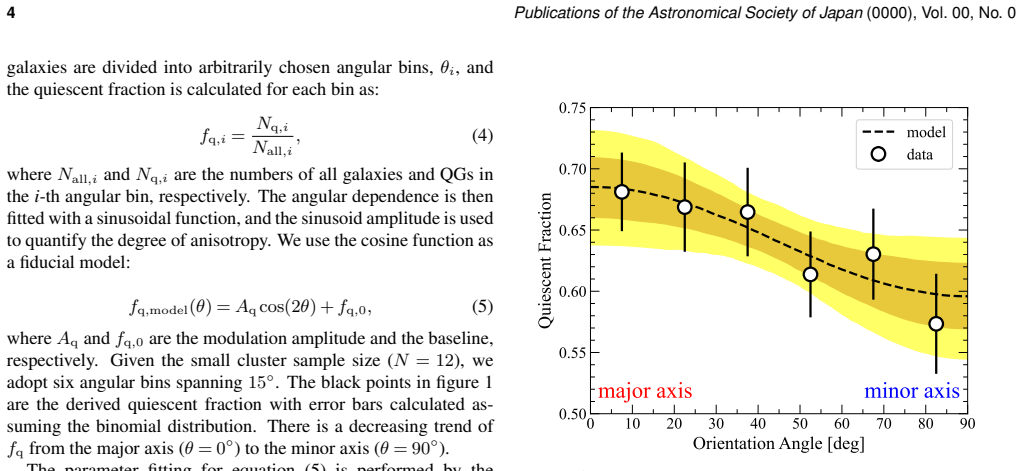
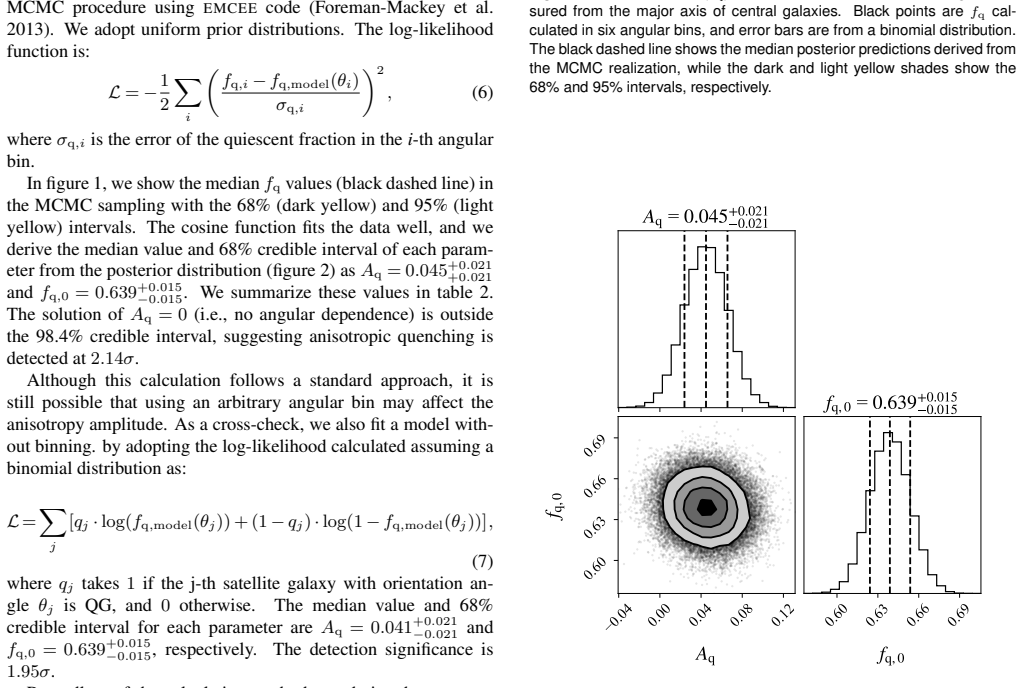
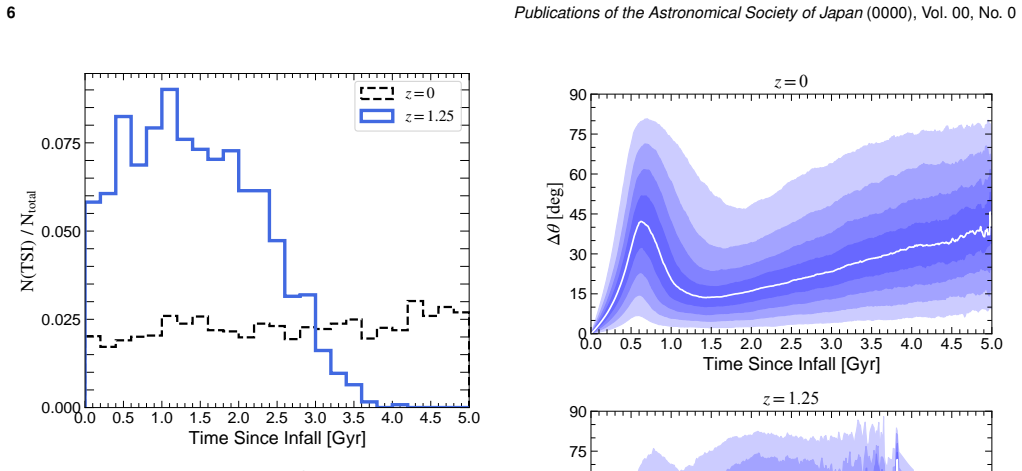
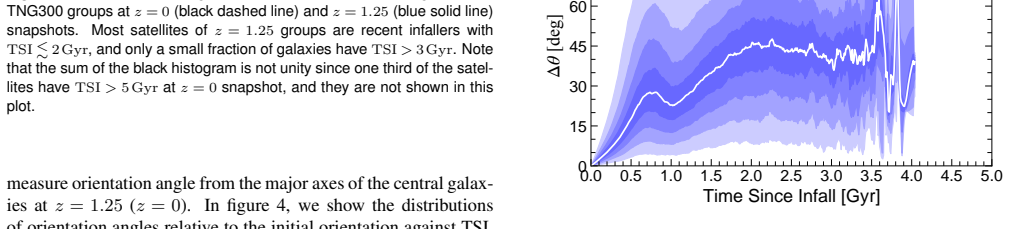
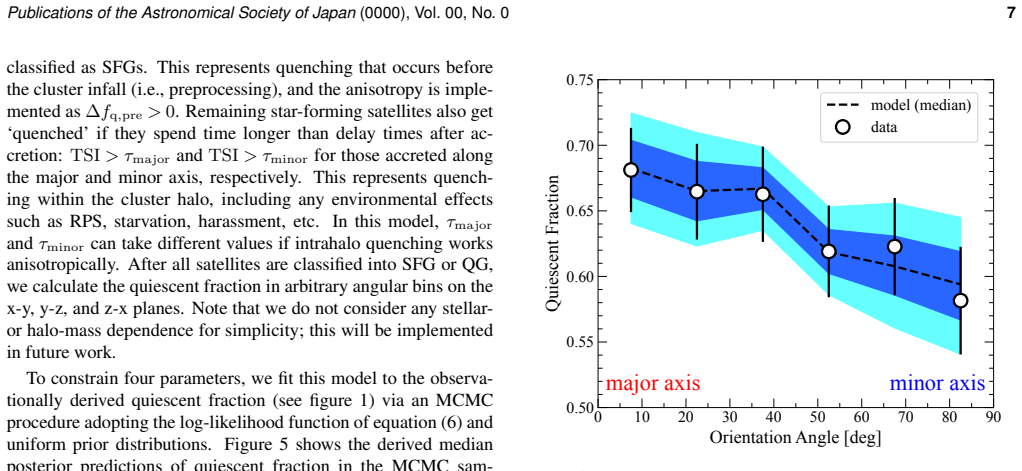
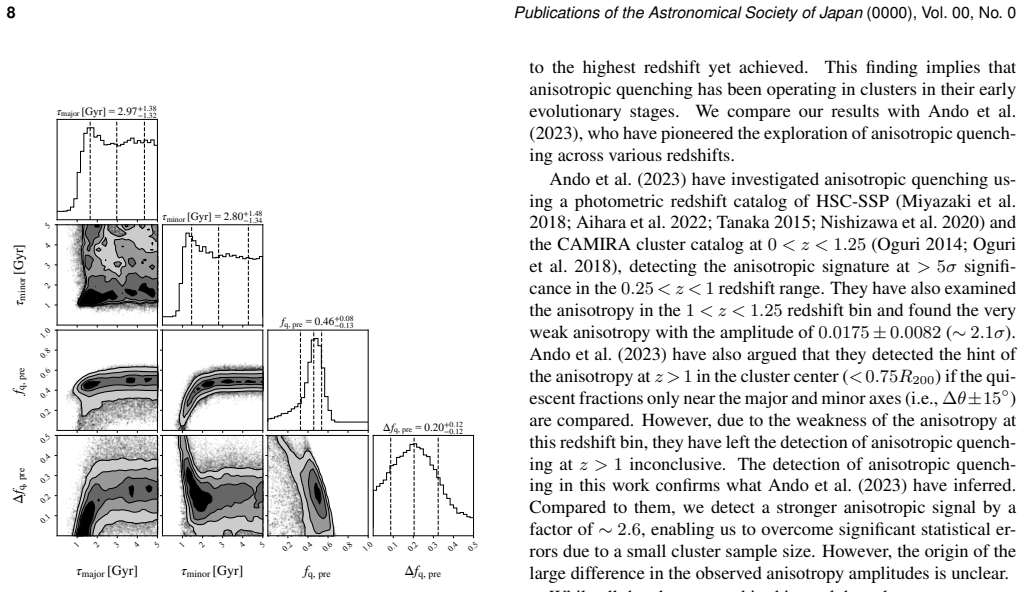
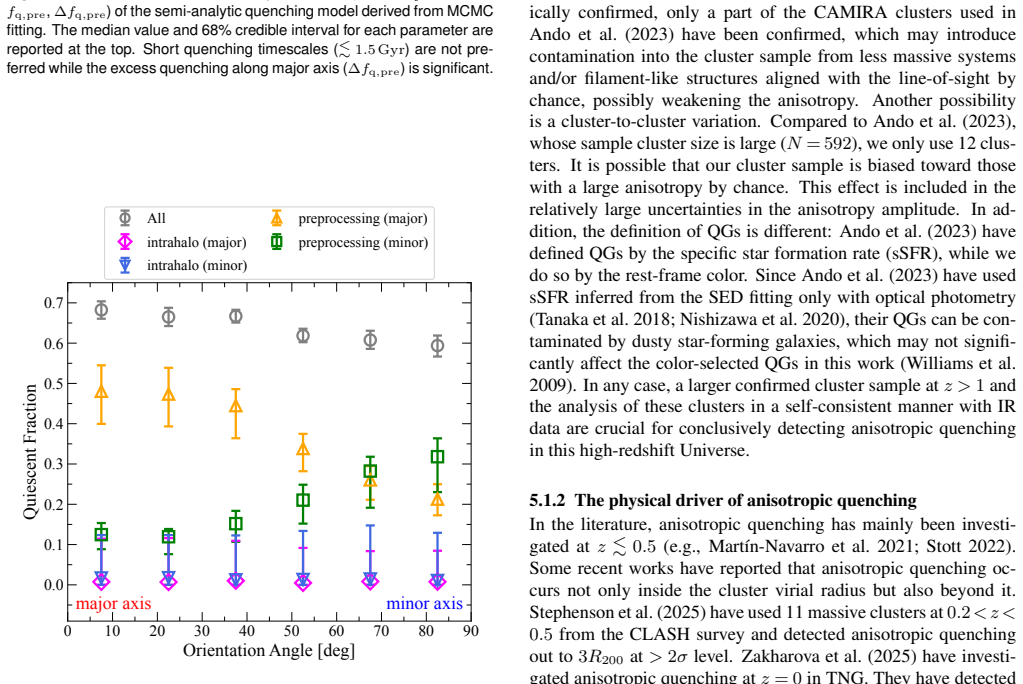
In 12 spectroscopically confirmed galaxy clusters at 0.9 < z < 1.4, the quiescent satellite fraction is higher along the major axis of the central galaxy. Cosmological simulations indicate that most satellites in z = 1.25 clusters have been accreted within the last 2 Gyr and that their orientations randomize on a similar timescale. A semi-analytic model combining these accretion histories with a delay-then-rapid quenching framework shows that preprocessing is the main driver of quenching, with the preprocessing contribution being approximately 20 percent higher along the major axis than the minor axis, thereby reproducing the observed anisotropic quenching.
What carries the argument
A semi-analytic model that integrates simulation-derived satellite accretion histories with a delay-then-rapid quenching framework, explicitly parameterizing the separate contributions from intrahalo quenching and preprocessing.
If this is right
- Preprocessing contributes more to satellite quenching than processes inside the cluster for these high-redshift systems.
- The anisotropy is carried exclusively by satellites accreted within the last ~2 Gyr whose orientations have not yet randomized.
- The ~20 percent excess quenched fraction along the major axis arises because preprocessing is stronger for galaxies that fall in along the filamentary directions aligned with the central galaxy.
- Anisotropic quenching can therefore serve as a clock for the timing of environmental effects outside clusters.
Where Pith is reading between the lines
- If preprocessing already dominates at z > 1, then the environmental transformation of galaxies begins in filaments and groups well before cluster assembly.
- The short ~2 Gyr randomization timescale implies that orientation memory from large-scale structure is transient, so larger samples at slightly lower redshift could map how the anisotropy fades as satellites spend more time inside clusters.
- The same modeling approach could be applied to lower-redshift clusters to test whether the relative importance of preprocessing declines as clusters grow and intrahalo processes become more efficient.
Load-bearing premise
The semi-analytic model correctly separates quenching that occurs inside the cluster from quenching that occurs beforehand in the surrounding large-scale structure.
What would settle it
Measuring the major-minus-minor axis difference in quenched fraction for only those satellites accreted more than 2 Gyr ago and finding that the difference remains as large as for the full population would falsify the claim that recent accretion and preprocessing drive the anisotropy.
Figures
read the original abstract
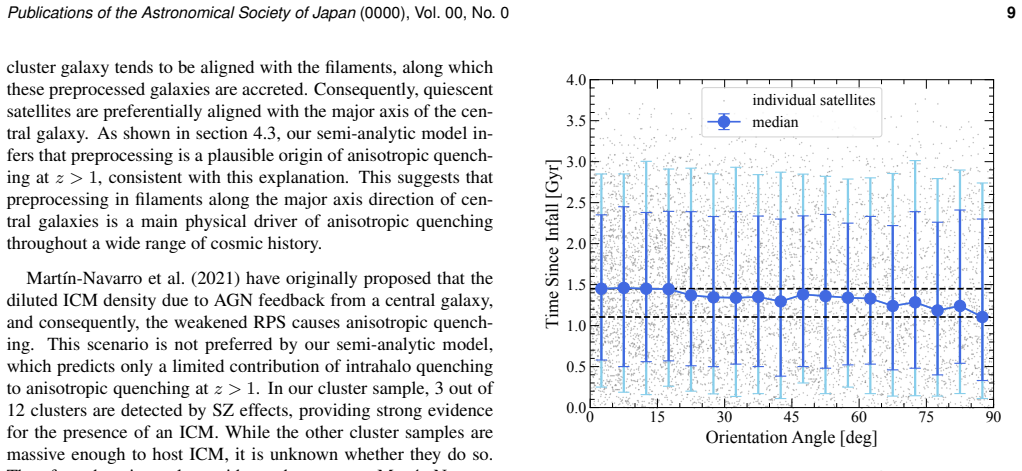
Recent studies have shown that, within galaxy clusters, quenched satellite galaxies tend to be distributed preferentially along the major axis of the central galaxy, dubbed anisotropic quenching. There are various discussions about the origin of this anisotropy: some link it to active galactic nucleus activity in the central galaxy, while others attribute it to the preprocessing of galaxies within large-scale structures outside clusters. However, the definitive cause and its redshift dependence remain unclear. In this study, we investigate anisotropic quenching with 12 spectroscopically confirmed galaxy clusters at $0.9<z<1.4$. We calculate the quiescent satellite galaxy fraction as a function of orientation angle measured from the central galaxy's major axis. Although the statistical significance is modest ($\sim 2\sigma$), we detect anisotropic quenching in the highest redshift ever. To understand the origin of the observed anisotropy, we examine the accretion history of satellite galaxies in a cosmological simulation. We find that, in the $z=1.25$ clusters, the majority of satellite galaxies are recently ($\lesssim 2\,\mathrm{Gyr}$) infalled galaxies. In addition, the orientation angles of satellites are randomized immediately after accretion in $\sim 2\,\mathrm{Gyr}$, suggesting that only recently accreted galaxies contribute to the observed anisotropy. We adopt a semi-analytic approach that combines the accretion history of satellite galaxies with a quenching model based on a delay-then-rapid quenching framework and parameterizes both intrahalo quenching and preprocessing effects. We find that preprocessing is the dominant contributor to quenching and that the quenched fraction attributable to preprocessing is higher along the major axis than along the minor axis by $\sim20\%$, reproducing the observed anisotropic quenching signal.
Editorial analysis
A structured set of objections, weighed in public.
Referee Report
Summary. The manuscript reports a ~2σ detection of anisotropic quenching among satellite galaxies in 12 spectroscopically confirmed clusters at 0.9<z<1.4, with higher quiescent fractions along the major axis of the central galaxy. Using cosmological simulations at z=1.25, the authors find that most satellites are recently accreted (≲2 Gyr) and that orbital orientations randomize on a comparable timescale. They then apply a semi-analytic model based on the delay-then-rapid quenching framework that separately parameterizes intrahalo quenching and preprocessing; the model attributes the observed anisotropy to preprocessing, which produces a ~20% higher quenched fraction along the major axis than the minor axis.
Significance. If the separation of quenching channels can be shown to be robust rather than tuned, the result would strengthen the case that preprocessing in large-scale structure dominates anisotropic quenching at z>1 and would have implications for how filamentary accretion shapes satellite populations. The combination of high-redshift observations, simulation-derived accretion histories, and explicit modeling of two quenching channels is a constructive approach; however, the modest statistical significance and lack of independent model validation limit the strength of the conclusions at present.
major comments (3)
- [semi-analytic modeling section] The semi-analytic model (described after the simulation analysis) explicitly introduces free parameters for both intrahalo quenching and a preprocessing efficiency contrast between major and minor axes. No section demonstrates that these parameters are constrained by any observable other than the anisotropy signal itself (e.g., no radial quenched-fraction profiles, stellar-mass trends, or field-galaxy comparisons at the same epoch are shown to anchor the relative efficiencies). Consequently the reported ~20% major-axis excess may be reproduced by construction once the preprocessing contrast is allowed to vary.
- [observational results] The observational detection is stated to be only ~2σ. Because the central claim that preprocessing dominates and reproduces the anisotropy rests on this marginal signal, the quantitative conclusion that preprocessing accounts for the full observed difference requires a clearer assessment of how the result changes when the significance threshold or sample definition is varied.
- [simulation accretion history analysis] The simulation analysis concludes that orientation angles randomize in ~2 Gyr and that only recently accreted galaxies contribute to the anisotropy. It is not shown whether this timescale or the accretion history at z=1.25 remains consistent when the same analysis is repeated on the observed cluster sample or on lower-redshift comparison simulations.
minor comments (2)
- [observational methods] The abstract and main text should state the exact number of satellites used for the orientation-angle measurement and the precise definition of the major-axis angle binning.
- [figures] Figure captions for the quenched-fraction vs. angle plots should include the Poisson or bootstrap uncertainties on each bin so that the ~2σ claim can be directly verified from the figure.
Simulated Author's Rebuttal
We are grateful to the referee for their detailed and constructive feedback on our manuscript. We have carefully considered each major comment and provide point-by-point responses below. Where appropriate, we outline revisions that will be incorporated into the next version of the paper to address the concerns raised.
read point-by-point responses
-
Referee: The semi-analytic model (described after the simulation analysis) explicitly introduces free parameters for both intrahalo quenching and a preprocessing efficiency contrast between major and minor axes. No section demonstrates that these parameters are constrained by any observable other than the anisotropy signal itself (e.g., no radial quenched-fraction profiles, stellar-mass trends, or field-galaxy comparisons at the same epoch are shown to anchor the relative efficiencies). Consequently the reported ~20% major-axis excess may be reproduced by construction once the preprocessing contrast is allowed to vary.
Authors: We thank the referee for highlighting this important point. The parameters in the semi-analytic model are informed by the accretion histories derived from the cosmological simulation, which dictate the timing of infall and the expected alignment with large-scale structure. The preprocessing contrast is physically motivated by the filamentary accretion along the major axis. Nevertheless, we agree that demonstrating consistency with additional observables would better validate the model. In the revised manuscript, we will add comparisons of the model's radial quenched fraction profiles and stellar mass trends to the observed data in our clusters and to field galaxy quenched fractions at similar redshifts from the literature. This will help anchor the relative efficiencies beyond the anisotropy signal alone. revision: yes
-
Referee: The observational detection is stated to be only ~2σ. Because the central claim that preprocessing dominates and reproduces the anisotropy rests on this marginal signal, the quantitative conclusion that preprocessing accounts for the full observed difference requires a clearer assessment of how the result changes when the significance threshold or sample definition is varied.
Authors: We fully acknowledge that the detection of anisotropic quenching is at a modest ~2σ significance level, as stated in the manuscript. The conclusions are presented with appropriate caution. To provide a clearer assessment of robustness, we will include in the revised manuscript an analysis of how the anisotropy signal varies with different sample definitions, such as restricting to clusters with higher spectroscopic completeness or varying the quiescent galaxy selection criteria. This will allow readers to evaluate the stability of the quantitative conclusions regarding the preprocessing contribution. revision: yes
-
Referee: The simulation analysis concludes that orientation angles randomize in ~2 Gyr and that only recently accreted galaxies contribute to the anisotropy. It is not shown whether this timescale or the accretion history at z=1.25 remains consistent when the same analysis is repeated on the observed cluster sample or on lower-redshift comparison simulations.
Authors: The accretion history analysis is performed using cosmological simulations at z=1.25 to represent the epoch of our observed clusters (0.9<z<1.4). Repeating the analysis directly on the observed sample is not feasible, as it would require detailed orbital and accretion histories that are not available from observations alone. Regarding lower-redshift simulations, we will add a discussion in the revised version comparing our ~2 Gyr randomization timescale to results from lower-redshift cluster simulations in the literature. We believe this provides the necessary context while recognizing the focus of our study on high-redshift systems. revision: partial
Circularity Check
Semi-analytic model parameterizes intrahalo vs. preprocessing quenching then reproduces observed anisotropy by construction
specific steps
-
fitted input called prediction
[Abstract]
"We adopt a semi-analytic approach that combines the accretion history of satellite galaxies with a quenching model based on a delay-then-rapid quenching framework and parameterizes both intrahalo quenching and preprocessing effects. We find that preprocessing is the dominant contributor to quenching and that the quenched fraction attributable to preprocessing is higher along the major axis than along the minor axis by ∼20%, reproducing the observed anisotropic quenching signal."
The model is constructed by parameterizing the two channels separately; the subsequent 'finding' that preprocessing dominates and produces a 20% anisotropy that matches the data is the direct output of those parameters. No independent observable is cited to fix the relative efficiencies, so the reported difference is statistically forced once the preprocessing efficiency is allowed to vary.
full rationale
The central claim rests on a semi-analytic model that explicitly parameterizes both quenching channels and is stated to reproduce the ~20% major-axis excess. The accretion histories and ~2 Gyr randomization timescale are taken from simulation, but the relative efficiencies of the two channels have no external anchor shown; the reported dominance and anisotropy therefore reduce to the chosen parameterization rather than an independent prediction.
Axiom & Free-Parameter Ledger
free parameters (2)
- quenching delay timescale
- preprocessing efficiency contrast (major vs minor axis)
axioms (2)
- domain assumption Satellite orientation angles randomize within ~2 Gyr after accretion
- domain assumption Majority of satellites in z=1.25 clusters are recently infallen (lesssim 2 Gyr)
Reference graph
Works this paper leans on
-
[1]
Ram pressure stripping of spiral galaxies in clusters. , keywords =. doi:10.1046/j.1365-8711.1999.02715.x , archivePrefix =. astro-ph/9903436 , primaryClass =
-
[2]
The Second Data Release of the Sloan Digital Sky Survey
The Second Data Release of the Sloan Digital Sky Survey. , keywords =. doi:10.1086/421365 , archivePrefix =. astro-ph/0403325 , primaryClass =
work page internal anchor Pith review Pith/arXiv arXiv doi:10.1086/421365
-
[3]
Evolution of spatially resolved star formation main sequence and surface density profiles in massive disc galaxies at 0 z 1: inside-out stellar mass buildup and quenching. , keywords =. doi:10.1093/mnras/sty1771 , archivePrefix =. 1802.03782 , primaryClass =
work page internal anchor Pith review Pith/arXiv arXiv doi:10.1093/mnras/sty1771
-
[4]
The Hyper Suprime-Cam SSP Survey: Overview and Survey Design
The Hyper Suprime-Cam SSP Survey: Overview and survey design. , keywords =. doi:10.1093/pasj/psx066 , archivePrefix =. 1704.05858 , primaryClass =
work page internal anchor Pith review Pith/arXiv arXiv doi:10.1093/pasj/psx066
-
[5]
First Data Release of the Hyper Suprime-Cam Subaru Strategic Program
First data release of the Hyper Suprime-Cam Subaru Strategic Program. , keywords =. doi:10.1093/pasj/psx081 , archivePrefix =. 1702.08449 , primaryClass =
work page internal anchor Pith review Pith/arXiv arXiv doi:10.1093/pasj/psx081
-
[6]
2019, Publications of the Astronomical Society of Japan, 71, 114, doi: 10.1093/pasj/psz103
Second data release of the Hyper Suprime-Cam Subaru Strategic Program. , keywords =. doi:10.1093/pasj/psz103 , archivePrefix =. 1905.12221 , primaryClass =
-
[7]
Third data release of the Hyper Suprime-Cam Subaru Strategic Program. , keywords =. doi:10.1093/pasj/psab122 , archivePrefix =. 2108.13045 , primaryClass =
-
[8]
, journal=
Akaike, H. , journal=. A new look at the statistical model identification , year=
-
[9]
Multitracer extension of the halo model: probing quenching and conformity in eBOSS. , keywords =. doi:10.1093/mnras/staa1956 , archivePrefix =. 1910.05095 , primaryClass =
-
[10]
From Clusters to Proto-Clusters: The Infrared Perspective on Environmental Galaxy Evolution. Universe , keywords =. doi:10.3390/universe8110554 , archivePrefix =. 2209.02781 , primaryClass =
-
[11]
Star formation sustained by gas accretion
Star formation sustained by gas accretion. , keywords =. doi:10.1007/s00159-014-0071-1 , archivePrefix =. 1405.3178 , primaryClass =
work page internal anchor Pith review Pith/arXiv arXiv doi:10.1007/s00159-014-0071-1
-
[12]
Protocluster detection in simulations of HSC-SSP and the 10-yr LSST forecast, using PCcones. , keywords =. doi:10.1093/mnras/stab1133 , archivePrefix =. 2104.10161 , primaryClass =
-
[13]
LARgE Survey - I. Dead monsters: the massive end of the passive galaxy stellar mass function at cosmic noon. , keywords =. doi:10.1093/mnras/stz1169 , archivePrefix =. 1904.11654 , primaryClass =
work page internal anchor Pith review Pith/arXiv arXiv doi:10.1093/mnras/stz1169 1904
-
[14]
A systematic search for galaxy proto-cluster cores at z 2. , keywords =. doi:10.1093/mnras/staa1757 , archivePrefix =. 2002.10511 , primaryClass =
-
[15]
A systematic search for galaxy protocluster cores at the transition epoch of their star formation activity. , keywords =. doi:10.1093/mnras/stac1049 , archivePrefix =. 2201.05185 , primaryClass =
-
[16]
Detection of anisotropic satellite quenching in galaxy clusters up to z 1. , keywords =. doi:10.1093/mnras/stac3251 , archivePrefix =. 2209.00015 , primaryClass =
-
[17]
Measuring the redshift evolution of clustering: the Hubble Deep Field South. , keywords =. 2002. doi:10.1046/j.1365-8711.2002.04988.x , archivePrefix =. astro-ph/0109453 , primaryClass =
-
[18]
Angular distribution of satellite galaxies from the Sloan Digital Sky Survey Data Release 4. , keywords =. doi:10.1111/j.1745-3933.2007.00282.x , archivePrefix =. astro-ph/0607139 , primaryClass =
-
[19]
Quantifying the bimodal color-magnitude distribution of galaxies
Quantifying the Bimodal Color-Magnitude Distribution of Galaxies. , keywords =. doi:10.1086/380092 , archivePrefix =. astro-ph/0309710 , primaryClass =
work page internal anchor Pith review Pith/arXiv arXiv doi:10.1086/380092
-
[20]
The GEEC2 spectroscopic survey of Galaxy Groups at $0.8<z<1$
The GEEC2 spectroscopic survey of Galaxy groups at 0.8 < z < 1. , keywords =. 2014. doi:10.1093/mnras/stu1332 , archivePrefix =. 1406.4528 , primaryClass =
work page internal anchor Pith review Pith/arXiv arXiv doi:10.1093/mnras/stu1332 2014
-
[21]
Evidence for a change in the dominant satellite galaxy quenching mechanism at z=1
Evidence for a change in the dominant satellite galaxy quenching mechanism at z = 1. , keywords =. doi:10.1093/mnras/stv2949 , archivePrefix =. 1511.07344 , primaryClass =
work page internal anchor Pith review Pith/arXiv arXiv doi:10.1093/mnras/stv2949
-
[22]
The GOGREEN and GCLASS surveys: first data release. , keywords =. doi:10.1093/mnras/staa3008 , archivePrefix =. 2009.13345 , primaryClass =
-
[23]
Galaxy Zoo: the dependence of morphology and colour on environment*. , keywords =. doi:10.1111/j.1365-2966.2008.14252.x , archivePrefix =. 0805.2612 , primaryClass =
-
[24]
The Average Star Formation Histories of Galaxies in Dark Matter Halos from z=0-8
The Average Star Formation Histories of Galaxies in Dark Matter Halos from z = 0-8. , keywords =. 2013. doi:10.1088/0004-637X/770/1/57 , archivePrefix =. 1207.6105 , primaryClass =
work page internal anchor Pith review Pith/arXiv arXiv doi:10.1088/0004-637x/770/1/57 2013
-
[25]
The Luminosities, Sizes, and Velocity Dispersions of Brightest Cluster Galaxies: Implications for Formation History. , keywords =. doi:10.1086/511783 , archivePrefix =. astro-ph/0607117 , primaryClass =
work page internal anchor Pith review Pith/arXiv arXiv doi:10.1086/511783
-
[26]
PRIMUS: One- and Two-halo Galactic Conformity at 0.2 < z < 1. , keywords =. doi:10.3847/1538-4357/834/1/87 , archivePrefix =. 1608.05084 , primaryClass =
-
[27]
SExtractor: Software for source extraction. , keywords =. doi:10.1051/aas:1996164 , adsurl =
-
[28]
Clustering, host halos, and environment of z -0.5ex 2 galaxies as a function of their physical properties. , keywords =. 2014. doi:10.1051/0004-6361/201423451 , archivePrefix =. 1405.0492 , primaryClass =
work page internal anchor Pith review Pith/arXiv arXiv doi:10.1051/0004-6361/201423451 2014
-
[29]
On the occurrence of galaxy harassment
On the occurrence of galaxy harassment. , keywords =. doi:10.1051/0004-6361/201425235 , archivePrefix =. 1503.01965 , primaryClass =
work page internal anchor Pith review Pith/arXiv arXiv doi:10.1051/0004-6361/201425235
-
[30]
Advanced Camera for Surveys Photometry of the Cluster RDCS 1252.9-2927: The Color-Magnitude Relation at z = 1.24. , keywords =. 2003. doi:10.1086/379234 , archivePrefix =. astro-ph/0309036 , primaryClass =
work page internal anchor Pith review Pith/arXiv arXiv doi:10.1086/379234 2003
-
[31]
Astronomical Data Analysis Software and Systems XXVII , year = 2019, editor =
An Overview of the LSST Image Processing Pipelines. Astronomical Data Analysis Software and Systems XXVII , year = 2019, editor =
2019
-
[32]
The Hyper Suprime-Cam Software Pipeline
The Hyper Suprime-Cam software pipeline. , keywords =. doi:10.1093/pasj/psx080 , archivePrefix =. 1705.06766 , primaryClass =
work page internal anchor Pith review Pith/arXiv arXiv doi:10.1093/pasj/psx080
-
[33]
Environmental Effects on Late-Type Galaxies in Nearby Clusters
Environmental Effects on Late-Type Galaxies in Nearby Clusters. , keywords =. doi:10.1086/500691 , archivePrefix =. astro-ph/0601108 , primaryClass =
work page internal anchor Pith review Pith/arXiv arXiv doi:10.1086/500691
-
[34]
The GALEX Ultraviolet Virgo Cluster Survey (GUViCS). IV. The role of the cluster environment on galaxy evolution. , keywords =. doi:10.1051/0004-6361/201424419 , archivePrefix =. 1407.4986 , primaryClass =
work page internal anchor Pith review Pith/arXiv arXiv doi:10.1051/0004-6361/201424419
-
[35]
Ram pressure stripping in high-density environments. , keywords =. doi:10.1007/s00159-022-00140-3 , archivePrefix =. 2109.13614 , primaryClass =
-
[36]
IllustrisTNG in the HSC-SSP: image data release and the major role of mini mergers as drivers of asymmetry and star formation. , keywords =. doi:10.1093/mnras/stad2971 , archivePrefix =. 2308.14793 , primaryClass =
-
[37]
The colour-magnitude relation as a constraint on the formation of rich cluster galaxies. , keywords =. 1998. doi:10.1046/j.1365-8711.1998.01868.x , archivePrefix =. astro-ph/9805290 , primaryClass =
-
[38]
EAZY: A Fast, Public Photometric Redshift Code
EAZY: A Fast, Public Photometric Redshift Code. , keywords =. doi:10.1086/591786 , archivePrefix =. 0807.1533 , primaryClass =
work page internal anchor Pith review Pith/arXiv arXiv doi:10.1086/591786
-
[39]
doi:10.5281/zenodo.8370018 , url =
Brammer, Gabriel , title =. doi:10.5281/zenodo.8370018 , url =
-
[40]
doi:10.5281/zenodo.15472354 , url =
Brammer, Gabriel and Valentino, Francesco , title =. doi:10.5281/zenodo.15472354 , url =
-
[41]
The Era of Star Formation in Galaxy Clusters
The Era of Star Formation in Galaxy Clusters. , keywords =. doi:10.1088/0004-637X/779/2/138 , archivePrefix =. 1310.6039 , primaryClass =
work page internal anchor Pith review Pith/arXiv arXiv doi:10.1088/0004-637x/779/2/138
-
[42]
The eROSITA Final Equatorial Depth Survey (eFEDS). X-ray catalogue. , keywords =. doi:10.1051/0004-6361/202141266 , archivePrefix =. 2106.14517 , primaryClass =
-
[43]
Stellar population synthesis at the resolution of 2003. , keywords =. doi:10.1046/j.1365-8711.2003.06897.x , archivePrefix =. astro-ph/0309134 , primaryClass =
-
[44]
The Dust Content and Opacity of Actively Star-forming Galaxies. , keywords =. doi:10.1086/308692 , archivePrefix =. astro-ph/9911459 , primaryClass =
work page internal anchor Pith review Pith/arXiv arXiv doi:10.1086/308692
-
[45]
The evolution of galaxies in clusters. V. A study of populations since Z 0.5. , keywords =. doi:10.1086/162519 , adsurl =
-
[46]
Astronomy and Computing , keywords =
SKIRT 9: Redesigning an advanced dust radiative transfer code to allow kinematics, line transfer and polarization by aligned dust grains. Astronomy and Computing , keywords =. doi:10.1016/j.ascom.2020.100381 , archivePrefix =. 2003.00721 , primaryClass =
-
[47]
Galactic Stellar and Substellar Initial Mass Function
Galactic Stellar and Substellar Initial Mass Function. , keywords =. 2003. doi:10.1086/376392 , archivePrefix =. astro-ph/0304382 , primaryClass =
work page internal anchor Pith review Pith/arXiv arXiv doi:10.1086/376392 2003
-
[48]
Large-scale Structures in the CANDELS Fields: The Role of the Environment in Star Formation Activity. , keywords =. doi:10.3847/1538-4357/ab61fd , archivePrefix =. 1912.04890 , primaryClass =
-
[49]
LARgE Survey - II. The dark matter haloes and the progenitors and descendants of ultramassive passive galaxies at cosmic noon. , keywords =. doi:10.1093/mnras/staa601 , archivePrefix =. 2002.12891 , primaryClass =
-
[50]
Ancient Light from Young Cosmic Cities: Physical and Observational Signatures of Galaxy Proto-clusters. , keywords =. 2013. doi:10.1088/0004-637X/779/2/127 , archivePrefix =. 1310.2938 , primaryClass =
work page internal anchor Pith review Pith/arXiv arXiv doi:10.1088/0004-637x/779/2/127 2013
-
[51]
Discovery of a Large Number of Candidate Protoclusters Traced by -0.5ex 15 Mpc-scale Galaxy Overdensities in COSMOS. , keywords =. 2014. doi:10.1088/2041-8205/782/1/L3 , archivePrefix =. 1312.4747 , primaryClass =
work page internal anchor Pith review Pith/arXiv arXiv doi:10.1088/2041-8205/782/1/l3 2014
-
[52]
Surveying Galaxy Proto-clusters in Emission: A Large-scale Structure at z = 2.44 and the Outlook for HETDEX. , keywords =. 2015. doi:10.1088/0004-637X/808/1/37 , archivePrefix =. 1505.03877 , primaryClass =
work page internal anchor Pith review Pith/arXiv arXiv doi:10.1088/0004-637x/808/1/37 2015
-
[53]
Galaxy Protoclusters as Drivers of Cosmic Star-Formation History in the First 2 Gyr
Galaxy Protoclusters as Drivers of Cosmic Star Formation History in the First 2 Gyr. , keywords =. 2017. doi:10.3847/2041-8213/aa7e7b , archivePrefix =. 1705.01634 , primaryClass =
work page internal anchor Pith review Pith/arXiv arXiv doi:10.3847/2041-8213/aa7e7b 2017
-
[54]
A direct empirical proof of the existence of dark matter
A Direct Empirical Proof of the Existence of Dark Matter. , keywords =. doi:10.1086/508162 , archivePrefix =. astro-ph/0608407 , primaryClass =
work page internal anchor Pith review Pith/arXiv arXiv doi:10.1086/508162
-
[55]
The 0.1<z<1.65 evolution of the bright end of the [OII] luminosity function
The 0.1 <z < 1.65 evolution of the bright end of the [O ii] luminosity function. , keywords =. 2015. doi:10.1051/0004-6361/201424767 , archivePrefix =. 1408.1523 , primaryClass =
work page internal anchor Pith review Pith/arXiv arXiv doi:10.1051/0004-6361/201424767 2015
-
[56]
On the formation and physical properties of the intracluster light in hierarchical galaxy formation models. , keywords =. doi:10.1093/mnras/stt2174 , archivePrefix =. 1311.2076 , primaryClass =
work page internal anchor Pith review Pith/arXiv arXiv doi:10.1093/mnras/stt2174 2076
-
[57]
Semi-Analytic Model Predictions of the Galaxy Population in Proto-clusters
Semi-analytic model predictions of the galaxy population in protoclusters. , keywords =. doi:10.1093/mnras/stv2852 , archivePrefix =. 1512.01561 , primaryClass =
work page internal anchor Pith review Pith/arXiv arXiv doi:10.1093/mnras/stv2852
-
[58]
The Roles of Mass and Environment in the Quenching of Galaxies. II. , keywords =. 2020. doi:10.3847/1538-4357/ab6730 , archivePrefix =. 2001.01369 , primaryClass =
-
[59]
A z = 2.5 protocluster associated with the radio galaxy MRC 2104-242: star formation and differing mass functions in dense environments. , keywords =. 2014. doi:10.1093/mnras/stu522 , archivePrefix =. 1403.4259 , primaryClass =
work page internal anchor Pith review Pith/arXiv arXiv doi:10.1093/mnras/stu522 2014
-
[60]
A mature galaxy cluster at z=1.58 around the radio galaxy 7C1753+6311
A Mature Galaxy Cluster at z=1.58 around the Radio Galaxy 7C1753+6311. , keywords =. 2016. doi:10.3847/0004-637X/816/2/83 , archivePrefix =. 1511.05150 , primaryClass =
work page internal anchor Pith review Pith/arXiv arXiv doi:10.3847/0004-637x/816/2/83 2016
-
[61]
Stellar Mass Growth of Brightest Cluster Galaxy Progenitors in COSMOS Since z 3. , keywords =. doi:10.3847/1538-4357/ab30c9 , archivePrefix =. 1907.04337 , primaryClass =
-
[62]
The DEEP2 galaxy redshift survey: evolution of the colour-density relation at 0.4 < z < 1.35. , keywords =. doi:10.1111/j.1365-2966.2007.11534.x , archivePrefix =. astro-ph/0607512 , primaryClass =
-
[63]
The Environment of Galaxies at Low Redshift
The Environment of Galaxies at Low Redshift. , keywords =. doi:10.1086/528986 , archivePrefix =. 0801.0312 , primaryClass =
work page internal anchor Pith review Pith/arXiv arXiv doi:10.1086/528986
-
[64]
Radio-quiet QSO environments - I. The correlation of QSOs and b\_J<23 galaxies. , keywords =. 1999. doi:10.1046/j.1365-8711.1999.02232.x , archivePrefix =. astro-ph/9810170 , primaryClass =
-
[65]
From Voids to Coma: the prevalence of pre-processing in the local Universe
From voids to Coma: the prevalence of pre-processing in the local Universe. , keywords =. doi:10.1093/mnras/stu200 , archivePrefix =. 1401.7328 , primaryClass =
work page internal anchor Pith review Pith/arXiv arXiv doi:10.1093/mnras/stu200
-
[66]
A Comparative Study of Density Field Estimation for Galaxies: New Insights into the Evolution of Galaxies with Environment in COSMOS out to z̃3. , keywords =. doi:10.1088/0004-637X/805/2/121 , archivePrefix =. 1503.07879 , primaryClass =
work page internal anchor Pith review Pith/arXiv arXiv doi:10.1088/0004-637x/805/2/121
-
[67]
Effects of Local Environment and Stellar Mass on Galaxy Quenching out to z~3
The Effects of the Local Environment and Stellar Mass on Galaxy Quenching to z 3. , keywords =. doi:10.3847/0004-637X/825/2/113 , archivePrefix =. 1605.03182 , primaryClass =
work page internal anchor Pith review Pith/arXiv arXiv doi:10.3847/0004-637x/825/2/113
-
[68]
The VIMOS Public Extragalactic Redshift Survey (VIPERS). A precise measurement of the galaxy stellar mass function and the abundance of massive galaxies at redshifts 0.5 < z < 1.3. , keywords =. doi:10.1051/0004-6361/201321511 , archivePrefix =. 1303.3808 , primaryClass =
work page internal anchor Pith review Pith/arXiv arXiv doi:10.1051/0004-6361/201321511
-
[69]
The COSMOS2015 galaxy stellar mass function . Thirteen billion years of stellar mass assembly in ten snapshots. , keywords =. doi:10.1051/0004-6361/201730419 , archivePrefix =. 1701.02734 , primaryClass =
work page internal anchor Pith review Pith/arXiv arXiv doi:10.1051/0004-6361/201730419
-
[70]
A remarkable ruby: Absorption in dense gas, rather than evolved stars, drives the extreme Balmer break of a little red dot at z = 3.5. , keywords =. doi:10.1051/0004-6361/202554681 , archivePrefix =. 2503.16600 , primaryClass =
-
[71]
RUBIES: A complete census of the bright and red distant Universe with JWST/NIRSpec. , keywords =. doi:10.1051/0004-6361/202452186 , archivePrefix =. 2409.05948 , primaryClass =
-
[72]
Little Red Dots host Black Hole Stars: A unified family of gas-reddened AGN revealed by JWST/NIRSpec spectroscopy. arXiv e-prints , keywords =. doi:10.48550/arXiv.2511.21820 , archivePrefix =. 2511.21820 , primaryClass =
-
[73]
Galaxy bimodality due to cold flows and shock heating. , keywords =. doi:10.1111/j.1365-2966.2006.10145.x , archivePrefix =. astro-ph/0412300 , primaryClass =
-
[74]
Gravitational quenching in massive galaxies and clusters by clumpy accretion. , keywords =. doi:10.1111/j.1365-2966.2007.12569.x , archivePrefix =. 0707.1214 , primaryClass =
-
[75]
An analytic solution for the minimal bathtub toy model: challenges in the star formation history of high-z galaxies. , keywords =. doi:10.1093/mnras/stu1427 , archivePrefix =. 1402.2283 , primaryClass =
work page internal anchor Pith review Pith/arXiv arXiv doi:10.1093/mnras/stu1427
-
[76]
Physical properties of E+A galaxies formed from galaxy merging and interaction
The formation history of elliptical galaxies. , keywords =. doi:10.1111/j.1365-2966.2005.09879.x , archivePrefix =. astro-ph/0509725 , primaryClass =
-
[77]
The hierarchical formation of the brightest cluster galaxies. , keywords =. doi:10.1111/j.1365-2966.2006.11287.x , archivePrefix =. astro-ph/0606519 , primaryClass =
-
[78]
The environmental history of group and cluster galaxies in a cold dark matter universe. , keywords =. doi:10.1111/j.1365-2966.2012.20983.x , archivePrefix =. 1111.6590 , primaryClass =
-
[79]
The VLA-COSMOS 3~GHz Large Project: AGN and host-galaxy properties out to z$\lesssim$6
The VLA-COSMOS 3 GHz Large Project: AGN and host-galaxy properties out to z 6. , keywords =. 2017. doi:10.1051/0004-6361/201629367 , archivePrefix =. 1703.09720 , primaryClass =
work page internal anchor Pith review Pith/arXiv arXiv doi:10.1051/0004-6361/201629367 2017
-
[80]
COLOSSUS: A python toolkit for cosmology, large-scale structure, and dark matter halos
COLOSSUS: A Python Toolkit for Cosmology, Large-scale Structure, and Dark Matter Halos. , keywords =. 2018. doi:10.3847/1538-4365/aaee8c , archivePrefix =. 1712.04512 , primaryClass =
work page internal anchor Pith review Pith/arXiv arXiv doi:10.3847/1538-4365/aaee8c 2018
discussion (0)
Sign in with ORCID, Apple, or X to comment. Anyone can read and Pith papers without signing in.