Constraining supermassive primordial black hole clustering with the angular auto-correlation of zsimeq 6 quasars
Pith reviewed 2026-06-25 20:32 UTC · model grok-4.3
The pith
z≃6 quasar angular correlations constrain supermassive primordial black hole abundance to ~10^{-3} and clustering scales to ~76 Mpc.
A machine-rendered reading of the paper's core claim, the machinery that carries it, and where it could break.
Core claim
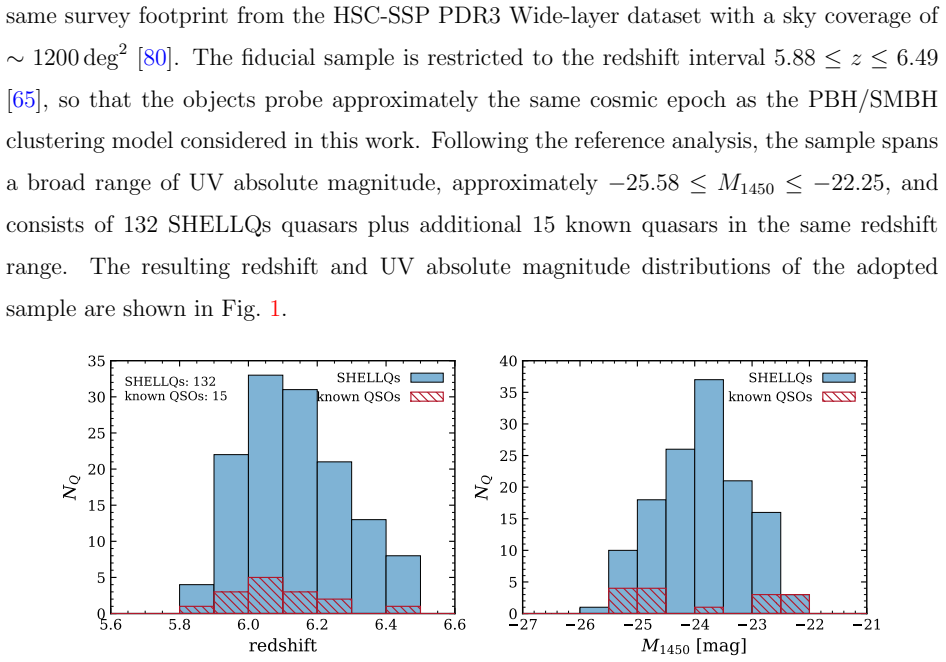
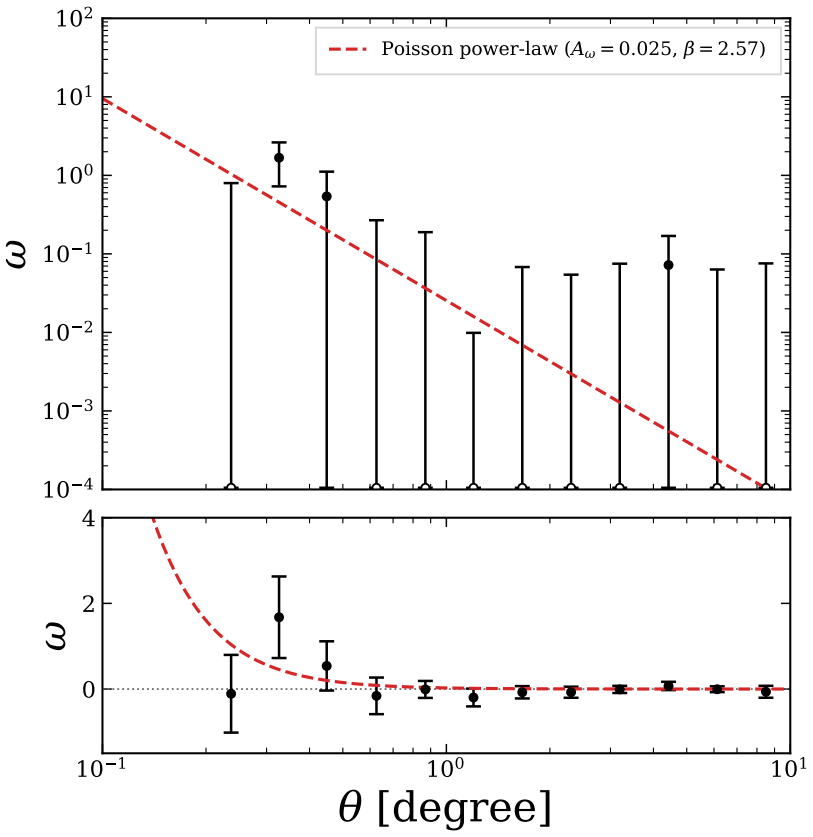
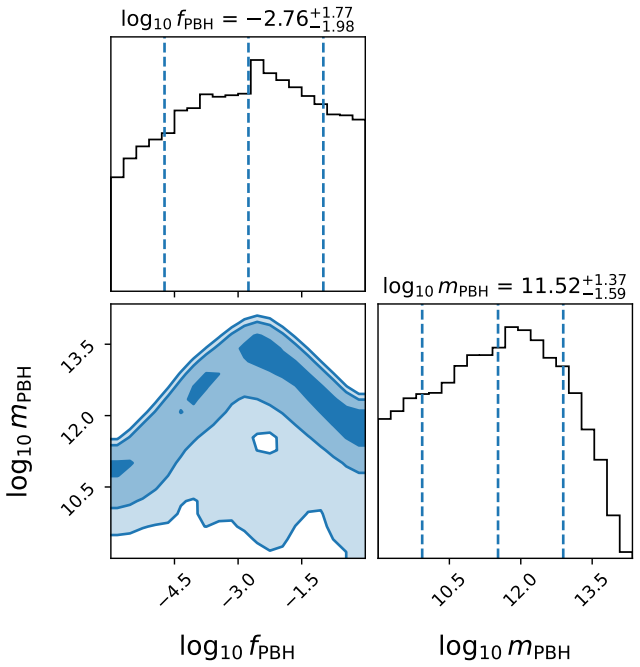
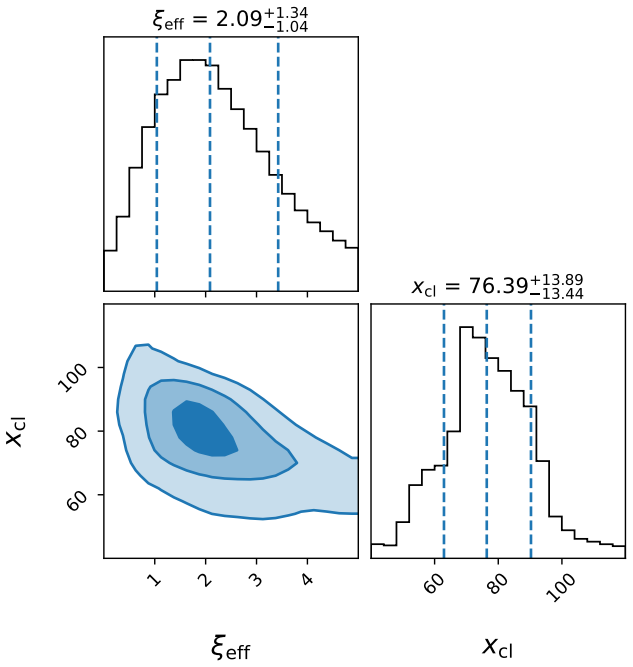
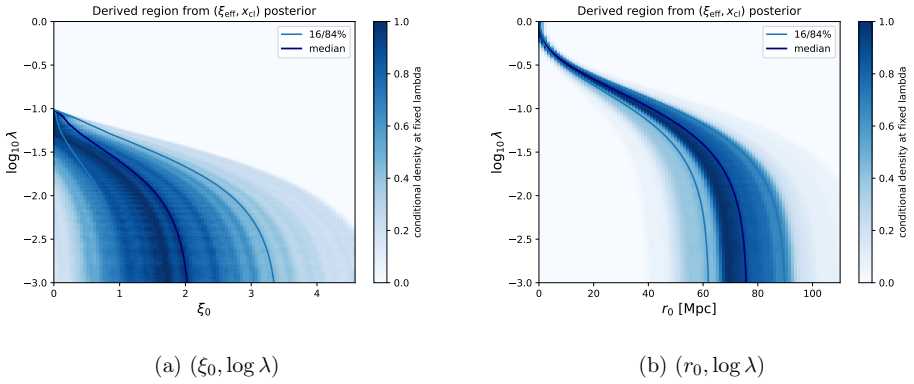
The angular auto-correlation function of z≃6 quasars is compared with the line-of-sight projection of evolved supermassive primordial black hole correlation functions for both Poisson and initially clustered distributions. Markov chain Monte Carlo inference shows that the Poisson model favors an abundance f_PBH∼10^{-3} and an effective mass m_PBH∼10^{12}M_⊙ interpreted as controlling quasar host-halo formation, while the initially clustered model favors an effective clustering amplitude ξ_eff≃2.1 and a top-hat boundary scale r_cl≃76 Mpc that corresponds to weak relative contraction of PBH pairs in comoving coordinates.
What carries the argument
The line-of-sight projection of the evolved PBH two-point correlation function (Poisson or initially clustered) onto the observed angular auto-correlation function of quasars, sampled by MCMC.
If this is right
- The Poisson model requires a PBH abundance near 10^{-3} and an effective mass scale near 10^{12} solar masses that governs host-halo clustering.
- The initially clustered model requires an effective amplitude near 2.1 on a 76 Mpc top-hat scale.
- PBH pairs experience only weak relative contraction in comoving coordinates.
- Both models are tested by direct comparison of the projected correlation function to the measured angular auto-correlation.
Where Pith is reading between the lines
- If the association holds, PBH clustering could supply an alternative channel for early halo assembly that competes with standard baryonic seeding.
- Future wide-field surveys at similar or higher redshift could tighten the posterior on the boundary scale and distinguish the two formation scenarios.
- The derived mass scale could be cross-checked against independent limits on the halo mass function at z≃6 derived from galaxy luminosity functions.
- The same projection technique could be applied to other high-redshift tracers such as Lyman-alpha emitters to test consistency of the PBH hypothesis.
Load-bearing premise
That supermassive primordial black holes are associated with the observed quasar population at z≃6.
What would settle it
A new measurement of the z≃6 quasar angular correlation function lying outside the 1σ posterior range predicted by either the Poisson or clustered PBH model with the reported parameter values.
Figures
read the original abstract
High-redshift quasars provide a direct probe of the origin and environment of the earliest supermassive black holes. We use their angular auto-correlation function at $z\simeq 6$ to test scenarios in which supermassive primordial black holes (SMPBHs) are associated with the observed quasar population. The evolved PBH correlation functions, for both Poisson fluctuations and initial PBH clustering, are projected over the quasar redshift window and compared with the measured angular correlation function using Markov chain Monte Carlo inference. It is observed that for the Poisson model, the posterior favors a small abundance, $f_{\rm PBH}\sim 10^{-3}$, and a supermassive effective mass scale, $m_{\rm PBH}\sim 10^{12}M_\odot$, interpreted here as a scale controlling quasar host-halo formation and clustering, and for the initially clustered model, the data prefer an effective clustering amplitude $\xi_{\rm eff}\simeq 2.1$ and a top-hat boundary scale $r_{\rm cl}\simeq 76\,{\rm Mpc}$, corresponding to weak relative contraction of PBH pairs in comoving coordinates.
Editorial analysis
A structured set of objections, weighed in public.
Referee Report
Summary. The paper claims that the angular auto-correlation function of z≃6 quasars can be used to test scenarios where supermassive primordial black holes (SMPBHs) are associated with the observed quasar population. It projects evolved 3D PBH correlation functions (Poisson and initially clustered top-hat models) over the quasar redshift window and employs MCMC inference to obtain posteriors: for the Poisson model, f_PBH∼10^{-3} and m_PBH∼10^{12}M_⊙ (reinterpreted as controlling quasar host-halo formation), and for the clustered model, ξ_eff≃2.1 and r_cl≃76 Mpc.
Significance. If the association premise holds, the work provides a data-driven method to constrain effective parameters in SMPBH clustering models at high redshift using standard projection and MCMC techniques. The approach is a reasonable extension of correlation-function analyses to PBH scenarios, though the parameter reinterpretation limits direct comparison to conventional PBH abundance constraints.
major comments (2)
- [Abstract] Abstract: the claim that m_PBH∼10^{12}M_⊙ is interpreted as 'a scale controlling quasar host-halo formation and clustering' decouples the fitted f_PBH from the standard PBH number density n_PBH = f_PBH ρ_m / m_PBH, so the reported abundance posterior does not correspond to a conventional PBH fraction constraint.
- The central premise that z≃6 quasars directly trace an SMPBH population (allowing the correlation function to be interpreted as a PBH signal) is load-bearing for all reported posteriors, yet the manuscript supplies no independent evidence or falsifiable test for this association beyond the modeling assumption itself.
minor comments (1)
- [Abstract] The abstract would benefit from explicitly stating the assumed redshift distribution or window function used to project the 3D correlation functions.
Simulated Author's Rebuttal
We thank the referee for their thoughtful and constructive comments. We address each major comment below. Revisions have been made where they improve clarity on parameter interpretations and model assumptions without altering the core analysis.
read point-by-point responses
-
Referee: [Abstract] Abstract: the claim that m_PBH∼10^{12}M_⊙ is interpreted as 'a scale controlling quasar host-halo formation and clustering' decouples the fitted f_PBH from the standard PBH number density n_PBH = f_PBH ρ_m / m_PBH, so the reported abundance posterior does not correspond to a conventional PBH fraction constraint.
Authors: We agree with the referee's observation. In our model, m_PBH functions as an effective scale governing quasar host-halo formation and clustering rather than a literal PBH mass, which intentionally decouples f_PBH from the conventional number-density relation. The posteriors therefore apply to this effective quasar-associated scenario and are not standard PBH abundance constraints. We will revise the abstract and add an explicit clarifying statement in the methods and discussion sections to emphasize this distinction and limit direct comparison to conventional PBH limits. revision: yes
-
Referee: The central premise that z≃6 quasars directly trace an SMPBH population (allowing the correlation function to be interpreted as a PBH signal) is load-bearing for all reported posteriors, yet the manuscript supplies no independent evidence or falsifiable test for this association beyond the modeling assumption itself.
Authors: The manuscript is framed as an exploration of the consequences of associating SMPBHs with the z≃6 quasar population; the association is the central modeling hypothesis under which the correlation-function constraints are derived. No independent evidence for the association is provided or claimed, as that would require separate observational tests outside the scope of this work. The resulting parameter constraints (e.g., ξ_eff and r_cl) do supply specific, testable predictions for clustering under the assumed association. We will add language in the introduction and conclusions to make the conditional nature of the results more explicit. revision: partial
Circularity Check
No significant circularity; standard data-driven constraints
full rationale
The paper projects evolved PBH 3D correlation functions (Poisson or top-hat clustered) onto the angular correlation function over the z≈6 quasar window and performs MCMC fitting to obtain posteriors on f_PBH, m_PBH (or ξ_eff, r_cl). This is a direct model-to-data comparison under the explicitly stated premise that quasars trace SMPBHs; the reported values are fits, not claimed first-principles predictions. No self-definitional steps, fitted inputs renamed as predictions, load-bearing self-citations, or ansatz smuggling appear in the abstract or described chain. The re-interpretation of m_PBH as a host-halo scale is an interpretive choice within the tested scenario, not a reduction of the result to its inputs by construction. The derivation remains self-contained against external benchmarks.
Axiom & Free-Parameter Ledger
free parameters (4)
- f_PBH =
~10^{-3}
- m_PBH =
~10^{12} M_⊙
- ξ_eff =
2.1
- r_cl =
76 Mpc
axioms (2)
- domain assumption SMPBHs are associated with the observed z≃6 quasar population
- standard math Standard projection of 3D PBH correlation functions onto the quasar redshift window
invented entities (1)
-
SMPBHs associated with quasars
no independent evidence
Reference graph
Works this paper leans on
-
[1]
Fan et al.,A Survey of z ¿ 5.8 quasars in the Sloan Digital Sky Survey
X. Fan et al.,A Survey of z ¿ 5.8 quasars in the Sloan Digital Sky Survey. 1. Discovery of three new quasars and the spatial density of luminous quasars at z approximately 6,Astron. J.122(2001) 2833–2849, [astro-ph/0108063]
Pith/arXiv arXiv 2001
-
[2]
Fan et al.,A Survey of z ¿ 5.7 quasars in the Sloan Digital Sky Survey
X. Fan et al.,A Survey of z ¿ 5.7 quasars in the Sloan Digital Sky Survey. 3. Discovery of five additional quasars,Astron. J.128(2004) 515–522, [astro-ph/0405138]
Pith/arXiv arXiv 2004
-
[3]
L. Jiang, X. Fan, J. Annis, R. H. Becker, R. L. White, K. Chiu, H. Lin, R. H. Lupton, G. T. Richards, M. A. Strauss, et al.,A survey ofz∼6quasars in the sloan digital sky survey deep stripe. i. a flux-limited sample atz AB <21,The Astronomical Journal135(Mar., 2008) 1057–1066, [arXiv:0708.2578]
Pith/arXiv arXiv 2008
-
[4]
Jiang et al.,The Final SDSS High-Redshift Quasar Sample of 52 Quasars at z>5.7, Astrophys
L. Jiang et al.,The Final SDSS High-Redshift Quasar Sample of 52 Quasars at z>5.7, Astrophys. J.833(2016), no. 2 222, [arXiv:1610.05369]
Pith/arXiv arXiv 2016
-
[5]
Y. Matsuoka, M. Onoue, N. Kashikawa, K. Iwasawa, M. A. Strauss, T. Nagao, M. Imanishi, C.-H. Lee, M. Akiyama, N. Asami, et al.,Subaru high-z exploration of low-luminosity quasars (shellqs). ii. discovery of 32 quasars and luminous galaxies at5.7< z <6.8, Publications of the Astronomical Society of Japan70(Jan., 2018) S35, [arXiv:1704.05854]
Pith/arXiv arXiv 2018
-
[6]
Matsuoka et al.,Discovery of the First Low-luminosity Quasar atz >7,Astrophys
Y. Matsuoka et al.,Discovery of the First Low-luminosity Quasar atz >7,Astrophys. J. Lett.872(2019), no. 1 L2, [arXiv:1901.10487]
arXiv 2019
-
[7]
Y. Matsuoka, K. Iwasawa, M. Onoue, T. Nagao, T. Izumi, M. A. Strauss, M. Imanishi, N. Kashikawa, F. Wang, Y. Toba, et al.,Subaru high-z exploration of low-luminosity quasars (shellqs). xvi. 69 new quasars at5.8< z <7.0,The Astrophysical Journal Supplement Series 259(Mar., 2022) 18, [arXiv:2111.12766]
arXiv 2022
-
[8]
C. J. Willott et al.,Four Quasars above Redshift 6 Discovered by the Canada-France High-z Quasar Survey,Astron. J.134(2007) 2435–2450, [arXiv:0706.0914]
Pith/arXiv arXiv 2007
-
[9]
C. J. Willott et al.,The Canada-France High-z Quasar Survey: Nine New Quasars and the Luminosity Function at Redshift 6,Astron. J.139(2010) 906–918, [arXiv:0912.0281]
Pith/arXiv arXiv 2010
-
[10]
E. Banados, B. P. Venemans, R. Decarli, E. P. Farina, C. Mazzucchelli, F. Walter, X. Fan, D. Stern, E. Schlafly, K. C. Chambers, et al.,The pan-starrs1 distantz >5.6quasar survey: More than 100 quasars within the first gyr of the universe,The Astrophysical Journal 16 Supplement Series227(Nov., 2016) 11, [arXiv:1608.03279]
Pith/arXiv arXiv 2016
-
[11]
D. J. Mortlock et al.,A luminous quasar at a redshift of z = 7.085,Nature474(2011) 616–619, [arXiv:1106.6088]
Pith/arXiv arXiv 2011
-
[12]
X. Fan, E. Banados, and R. A. Simcoe,Quasars and the Intergalactic Medium at Cosmic Dawn,Ann. Rev. Astron. Astrophys.61(2023) 373–426, [arXiv:2212.06907]
arXiv 2023
-
[13]
X.-B. Wu et al.,An ultraluminous quasar with a twelve-billion-solar-mass black hole at redshift 6.30,Nature518(2015) 512–515, [arXiv:1502.07418]
Pith/arXiv arXiv 2015
-
[14]
Onoue et al.,Subaru High-z Exploration of Low-Luminosity Quasars (SHELLQs)
M. Onoue et al.,Subaru High-z Exploration of Low-Luminosity Quasars (SHELLQs). VI. Black Hole Mass Measurements of Six Quasars at6.1≤z≤6.7,Astrophys. J.880(2019), no. 2 77, [arXiv:1904.07278]
arXiv 2019
-
[15]
E. P. Farina et al.,The X-shooter/ALMA Sample of Quasars in the Epoch of Reionization. II. Black Hole Masses, Eddington Ratios, and the Formation of the First Quasars, Astrophys. J.941(2022), no. 2 106, [arXiv:2207.05113]
arXiv 2022
-
[16]
M. Volonteri, M. Habouzit, and M. Colpi,The origins of massive black holes,Nature Rev. Phys.3(2021), no. 11 732–743, [arXiv:2110.10175]
arXiv 2021
-
[17]
K. Inayoshi, E. Visbal, and Z. Haiman,The Assembly of the First Massive Black Holes, Ann. Rev. Astron. Astrophys.58(2020) 27–97, [arXiv:1911.05791]
arXiv 2020
-
[18]
S. W. Hawking,Gravitationally collapsed objects of very low mass,Mon. Not. Roy. Astron. Soc.152(1971) 75
1971
-
[19]
B. J. Carr and S. W. Hawking,Black holes in the early Universe,Mon. Not. Roy. Astron. Soc.168(1974) 399–415
1974
-
[20]
Y. B. Zel’dovich and I. D. Novikov,The Hypothesis of Cores Retarded during Expansion and the Hot Cosmological Model,Sov. Astron.10(1967) 602
1967
-
[21]
B. Carr, F. Kuhnel, and M. Sandstad,Primordial Black Holes as Dark Matter,Phys. Rev. D 94(2016), no. 8 083504, [arXiv:1607.06077]
Pith/arXiv arXiv 2016
-
[22]
G. F. Chapline,Cosmological effects of primordial black holes,Nature253(1975) 251–252
1975
-
[23]
Meszaros,Primeval black holes and galaxy formation,Astron
P. Meszaros,Primeval black holes and galaxy formation,Astron. Astrophys.38(1975) 5–13
1975
-
[24]
B. Carr, K. Kohri, Y. Sendouda, and J. Yokoyama,Constraints on primordial black holes, Rept. Prog. Phys.84(2021), no. 11 116902, [arXiv:2002.12778]
Pith/arXiv arXiv 2021
-
[25]
B. Carr, S. Clesse, J. Garcia-Bellido, M. Hawkins, and F. Kuhnel,Observational evidence for primordial black holes: A positivist perspective,Phys. Rept.1054(2024) 1–68, 17 [arXiv:2306.03903]
arXiv 2024
-
[26]
T. Nakama, T. Suyama, and J. Yokoyama,Supermassive black holes formed by direct collapse of inflationary perturbations,Phys. Rev. D94(2016), no. 10 103522, [arXiv:1609.02245]
Pith/arXiv arXiv 2016
-
[27]
H.-L. Huang, Z.-H. Wang, Q.-Y. Lan, J.-Q. Jiang, J. He, Y.-T. Wang, J. Zhang, and Y.-S. Piao,Search for primordial black holes from gravitational wave populations using deep learning,arXiv:2503.05570
-
[28]
J.-Q. Jiang, H.-L. Huang, J. He, Y.-T. Wang, and Y.-S. Piao,A fast deep-learning approach to probing primordial black hole populations in gravitational wave events,arXiv:2505.15530
-
[29]
H.-L. Huang, Y.-T. Wang, and Y.-S. Piao,Supermassive primordial black holes for the GHZ9 and UHZ1 observed by the JWST,arXiv:2410.05891
-
[30]
H.-L. Huang, J.-Q. Jiang, J. He, Y.-T. Wang, and Y.-S. Piao,Sub-Eddington accreting supermassive primordial black holes explain Little Red Dots,arXiv:2410.20663
- [31]
-
[32]
P.-X. Lin and Y.-S. Piao,Populating the landscape in an inhomogeneous universe,Phys. Rev. D105(2022), no. 6 063534, [arXiv:2111.09174]
arXiv 2022
- [33]
-
[34]
H.-H. Li, G. Ye, and Y.-S. Piao,Is the NANOGrav signal a hint of dS decay during inflation?,Phys. Lett. B816(2021) 136211, [arXiv:2009.14663]
arXiv 2021
-
[35]
G. Ye and Y.-S. Piao,Is the Hubble tension a hint of AdS phase around recombination?, Phys. Rev. D101(2020), no. 8 083507, [arXiv:2001.02451]
arXiv 2020
-
[36]
J.-Q. Jiang and Y.-S. Piao,Testing AdS early dark energy with Planck, SPTpol, and LSS data,Phys. Rev. D104(2021), no. 10 103524, [arXiv:2107.07128]
arXiv 2021
-
[37]
G. Ye, J. Zhang, and Y.-S. Piao,Alleviating bothH 0 andS 8 tensions: Early dark energy lifts the CMB-lockdown on ultralight axion,Phys. Lett. B839(2023) 137770, [arXiv:2107.13391]
arXiv 2023
-
[38]
H. Wang and Y.-S. Piao,Dark energy in light of recent DESI BAO and Hubble tension, arXiv:2404.18579
-
[39]
H. Wang, Z.-Y. Peng, and Y.-S. Piao,Can recent DESI BAO measurements accommodate a negative cosmological constant?,arXiv:2406.03395. 18
-
[40]
Q.-Y. Lan and Y.-S. Piao,Prepare inflationary universe via the Euclidean charged wormhole, arXiv:2411.13844
-
[41]
Z.-Y. Peng, H.-S. Yuan, Q. Lai, J.-Q. Jiang, G. Ye, J. Zhang, and Y.-S. Piao,DeepInflation: an AI agent for research and model discovery of inflation,arXiv:2601.14288
- [42]
-
[43]
D. J. Fixsen, E. S. Cheng, J. M. Gales, J. C. Mather, R. A. Shafer, and E. L. Wright,The Cosmic Microwave Background spectrum from the full COBE FIRAS data set,Astrophys. J. 473(1996) 576, [astro-ph/9605054]
Pith/arXiv arXiv 1996
-
[44]
J. C. Mather et al.,Measurement of the Cosmic Microwave Background spectrum by the COBE FIRAS instrument,Astrophys. J.420(1994) 439–444
1994
-
[45]
Y. B. Zeldovich and R. A. Sunyaev,The Interaction of Matter and Radiation in a Hot-Model Universe,Astrophys. Space Sci.4(1969) 301–316
1969
-
[46]
J. Chluba and R. A. Sunyaev,The evolution of CMB spectral distortions in the early Universe,Mon. Not. Roy. Astron. Soc.419(2012) 1294–1314, [arXiv:1109.6552]
Pith/arXiv arXiv 2012
-
[47]
K. Kohri, T. Nakama, and T. Suyama,Testing scenarios of primordial black holes being the seeds of supermassive black holes by ultracompact minihalos and CMBµ-distortions,Phys. Rev. D90(2014), no. 8 083514, [arXiv:1405.5999]
Pith/arXiv arXiv 2014
-
[48]
A. D. Gow, C. T. Byrnes, P. S. Cole, and S. Young,The power spectrum on small scales: Robust constraints and comparing PBH methodologies,JCAP02(2021) 002, [arXiv:2008.03289]
arXiv 2021
-
[49]
T. Nakama, B. Carr, and J. Silk,Limits on primordial black holes fromµdistortions in cosmic microwave background,Phys. Rev. D97(2018), no. 4 043525, [arXiv:1710.06945]
Pith/arXiv arXiv 2018
- [50]
-
[51]
C. T. Byrnes, J. Lesgourgues, and D. Sharma,Robustµ-distortion constraints on primordial supermassive black holes from non-Gaussian perturbations,arXiv:2404.18475
-
[52]
X. Pritchard, C. T. Byrnes, J. Lesgourgues, and D. Sharma,Robustµ-distortion constraints on primordial supermassive black holes from cubic (gNL) non-Gaussian perturbations,JCAP 07(2025) 079, [arXiv:2505.08442]
arXiv 2025
-
[53]
Z.-H. Wang, H.-L. Huang, and Y.-S. Piao,Broad primordial power spectrum andµ-distortion 19 constraints on primordial black holes,arXiv:2501.08542
-
[54]
V. D. Luca, V. Desjacques, G. Franciolini, and A. Riotto,The clustering evolution of primordial black holes,Journal of Cosmology and Astroparticle Physics2020(Nov, 2020) 028–028
2020
-
[55]
Y. Tada and S. Yokoyama,Primordial black holes as biased tracers,Phys. Rev. D91(2015), no. 12 123534, [arXiv:1502.01124]
Pith/arXiv arXiv 2015
-
[56]
S. Young and C. T. Byrnes,Primordial black holes in non-Gaussian regimes,JCAP08 (2013) 052, [arXiv:1307.4995]
Pith/arXiv arXiv 2013
-
[57]
G. Franciolini, A. Kehagias, S. Matarrese, and A. Riotto,Primordial Black Holes from Inflation and non-Gaussianity,JCAP03(2018) 016, [arXiv:1801.09415]
Pith/arXiv arXiv 2018
-
[58]
T. Suyama and S. Yokoyama,Clustering of primordial black holes with non-Gaussian initial fluctuations,PTEP2020(2020), no. 2 023E03, [arXiv:1912.04687]
arXiv 2020
- [59]
-
[60]
H.-L. Huang and Y.-S. Piao,Towards supermassive primordial black holes from inflationary bubbles,arXiv:2312.11982
-
[61]
H.-L. Huang, J.-Q. Jiang, and Y.-S. Piao,High-redshift jwst massive galaxies and the initial clustering of supermassive primordial black holes,arXiv:2407.15781
-
[62]
H.-L. Huang, J.-Q. Jiang, and Y.-S. Piao,Merger rate of supermassive primordial black hole binaries,Phys. Rev. D109(2024), no. 6 063515, [arXiv:2312.00338]
arXiv 2024
-
[63]
V. De Luca, G. Franciolini, A. Riotto, and H. Veermae,Ruling out initially clustered primordial black holes as dark matter,Physical Review Letters129(Nov., 2022) 191302, [arXiv:2208.01683]
arXiv 2022
-
[64]
T. Shinohara, T. Suyama, and T. Takahashi,Angular correlation as a novel probe of supermassive primordial black holes,Phys. Rev. D104(2021), no. 2 023526, [arXiv:2103.13692]
arXiv 2021
-
[65]
T. Shinohara, W. He, Y. Matsuoka, T. Nagao, T. Suyama, and T. Takahashi,Supermassive primordial black holes: A view from clustering of quasars at z∼6,Phys. Rev. D108(2023), no. 6 063510, [arXiv:2304.08153]
arXiv 2023
-
[66]
J. Arita, N. Kashikawa, Y. Matsuoka, W. He, K. Ito, Y. Liang, R. Ishimoto, T. Yoshioka, 20 Y. Takeda, K. Iwasawa, M. Onoue, Y. Toba, and M. Imanishi,Subaru High-zExploration of Low-Luminosity Quasars (SHELLQs). XVIII. The Dark Matter Halo Mass of Quasars at z∼6,Astrophys. J.954(2023), no. 2 210, [arXiv:2307.02531]
arXiv 2023
-
[67]
P. J. E. Peebles,The large-scale structure of the universe. Princeton university press, 2020
2020
-
[68]
Y. Matsuoka, K. Iwasawa, M. Onoue, T. Izumi, M. A. Strauss, M. Akiyama, K. Aoki, J. Arita, X. Ding, M. Imanishi, et al.,Subaru high-z exploration of low-luminosity quasars (shellqs). xxiv. 54 new quasars and candidate obscured quasars at5.71≤z≤7.02,The Astrophysical Journal Supplement Series280(Aug., 2025) 68, [arXiv:2508.21229]
Pith/arXiv arXiv 2025
-
[69]
Y. Matsuoka, K. Iwasawa, M. Onoue, N. Kashikawa, M. A. Strauss, C.-H. Lee, M. Imanishi, T. Nagao, M. Akiyama, N. Asami, et al.,Subaru high-z exploration of low-luminosity quasars (shellqs). x. discovery of 35 quasars and luminous galaxies at5.7≤z≤7.0,The Astrophysical Journal883(Sept., 2019) 183, [arXiv:1908.07910]
arXiv 2019
-
[70]
Y. Matsuoka, K. Iwasawa, M. Onoue, N. Kashikawa, M. A. Strauss, C.-H. Lee, M. Imanishi, T. Nagao, M. Akiyama, N. Asami, et al.,Subaru high-z exploration of low-luminosity quasars (shellqs). iv. discovery of 41 quasars and luminous galaxies at5.7< z <6.9,The Astrophysical Journal Supplement Series237(July, 2018) 5, [arXiv:1803.01861]
Pith/arXiv arXiv 2018
-
[71]
Y. Matsuoka, M. Onoue, N. Kashikawa, K. Iwasawa, M. A. Strauss, T. Nagao, M. Imanishi, M. Niida, Y. Toba, M. Akiyama, et al.,Subaru high-z exploration of low-luminosity quasars (shellqs). i. discovery of 15 quasars and bright galaxies at5.7< z <6.9,The Astrophysical Journal828(Sept., 2016) 26, [arXiv:1603.02281]
Pith/arXiv arXiv 2016
-
[72]
C. J. Willott, A. Omont, and J. Bergeron,Redshift 6.4 host galaxies of10 8 solar mass black holes: Low star formation rate and dynamical mass,The Astrophysical Journal770(June,
-
[73]
13, [arXiv:1302.1587]
-
[74]
B. P. Venemans, R. G. McMahon, E. Banados, E. A. Gonzalez-Solares, R. Decarli, P. C. Hewett, D. J. Mortlock, T. Shanks, S. J. Warren, M. Banerji, et al.,First discoveries ofz∼6 quasars with the kilo-degree survey and vista kilo-degree infrared galaxy survey,Monthly Notices of the Royal Astronomical Society453(Nov., 2015) 2259–2266, [arXiv:1507.00726]
Pith/arXiv arXiv 2015
-
[75]
C. J. Willott, P. Delorme, C. Reyle, L. Albert, J. Bergeron, D. Crampton, X. Delfosse, T. Forveille, J. B. Hutchings, R. J. McLure, et al.,Six more quasars at redshift 6 discovered by the canada–france high-z quasar survey,The Astronomical Journal137(Mar., 2009) 3541, [arXiv:0901.0565]. 21
Pith/arXiv arXiv 2009
-
[76]
Jiang, X
L. Jiang, X. Fan, F. Bian, J. Annis, K. Chiu, S. Jester, H. Lin, R. H. Lupton, G. T. Richards, M. A. Strauss, et al.,A survey ofz∼6quasars in the sloan digital sky survey deep stripe. ii. discovery of six quasars atz AB >21,The Astronomical Journal138(July, 2009) 305
2009
-
[77]
C. Mazzucchelli, E. Banados, B. P. Venemans, R. Decarli, E. P. Farina, F. Walter, A.-C. Eilers, H.-W. Rix, R. Simcoe, D. Stern, et al.,Physical properties of 15 quasars atz≃6.5, The Astrophysical Journal849(Nov., 2017) 91, [arXiv:1710.01251]
Pith/arXiv arXiv 2017
-
[78]
Y. Kim, M. Im, Y. Jeon, M. Kim, C. Choi, J.-W. Hong, M. Hyun, H. D. Jun, M. Karouzos, D. Kim, et al.,Discovery of a faint quasar atz∼6and implications for cosmic reionization, The Astrophysical Journal Letters813(Nov., 2015) L35
2015
-
[79]
N. Kashikawa, Y. Ishizaki, C. J. Willott, M. Onoue, M. Im, H. Furusawa, J. Toshikawa, S. Ishikawa, Y. Niino, K. Shimasaku, et al.,The subaru high-z quasar survey: Discovery of faintz∼6quasars,The Astrophysical Journal798(Jan., 2015) 28, [arXiv:1410.7401]
Pith/arXiv arXiv 2015
-
[80]
G. R. Zeimann, R. L. White, R. H. Becker, J. A. Hodge, S. A. Stanford, and G. T. Richards, Discovery of a radio-selectedz∼6quasar,The Astrophysical Journal736(July, 2011) 57
2011
discussion (0)
Sign in with ORCID, Apple, or X to comment. Anyone can read and Pith papers without signing in.