REVIEW 4 major objections 5 minor 47 references
The paper claims that chiral symmetry — the bipartite sublattice structure of a hopping model with no on-site disorder — produces a new class of eigenfunction statistics, called semi-fractal, at zero energy, with a sharp crossover to locali
Reviewed by Pith at T0; open to challenge. T0 means a machine referee read the full paper against a public rubric. the ladder, T0–T4 →
T0 review · deepseek-v4-flash
2026-08-01 15:44 UTC pith:QR4D7TRZ
load-bearing objection Semi-fractal side is solid; localized side rests on a conversion step that the paper itself adjusts by hand. the 4 major comments →
Semi-fractality and localization on a chiral Cayley tree
The pith
A machine-rendered reading of the paper's core claim, the machinery that carries it, and where it could break.
Core claim
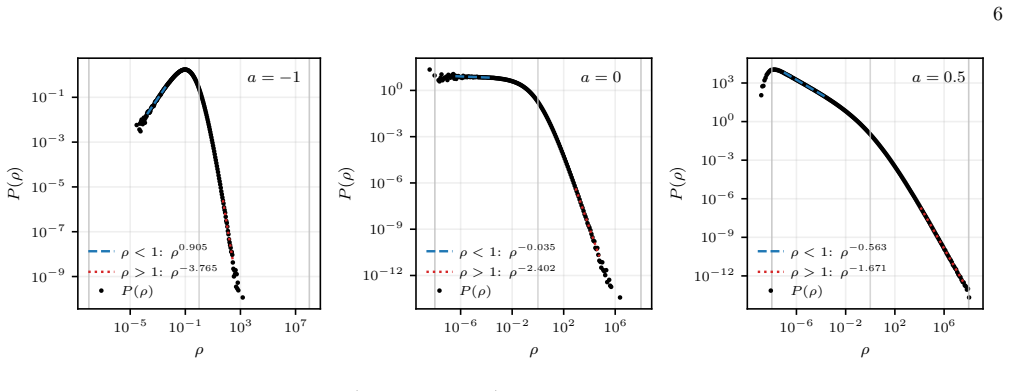
The central claim is that at zero energy the distribution P(ρ) of the local density of states on the chiral Cayley tree obeys a piecewise power law, P(ρ) ∼ ρ^{1+β−γ} for small ρ and P(ρ) ∼ ρ^{−(1+β)} for large ρ, with β and γ depending continuously on the exponent a of the hopping distribution p(t) ∝ e^{−t²}/|t|^{a}. These tails satisfy the Mirlin–Fyodorov reflection symmetry P(1/ρ) = ρ^γ P(ρ), but γ is not fixed by the symmetry class; here it varies with a. The authors show that such a two-tail distribution implies a piecewise-linear spectrum of fractal dimensions f(α) with a linear segment of slope β, leading to D_q = 1 for q < β and D_q = (β−1)/(q−1) for q > β when β > 1 — the semi-fracta
What carries the argument
The organizing mechanism is the chiral (sublattice) symmetry of the bipartite graph, which makes the retarded Green's function pure imaginary at E = 0 and leads to the cavity recursion G_{i→j} = (−E−iη − Σ t² G_{a→i})^{−1}. The paper solves this recursion by population dynamics and finds that the LDoS distribution has two power-law tails connected by the Mirlin–Fyodorov symmetry P(1/ρ) = ρ^γ P(ρ). The bridge from P(ρ) to eigenfunction multifractality is Eq. (13), which converts finite-broadening LDoS moments into finite-size participation moments through the self-consistency condition η_c N⟨ρ⟩ ∼ 1. This yields the piecewise-linear spectrum τ(q) and hence the fractal dimensions D_q and the sp
Load-bearing premise
The derivation of the multifractal spectrum assumes that the two-power-law form of the LDoS distribution holds all the way to vanishing broadening η and that the mean LDoS equals the mean density of states, so that the self-consistency condition η_c N⟨ρ⟩ ∼ 1 faithfully converts infinite-size LDoS moments into finite-size eigenfunction moments; if level-spacing fluctuations or the divergent mean LDoS for β < 1 break this conversion, the predicted D_q and the phase boundary a_c
What would settle it
Compute the inverse participation ratios I_q = N⟨|ψ|^{2q}⟩ for the chiral random regular graph at the level closest to E = 0 for sizes up to N = 2^{16}, setting η to the level spacing; if the crossover from N^{1−q} to N^{1−β} occurs at q differing from β(a), or if the rank-ordered weight exponent µ fails to satisfy β = 1/µ, the semi-fractal scenario is falsified.
If this is right
- If chirality is the organizing principle, semi-fractal statistics should appear at band center in any disordered system with exact or approximate sublattice symmetry, not only on trees.
- At the critical value a_c ≈ 0.25 the wave functions realize the 'semi-localized' phase, which is simultaneously extended in support and localized in higher moments; this phase was previously anticipated but had no known realization.
- The exponent γ varies continuously with the disorder parameter, in contrast to the standard Dyson symmetry classes where γ is fixed (γ = 3) — chiral classes thus carry a non-universal Mirlin–Fyodorov exponent.
- Away from E = 0 the two power-law tails disappear and the standard Dyson value γ = 3 is restored, so the phenomenon is a zero-energy, chirality-protected effect.
- The rank-ordered eigenstate probabilities exhibit a power-law hierarchy, giving a microscopic picture of semi-fractality as a hierarchy of wave-function weights rather than a fractal support set.
Where Pith is reading between the lines
- One could test the chirality mechanism directly: in the quantum-simulator experiment, measuring participation entropies for eigenstates near the center of the band should reveal the plateau D_q = 1 for q < β followed by a multifractal branch, with β controlled by the effective disorder strength.
- The power-law hierarchy of eigenstate weights suggests an analogy to log-correlated random potentials and 'frozen' multifractality; if that analogy holds, the semi-fractal phase might be characterized by a freezing transition in the statistics of wave-function amplitudes.
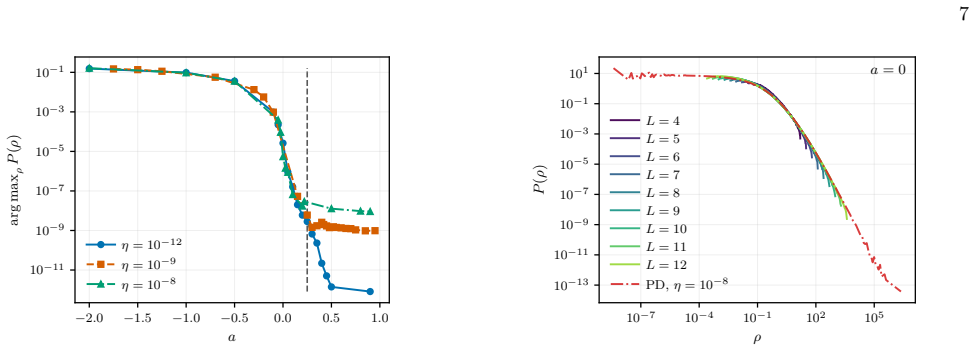
- The semi-localized point β = 1 may be a generic critical point for disordered chiral systems; a finite-size scaling collapse of the LDoS distribution around the most probable value, which drops by about ten orders of magnitude across the transition, could sharpen the estimate a_c ≈ 0.25.
- Because the derivation relies on the equality of mean LDoS and mean DoS, a numerical check of level-spacing fluctuations at the band center for β < 1 would clarify whether the localized-phase boundary is exactly at β = 1 or shifted by rare events.
Editorial analysis
A structured set of objections, weighed in public.
Referee Report
Summary. The paper studies a single-particle hopping model on a Cayley tree / random regular graph with chiral symmetry (no on-site disorder, bipartite hopping amplitudes drawn from p(t) ∝ e^{-t^2}/|t|^a). Using cavity equations solved by population dynamics, the authors find that the local density of states at E=0 has a piecewise power-law distribution P(ρ) with ρ^{1+β−γ} at small ρ and ρ^{−(1+β)} at large ρ, with β(a), γ(a) fitted numerically. They convert finite-η LDoS moments to finite-N eigenfunction moments using the self-consistency condition η_c N⟨ρ⟩∼1, obtaining D_q = 1 for q<β and D_q=(β−1)/(q−1) for q>β when β>1 (semi-fractal), D_q=0 for q>β and a non-ergodic form when β<1 (localized), and a jump from 1 to 0 at q=1 when β=1 (semi-localized). The fitted β(a) gives the transition at a_c≈0.25. Exact diagonalization on random regular graphs is used to support the f(α) spectra, and rank-ordered eigenfunction weights are argued to exhibit a power-law hierarchy.
Significance. If correct, the paper would provide a concrete chiral mechanism for the recently reported 'semi-fractal' statistics in quantum simulators, Erdős–Rényi graphs, and β-ensembles, and would sharpen the classification of non-ergodic extended phases. The population-dynamics implementation and the comparison with exact diagonalization on finite random regular graphs are valuable, and the release of code is a plus. The β>1 (semi-fractal) side appears to have reasonably direct numerical support from the f(α) extrapolations in Fig. 11. The main significance, however, depends on the reliability of the LDoS-to-eigenfunction conversion and on the fitted exponents; those are the points that need attention before the broad claims can be accepted.
major comments (4)
- [Sec. III B and Sec. V A (Eqs. 21–23, Fig. 10)] The localized phase for β<1 rests on Eq. (13) combined with η_c∼N^{−1/β}. This conversion is not independently verified in the β<1 regime. The only direct check, Fig. 10, shows that when η crosses N^{−1/β} the ED tail exponent β changes by ~0.1, and the authors then use this 'adjusted' β in Eq. (23) to match the f(α) data. That is circular: the prediction is brought into agreement by changing one of its inputs. A non-circular test would be to compute I_q from ED eigenfunctions at finite N and compare with Eq. (22) using the population-dynamics β, or to derive the expected η-shift of β from the model. Without this, the quantitative phase boundary a_c≈0.25 and the β<1 side are not supported.
- [Sec. IV, Fig. 6] The transition point a_c≈0.25 is read off from the condition β=1 on a fitted curve β(a), with no error bars, no finite-η extrapolation, and no account of the fitting range used for the power-law tails. Since the entire phase diagram depends on these fitted exponents, the absence of uncertainty estimates is load-bearing. The authors should provide bootstrap or range-scan errors for β(a) and γ(a), and show explicitly that the exponent determination is stable as η→0 (or how the finite-η drift affects a_c).
- [Sec. V C, Eqs. (29)–(33) and Fig. 13] There is an internal inconsistency in the rank-ordered weight analysis. Fig. 13 shows a slope of −0.70, i.e. ⟨w(r)⟩∼N^{μ−1}r^{−μ} with μ≈0.7, but Eq. (29) prints r^{μ}. More seriously, substituting the correct r^{−μ} form gives τ(q)=q−1 for q<1/μ and τ(q)=q(1−μ) for q>1/μ, whereas the LDoS-derived semi-fractal spectrum from Sec. III A gives τ(q)=q−1 for q<β and τ(q)=β−1 (a plateau) for q>β. The statement 'identifies β=1/μ' only matches the crossover point, not the shape of τ(q). For a=−0.5, the paper's own numbers (β≈2.07 from Fig. 11 and μ≈0.7) give 1/μ≈1.43, not 2.07, and D_2 differs (1 from the LDoS theory versus ≈0.6 from the rank profile). This discrepancy must be resolved or the rank-profile section should be explicitly presented as a separate, qualitative observation rather than a derivation of the same D_q.
- [Sec. II–III (Eqs. 11–14)] The piecewise power-law form (14) is an empirical fit to population-dynamics data, not a derived result, and the subsequent D_q and f(α) calculations assume that both exponents β and γ are independent of η in the entire range η≪ρ≪η^{-1}. The paper does not provide a check that β and γ extracted at finite η (e.g. η=10^{-8}) remain valid as η→0 for all a, nor a discussion of why the two-power-law form should be exact or asymptotically exact. Since Eq. (14) is the input to the Mellin-type moment calculation, the authors should state clearly the numerical/analytical evidence for η-independence, or qualify the results as conditional on this assumption.
minor comments (5)
- [Sec. V C, Eq. (29)] The displayed formula ⟨w(r)⟩∼N^{−(1−μ)}r^{μ} has the wrong sign in the rank exponent; the figure and the subsequent summation use r^{−μq}. Please correct to r^{−μ}.
- [Sec. II heading] The heading 'CHIRAL OR THOGONAL SYMMETR Y CLASS' contains typos ('OR' should be 'ORTHOGONAL' and 'SYMMETR Y' should be 'SYMMETRY').
- [Sec. II, Eq. (5)] The notation ρ^q is overloaded: it is used both for the q-th power of the LDoS and for the disorder-averaged moment ⟨ρ^q⟩. Please use a distinct symbol for the averaged moment, e.g. M_q.
- [Fig. 2 caption] The value γ=2.437 for a=0 is quoted in the caption but the main text/Fig. 6 uses fitted values without explicit table. A small table of β(a), γ(a) with fitting ranges and errors would be useful.
- [References] Refs. [29] and [42] are marked 'To be posted'; if they are essential to the Discussion, please provide arXiv IDs or checkable details. Otherwise, referencing unpublished works weakens the reproducibility of the claims.
Circularity Check
No circular derivation: the LDoS-to-eigenfunction mapping is analytic, and the β(a) phase boundary is a numerical output rather than a fitted prediction.
full rationale
The paper's central chain is self-contained. Population dynamics solves the cavity equations (24)-(25) and produces P(ρ); the exponents β and γ are fitted to the tails of this distribution (Figs. 4-6), not to the eigenfunction moments that the theory then predicts. The conversion from tail exponents to I_q and D_q goes through the analytic relations Eqs. (5)-(23), including the self-consistency condition Eq. (11). If the two-power-law form or the mean-LDoS=mean-DoS assumption of footnote [37] fails, the results would not follow, but an unverified assumption is a correctness risk, not circularity. Locating a_c≈0.25 by solving the computed β(a)=1 is a standard numerical phase-boundary determination; β is not defined by the transition. The semi-fractal side β>1 is confirmed against ED in Fig. 11 using the PD-derived β without adjustment. On the localized side, Sec. V.A states that 'the value of β increases by approximately 0.1' in ED and that this adjusted β should be used in Eq. (23); this is an admitted finite-size correction and weakens the quantitative test, but the adjusted β is extracted from the ED LDoS tail, a different observable from the f(α) slope that is compared, so the check is not an identity by construction. Self-citations (Refs. 19,20,21,22,29,42) are contextual or heuristic and are not load-bearing for the derivation. No equation reduces to its own input.
Axiom & Free-Parameter Ledger
free parameters (3)
- β(a) — large-ρ tail exponent of P(ρ) =
ranges ≈2.4 (a=-1) down to ≈0.6 (a=0.6); β=1 at a_c≈0.25 (Fig. 6)
- γ(a) — Mirlin–Fyodorov symmetry exponent =
≈2.44 (a=0), between 2 and 3 for a∈[-2,0.95] (Fig. 6)
- μ (rank-ordered weight exponent) =
≈0.7 for a=-0.5 (Fig. 13)
axioms (5)
- domain assumption Cavity recursion (Eq. 24) has a unique stationary distribution describing the infinite Cayley tree; population dynamics converges to it.
- domain assumption At E=0 the single-particle Green's functions are pure imaginary due to chiral symmetry (Eqs. 3-4).
- ad hoc to paper The LDoS distribution has the two-power-law form (14) over the whole range η≪ρ≪η^{-1}, with exponents β,γ independent of η.
- domain assumption The mean LDoS equals the mean DoS (footnote [37]), and the self-consistency condition η_c N⟨ρ⟩∼1 (Eq. 11) converts infinite-size finite-η LDoS moments into finite-size eigenfunction moments (Eqs. 12-13).
- standard math The Mirlin-Fyodorov symmetry P(1/ρ)=ρ^γ P(ρ) holds for the chiral class, with γ not fixed by the symmetry class.
invented entities (2)
-
semi-fractal phase
independent evidence
-
semi-localized phase
independent evidence
read the original abstract
We study a quantum particle hopping on an infinite Cayley tree with nearest-neighbor hopping amplitudes drawn from a distribution singular as $|t|^{-a}$ near weak links and no on-site disorder. Because the graph is bipartite, the model has chiral symmetry, which strongly affects the statistics of eigenstates at the center of the spectrum. Using population dynamics to solve the cavity equations for the propagator, we analyze the distribution of the local density of states and show that it develops broad power-law tails. These tails imply an unusual form of wave-function statistics, which we call semi-fractality: the eigenstates occupy an extensive fraction of the system, but their higher moments behave as in a multifractal state. We find that the symmetry properties of the local-density-of-states distribution are not fixed only by the symmetry class, but vary continuously with the exponent controlling the power-law hopping distribution. As this exponent is changed, the system crosses from a semi-fractal regime to a localized one. At the transition, the wave functions realize an extreme intermediate form that we call semi-localized, simultaneously extended in their support but localized according to higher moments.
Figures





Reference graph
Works this paper leans on
-
[1]
The support set of wave functions in such a phase is proportional toN, but other important measures, e.g., the return probability,R(t), which is determined by the fractal dimensionD 2, may show a typical multifractal behaviorR t ∝t −D2 [3, 23, 24]. According to its definition,D q in the semi-fractal phase must benon-analytic, generally with a jump of the ...
Pith/arXiv arXiv 2026
-
[2]
The central and the right panels of Fig
We verified that all the extrapolations are consistent with the predictions. The central and the right panels of Fig. 11 show the1/Lextrapolation of data from finite values of1/L(black points) to1/L→0and the corre- sponding target following from the theory (black square). Notethatthenodesofthewavefunctionheavilyinfluence the part of the plot corresponding...
-
[3]
P. W. Anderson, Absence of diffusion in certain random lattices, Phys. Rev.109, 1492 (1958)
1958
-
[4]
Abrahams, P
E. Abrahams, P. W. Anderson, D. C. Licciardello, and T. V. Ramakrishnan, Scaling theory of localization: Ab- sence of quantum diffusion in two dimensions, Physical Review Letters42, 673 (1979)
1979
-
[5]
Evers and A
F. Evers and A. D. Mirlin, Anderson transitions, Reviews of Modern Physics80, 1355 (2008)
2008
-
[6]
B.L.Altshuler, Y.Gefen, A.Kamenev,andL.S.Levitov, Quasiparticle lifetime in a finite system: A nonperturba- tive approach, Physical Review Letters78, 2803–2806 (1997)
1997
-
[7]
Basko, I
D. Basko, I. Aleiner, and B. Altshuler, Metal–insulator transition in a weakly interacting many-electron system with localized single-particle states, Ann. Phys. (N. Y.) 321, 1126–1205 (2006)
2006
-
[8]
Oganesyan and D
V. Oganesyan and D. A. Huse, Localization of interacting fermions at high temperature, Phys. Rev. B75, 155111 (2007)
2007
-
[9]
D. A. Abanin, E. Altman, I. Bloch, and M. Serbyn, Col- loquium: Many-body localization, thermalization, and entanglement, Rev. Mod. Phys.91, 021001 (2019)
2019
-
[10]
Sierant, M
P. Sierant, M. Lewenstein, A. Scardicchio, L. Vidmar, and J. Zakrzewski, Many-body localization in the age of classical computing*, Reports on Progress in Physics88, 026502 (2025)
2025
-
[11]
De Luca, B
A. De Luca, B. L. Altshuler, V. E. Kravtsov, and A. Scardicchio, Anderson localization on the Bethe lat- tice: Nonergodicity of extended states, Phys. Rev. Lett. 113, 046806 (2014)
2014
-
[12]
K. S. Tikhonov, A. D. Mirlin, and M. A. Skvortsov, Anderson localization and ergodicity on random regular graphs, Phys. Rev. B94, 220203 (2016)
2016
-
[13]
B. L. Altshuler, E. Cuevas, L. B. Ioffe, and V. E. Kravtsov, Nonergodic phases in strongly disordered ran- dom regular graphs, Phys. Rev. Lett.117, 156601 (2016)
2016
-
[14]
Kravtsov, B
V. Kravtsov, B. Altshuler, and L. Ioffe, Non-ergodic de- localized phase in Anderson model on Bethe lattice and regular graph, Ann. Phys.389, 148 (2018)
2018
-
[15]
Tikhonov and A
K. Tikhonov and A. Mirlin, From anderson localization onrandomregulargraphstomany-bodylocalization,An- nals of Physics435, 168525 (2021)
2021
-
[16]
G. Biroli, A. Ribeiro-Teixeira, and M. Tarzia, Differ- ence between level statistics, ergodicity and localiza- tion transitions on the Bethe lattice, preprint (2012), arXiv:1211.7334
Pith/arXiv arXiv 2012
-
[17]
Savitz, C
S. Savitz, C. Peng, and G. Refael, Anderson localization on the Bethe lattice using cages and the Wegner flow, Phys. Rev. B100, 094201 (2019)
2019
-
[18]
M. R. Zirnbauer, Wegner model in high dimension: U(1) symmetry breaking and a non-standard phase of disor- dered electronic matter, I. One-replica theory, preprint (2023), arXiv:2309.17323
Pith/arXiv arXiv 2023
-
[19]
Janssen, Multifractal analysis of broadly-distributed observables at criticality, International Journal of Mod- ern Physics B8, 943 (1994)
M. Janssen, Multifractal analysis of broadly-distributed observables at criticality, International Journal of Mod- ern Physics B8, 943 (1994)
1994
-
[20]
Rodriguez, L
A. Rodriguez, L. J. Vasquez, K. Slevin, and R. A. Römer, Multifractal finite-size scaling and universality at the An- derson transition, Phys. Rev. B84, 134209 (2011)
2011
-
[21]
A. D. Luca, A. Scardicchio, V. E. Kravtsov, and B. L. Altshuler, Support set of random wave-functions on the Bethe lattice, preprint (2013), arXiv:1401.0019
Pith/arXiv arXiv 2013
-
[22]
Vanoni, B
C. Vanoni, B. L. Altshuler, V. E. Kravtsov, and A. Scardicchio, Renormalization group analysis of the an- derson model on random regular graphs, Proceedings of the National Academy of Sciences of the United States of America121, e2401955121 (2024)
2024
-
[23]
B. L. Altshuler, V. E. Kravtsov, A. Scardicchio, P. Sier- ant, and C. Vanoni, Renormalization group for anderson localization on high-dimensional lattices, Proceedings of the National Academy of Sciences of the United States of America122, e2423763122 (2025)
2025
-
[24]
Balducci, G
F. Balducci, G. B. Testasecca, J. Niedda, A. Scardic- chio, and C. Vanoni, Scaling analysis and renormaliza- tion group on the mobility edge in the quantum random energy model, Physical Review B111, 214206 (2025)
2025
-
[25]
J. T. Chalker and G. J. Daniell, Scaling, diffusion, and the integer quantized hall effect, Phys. Rev. Lett.61, 593 (1988)
1988
-
[26]
V. E. Kravtsov, A. Ossipov, and O. M. Yevtushenko, Return probability and scaling exponents in the critical random matrix ensemble, Journal of Physics A: Mathe- matical and Theoretical44, 305003 (2011)
2011
-
[27]
A. Lukin et al., Hilbert space signatures of non-ergodic glassy dynamics (2026), arXiv:2601.01309 [quant-ph]
Pith/arXiv arXiv 2026
-
[28]
L. F. Cugliandolo, G. Schehr, M. Tarzia, and D. Ven- turelli, Multifractal phase in the weighted adjacency ma- trices of random erdös-rényi graphs, Physical Review B 110, 174202 (2024)
2024
-
[29]
Dumitriu and A
I. Dumitriu and A. Edelman, Matrix models for beta ensembles, Journal of Mathematical Physics43, 5830 (2002)
2002
-
[30]
A. K. Das, A. Ghosh, and I. M. Khaymovich, Emergent multifractality in power-law decaying eigenstates, Physi- cal Review B112, 024201 (2025). 12
2025
-
[31]
M. S. Bahovadinov, F. N. Jalolov, V. E. Kravtsov, B. L. Altshuler, and G. V. Shlyapnikov, Semi-localized ground state in a 1d system with long-range hopping, To be posted (2026)
2026
-
[32]
Abou-Chacra, D
R. Abou-Chacra, D. J. Thouless, and P. W. Anderson, A selfconsistent theory of localization, Journal of Physics C: Solid State Physics6, 1734 (1973)
1973
-
[33]
Mézard, G
M. Mézard, G. Parisi, and M. Virasoro,Spin glass the- ory and beyond: An Introduction to the Replica Method and Its Applications, Vol. 9 (World Scientific Publishing, 1987)
1987
-
[34]
Parisi, S
G. Parisi, S. Pascazio, F. Pietracaprina, V. Ros, and A. Scardicchio, Anderson transition on the bethe lattice: an approach with real energies, Journal of Physics A: Mathematical and Theoretical53, 014003 (2019)
2019
-
[35]
Baroni, G
M. Baroni, G. G. Lorenzana, T. Rizzo, and M. Tarzia, Corrections to the bethe lattice solution of anderson lo- calization, Phys. Rev. B109, 174216 (2024)
2024
-
[36]
A. Altland and M. R. Zirnbauer, Novel symmetry classes in mesoscopic normal-superconducting hybrid struc- tures, arXiv 10.48550/arxiv.cond-mat/9602137 (2001), arXiv:cond-mat/9602137
-
[37]
Zirnbauer, Symmetry classes in random matrix the- ory, inEncyclopedia of Mathematical Physics(Elsevier,
M. Zirnbauer, Symmetry classes in random matrix the- ory, inEncyclopedia of Mathematical Physics(Elsevier,
-
[38]
A. D. Mirlin, Y. V. Fyodorov, A. Mildenberger, and F. Evers, Exact relations between multifractal exponents at the anderson transition, Physical Review Letters97, 046803 (2006)
2006
-
[39]
This happens both for the fully delocalized and for the localized states and is supposed to be valid by the order of magnitude in all the phases
The mean LDoS is equal to the mean DoS exactly if the eigenfunction amplitude and the DoS fluctuations are statistically independent. This happens both for the fully delocalized and for the localized states and is supposed to be valid by the order of magnitude in all the phases
-
[40]
I. A. Gruzberg, A. W. W. Ludwig, A. D. Mirlin, and M. R. Zirnbauer, Symmetries of multifractal spectra and field theories of anderson localization, Physical Review Letters107, 086403 (2011)
2011
-
[41]
Mudry, S
C. Mudry, S. Ryu, and A. Furusaki, Density of states for theπ-flux state with bipartite real random hopping only: A weak disorder approach, Physical Review B67, 064202 (2003)
2003
-
[42]
P. W. Brouwer, E. Racine, A. Furusaki, Y. Hatsugai, Y. Morita, and C. Mudry, Zero modes in the random hopping model, Physical Review B66, 014204 (2002)
2002
-
[43]
Truong and A
K. Truong and A. Ossipov, Statistics of eigenvectors in the deformed gaussian unitary ensemble of random ma- trices, Journal of Physics A: Mathematical and Theoret- ical49, 145005 (2016)
2016
-
[44]
V. E. Kravtsov, L. B. Ioffe, A. V. Lunkin, and M. V. Feigel’man, Uncovering chiral symmetry in quantum sim- ulator of two-dimensional spin-1/2XY array in a random filed, To be posted (2026)
2026
-
[45]
Gade and F
R. Gade and F. Wegner, The n = 0 replica limit of u(n) and u(n)so(n) models, Nuclear Physics B360, 213 (1991)
1991
-
[46]
Gade, Anderson localization for sublattice models, Nuclear Physics B398, 499 (1993)
R. Gade, Anderson localization for sublattice models, Nuclear Physics B398, 499 (1993)
1993
-
[47]
GitHub repository athttps://github.com/ CarloVanoni/Chiral_Cayley_Tree.git
discussion (0)
Sign in with ORCID, Apple, or X to comment. Anyone can read and Pith papers without signing in.