Chiral-Angle-Controlled Altermagnetic Spin Splitting in Nanotubes
Pith reviewed 2026-06-27 17:52 UTC · model grok-4.3
The pith
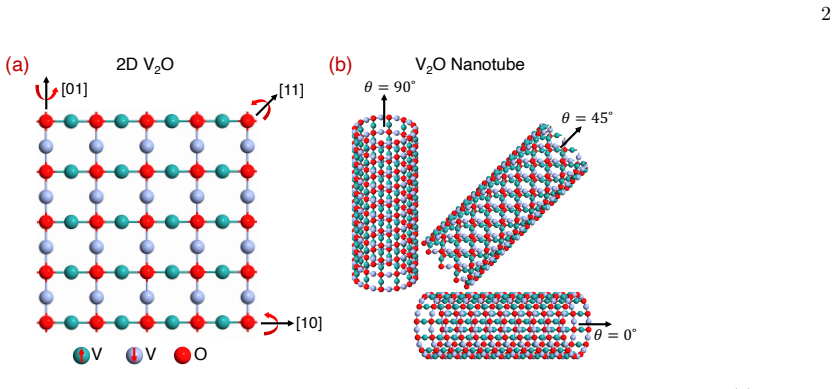
Rolling a 2D d-wave altermagnet into a nanotube turns its momentum-dependent spin splitting into chiral-angle-controlled 1D splitting.
A machine-rendered reading of the paper's core claim, the machinery that carries it, and where it could break.
Core claim
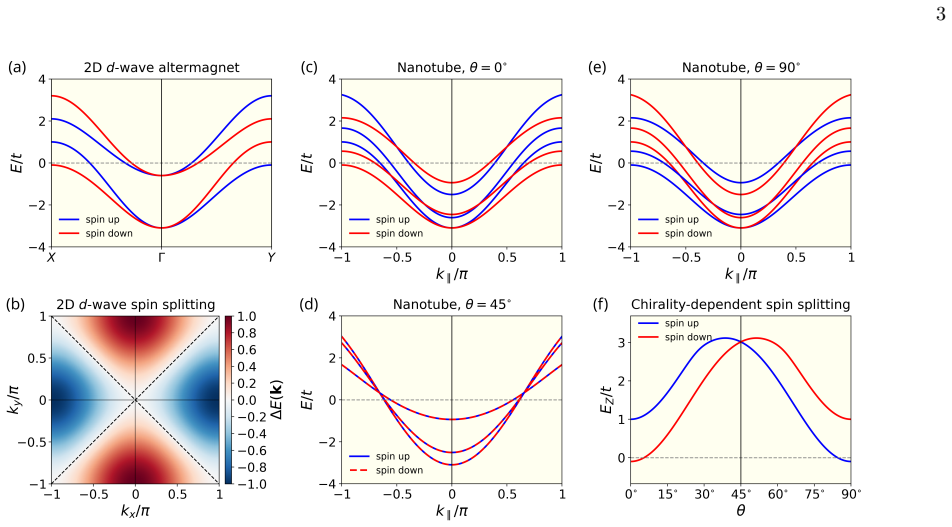
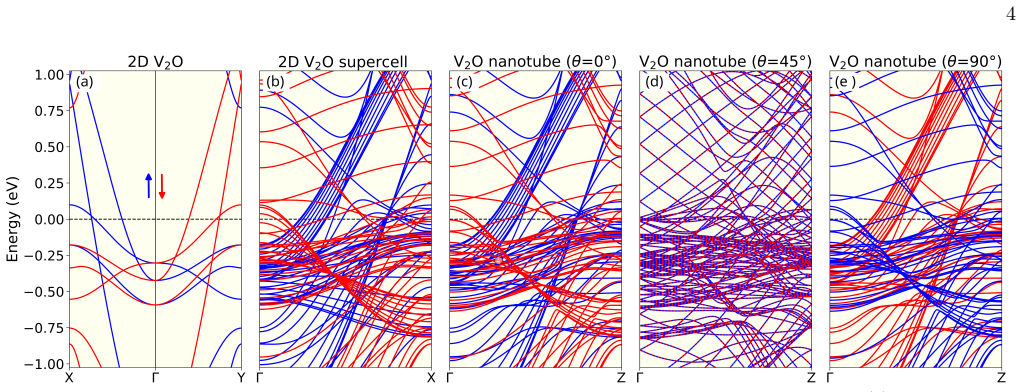
Rolling a two-dimensional d-wave altermagnet into a nanotube transforms this momentum-dependent spin splitting into chiral-angle-controlled one-dimensional spin splitting through dimensional projection. The nanotube spin splitting follows a characteristic cos(2θ) dependence, vanishing for nodal orientations and reaching extrema for antinodal orientations. The mechanism remains robust across a broad class of nanotubes derived from 2D altermagnets.
What carries the argument
Dimensional projection that maps the 2D momentum-dependent altermagnetic splitting onto the 1D nanotube dispersion modulated by the chiral angle θ.
Load-bearing premise
The strictly d-wave character of the 2D altermagnetic spin splitting survives rolling into a nanotube without significant modification from curvature-induced effects or edges.
What would settle it
Synthesize nanotubes from a known 2D d-wave altermagnet at both nodal and antinodal chiral angles, then measure whether the 1D spin splitting vanishes exactly at the nodal angles and follows the predicted cos(2θ) curve.
Figures
read the original abstract
Altermagnets exhibit momentum-dependent spin splitting despite having zero net magnetization. Here, we show that rolling a two-dimensional (2D) $d$-wave altermagnet into a nanotube transforms this momentum-dependent spin splitting into chiral-angle-controlled one-dimensional (1D) spin splitting through dimensional projection. Using a minimal tight-binding model and first-principles calculations, we demonstrate that the nanotube spin splitting follows a characteristic $\cos(2\theta)$ dependence, vanishing for nodal orientations and reaching extrema for antinodal orientations. The mechanism remains robust across a broad class of nanotubes derived from 2D altermagnets. Our results establish dimensional projection as a general route for transferring momentum-dependent altermagnetic spin splitting into 1D systems and provide a framework for engineering spin-split quantum states in low-dimensional magnetic materials.
Editorial analysis
A structured set of objections, weighed in public.
Referee Report
Summary. The paper claims that rolling a 2D d-wave altermagnet into a nanotube projects its momentum-dependent spin splitting into a chiral-angle-controlled 1D spin splitting via dimensional projection. Using a minimal tight-binding model and first-principles calculations, it demonstrates that the nanotube spin splitting follows a cos(2θ) dependence, vanishing for nodal orientations and maximizing for antinodal ones. The mechanism is asserted to remain robust across a broad class of nanotubes derived from 2D altermagnets.
Significance. If the central projection mechanism holds without significant curvature corrections, the work establishes dimensional projection as a general route to engineer tunable spin-split states in 1D altermagnetic systems, with the cos(2θ) form providing a direct handle via nanotube chirality. This could impact spintronics in low-dimensional materials by linking 2D altermagnetism to 1D quantum states.
major comments (2)
- [Abstract / tight-binding model description] The central claim that the spin splitting follows an exact cos(2θ) dependence with vanishing at nodal orientations rests on the premise that the 2D d-wave splitting projects unaltered. The minimal tight-binding model implements this by imposing periodic boundary conditions on the flat 2D Hamiltonian, which implicitly sets curvature to zero; this assumption is load-bearing and requires explicit testing.
- [Abstract / first-principles section] First-principles calculations are invoked to demonstrate robustness, but the abstract provides no information on the nanotube diameters studied or direct side-by-side comparison to the TB limit for small radii where curvature-induced σ-π rehybridization or circumferential strain could shift nodal/antinodal amplitudes and break the cos(2θ) form.
minor comments (2)
- The abstract states the mechanism 'remains robust across a broad class' without quantifying the range of diameters or chiral angles tested; adding this detail would strengthen the presentation.
- Notation for the chiral angle θ and the definition of nodal vs. antinodal orientations should be introduced with a figure or equation reference early in the main text for clarity.
Simulated Author's Rebuttal
We thank the referee for the constructive comments. We address each major point below and have revised the manuscript to improve clarity on the role of curvature and to provide additional details on the first-principles calculations.
read point-by-point responses
-
Referee: [Abstract / tight-binding model description] The central claim that the spin splitting follows an exact cos(2θ) dependence with vanishing at nodal orientations rests on the premise that the 2D d-wave splitting projects unaltered. The minimal tight-binding model implements this by imposing periodic boundary conditions on the flat 2D Hamiltonian, which implicitly sets curvature to zero; this assumption is load-bearing and requires explicit testing.
Authors: The minimal tight-binding model is intentionally constructed on the flat 2D lattice to isolate the dimensional-projection mechanism without confounding curvature effects. The first-principles calculations on rolled nanotubes already incorporate realistic curvature, σ-π rehybridization, and circumferential strain; these results confirm that the cos(2θ) form is preserved for the diameters examined. We have added an explicit paragraph in the results section discussing the regime of validity of the flat approximation and noting that deviations are expected only at extremely small radii not accessed in our study. revision: partial
-
Referee: [Abstract / first-principles section] First-principles calculations are invoked to demonstrate robustness, but the abstract provides no information on the nanotube diameters studied or direct side-by-side comparison to the TB limit for small radii where curvature-induced σ-π rehybridization or circumferential strain could shift nodal/antinodal amplitudes and break the cos(2θ) form.
Authors: We have revised the abstract to state the range of nanotube diameters (approximately 1–3 nm) employed in the first-principles calculations. In addition, we have added a direct comparison between the tight-binding and first-principles spin-splitting amplitudes versus chiral angle in the main text (new Figure X) and supplementary material, demonstrating quantitative agreement within the studied radius window and confirming that curvature corrections do not alter the nodal/antinodal locations or the overall cos(2θ) dependence. revision: yes
Circularity Check
No circularity: projection follows directly from standard TB model on 2D Hamiltonian
full rationale
The derivation applies a minimal tight-binding model with periodic boundary conditions to a flat 2D d-wave altermagnet Hamiltonian, yielding the cos(2θ) nanotube splitting as a geometric projection. First-principles calculations are invoked for validation on the same class of systems. No parameter is fitted to a data subset and then relabeled as a prediction of a related quantity; no load-bearing premise reduces to a self-citation whose content is itself unverified; and the central cos(2θ) form is not smuggled via ansatz or renamed known result. The chain remains independent of the target nanotube result and is therefore self-contained.
Axiom & Free-Parameter Ledger
axioms (2)
- domain assumption Tight-binding approximation captures the essential spin-splitting physics of the 2D altermagnet
- domain assumption First-principles calculations confirm the tight-binding results without major discrepancies
Forward citations
Cited by 1 Pith paper
-
Rolling Two-Dimensional Collinear Magnets into Chiral Nanotubes with $p$-Wave Magnetism
Chiral nanotubes from collinear magnets realize p-wave magnetism with p-wave spin splitting independent of the parent collinear order.
Reference graph
Works this paper leans on
-
[1]
L.-D. Yuan, Z. Wang, J.-W. Luo, and A. Zunger, Predic- tion of low-z collinear and noncollinear antiferromagnetic compounds having momentum-dependent spin splitting even without spin-orbit coupling, Physical Review Mate- rials5, 014409 (2021)
2021
-
[2]
ˇSmejkal, R
L. ˇSmejkal, R. Gonz´ alez-Hern´ andez, T. Jungwirth, and J. Sinova, Crystal time-reversal symmetry breaking and spontaneous hall effect in collinear antiferromagnets, Sci- ence Advances6, eaaz8809 (2020)
2020
-
[3]
ˇSmejkal, J
L. ˇSmejkal, J. Sinova, and T. Jungwirth, Beyond conven- tional ferromagnetism and antiferromagnetism: A phase with nonrelativistic spin and crystal rotation symmetry, Physical Review X12, 031042 (2022)
2022
-
[4]
ˇSmejkal, Y
L. ˇSmejkal, Y. Mokrousov, B. Yan, and A. H. MacDon- ald, Altermagnetism and spin-splitting by crystal sym- metry, Nature Physics18, 242 (2022)
2022
-
[5]
ˇSmejkal, J
L. ˇSmejkal, J. Sinova, and T. Jungwirth, Emerging re- search landscape of altermagnetism, Nature Reviews Ma- terials7, 482 (2022)
2022
-
[6]
Jungwirthet al., Altermagnetism, Nature Reviews Physics6, 560 (2024)
T. Jungwirthet al., Altermagnetism, Nature Reviews Physics6, 560 (2024)
2024
-
[7]
I. I. Mazin, Altermagnetism in MnTe: Origin, predicted manifestations, and routes to detwinning, Physical Re- view B107, L100418 (2023)
2023
-
[8]
Giuli, N
N. Giuli, N. Bittner, M. T. Mercaldo, M. Cuoco, P. Gen- tile, S. M. Winter, and R. Valent´ ı, Interaction-driven itinerant magnetism in altermagnets, Phys. Rev. B111, L020401 (2025)
2025
-
[9]
Gonz´ alez-Hern´ andez, L.ˇSmejkal, K
R. Gonz´ alez-Hern´ andez, L.ˇSmejkal, K. Symonova,et al., Crystal time-reversal spin rotation symmetry breaking in collinear antiferromagnets, Physical Review Letters126, 127701 (2021)
2021
-
[10]
Fenget al., Spin splitting and spin current in altermag- netic materials, Nature Communications13, 4258 (2022)
Z. Fenget al., Spin splitting and spin current in altermag- netic materials, Nature Communications13, 4258 (2022)
2022
-
[11]
T. Jungwirth, L. ˇSmejkal, J. Sinova, R. Gonz´ alez- Hern´ andez,et al., Altermagnetic spintronics, arXiv preprint https://doi.org/10.48550/arXiv.2508.09748 (2025), arXiv:2508.09748, 2508.09748
-
[12]
S. Lee, S. Lee, S. Jung, J. Jung, D. Kim, Y. Lee, B. Seok, J. Kim, B. G. Park, L. ˇSmejkal, C.-J. Kang, and C. Kim, Broken kramers degeneracy in altermagnetic MnTe, Physical Review Letters132, 036702 (2024)
2024
-
[13]
Reimers, L
S. Reimers, L. Odenbreit, L. ˇSmejkal, V. N. Strocov, P. Constantinou, A. B. Hellenes, R. Jaeschke-Ubiergo, W. H. Campos, V. K. Bharadwaj, A. Chakraborty, T. Denneulin, W. Shi, R. E. Dunin-Borkowski, S. Das, M. Kl¨ aui, J. Sinova, and M. Jourdan, Direct observation of altermagnetic band splitting in CrSb thin films, Nature Communications15, 2116 (2024)
2024
-
[14]
Jiang, M
B. Jiang, M. Hu, J. Bai, Z. Song, C. Mu, G. Qu, W. Li, W. Zhu, H. Pi, Z. Wei, Y. Sun, Y. Huang, X. Zheng, Y. Peng, L. He, S. Li, J. Luo, Z. Li, G. Chen, H. Li, H. Weng, and T. Qian, A metallic room-temperatured- wave altermagnet, Nature Physics21, 754 (2025)
2025
-
[15]
L.-D. Yuan, Z. Wang, J.-W. Luo, E. I. Rashba, and A. Zunger, Giant momentum-dependent spin splitting in centrosymmetric low-zantiferromagnets, Physical Re- view B102, 014422 (2020)
2020
-
[16]
Sødequist and T
J. Sødequist and T. Olsen, Two-dimensional alter- magnets from high-throughput computational screening: Symmetry requirements, chiral magnons, and spin-orbit effects, Applied Physics Letters124, 182409 (2024)
2024
-
[17]
Jungwirth, J
T. Jungwirth, J. Sinova, R. M. Fernandes, Q. Liu, H. Watanabe, S. Murakami, S. Nakatsuji, and L.ˇSmejkal, Symmetry, microscopy and spectroscopy signatures of al- termagnetism, Nature649, 837 (2026)
2026
-
[18]
Bhattarai, P
R. Bhattarai, P. Minch, and T. D. Rhone, High- throughput screening of altermagnetic materials, Phys- ical Review Materials9, 064403 (2025)
2025
-
[19]
L. Bai, W. Feng, S. Liu, L. ˇSmejkal, Y. Mokrousov, and Y. Yao, Altermagnetism: Exploring new frontiers in mag- netism and spintronics, Advanced Functional Materials 34, 2409327 (2024)
2024
-
[20]
Tamang, S
R. Tamang, S. Gurung, D. P. Rai, S. Brahimi, and S. Lou- nis, Altermagnetism and altermagnets: A brief review, Magnetism5, 17 (2025)
2025
-
[21]
P. A. McClarty and J. G. Rau, Landau theory of alter- magnetism, Physical Review Letters132, 176702 (2024)
2024
-
[22]
Q. Song, S. Stavri´ c, P. Barone, A. Droghetti, D. S. An- tonenko, J. W. F. Venderbos, C. A. Occhialini, B. Ilyas, E. Erge¸ cen, N. Gedik,et al., Electrical switching of a p-wave magnet, Nature , 1 (2025)
2025
-
[23]
Brahimi, D
S. Brahimi, D. Prakash Rai, and S. Lounis, Confinement- induced altermagnetism in ruo2 ultrathin films, J. of Phys.: Condens. Matter37, 395801 (2025)
2025
-
[24]
Fukaya, B
Y. Fukaya, B. Lu, K. Yada, Y. Tanaka, and J. Cayao, Superconducting phenomena in systems with unconven- tional magnets, Journal of Physics: Condensed Matter 37, 313003 (2025)
2025
-
[25]
K. Zou, Y. Yang, B. Xin,et al., Monolayer m 2x2o as po- tential 2d altermagnets and half-metals: a first-principles study, Journal of Physics: Condensed Matter37(2024)
2024
-
[26]
J. Sødequist and T. Olsen, Two-dimensional alter- magnets from high-throughput computational screening: symmetry requirements, chiral magnons and spin-orbit effects, arXiv (2024), 2401.05992
arXiv 2024
-
[27]
J.-Y. Liet al., Strain-induced valley polarization, topo- logical states, and piezomagnetism in two-dimensional altermagnetic v 2te2o, v 2steo, v 2sseo, and v 2s2o, arXiv (2024), 2411.19237
arXiv 2024
-
[28]
Saito, G
R. Saito, G. Dresselhaus, and M. S. Dresselhaus,Physical Properties of Carbon Nanotubes(Imperial College Press, London, 1998)
1998
-
[29]
M. S. Dresselhaus, G. Dresselhaus, and P. Avouris,Car- bon Nanotubes: Synthesis, Structure, Properties, and Ap- plications(Springer, Berlin, 2001)
2001
-
[30]
Nakanishiet al., Structural diversity of single-walled transition metal dichalcogenide nanotubes grown via template reaction, Advanced Materials35, 2306631 (2023)
Y. Nakanishiet al., Structural diversity of single-walled transition metal dichalcogenide nanotubes grown via template reaction, Advanced Materials35, 2306631 (2023). 7
2023
-
[31]
Liuet al., Photoluminescence from single-walled mos 2 nanotubes coaxially grown on boron nitride nanotubes, ACS Nano15, 8418 (2021)
M. Liuet al., Photoluminescence from single-walled mos 2 nanotubes coaxially grown on boron nitride nanotubes, ACS Nano15, 8418 (2021)
2021
-
[32]
Daiet al., Metallic nbs 2 one-dimensional van der waals heterostructures, ACS Nano19, 32800 (2025)
W. Daiet al., Metallic nbs 2 one-dimensional van der waals heterostructures, ACS Nano19, 32800 (2025)
2025
-
[33]
Yanget al., Janus mosse nanotubes on 1d swcnt- bnnt van der waals heterostructures, Small21, 2570208 (2025)
C. Yanget al., Janus mosse nanotubes on 1d swcnt- bnnt van der waals heterostructures, Small21, 2570208 (2025)
2025
-
[34]
A. E. Mikkelsen, F. T. B¨ olle, K. S. Thygesen, T. Vegge, and I. E. Castelli, Band structure of moste janus nan- otubes, Physical Review Materials5, 014002 (2021)
2021
-
[35]
S. Zhao, C. Yang, Z. Zhu, X. Yao, and W. Li, Curvature- controlled band alignment transition in 1d van der waals heterostructures, npj Computational Materials9, 92 (2023)
2023
-
[36]
See supplemental material for additional computational details, tight-binding parameters, and first-principles re- sults for realistic altermagnetic nanotubes, to be pub- lished
-
[37]
J. P. Perdew, K. Burke, and M. Ernzerhof, Generalized gradient approximation made simple, Phys. Rev. Lett. 77, 3865 (1996)
1996
-
[38]
M. J. Van Setten, M. Giantomassi, E. Bousquet, M. J. Verstraete, D. R. Hamann, X. Gonze, and G.-M. Rig- nanese, The PseudoDojo: Training and grading a 85 ele- ment optimized norm-conserving pseudopotential table, Comput. Phys. Commun.226, 39 (2018)
2018
-
[39]
Smidstrup, T
S. Smidstrup, T. Markussen, P. Vancraeyveld, J. Wellen- dorff, J. Schneider, T. Gunst, B. Verstichel, D. Stradi, P. A. Khomyakov, U. G. Vej-Hansen, M.-E. Lee, S. T. Chill, F. Rasmussen, G. Penazzi, F. Corsetti, A. Ojan- per¨ a, K. Jensen, M. L. N. Palsgaard, U. Martinez, A. Blom, M. Brandbyge, and K. Stokbro, QuantumATK: an integrated platform of electron...
2019
-
[40]
Ablimit, Y.-J
A. Ablimit, Y.-J. Sun, H. Jiang, C. Wu, L. Wei, X. Chen, and G. Cao, Weak metal–metal transition in the vana- dium oxytelluride rb 1−δv2te2o, Physical Review Materi- als2, 044801 (2018)
2018
- [41]
-
[42]
R. Xu, Y. Gao, and J. Liu, Chemical design of mono- layer altermagnets, National Science Review13, nwaf528 (2026)
2026
-
[43]
Gonz´ alez-Garc´ ıa, W
A. Gonz´ alez-Garc´ ıa, W. L´ opez-P´ erez, P. Pacheco, L. Ram´ ırez-Montes, and R. Gonz´ alez-Hern´ andez, Coex- istence of d-wave altermagnetism and topological states in janus fese x (x= s, te) monolayers, Physical Review Materials10, 044004 (2026)
2026
discussion (0)
Sign in with ORCID, Apple, or X to comment. Anyone can read and Pith papers without signing in.