REVIEW 3 major objections 5 minor 14 cited by
Bell Inequality Violation of Light Quarks in Back-to-Back Dihadron Pair Production at Lepton Colliders
T0 review · 3 major / 5 minor · reviewed 2026-08-10 · deepseek-v4-flash
Pith's one-line read The Bell inequality of light quark pairs can be measured from the azimuthal correlation of two pion pairs.
desk verdict A genuinely new idea—using interference fragmentation as a spin analyzer for massless quark pairs—but the headline 2.5σ/6.2σ numbers rely on a spin-analyzing power that probably came from the same Belle data, so treat the projection as circular until that is checked. read the letter →
The pith
A machine-rendered reading of the paper's core claim, the machinery that carries it, and where it could break.
The reading
What carries the argument
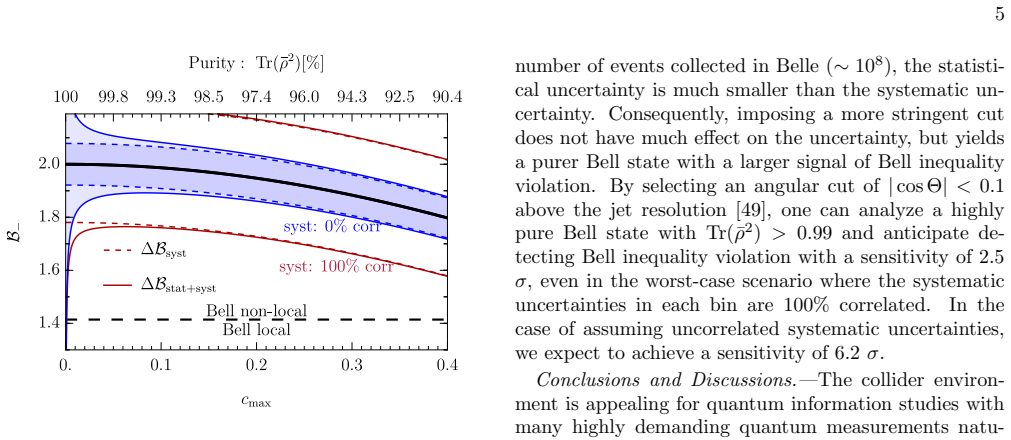
The interference dihadron fragmentation function $H_1^{\sphericalangle}$ is the central object: it transfers a light quark's transverse spin to the azimuthal orientation of a $\pi^+\pi^-$ pair, and its ratio to the unpolarized dihadron fragmentation function $D_1$ acts as the event-by-event spin analyzing power. The factorization formula Eq. (13) turns the $q\bar{q}$ spin correlation matrix into azimuthal modulations; the cut $|\cos\Theta|<c_{\mathrm{max}}$ prepares the spin state; and Eq. (17) rescales the published $A_{12}$ values to the new cut using the leading-order Standard Model prediction.
What would settle it
A Monte Carlo study of the Belle event selection would check whether the measured thrust-angle distribution corresponds to a parton-level cut $|\cos\Theta|<0.67$; alternatively, a reanalysis of the Belle data that applies the actual angular cut and uses the full covariance matrix would replace the rescaled $A_{12}$ values with direct measurements. If the rescaled values drift below the CHSH bound $\sqrt{2}$ or the correlated uncertainties exceed the assumed size, the quoted $2.5\sigma$ and $6.2\sigma$ significances would not be realized.
Extended reading notes
Core claim
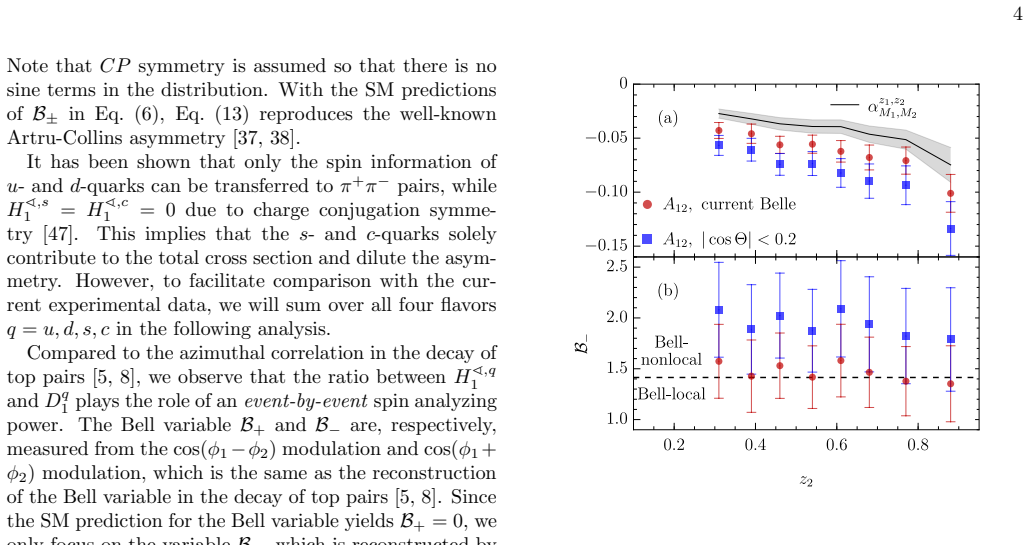
The central claim is that the Bell inequality of the quark pair system can be measured with a single observable, the azimuthal angle correlation of the dihadron pairs. In $e^+e^- \to q\bar{q} \to (\pi^+\pi^-)(\pi^+\pi^-)X$ under collinear factorization, the cross section carries the modulations $B_+ \cos(\phi_1-\phi_2)$ and $B_- \cos(\phi_1+\phi_2)$, with $B_\pm = C_{xx} \pm C_{yy}$. The Standard Model gives $B_+=0$ and $B_- = 2\sin^2\Theta/(1+\cos^2\Theta)$, which reaches 2 at $\Theta=\pi/2$; the paper identifies $B_- = A_{12}/\alpha$, where $A_{12}$ is the experimentally measured asymmetry and $\alpha$ is the ratio of interference to unpolarized dihadron fragmentation functions. Selecting $|\cos\Theta|<0.1$ prepares a nearly pure Bell state with $\mathrm{Tr}(\bar{\rho}^2)>0.99$, and the reconstructed $B_-$ from Belle data then lies above the CHSH bound $\sqrt{2}$ at the quoted significances.
Load-bearing premise
The load-bearing premise is that the published Belle $A_{12}$ values can be rescaled to a tighter parton-level cut $|\cos\Theta|<0.67$ using leading-order Standard Model kinematics, with the measured thrust angle mapped to that parton-level cut and the systematic uncertainties unchanged by the rescaling.
Editorial extensions
If this is right
- A reconstructed $|B_-|>\sqrt{2}$ in any existing or future dihadron-pair dataset would demonstrate Bell inequality violation in a massless quark pair, using fragmentation rather than perturbative decay as the spin analyzer.
- The same $A_{12}$ observable from Belle can be reanalyzed with the angular cut, and analogous datasets from other $e^+e^-$ colliders could be reused for quantum-information measurements.
- A measured Bell violation automatically implies entanglement of the quark pair, so this single azimuthal asymmetry doubles as an entanglement witness at colliders.
- The method extends quantum-information studies from top, tau, and gauge-boson pairs to light quark pairs, where no perturbative decay exists.
Reading between the lines
- The paper leaves the generalization to TMD fragmentation functions as future work; a TMD treatment could in principle reconstruct longitudinal spin components as well, giving a fuller density matrix rather than only the transverse $B_-$ part.
- The quoted significances rest on scaling existing data to a new angular cut; a dedicated experimental analysis with the actual cut and the full covariance matrix would be the decisive test, and could move the significance in either direction.
- A similar azimuthal-correlation measurement could be designed for other quark flavors or at other collision energies, since the spin analyzing power depends only on dihadron fragmentation functions already extracted from global fits.
Signed reviews
Editorial analysis
A structured set of objections, weighed in public.
Referee Report
Summary. This paper proposes that the Bell inequality for massless q\bar q pairs produced in e+e− annihilation can be tested through the azimuthal correlation of two π+π− dihadron pairs. The quark-pair spin correlation matrix is reconstructed from the observable A12 = 2⟨cos(φ1+φ2)⟩ divided by a spin analyzing power α built from dihadron fragmentation functions, Eqs. (14)–(15). Using the JAMDiFF framework for the diFFs and the published Belle A12 data [39], the authors estimate that applying a cut |cosΘ| < 0.1 (or 0.2) on the hard scattering angle would make the reconstructed Bell variable B− violate the CHSH bound |B−| ≤ √2 with a significance of 2.5σ under 100% correlated systematic uncertainties and 6.2σ under uncorrelated systematics. The paper presents this both as a new method for Bell tests with massless quarks and as a concrete projection from existing data.
Significance. If the reconstruction is genuinely independent of the data being used to determine α, the method is significant: it extends collider Bell tests to massless quark pairs whose spin is accessed through non-perturbative fragmentation, and it would make a large body of existing e+e− data available for quantum information studies. The analytic derivation is compact, and the connection to the Artru-Collins asymmetry is clearly made. The main caveat is that the quantitative claims depend on the provenance of α and on the thrust-angle mapping; absent clarification of these points, the paper is a promising methodology proposal rather than an established observation.
major comments (3)
- [Estimated Sensitivity, Eqs. (14)–(16)] The spin analyzing power α in Eq. (15) is taken from the JAMDiFF global fit [47,48], but the manuscript does not state which datasets enter that fit. If the Belle A12 measurement [39] that is being reinterpreted is among them, then the product H1^∢H1^∢ in the numerator of α is effectively determined by fitting A12 under the assumed SM q\bar q spin correlation. In that case Eq. (14) reconstructs B− = A12/α, and the resulting values simply return the assumed SM B−, so the projected 2.5σ and 6.2σ significances are a consistency check of the fit rather than an independent Bell test. The authors must list the JAMDiFF input datasets, state explicitly whether [39] was excluded, and quantify the change in their results if it is removed; the quadrature combination in Eq. (16) is also invalid if δα and δA12 are correlated.
- [Estimated Sensitivity, after Eq. (17)] The rescaling A12^{|cosΘ|<c_a}/A12^{|cosΘ|<c_b} by the leading-order SM ratio assumes a sharp parton-level cut on the hard scattering angle. The paper justifies this with the sentence 'the expected value of the thrust angle aligns with a parton-level cut of |cosΘ| < 0.67 at leading order,' but the measured thrust axis differs from the parton direction because of gluon radiation and hadronization. A biased mapping changes both the central values (Eq. 17) and the event-number scaling (Eq. 18), and therefore feeds directly into the 2.5σ/6.2σ projections. Please provide a validation of the thrust-to-Θ mapping, for example with a parton-shower Monte Carlo, or recast the projection as a forecast for a future analysis that applies the cut at hadron level.
- [Fragmentation of quark pair spin state, Eqs. (14)–(15)] The manuscript describes the Belle data as 9×9 bins in (z1,z2) but does not specify how the M1,M2 dependence of α is handled. Equation (15) defines α at fixed M1,M2; if A12 is integrated over the dihadron invariant masses, α should be the M1,M2-weighted ratio of the H1^∢H1^∢ and D1D1 integrals over the same phase space. Using a fixed M value can bias the reconstructed B− because H1^∢ is strongly M dependent. Please state the M window used for each A12 data point and the exact integration performed, or confirm that the Belle data are binned in M1,M2 as well.
minor comments (5)
- [Figure 3] The caption contains 'systematical uncertainties'; this should be 'systematic uncertainties'.
- [Eq. (20)] The covariance Cov(B−,i,B−,j) is used without a definition; clarify whether it includes only systematic correlations or also correlated theory uncertainties.
- [Conclusions and Abstract] The values 2.5σ and 6.2σ are quoted in the abstract but in the text appear only in Figure 3; state them explicitly along with the exact input assumptions, including cmax, the number of bins, and the treatment of correlated systematics.
- [Fragmentation of quark pair spin state, Eq. (14)] The term 'event-by-event factor' for α is misleading because α is constructed from collinear fragmentation functions; consider using 'dihadron analyzing power' instead.
- [Conclusions and Discussions] A period is missing after 'future works' before the acknowledgments paragraph.
Circularity Check
Projected Bell-violation significance may reduce to SM input: the spin analyzing power α used to convert Belle A12 into B− comes from JAMDiFF, a global fit of the same type of e+e− azimuthal asymmetry, and the paper never demonstrates that Belle A12 was excluded from that fit.
-
fitted input called prediction
[Eq. (14)-(15) and 'Estimated Sensitivity' section]
"B− = 2⟨cos(ϕ1 + ϕ2)⟩ / α^{z1,z2}_{M1,M2} = A12 / α^{z1,z2}_{M1,M2} ... For the theory prediction of α^{z1,z2}_{M1,M2}, we utilize the JAMDiFF framework [47,48] for the values of D^q_1(z_i,M_i) and H^{∢,q}_1(z_i,M_i), along with their associated uncertainties."
The reconstruction assumes that α carries no memory of the A12 it divides. But α is built from interference diFFs H1 obtained from JAMDiFF, a global extraction whose natural constraints are e+e− azimuthal asymmetries of exactly the Belle A12 type; the manuscript never states that the Belle dataset [39] was excluded from the fit. Under Eq. (13), A12 = α B−. If JAMDiFF fitted H1 using Belle A12 together with the SM value of B−, then α already contains the fitted asymmetry, and Eq. (14) is the inverse of the fitting relation: A12/α returns the assumed SM B−. The subsequent 2.5σ/6.2σ projection after the |cosΘ|<0.1 cut then follows from the SM B−(Θ) shape via Eq. (17), so the central 'prediction' reduces to the fit input.
full rationale
Apart from the α-dependence issue, the derivation is largely self-contained: the Bell-variable definitions, the factorization formula Eq. (13), and the angular rescaling Eq. (17) are explicitly stated, and the thrust-angle mapping is a transparent assumption rather than a hidden circular step. The sole load-bearing circularity concern is the use of JAMDiFF's diFFs to convert the measured asymmetry A12 into B−. Because JAMDiFF is a global fit of dihadron fragmentation functions and the Belle A12 measurement is a canonical input to such fits, the independence of α from [39] is not established. If Belle A12 was included in JAMDiFF, the reconstructed B− and the projected violation simply return the SM input used in the fit. The authors acknowledge JAMDiFF's poor description of small-z Belle bins but do not disclose the full dataset list, so the reader cannot certify that the spin analyzer is independent of the data being reinterpreted. If the authors later verify that Belle A12 was excluded from the JAMDiFF fit, the circularity would be resolved and the score would drop substantially; as written, the central projection is not demonstrably independent.
Assumptions & free parameters
free parameters (3)
- z1,z2 minimum threshold =
0.275
- Belle thrust-angle to parton-level cut c =
0.67
- Spin analyzing power alpha via JAMDiFF diFFs =
external global fit, numerical values not listed in the paper
assumptions (6)
- domain assumption Collinear factorization and universality of dihadron fragmentation functions hold for e+e- -> q qbar -> (pi+pi-) + (pi+pi-) + X.
- domain assumption CP symmetry holds, so there are no sine terms in the azimuthal distribution.
- domain assumption The q qbar spin correlation matrix is the leading-order Standard Model prediction C = diag(sin^2 Theta/(1+cos^2 Theta), -sin^2 Theta/(1+cos^2 Theta), 1).
- domain assumption Charge conjugation symmetry implies H1^s = H1^c = 0 for the interference diFFs.
- ad hoc to paper The measured thrust angle can be identified with the leading-order parton-level scattering angle, giving |cos Theta| < 0.67.
- standard math CHSH violation for a 2-qubit correlation matrix C occurs iff the two largest eigenvalues of C^T C satisfy mu1 + mu2 > 1.
Cite this review
Pith. "Pith review of Bell Inequality Violation of Light Quarks in Back-to-Back Dihadron Pair Production at Lepton Colliders." pith.science (2026). https://pith.science/paper/QUXSAJ5M
@misc{pith2026250103321,
  author       = {Pith},
  title        = {Pith review of: Bell Inequality Violation of Light Quarks in Back-to-Back Dihadron Pair Production at Lepton Colliders},
  year         = {2026},
  howpublished = {\url{https://pith.science/paper/QUXSAJ5M}},
  note         = {Machine review of arXiv:2501.03321}
}
abstract
Spin correlations between particles produced at colliders provide valuable insights for quantum information studies. While traditional studies of quantum information at colliders are typically limited to massive particles with perturbative decay, we propose an innovative method to explore the Bell inequality in massless quark pair systems by analyzing the azimuthal correlations in back-to-back $\pi^+\pi^-$ dihadron pair production at lepton colliders. Revisiting the Belle data, we have shown the potential to detect Bell inequality violation of light quarks by introducing an additional angular cut, achieving a significance of 2.5 $\sigma$ even in the worst-case scenario of 100% correlated systematic uncertainties in each bins. The significance substantially exceeds $5\sigma$ when considering uncorrelated systematic uncertainties. Our approach opens avenues for exploring spin quantum information in the non-perturbative aspect and leverages existing data for quantum information research.
Figures

Forward citations
Cited by 14 Pith papers
-
Probing Gluon Linear Polarization with Dihadron Fragmentation in $\chi_b$ Decays
The two gluons from chi_b0 decay carry correlated linear polarizations, so the angular correlation between two pion pairs can directly probe the previously unmeasured linearly polarized gluon dihadron fragmentation function.
-
Qubit-qubit-qutrit quantum correlations in $H \to f \bar f V$
In h→τ^-τ^+ Z decays, the spin state is genuinely qubit-qubit-qutrit entangled almost everywhere, violates Bell inequalities throughout, and carries up to 1.95 bits of non-local magic.
-
High Energy Photon Polarimetry at Lepton Colliders: Quantum Information from Converted Photons
Converted photons in Belle II enable high-significance measurements of Bell nonlocality, discord, concurrence, magic and steerability for macroscopically separated GeV diphotons, provided opening-angle resolution reac...
-
Flavor--Kinetic Entanglement Production from Decay and Scattering at Finite Density
At finite density, the leading flavor-kinetic entanglement entropy equals twice the occupation-weighted branch-changing collision probability, and this quantity is used to diagnose first-order versus continuous therma...
-
Hadron Structure from the Hierarchy of Quantum Correlations in Deep-Inelastic Scattering
Quantum-information measures of the DIS final electron-quark state are shown to be sensitive to transversity PDFs and can discriminate between different tensor-charge extractions.
-
Quantum Tomography and Entanglement in Semi-Leptonic $h\to VV^*$ Decays at Higher Orders
Semi-leptonic h→VV* decays retain an effective two-qutrit quantum description under NLO QCD and electroweak corrections, unlike the fully leptonic h→4ℓ channel.
-
Extracting a Toponium Signal at the LHC with Spin and Quantum Information Tools
Spin and quantum-information observables add only marginal statistical power beyond kinematic variables for isolating toponium in near-threshold top-pair events, but improve interpretability.
-
Excluding Local Hidden Variables in $\Lambda\bar{\Lambda}$ Production: The Incompatibility with Angular-Momentum Conservation and CPT Invariance
Scalar h→ΛarΛ decay is incompatible with any angular-momentum-conserving LHVT, while pseudoscalar a→ΛarΛ can be mimicked by an LHVT only if CPT symmetry is relaxed.
-
Unveiling Light-Quark Yukawa Flavor Structure via Dihadron Fragmentation at Lepton Colliders
A dihadron fragmentation azimuthal asymmetry at e+e− colliders can probe light-quark Yukawa couplings linearly and separate y_u from y_d at the 10^-4 level.
-
Bypassing Spin-Analyzing Power Dependence for Quantum Entanglement at Colliders: A Case Study of $\Lambda\bar{\Lambda}$
An entanglement witness for J/ψ→ΛΛ̄ built from angular-correlation ratios can certify entanglement without the parity-violating decay parameters, while angle-only ratio tests are shown to fail.
-
Spin versus Magic: Lessons from Gluon and Graviton Scattering
For 2 to 2 scattering of massless spin-1/2 to spin-2 particles, the averaged generated magic decreases monotonically with spin, with maxima well below the two-qubit upper bound.
-
Quantum Entanglement Autodistillation in Baryon Pair Decays
Weak decays of spin-1/2 baryon-antibaryon pairs into a spin-1/2 baryon and a spin-0 meson can probabilistically increase the pair's spin entanglement, with the effect controlled by the decay asymmetry parameter alphaD.
-
Entanglement redistribution of hyperon-antihyperon pair via sequential decay
In e+e−→ψ→Ξ(→Λπ)Ξ̄(→Λ̄π), the ΛΛ̄ pair's concurrence and negativity can decrease relative to the mother pair yet stay nonzero except at θ=0 and π, while quantum discord can always increase.
-
Manipulating Bell nonlocality and entanglement in polarized electron-positron annihilation
Polarized lepton beams can tune hyperon-antihyperon entanglement and Bell nonlocality, with transverse polarization capable of producing maximally entangled pairs.
Reference graph
Works this paper leans on
-
[39]
A. Vossen et al. (Belle), Phys. Rev. Lett. 107, 072004 (2011), arXiv:1104.2425 [hep-ex]
arXiv 2011
-
[1]
Y. Afik and J. R. M. n. de Nova, Eur. Phys. J. Plus 136, 907 (2021), arXiv:2003.02280 [quant-ph]
arXiv 2021
-
[2]
M. Fabbrichesi, R. Floreanini, and G. Panizzo, Phys. Rev. Lett. 127, 161801 (2021), arXiv:2102.11883 [hep- ph]
arXiv 2021
- [3]
-
[4]
Y. Afik and J. R. M. n. de Nova, Quantum 6, 820 (2022), arXiv:2203.05582 [quant-ph]
arXiv 2022
-
[5]
J. A. Aguilar-Saavedra and J. A. Casas, Eur. Phys. J. C 82, 666 (2022), arXiv:2205.00542 [hep-ph]
arXiv 2022
-
[6]
Y. Afik and J. R. M. n. de Nova, Phys. Rev. Lett. 130, 221801 (2023), arXiv:2209.03969 [quant-ph]
arXiv 2023
-
[7]
Z. Dong, D. Gon¸ calves, K. Kong, and A. Navarro, Phys. Rev. D 109, 115023 (2024), arXiv:2305.07075 [hep-ph]
arXiv 2024
Show all 58 references
-
[8]
T. Han, M. Low, and T. A. Wu, JHEP 07, 192 (2024), arXiv:2310.17696 [hep-ph]
2024 arXiv
-
[9]
Maltoni, C
F. Maltoni, C. Severi, S. Tentori, and E. Vryonidou, JHEP 09, 001 (2024), arXiv:2404.08049 [hep-ph]
2024 arXiv
-
[10]
C. D. White and M. J. White, Phys. Rev. D 110, 116016 (2024), arXiv:2406.07321 [hep-ph]
2024 arXiv
-
[11]
T. Han, M. Low, N. McGinnis, and S. Su, (2024), arXiv:2412.21158 [hep-ph]
2024 arXiv
- [12]
- [13]
-
[14]
Hayrapetyan et al
A. Hayrapetyan et al. (CMS), Rept. Prog. Phys. 87, 117801 (2024), arXiv:2406.03976 [hep-ex]
2024 arXiv
-
[15]
M. M. Altakach, P. Lamba, F. Maltoni, K. Mawatari, and K. Sakurai, Phys. Rev. D 107, 093002 (2023), arXiv:2211.10513 [hep-ph]
2023 arXiv
-
[16]
Ehat¨ aht, M
K. Ehat¨ aht, M. Fabbrichesi, L. Marzola, and C. Veelken, Phys. Rev. D 109, 032005 (2024), arXiv:2311.17555 [hep- ph]
2024 arXiv
-
[17]
Fabbrichesi and L
M. Fabbrichesi and L. Marzola, Phys. Rev. D 110, 076004 (2024), arXiv:2405.09201 [hep-ph]
2024 arXiv
- [18]
-
[19]
A. J. Barr, P. Caban, and J. Rembieli´ nski, Quantum 7, 1070 (2023), arXiv:2204.11063 [quant-ph]
2023 arXiv
-
[20]
Ashby-Pickering, A
R. Ashby-Pickering, A. J. Barr, and A. Wierzchucka, JHEP 05, 020 (2023), arXiv:2209.13990 [quant-ph]
2023
-
[21]
J. A. Aguilar-Saavedra, A. Bernal, J. A. Casas, and J. M. Moreno, Phys. Rev. D 107, 016012 (2023), arXiv:2209.13441 [hep-ph]
2023 arXiv
-
[22]
Fabbrichesi, R
M. Fabbrichesi, R. Floreanini, E. Gabrielli, and L. Mar- zola, Eur. Phys. J. C 83, 823 (2023), arXiv:2302.00683 [hep-ph]
2023 arXiv
-
[23]
Fabbri, J
F. Fabbri, J. Howarth, and T. Maurin, Eur. Phys. J. C 84, 20 (2024), arXiv:2307.13783 [hep-ph]
2024 arXiv
-
[24]
Bi, Q.-H
Q. Bi, Q.-H. Cao, K. Cheng, and H. Zhang, Phys. Rev. D 109, 036022 (2024), arXiv:2307.14895 [hep-ph]
2024 arXiv
-
[25]
S. Wu, C. Qian, Q. Wang, and X.-R. Zhou, Phys. Rev. D 110, 054012 (2024), arXiv:2406.16298 [hep-ph]
2024 arXiv
-
[26]
Y. Afik, Y. Kats, J. R. M. n. de Nova, A. Soffer, and D. Uzan, (2024), arXiv:2406.04402 [hep-ph]
2024 arXiv
-
[27]
Bianconi, S
A. Bianconi, S. Boffi, R. Jakob, and M. Radici, Phys. Rev. D 62, 034008 (2000), arXiv:hep-ph/9907475
2000 arXiv
-
[28]
Barone, A
V. Barone, A. Drago, and P. G. Ratcliffe, Phys. Rept. 359, 1 (2002), arXiv:hep-ph/0104283
2002 arXiv
-
[29]
Zhou and A
J. Zhou and A. Metz, Phys. Rev. Lett. 106, 172001 (2011), arXiv:1101.3273 [hep-ph]
2011 arXiv
-
[30]
Metz and A
A. Metz and A. Vossen, Prog. Part. Nucl. Phys. 91, 136 (2016), arXiv:1607.02521 [hep-ex]
2016 arXiv
-
[31]
X.-K. Wen, B. Yan, Z. Yu, and C. P. Yuan, (2024), arXiv:2408.07255 [hep-ph]
2024 arXiv
- [32]
-
[33]
X.-K. Wen, B. Yan, Z. Yu, and C. P. Yuan, (2024), arXiv:2411.13845 [hep-ph]
2024
- [34]
-
[35]
Z. Yu, K. A. Mohan, and C. P. Yuan, Phys. Lett. B 856, 138959 (2024), arXiv:2211.00845 [hep-ph]
2024 arXiv
-
[36]
Y. Guo, X. Liu, F. Yuan, and H. X. Zhu, (2024), arXiv:2406.05880 [hep-ph]
2024 arXiv
- [37]
-
[38]
D. Boer, R. Jakob, and M. Radici, Phys. Rev. D 67, 094003 (2003), [Erratum: Phys.Rev.D 98, 039902 (2018)], arXiv:hep-ph/0302232
2003 arXiv
-
[40]
J. F. Clauser, M. A. Horne, A. Shimony, and R. A. Holt, Phys. Rev. Lett. 23, 880 (1969)
1969
-
[41]
Horodecki, P
R. Horodecki, P. Horodecki, and M. Horodecki, Physics Letters A 200, 340 (1995)
1995
-
[42]
K. Chen, G. R. Goldstein, R. L. Jaffe, and X.-D. Ji, Nucl. Phys. B 445, 380 (1995), arXiv:hep-ph/9410337
1995 arXiv
-
[43]
Cheng, T
K. Cheng, T. Han, and M. Low, Phys. Rev. D 109, 116005 (2024), arXiv:2311.09166 [hep-ph]
2024 arXiv
-
[44]
Cheng, T
K. Cheng, T. Han, and M. Low, Phys. Rev. D 111, 033004 (2025), arXiv:2407.01672 [hep-ph]
2025
-
[45]
J. C. Collins, S. F. Heppelmann, and G. A. Ladinsky, Nucl. Phys. B 420, 565 (1994), arXiv:hep-ph/9305309
1994 arXiv
-
[46]
Collins, Foundations of Perturbative QCD, Vol
J. Collins, Foundations of Perturbative QCD, Vol. 32 (Cambridge University Press, 2011)
2011
-
[47]
Cocuzza, A
C. Cocuzza, A. Metz, D. Pitonyak, A. Prokudin, N. Sato, and R. Seidl (Jefferson Lab Angular Momentum (JAM)), Phys. Rev. D 109, 034024 (2024), arXiv:2308.14857 [hep- ph]
2024 arXiv
-
[48]
Cocuzza, A
C. Cocuzza, A. Metz, D. Pitonyak, A. Prokudin, N. Sato, and R. Seidl (JAM), Phys. Rev. Lett.132, 091901 (2024), arXiv:2306.12998 [hep-ph]
2024 arXiv
-
[49]
Abashian et al
A. Abashian et al. (Belle), Nucl. Instrum. Meth. A 479, 117 (2002)
2002
-
[50]
Fabbrichesi, R
M. Fabbrichesi, R. Floreanini, and E. Gabrielli, Eur. Phys. J. C 83, 162 (2023), arXiv:2208.11723 [hep-ph]
2023 arXiv
-
[51]
Aoude, E
R. Aoude, E. Madge, F. Maltoni, and L. Mantani, Phys. Rev. D 106, 055007 (2022), arXiv:2203.05619 [hep-ph]. 7
2022 arXiv
-
[52]
Fabbrichesi, R
M. Fabbrichesi, R. Floreanini, E. Gabrielli, and L. Mar- zola, JHEP 09, 195 (2023), arXiv:2304.02403 [hep-ph]
2023 arXiv
-
[53]
Bernal, P
A. Bernal, P. Caban, and J. Rembieli´ nski, Eur. Phys. J. C 83, 1050 (2023), arXiv:2307.13496 [hep-ph]
2023 arXiv
-
[54]
Aoude, E
R. Aoude, E. Madge, F. Maltoni, and L. Mantani, JHEP 12, 017 (2023), arXiv:2307.09675 [hep-ph]
2023 arXiv
-
[55]
Maltoni, C
F. Maltoni, C. Severi, S. Tentori, and E. Vryonidou, JHEP 03, 099 (2024), arXiv:2401.08751 [hep-ph]
2024 arXiv
- [56]
-
[57]
D. Boer, A. Brandenburg, O. Nachtmann, and A. Uter- mann, Eur. Phys. J. C 40, 55 (2005), arXiv:hep- ph/0411068
2005
-
[58]
C. A. Aidala and T. C. Rogers, Phil. Trans. A. Math. Phys. Eng. Sci. 380, 20210058 (2021), arXiv:2108.12319 [quant-ph]
2021 arXiv
Reviewed August 10, 2026 · model on record in the stance chip above.
Discussion (0). Continue with ORCID to comment.