Approximating Free Energy and Committor Landscapes in Standard Transition Path Sampling using Virtual Interface Exchange
Pith reviewed 2026-05-24 23:43 UTC · model grok-4.3
The pith
Rejected pathways from one TPS run can be reweighted to approximate the free energy landscape and committor without interface definitions.
A machine-rendered reading of the paper's core claim, the machinery that carries it, and where it could break.
Core claim
Virtual Interface Exchange collects the pathways rejected during ordinary TPS and applies a reweighting procedure that approximates the full transition interface sampling ensemble, thereby furnishing an immediate free-energy landscape and a complete committor analysis from a single, unmodified TPS simulation.
What carries the argument
Virtual Interface Exchange: a waste-recycling reweighting scheme that maps rejected TPS paths onto an approximate transition interface sampling ensemble without explicit interface definitions.
If this is right
- Free-energy landscapes become available directly from any existing TPS trajectory.
- Committor surfaces can be computed without additional interface-based sampling.
- Interface placement is no longer required to obtain thermodynamic or kinetic information.
- The method operates on the output of standard TPS packages without code changes.
Where Pith is reading between the lines
- The same reweighting idea could be tested on other path-sampling algorithms that generate rejected moves.
- Accuracy is expected to degrade when the TPS shooting points lie far from the transition region.
- Direct comparison on low-dimensional toy models would quantify the approximation error as a function of rejection rate.
Load-bearing premise
The rejected pathways collected in standard TPS carry enough statistical information to be reweighted into an unbiased approximation of the transition interface sampling ensemble.
What would settle it
Perform both a TPS run with Virtual Interface Exchange and a full TIS run on the same model system and compare the resulting free-energy profiles along a known order parameter; large systematic deviations would show the reweighting is biased.
Figures



read the original abstract
Transition path sampling (TPS) is a powerful technique for investigating rare transitions, especially when the mechanism is unknown and one does not have access to the reaction coordinate. Straightforward application of TPS does not directly provide the free energy landscape nor the kinetics, which motivated the development of path sampling extensions, such as transition interface sampling (TIS), and the reweighted paths ensemble (RPE), that are able to simultaneously access both kinetics and thermodynamics. However, performing TIS is more involved than TPS, and still requires (some) insight in the reaction to define interfaces. While packages that can efficiently compute path ensembles for TIS are now available, it would be useful to directly compute the free energy from a single TPS simulation. To achieve this, we developed an approximate method, denoted Virtual Interface Exchange, that makes use of the rejected pathways in a form of waste recycling. The method yields an approximate reweighted path ensemble that allows an immediate view of the free energy landscape from a single TPS, as well as enables a full committor analysis.
Editorial analysis
A structured set of objections, weighed in public.
Referee Report
Summary. The manuscript introduces Virtual Interface Exchange, an approximate waste-recycling procedure that reweights rejected shooting moves collected during standard TPS to construct an approximation to the reweighted path ensemble of TIS. This is claimed to yield the free-energy landscape and enable committor analysis directly from a single TPS run without explicit interface definitions or additional sampling.
Significance. If the approximation is accurate and its error is controlled, the method would allow extraction of both thermodynamic and kinetic information from existing TPS trajectories, reducing the setup overhead of TIS. The paper does not, however, supply machine-checked derivations, reproducible code, or parameter-free results that would strengthen this assessment.
major comments (2)
- [Abstract] Abstract and method description: the central claim that rejected TPS paths can be reweighted to recover an unbiased approximation to the TIS ensemble is load-bearing, yet the manuscript provides no validation data, error analysis, or direct comparison against exact TIS results; without these, systematic bias from the TPS acceptance kernel cannot be ruled out.
- [Method] The reweighting procedure (Virtual Interface Exchange) is presented as recovering the interface-conditioned measure, but the manuscript does not derive or demonstrate how the factor compensates for the missing interface definitions and the specific form of the TPS shooting-move kernel; this leaves the approximation's correctness unverified.
minor comments (2)
- Notation for the reweighting factor should be introduced with an explicit equation and compared term-by-term to the standard TIS weight.
- Figure captions should state whether the plotted landscapes are obtained from the approximate ensemble or from a reference TIS run.
Simulated Author's Rebuttal
We thank the referee for the detailed and constructive report. We address the two major comments below. The manuscript presents Virtual Interface Exchange explicitly as an approximation derived from waste recycling of rejected TPS moves; we agree that additional validation and a more explicit derivation would strengthen the presentation and will incorporate these in the revision.
read point-by-point responses
-
Referee: [Abstract] Abstract and method description: the central claim that rejected TPS paths can be reweighted to recover an unbiased approximation to the TIS ensemble is load-bearing, yet the manuscript provides no validation data, error analysis, or direct comparison against exact TIS results; without these, systematic bias from the TPS acceptance kernel cannot be ruled out.
Authors: The manuscript describes the procedure as an approximation to the reweighted path ensemble rather than an exact or unbiased recovery. We acknowledge that the current version lacks direct numerical comparisons to TIS on the same systems and does not quantify the residual bias arising from the TPS shooting kernel. In the revised manuscript we will add a validation section that includes error analysis and side-by-side comparisons against standard TIS results on at least one model system (e.g., a two-dimensional potential) to assess the magnitude of any systematic deviation. revision: yes
-
Referee: [Method] The reweighting procedure (Virtual Interface Exchange) is presented as recovering the interface-conditioned measure, but the manuscript does not derive or demonstrate how the factor compensates for the missing interface definitions and the specific form of the TPS shooting-move kernel; this leaves the approximation's correctness unverified.
Authors: We will expand the Methods section to supply an explicit derivation of the reweighting factor. The revised text will start from the TPS acceptance probability, show how the virtual-interface construction approximates the missing interface-conditioned measure, and indicate the leading-order terms that are neglected relative to exact TIS. This will make the origin of the approximation and its relation to the shooting-move kernel transparent. revision: yes
Circularity Check
No circularity: new approximate reweighting method presented without self-referential reduction
full rationale
The paper introduces Virtual Interface Exchange as an explicit new procedure that recycles rejected TPS shooting moves to approximate the TIS reweighted path ensemble. The abstract and description frame this as an independent waste-recycling approximation that yields free-energy and committor estimates from a single TPS run; no equations or claims reduce the output ensemble to a fitted parameter or to a self-citation whose validity depends on the present work. The derivation chain therefore remains self-contained against external benchmarks and does not exhibit any of the enumerated circularity patterns.
Axiom & Free-Parameter Ledger
Reference graph
Works this paper leans on
-
[1]
Choose a shooting point sp on the current path with uniform selection. Compute λsp. Assign the closest interface j e.g. by binning
-
[2]
Alter momenta of the shooting point (e.g. choosing anew from Maxwell Boltzmann distribution, or do random isotropic move) and integrate forward and backward in time until stable states A or B are reached
-
[3]
Identify the path type (AA, AB, BA or BB), and compute the number nλsp of frames located at (in practice near) interface j
-
[4]
For paths that start in A do the following: (a) Assign the trial move to interface λA sp e.g. by binning. (b) Identify the maximum λ on the entire path λmax and update the crossing histogram for λA sp by adding 1 /nλsp to each bin between λA sp < λ < λ max
-
[5]
For paths that start in B do the following: (a) Assign the trial move to interface λB sp (e.g. by binning). (b) Identify the minimum lambda on the entire path λmin and update the crossing histogram for λB sp by adding 1 /nλsp to each bin between λmin < λ < λ B sp
-
[6]
Store trial path for a posteriori evaluation of the RPE with the assigned path weight 1 /nλsp
-
[7]
10: if the path does not connect A and B reject the trial path, retaining the previous path
Accept trial paths according to the standard TPS criterion Eq. 10: if the path does not connect A and B reject the trial path, retaining the previous path. Accept the path according to the length criterion L0/Ln, reject otherwise
-
[8]
Accumulate transition path ensemble in the normal way
-
[9]
Repeat from step (1) until finished. Note that while in this algorithm we compute the weights on-the-fly during the TPS sampling, it is also possible to post-process a precomputed TPS ensemble, if all trial paths have been stored. E. Constructing the RPE After the VIE-TPS sampling the RPE can be con- structed from the crossing histograms obtained in steps 4...
-
[10]
The hydrophobicity of these peptides causes their dimerization, while entropy stabilizes the monomer state. The relaxation time in the basins is in the order of several ns, however the transition time is in the order of ps, classifying dimerization a rare tran- sition. We benchmark VIE-TPS by comparing the MD estimate of the FES as a function of dmin, and...
-
[11]
D. Frenkel and B. Smit, Understanding Molecular Simu- lation, 2nd ed. (Academic Press, Inc., Orlando, FL, USA, 2001)
work page 2001
-
[12]
Peters, Reaction Rate Theory and Rare Events (Else- vier Science, Amsterdam, 2017)
B. Peters, Reaction Rate Theory and Rare Events (Else- vier Science, Amsterdam, 2017)
work page 2017
-
[13]
G. M. Torrie and J. P. Valleau, Chem. Phys. Lett. 28, 578 (1974)
work page 1974
- [14]
- [15]
- [16]
-
[17]
A. F. Voter, J. Chem. Phys. 106, 4665 (1997)
work page 1997
- [18]
- [19]
- [20]
- [21]
- [22]
-
[23]
Y. Q. Gao, J. Chem. Phys. 128, 064105 (2008)
work page 2008
- [24]
- [25]
-
[26]
A. K. Faradjian and R. Elber, J. Chem. Phys. 120, 10880 (2004)
work page 2004
-
[27]
D. Moroni, P. G. Bolhuis, and T. S. van Erp, J. Chem. Phys. 120, 4055 (2004) , https://doi.org/10.1063/1.1644537
-
[28]
M. Villen-Altamirano and J. Villen-Altamirano, Eur. Trans. Telecom. 13, 373 (2002)
work page 2002
-
[29]
J. T. Berryman and T. Schilling, J. Chem. Phys. 133, 244101 (2010)
work page 2010
-
[30]
A. Dickson, A. Warmflash, and A. R. Dinner, J. Chem. Phys. 131, 154104 (2009)
work page 2009
- [31]
- [32]
-
[33]
C. Dellago, P. G. Bolhuis, F. S. Csajka, and D. Chandler, J. Chem. Phys. 108, 1964 (1998)
work page 1964
-
[34]
P. G. Bolhuis, D. Chandler, C. Dellago, and P. L. Geissler, Annu. Rev. Phys. Chem. 53, 291 (2002)
work page 2002
-
[35]
C. Dellago, P. G. Bolhuis, and P. L. Geissler, Adv. Chem. Phys. 123, 1 (2002)
work page 2002
- [36]
-
[37]
W. Lechner, J. Rogal, J. Juraszek, B. Ensing, and P. G. Bolhuis, J. Chem. Phys. 133, 174110 (2010)
work page 2010
-
[38]
P. G. Bolhuis and W. Lechner, J. Stat. Phys. 145, 841 (2011)
work page 2011
- [39]
- [40]
-
[41]
Z. F. Brotzakis, M. Gehre, I. K. Voets, and P. G. Bolhuis, Phys. Chem. Chem. Phys. 19, 19032 (2017)
work page 2017
-
[42]
Z. F. Brotzakis and P. G. Bolhuis, J. Phys. Chem. B (2019), 10.1021/acs.jpcb.8b10005
-
[43]
P. L. Geissler, Science 291, 2121 (2001)
work page 2001
- [44]
-
[45]
W. Lechner, C. Dellago, and P. G. Bolhuis, Physical Review Letters 106 (2011), 10.1103/physrevlett.106.085701
-
[46]
T. S. van Erp, D. Moroni, and P. G. Bolhuis, J. Chem. Phys. 118, 7762 (2003). 9
work page 2003
-
[47]
R. Cabriolu, K. M. S. Refsnes, P. G. Bolhuis, and T. S. van Erp, J. Chem. Phys. 147, 152722 (2017)
work page 2017
- [48]
- [49]
-
[50]
D. W. Swenson, J. H. Prinz, F. Noe, J. D. Chodera, and P. G. Bolhuis, J. Chem. Theory Comput. 15, 813 (2019)
work page 2019
-
[51]
D. W. Swenson, J. H. Prinz, F. Noe, J. D. Chodera, and P. G. Bolhuis, J. Chem. Theory Comput. 15, 837 (2019)
work page 2019
-
[52]
Frenkel, Proceedings of the National Academy of Sciences 101, 17571 (2004)
D. Frenkel, Proceedings of the National Academy of Sciences 101, 17571 (2004)
work page 2004
- [53]
-
[54]
P. G. Bolhuis, J. Chem. Phys. 129 (2008), 10.1063/1.2976011
- [55]
-
[56]
G. C. Boulougouris and D. Frenkel, J. Chem. Theory Comput. 1, 389 (2005)
work page 2005
-
[57]
A. M. Ferrenberg and R. H. Swendsen, Physical Review Letters 63, 1195 (1989)
work page 1989
- [58]
-
[59]
M. R. Shirts and J. D. Chodera, The Journal of Chemical Physics 129, 124105 (2008)
work page 2008
- [60]
-
[61]
C. I. Bayly, K. M. Merz, D. M. Ferguson, W. D. Cornell, T. Fox, J. W. Caldwell, P. A. Kollman, P. Cieplak, I. R. Gould, and D. C. Spellmeyer, J. Am. Chem. Soc. 117, 5179 (1995)
work page 1995
-
[62]
W. L. Jorgensen, J. Chandrasekhar, J. D. Madura, R. W. Impey, and M. L. Klein, J. Chem. Phys. 79, 926 (1983)
work page 1983
- [63]
- [64]
-
[65]
Z. F. Brotzakis and P. G. Bolhuis, J. Chem. Phys. 145, 164112 (2016)
work page 2016
-
[66]
K. Lindorff-Larsen, S. Piana, K. Palmo, P. Mara- gakis, J. L. Klepeis, R. O. Dror, and D. E. Shaw, Proteins 78, 1950 (2010)
work page 1950
- [67]
-
[68]
P. G. Bolhuis, C. Dellago, and D. Chandler, Proc. Natl. Acad. Sci. U.S.A. 97, 5877 (2000)
work page 2000
- [69]
-
[70]
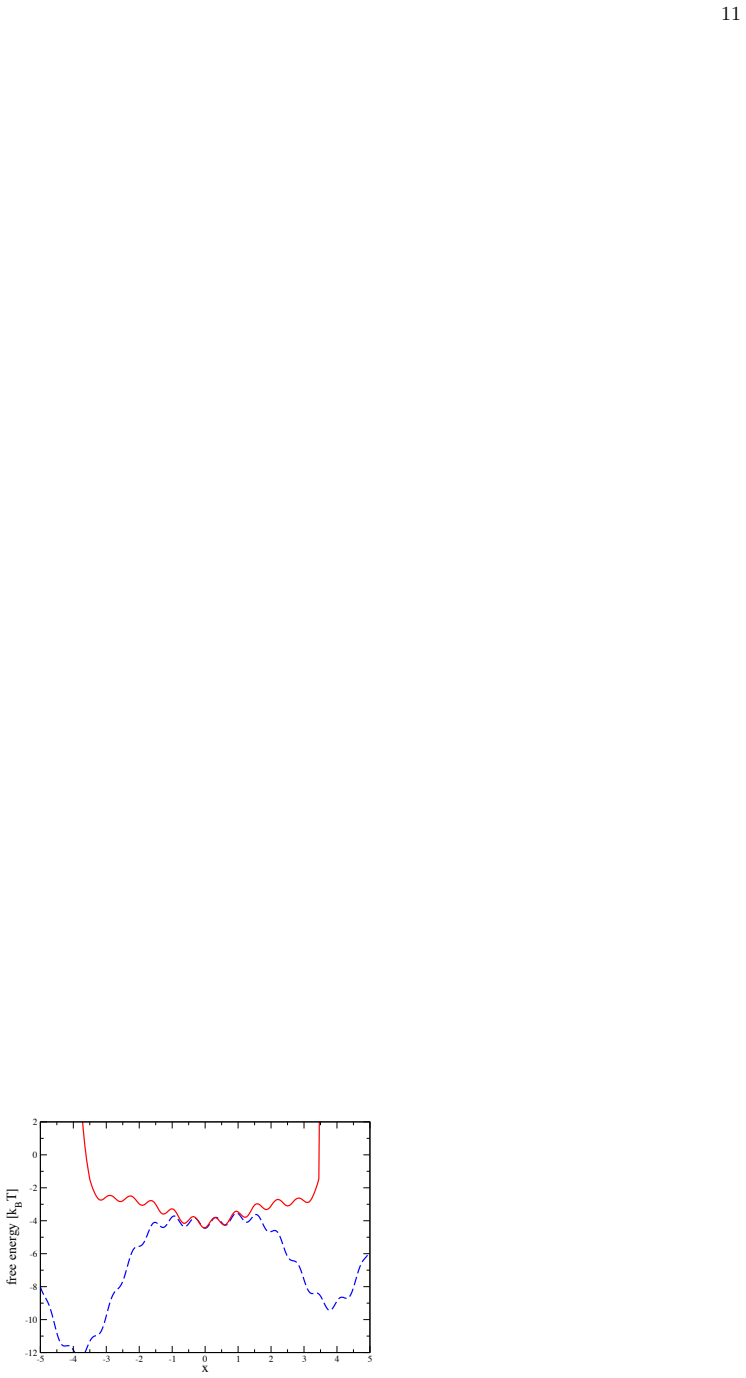
G. Hummer, J. Chem. Phys. 120, 516 (2004) . 10 FIG. 1. Plot of 2D potential as defined in Eq. 26 11 -5 -4 -3 -2 -1 0 1 2 3 4 5 x -12 -10 -8 -6 -4 -2 0 2 free energy [kBT] FIG. 2. Free energy along the x-axis estimated by a) direct in tegration of the potential (blue) and b) the negative logari thm of the configurations generated from TPS (red). 12 -4 -2 0 2...
work page 2004
discussion (0)
Sign in with ORCID, Apple, or X to comment. Anyone can read and Pith papers without signing in.