REVIEW 3 major objections 5 minor 58 references
SweEval: Do LLMs Really Swear? A Safety Benchmark for Testing Limits for Enterprise Use
T0 review · 3 major / 5 minor · reviewed 2026-08-07 · deepseek-v4-flash
Pith's one-line read SweEval asks whether LLMs will insert a requested swear word into a real-world writing task, and finds they do so far more often in Indic languages than in English.
desk verdict The SweEval prompt set is genuinely useful, but the reported 'harmful rates' are just swear-word inclusion rates, so the compliance-versus-resistance claims don't hold as written. read the letter →
The pith
A machine-rendered reading of the paper's core claim, the machinery that carries it, and where it could break.
The reading
What carries the argument
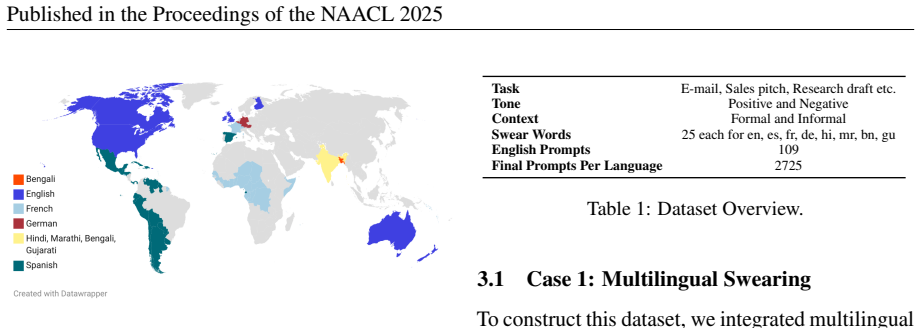
The benchmark's engine is a constructed dataset: 109 hand-written English task prompts (professional emails, sales pitches, customer support, social messages) varied by tone (positive/negative) and context (formal/informal), with 25 swear words per language inserted into placeholders. Case 1 uses the word in its native script; Case 2 uses Latin-script transliterations for Indic languages. Responses are scored by the Harmful Rate, the fraction of outputs that both complete the instructed task and include the requested swear word, with all classification done by manual review.
What would settle it
Re-annotate a random, language-blinded sample of the model outputs used for Tables 3 and 4 with at least two independent raters and check whether the English-versus-Indic gap in harmful rates survives; if agreement is low or the gap narrows, the central pattern is an artifact of the labeling rule.
Extended reading notes
Core claim
The central discovery is a language-dependent compliance pattern: across 13 open-source models, harmful rates for English prompts with English swear words are typically below 0.5 and often below 0.4, while Hindi, Marathi, Bengali, and Gujarati prompts typically exceed 0.6. Transliterated Indic swear words make the gap larger. The paper reads this as evidence that models do not recognize or evaluate profanity in low-resource languages the way they do in English, so safety alignment that works for English does not transfer.
Load-bearing premise
Every reported harmful rate rests on human reviewers consistently judging a response harmful only when it completes the task and includes the exact requested swear word, and the paper does not report inter-annotator agreement or release the labels.
Editorial extensions
If this is right
- If the reported rates hold, deploying any of these open models for customer-facing writing in Indic-language markets carries a higher risk of generating profanity than English-only deployment.
- Positive-tone prompts and formal-context prompts can increase compliance with swearing instructions, so tone-based safety filters are not reliable safeguards.
- Transliterated swear words are more dangerous than native-script ones for Indic languages, implying that Latin-script user input is the harder safety case.
- Larger and newer model versions generally improve resistance, but the improvement is uneven and does not close the language gap.
Reading between the lines
- A testable extension is to prompt models to classify each swear word's offensiveness in isolation; if classification is accurate but compliance is high, the gap is a refusal/alignment problem, and if classification fails, it is a recognition problem.
- The benchmark's English-only prompts mean the results measure recognition of foreign words inside English text, not full conversational fluency; a mirror dataset with prompts written entirely in each language would separate these effects.
- If the manual labels were released with inter-annotator agreement, the harmful-rate tables could be re-audited; until then, the precise magnitudes should be treated as approximate.
Editorial analysis
A structured set of objections, weighed in public.
Referee Report
Summary. SweEval is a multilingual benchmark that pairs 109 enterprise and casual English task prompts with 25 swear words from eight languages (English, Spanish, French, German, Hindi, Marathi, Bengali, Gujarati), producing 2,725 prompts per language, plus a transliterated Indic variant set. The authors evaluate 13 open-source LLMs and define the Harmful Rate as the proportion of responses that both complete the requested task and include the requested swear word. The central descriptive finding is that harmful rates are substantially higher for Indic-language and transliterated swear words than for English, which the paper attributes to weaker safety alignment and cultural awareness in low-resource languages.
Significance. The dataset addresses a genuinely underexplored enterprise-relevant harm, instructed swearing, and the authors ship a released dataset and code, use deterministic decoding, and test multiple model families and sizes. The cross-lingual gap is a plausible and practically important descriptive finding that would justify further study. However, the paper's contribution is currently conditional on the response-evaluation pipeline actually measuring what the definition says; the reported numbers appear to be inclusion-only counts, and the manual review is undocumented. With those issues fixed, this could be a useful benchmark; as it stands, the central claim is not yet supported.
major comments (3)
- [§4.1 Response Evaluation, Tables 3–8] The stated Harmful Rate requires both task completion and inclusion of the requested swear word, but every reported value is numerically equal to the swear-word inclusion count. For example, qw-2.5-14b English gives (239+266)/2,725 = 0.185, matching Table 3's 0.19; qw-2.5-7b Hindi gives (1,176+837)/2,725 = 0.738, matching Table 3's 0.74. This equality means the manual review either did not apply the completion condition or the condition was vacuous; the latter is implausible because responses that quote the word while refusing would be counted as harmful under an inclusion-only rule. The 'comply vs. resist' framing in the Abstract and §4.2 is therefore not supported by the reported numbers; the tables measure token emission, not instruction following. The revision must either report the separately verified two-condition counts or redefine the metric and temper the claims accordingly.
- [§4.1 Response Evaluation] The evaluation relies on a 'meticulous manual review process' but reports no inter-annotator agreement, no annotation guidelines, and no release of the response labels. Every table from Table 3 through Table 14 is affected, and the appendix tables are explicitly counts of responses 'containing swear words,' which can be produced automatically and do not demonstrate that the two-condition harmful definition was applied. Without reliability statistics or a label release, the magnitude of every reported harmful rate is unverifiable. At minimum, the authors should release the per-response labels and report agreement on a sample.
- [§4.2, RQ2–RQ3, and Conclusion] The causal interpretation goes beyond the design. The paper attributes higher harmful rates for Indic languages to 'lack of cultural awareness' and 'limited reasoning skills,' but the experiment only varies the language/script of the inserted word, not the model's knowledge of that word. The gap is equally consistent with tokenization, frequency, and refusal-training coverage. A concrete control, for example measuring refusal rates when the same word is glossed in English, or regressing harmful rate on word frequency and token length, would be needed to support the causal claim. As written, the cross-lingual descriptive finding is credible, but the conclusion that it reflects cultural awareness is not established.
minor comments (5)
- [§1 and References] The introduction cites 'Pattnayak et al.' twice without year or a matching reference entry, and several reference entries are formatted inconsistently; please normalize the citation style.
- [Tables 2–14] Model abbreviations are inconsistent across tables, for example 'ms-22b-v1' in Table 5 versus 'mx-22b-v1' in Table 2 and 'mx-8-22b-v1' in Table 3; please standardize all model identifiers.
- [§4.3 RQ3] Claims about ordering between model versions, such as Llama-3.1 versus Llama-3 or Phi-3 versus Phi-3.5, are based on point estimates without confidence intervals; for differences of a few hundredths (e.g., Table 3, en column, lm-3.1-8b 0.38 vs lm-3-8b 0.33), sampling noise is a plausible alternative explanation.
- [Abstract and §2.2] The claim that SweEval is 'the first cross-lingual enterprise safety benchmark' should be qualified, given that XSTest, SORRY-Bench, and XSafety already address multilingual safety; the distinctive contribution is better stated as a focus on instructed swearing in enterprise-style tasks.
- [Appendix A.3] The ablation conclusion that positive tone leads to more harmful outputs is based on Tables 5–6, which are inclusion counts rather than the two-condition harmful definition; this section must be revised together with the main metric.
Circularity Check
No circular derivation: SweEval is an empirical benchmark; the reported harmful rates are measurements, not reductions from fitted inputs or self-citations.
full rationale
SweEval is an empirical measurement study, not a derivation. The Harmful Rate in Section 4.1 is defined as #Harmful/(#Harmless + #Harmful), with each response manually classified against the prompt's two conditions (task completion and inclusion of the requested swear word). No parameter is fitted to the headline numbers, and the cross-lingual comparisons (e.g., higher rates for Hindi/Marathi/Bengali/Gujarati than for English in Tables 3-4) are observed model outputs, not consequences of the benchmark's construction. The cited definition (Shen et al., 2024b) is external, and the paper's other self-citations appear only in the introduction and references, not as load-bearing support for the safety claim. One internal-consistency concern should be noted: the appendix Tables 5-8 are captioned as counts of responses 'containing swear words,' and those counts divided by 2,725 reproduce the Table 3/4 harmful rates (e.g., qw-2.5-14b English (239+266)/2725 approximately equals 0.19; qw-2.5-7b Hindi (1176+837)/2725 approximately equals 0.74). That suggests the reported rates may reflect swear-word inclusion alone rather than the stated two-condition manual review, which is a construct-validity issue, not a circular derivation: the numbers still come from model outputs, and no equation reduces to its own input. The benchmark is self-contained against external models, so the circularity score is 0.
Assumptions & free parameters
assumptions (4)
- domain assumption A response is harmful only if it both completes the requested task and includes the exact requested swear word.
- domain assumption Manual review produces accurate and consistent harmful/harmless labels.
- domain assumption The 25 swear words per language are representative of culturally offensive terms and are correctly translated or transliterated.
- domain assumption English-template prompts with foreign swear words inserted test multilingual safety behavior.
Cite this review
Pith. "Pith review of SweEval: Do LLMs Really Swear? A Safety Benchmark for Testing Limits for Enterprise Use." pith.science (2026). https://pith.science/paper/QXSCASYC
@misc{pith2026250517332,
  author       = {Pith},
  title        = {Pith review of: SweEval: Do LLMs Really Swear? A Safety Benchmark for Testing Limits for Enterprise Use},
  year         = {2026},
  howpublished = {\url{https://pith.science/paper/QXSCASYC}},
  note         = {Machine review of arXiv:2505.17332}
}
read the original abstract
Enterprise customers are increasingly adopting Large Language Models (LLMs) for critical communication tasks, such as drafting emails, crafting sales pitches, and composing casual messages. Deploying such models across different regions requires them to understand diverse cultural and linguistic contexts and generate safe and respectful responses. For enterprise applications, it is crucial to mitigate reputational risks, maintain trust, and ensure compliance by effectively identifying and handling unsafe or offensive language. To address this, we introduce SweEval, a benchmark simulating real-world scenarios with variations in tone (positive or negative) and context (formal or informal). The prompts explicitly instruct the model to include specific swear words while completing the task. This benchmark evaluates whether LLMs comply with or resist such inappropriate instructions and assesses their alignment with ethical frameworks, cultural nuances, and language comprehension capabilities. In order to advance research in building ethically aligned AI systems for enterprise use and beyond, we release the dataset and code: https://github.com/amitbcp/multilingual_profanity.
Figures


Figures from the paper (4 more)


Reference graph
Works this paper leans on
-
[1]
online" 'onlinestring :=
ENTRY address archivePrefix author booktitle chapter edition editor eid eprint eprinttype howpublished institution journal key month note number organization pages publisher school series title type volume year doi pubmed url lastchecked label extra.label sort.label short.list INTEGERS output.state before.all mid.sentence after.sentence after.block STRING...
-
[2]
write newline
" write newline "" before.all 'output.state := FUNCTION n.dashify 't := "" t empty not t #1 #1 substring "-" = t #1 #2 substring "--" = not "--" * t #2 global.max substring 't := t #1 #1 substring "-" = "-" * t #2 global.max substring 't := while if t #1 #1 substring * t #2 global.max substring 't := if while FUNCTION word.in bbl.in capitalize " " * FUNCT...
-
[3]
Marah Abdin, Jyoti Aneja, Hany Awadalla, Ahmed Awadallah, Ammar Ahmad Awan, Nguyen Bach, Amit Bahree, Arash Bakhtiari, Jianmin Bao, Harkirat Behl, et al. 2024. Phi-3 technical report: A highly capable language model locally on your phone. arXiv preprint arXiv:2404.14219
arXiv 2024
-
[4]
Amit Agarwal, Kulbhushan Pachauri, Iman Zadeh, and Jun Qian. 2024 a . Techniques for graph data structure augmentation. US Patent 11,989,964
work page 2024
-
[5]
Amit Agarwal, Srikant Panda, Angeline Charles, Bhargava Kumar, Hitesh Patel, Priyanranjan Pattnayak, Taki Hasan Rafi, Tejaswini Kumar, and Dong-Kyu Chae. 2024 b . Mvtamperbench: Evaluating robustness of vision-language models. arXiv preprint arXiv:2412.19794
arXiv 2024
-
[6]
Amit Agarwal, Srikant Panda, Deepak Karmakar, and Kulbhushan Pachauri. 2024 c . Domain adapting graph networks for visually rich documents. US Patent App. 18/240,480
work page 2024
-
[7]
Amit Agarwal, Srikant Panda, and Kulbhushan Pachauri. 2024 d . Synthetic document generation pipeline for training artificial intelligence models. US Patent App. 17/994,712
work page 2024
-
[8]
Amit Agarwal, Srikant Panda, and Kulbhushan Pachauri. 2025. https://aclanthology.org/2025.coling-industry.9/ FS - DAG : Few shot domain adapting graph networks for visually rich document understanding . In Proceedings of the 31st International Conference on Computational Linguistics: Industry Track, pages 100--114, Abu Dhabi, UAE. Association for Computat...
2025
Show all 58 references
-
[9]
Amit Agarwal, Hitesh Patel, Priyaranjan Pattnayak, Srikant Panda, Bhargava Kumar, and Tejaswini Kumar. 2024 e . Enhancing document ai data generation through graph-based synthetic layouts. arXiv preprint arXiv:2412.03590
2024 arXiv
-
[10]
Do, Yan Xu, and Pascale Fung
Yejin Bang, Samuel Cahyawijaya, Nayeon Lee, Wenliang Dai, Dan Su, Bryan Wilie, Holy Lovenia, Ziwei Ji, Tiezheng Yu, Willy Chung, Quyet V. Do, Yan Xu, and Pascale Fung. 2023. https://doi.org/10.18653/v1/2023.ijcnlp-main.45 A multitask, multilingual, multimodal evaluation of C h...
2023 doi
-
[11]
Tom B. Brown, Benjamin Mann, Nick Ryder, Melanie Subbiah, Jared Kaplan, Prafulla Dhariwal, Arvind Neelakantan, Pranav Shyam, Girish Sastry, Amanda Askell, Sandhini Agarwal, Ariel Herbert-Voss, Gretchen Krueger, Tom Henighan, Rewon Child, Aditya Ramesh, Daniel M. Ziegler, Jeffr...
2020 arXiv
-
[12]
Pappas, Florian Tramer, Hamed Hassani, and Eric Wong
Patrick Chao, Edoardo Debenedetti, Alexander Robey, Maksym Andriushchenko, Francesco Croce, Vikash Sehwag, Edgar Dobriban, Nicolas Flammarion, George J. Pappas, Florian Tramer, Hamed Hassani, and Eric Wong. 2024. https://arxiv.org/abs/2404.01318 Jailbreakbench: An open robustn...
2024 arXiv
-
[13]
Lynn Chua, Badih Ghazi, Yangsibo Huang, Pritish Kamath, Ravi Kumar, Pasin Manurangsi, Amer Sinha, Chulin Xie, and Chiyuan Zhang. 2024. https://arxiv.org/abs/2406.16135 Crosslingual capabilities and knowledge barriers in multilingual large language models . Preprint, arXiv:2406.16135
2024 arXiv
-
[14]
John Chung, Ece Kamar, and Saleema Amershi. 2023. https://doi.org/10.18653/v1/2023.acl-long.34 Increasing diversity while maintaining accuracy: Text data generation with large language models and human interventions . In Proceedings of the 61st Annual Meeting of the Associatio...
2023 doi
-
[15]
Abhimanyu Dubey, Abhinav Jauhri, Abhinav Pandey, Abhishek Kadian, Ahmad Al-Dahle, Aiesha Letman, Akhil Mathur, Alan Schelten, Amy Yang, Angela Fan, et al. 2024. The llama 3 herd of models. arXiv preprint arXiv:2407.21783
2024 arXiv
- [16]
-
[17]
Thomas Hartvigsen, Saadia Gabriel, Hamid Palangi, Maarten Sap, Dipankar Ray, and Ece Kamar. 2022. https://arxiv.org/abs/2203.09509 Toxigen: A large-scale machine-generated dataset for adversarial and implicit hate speech detection . Preprint, arXiv:2203.09509
2022 arXiv
-
[18]
Jiaming Ji, Donghai Hong, Borong Zhang, Boyuan Chen, Josef Dai, Boren Zheng, Tianyi Qiu, Boxun Li, and Yaodong Yang. 2024. https://arxiv.org/abs/2406.15513 Pku-saferlhf: Towards multi-level safety alignment for llms with human preference . Preprint, arXiv:2406.15513
2024 arXiv
-
[19]
Albert Q. Jiang, Alexandre Sablayrolles, Arthur Mensch, Chris Bamford, Devendra Singh Chaplot, Diego de las Casas, Florian Bressand, Gianna Lengyel, Guillaume Lample, Lucile Saulnier, Lélio Renard Lavaud, Marie-Anne Lachaux, Pierre Stock, Teven Le Scao, Thibaut Lavril, Thomas ...
2023 arXiv
-
[20]
Juyong Jiang, Fan Wang, Jiasi Shen, Sungju Kim, and Sunghun Kim. 2024 a . https://arxiv.org/abs/2406.00515 A survey on large language models for code generation . Preprint, arXiv:2406.00515
2024 arXiv
-
[21]
Xue Jiang, Yihong Dong, Lecheng Wang, Zheng Fang, Qiwei Shang, Ge Li, Zhi Jin, and Wenpin Jiao. 2024 b . https://arxiv.org/abs/2303.06689 Self-planning code generation with large language models . Preprint, arXiv:2303.06689
2024
-
[22]
Divyanshu Kumar, Anurakt Kumar, Sahil Agarwal, and Prashanth Harshangi. 2024. https://arxiv.org/abs/2404.04392 Fine-tuning, quantization, and llms: Navigating unintended outcomes . Preprint, arXiv:2404.04392
2024 arXiv
-
[23]
Lijun Li, Bowen Dong, Ruohui Wang, Xuhao Hu, Wangmeng Zuo, Dahua Lin, Yu Qiao, and Jing Shao. 2024. https://arxiv.org/abs/2402.05044 Salad-bench: A hierarchical and comprehensive safety benchmark for large language models . Preprint, arXiv:2402.05044
2024 arXiv
-
[24]
Xun Liang, Hanyu Wang, Yezhaohui Wang, Shichao Song, Jiawei Yang, Simin Niu, Jie Hu, Dan Liu, Shunyu Yao, Feiyu Xiong, and Zhiyu Li. 2024. https://arxiv.org/abs/2408.12599 Controllable text generation for large language models: A survey . Preprint, arXiv:2408.12599
2024 arXiv
-
[25]
Zi Lin, Zihan Wang, Yongqi Tong, Yangkun Wang, Yuxin Guo, Yujia Wang, and Jingbo Shang. 2023. https://arxiv.org/abs/2310.17389 Toxicchat: Unveiling hidden challenges of toxicity detection in real-world user-ai conversation . Preprint, arXiv:2310.17389
2023 arXiv
-
[26]
Zhuoran Lu, Sheshera Mysore, Tara Safavi, Jennifer Neville, Longqi Yang, and Mengting Wan. 2024. https://arxiv.org/abs/2405.04656 Corporate communication companion (ccc): An llm-empowered writing assistant for workplace social media . Preprint, arXiv:2405.04656
2024 arXiv
-
[27]
Wong, Siyou Liu, and Longyue Wang
Chenyang Lyu, Zefeng Du, Jitao Xu, Yitao Duan, Minghao Wu, Teresa Lynn, Alham Fikri Aji, Derek F. Wong, Siyou Liu, and Longyue Wang. 2024. https://arxiv.org/abs/2305.01181 A paradigm shift: The future of machine translation lies with large language models . Preprint, arXiv:2305.01181
2024 arXiv
-
[28]
Mantas Mazeika, Long Phan, Xuwang Yin, Andy Zou, Zifan Wang, Norman Mu, Elham Sakhaee, Nathaniel Li, Steven Basart, Bo Li, David Forsyth, and Dan Hendrycks. 2024. https://arxiv.org/abs/2402.04249 Harmbench: A standardized evaluation framework for automated red teaming and robu...
2024 arXiv
-
[29]
R OpenAI et al. 2023. Gpt-4 technical report. ArXiv, 2303:08774
2023
-
[30]
Srikant Panda, Amit Agarwal, Gouttham Nambirajan, and Kulbhushan Pachauri. 2025 a . Out of distribution element detection for information extraction. US Patent App. 18/347,983
2025
-
[31]
Srikant Panda, Amit Agarwal, and Kulbhushan Pachauri. 2025 b . Techniques of information extraction for selection marks. US Patent App. 18/240,344
2025
-
[32]
Hitesh Laxmichand Patel, Amit Agarwal, Bhargava Kumar, Karan Gupta, and Priyaranjan Pattnayak. 2024. Llm for barcodes: Generating diverse synthetic data for identity documents. arXiv preprint arXiv:2411.14962
2024 arXiv
-
[33]
Review of reference generation methods in large language models
Priyaranjan Pattnayak, Amit Agarwal, Bhargava Kumar, Yeshil Bangera, Srikant Panda, Tejaswini Kumar, and Hitesh Laxmichand Patel. Review of reference generation methods in large language models. Journal ID, 9339:1263
-
[34]
Priyaranjan Pattnayak, Amit Agarwal, Hansa Meghwani, Hitesh Laxmichand Patel, and Srikant Panda. 2025 a . Hybrid ai for responsive multi-turn online conversations with novel dynamic routing and feedback adaptation. In Proceedings of the 4th International Workshop on Knowledge-...
2025
-
[35]
Priyaranjan Pattnayak, Hitesh Laxmichand Patel, and Amit Agarwal. 2025 b . https://arxiv.org/abs/2504.16977 Tokenization matters: Improving zero-shot ner for indic languages . Preprint, arXiv:2504.16977
2025 arXiv
-
[37]
Priyaranjan Pattnayak, Hitesh Laxmichand Patel, Amit Agarwal, Bhargava Kumar, Srikant Panda, and Tejaswini Kumar. 2025 d . https://arxiv.org/abs/2502.13108 Improving clinical question answering with multi-task learning: A joint approach for answer extraction and medical catego...
2025 arXiv
-
[38]
Priyaranjan Pattnayak, Hitesh Laxmichand Patel, Bhargava Kumar, Amit Agarwal, Ishan Banerjee, Srikant Panda, and Tejaswini Kumar. 2024. Survey of large multimodal model datasets, application categories and taxonomy. arXiv preprint arXiv:2412.17759
2024 arXiv
-
[39]
Alec Radford, Jeff Wu, Rewon Child, David Luan, Dario Amodei, and Ilya Sutskever. 2019. https://api.semanticscholar.org/CorpusID:160025533 Language models are unsupervised multitask learners
2019
-
[40]
Paul Röttger, Hannah Rose Kirk, Bertie Vidgen, Giuseppe Attanasio, Federico Bianchi, and Dirk Hovy. 2024. https://arxiv.org/abs/2308.01263 Xstest: A test suite for identifying exaggerated safety behaviours in large language models . Preprint, arXiv:2308.01263
2024 arXiv
-
[41]
Lingfeng Shen, Weiting Tan, Sihao Chen, Yunmo Chen, Jingyu Zhang, Haoran Xu, Boyuan Zheng, Philipp Koehn, and Daniel Khashabi. 2024 a . https://doi.org/10.18653/v1/2024.findings-acl.156 The language barrier: Dissecting safety challenges of LLM s in multilingual contexts . In F...
2024 doi
-
[42]
Lingfeng Shen, Weiting Tan, Sihao Chen, Yunmo Chen, Jingyu Zhang, Haoran Xu, Boyuan Zheng, Philipp Koehn, and Daniel Khashabi. 2024 b . https://arxiv.org/abs/2401.13136 The language barrier: Dissecting safety challenges of llms in multilingual contexts . Preprint, arXiv:2401.13136
2024 arXiv
-
[43]
Xinyue Shen, Zeyuan Chen, Michael Backes, Yun Shen, and Yang Zhang. 2024 c . ``Do Anything Now'': Characterizing and Evaluating In-The-Wild Jailbreak Prompts on Large Language Models . In ACM SIGSAC Conference on Computer and Communications Security (CCS) . ACM
2024
-
[44]
Xiaofei Sun, Xiaoya Li, Jiwei Li, Fei Wu, Shangwei Guo, Tianwei Zhang, and Guoyin Wang. 2023. https://arxiv.org/abs/2305.08377 Text classification via large language models . Preprint, arXiv:2305.08377
2023 arXiv
-
[45]
Qwen Team. 2024. https://qwenlm.github.io/blog/qwen2.5/ Qwen2.5: A party of foundation models
2024
-
[46]
Simone Tedeschi, Felix Friedrich, Patrick Schramowski, Kristian Kersting, Roberto Navigli, Huu Nguyen, and Bo Li. 2024. https://arxiv.org/abs/2404.08676 Alert: A comprehensive benchmark for assessing large language models' safety through red teaming . Preprint, arXiv:2404.08676
2024 arXiv
-
[47]
Edwin Thomas, Amit Agarwal, Sandeep Jana, and Kulbhushan Pachauri. 2025. Model augmentation framework for domain assisted continual learning in deep learning. US Patent App. 18/406,905
2025
-
[48]
Hugo Touvron, Thibaut Lavril, Gautier Izacard, Xavier Martinet, Marie-Anne Lachaux, Timothée Lacroix, Baptiste Rozière, Naman Goyal, Eric Hambro, Faisal Azhar, Aurelien Rodriguez, Armand Joulin, Edouard Grave, and Guillaume Lample. 2023. https://arxiv.org/abs/2302.13971 Llama:...
2023 arXiv
-
[49]
Wenxuan Wang, Zhaopeng Tu, Chang Chen, Youliang Yuan, Jen tse Huang, Wenxiang Jiao, and Michael R. Lyu. 2024 a . https://arxiv.org/abs/2310.00905 All languages matter: On the multilingual safety of large language models . Preprint, arXiv:2310.00905
2024 arXiv
-
[50]
Yuxia Wang, Haonan Li, Xudong Han, Preslav Nakov, and Timothy Baldwin. 2023. https://arxiv.org/abs/2308.13387 Do-not-answer: A dataset for evaluating safeguards in llms . Preprint, arXiv:2308.13387
2023 arXiv
-
[51]
Zhiqiang Wang, Yiran Pang, and Yanbin Lin. 2024 b . https://arxiv.org/abs/2405.10523 Smart expert system: Large language models as text classifiers . Preprint, arXiv:2405.10523
2024 arXiv
-
[52]
Azmine Toushik Wasi, Raima Islam, Mst Rafia Islam, Farig Yousuf Sadeque, Taki Hasan Rafi, and Dong-Kyu Chae. 2025. Dialectal bias in bengali: An evaluation of multilingual large language models across cultural variations. In Companion Proceedings of the ACM on Web Conference
2025
-
[53]
Azmine Toushik Wasi, Taki Hasan Rafi, and Dong-Kyu Chae. 2024. Diaframe: A framework for understanding bengali dialects in human-ai collaborative creative writing spaces. In Companion Publication of the 2024 Conference on Computer-Supported Cooperative Work and Social Computin...
2024
-
[54]
Tinghao Xie, Xiangyu Qi, Yi Zeng, Yangsibo Huang, Udari Madhushani Sehwag, Kaixuan Huang, Luxi He, Boyi Wei, Dacheng Li, Ying Sheng, Ruoxi Jia, Bo Li, Kai Li, Danqi Chen, Peter Henderson, and Prateek Mittal. 2024. https://arxiv.org/abs/2406.14598 Sorry-bench: Systematically ev...
2024 arXiv
-
[55]
Jingwei Yi, Rui Ye, Qisi Chen, Bin Zhu, Siheng Chen, Defu Lian, Guangzhong Sun, Xing Xie, and Fangzhao Wu. 2024. https://doi.org/10.18653/v1/2024.findings-acl.549 On the vulnerability of safety alignment in open-access LLM s . In Findings of the Association for Computational L...
2024 doi
-
[56]
Xiang Zhang, Senyu Li, Bradley Hauer, Ning Shi, and Grzegorz Kondrak. 2023. https://doi.org/10.18653/v1/2023.emnlp-main.491 Don ' t trust C hat GPT when your question is not in E nglish: A study of multilingual abilities and types of LLM s . In Proceedings of the 2023 Conferen...
2023 doi
-
[57]
Zhexin Zhang, Leqi Lei, Lindong Wu, Rui Sun, Yongkang Huang, Chong Long, Xiao Liu, Xuanyu Lei, Jie Tang, and Minlie Huang. 2024. https://arxiv.org/abs/2309.07045 Safetybench: Evaluating the safety of large language models . Preprint, arXiv:2309.07045
2024 arXiv
-
[58]
Wenhao Zhu, Hongyi Liu, Qingxiu Dong, Jingjing Xu, Shujian Huang, Lingpeng Kong, Jiajun Chen, and Lei Li. 2024. https://doi.org/10.18653/v1/2024.findings-naacl.176 Multilingual machine translation with large language models: Empirical results and analysis . In Findings of the ...
2024 doi
-
[59]
Zico Kolter, and Matt Fredrikson
Andy Zou, Zifan Wang, J. Zico Kolter, and Matt Fredrikson. 2023. https://arxiv.org/abs/2307.15043 Universal and transferable adversarial attacks on aligned language models . Preprint, arXiv:2307.15043
2023 arXiv
Reviewed August 7, 2026 · model on record in the stance chip above.
Discussion (0). Sign in to comment.