REVIEW 6 minor 53 references
Representational separation between unitary and channel quantum generative models via shared classical randomness at shallow depth
T0 review · 0 major / 6 minor · reviewed 2026-08-06 · deepseek-v4-flash
Pith's one-line read A single shared classical random bit, coordinating Pauli gates on two distant qubits of an otherwise shallow local circuit, creates output distributions that no purely unitary Born model of the same shallow depth can produce; in one…
desk verdict Shared randomness gives a real shallow-depth separation over unitary Born models; the proof is solid, the product-input scope should be explicit, and the code link needs fixing. read the letter →
The pith
A machine-rendered reading of the paper's core claim, the machinery that carries it, and where it could break.
The reading
What carries the argument
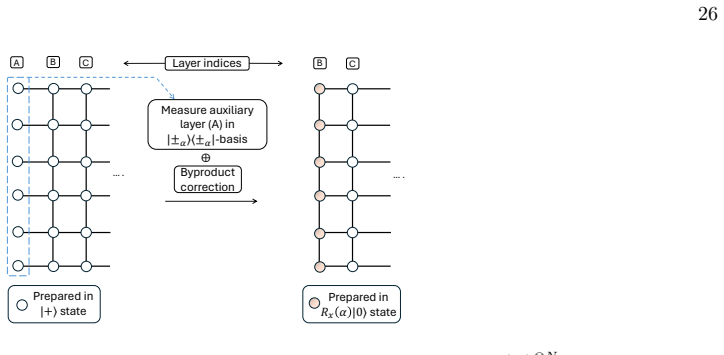
The central object is the minimal correlated channel model of Definition 1: a depth-$D$ local brickwall circuit with a stochastic Pauli string $P_M^s = P_a^s \otimes P_b^s$, $s \sim \mathrm{Bernoulli}(p)$, inserted at an intermediate layer. The argument runs on three lemmas: Lemma 8 bounds backward light cones so that depth $D < \mathrm{dist}(a,b)/4$ keeps the two measured sites causally disjoint; Lemma 10 uses the product input to force the two-site marginal of any such unitary circuit to factorize; and Lemma 14 converts a covariance gap into a total-variation gap, giving $\mathrm{TV} \ge |\Delta \mathrm{Cov}|/6$. In the channel model, branch-conditioned factorization gives the covariance identity $\mathrm{Cov}_{E^\star}(\hat{Z}_a,\hat{Z}_b) = p^\star(1-p^\star)\,\Delta_a\Delta_b$, which is nonzero exactly when the shared Pauli string flips both local responses. In MBQC, the same shared bit is realized natively through correlated byproduct retention, reducing the stochastic Pauli string to branch-dependent sign flips of non-Clifford rotation angles.
What would settle it
Run the depth-2 MBQC construction on $N \geq 6$ qubits with a shared byproduct bit at $p = 1/2$ and angles satisfying the paper's condition $\beta \neq 0$, then measure the covariance of the boundary $Z$ outcomes; a zero result would contradict the branch-factorization covariance formula, while a nonzero result from any depth $D < (N-1)/2$ unitary nearest-neighbor circuit with product input would contradict Lemma 10 and collapse the separation.
Extended reading notes
Core claim
The central claim is that shared classical randomness alone strictly enlarges the set of output distributions accessible to shallow local quantum generative models. Concretely, augment a bounded-connectivity shallow unitary circuit, followed by computational-basis measurements, with a stochastic Pauli string $P_M^s = P_a^s \otimes P_b^s$ whose two distant factors are applied together according to one Bernoulli bit $s$. Averaging over $s$ gives a channel model whose two-site $Z$-covariance is nonzero, whereas any purely unitary circuit whose measured sites have disjoint backward light cones must produce a factorized two-site marginal. The formal separation theorem states that for a one-dimensional nearest-neighbor brickwall architecture with product input there exists a shallow channel output $Q^\star$ such that for every unitary depth $D_0 < \mathrm{dist}(a,b)/4$, $Q^\star$ is not in the unitary family and the total-variation distance from any unitary output is at least $\delta^\star = p^\star(1-p^\star)|\Delta_a \Delta_b|/6$. For boundary sites at distance $\Theta(N)$, reproducing $Q^\star$ with a nearest-neighbor unitary model requires depth $\Omega(N)$. The paper also constructs an MBQC realization in which the shared bit is implemented by jointly retaining or anti-correcting measurement-induced byproducts, with an explicit witness covariance whose magnitude can reach $4/27$.
Load-bearing premise
The proof assumes the circuit input is a fixed product state with no correlations between sites, and that the two measured sites sit in disjoint backward light cones; if the input itself could carry long-range correlation, a shallow unitary circuit could reproduce the channel's covariance without any depth penalty.
Editorial extensions
If this is right
- For any finite-range local circuit architecture, correlated stochastic Pauli operations create shallow-depth distributions inaccessible to the corresponding unitary setup at shallow depth, with the required unitary depth governed by the graph distance between correlated regions.
- On one-dimensional nearest-neighbor hardware, a channel model of fixed shallow depth can generate endpoint correlations that a purely unitary nearest-neighbor Born model can reproduce only at depth $\Omega(N)$ in the worst case.
- In MBQC, the shared random bit is not an extra quantum resource: it is realized by retaining or anti-correcting measurement-induced byproducts, and the effective byproduct probability is tunable over the full interval $[0,1]$ without extra mid-circuit measurements or long-range entangling gates.
- The correlated channel adds only a few trainable probabilities and is trainable with parameter-shift and stochastic-channel gradient rules; numerical experiments on a branch-peaked mixture target show the channel model reaching lower maximum-mean-discrepancy loss than its unitary baseline.
- The result is a representational separation between two quantum model classes under identical shallow local quantum resources, not a quantum computational advantage over classical methods.
Reading between the lines
- If the input state were allowed to be entangled or classically correlated, a shallow unitary circuit could import long-range correlation through the input rather than through overlapping light cones, so the separation should be read as specific to product-input Born machines.
- The same covariance mechanism should transfer to other shallow parameterized quantum models whose outputs are bit strings, provided the task rewards long-range output correlations and a shared random variable can coordinate sign flips of non-Clifford rotations.
- On hardware with native long-range gates the separation weakens as graph distances shrink, but the channel construction may still save quantum depth by replacing coherent long-range operations with coordinated local sign flips controlled by one classical bit.
- A directly testable extension is to measure endpoint covariance in the two-layer cluster-state implementation as a function of $p$ and the rotation angles: the predicted signature is an even function of the boundary angles, zero at $p=0$ and $p=1$, and maximal at $p=1/2$, a profile no shallow unitary product-input circuit can reproduce.
Editorial analysis
A structured set of objections, weighed in public.
Referee Report
Summary. The paper studies the representational power of shallow quantum generative models. It compares unitary Born machines, defined as depth-D nearest-neighbour brickwall circuits acting on a fixed product input state, with channel models in which a stochastic Pauli string controlled by a single shared classical bit is inserted at an intermediate layer. The central result, Theorem 4/Theorem 15, states that for N≥6 there exists a shallow channel distribution Q* with a nonzero two-site Z-covariance, while any purely unitary circuit of depth D < dist(a,b)/4 has zero such covariance for product inputs. This yields a total-variation lower bound δ*>0 and, for dist(a,b)=Θ(N), a linear depth requirement for unitary realizations. The proof uses backward light cones, a factorization lemma for two-site marginals, a covariance-to-total-variation bound, and an explicit MBQC construction in Corollary 18 that realizes a nonzero covariance with |β|_max=4/27. Numerical experiments on N=6, D=2 support the theoretical separation but are explicitly auxiliary to it.
Significance. If accepted, the result provides a strict, scalable representational separation between unitary and channel quantum generative models at fixed shallow depth, using only shared classical randomness rather than additional quantum depth, long-range gates, or adaptive mid-circuit measurements. The strength of the paper is its explicit and self-contained proof in Appendix B: the light-cone bound (Lemma 8), the factorization of two-site marginals (Lemma 10), the covariance-to-total-variation lemma (Lemma 14), and the explicit nonzero covariance computation in Corollary 18 all check out. The paper also provides a concrete MBQC realization and a numerical demonstration with available code. The main limitation is that the separation holds for the fixed product input state of Eq. (5)/(A4); with an entangled or classically correlated input, a shallow unitary could import long-range correlations without overlapping light cones. This restriction is stated in the technical sections, and I do not see a load-bearing flaw in the formal derivation within that scope.
minor comments (6)
- [Abstract and Theorem 4] The abstract and the informal Theorem 4 state that 'no purely unitary shallow-depth model with bounded connectivity' can reproduce Q*, but this should be qualified by the fixed product-input assumption of Eq. (5)/(A4). A depth-zero unitary acting on an entangled or classically correlated input state could generate long-range covariance without overlapping light cones, so the unqualified statement is stronger than what Lemma 10 and Theorem 15 prove.
- [Theorem 15 and Appendix B] The symbol D is used both for the depth of the witness channel model and for the depth of the unitary candidate, for example in the theorem statement and in Eq. (B19). Using D_E for the channel depth and D_U for the unitary depth would remove an avoidable ambiguity in reading the separation.
- [Corollary 18] After Eq. (B63), the proof would benefit from an explicit sentence confirming that the endpoint Pauli correction is a deterministic map and that the nonzero β arises from the branch-dependent sign-flipped angles, not from classical bit-flip post-processing. A direct evaluation of the covariance before applying the correction would remove any remaining doubt that the separation is due to the shared-randomness feedforward rather than to the final correction layer.
- [Corollary 5 and Corollary 16] Corollary 5 in the main text is informal ('For any finite-range local circuit architecture' is not a precise condition), while the formal version in Corollary 16 requires a constant-velocity light-cone expansion. Add a forward reference to Corollary 16 and state the velocity assumption explicitly in the main text.
- [Eq. (52)] The subscript notation in the MMD loss, for example 'E_{x∼P_E(θ,p), y∼P_E(θ,p)}', is hard to parse because the commas inside the expectation subscript are easy to miss. Consider using a clearer convention, such as 'E_{x∼P_E(θ,p), y∼P_E(θ,p)}' with explicit separate subscripts or a sentence defining the notational shorthand.
- [Appendix B.1 / Corollary 18] The depth threshold changes from dist(a,b)/4 in Theorem 15 to (N-1)/2 in Corollary 18 because the cluster-state layer convention expands each light cone by one site per layer rather than two; state this explicitly at the point where Corollary 18 is introduced so that the different constants are not perceived as inconsistent.
Circularity Check
No significant circularity: the covariance-based separation is derived from the explicit model definitions, and the same-group citations are used only for standard, independently derivable algebraic byproduct-propagation rules.
full rationale
The central claim is not circular. Theorem 15 (Appendix B) derives the channel covariance as p*(1-p*) Delta_a Delta_b directly from the branch probabilities and branch-conditioned factorized responses, and shows via Lemma 10 that every depth-D unitary brickwall circuit with product input and disjoint light cones has zero covariance on the two measured sites. The lower bound delta* = (1/6)p*(1-p*)|Delta_a Delta_b| follows from Lemma 14 (covariance-to-TV bound), which is proved in the paper from the diagonal-observable bound. Corollary 18 supplies an explicit nonzero covariance beta on a cluster-state realization, computed from the input Bloch components and branched angle flips; no parameter is fitted and no 'prediction' is extracted from data. The product-input assumption in Eq. (5) and Appendix A(b) is explicitly stated and is required for Lemma 10's factorization; it limits the scope of the separation but does not make the derivation circular, because the unitary model family P_unit(D) is defined with the same product input. Same-group references [14,15,24] are used to define the VMBQC channel model and to quote elementary Pauli propagation relations; these are model definitions and standard algebraic identities that are independently derivable, and no load-bearing step reduces to an unverified self-citation. The numerical section explicitly states that 'the analytical separation, rather than the numerical experiment, establishes the representational result,' so the numerics are not presented as a prediction forced by construction. I find no equation in the proof that is equivalent by definition to its own input.
Assumptions & free parameters
free parameters (2)
- Shared insertion probability p =
p = 1/2 in the explicit analytic witness; p1 is trained in numerical experiments, final values not reported
- Input-state angle alpha in rho_in = R_x(alpha)|0> =
alpha = pi/4 in numerical experiments; any alpha not in (pi/2)Z in the analytical witness
assumptions (5)
- standard math The Born rule with computational-basis measurement defines the output probabilities of all model classes.
- domain assumption The input state is a fixed product state rho_in = tensor_j rho_j.
- domain assumption The MBQC cluster-state circuit representation and Pauli byproduct propagation rules from Refs. [14,24] are valid.
- domain assumption In MBQC, individual measurement outcomes are unbiased Bernoulli variables and feedforward correction is freely available.
- domain assumption A stochastic Pauli string inserted at a fixed intermediate slot does not increase the quantum circuit depth counted in the separation.
Cite this review
Pith. "Pith review of Representational separation between unitary and channel quantum generative models via shared classical randomness at shallow depth." pith.science (2026). https://pith.science/paper/QY7DORL4
@misc{pith2026260805110,
  author       = {Pith},
  title        = {Pith review of: Representational separation between unitary and channel quantum generative models via shared classical randomness at shallow depth},
  year         = {2026},
  howpublished = {\url{https://pith.science/paper/QY7DORL4}},
  note         = {Machine review of arXiv:2608.05110}
}
abstract
Near-term quantum hardware limits circuit depth and often imposes geometrically local connectivity for quantum generative models, restricting the output distributions accessible to shallow unitary Born models. Introducing stochasticity into a unitary quantum Born model can improve the empirical generative performance of the resulting channel model and, for a restricted small-scale architecture, has been proven to represent a strictly larger family of distributions than its unitary counterpart. However, whether such randomness provides a provable separation at fixed shallow depth for arbitrarily large systems has remained open. Here, we show that shared classical randomness, a comparatively weak resource from entanglement theory, is sufficient to establish such a strict scalable representational separation over the corresponding shallow unitary Born model. More specifically, we augment bounded-connectivity shallow unitary circuits, followed by computational-basis measurements, with spatially separated local Pauli operations, whose joint application is controlled by a single classically sampled random bit. The resulting shallow-depth channel model generates long-range correlations in the classical output distribution that no purely unitary shallow-depth model with bounded connectivity can reproduce. For one-dimensional nearest-neighbour architectures, reproducing such distributions with a purely unitary model can require depth $\Omega(N)$ in the worst case. We further show that measurement-based quantum computation (MBQC) provides a natural implementation of the required shared classical randomness through suitable adaptation of the random measurement outcomes. Numerical experiments on MBQC-based generative models support the analytical results.
Figures


Figures from the paper (6 more)




Reference graph
Works this paper leans on
-
[32]
Majumder, Shared randomness for quantum genera- tive models (2026)
A. Majumder, Shared randomness for quantum genera- tive models (2026)
work page 2026
-
[1]
P. W. Shor, Polynomial-time algorithms for prime factor- ization and discrete logarithms on a quantum computer, SIAM review41, 303 (1999)
1999
-
[2]
L. K. Grover, A fast quantum mechanical algorithm for database search, inProceedings of the twenty-eighth an- nual ACM symposium on Theory of computing(1996) pp. 212–219
1996
-
[3]
Arute, K
F. Arute, K. Arya, R. Babbush, D. Bacon, J. C. Bardin, R. Barends, R. Biswas, S. Boixo, F. G. Brandao, D. A. Buell,et al., Quantum supremacy using a programmable superconducting processor, Nature574, 505 (2019)
2019
-
[4]
Benedetti, E
M. Benedetti, E. Lloyd, S. Sack, and M. Fiorentini, Pa- rameterized quantum circuits as machine learning mod- els, Quantum science and technology4, 043001 (2019)
2019
-
[5]
Preskill, Quantum computing in the nisq era and be- yond, Quantum2, 79 (2018)
J. Preskill, Quantum computing in the nisq era and be- yond, Quantum2, 79 (2018)
2018
-
[6]
Liu and L
J.-G. Liu and L. Wang, Differentiable learning of quan- tum circuit born machines, Physical Review A98, 062324 (2018)
2018
-
[7]
M. Benedetti, D. Garcia-Pintos, O. Perdomo, V. Leyton- Ortega, Y. Nam, and A. Perdomo-Ortiz, A generative modeling approach for benchmarking and training shal- low quantum circuits, npj Quantum information5, 45 (2019)
work page 2019
Show all 53 references
-
[8]
Bouland, B
A. Bouland, B. Fefferman, C. Nirkhe, and U. Vazirani, On the complexity and verification of quantum random circuit sampling, Nature Physics15, 159 (2019)
2019
-
[9]
M. J. Bremner, A. Montanaro, and D. J. Shepherd, Average-case complexity versus approximate simulation of commuting quantum computations, Physical Review Letters117, 080501 (2016)
2016
-
[10]
Hwang, H.-T
K. Hwang, H.-T. Lim, Y.-S. Kim, D. K. Park, and Y. Kim, Distributed quantum machine learning via clas- sical communication, Quantum Science and Technology 10, 015059 (2025)
2025
-
[11]
B¨ aumer, V
E. B¨ aumer, V. Tripathi, D. S. Wang, P. Rall, E. H. Chen, S. Majumder, A. Seif, and Z. K. Minev, Efficient long- range entanglement using dynamic circuits, PRX Quan- tum5, 030339 (2024)
2024
-
[12]
Piroli, G
L. Piroli, G. Styliaris, and J. I. Cirac, Approximat- ing many-body quantum states with quantum circuits and measurements, Physical Review Letters133, 230401 (2024)
2024
-
[13]
Cao and J
C. Cao and J. Eisert, Measurement-driven quantum ad- vantages in shallow circuits, Phys. Rev. Lett.136, 080601 (2026)
2026
-
[14]
Majumder, M
A. Majumder, M. Krumm, T. Radkohl, L. J. Fiderer, H. P. Nautrup, S. Jerbi, and H. J. Briegel, Variational measurement-based quantum computation for generative modeling, Physical Review A110, 062616 (2024)
2024
- [15]
-
[16]
Heredge, M
J. Heredge, M. West, L. Hollenberg, and M. Sevior, Nonunitary quantum machine learning, Physical Review Applied23, 044046 (2025)
2025
-
[17]
J. Wen, L. Qian, S. Wei, and G. Long, Train- able quantum channels as computational primitives for quantum learning, arXiv preprint arXiv:2606.15808 https://doi.org/10.48550/arXiv.2606.15808 (2026)
2026 doi
-
[18]
Buscemi, All entangled quantum states are nonlocal, Phys
F. Buscemi, All entangled quantum states are nonlocal, Phys. Rev. Lett.108, 200401 (2012)
2012
-
[19]
Schmid, D
D. Schmid, D. Rosset, and F. Buscemi, The type- independent resource theory of local operations and shared randomness, Quantum4, 262 (2020)
2020
- [20]
-
[21]
Raussendorf and H
R. Raussendorf and H. J. Briegel, A one-way quantum computer, Physical review letters86, 5188 (2001)
2001
-
[22]
H. J. Briegel and R. Raussendorf, Persistent entangle- ment in arrays of interacting particles, Physical Review Letters86, 910 (2001)
2001
- [23]
-
[24]
Poulsen Nautrup and H
H. Poulsen Nautrup and H. J. Briegel, Measurement- based quantum computation from clifford quantum cel- lular automata, Physical Review A110, 062617 (2024)
2024
-
[25]
Gretton, K
A. Gretton, K. M. Borgwardt, M. J. Rasch, B. Sch¨ olkopf, and A. Smola, A kernel two-sample test, The journal of machine learning research13, 723 (2012)
2012
-
[26]
Larocca, S
M. Larocca, S. Thanasilp, S. Wang, K. Sharma, J. Bia- monte, P. J. Coles, L. Cincio, J. R. McClean, Z. Holmes, and M. Cerezo, Barren plateaus in variational quantum computing, Nature Reviews Physics7, 174 (2025)
2025
-
[27]
J. R. McClean, S. Boixo, V. N. Smelyanskiy, R. Bab- bush, and H. Neven, Barren plateaus in quantum neural network training landscapes, Nature communications9, 4812 (2018)
2018
-
[28]
Ragone, B
M. Ragone, B. N. Bakalov, F. Sauvage, A. F. Kemper, C. Ortiz Marrero, M. Larocca, and M. Cerezo, A lie al- gebraic theory of barren plateaus for deep parameter- ized quantum circuits, Nature Communications15, 7172 (2024)
2024
-
[29]
Debnath, N
S. Debnath, N. M. Linke, C. Figgatt, K. A. Landsman, K. Wright, and C. Monroe, Demonstration of a small programmable quantum computer with atomic qubits, Nature536, 63 (2016)
2016
-
[30]
D. C. McKay, C. J. Wood, S. Sheldon, J. M. Chow, and J. M. Gambetta, Efficientzgates for quantum comput- ing, Phys. Rev. A96, 022330 (2017)
2017
-
[31]
Kandala, A
A. Kandala, A. Mezzacapo, K. Temme, M. Takita, M. Brink, J. M. Chow, and J. M. Gambetta, Hardware- efficient variational quantum eigensolver for small molecules and quantum magnets, Nature549, 242 (2017)
2017
-
[33]
Y. Wu, J. Yao, P. Zhang, and X. Li, Randomness- enhanced expressivity of quantum neural networks, Phys- ical Review Letters132, 010602 (2024)
2024
-
[34]
Coyle, S
B. Coyle, S. Raj, N. Mathur, E. A. Cherrat, N. Jain, S. Kazdaghli, and I. Kerenidis, Training-efficient density quantum machine learning, npj Quantum Information 11, 172 (2025)
2025
-
[35]
Domingo, G
L. Domingo, G. Carlo, and F. Borondo, Taking advan- tage of noise in quantum reservoir computing, Scientific Reports13, 8790 (2023)
2023
-
[36]
D. Fry, A. Deshmukh, S. Y.-C. Chen, V. Rastunkov, and V. Markov, Optimizing quantum noise-induced reservoir computing for nonlinear and chaotic time series predic- tion, Scientific Reports13, 19326 (2023)
2023
-
[37]
Sannia, R
A. Sannia, R. Mart ´ ınez-Pe˜ na, M. C. Soriano, G. L. Giorgi, and R. Zambrini, Dissipation as a resource for quantum reservoir computing, Quantum8, 1291 (2024)
2024
-
[38]
Kubota, Y
T. Kubota, Y. Suzuki, S. Kobayashi, Q. H. Tran, N. Ya- mamoto, and K. Nakajima, Temporal information pro- cessing induced by quantum noise, Physical Review Re- search5, 023057 (2023)
2023
-
[39]
Scala, A
F. Scala, A. Ceschini, M. Panella, and D. Gerace, A gen- eral approach to dropout in quantum neural networks, Advanced Quantum Technologies8, 2300220 (2025)
2025
-
[40]
Kuzmin, W
V. Kuzmin, W. Somogyi, E. Pankovets, and A. Melnikov, Method for noise-induced regularization in quantum neu- ral networks, Advanced Quantum Technologies8, e00603 (2025)
2025
-
[41]
Huang, Y.-L
J.-C. Huang, Y.-L. Tsai, C.-H. H. Yang, C.-F. Su, C.- M. Yu, P.-Y. Chen, and S.-Y. Kuo, Certified robust- ness of quantum classifiers against adversarial examples through quantum noise, inICASSP 2023-2023 IEEE In- ternational Conference on Acoustics, Speech and Signal Processi...
2023
-
[42]
Winderl, N
D. Winderl, N. Franco, and J. M. Lorenz, Constructing optimal noise channels for enhanced robustness in quan- tum machine learning, in2025 IEEE International Con- ference on Quantum Computing and Engineering (QCE), Vol. 1 (IEEE, 2025) pp. 1566–1577
2025
-
[43]
J. Liu, F. Wilde, A. A. Mele, X. Jin, L. Jiang, and J. Eis- ert, Stochastic noise can be helpful for variational quan- tum algorithms, Physical Review A111, 052441 (2025)
2025
-
[44]
X. Gao, E. R. Anschuetz, S.-T. Wang, J. I. Cirac, and M. D. Lukin, Enhancing generative models via quantum correlations, Physical Review X12, 021037 (2022)
2022
-
[45]
Z. Qin, X. Li, Y. Zhou, S. Zhang, R. Li, C. Du, and Z. Xiao, Applicability of measurement-based quantum computation towards physically-driven variational quan- tum eigensolver, New Journal of Physics26, 073040 (2024)
2024
-
[46]
randomness helps
I. D. Smith, H. P. Nautrup, and H. J. Briegel, Par- ity quantum computing asyz-plane measurement-based quantum computing, Phys. Rev. Lett.132, 220602 (2024). 15 VII. RELA TED WORK Generically, previous works adding classical randomness into parameterized quantum circuits mostl...
2024
-
[47]
!,𝑍""#!"#$%≠0 𝜌$%&'( =12𝜌)*+,+12𝜌-*+, 𝑋!
MBQC on a cluster state As an illustrative realization of a one-dimensional nearest-neighbor architecture used in Theorem 15, we consider measurement-based quantum computation on anN×(D+ 1) cluster state, where the final column is the readout layer. We focus on an open chain o...
-
[48]
The white qubits are initialized in|+⟩, while the orange qubits are prepared inR x(α)|0⟩
(b) Averaging over the two stochastic branchesρ out + andρ out − corresponding tos 1 = 0 ands 1 = 1, respectively, gives the final output stateρ final = 1 2 ρout + + 1 2 ρout − , whose endpoint observables exhibit a nonvanishing covariance, Cov( ˆZ1, ˆZ6)ρfinal ̸= 0. The white...
-
[49]
In the next propagation step,X s1 1 becomesZ s1 1 X s1 2 at the readout layer
gate asX s1 1 Rz(θ2 1)7→R z((−1)s1 θ2 1)X s1 1 . In the next propagation step,X s1 1 becomesZ s1 1 X s1 2 at the readout layer. Since these final Pauli byproducts are corrected as shown in Sec. II C 4, the only remaining effect ofZ s1 1 is the intermediate sign change ofθ 2 1 ...
-
[50]
The same argument applies to the other boundary byproductZ s1 N , whose only remaining effect isθ 2 N 7→(−1) s1 θ2 N . 28 Thus, for anyN≥6, the shared variables 1 changes only the two boundary anglesθ 2 1 andθ 2 N in the second computational layer, and the rest of the{θ 2 j }j...
-
[51]
,$", !!) 𝛼⊗
Branch-peaked mixture distributions A branch-peaked mixture distribution has the form P(x) = X s∈S π(s) [δs 1[x=x ⋆ s] + (1−δ s)Rs(x)], x∈ {0,1} N ,(C1) whereS ⊆ {0,1}L is a finite set satisfying|S| ≤S max, withS max =O(1) is independent ofN. Here,π(s)≥0 is the probability of ...
-
[52]
(52) with respect to the application probabilities{p i}L i=1
Gradient of the loss function In this section, we derive the gradient of the squared MMD loss in Eq. (52) with respect to the application probabilities{p i}L i=1. The output distribution of the channel model, in Eq. (18), can be rewritten using Eq. (16) as PEθ,p (x) = X s∈{0,1...
-
[53]
5 summarizes the minimum MMD losses obtained from 20 independent training runs
Box plot details Each box plot in Fig. 5 summarizes the minimum MMD losses obtained from 20 independent training runs. The losses are first ordered from smallest to largest. The lower and upper boundaries of the box are the first and third quartiles, denoted byQ 1 andQ 3. Thus...
Reviewed August 6, 2026 · model on record in the stance chip above.
Discussion (0). Sign in to comment.